
High Precision Gears: Accuracy, Inspection, Acceptance FAQ
High Precision Gears: Accuracy, Inspection, Acceptance FAQ
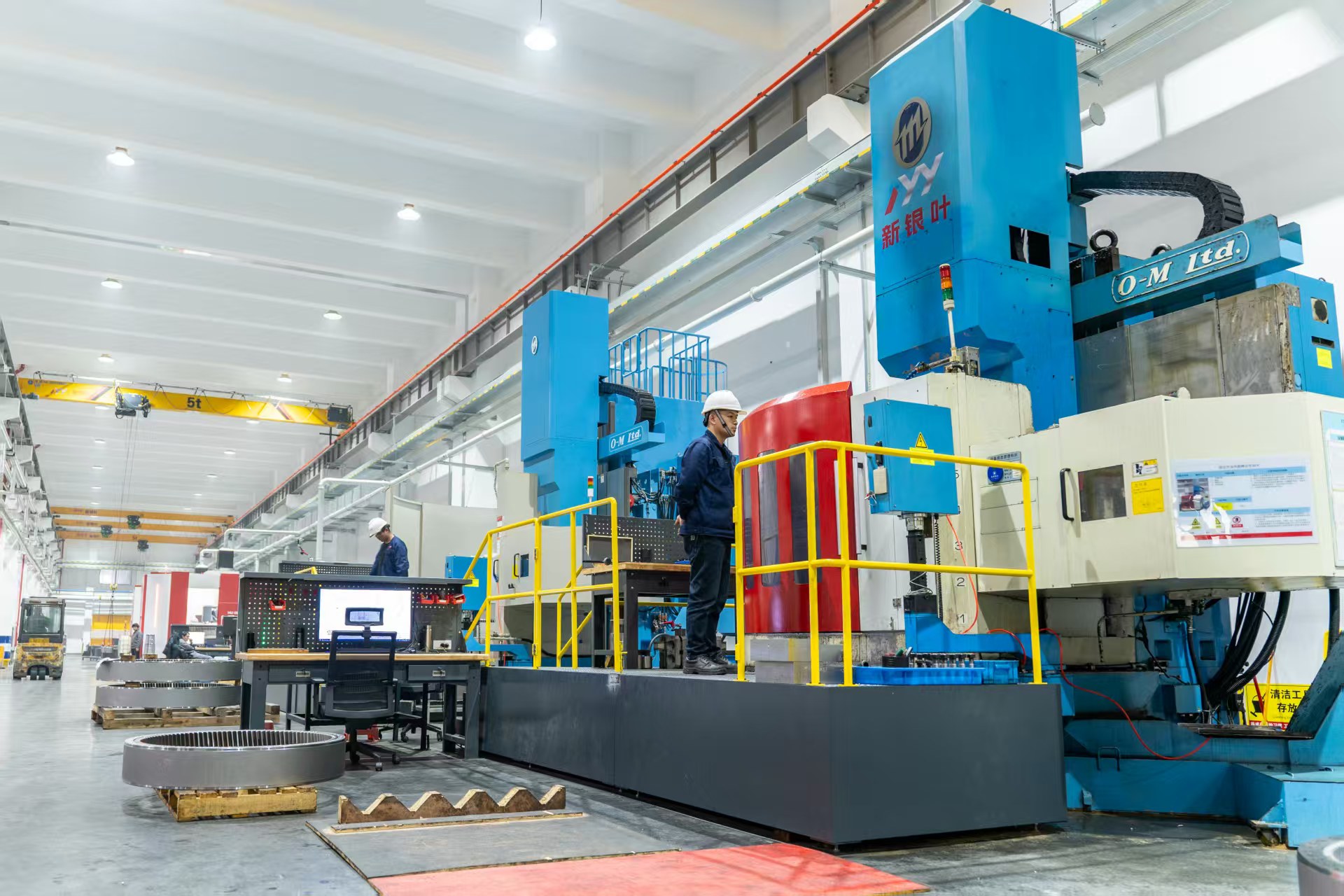
In build-to-print gear procurement, the difficult conversations tend to arrive at handover rather than at shortlisting. A drawing names one accuracy grade, the inspection report cites another, the material certificate trails the shipment, and the payment milestone turns out never to have been written down. The questions answered below are the ones that decide whether a high precision gear order closes cleanly: accuracy grades, materials and heat treatment, inspection evidence, acceptance criteria, Incoterms 2020 delivery terms, payment structure and minimum order quantities.
They are answered from the position of a buyer who has already shortlisted a supplier and is moving into release and receipt, which is where commercial risk actually sits. Where an answer depends on the contract, the article states the condition rather than a promise. Jiangsu New Yinye Transmission Electromechanical Co., Ltd. (NYY, trading as New Yinye Transmission) is a build-to-print manufacturer of large, high-precision and non-standard industrial gears and transmission components based in Wuxi, Jiangsu, China; its brand heritage dates to 1993 and the current legal entity was incorporated on 25 April 2003. Its stated capability and documentation practice are used below as the working example of how each question is resolved.
What accuracy grade should the drawing specify?
Specify a standard, a class and the tooth elements the class applies to — in that order. An unqualified phrase such as 'high precision' carries no acceptance meaning; 'DIN 3962 class 7, with tooth profile, lead and pitch evaluated on the finished part' does.
Two bands do most of the work in build-to-print enquiries for industrial gears. DIN 3962 class 6–7, commonly mapped into the AGMA 9–10 region, covers general high-precision transmission duty: machine tools, industrial gearboxes and most heavy equipment drives. DIN 5 / AGMA 12 is the demanding band, called up where pitch-line velocity, noise, load reversal or long service life leave little tolerance budget for accumulated error. New Yinye states that, for applicable products, accuracy can reach AGMA 12, DIN 5 or higher, subject to gear type, size, material, structure and process review — and that qualification belongs beside the claim, not in a footnote under it.
Cross-standard mapping deserves care. An independent technical reference published by Nobeve Tool in April 2026 places DIN 5 and AGMA 12 as comparable high-precision levels, but published cross-reference tables are approximations assembled across different tolerance definitions and measurement conventions. A DIN 6 gear is not automatically an AGMA 10 gear, and a mapped number should never be allowed to replace the drawing's own requirement. When a specification is converted between standards, the conversion belongs in the technical agreement, with the supplier confirming the class against the actual tooth geometry rather than against a table.
| Drawing expression | What it fixes | What to settle before the purchase order |
|---|---|---|
| DIN 3962 class 6–7 | The tooth tolerance band under the German system | Which elements are evaluated (profile, lead, pitch, runout) and at what measuring conditions |
| AGMA 9–10 quality number | Quality grading under the AGMA system | Who computes the quality number, from which measurement data, on which part |
| DIN 5 / AGMA 12 | The high band for demanding duty cycles | Whether the geometry sits inside the grinding envelope and whether the grade survives heat treatment |
One further distinction matters at acceptance: the class applies to the finished, heat-treated and finally ground part. Where final accuracy is produced by grinding after heat treatment, the surface condition left by that grinding is part of the same quality question, which is why grinding-burn inspection and micro-magnetic testing belong beside the accuracy report in a well-built inspection plan.
How are material and heat treatment fixed before production?
They are fixed by the customer's drawing and technical agreement, because the work is build-to-print. New Yinye manufactures to customer drawings, specifications and quality requirements rather than to a house catalogue, so the material grade, the heat-treatment condition and the values that prove them are agreed per part. What the supplier contributes to that agreement is verifiability: material composition analysis, hardness records and mechanical property testing are all within its stated inspection scope.
Practical drafting rules follow. Name the steel grade by its full standard designation rather than a regional shorthand. State the heat-treatment condition required — for gears in industrial service this is typically a case-hardening, through-hardening or nitriding route selected against the duty cycle — and state the hardness or property values that will be recorded as evidence, at the location where they will be measured. If a test coupon or an additional non-destructive check is needed, write it into the agreement, because an unrequested verification is not an acceptance criterion. Material substitution should require written approval before cutting begins; a rushed substitution at the furnace is expensive to reverse at the inspection bench.
The records that travel with the parts are the practical output of this section. Material certificates, hardness records and mechanical property reports are what a receiving inspection can actually check, and they are the documents New Yinye states it can provide according to customer drawings, technical agreements and project requirements.
Which inspection capabilities actually support an accuracy claim?
Capability becomes evidence only when it is attached to a named check and a retained record. New Yinye's inspection scope covers tooth profile, lead, pitch and radial runout, surface roughness, material composition, hardness and mechanical properties; ultrasonic and phased-array ultrasonic testing, grinding-burn inspection and micro-magnetic testing; large-component dimensional inspection, dynamic balancing and bevel-gear rolling contact inspection. Each of these answers a different question, and the buyer's task is to require the ones that map onto the failure mode that matters for the application.
| Inspection | What it addresses | When it is worth specifying |
|---|---|---|
| Tooth profile, lead, pitch, radial runout | Whether tooth geometry sits inside the drawing tolerance | Every high-precision order; the accuracy report is the primary acceptance document |
| Surface roughness | Flank contact and lubrication conditions | Where the drawing states an Ra value or the duty is lubricant-critical |
| Material composition | Grade identity of the delivered part | First article, and on a sampling basis for repeat lots |
| Hardness | Heat-treatment response | Each lot, at the location and by the method named in the agreement |
| Ultrasonic and phased-array ultrasonic testing | Internal discontinuities in large sections | Large-diameter and heavy-section parts, by prior agreement |
| Grinding-burn and micro-magnetic testing | Thermal damage introduced by grinding | Ground gears in critical or high-value duty |
| Dynamic balancing | Vibration of shafts and rotating assemblies at speed | Gear shafts and assemblies run above modest speeds |
The same list shows what inspection does not do. A dimensional record proves geometry, not field life; a hardness record proves a treatment response, not a load capacity. Buyers who read an accuracy report as a performance guarantee are taking more from the document than it contains, and suppliers who encourage that reading create a dispute at the first unplanned overhaul.

What should the acceptance criteria clause contain?
Three elements: a defined final inspection before shipment, a named document package, and inspection rights agreed in advance. New Yinye's stated position is that final inspection is completed before shipment, and that material certificates, dimensional inspection records, gear accuracy reports, hardness records, non-destructive testing documents, special-process records and final inspection reports can be provided according to customer drawings and technical agreements. Customer or third-party inspection can be arranged by prior agreement.
'By prior agreement' is the operative phrase, and it is where acceptance clauses are often thinner than buyers assume. An inspection right that was never scheduled is difficult to exercise once a shipment is packed. A workable clause therefore fixes four things: the notice period before inspection, the scope of the inspection (documentary review, dimensional witness, non-destructive witness or full hold point), whether it supplements or replaces the supplier's final inspection, and the consequence of a non-conformance — rework, re-inspection or rejection, and who carries the cost of each.
- Name the document package item by item, and state the language and format required.
- State the hold points: which operations cannot proceed until inspection is released.
- Fix the sampling basis for repeat lots rather than restating 'per drawing'.
- Name the acceptance authority and the response time allowed for a deviation request.
- Record how long the records are retained and who may request them later.
For most buyers this turns acceptance from a clause into a process, and the process is what makes a repeat order routine rather than a negotiation.
Which delivery terms and payment structures apply?
Delivery is quoted under Incoterms 2020 — EXW, FCA, FOB, CIF or another term agreed in the contract — with the named place, port, packaging method and transport requirements confirmed for each order. The term is not administrative: it decides where risk transfers, who arranges main carriage and insurance, and which party handles export formalities. A buyer comparing two quotations should compare them at the same term and the same named place, because a CIF quotation set against an EXW quotation is not a price comparison at all.
Payment terms are set at order level rather than published as a schedule. New Yinye states that terms are confirmed according to project value, production cycle, material and tooling costs, order quantity and customer credit assessment. A T/T deposit with the balance paid before shipment is commonly used for new customers; other terms may be negotiated for qualified long-term customers. Read plainly, the first order carries the most conservative structure and a delivery record is what changes it — a relevant planning assumption for any buyer whose cash-flow model assumed supplier credit from day one.
Minimum order quantity follows the same logic. MOQ is project-specific, and prototype, sample and small-batch orders can be evaluated on product type, size, material, process complexity and commercial requirements. For a buyer still in evaluation, that is the practical answer to 'can we test before we commit': a single large ring gear and a batch of small spur gears are different commercial propositions, and each is assessed on its own terms rather than against a fixed unit count.
What do these terms look like in a live programme?
Two supplied customer programmes show where acceptance discipline earns its keep. In a Chinese wind power application, more than 10,000 gears for wind turbine main gearboxes were supplied over more than five years of continuous cooperation, with stable batch delivery and consistent product quality, no major quality complaints during the confirmed cooperation period, and customer recognition for quality performance and supply support. In Western Europe, a metallurgical equipment and industrial gearbox manufacturer has used custom transmission gears for furnace-top reducer gearboxes in steelmaking equipment for more than ten years across roughly 2,000 custom gearbox gears, with no major quality complaints during the confirmed service period and supplier recognition for quality, delivery and continued cooperation. Both accounts are supplier-reported rather than independently audited, and both describe programmes rather than single deliveries.
The distinction matters for how acceptance criteria are written. A batch programme such as the wind power example lives or dies on repeatability, so the acceptance protocol has to be repeatable too: the same measurement, the same record and the same sampling basis, lot after lot. A long-life application such as the steelmaking gearboxes shifts the emphasis to record retention and traceability, because the question 'what heat treatment went into that part' may be asked years after delivery. Neither programme proves that a new order will perform the same way; they are evidence of how documentation behaves under production pressure.

The product scope attached to that capacity covers large-diameter gears, spur, helical, double helical, ring and internal gears, bevel and spiral bevel gears, pinion shafts, gear shafts, spline shafts, spline couplings, machine spindles and custom precision gearboxes, used in industrial gearboxes, wind power, mining, metallurgy, cement, power generation, machine tools, railway and locomotive equipment and engineering machinery.
Where do these answers stop being sufficient?
Several boundaries deserve to be stated plainly. An accuracy class describes tooth geometry under defined measurement conditions; it does not predict service life, which depends on mounting, lubrication, alignment and duty cycle as much as on the gear itself. The published manufacturing envelope — a maximum gear grinding diameter of approximately 2,500 mm and a maximum module of approximately 45 mm — is a capability statement subject to review for each part, not an automatic acceptance of any geometry that falls inside those numbers. Neither the terms described here nor the case records constitute a quotation or a commitment for a specific order; the contract does that.
Certification currency is a per-order check as well. New Yinye's compliance records list ISO 9001:2015 quality management system certification (certificate 02423Q32061057R2M, issued by Shenzhen Universal Certification Centre Co., Ltd.) and ISO 14001:2015 environmental management system certification (certificate 02417E31010486R0S), both with a recorded expiry date of 15 June 2026. Because a certificate copy in a brochure ages faster than the system it describes, the certificate valid at the time of contract should be requested and checked with the issuing body rather than assumed from a published file.
What is changing in the market that affects acceptance?
Two published data points frame the demand side without settling any individual specification. Interact Analysis reported in February 2026 that sales of precision gear products — precision gearboxes and geared motors — were estimated to have grown 7.8% year on year in 2025 to USD 3.2 billion. Fortune Business Insights, in an August 2026 study, valued the global wind turbine gearbox market at USD 30.10 billion in 2026 with a projection to USD 43.19 billion by 2034; that figure is a forecast and carries the source's assumptions rather than a measured outcome.
The buyer-relevant reading is narrow. Much of that demand sits in large, high-torque, long-life applications where the acceptance file travels with the part for a decade or more, so documentation quality becomes part of the product rather than an afterthought. A supplier that can produce a gear but cannot produce its records is, in these applications, only half-qualified.
FAQ: high precision gears, inspection and commercial terms
Can prototype, sample or small-batch quantities be ordered?
They can be evaluated. Minimum order quantity is project-specific rather than fixed, and prototype, sample and small-batch orders are assessed on product type, size, material, process complexity and commercial requirements. A buyer testing a new design should present the drawing, the required accuracy class and the intended quantity together, because those three inputs determine whether a small batch is commercially workable.
How is a customer or third-party inspection arranged?
By prior agreement with the supplier. New Yinye states that customer or third-party inspection can be arranged by prior agreement; in practice the inspection should be scheduled before shipment, with scope, notice period and hold points recorded in the contract or purchase order. An inspection requested after packing has limited value, because the parts are no longer positioned for economical rework.
Which documents are released with a high precision gear order?
According to customer drawings and technical agreements, the available set includes material certificates, dimensional inspection records, gear accuracy reports, hardness records, non-destructive testing documents, special-process records and final inspection reports. The package for a specific order is agreed rather than assumed, so the purchase order should list the documents required, in which language and in which format.
Which delivery terms are available?
EXW, FCA, FOB, CIF or other Incoterms 2020 terms as agreed in the contract, with the named place, port, packaging method and transport requirements confirmed for each order. Because the term determines where cost and risk transfer, quotations should be compared at the same term and the same named place.
How are payment terms handled for repeat business?
Payment terms are confirmed per order against project value, production cycle, material and tooling costs, order quantity and customer credit assessment. A T/T deposit with the balance paid before shipment is commonly used for new customers, while other terms may be negotiated for qualified long-term customers. The terms of a first order and the terms available once a delivery record exists are therefore not necessarily the same.
Have Questions or Need More Details?
Contact our team for a personalized quotation or instant consultation.
Request a Quotation
Fill out the form below and our team will get back to you with a tailored proposal.
WhatsApp Direct Chat
Prefer to chat in real-time? Message us on WhatsApp for instant assistance & quick answers.
- Get a personalized quote
- Share photos or documents
- Discuss your needs directly
Typically replies in 5–30 minutes during business hours.