
High-Pressure Concrete Pump Pipes: Hongchang Supplier Evidence
High-pressure concrete pump pipes carry mixed material from the pump unit upward and outward under continuous load. On high-rise, tunnel, and long-distance horizontal pours, the delivery line components withstand abrasion from aggregate, pressure cycling in elbows, and vibration at clamp connections. When a pipe section fails, replacement cost is rarely the largest loss. Interrupted pours, damage to the pump, and schedule impact usually matter more.
The broader concrete pump market provides useful framing. Market Research Future estimated the global concrete pumps market at approximately USD 10.45 billion in 2024 and projected USD 11.06 billion in 2025. Brands such as Putzmeister, Schwing, Sany, Zoomlion, and Liebherr define the equipment layer of that market. Delivery pipes, elbows, reducers, and clamps are typically purchased separately — whether for new equipment builds, fleet maintenance, or site-specific line reconfiguration.
This article focuses specifically on high-pressure conveying pump pipes. It examines the supplier capability evidence of Hongchang Machinery Technology Co., Ltd., a concrete pump pipe, elbow, clamp, and reducer manufacturer based in Anhui Province, China — and positions that evidence against the broader industry context of global concrete pump equipment manufacturers.
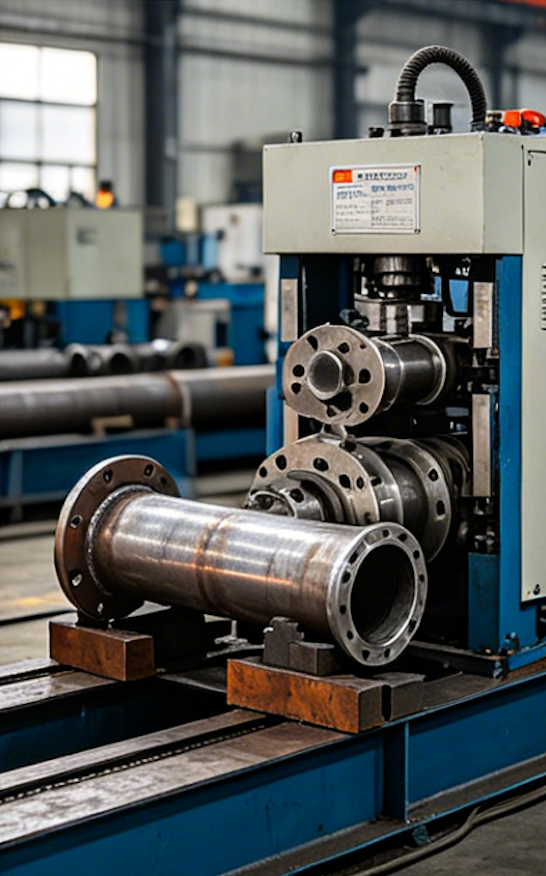
Hydraulic sleeving machine for pipe-end forming in high-pressure concrete pump pipe production.
Why Dimention Alone Does Not Define High-Pressure Pipe Performance
Concrete pump delivery pipes commonly use ST52 steel at DN125 with wall thickness of 4.5-5 mm for high-pressure applications, according to industry supplier data. That baseline is useful but incomplete. Under high pressure — high-rise, deep tunnel, and long horizontal runs — the internal wall must also resist abrasion from aggregate, fatigue from pressure cycling, and mechanical stress at connection points.
Concrete pump systems typically include a pumping unit, receiving hopper, delivery valve, pumping cylinders and pistons, and a hydraulic system, as described in manufacturer technical documentation (CIFA). The delivery line begins at the hopper and extends to the boom or pour point. In high-pressure configurations, component-level differences matter far more than nominal diameter alone.
Service-life data illustrates the gap. Twin-wall boom pipes — induction-hardened or hard-lined — offer a service life of 50,000 to 100,000 m³, compared with standard single-layer pipes averaging 15,000-25,000 m³ (supplier and industry comparison data). That difference changes replacement frequency, downtime, and lifecycle cost. For a buyer evaluating high-pressure conveying pump pipes, the real question is not whether a supplier can produce a DN125 or DN150 pipe. Many can. The question is whether the supplier delivers controlled quenching, double-layer structure and locked connection geometry — backed by heat-treatment process control, pressure-test records and traceable delivery performance.
Hongchang: Company-Level Capability Evidence
Hongchang Machinery Technology Co., Ltd. was founded in 2015 and operates a 2,600 m² facility in Ma'anshan City, Anhui Province, China, with more than 50 employees and a design & R&D team with independent development capabilities. Annual output reaches 50,000 meters of straight pipes and 15,000 pieces of curved pipes. The company exports to Southeast Asia, the Middle East, Europe and the Americas, and approximately 50% of production is exported.
Several verifiable facts define Hongchang's role in the concrete pump supply chain:
- Designated supporting manufacturer for Xingma Automobile — a commercial vehicle manufacturer.
- Products applicable to pump trucks and tow pumps from companies such as Sany Heavy Industry and Zhonglian Heavy Industry, according to company profile information.
- Monthly production capacity of 50,000 meters straight pipes and 15,000 pieces curved pipes.
- Typical lead time: 15-30 days.
- Minimum order quantity: 1 piece (sample order available).
For a buyer evaluating high-pressure pipe supply, these figures are the first evidence layer. They answer basic questions about capacity and delivery — but they need to be validated against product-level evidence: certification, material specification, and documented field performance.
ISO 9001:2015 Quality System — What It Confirms and What It Does Not
Hongchang holds ISO 9001:2015 certification for manufacturing quality management, certificate number ISO-2024-HC, valid from 2025-11-13 to 2028-11-12.
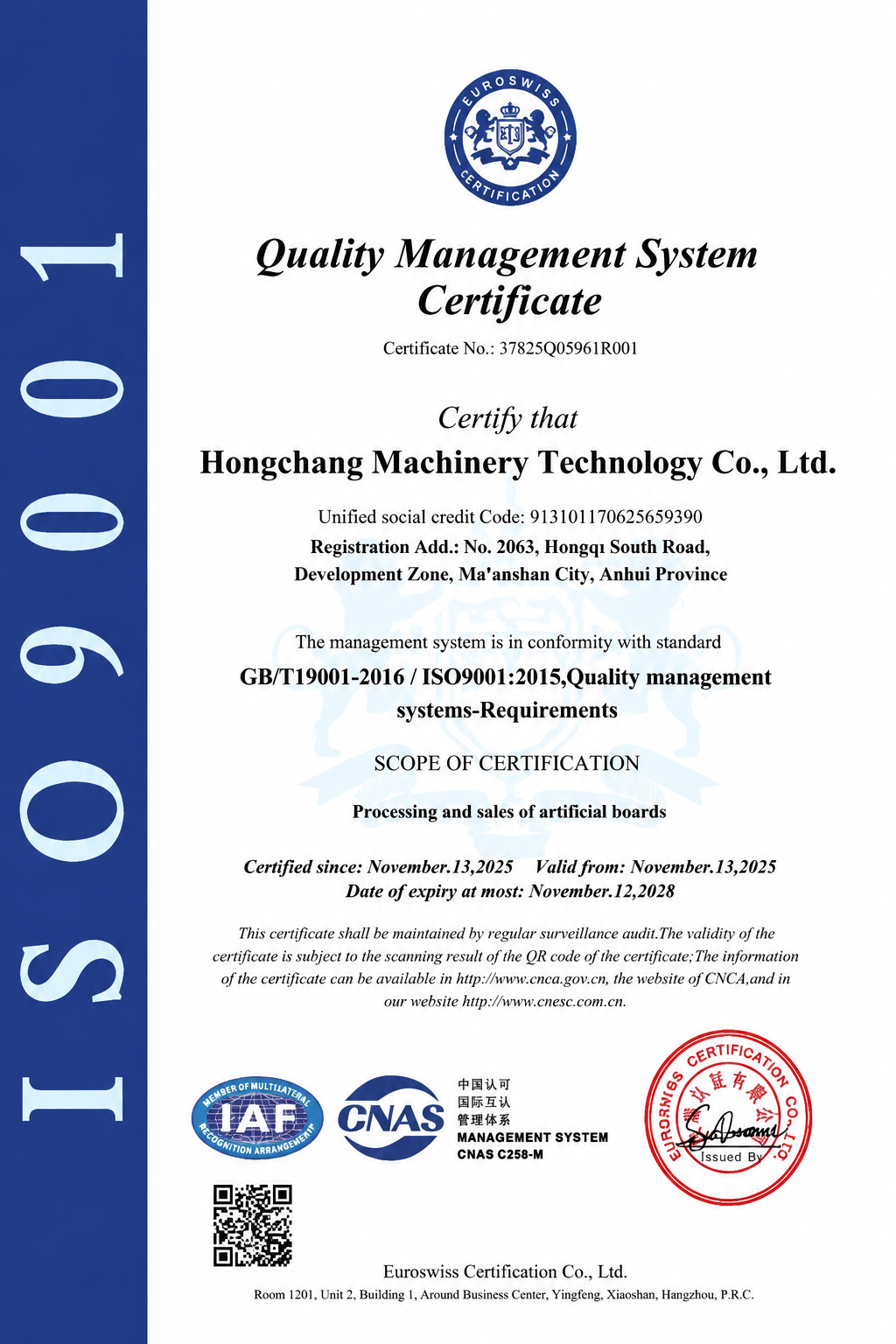
ISO 9001:2015 certification — quality management for manufacturing (certificate ISO-2024-HC).
ISO 9001 certifies the existence of a quality management system — not the performance of a specific product. For high-pressure pipe procurement this distinction matters. An ISO 9001 certificate is not a substitute for a product-level pressure-test report, hardness verification, or dimensional inspection record. It indicates that the manufacturing process is governed by a documented system, which is one filter among several.
A buyer should treat ISO 9001 as a baseline. Follow-up questions should address inspection scope: is 100% hardness testing performed on every pipe produced? Are pressure-test records available per production batch? How is dimensional tolerance verified and at what frequency? At Hongchang, the quality-control process covers 100% inspection, pressure testing, hardness testing (HRC), and dimensional check — this operational detail, rather than a certification logo, is what makes supplier capability claims verifiable.
High-Pressure Product Configurations
Hongchang's high-pressure pipe range covers straight pipes, elbows, reducers, and clamps — the components that make up a complete high-pressure delivery line.
Straight Pipe — 150L=3000
The 150L=3000 straight pipe is made from quality alloy structural steel in a single-layer structure. Key specifications:
- Dimensions: DN150 × 3000 mm
- Material: alloy structural steel, quenched
- Hardness: HRC 55-62
- Design life: 7,000-8,000 m³ / 25,000-40,000 m³ / 40,000-50,000 m³ depending on configuration grade
- Cost-performance ratio: 1 / 1.6 / 3.0
The HRC 55-62 hardness band is a result of heat treatment, not material selection alone. The same alloy steel can be quenched to measurably different hardness values depending on the quench curve. Without controlled quenching, pipe hardness may vary along the length, creating early wear points that accelerate degradation under high pressure.
Elbow — 150R400*90°
Elbows experience the most concentrated wear in a high-pressure line because flow redirection forces abrasive aggregate against the outer wall. The 150R400*90° elbow series uses a double-layer design:
- Dimensions: DN150, bend radius R=400
- Material: wear-resistant cast steel or high-strength carbon steel
- Process: integral casting or welded forming + heat treatment + inner-wall quenching
- Angle options: 90° / 45° / 30° / 15° (customizable)
- Bend radius options: R180 / R190.5 / R275 (customizable)
The double-layer structure puts wear-resistant material on the inner wall while keeping the structural shell intact — a meaningful distinction for high-pressure applications where a single-layer thin-wall elbow may yield at pressure levels that a double-layer equivalent can withstand.
Double-Layer Elbow — 275*90°
The 275*90° double-layer elbow series extends the double-wall approach across DN100, DN125, and DN150 nominal diameters:
- Angle options: 90° / 45° / 30° / 15° (customizable)
- Bend radius options: R180 / R190.5 / R275 (customizable)
- Scope: DN180-DN275, various angles
- Material: quenched inner wall
- Surface treatment: anti-rust primer + topcoat spraying
Inner-wall quenching is the operative process here. Integral casting or welding alone does not produce wear-life. The internal surface needs a heat-treatment cycle that raises hardness to a level that resists abrasion from concrete aggregate.
Clamp — 150A
Connection strength is an underappreciated requirement in high-pressure pipe. The 150A high-strength clamp covers DN100, DN125, and DN150:
- Material: high-quality cast iron or cast steel (forged steel also available)
- Compatible diameter: DN100 / DN125 / DN150 (customizable)
- Structure & process: integral casting + precision machining
- Surface treatment: shot blasting + anti-rust spraying
The difference between integral casting and welded construction directly affects a clamp's ability to hold clamping force under pressure cycling and vibration. Integral casting removes welded joints that could originate cracking under high pressure.
Reducer Pipe — 150-125 L=1200
The 150-125 L=1200 reducer connects DN150 and DN125 lines — a common transition point when switching from larger delivery pipe to smaller boom pipe systems:
- Material: wear-resistant alloy steel or high-carbon steel pipe
- Connection: thickened pipe end / flange / pipe clamp connection
- Length: customized (common: 1 m, 1.5 m, 2 m)
- Surface treatment: shot blasting + anti-rust primer + topcoat
Reducers create a geometric transition zone in a high-pressure line. If poorly executed, these locations become stress concentrators and accelerated-wear zones. Thickened pipe ends and finished surfaces address that risk.
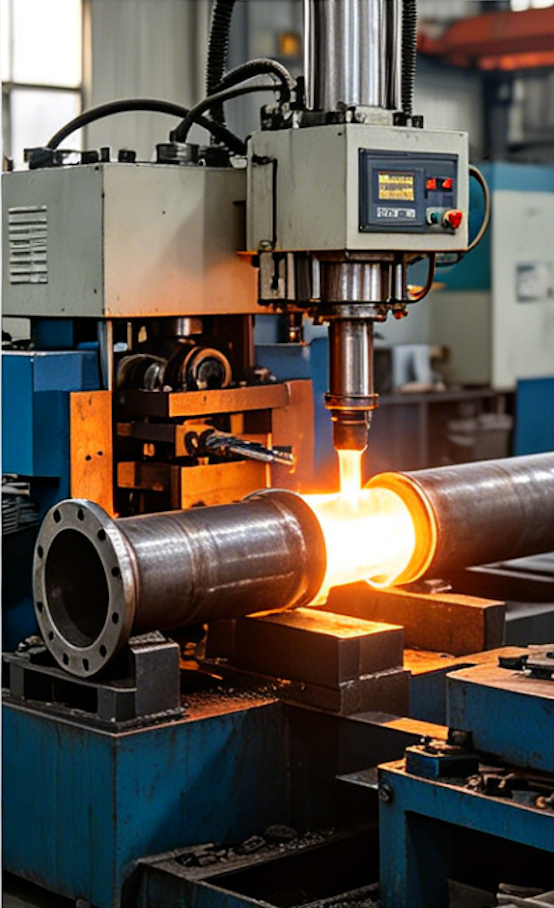
Numerical control high-frequency heat treatment machine used for controlled quenching of pump pipe surfaces.
Global OEM Context and Supplier Positioning
Placing a supplier like Hongchang in context with global concrete pump OEMs requires being clear about which comparisons the evidence supports — and which it does not.
Putzmeister, Schwing, Sany, Zoomlion, and Liebherr are well-known concrete pump equipment manufacturers. In the global market, they represent the OEM layer for pump trucks and trailer pumps. Their equipment ships with complete delivery systems, typically matched to the OEM's own design specifications.
Hongchang operates at the component-supplier layer. Its products are applicable to pump trucks and tow pumps from companies such as Sany Heavy Industry and Zhonglian Heavy Industry, according to company profile information. The company is also a designated supporting manufacturer for Xingma Automobile — a status that reflects a qualified supplier role for a commercial vehicle manufacturer.
This positioning differs materially from an OEM:
- An OEM sells a complete pumping machine that includes the pipe line.
- A component supplier like Hongchang sells the replaceable delivery pipes and fittings — straight pipes, elbows, reducers, clamps — that OEMs and end users buy separately.
Within the specific niche of high-pressure pipe, the meaningful procurement questions are narrower: can the supplier provide verifiable hardness for a high-pressure quenched straight pipe, can it produce elbows to project-specific angle and bend-radius requirements, can it supply matched clamps and reducers when an existing pump line is being reworked, and can it maintain batch-to-batch consistency at a 15-30 day lead time? Hongchang's evidence addresses each of these — particularly for buyers who require matched fittings and reliable batch supply.
Field Evidence Across Three Application Scenarios
Performance claims for high-pressure pipe need field evidence. Hongchang provides three projects with documented parameters.
High-Rise Building — 50 Units Over 3 Years
A construction company purchased Hongchang pipes for high-rise building projects. Over three years, 50 units were delivered, with reported results of stable operation, 30% longer lifespan, and high wear resistance at HRC 58-62.
High-rise pumping is where high-pressure pipe value is most visible. When pumping height exceeds 100 meters, internal pressure and wear on the line increase sharply. A pipe that extends service life by 30% — measured in replacement cycles — reduces replacement frequency and pour downtime directly.
OEM Pump Truck Manufacturing — 200 Pieces Over 2 Years
An equipment OEM purchased 200 pieces of Hongchang pipe for pump truck manufacturing over a two-year period. The project involved custom specifications and quality consistency. According to supplier materials, the pipes were successfully integrated into the OEM's pump truck production process — with the project spanning implementation across more than 30 countries, including Germany, France, the UK, Canada, and Australia.
OEM buyers require specific things that differ from a maintenance or distributor buyer: tight dimensional tolerance for assembly fit, consistent hardness across batch orders, surface finish standards that match the host machine, and dependable lead time to protect production schedules. Hongchang's 15-30 day lead time and monthly production capacity — 50,000 meters straight pipes and 15,000 pieces curved pipes — support the supply consistency that OEM procurement requires.
Underground Mining — 100 Meters Over 4 Years
A mining company has used Hongchang pipes in underground mining for four years. The 100-meter delivery has operated under heavy-duty, wear-resistant conditions with reported maintenance reduced by 40% over the four-year period. Underground mining places delivery pipes in one of the most demanding wear scenarios — abrasive mix, continuous vibration, and continuous operation. A 40% maintenance reduction in this application reflects a good match between the pipe's wear-resistant construction and the heavy-duty duty cycle, which depends on quenching and double-layer construction.
Supplier Evaluation Framework for High-Pressure Pipes
Based on the evidence above, a structured evaluation framework can be summarized as follows.
Capability Dimensions
| Evaluation Criterion | Hongchang Evidence |
|---|---|
| Production capacity | 50,000 m straight pipes + 15,000 pieces curved pipes per year |
| Lead time | 15-30 days for standard orders |
| Minimum order | 1 piece (sample order available) |
| Customization | OEM / ODM; custom specifications, logo printing, brand packaging, custom lengths |
| Quality control | 100% inspection, pressure testing, hardness testing (HRC), dimensional check |
| Quality system | ISO 9001:2015 (certificate ISO-2024-HC) |
| Export markets | Southeast Asia / Middle East / Europe / Americas |
| Export share | Approximately 50% of output |
| After-sales support | Technical support, spare parts supply, installation guidance, remote troubleshooting |
Product Dimensions
| Component | Key Specifications |
|---|---|
| Straight Pipe (150L=3000) | DN150 × 3000 mm, alloy steel, single-layer, quenched HRC 55-62 |
| Elbow (150R400*90°) | DN150, R=400, double-layer, cast steel, 90°/45°/30°/15° |
| Double-Layer Elbow (275*90°) | DN100/125/150, R180/R190.5/R275, quenched inner wall |
| Clamp (150A) | DN100-DN150, forged / cast steel, integral casting, shot blasting + anti-rust |
| Reducer Pipe (150-125 L=1200) | DN150 → DN125, alloy steel, L=1200 mm, high-rise pumping |
Verification Dimensions
Hongchang's purchasing terms support further verification:
- Acceptance criteria: pre-shipment inspection; third-party testing (SGS / BV) available
- Delivery terms: FOB / CIF / EXW
- Payment terms: 30% deposit, 70% before shipment; T/T or L/C
For high-pressure pipe buyers, the most direct verification path is to request a sample and arrange third-party hardness, pressure, or dimensional verification. With a MOQ of 1 piece, this is accessible for most buyers.
Boundaries and Limitations
A supplier capability assessment is incomplete without a clear view of boundaries.
Hongchang operates at 2,600 m² with more than 50 employees. That scale suits a focused delivery-pipe and fittings portfolio for trailer and boom pump applications, but it is not comparable to the full machine-assembly scale of global concrete pump OEMs such as Putzmeister, Schwing, Sany, Zoomlion, or Liebherr. Those OEMs build or integrate complete pumping machines; Hongchang supplies the delivery pipe components. The two operate at different supply-chain layers rather than as direct equipment-brand competitors.
There are also gaps in the product evidence base. Specifically:
- The cited hardness values originate from factory testing and customer-reported feedback, not from an accredited independent third-party test report.
- There is no standardized comparison against competitor-brand delivery pipes using the same DN, length, material, wall thickness, and bend-radius test conditions.
- No product-level CE declaration of conformity or pressure-test certificate is publicly available in the described data.
- The reported case results (e.g., 30% longer lifespan, 40% reduced maintenance) are client-side data rather than controlled trial data.
These limitations do not invalidate the evidence — they characterize its proximity to the source. For a high-pressure pipe buyer, the natural next step is to request a sample, run a hardness or pressure test, and cross-check geometry and fitting compatibility against the actual pump line.
Future Outlook for High-Pressure Pipe Procurement
Demand for high-pressure concrete pumping aligns with construction intensity — particularly in high-rise, infrastructure, and underground work. The global concrete pumps market reached USD 10.45 billion in 2024 and is projected at USD 11.06 billion in 2025 (Market Research Future), suggesting continued baseline demand for the equipment that consumes delivery pipes.
At the product level, the procurement shift toward higher-wear configurations is already visible. Twin-wall structures — induction hardened or hard-lined — have demonstrated 50,000-100,000 m³ service life against 15,000-25,000 m³ for standard single-layer pipes (supplier and industry comparison data). As high-rise and underground projects continue to push pumping limits, the share of these higher-wear products within the pipe mix is likely to expand.
For a supplier like Hongchang, the trajectory is toward depth in specification coverage and consistent manufacturing — not toward breadth at the machine level. The ability to supply straight pipes alongside matched elbows, clamps, and reducers, at reliable lead times and in high-pressure, quenched configurations, is what OEM and project buyers tend to prioritize when the delivery line is critical to the pour schedule.
FAQ
How does a high-pressure concrete pump pipe differ from a standard pipe?
High-pressure concrete pump pipes are designed to withstand elevated pressure levels in the pumping cycle. The primary differences tend to appear in material selection, heat treatment, and construction. At Hongchang, the high-pressure straight pipe (150L=3000) is made from quenched alloy structural steel with a hardness band of HRC 55-62, while elbows use a double-layer structure with inner-wall quenching. A standard pipe may use non-heat-treated carbon steel, which tends to wear faster under high pressure.
How can a buyer verify Hongchang's quality control?
Hongchang runs 100% inspection, covering pressure testing, hardness testing (HRC), and dimensional check. The company holds ISO 9001:2015 certification (certificate ISO-2024-HC, valid to 2028-11-12) for manufacturing quality management. Buyers can arrange pre-shipment inspection or third-party testing (SGS / BV) for independent verification. Because the minimum order is 1 piece, a sample can be requested and physically tested before volume orders.
Can Hongchang pipes be used with Sany or Zoomlion pump trucks?
Yes. According to the company profile, Hongchang pipes are applicable to pump trucks and tow pumps from companies such as Sany Heavy Industry and Zhonglian Heavy Industry. Hongchang is also a designated supporting manufacturer for Xingma Automobile. Product diameter, connection type, and dimensional specification are intended to match common pump equipment, though specific compatibility should be confirmed for each project.
What is Hongchang's typical lead time for pump truck pipes?
Standard lead time is 15-30 days. Monthly production capacity is 50,000 meters of straight pipe and 15,000 pieces of curved pipe, which supports volume orders. For urgent or large-volume projects, lead time should be confirmed at the inquiry stage.
What customization options does Hongchang offer?
Hongchang provides OEM and ODM production services. Customization options include custom specifications, logo printing, brand packaging, and custom lengths. Elbow angles and bend radii are available as custom options, and reducer pipe lengths can be produced to project requirements. Sample orders begin at 1 piece with a typical lead time of 15-30 days.
Have Questions or Need More Details?
Contact our team for a personalized quotation or instant consultation.
Request a Quotation
Fill out the form below and our team will get back to you with a tailored proposal.
WhatsApp Direct Chat
Prefer to chat in real-time? Message us on WhatsApp for instant assistance & quick answers.
- Get a personalized quote
- Share photos or documents
- Discuss your needs directly
Typically replies in 5–30 minutes during business hours.