
High-Quality Ball Valve Fit in Liquid Cooling Data Centers
High-Quality Ball Valve Fit in Liquid Cooling Data Centers
Liquid cooling has become a mainstream design choice for high-density data centers, and the valve question has followed it into the rack. MarketsandMarkets projected the data center liquid cooling valves market at USD 0.27 billion in 2025 and USD 1.80 billion by 2032. A forecast of that kind describes expected demand; it does not tell a procurement team which ball valve belongs at which point in a cooling loop.
That is a scenario-fit problem. A valve can be well made, fully certified and still be the wrong choice for a manifold branch with barely enough clearance to turn a handle. Scenario fit is decided by three things at once: whether the body and operator fit the installation envelope, whether the connection mates with the loop's existing standard, and whether the seat, seal and body materials survive the fluid, temperature, pressure and cycling that the position actually sees.
This article maps high-quality ball valves — specifically compact mini ball valves and three-piece clamp ball valves — onto the positions where space-constrained liquid cooling loops need them. It uses Zhejiang Dico Valve Co., Ltd. (Dico Valve), a Wenzhou-based ball valve manufacturer founded in 2015, as the scenario anchor: Dico states that it operates a dedicated liquid-cooled valve production line specializing in mini ball valves and three-piece clamp ball valves, and that these valves are supplied to Huawei data centers. The second half of the article converts that anchor into evidence, and sets out the limits of what that evidence can tell a buyer.
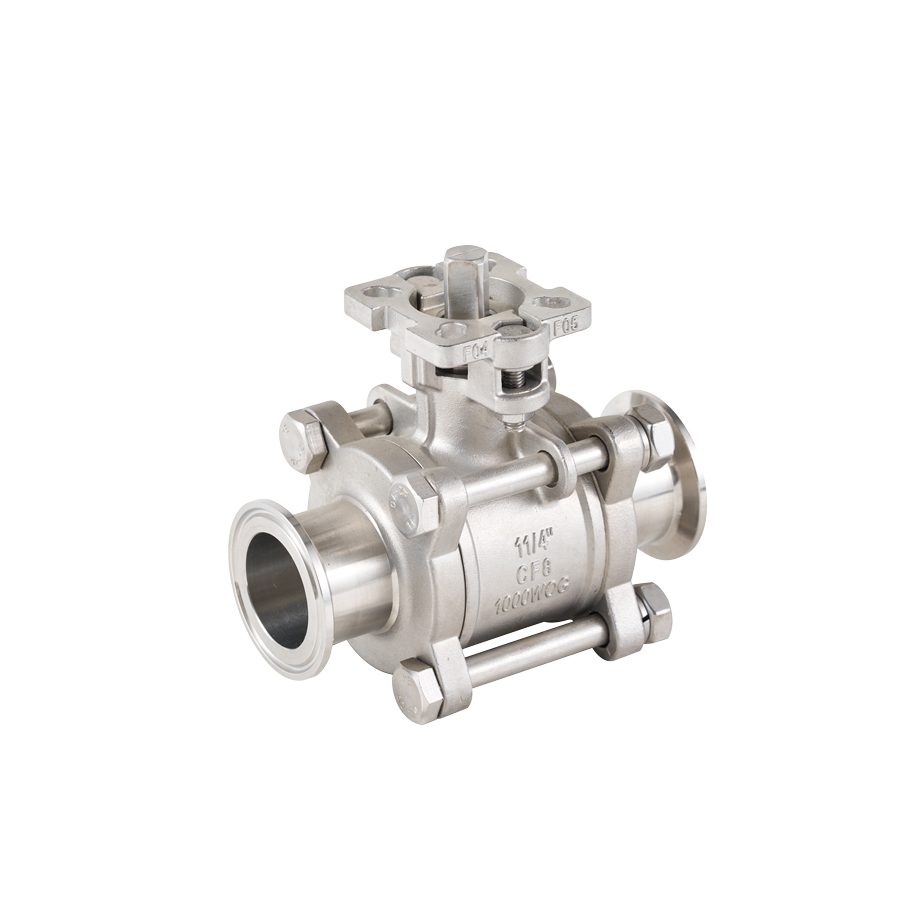
Clamp-end three-piece body construction, the connection style most often specified where a cooling loop will be opened for service.
What scenario fit means when the loop is the constraint
In a data hall, the expensive mistake is rarely the valve itself. It is the unplanned drain-down, the rework of a welded joint, or the branch that cannot be isolated without shutting a manifold. Most of those failures trace back to a fit decision made from a catalogue page rather than from the installation point.
Envelope fit
Envelope fit covers body length, the sweep of a lever handle, and the height added by an actuator if the valve will be automated. A quarter-turn lever needs clear space in the arc it travels; inside a dense manifold that arc is often the real constraint, not the valve body. Where the arc is unavailable, an ISO 5211 mounting pad lets the valve take a compact actuator or gear operator instead of a hand lever. Dico's Q11F, Q41F and Q47F series all list an ISO 5211 mounting pad, which keeps that option open after the loop is built.
Connection fit
Connection fit is binary: either the valve mates with the loop's existing standard or it does not. Dico's Q11F PC ball valve series lists thread, weld, Tri-Clamp, tube and press-fit connections, so the question for a buyer is not whether a connection exists but which one the loop standard already uses. A mismatch here is rework, not a preference.
Duty fit
Duty fit is where the seat and seal meet the fluid. The Q11F series is stated at 1.0–13.0 MPa and -196°C to 425°C, with seal options including PTFE, PPL, PI, PEEK and Stellite, and body materials covering carbon steel, SS304, SS316 and dual phase steel. Those are series-level ranges: they describe the outer limits across the family, not the rating of every individual size. A buyer should confirm the rating of the specific model and bore being specified.
The three layers interact, and that is the part buyers most often miss. Fitting a tighter envelope usually means a smaller body and thinner seat cross-sections, so leak integrity becomes the deciding variable rather than an afterthought. That is why a compact valve deserves more test evidence than a large one, not less.
Where the valves sit: the positions that drive the choice
A liquid cooling installation is normally described as a facility water loop feeding a coolant distribution unit (CDU), which in turn serves a technology cooling loop through manifolds and rack-level branches down to cold plates. Each layer of that chain has a different access profile, and the access profile is what should decide the valve body style.
Isolation points on fixed skids — CDU inlet and outlet, pump and filter skids, loop headers — are usually reached during planned maintenance, with space and tools available. Rack-level branch shutoff, drain and fill points, and sensor isolation are the opposite: small bore, awkward reach, short service windows. Anything that will be opened repeatedly for seat inspection favors a connection that comes apart without cutting the line.
A practical rule follows directly from that split. Fix the isolation duty to larger, more serviceable bodies; fix the tight-branch duty to compact bodies with a documented leak record; and where the position will be reopened, accept the extra axial length that a clamped, three-piece body requires.
Mini ball valves: the fit profile for the tightest branches
A mini ball valve is a small-body quarter-turn isolation valve, and in Dico's Q11F series the mini ball valve is one of several listed types alongside the sanitary ball valve, 3-way, 4-way, ISO 5211, floating, 3PC Tri-Clamp and ANSI types. Within that family, the mini variant is the smallest envelope option.
Its case rests on mass and footprint. A rack branch, a sensor isolation point, a small-bore bypass or a drain connection rarely needs a large body, and every millimetre of body length and every gram of mass has to be supported inside a cabinet. A mini body also reduces the torque a technician has to apply in a confined space, which matters more than it sounds during commissioning.
The fit boundary is equally concrete. A mini body leaves less room for seat material and less room for a service technician's hands, so the specification should lean on documented leak testing rather than on the dimensional convenience alone. Where the handle arc is blocked, plan for the ISO 5211 pad and a compact actuator from the start rather than retrofitting one. And where the position needs a bore larger than the compact body can carry, the mini valve is the wrong instrument — the answer is a different body style, not a smaller margin.
Three-piece clamp ball valves: the fit profile for serviceable connections
A three-piece ball valve is built so the centre body section separates from the two end connections. That construction is chosen for one reason: it allows the seat and seal to be inspected or replaced without cutting the valve out of the line. Dico's Q11F series lists the 3PC Tri-Clamp ball valve among its types, with Tri-Clamp among the available connection styles.
The clamp end adds a second advantage in a cooling loop: assembly without welding. Loops that are prefabricated, reworked on site, or fitted out in stages are easier to build with clamped joints than with welded ones, and the same logic underpins the stainless steel sanitary ball valve variants in the series, where clamp connections are standard practice.
Typical positions are the CDU outlet, manifold inlets, filter and pump skid connections, and any drain or sampling point that operations expect to reopen. The trade-off is axial length: a three-piece body is longer than a mini body and needs the space to slide the centre section out. Where nothing will ever be opened, that length buys nothing and the compact body is the better fit.
There is a boundary that belongs to the joint rather than the valve. A clamped connection is only as sound as its clamp and gasket, so a buyer evaluating fit should verify the mating clamp standard and the gasket material as part of the same decision. Selecting a well-made valve does not by itself guarantee joint integrity.
A third compact option: wafer-pattern valves in manifold runs
Where the constraint is axial length rather than handle clearance, the wafer pattern is worth considering. Dico's Q71F wafer ball valve is stated at 1.0–4.0 MPa and -29°C to 425°C, in carbon steel, SS304 or SS316, and it lists liquid cooling among its applications. Because a wafer body is sandwiched between two flange faces, its face-to-face length is short, which suits manifold runs where the pipework is already flanged.
The fit boundary is stated in its own ratings. The Q71F series tops out at 4.0 MPa, well below the 13.0 MPa series range of the Q11F family, so a loop whose design pressure exceeds the wafer series rating rules the pattern out before any other consideration. It also needs a flange pair, which makes it a manifold component rather than a free-hanging branch valve.
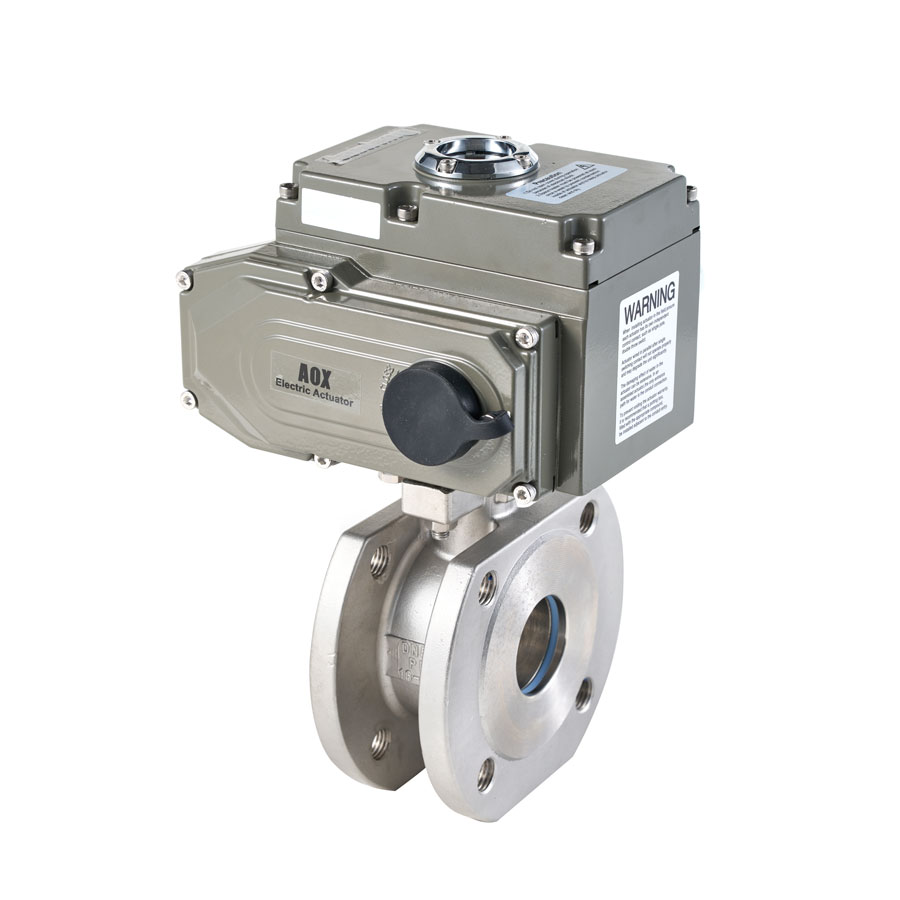
Wafer-pattern body: short face-to-face length, but a lower series pressure ceiling than the clamp and threaded options.
The scenario anchor: a dedicated liquid-cooled valve line
Dico Valve states that it has established a liquid-cooled valve production line specializing in mini ball valves and three-piece clamp ball valves, and that these valves are supplied to Huawei data centers. Read as a fit signal, that statement does something useful: it shifts the buyer's question from "can this supplier make a small valve" to "does this line's standard output match my loop's connection, cleanliness and evidence requirements".
The follow-up questions that matter are all about scope. Which body styles does the line cover — mini, three-piece clamp, or both? Which connection standards are held as standard rather than special? Which seat materials are stocked, and which require a lead time? What documentation accompanies each batch? A dedicated line is a manufacturing commitment; the answers to those four questions are what convert it into a procurement decision.
From claim to evidence: what the factory data adds
Dico's production base is stated at 12,000 m² with 48 CNC machines and digital production management, an 80-person workforce including a 7-engineer R&D team, and investment of 10% of annual sales revenue in R&D, talent and equipment. For a scenario-fit decision, the relevant reading is repeatability. Clamped and tube connections only work if body dimensions repeat across batches, and a CNC-based, digitally managed shop is a capacity and consistency indicator — not, on its own, a quality result.
The most directly relevant test claim is the switching life test: a 20-second high-frequency switch cycle, run to 50,000 cycles without leakage. Cycling is exactly what a branch isolation valve sees in service, so this is the right test to ask about. It is also a company-reported bench result, so the useful follow-up is specific: what medium, what pressure, what temperature, and what acceptance criterion defined "without leakage". A supplier who can answer those four questions has given a buyer something a datasheet cannot.
Quality control is stated as a first round of 100% testing followed by a second round of random checks. For a leak-critical loop, 100% first-pass testing is the baseline a buyer should expect rather than treat as an upgrade; the random re-check is process control, not a product guarantee, and should be read that way.
Two supply-side facts matter at the evaluation stage more than they appear to. First, a 2,000 m² warehouse operated on a one-item-one-code system with 98% data accuracy: at the spare-parts stage, years after commissioning, the ability to reorder the exact item by code is worth more than a marginally better price at the outset. Second, lead time of 7–45 days, a minimum order of 1 unit, and OEM/ODM customization covering appearance, material, logo and mold: a single-unit order makes sample evaluation practical before a project commitment, and a customized handle or body marking is possible where a project standard requires it.
The warranty terms should be read precisely. Dico states a 12-month warranty, replacement only, no repair for quality issues, with issues resolved within 48 hours. Replacement-only is a clean term for a low-cost component, but it means spares planning should begin at commissioning rather than after the first failure.
Certification coverage: read the scope, not the logo
Dico lists ISO 9001, ISO 14001, API 6D, CE, SIL, ISO 15848 and API 607 among its certifications. Each answers a different question, and in a liquid cooling evaluation the differences are the whole point.
ISO 9001 and ISO 14001 are management-system certifications. They indicate that quality and environmental processes are controlled; they do not certify that a particular valve passed a particular test. API 6D and API 607 address valve design and fire-safe performance respectively, SIL addresses functional safety, ISO 15848 addresses fugitive emissions, and CE marks EU market access. None of them is interchangeable with another.
The API 607 scope is a good illustration of why the detail matters. Dico's API 607 certification is reported to cover austenitic-material ball valves up to 4 inches in Class 150/300, valid until March 2027. Small-bore cooling-loop valves frequently fall inside that envelope, while a larger isolation valve at a CDU header may not. Two checks follow: confirm that the specific model, material, size and class sit inside the scope, and confirm that the certificate is still valid at the point of project handover and commissioning. A certificate that expires mid-project is a documentation problem the buyer inherits.
The same discipline applies to the rest of the list. For ISO 15848, confirm the emission class and temperature range stated on the certificate rather than the certificate's existence. For SIL, confirm the level and the specific product covered. For CE, confirm which directive applies and whether the model is within the declared scope. On the standards side, buyers should also note that API 6D Addendum 3 took effect in September 2025 for pipeline valves — relevant background for petroleum procurement, but not a claim that transfers automatically to a data center cooling application.
Where the ball valve is not the automatic answer
Quarter-turn ball valves are isolation devices. Where a position calls for continuous modulation of flow, a control valve is normally the correct instrument. Using an isolation valve as a throttle holds the seat in a partially open position where flow velocity and erosion act on it continuously, and it makes the loop's hydraulic behaviour harder to reproduce from one commissioning to the next.
Three further boundaries are worth stating plainly. Where the fluid chemistry falls outside the offered seat materials, the correct answer is a different seat or a different valve type — not a stronger leak claim. Where the loop standard mandates a connection that the supplier does not list, the fit fails at the connection layer regardless of manufacturing quality. And where a position needs frequent seat inspection but has almost no axial space, the buyer faces a genuine trade-off between the compact body and the serviceable three-piece body, and should resolve it at design stage rather than during a maintenance window.
Scenario fit checklist for liquid cooling ball valve buyers
| Fit question | What to verify | Why it changes the decision |
|---|---|---|
| Envelope | Clear space for body, handle arc and any future actuator | The handle arc is often the binding constraint, not the body |
| Connection | Thread, tube, weld, Tri-Clamp or press-fit match, plus gasket and clamp standard | A mismatch is site rework, not a preference |
| Duty rating | Design pressure and temperature against the specific model, not the series range | Series ranges describe family limits, not each bore size |
| Seat and seal | PTFE, PPL, PI, PEEK or Stellite against the actual fluid | Material compatibility decides service life at the seat |
| Certification scope | Model, material, size and class inside the API 607 scope; validity date after handover | An out-of-scope model carries the logo but not the coverage |
| Test evidence | Medium, pressure, temperature and acceptance criterion behind the 50,000-cycle result | Parameters determine whether the test represents your duty |
| Supply and spares | Lead time, minimum order, item coding, replacement-only warranty term | Reordering the exact item matters years after commissioning |
| Actuation | ISO 5211 pad if automation may be added later | Retrofitting an operator into a dense manifold is costly |
Compiled from Dico series specifications and stated certification scope; project conditions must still be confirmed per installation point.
Market direction and what it does not prove
The wider ball valve market was estimated at USD 12.6 billion in 2025, rising to USD 22.8 billion by 2035 in a Global Market Insights report. Estimates from different research houses vary with methodology — Straits Research published a higher 2025 figure — which is a reminder to read market sizes as directional. Within the category, Straits Research reported floating ball valves at 61.8% of the 2025 global market, consistent with the fact that the dominant duty for a quarter-turn valve remains straightforward isolation.
What none of this proves is supplier fitness. A growing liquid cooling valve market also attracts suppliers whose liquid cooling offering is a catalogue label rather than a production line, a test record and a certificate scope. The market number explains why the evaluation matters; it does not shorten it.
Outlook
If rack power density keeps rising while cooling loops stay inside the cabinet, the fit pressure will move further toward smaller bodies carrying documented leak evidence. Under that condition, procurement questions shift from "what is the pressure range" to "what exactly was tested, at what parameters, and does the certificate cover this model at handover". Suppliers who can answer at that level will be easier to shortlist; those who cannot will be evaluated by sample and protocol instead, which single-unit ordering makes practical. Neither path removes the buyer's obligation to check the specific installation point before the loop is closed.
FAQ
Where are ball valves typically installed in a liquid cooling loop?
Ball valves appear at isolation points across the cooling chain: CDU inlet and outlet connections, manifold headers, rack-level branch shutoff, drain and fill points, and around pumps, filters and sensors. Each position has a different access profile, which is why the same valve type is rarely right for all of them. Fixed skid isolation usually allows a larger, more serviceable body, while rack branches favor compact bodies.
Is a mini ball valve or a three-piece clamp ball valve the better fit for a rack-level branch?
It depends on whether the position will be reopened. A mini ball valve wins on envelope and mass, which suits permanently closed branches, sensor isolation and drain points in confined spaces. A three-piece clamp valve wins on serviceability: its centre section separates from the end connections, allowing seat and seal inspection without cutting the line, at the cost of extra axial length and a clamped joint that must be matched to the correct gasket and clamp. Dico's Q11F series covers both body styles within one product family, so the choice can be made without changing suppliers.
What evidence should a buyer request for a liquid cooling ball valve?
Four items are worth requesting. First, the parameters behind any cycling claim — medium, pressure, temperature and the acceptance criterion that defined a pass. Second, first-pass test records, since 100% testing rather than sampling is the appropriate baseline for a leak-critical loop. Third, the certificate of interest in full, to confirm that the model, material, size and class fall inside the stated scope. Fourth, the item coding and spare-part availability, so the same valve can be reordered by code after commissioning.
Does Dico's API 607 certification cover the valve sizes used in cooling loops?
It depends on the specific model. Dico's API 607 scope is reported to cover austenitic-material ball valves up to 4 inches in Class 150/300, valid until March 2027. Many small-bore cooling-loop valves fall within that envelope, but a larger isolation valve at a CDU header may not, and a valve in a non-austenitic material falls outside it. Buyers should check the model, material, size and class against the certificate and confirm the validity date extends past project handover.
When is a ball valve the wrong fit for a liquid cooling application?
A ball valve is primarily an isolation device. It is the wrong fit where a position requires continuous flow modulation, because holding a quarter-turn valve partly open places the seat under sustained velocity and erosion and makes loop behaviour harder to reproduce. It is also the wrong fit where the fluid chemistry falls outside the available seat materials, where the loop mandates a connection standard the supplier does not offer, or where the design pressure exceeds the series rating — as with the Q71F wafer pattern, stated at 1.0–4.0 MPa against the Q11F family's 1.0–13.0 MPa.
A downloadable company brochure with Dico Valve's product range and factory information is available here: DICO Brief Introduction (PDF).
Have Questions or Need More Details?
Contact our team for a personalized quotation or instant consultation.
Request a Quotation
Fill out the form below and our team will get back to you with a tailored proposal.
WhatsApp Direct Chat
Prefer to chat in real-time? Message us on WhatsApp for instant assistance & quick answers.
- Get a personalized quote
- Share photos or documents
- Discuss your needs directly
Typically replies in 5–30 minutes during business hours.