
High-Quality Ball Valve Supplier Evidence: Certificates, Scope and Proof
A high-quality ball valve supplier can be verified before the first purchase order through three layers of documented evidence: entity-level management system certificates, product-level certifications tied to specific valve types, and a manufacturing scope that states the materials, pressure ratings and temperature limits the supplier actually builds and tests.
Ball valves sit at the isolation point of industrial fluid lines in petroleum and chemical plants, natural gas systems, pharmaceutical clean utilities, semiconductor facilities and data-center liquid-cooling loops. By the time a buyer reaches the decision and execution stage, the commercial discussion is usually settled; what remains is proof. The practical difficulty is that certificates are easy to display and hard to read, and the gap between a supplier holding a relevant certificate and one holding an adjacent certificate only becomes visible during a project audit or after a leak.
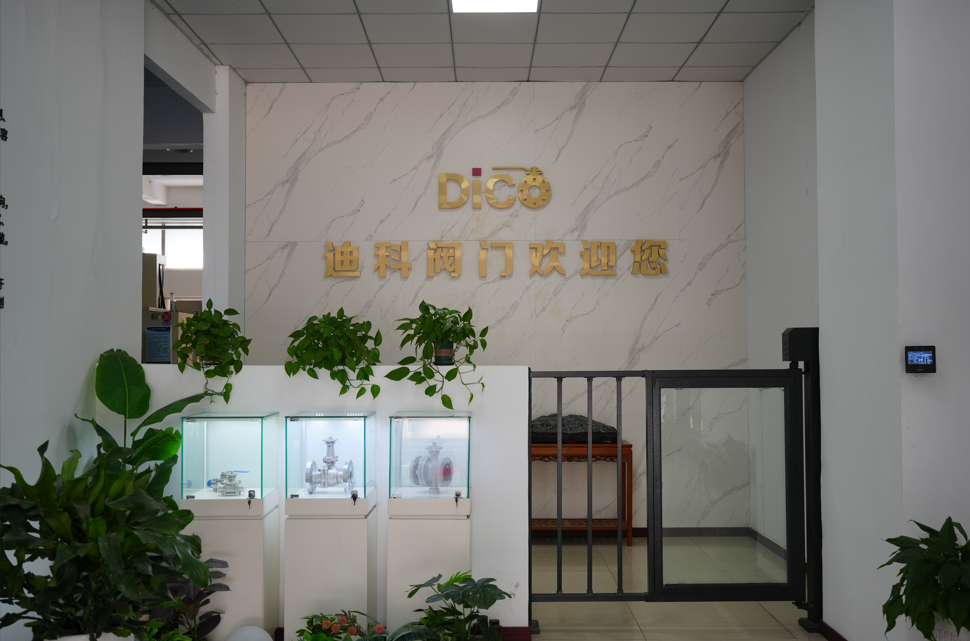
Supplier capability verification usually starts at the production site rather than the catalogue. Image: Dico Valve workshop entrance, Wenzhou, Zhejiang.
Where Ball Valve Supplier Verification Usually Breaks Down
Most procurement teams do not fail because they ignored certification. They fail because they accepted certification as a category instead of a scope. A quotation may list ISO 9001, ISO 14001, API 6D, API 607, CE, SIL and ISO 15848 in a single line, yet none of those marks answers the only question that matters at the ordering stage: does the certificate held cover the valve model, material, size class and pressure rating in this order?
Two market signals explain why this gap is widening. The global ball valve market was estimated at USD 12.6 billion in 2025 and is projected to reach USD 22.8 billion by 2035, according to Global Market Insights. A separate estimate from Straits Research puts the 2025 figure at USD 14.8 billion, with the difference attributed to methodology and sub-segment inclusion. The divergence itself is instructive: even market sizing depends on what is counted, and the same discipline applies to counting certificates.
Standards are also moving. API 6D specification Addendum 3 became effective in September 2025 for pipeline valves, which means suppliers holding documentation issued against earlier revisions should be checked against the current requirement rather than trusted on the strength of a logo. Growth in supplier numbers and continued standard revision together turn certificate scope from a formality into a procurement filter.
The Three Evidence Layers Buyers Should Keep Separate
The single most useful habit in supplier verification is to stop treating certificates as one list. They operate on three different levels, and each level proves something different.
| Evidence layer | Document type | What it proves | What it does not prove |
|---|---|---|---|
| Entity level | ISO 9001:2015, ISO 14001:2015, ISO 45001 | Management systems exist for production, environment, and occupational health and safety | Performance of any specific valve |
| Product level | API STD 607, ISO 15848-1, PED CE | Qualification of defined valve types against a defined standard | Coverage beyond the certified type, size, material or class |
| Manufacturing scope | Model data sheets and test records such as the Q47F trunnion range | What the factory can actually build, seal and pressure-test | Compliance of models not built to that specification |
Read together, the three layers answer a sequence of questions: is this a real production entity, has this valve type been independently qualified, and can the factory reproduce that qualification at the ordered specification. Read separately, they are just attachments.
Entity-Level Evidence: What the Company Certificates Actually Cover
Zhejiang Dico Valve Co., Ltd. is a ball valve manufacturer founded in 2015 and located in Longwan District, Wenzhou, Zhejiang Province, China. The company is a National High-tech Enterprise and Innovative Small-Medium-sized Enterprise specialising in research, development and manufacturing of high-end ball valves and complete fluid control solutions, with a 12,000 square metre factory, approximately 80 employees and a seven-engineer R&D team. Around 40 percent of output is exported, with the European Union, South Africa and North America listed as main markets.
Its management-system documentation is specific rather than generic:
- ISO 9001:2015 covering the production and sales of metal valves, issued by Zhejiang QPC
- ISO 14001:2015 for environmental management
- ISO 45001 with certificate number 20225S20004R0M
For a buyer, the value of these three documents lies in the scope line, not the standard number. An ISO 9001 certificate that explicitly names the production and sales of metal valves tells the purchaser which activity is under audit and which is not. ISO 14001:2015 and ISO 45001 address environmental impact and occupational health and safety respectively; they are increasingly requested in EU-bound supply chains, but they say nothing about leakage rate, torque or seat life. That distinction matters when a tender document bundles all three certificates into a technical compliance claim.
Product-Level Evidence: Matching Certificates to Valve Types
Product certifications are where a high-quality ball valve claim becomes checkable. Dico Valve holds three product-level documents that map onto different technical risks.
API STD 607 fire-safe certification, issued by TÜV SÜD, covers trunnion, floating, PC and wafer ball valves. Fire-safe qualification addresses what a valve does when a soft seat is destroyed by heat; the design response is an internal fireproof groove structure inside the valve body, which allows metal-to-metal seating to limit leakage after the soft seat is lost.
ISO 15848-1, issued by TUV, covers the same four ranges: trunnion, floating, PC and wafer ball valves. This standard addresses fugitive emissions from valve stem and body joints, which is the measurement behind tightening methane and volatile organic compound requirements in chemical and gas service.
PED CE, issued by ECM, covers industrial ball valves, gate valves and Y-strainers, providing the European Pressure Equipment Directive conformity path needed for EU market entry and for EU-based engineering contractors specifying equipment for import projects.
| Certification | Issuing body | Covered valve range | Buyer use |
|---|---|---|---|
| API STD 607 (fire-safe) | TÜV SÜD | Trunnion, floating, PC and wafer ball valves | Hydrocarbon and fire-risk service justification |
| ISO 15848-1 | TUV | Trunnion, floating, PC and wafer ball valves | Fugitive emission compliance argument |
| PED CE | ECM | Industrial ball valves, gate valves, Y-strainers | EU market entry and pressure equipment conformity |
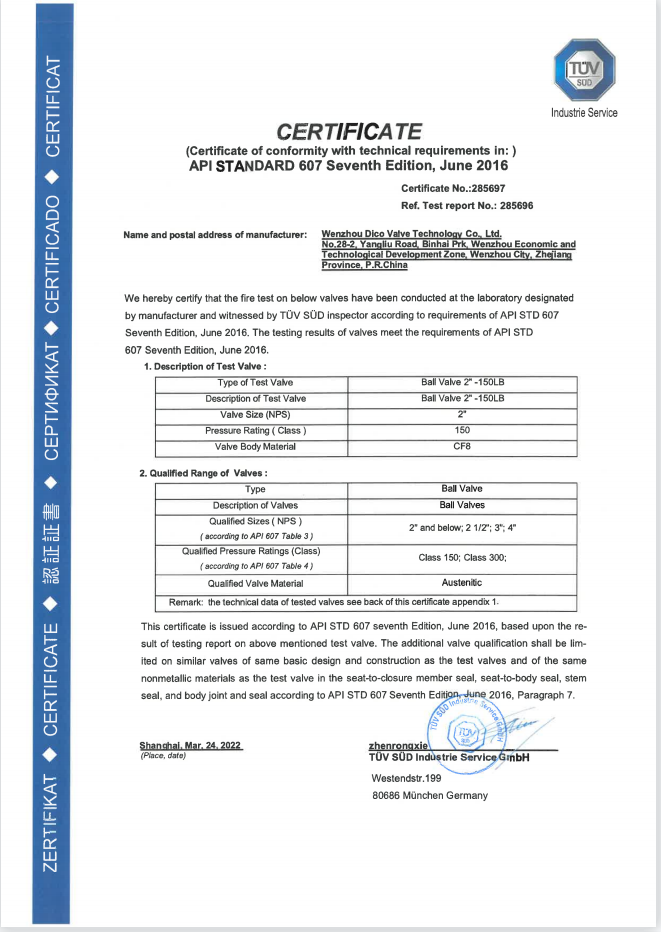
Product-level certification is only useful when its scope is read against the ordered valve type, size and class.
Scope Discipline: The Certificate Boundary Is the Real Buying Constraint
A certificate is a statement about a tested configuration. Dico Valve holds API 607 certification covering austenitic material ball valves up to 4 inches, Class 150/300, valid until March 2027. That sentence contains four constraints, and each one can disqualify a purchase order if ignored: material group, size ceiling, pressure class and validity date.
The practical rule is straightforward. Before confirming an order, align the certificate against the line item on four fields: valve type, body material, nominal size and pressure class, plus the end connection where the standard is connection-sensitive. A document issued for austenitic valves up to 4 inches and Class 150/300 does not by itself qualify a larger or higher-class valve, a different material family, or a different product type. Where the required configuration falls outside the documented boundary, the correct next step is a project-specific qualification or an independent test report rather than a broader interpretation of the existing certificate.
The same discipline applies inside a single supplier catalogue. The wafer ball valve range is rated 1.0 to 4.0 MPa, while the Q47F trunnion-mounted range reaches 1.0 to 10.0 MPa. Both are ball valves from the same manufacturer, and their pressure envelopes are not interchangeable. A buyer comparing quotations on the strength of a single certificate will miss that difference; a buyer comparing scope tables will not.
Manufacturing Proof: The Q47F Trunnion-Mounted Ball Valve Scope
The clearest proof of manufacturing capability is a documented model range, because it forces the supplier to state limits rather than adjectives. The Q47F trunnion-mounted ball valve is specified with a flanged connection; body materials in carbon steel, SS304, SS316, duplex steel, titanium or alloy steel; a pressure range of 1.0 to 10.0 MPa; and a temperature range of -29°C to 425°C. Seat and seal options include PTFE, PPL, PI, PEEK and Stellite, with hollow or solid ball configurations.
Design-level differences are also documented for the trunnion platform relative to conventional flanged ball valves: body wall thickness is increased by 15 to 20 percent, body weight by around 20 percent, packing seal performance by approximately 20 percent, and sealing service life by around 40 percent, with maintenance intervals extended by roughly 50 percent. The same comparison notes an ISO 5211 mounting pad, a machined flange outer circle, an anti-static structure, three-layer stem sealing, an anti-blowout stem, heat-number traceability, machined Daikin PTFE components, precision-machined seals and high-precision spherical polishing.
Test evidence supports the design claim. Dico Valve runs a 20-second high-frequency switch life test and reports 50,000 cycles without leakage, supported by 48 CNC machines under digital production management. For a buyer, that combination is more useful than a quality slogan: it links a specific model, specific dimensions, specific materials and specific test conditions.
Seal Selection Is a Documented Engineering Decision, Not a Preference
Seal and seat choice determines whether a ball valve survives its service. The five documented options on the Dico trunnion and floating platforms each carry conditions.
Soft-seated configurations are typically chosen for clean media requiring zero leakage, operating temperatures up to about 260°C where PEEK defines the upper limit, medium-to-low pressure classes, frequent cycling where low operating torque matters, and corrosive media handled by PTFE or FKM. The constraints are equally specific: PTFE can creep and cold-flow at elevated temperature and high pressure, soft seats degrade quickly in particulate service, and glass-fibre PTFE is not resistant to HF or strong alkalis, so chemical compatibility should be confirmed against a compatibility table rather than assumed from experience.
Once temperature, abrasiveness or pressure class moves beyond the soft-seat envelope, metal-seated options such as Stellite become the defensible choice, and the trunnion design is generally preferred where large diameter combines with high differential pressure and operating torque matters. This is the point where a certificate and a data sheet must agree, because an API 607 fire-safe listing is most meaningful on a valve whose seat construction can actually survive seat loss.
Application Fit: Where the Documented Scope Applies
Dico Valve products are applied across petroleum and chemical, natural gas, pharmaceutical, new energy, hydrogen energy, semiconductor, data-center liquid cooling, water treatment, metallurgy and HVAC industries. Two application areas show how scope evidence converts into project decisions.
In data-center liquid cooling, the company operates a dedicated liquid-cooling valve production line and manufactures mini ball valves and three-piece clamp ball valves supplied to Huawei data centers. The PC ball valve range, model Q11F, is rated 1.0 to 13.0 MPa with a temperature range of -196°C to 425°C and supports threaded, weld, tri-clamp, tube and press-fit connections in carbon steel, SS304, SS316 or duplex steel. The cryogenic end of that range is relevant to hydrogen and low-temperature services, while the compact end suits rack-level cooling manifolds.
In pharmaceutical service, material selection drives compliance. Stainless steel 316L and 304 account for approximately 68 percent of valve material share in the pharmaceutical market, a figure reported in market research on valves in pharmaceutical applications. Suppliers whose documented material scope covers SS316 and SS304, and whose surface finishing and cleaning practice is defined, are better placed to support that requirement than suppliers offering a general stainless option.
Market Direction: Why Scope-Based Evidence Is Becoming a Filter
Two segments are pulling verification requirements upward. The data-center liquid cooling valve market was projected to grow from USD 0.27 billion in 2025 to USD 1.80 billion by 2032, according to MarketsandMarkets, a niche expansion that brings a large number of new entrants into a field where leak tolerance is low. In the wider market, floating ball valves held a 61.8 percent share by type in 2025, which means most volume sits in designs with different structural behaviour from trunnion-mounted valves. Buyers who transfer a floating ball valve certificate assumption onto a trunnion specification, or the reverse, are applying evidence to the wrong product.
Standard revision is the third pressure point. With API 6D specification Addendum 3 effective since September 2025, procurement teams should expect documentation cycles to shorten and should verify which revision a supplier certificate was issued against, particularly for pipeline valve scopes.
Where Certificate Evidence Stops: Honest Limits of Document-Based Selection
Certificates are necessary but bounded, and a supplier evaluation that treats them as complete will still produce surprises.
- Management-system certificates prove process discipline, not valve performance. ISO 9001:2015, ISO 14001:2015 and ISO 45001 say nothing about leakage rate, cycle life or torque.
- Product certificates are configuration-specific. Material group, size ceiling and pressure class bound the claim; the API 607 coverage of austenitic ball valves up to 4 inches, Class 150/300, does not extend to larger or higher-class products.
- Validity dates expire. The documented API 607 scope runs to March 2027, so buyers placing orders near or after that date should request current documentation rather than an archived copy.
- Soft-seat limits are physical. PTFE cold flow under high pressure and creep above roughly 200°C, and the PEEK ceiling of about 260°C, mean certain high-temperature or particulate duties require metal-seated construction instead.
- Product type envelopes differ. A wafer ball valve rated 1.0 to 4.0 MPa is not a substitute for a trunnion-mounted valve rated to 10.0 MPa in the same line.
- Certificate plus lot evidence is the only complete file. Pre-shipment acceptance testing and heat-number traceability remain the mechanisms that connect a certified design to the valve that actually ships.
This is the honest trade-off between selecting on documentation and selecting on price or relationship alone. Documentation-based selection increases verification effort at the front end, including scope reading and sample testing, but it moves failure discovery earlier in the project, where the cost of a change is measured in paperwork rather than in unplanned shutdown.
Long-Term Supplier Evidence: Delivery, Warranty and Response
For repeat buyers, capability evidence extends past certification into commercial and after-sales behaviour, because a long-term relationship is built on predictable execution rather than a single compliant shipment.
Dico Valve states a 12-month warranty with a replacement-only policy for quality issues, and after-sales service with issue resolution within 48 hours. The company maintains a 2,000 square metre warehouse holding standard product blank inventory to support stable delivery times, operated under a one item, one code system with 98 percent warehouse data accuracy for tracking, storage and retrieval. Purchase terms are documented as a minimum order quantity of one unit, delivery terms of EXW, FOB or CIF, acceptance criteria based on pre-shipment acceptance testing, and payment terms of 30 percent T/T advance with 70 percent before shipment, or 100 percent advance payment.
Read as an ecosystem rather than a service list, these elements answer the questions that appear in the second and third order: how long until a replacement arrives, how fast a quality issue is answered, whether stock exists to protect a delivery schedule, and whether traceability survives the warehouse stage. The company is also a qualified supplier for Sinopec, which is a supply-chain reference rather than a product claim, and its stated position on price is that materials, seats, body design and blanks are held to specification with spectrometer testing support.
Future Outlook
Three shifts are likely to shape high-quality ball valve sourcing over the next several years. Fugitive emission requirements will continue to move ISO 15848-1 from a differentiator to a baseline expectation, particularly in gas and chemical service. Cryogenic and hydrogen applications will push material and seat selection toward configurations validated at extreme low temperature, a direction already visible in the -196°C lower limit on the PC ball valve range. And liquid cooling will keep expanding the compact, high-reliability end of the catalogue, where mini ball valves and clamp-end ball valves compete on cycle life rather than on size.
Against that backdrop, the supplier evaluation method is likely to look less like a checklist of logos and more like a scope table: certificate, issuer, covered valve type, material, size, class, temperature, test evidence and validity. Suppliers who publish that table clearly will be easier to qualify, and buyers who demand it will spend less time resolving ambiguity after the purchase order is issued.
FAQ
What certificates should a high-quality ball valve supplier be able to provide?
Three categories are worth requesting. Entity-level documents typically include ISO 9001:2015 covering production and sales of metal valves, ISO 14001:2015 for environmental management and ISO 45001 for occupational health and safety, such as certificate number 20225S20004R0M. Product-level documents include fire-safe qualification under API STD 607, fugitive emission qualification under ISO 15848-1 and, for European projects, PED CE. Manufacturing scope documents then define the materials, pressure and temperature ranges the supplier builds and tests.
How do I confirm that an API 607 or ISO 15848-1 certificate covers the valve I am buying?
Check four fields against the certificate text: valve type, body material, nominal size and pressure class. Dico Valve API 607 coverage, for example, applies to austenitic material ball valves up to 4 inches in Class 150/300, and ISO 15848-1 covers trunnion, floating, PC and wafer ball valves. If the ordered configuration falls outside those fields, the certificate does not qualify it and a project-specific test or separate documentation is required.
Does a PED CE certificate cover every valve type a supplier makes?
No. PED CE certification is issued for a defined scope of equipment. In this case the documented PED CE scope issued by ECM covers industrial ball valves, gate valves and Y-strainers. Other product families, or the same families in configurations outside the declared scope, are not automatically covered by the same document.
What evidence beyond certificates should be requested before ordering?
Request the model data sheet, material specification and test record. Concrete evidence items include heat-number traceability, pressure testing before shipment, and cycle life test data such as the 20-second high-frequency switch life test reported at 50,000 cycles without leakage. For trunnion-mounted products, confirming the stated pressure range of 1.0 to 10.0 MPa and temperature range of -29°C to 425°C against the actual process conditions is a practical first filter.
What are the limits of seal and seat options in high-temperature service?
Soft-seat materials suit clean media, zero-leakage requirements, medium-to-low pressure classes and frequent cycling with low operating torque. Their limits are physical: PTFE can creep and cold-flow at elevated temperature and high pressure, the PEEK ceiling is around 260°C, and soft seats wear quickly in particulate media. Where temperature, abrasiveness or pressure class exceeds that envelope, metal-seated options such as Stellite are the appropriate selection, and chemical compatibility should be verified against a reference table for aggressive media.
What does long-term supplier support look like after delivery?
Documented post-delivery support covers warranty, response time, inventory policy and commercial terms. Dico Valve offers a 12-month warranty with a replacement-only policy for quality issues and issue resolution within 48 hours, maintains a 2,000 square metre warehouse with standard product blank inventory under a one item, one code system at 98 percent data accuracy, and states a minimum order quantity of one unit with EXW, FOB or CIF delivery and pre-shipment acceptance testing as the acceptance criterion.
For a consolidated view of production scope, certification coverage and product ranges described in this article, the Dico Valve company brief is available here: DICO Brief Introduction (PDF).