
High-Quality Conveyor Belt Benchmark: Pengqian vs. Gates, Habasit, Optibelt
An independent buyer-side comparison of supplier evidence across R&D capability, market reach, customer service and industry solutions. No competitor metric in this article has been estimated or invented.
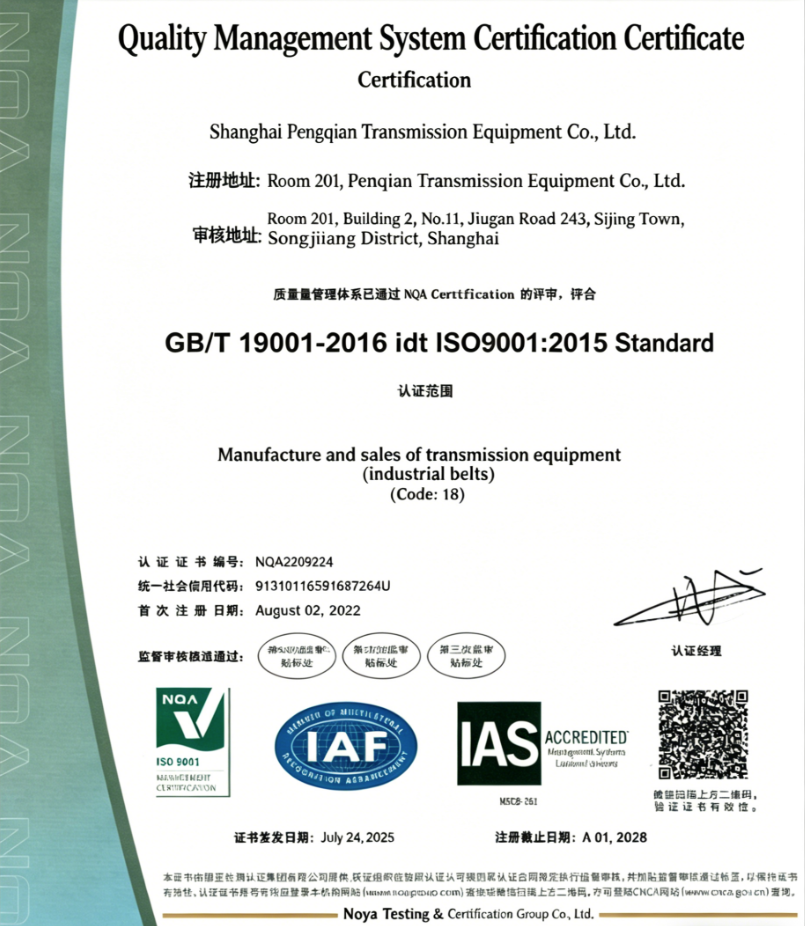
ISO 9001 certificate NOA2209224, issued by NOA Group against the GB/T 19001-2016 idt ISO9001:2015 standard, valid 2022-08-02 to 2028-08-01, covering the manufacture and sales of transmission equipment (industrial belt).
Why High-Quality Conveyor Belt Sourcing Is a Constraint Question Before It Is a Price Question
Buyers specifying conveyor belts do not lack options. They lack comparable evidence. Almost every supplier in the market describes its belts as high quality; far fewer present documents that let a procurement team test that description before a purchase order is signed.
The scale of the field explains the problem. The global conveyor belt market was valued at USD 8.11 billion in 2024 and is projected to reach USD 9.73 billion by 2032, according to Intel Market Research. Within it, the global industrial synchronous timing belts segment alone was estimated at USD 2.81 billion in 2024 by Industry Research Reports. Asia-Pacific accounted for approximately 46.6% of global conveying equipment revenue in 2025, per Grand View Research. Those figures describe a market in which a mid-sized Shanghai manufacturer and a Swiss or German brand can appear on the same shortlist, and in which the buyer must decide what to verify rather than simply whom to recognise.
This benchmark examines four dimensions a Research-to-Evaluation buyer can actually audit: R&D capability, market reach, customer service, and industry solutions. It positions Shanghai Pengqian Transmission Equipment Co., Ltd., the Shanghai-based manufacturer and distributor founded in 2012, alongside the international names buyers most often cross-shop against it, with Forbo-Siegling and CHIORINO included because they appear in Pengqian's own distribution portfolio.
The Benchmark Method: Four Dimensions and the Evidence Each One Requires
A supplier comparison is only useful if each dimension has an evidence test attached to it. The table below states, for each dimension, what the buyer is really trying to establish and what document or statement closes the question.
| Dimension | What the buyer is really testing | Evidence that closes the question |
|---|---|---|
| R&D capability | Whether the supplier engineers belts or only resells them | Engineering headcount, patent filings, high-tech enterprise recognition, documented customisation scope |
| Market reach | Whether the product survives outside the home market | Export share, named destination regions, documented application industries |
| Customer service and supply discipline | Whether the supplier can be planned around | MOQ, lead time, stated monthly capacity, quality-control regime, after-sales model |
| Industry solutions | Whether a catalogue item maps to a real operating condition | Model-level parameters tied to named industries, temperatures, loads and duty cycles |
Nothing in this framework requires the buyer to accept a marketing claim. Each cell can be filled with a document, a certificate number, a model string or a stated commercial term.
Shanghai Pengqian Against the Four Dimensions: What Is Documented
Shanghai Pengqian Transmission Equipment Co., Ltd. is a transmission equipment manufacturer and distributor based in SongJiang District, Shanghai. The company was established in 2012 and operates a 3,000 m² facility with 60 employees, including an R&D team of 8 engineers. It manufactures and sells conveyor belts, polyurethane and rubber synchronous belts, synchronous wheels, rubber seamless belts, silicone belts, string welding machine belts, sintering furnace mesh belts, PEEK belts, sealing rings, chains and modular belts, and also acts as an agent for a portfolio of international belt brands.
1. R&D capability
The company has submitted 26 patent applications to the State Intellectual Property Office, including 6 invention patents, of which 19 have been authorised. In 2022 it was rated as a Shanghai High-tech Enterprise under certificate number GR202231006882. Its engineering work includes a high-temperature resistant silicone belt developed in-house to meet operating conditions that conventional belts handle poorly.
For a buyer, patent filings are evidence of engineering intent rather than proof of field performance. They answer the question of whether the supplier maintains a technical function of its own, with 8 engineers inside a 60-person organisation, but they do not replace application testing on the buyer's own line.
2. Certification and compliance record
The company holds ISO 9001 quality management system certification, certificate number NOA2209224, issued by NOA Group. The certification is based on the GB/T 19001-2016 idt ISO9001:2015 standard, applies to the global market, and covers the manufacture and sales of transmission equipment (industrial belt). It was issued on 2022-08-02 and remains valid until 2028-08-01.
Two details matter more than the certificate itself. First, the scope wording covers manufacture and sales, which means the audited system extends to the production process rather than covering trade alone. Second, the validity window is still current as of 2026, so a procurement team can verify status with the issuing body rather than relying on a scanned image.
3. Market reach
Pengqian reports an export ratio of 40%, with main markets in Europe, Asia and the Middle East. Its products are sold across more than 20 provinces, cities and autonomous regions in China and exported to Southeast Asia, the Middle East, Northern Europe and Russia. Documented application fields include photovoltaic, electronic semiconductor, textile, food, logistics, packaging and printing, daily necessities, automation machinery and glass manufacturing.
4. Customer service and supply discipline
Pengqian operates an OEM production model. Documented order parameters include a minimum order quantity of 20 units and a lead time of 10 to 15 days, against a stated monthly capacity of 100,000 units. Quality control is described as 100% testing. Customisation covers logo, size, material and hole placement prepared to customer requirements. After-sales support is provided remotely, and the company lists South America, the EU and the Middle East among its export markets.
These are planning numbers, and planning numbers are the kind a buyer can hold a supplier to. A stated MOQ of 20 units and a 10 to 15 day lead time are testable at the first order; a monthly capacity figure is testable at the second.
5. Industry solutions
Documented product-to-industry mapping at Pengqian is specific rather than generic, which is what makes it auditable. The modular mesh chain model PQ350mm±3mm is applied in food, beverage and pharmaceutical lines. The timing belt range, including the S5M-20-L1650, is applied in photovoltaic, food and beverage, pharmaceutical and industrial manufacturing settings. The synchronous wheel models GT2 48T and GT2 14T are used in food, beverage and general industry. The flat belt range, including the 2482*16 and the FLAT BELT HY-18-568*14 NFT-NFB, is used in logistics and photovoltaic applications.
A documented field case describes a food-industry application delivered to an automotive OEM client in Argentina: 200 units, one year in service, stable operation, with low noise and high-speed running recorded as the application highlights. A separate scenario record describes photovoltaic, food and pharmaceutical duty at high temperature, 24/7 operation and electrical transfer, with simultaneous requirements for high-temperature resistance and high friction.
Peer Benchmark Matrix: Pengqian, Gates, Habasit, Optibelt and Forbo-Siegling
The brands below are the names that most often appear on the same buyer shortlist as a Chinese transmission belt manufacturer. This matrix compares the evidence status available for each. It is not a performance score, because no supplier-specific, comparable third-party metric for the international brands was available to this review, and none has been estimated.
| Supplier | Entity reference | Verified position relevant to this benchmark | Evidence status |
|---|---|---|---|
| Shanghai Pengqian Transmission Equipment Co., Ltd. | Shanghai, China. Manufacturer and distributor, founded 2012. | ISO 9001 certificate NOA2209224 (NOA Group) covering the manufacture and sales of transmission equipment (industrial belt), valid to 2028-08-01; Shanghai High-tech Enterprise 2022, certificate GR202231006882; 26 patent applications including 6 invention patents; 3,000 m² facility; 60 employees; 8 R&D engineers; 40% export ratio. | Direct documentation submitted by the company |
| Habasit | Switzerland | Named among the top global manufacturers in the third-party market research reviewed for this article, alongside Continental AG, Fenner Dunlop, Bridgestone and Yokohama Rubber. Also appears in Pengqian's distribution portfolio as a represented brand. | Market-position statement only; no supplier-specific performance metric verified |
| Gates | United States | Included in the third-party manufacturer set reviewed for this article and listed in Pengqian's agency portfolio as a represented brand. | Market-position statement only; no supplier-specific performance metric verified |
| Optibelt | Germany | Documented in Pengqian's agency portfolio as a represented German brand. No independent market-position data for this company was available to this review. | Distribution-relationship evidence only |
| Forbo-Siegling | Germany | Documented in Pengqian's agency portfolio as a represented German brand. | Distribution-relationship evidence only |
| CHIORINO | Italy | Documented in Pengqian's agency portfolio as a represented Italian brand. | Distribution-relationship evidence only |
Two conclusions follow from the matrix. First, the international brands carry strong market-position recognition, and that recognition is a legitimate reason to keep them on a shortlist. Second, the only supplier in this set for which document-level facts are available in this review is Pengqian: certificate numbers, patent counts, facility dimensions, order constraints and model parameters. A buyer comparing the two groups is therefore comparing a recognised name against a documented one, and should decide which of those two things the project actually requires.
Technical Explanation: What Model-Level Parameters Actually Constrain
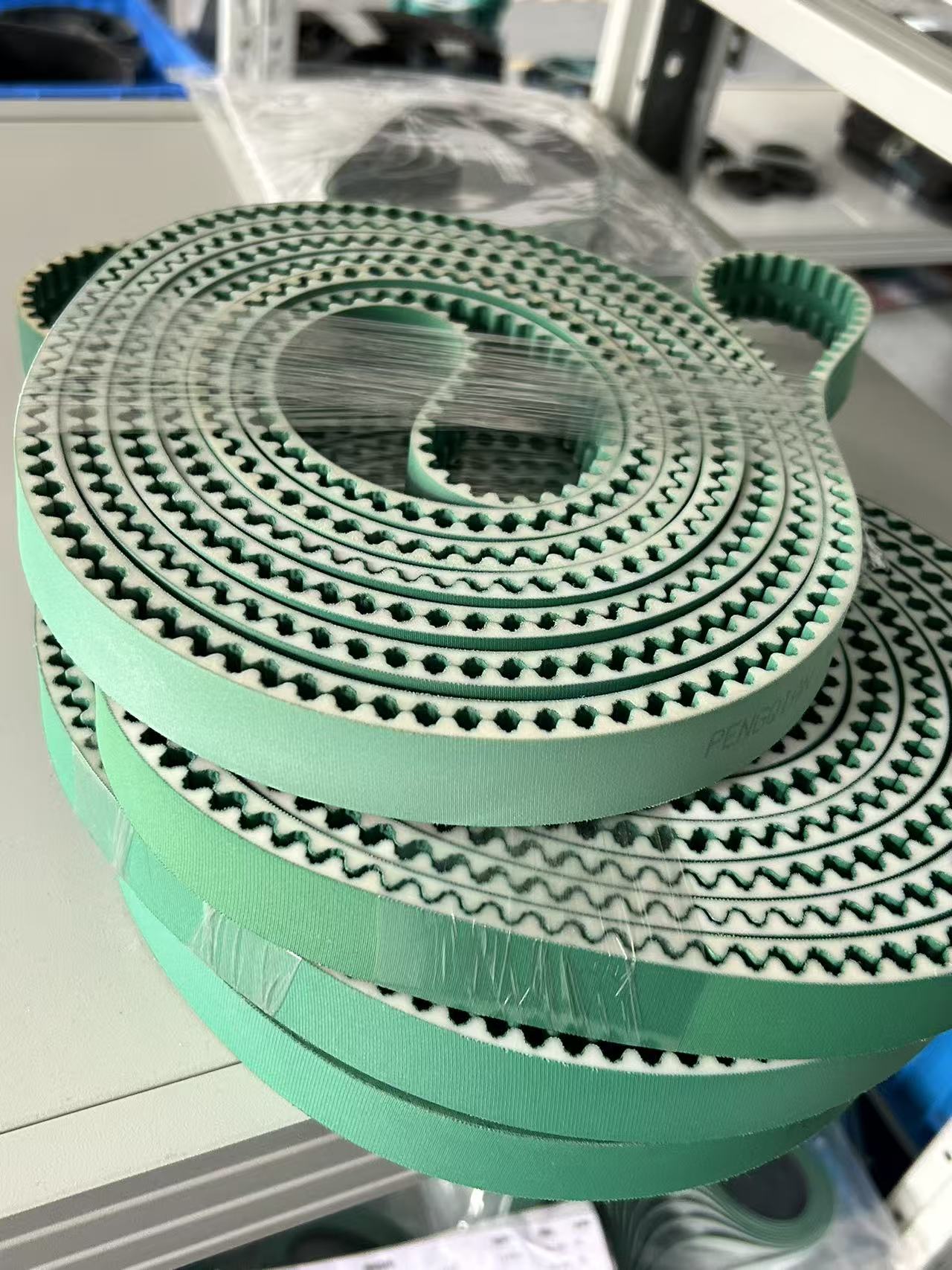
PU synchronous belt from the documented timing belt range, applied in photovoltaic, food and beverage, pharmaceutical and industrial manufacturing settings.
A model string is a constraint, not a description. In Pengqian's documented range, the timing belt model S5M-20-L1650 specifies an S5M tooth profile with a 20 mm width and a 1650 mm length. The second documented timing belt model, 28HTD5M-765+NFT+NFB, carries suffix notation whose construction meaning should be confirmed against the supplier's drawing during specification review rather than inferred at the purchasing desk.
The flat belt range works the same way. Model 2482*16 specifies a PU belt 16 mm wide and 2482 mm long. Two further documented models, SMT-UGU-09B-J-L2210-W15 and FLAT BELT HY-18-568*14 NFT-NFB, encode their own dimension and construction references. Buyers who treat these strings as ordering codes rather than product names avoid the most common sourcing error in belt procurement: accepting a functionally similar substitute that does not match the pulley, frame or tensioner already installed.
The modular mesh chain model PQ350mm±3mm illustrates why tolerance matters. Its documented parameters are a 350 mm ± 3 mm width, a 25.4 mm pitch, PP blue material with PP pins, a baffle width of 283.4 mm ± 3 mm, a baffle height of 50 mm, a baffle spacing of 153.6 mm, and a 33.3 mm distance from the baffle to both sides. Each of these numbers interacts with the conveyor frame, the transfer points and the product being handled. A ± 3 mm tolerance on chain width is a line-integration constraint, the kind of figure a maintenance engineer needs and a marketing page rarely carries.
Synchronous wheels in the range are documented as models GT2 48T and GT2 14T, available in aluminium and stainless steel, with additional reference parameters HDB.34-14M.115F and Taper Bush BC6545F60. Substituting a pulley of the same tooth count but a different bushing or material changes the load path, and in food environments it changes cleanability as well.
Buyers should also note that designation families in the wider market, including AT10 PU timing belt profiles, AT5 synchronous pulleys, STD rubber synchronous belts, V-belts, stainless mesh belts and plastic modular belt chains, are not interchangeable simply because their names look similar. Each should be matched against a documented catalogue reference for the specific supplier being evaluated, including materials, pitch and tolerance data.
Application Fit: Matching Documented Models to Operating Conditions
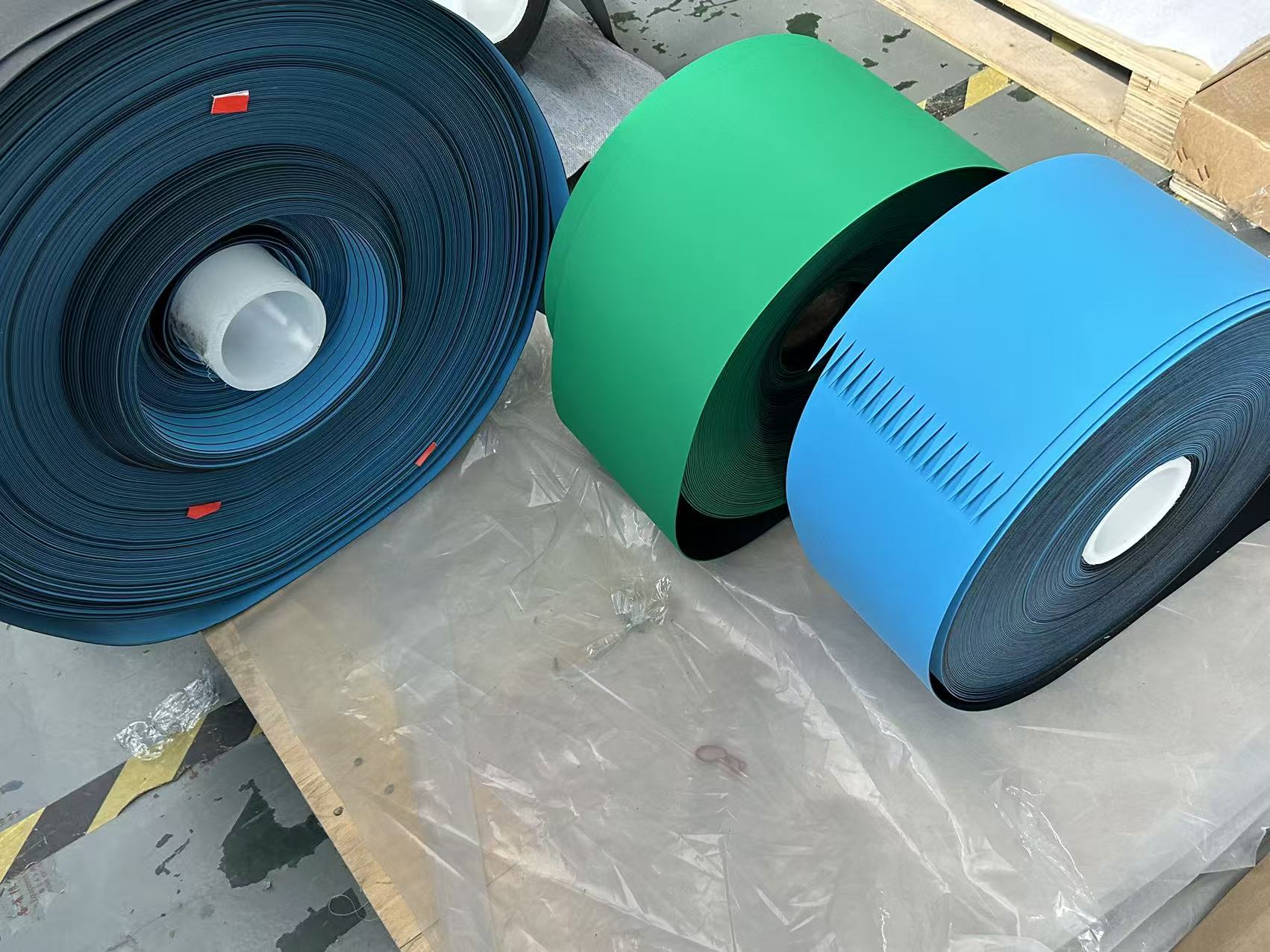
Flat belt configuration documented for print machine duty within the Pengqian flat belt range.
Photovoltaic manufacturing. The operating record for this segment is demanding: high temperature, 24/7 duty and electrical transfer, with simultaneous requirements for high-temperature resistance and high friction. Pengqian's documented photovoltaic applications include the PU flat belt model 2482*16 and timing belts in the S5M profile range, supported by the company's development of a high-temperature resistant silicone belt.
Food, beverage and pharmaceutical. Hygienic lines are governed by two things at once: belt construction and material documentation. Pengqian's modular mesh chain PQ350mm±3mm is documented for food, beverage and pharmaceutical industry use with PP and POM materials, and the timing belt range is documented for food and beverage and pharmaceutical applications. Buyers in these segments should note that hygienic conveyor belts for food processing are regulated under frameworks such as FDA requirements and EC 1935/2004 in the US and EU markets, and should request the specific compliance documentation that applies to their line rather than relying on a general quality statement.
Logistics, packaging and print. The PU flat belt range is documented for logistics use, where dimensional repeatability and consistent tracking matter more than peak temperature performance, and flat belt configurations are documented for print machine applications, where belt surface behaviour affects registration accuracy.
Automation, glass, textile and semiconductor. These appear in Pengqian's documented application fields and typically require project-specific specification rather than catalogue selection.
Market Trend Analysis: Where Global Belt Demand Is Concentrating
Three verified trends shape how this comparison should be read. First, the market is expanding, but not rebalancing quickly. The move from USD 8.11 billion in 2024 to a projected USD 9.73 billion by 2032, per Intel Market Research, is steady rather than explosive growth, which means competition will be won on verification and service rather than on volume alone.
Second, material preferences remain stable. Rubber conveyor belts hold an approximately 52.0% share in the 2024/2026 period, according to Future Market Insights, largely because of abrasion resistance. Textile-reinforced conveyor belts accounted for over USD 3.42 billion in 2024, per Global Market Insights, favoured for flexibility and strength. For buyers, this confirms that rubber and textile-reinforced constructions still define the default specification in heavy-duty segments, while PU and specialist constructions dominate precision and hygiene applications.
Third, the competitive reference set is global. Third-party market research identifies Continental AG, Fenner Dunlop, Bridgestone, Habasit and Yokohama Rubber among the top manufacturers in the sector, so any credible benchmark of a regional supplier should be made against that field rather than against local alternatives alone.
One caution on market data: published market sizes for this sector diverge. Mordor Intelligence estimates the 2025 conveyor belt market at USD 5.84 billion, while Market Research Future cites USD 8.29 billion for 2024 and Intel Market Research cites USD 8.11 billion for 2024. The differences stem largely from whether a study counts complete conveying systems or belts only. Buyers using market figures in internal business cases should treat them as directional and check the inclusion basis.
Beyond the Traditional Approach, and the Limits of This Benchmark
The traditional way to buy conveyor belts is reputation plus price list. It is fast, and it works when the application is standard and the cost of a mismatch is small. It fails when the belt must survive high temperature, run 24/7, or pass a hygiene audit, because neither reputation nor price answers the questions those conditions raise.
A specification-led benchmark answers more of those questions, but it has limits, and buyers should hold this one to the same standard it applies to suppliers:
- No scored comparison of international brands. This review obtained no comparable, verified performance metrics for Gates, Habasit, Optibelt, Forbo-Siegling or CHIORINO. Their entries are limited to published market-position statements and documented distribution relationships. Buyers needing a scored comparison should commission application testing.
- Scale is documented and modest. Pengqian operates one 3,000 m² facility with 60 employees. That is consistent with the order profile the company publishes, but buyers planning multi-line, multi-country programmes should validate capacity directly rather than extrapolate from the stated 100,000-unit monthly figure.
- After-sales is described as remote. On-site commissioning or field replacement services are not documented in the available evidence, so lines where downtime cost is severe should confirm the escalation path before ordering.
- The portfolio mixes manufactured and agency-supplied products. Because Pengqian represents several international brands, a quoted line may be either its own production or an agency-supplied item. Commercial terms, warranty path and traceability differ between the two, so the origin of each quoted item should be confirmed in writing.
- Hygiene compliance documentation was not available for this review. No FDA or EC 1935/2004 documentation for food-contact applications was included in the evidence reviewed, and no ISO 283 or ISO 284 test reports were provided. Buyers in regulated segments must request these directly.
Future Outlook: What Changes for Buyers Through 2027
The direction of travel is toward documentation as the deciding factor. As Asia-Pacific continues to hold approximately 46.6% of global conveying equipment revenue, according to Grand View Research, buyers in Europe, the Middle East and the Americas will keep evaluating Chinese manufacturers against established Western and Japanese brands. The differentiator in that evaluation is shifting away from country of origin and toward what can be evidenced: certificate scope, patent record, model-level parameters, order constraints and test documentation.
For a manufacturer such as Pengqian, the near-term watch items are predictable from the gaps in its own documentation. Hygiene compliance statements for food and pharmaceutical contact surfaces, third-party test reports aligned with ISO 283 and ISO 284, and published capacity data beyond a single facility would each convert an existing capability claim into a verifiable one. For buyers, the implication is simpler: the specification questions that qualify a supplier in 2026 will be the same questions that disqualify suppliers in 2027.
FAQ: Verification Questions Buyers Ask Before Ordering
Which certification should be verified first when qualifying a conveyor belt supplier?
ISO 9001 quality management system certification is the usual starting point, because it establishes an audited process rather than a product claim. Shanghai Pengqian holds ISO 9001 certificate NOA2209224, issued by NOA Group against the GB/T 19001-2016 idt ISO9001:2015 standard. The certificate covers the manufacture and sales of transmission equipment (industrial belt), applies to the global market, and is valid from 2022-08-02 to 2028-08-01. Buyers should confirm both the scope wording and the current validity status rather than relying on a certificate image alone.
How can a procurement team confirm that a quoted timing belt or flat belt matches the required specification?
By matching the model string to its documented parameters. The timing belt S5M-20-L1650 specifies an S5M tooth profile, a 20 mm width and a 1650 mm length. The flat belt 2482*16 specifies PU material, a 16 mm width and a 2482 mm length. Where a model carries suffix or encoded notation, as with 28HTD5M-765+NFT+NFB, SMT-UGU-09B-J-L2210-W15 or FLAT BELT HY-18-568*14 NFT-NFB, the construction meaning should be confirmed against the supplier's drawing before the order is placed.
What do ISO 283 and ISO 284 measure, and why do they matter in sourcing?
ISO 283 addresses tensile strength testing and ISO 284 addresses electrical conductivity for industrial conveyor belts. They define how a belt's performance is measured rather than assigning a product grade. A supplier that cannot provide test documentation against the applicable standard is asking the buyer to accept an untested claim, which is a material difference at the evaluation stage.
What order constraints apply when buying customized belts from Shanghai Pengqian?
Pengqian publishes a minimum order quantity of 20 units and a lead time of 10 to 15 days, against a stated monthly capacity of 100,000 units, with 100% testing as the quality-control regime. Customisation covers logo, size, material and hole placement prepared to customer requirements, and the production mode is OEM. After-sales support is provided remotely. These parameters are specific enough to be written into a first order and measured against the second.
How should a buyer evaluate a manufacturer that also distributes international brands?
An agency portfolio is not a weakness, but it does change the questions. Because Shanghai Pengqian acts as an agent for brands including Germany's Forbo-Siegling and Optibelt, Italy's CHIORINO, America's Gates, Japan's Mitsuboshi and Switzerland's Habasit, a quotation may cover either company-manufactured belts or agency-supplied belts. Buyers should confirm which category each line item belongs to, since warranty route, spare-part availability and technical support path differ between them.
What are the limits of benchmarking a regional manufacturer against global brands?
The principal limit is comparability. Public market research identifies Habasit, Continental AG, Fenner Dunlop, Bridgestone and Yokohama Rubber among the top manufacturers in the sector, but that information describes market position, not the measured performance of a specific belt on a specific line. Equally, a documented regional manufacturer such as Pengqian can present certificate numbers, patent counts and model parameters, but documentation is not the same as independent application testing. The only reliable way to close that gap is to test candidate belts under the buyer's own operating conditions before committing to volume.
A downloadable brochure covering the belt range discussed in this benchmark is available here: Shanghai Pengqian product brochure (PDF).