
High Quality Shower Faucet: What Buyers Must Verify
In the shower faucet category, “high quality” is a phrase catalogues use freely and specifications rarely define. For a procurement team in the research and evaluation stage, it is more useful as a set of measurable constraints than as a description: the alloy of the body, the type and diameter of the cartridge, the thickness of the plating, the geometry of the connection thread, the pressure band the valve is designed for, and the paperwork that can prove any of it. This reference sets out those constraints, the standard thresholds that can be checked against them, and what a manufacturer such as Ehoo Plumbing Co., Ltd. discloses in relation to each.
The problem: quality claims without constraints
Most shower faucet listings in export marketplaces compete on appearance — finish colour, head diameter, handle shape. Project specifications compete on something else entirely. Plumbing supply fittings fall within recognised standards that treat shower and bath fittings as engineered components rather than decorative objects. The ASME A112.18.1-2018 / CSA B125.1-18 standard, in its 2018 edition, covers automatic compensating valves for individual wall-mounted showering systems and bath-and-shower supply fittings, and brings showerheads, body sprays and hand-held shower assemblies into scope.
That framing is useful to buyers for one reason: it replaces “is this a good faucet?” with “which of these parameters can I check, and against what?” A supplier that answers the second question in documents is a lower-risk supplier than one that answers the first with adjectives.
It also explains a recurring sourcing problem. Two quotations for what appears to be the same wall-mounted shower faucet can differ substantially in body weight, cartridge diameter and plating thickness without any of those appearing on the quotation sheet. Without a constraint list agreed in advance, the lowest quote wins on the only visible variable — price — and the difference surfaces two years later as a leaking cartridge or a pitted chrome surface.
Six specifications that actually determine grade
The six parameters below form the practical core of a shower faucet evaluation. The middle column is not a universal legal requirement; it is the reference point a buyer should ask a supplier to declare a value against.
| Parameter | Checkable reference | Why it matters in service |
|---|---|---|
| Body material | Brass | Corrosion resistance and pressure tolerance in humid bathroom environments |
| Cartridge | Ceramic cartridge with a declared diameter | Leak path and service life; the most common single failure point |
| Plating | Chrome >0.3 µm; nickel >10 µm | Surface durability and resistance to pitting in high-humidity use |
| Connection thread | 1/2-14 NPSM or ISO 228-G 1/2 for hand-held shower connections | Hose and head compatibility, replacement availability |
| Pressure band | Rated 690 kPa (100 psi); functional range 140–860 kPa (20–125 psi) | Stable flow and sealing across building pressure variation |
| Documentation | ISO 9001, CE / TUV, model-level test reports | Market access, warranty defensibility, incoming inspection |
Table 1. Six evaluation parameters for shower faucets, with the reference points buyers can ask a supplier to declare against.
The pressure and thread values above come from the cited standard, not from any specific manufacturer's product. They are useful as checkpoints in a request for quotation, and should be confirmed against the standard edition actually adopted in the destination market.
Where a supplier's disclosure sits against those parameters
Ehoo Plumbing Co., Ltd. is a brass faucet manufacturer established in 2002 and located in the plumbing industry park in Luncang, Nan'an, Quanzhou, Fujian — an address the company lists publicly as High-Tech Park, Luncang Town, Nan'an, Quanzhou, Fujian, China. The company describes its factory as covering more than 6,000 m², with approximately 100 employees, annual output of 1,800,000 units and an R&D team of 10 engineers. It reports a monthly manufacture value above 150,000 sets and a 100% export share, with stated markets in the EU, South America and South East Asia, and named sales destinations that include Singapore, Malaysia, the UK and Italy.
For shower faucets specifically, two models show how those constraints are declared in practice.
Model 8110-803D — hot and cold shower faucet with hand shower
A brass-bodied shower mixer supplied with an 8-inch brass shower mixer body, a 3-function hand shower and a 1/2-inch ceramic cartridge. Control is double-handle hot and cold. Net weight is 1.1 kg. Plating is declared at chrome >0.3 µm and nickel >10 µm, and the model is listed against CE and TUV standards.
Model 8115-955 — double handle shower faucet with head shower
A brass-bodied double-handle shower faucet built around a 35 mm ceramic cartridge as the closing mechanism, supplied with a 3-function shower head. Net weight is 1 kg, plating is declared at chrome >0.3 µm and nickel >10 µm, and the model is likewise listed against CE and TUV standards. Both models use a chrome metal handle and a chromed ABS shower head.
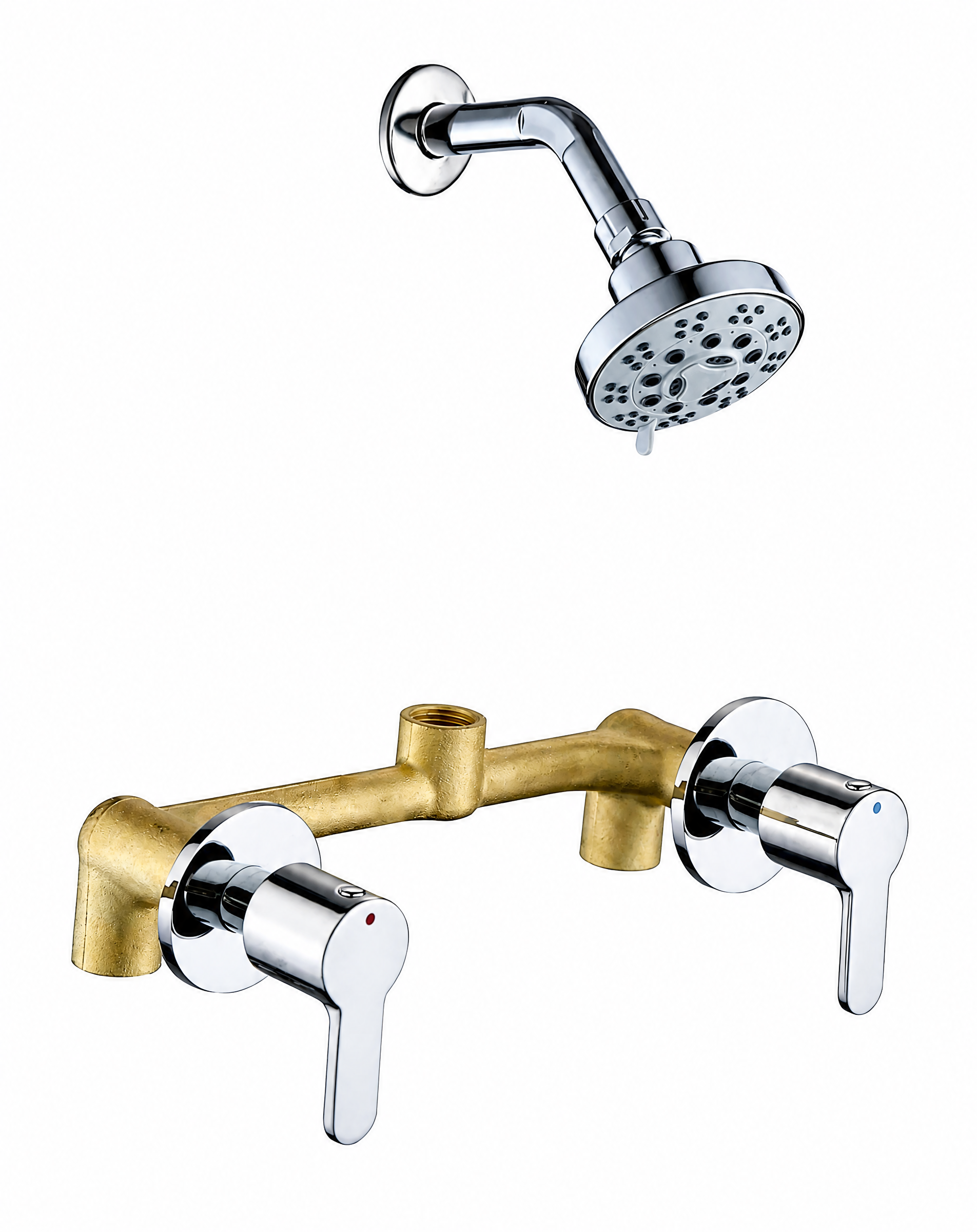
Ehoo model 8115-955: brass body, 35 mm ceramic cartridge, 3-function shower head, chrome >0.3 µm and nickel >10 µm plating.
| Specification | 8110-803D | 8115-955 |
|---|---|---|
| Configuration | Hot and cold shower faucet with hand shower | Double handle shower faucet with head shower |
| Body material | Brass | Brass |
| Cartridge | 1/2-inch ceramic | 35 mm ceramic (closing mechanism) |
| Shower components | 8-inch brass shower mixer body; 3-function hand shower | 3-function shower head |
| Control | Double handle, hot and cold | Double handle, hot and cold |
| Net weight | 1.1 kg | 1.0 kg |
| Plating | Chrome >0.3 µm; nickel >10 µm | Chrome >0.3 µm; nickel >10 µm |
| Standard | CE; TUV | CE; TUV |
Table 2. Declared specifications for the two Ehoo shower faucet reference models.
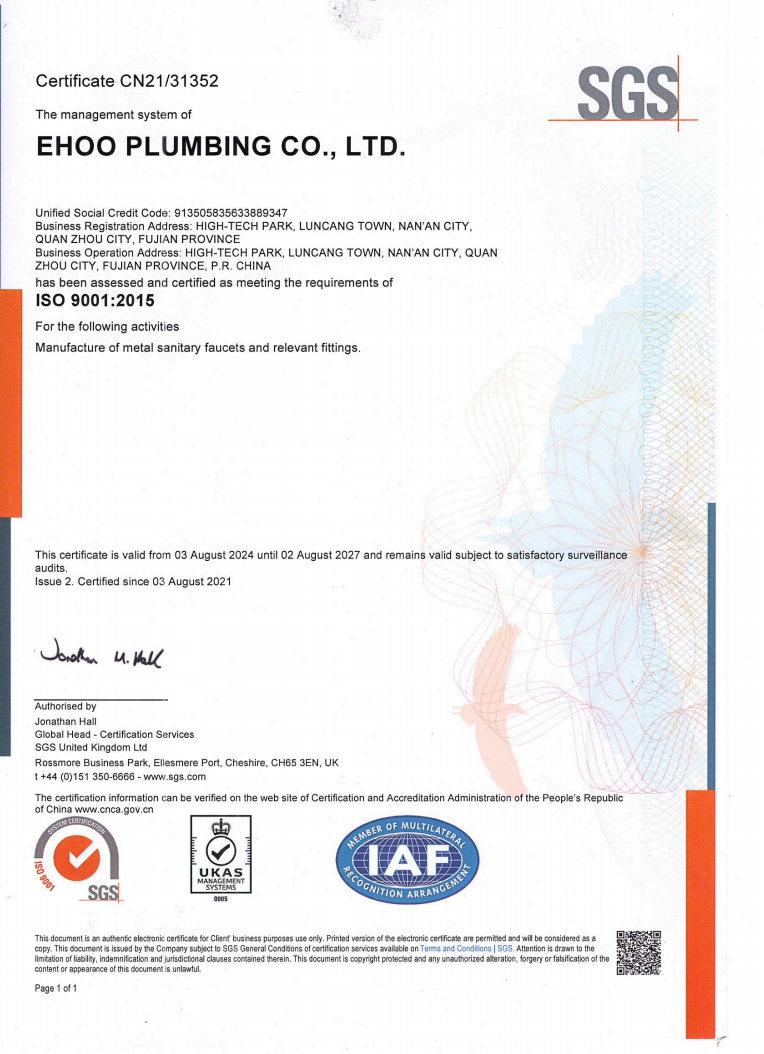
Ehoo holds SGS ISO 9001:2015 certification, certificate CN21/31351, valid from 3 August 2024 to 3 August 2027.
What each specification means in practice
Plating thickness is a corrosion budget, not a finish option
A chrome finish on a brass body is a two-layer system: a nickel layer underneath, a chromium layer on top. The declared values on both Ehoo models — nickel above 10 µm, chrome above 0.3 µm — describe a thickness floor rather than an average, which is the number worth writing into a purchase order. A thin nickel under-layer is the usual reason a chrome surface pits in a humid bathroom within a few years, even when the faucet body itself is sound. It is worth asking whether the supplier measures plating thickness in-house; Ehoo operates a salt spray testing machine and a metal spectrometer among its laboratory equipment, alongside valve life testing, water flow testing and product sealing testing machines, and lists multiple CNC multi-axis compound machines and CNC machining tools in production.
Cartridge diameter sets the service architecture
Both Ehoo models use ceramic cartridges, but not the same size: 8110-803D is built on a 1/2-inch cartridge and 8115-955 on a 35 mm cartridge acting as the closing mechanism. The distinction matters in two ways. First, ceramic discs rather than rubber washers remove the compression-set failure mode that causes older taps to drip. Second, diameter constrains flow capacity and replacement-part availability, so a buyer specifying a model for a hotel refurbishment should confirm which cartridge size the local service network can actually source.
Connection threads determine whether the set stays serviceable
The cited ASME/CSA standard specifies 1/2-14 NPSM or ISO 228-G 1/2 threads for hand-held shower connections. In practice this is the specification that decides whether a replacement hose or hand shower bought three years later fits without an adapter. For distributors, specifying a compliant thread standard at purchase-order stage is cheaper than handling compatibility complaints at the counter.
Body material and weight together indicate the alloy, not the look
Brass is the reference material for shower faucet bodies because it tolerates humid bathroom conditions and holds a seal under pressure. Net weight is a rough cross-check: within one configuration, a heavier body generally indicates more brass and less internal voiding. That is why the 1.1 kg and 1.0 kg figures are worth comparing against competing quotations for the same configuration, rather than in isolation.
Compliance and documentation: what to request, and what it does not guarantee
Documentation is where the evaluation stage most often stalls. A supplier can hold a valid quality management certificate while an individual SKU remains undocumented, so the two must be checked separately.
Ehoo holds SGS ISO 9001:2015 certification, certificate number CN21/31351, issued by SGS, covering the design and manufacturing of brass sanitary ware faucets. The certificate is valid from 3 August 2024 to 3 August 2027 and applies to the global market. The company also lists ISO 45001:2018 occupational health and safety management, ISO 14001:2015 environmental management and ISO 14067:2018 product carbon footprint certification, together with EN817:2008 and EN200 references, and states 100% testing on its quality control line.
Three limits belong next to those facts.
First, a management system certificate certifies process, not product performance. ISO 9001 indicates that the design and manufacturing system is controlled; it does not indicate that a specific shower faucet will pass a specific pressure or endurance test.
Second, model-level CE and TUV listings must be matched to the exact certificate scope and validity date for the SKU being ordered. Certificates carry issue and expiry dates, and a certificate issued for one model does not automatically extend to a derivative or a newly tooled series.
Third, the ASME/CSA standard referenced here requires covered fittings to comply with applicable NSF/ANSI 61 requirements. That is a standard requirement, not evidence that any particular supplier or SKU holds the certification. Buyers entering North American projects should request product-level NSF/ANSI 61 documentation directly.
On the trade side, bath and shower faucets are classified under HS 8481.80.1020 in the United States, and mixing valves under 8481.80.11 in the EU. Confirming classification at quotation stage avoids duty surprises later.
Application fit: hotel, commercial restroom and renovation projects
Ehoo lists both shower faucet models for residential construction, hotel applications, commercial restroom applications and bathroom renovation projects. The application profile published for the wider product family sets out working conditions of 0.5 MPa to 2 MPa water pressure in indoor basin, kitchen, bathroom or outdoor garden contexts, with hand control and a stated requirement for corrosion resistance under high-humidity bathroom conditions and lead-free materials.
The two reference models map differently onto that profile. The 8110-803D, with its 8-inch brass mixer body and separate 3-function hand shower, suits renovation projects where a combined overhead-and-hand configuration replaces an existing wall-mounted set. The 8115-955, with a 3-function head shower and a 35 mm cartridge, suits higher-turnover installations — hotel bathrooms and commercial restrooms — where a consistent, easily serviced double-handle control is preferred over a thermostatic or single-lever arrangement.
Reading the market numbers behind the category
Published market estimates for this category disagree, and the disagreement is informative rather than confusing. Fortune Business Insights values the global faucet market at USD 25.47 billion in 2025, projecting USD 51.37 billion by 2034 across bathroom and kitchen faucets. Report Ocean, measuring shower faucets specifically, puts revenue at USD 33.18 billion in 2023 rising to USD 65.34 billion by 2032, a CAGR of 7.82%. The shower-faucet figure is larger than the total-faucet figure for a nearby year, which points to a definitional split: the broader shower-systems number appears to include heads, arms and mixers, while the faucet number covers the valve and handle unit.
For procurement purposes, the useful signal is direction rather than magnitude. Market Research Future projects the brass faucet segment reaching USD 22.68 billion by 2035 at a CAGR of 4.8%, consistent with buyers continuing to specify brass over zinc-alloy substitutes in projects where service life is part of the decision.
Comparison with conventional manufacturing approaches — and where the limits sit
The conventional low-cost approach to shower faucets substitutes zinc alloy for brass in the body, reduces plating thickness, and uses a smaller or non-ceramic cartridge. It produces a lighter, cheaper unit that can look identical on a shelf. The difference appears in service: a thinner nickel under-layer pits sooner in humid bathrooms, and a non-ceramic closing mechanism develops drip earlier.
The trade-off is not free in either direction, and buyers should be clear about where a brass-and-ceramic specification stops being an advantage.
- Cost per unit is higher, and MOQ follows. Ehoo's standard minimum order starts from 400 pcs per model, with a stated order value threshold of USD 20,000 for custom programmes. That entry point suits importers and established brands, and is a poor fit for small trial orders.
- Lead time is a planning constraint. Ehoo lists 30–45 days production lead time. Customisation — packaging, logo, faucet body, faucet parts or sanitary accessories — fits inside that window only if drawings and approvals are settled early.
- The shower head is ABS, not metal. Both reference models use a chromed ABS shower head. ABS is lighter and resists impact better than a thin metal shell, but it carries lower metal content and lower recyclate value, and it will not satisfy a specification that calls for an all-metal head.
- Certification follows the model, not the brand. CE and TUV listings apply to declared models against declared standards. A new body or a new cartridge size is a new documentation question, not an inherited one.
- Published specifications are model-level, not SKU-level test reports. A buyer still needs flow rate, endurance and finish data for the exact order, and should treat a datasheet as a starting point rather than a substitute for incoming inspection.
None of these limits disqualifies a brass shower faucet for hotel or commercial work. They do mean that the evaluation stage should end with a document pack matching the ordered SKU, not with a general assurance about quality.
Future outlook
Three directions look likely to shape shower faucet sourcing over the next few years, and each is already visible in the documents buyers are requesting.
The first is material disclosure moving from optional to expected. Ehoo's ISO 14067:2018 product carbon footprint certification sits in the same category as material declarations and NSF/ANSI 61 references: buyers increasingly treat them as filter criteria rather than differentiators.
The second is that certificate scope, not brand familiarity, will decide who clears project gates. A supplier whose certificate list maps cleanly onto model numbers and validity dates answers a tender question in minutes; one whose certificates are generic answers it in weeks.
The third is a widening gap between the appearance-led and specification-led segments of the market. As brass content, plating thickness and cartridge specification become easier to check — through standards references, customs classification and published datasheets — the premium for verifiable construction should hold, while undifferentiated appearance-led supply competes on price alone.
A procurement checklist for shower faucet evaluation
- Confirm body material and net weight for the exact configuration being quoted.
- Record cartridge type and diameter, and check local spare-part availability for that size.
- Specify plating thickness as a floor — nickel and chrome separately — rather than as a finish name.
- Match the hand-shower connection thread to 1/2-14 NPSM or ISO 228-G 1/2 where the destination market requires it.
- State the design pressure band and confirm the supplier's declared working range.
- Request the quality management certificate, then request model-level CE/TUV scope and validity separately.
- Request flow rate, endurance and finish test reports for the ordered SKU.
- Confirm MOQ, lead time, customisation scope and warranty term in writing before tooling.
- Verify HS classification for the destination market before the first shipment.
FAQ
What makes a shower faucet “high quality” in procurement terms?
In procurement terms, quality is defined by checkable parameters rather than by description: a brass body, a ceramic cartridge of declared diameter, plating stated as a thickness floor — chrome above 0.3 µm and nickel above 10 µm on Ehoo's two reference models — a declared connection thread standard, a declared pressure band, and documentation that matches the ordered model.
Which certifications and standards should a buyer lock in before ordering?
At supplier level, a quality management certificate such as SGS ISO 9001:2015; Ehoo holds certificate CN21/31351, valid from 3 August 2024 to 3 August 2027, covering the design and manufacturing of brass sanitary ware faucets and applicable to the global market. At product level, the CE and TUV listings declared for the specific model, plus test reports for flow, endurance and finish. Where the destination market references ASME A112.18.1-2018 / CSA B125.1-18, note that the standard also cross-references applicable NSF/ANSI 61 requirements, which must be evidenced at product level rather than inferred from the standard.
Why does ceramic cartridge diameter matter?
The cartridge is the closing mechanism, so its type and size govern both leak behaviour and serviceability. Ehoo's 8110-803D uses a 1/2-inch ceramic cartridge; the 8115-955 uses a 35 mm ceramic cartridge. Ceramic discs replace rubber washers and remove the compression-set failure that causes dripping, while diameter affects flow capacity and whether a local service network can source a replacement.
What water pressure range should a shower faucet be specified for?
The cited ASME/CSA standard sets a rated supply pressure of 690 kPa (100 psi) with a functional supply-pressure range of 140 to 860 kPa (20 to 125 psi) for covered supply fittings. Ehoo's published application profile for its faucet family describes working conditions of 0.5 MPa to 2 MPa water pressure. Buyers should confirm the declared working range for the specific model against the building's actual supply pressure.
What thread standard applies to hand-held shower connections?
The cited standard specifies 1/2-14 NPSM or ISO 228-G 1/2 threads for hand-held shower connections. Specifying one of these at purchase-order stage avoids compatibility problems when hoses or hand showers are replaced later.
What MOQ and lead time apply to custom brass shower faucets?
Ehoo's standard minimum order starts from 400 pcs per model, with a stated order value threshold of USD 20,000 for custom programmes. Customisation covers packaging, logo, faucet body, faucet parts and sanitary accessories. Production lead time is listed at 30–45 days, with monthly capacity of 150,000 units.
What warranty and after-sales support are offered?
Ehoo provides a 3 to 5 year warranty depending on the product series, with a 5-year warranty on the body, together with remote technical support. Quality control is described as 100% testing, supported by in-house valve life, water flow, sealing, salt spray and metal spectrometry equipment.
How are bath and shower faucets classified for trade?
Bath and shower faucets fall under HS 8481.80.1020 in the United States, and mixing valves under 8481.80.11 in the EU. Classification should be confirmed for the destination market before the first shipment, since duty treatment follows the code rather than the product description.
Are brass shower faucets suitable for hotel and commercial restroom projects?
Ehoo lists both shower faucet models for residential construction, hotel applications, commercial restroom applications and bathroom renovation projects. The published application profile specifies corrosion resistance under high-humidity bathroom conditions and lead-free materials as requirements for those environments.
Reference material
The Ehoo catalog covering the 8110-803D and 8115-955 shower faucet ranges and the wider brass faucet line is available for download: Ehoo catalog 2025–2026.
Have Questions or Need More Details?
Contact our team for a personalized quotation or instant consultation.
Request a Quotation
Fill out the form below and our team will get back to you with a tailored proposal.
WhatsApp Direct Chat
Prefer to chat in real-time? Message us on WhatsApp for instant assistance & quick answers.
- Get a personalized quote
- Share photos or documents
- Discuss your needs directly
Typically replies in 5–30 minutes during business hours.