
High-Spec Emergency Eyewash Stations: A Data-Driven Shortlist
An emergency eyewash station is either usable at the moment of exposure or it is not — there is no middle state. That makes the category an unusual procurement decision: flow, access distance, water temperature and material exposure have to be settled before brand, model or price is discussed. This shortlist applies those constraints to three BOHUA models whose published specifications map to three clearly different site conditions.
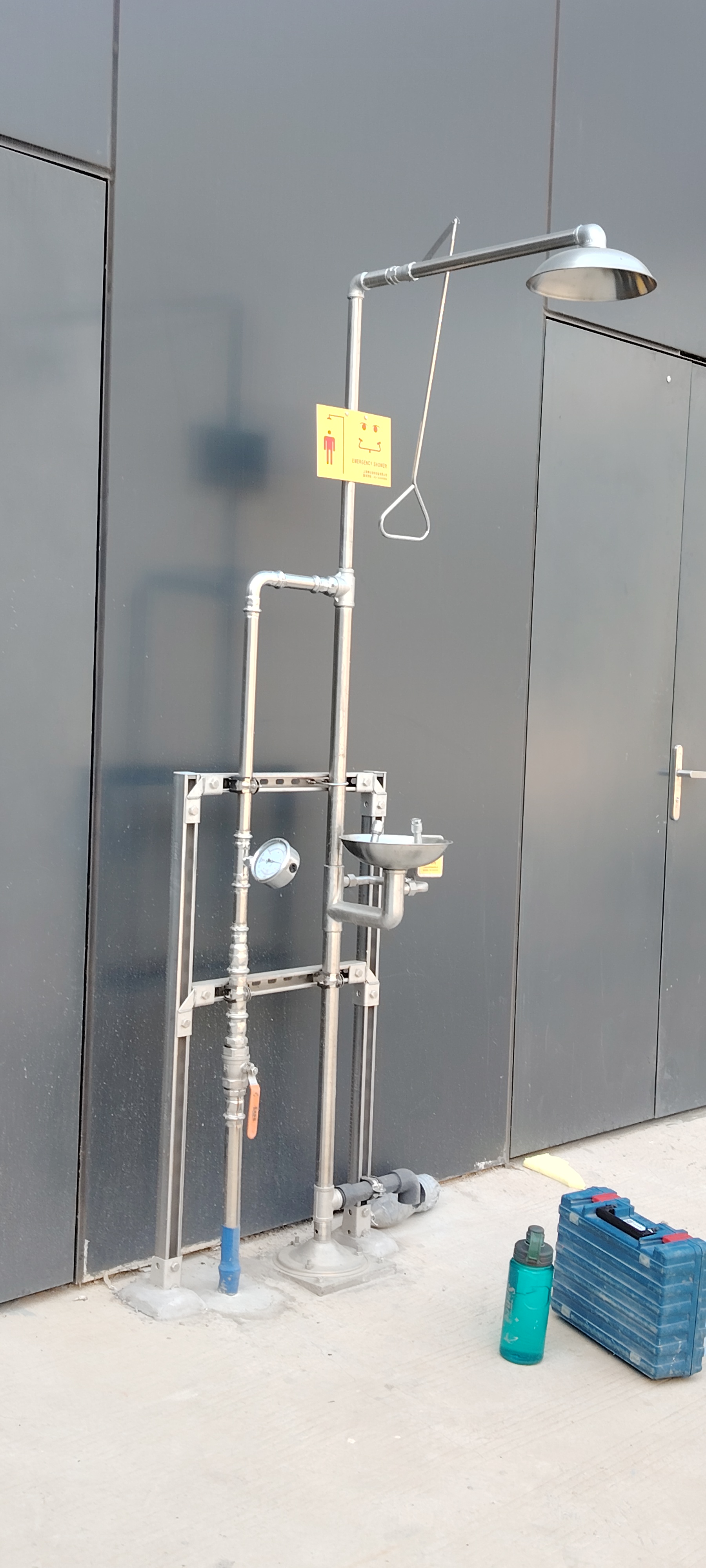
Compound emergency shower and eyewash equipment — the equipment class where eyewash and body drenching share one plumbed assembly.
BOHUA — Shanghai Bohua Safety Device Co., Ltd. — is a Shanghai-based manufacturer of emergency shower and eyewash equipment founded in 2006, with a catalogue of 11 series and more than 100 product types. The company states ANSI Z358.1-2014 and CE conformity for its eyewash range, holds ISO 9001, ISO 14001, OHSAS 18001/ISO 45001 and China Classification Society (CCS) certification, and reports nine patent certificates.
Why Eyewash Selection Is a Constraint Problem, Not a Catalogue Problem
Most eyewash procurement failures are specification failures, and they cluster into three patterns. The first is class mismatch: an eyewash-only unit is installed where full-body exposure to corrosive material is credible, so the equipment cannot perform the drench function the hazard requires. The second is environmental mismatch: a plumbed unit is installed in an unheated or outdoor location without protection against freezing or against supply water that becomes uncomfortably hot or cold. The third is documentation mismatch: a certificate exists for a product family, but no unit-level flow test record, installation drawing or commissioning sheet travels with the shipment.
The standards framework explains why these failures are avoidable. ANSI/ISEA Z358.1-2014 establishes minimum performance and use requirements for emergency eyewash and shower equipment, and it covers emergency showers, eyewashes, eye/face washes and combination units, with guidance spanning installation, testing, maintenance and training. In the United States, OSHA 29 CFR 1910.151(c) requires suitable facilities for quick drenching or flushing of the eyes and body where workers may be exposed to injurious corrosive materials. Operational summaries of the ANSI-referenced criteria add two practical filters that are frequently missed in RFQs: equipment should be reachable within 10 seconds, on the same level as the hazard and on an unobstructed path, and flushing fluid should be tepid — approximately 16 to 38 °C in the U.S. reference context, with EN 15154 citing 15 to 37 °C in Europe.
Flow criteria are configuration-specific, which is where many shortlists break down. OSHA's cited interpretation distinguishes permanently installed showers (minimum 30 gallons per minute of clean water), self-contained or portable showers (minimum 20 GPM continuously for at least 15 minutes), and eyewash units (not less than 0.4 GPM, with portable eyewash units providing water continuously for at least 15 minutes). A single generic flow number applied across all three configurations is therefore not a specification — it is a placeholder.
How This Shortlist Was Built
The three models below were not ranked by brochure language. Each was screened against five criteria that a buyer can verify from published data and third-party standards, and each survived because its published specification addresses a condition the other two do not.
| Screening criterion | What it removes from the shortlist | Evidence used |
|---|---|---|
| Fluid performance | Units whose published flow or actuation speed cannot be matched to the applicable requirement | Published shower and eyewash flow rates, start speed, ANSI/ISEA Z358.1-2014 and OSHA-referenced figures |
| Installation geometry | Units that cannot be placed within the access envelope of the hazard | Mounting type, overall height, shower head height, eyewash height, drainage height, inlet size |
| Material and environment | Units whose body material or thermal design is unsuited to the service condition | 304 vs 316 stainless steel, anti-freeze and anti-scald series designation |
| Activation and operability | Units whose activation method conflicts with the workflow of the area | Push-handle activation, fully automatic series designation, start speed |
| Certification and traceability | Units not covered by a verifiable certificate scope | ANSI Z358.1-2014 and CE certificate numbers, ISO management-system certificates |
Model 1 — BH30-1316: The Corrosion-Exposed Chemical Area Unit
The BH30-1316 is a compound emergency shower and eyewash in the BOHUA compound series, built in 316 stainless steel and floor-mounted. It is the shortlist entry for heavy chemical, petrochemical, metalworking, mining and pesticide-handling areas where splash, vapour or washdown exposure makes a 304 body a maintenance question rather than a durability question.
- Body material: 316 stainless steel.
- Hydraulics: water inlet and outlet DN32; shower flow rate 120–180 L/min (approximately 32–48 US gallons per minute by direct unit conversion); eyewash flow rate ≥1.5 L/min.
- Actuation: push handle, start speed within 1 second.
- Spray geometry: sprinkler spacing 101.6 mm; water discharge range 508 mm at a distance of 1524 mm from the surface.
- Dimensional envelope: overall height 2480 mm; shower head height 2100 mm; water inlet height 1600 mm; eyewash height 1050 mm; drainage height 133 mm.
- Components: PP+304 filter sprinkler, two-piece ball valve, adjustable-flow cow-horn bend, fixed soft rubber anti-dust cover, luminous aluminium alloy indicator.
- Commercial baseline: floor-mounted installation, one-year warranty.
The 316 designation is the reason this unit leads the shortlist for aggressive atmospheres. In general metallurgical terms, 316 stainless steel contains molybdenum, which typically improves resistance to chloride-bearing environments compared with 304. That is a corrosion-service decision, not a compliance decision: the standards classify equipment by function and performance, not by alloy. A buyer who selects 316 for a chemical plant is buying inspection interval and service life, and should price it as such.
The 508 mm discharge range measured at 1524 mm from the surface is the second differentiating number, and it is often overlooked. It describes the wetted pattern at the distance a standing worker actually occupies, which determines whether the shower functions as a body drench or as a narrow column of water. Combined with the 2100 mm shower head height and 1050 mm eyewash height, the geometry is designed around a standing adult rather than around pipe routing convenience.
Model 2 — BH30-1008: The Cold-Climate and Temperature-Control Unit
The BH30-1008 is an anti-freeze and anti-scald shower and eyewash in 304 stainless steel, floor-mounted, with push-handle activation. It is the shortlist entry for outdoor or unheated installations and for sites where the supply water temperature is unstable across the year.
- Series designation: anti-freeze and anti-scald — a thermal design function, distinct from the standard compound series.
- Hydraulics: DN32 inlet and outlet; shower flow rate 120–180 L/min; eyewash flow rate ≥1.5 L/min; start speed within 1 second.
- Dimensional envelope: overall height 2480 mm; shower head height 2100 mm; water inlet height 1600 mm; eyewash height 1050 mm; drainage height 133 mm; sprinkler spacing 101.6 mm.
- Discharge geometry: 508 mm range at 1524 mm from the surface.
- Components: PP+304 filter sprinkler, two-piece ball valve, adjustable-flow cow-horn bend, fixed soft rubber anti-dust cover, luminous aluminium alloy indicator.
- Commercial baseline: floor-mounted installation, one-year warranty.
The anti-scald element is not cosmetic. Tepid-water criteria in both the U.S. and European reference frameworks set a temperature band rather than a single value, which means an uncontrolled supply can fail on the hot side in summer as readily as it fails on the cold side in winter. A unit designated anti-freeze and anti-scald addresses both directions of the same problem, which is why it belongs on a shortlist ahead of a standard compound unit for seasonal climates.
BOHUA also lists an eyewash-only variant in the same series — the BH32-1008 anti-freeze and anti-scald vertical eyewash, 304 stainless steel, DN32 water inlet, 1050 mm height, eyewash flow 12–18 L. For sites where body exposure is not credible and only eye flushing is required at the cold-side location, this variant removes the shower column without giving up the thermal design.
Model 3 — BH32-1061: The Indoor Eyewash-Only Consistency Unit
The BH32-1061 is a fully automatic vertical eyewash in 304 stainless steel. It is the shortlist entry for temperature-controlled indoor environments — laboratories, pharmaceutical suites, electronics and light assembly areas — where the recurring risk is eye or face contact with a small quantity of chemical, and where consistent actuation matters more than drench coverage.
- Series designation: fully automatic series — the catalogue class in which actuation is not dependent on a manually operated push handle.
- Configuration: vertical eyewash, water inlet DN32, height 1050 mm, drainage height 133 mm.
- Performance: eyewash flow 12–18 L; start speed within 1 second.
- Components: PP+304 filter sprinkler, two-piece ball valve, adjustable-flow cow-horn bend, fixed soft rubber anti-dust cover.
This model is deliberately narrow. It carries no shower head and no body-drench function, so it belongs on the shortlist only where the hazard assessment supports an eyewash-only class. Its value in a procurement programme is standardisation: a single automatic eyewash specification repeated across multiple indoor rooms reduces the training and inspection burden compared with a mixed estate of manual units.
Side-by-Side: Published Specification Comparison
| Attribute | BH30-1316 | BH30-1008 | BH32-1061 |
|---|---|---|---|
| Equipment class | Compound emergency shower and eyewash | Anti-freeze and anti-scald shower and eyewash | Fully automatic vertical eyewash |
| Body material | 316 stainless steel | 304 stainless steel | 304 stainless steel |
| Shower flow rate | 120–180 L/min | 120–180 L/min | Not applicable (no shower) |
| Eyewash flow rate | ≥1.5 L/min | ≥1.5 L/min | 12–18 L |
| Activation | Push handle, start within 1 second | Push handle, start within 1 second | Fully automatic series, start within 1 second |
| Installation | Floor-mounted, DN32 | Floor-mounted, DN32 | Vertical, DN32 |
| Height | 2480 mm overall; shower head 2100 mm; eyewash 1050 mm | 2480 mm overall; shower head 2100 mm; eyewash 1050 mm | 1050 mm |
| Primary site fit | Corrosive, high-splash chemical and petrochemical areas | Outdoor, unheated or thermally unstable installations | Indoor, temperature-controlled eyewash-only points |
| Certificate coverage | Listed under the ANSI Z358.1-2014 and CE certificate scopes | Listed under the ANSI Z358.1-2014 and CE certificate scopes | Listed under the ANSI Z358.1-2014 and CE certificate scopes |
Reading the Numbers: What Each Specification Actually Constrains
Published specifications are only useful if the buyer knows which question each number answers. Five of them carry most of the decision weight in this shortlist.
The 120–180 L/min shower band is a range, not a guarantee. It reflects what the unit delivers across a working pressure band, so the figure that matters at commissioning is the flow measured on site with the actual supply. This is also the number to reconcile against the applicable local threshold in the correct unit system before signing: permanently installed showers and portable showers are governed by different criteria, and a band quoted in litres per minute has to be converted and checked rather than assumed.
The ≥1.5 L/min eyewash minimum sits at the same order of magnitude as the 0.4 GPM figure (approximately 1.5 L/min by direct conversion) cited in OSHA's referenced criteria. That alignment is useful during screening, but it is not a substitute for a unit-level flow test record, because the criterion also carries a duration dimension for portable equipment that a plumbed unit satisfies through its supply, not through a reservoir.
The 1-second start speed answers a different question from the 10-second access rule. Start speed describes how quickly water flows once the handle or automatic trigger is actuated; the access rule describes how long a worker needs to reach the equipment at all. A unit that activates instantly but sits 20 seconds away fails the second test, and a unit placed correctly but slow to open fails the first.
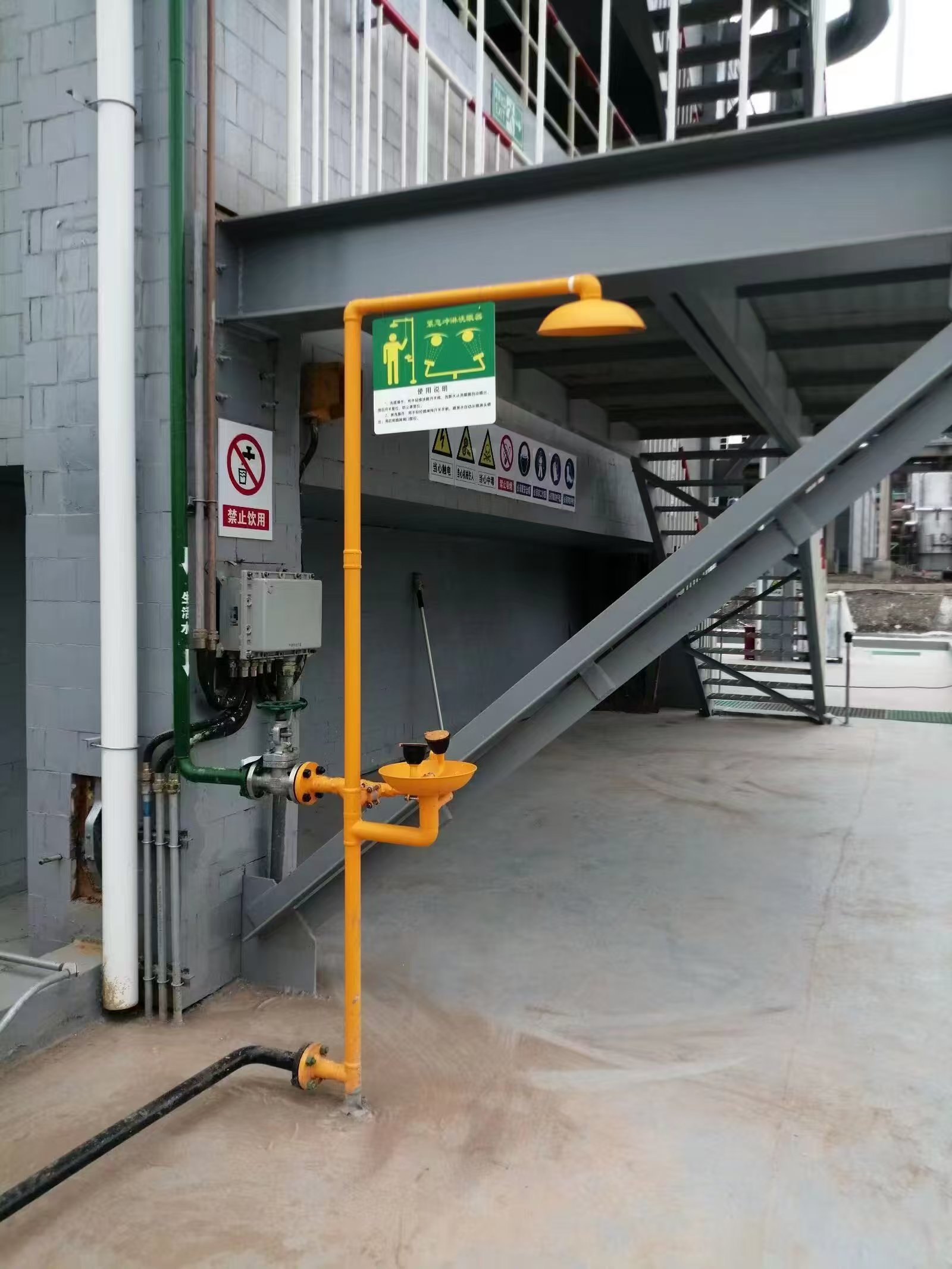
Combination geometry: shower head height, eyewash bowl height and drainage height are specified together because they determine usable standing position, not just pipe routing.
The 101.6 mm sprinkler spacing and 508 mm discharge range at 1524 mm together define pattern coverage. Spacing controls how evenly water is distributed across the shower head; the discharge range controls how wide the wetted area is where the worker stands. Both numbers are worth writing into an acceptance test, because a shower that meets a flow figure while delivering a narrow column still fails its purpose.
The mounting heights — 2480 mm overall, 2100 mm shower head, 1600 mm inlet, 1050 mm eyewash, 133 mm drainage — set the civil and plumbing interface. In retrofit projects, these are usually the numbers that decide feasibility, because drainage at 133 mm and a DN32 supply have to be reconciled with an existing floor slab and available pressure.
Application Fit by Site Condition
| Site condition | Appropriate shortlist entry | Reason |
|---|---|---|
| Chemical manufacturing, petrochemical, metalworking, mining, pesticide handling | BH30-1316 | 316 stainless steel body plus full combination coverage where body exposure is credible |
| Outdoor yard, unheated warehouse, winter-exposed loading area | BH30-1008 (or BH32-1008 for eyewash-only points) | Anti-freeze and anti-scald series addresses both temperature extremes of the supply |
| Laboratory, pharmaceutical suite, indoor assembly room | BH32-1061 | Fully automatic vertical eyewash with 1050 mm height suits controlled indoor environments |
| Food processing, agriculture, general manufacturing | BH30-1008 or BH30-1316 by corrosion exposure | Both series list these industries; alloy choice follows the cleaning and chemical regime |
| Oil and gas, pharmaceutical and biotechnology operations | BH30-1316 | Combination coverage with the higher-alloy body for aggressive service conditions |
The pattern across this table matters more than any single row: the three units are not competitors, they are three answers to three different constraint sets. A programme that installs one model everywhere is optimising for procurement simplicity at the cost of fit, and that trade-off usually surfaces during audit rather than during purchase.
Where This Shortlist Stops: Limits and Trade-offs
A shortlist that does not state its boundaries is a sales document. Four limits apply here.
First, all three models are plumbed installations. They require a DN32 supply, a drainage connection at 133 mm and floor or wall space within the access envelope of the hazard. Where no plumbing exists — remote loading points, temporary construction sites, satellite pumping stations — the appropriate class is portable. BOHUA lists the BH34-0628 portable shower and eyewash with a 28 L tank, 1.0 MPa tank pressure, 304 stainless steel body, 120–180 L/min shower flow and ≥1.5 L/min eyewash flow, and the BH34-0665F with a 65 L tank. The trade-off is explicit: portability removes the plumbing constraint and replaces it with a finite reservoir, a refill routine and a discharge duration that depends on tank volume rather than on supply.
Second, thermal protection is a maintenance commitment. The anti-freeze and anti-scald design of the BH30-1008 solves a real problem, but it introduces components that must be inspected on a schedule. A freeze-protected unit that is never verified is not materially safer than an unprotected one.
Third, alloy selection carries a cost premium. 316 stainless steel is generally more expensive as a material than 304, and the premium is justified only where the service condition actually calls for it. Specifying 316 across a whole site for consistency is a defensible decision, but it should be made as a cost decision with the reason recorded.
Fourth, the BH32-1061 cannot substitute for a combination unit. It has no shower head and no body-drench function. In any area where a corrosive material could contact the torso or a large skin area, the equipment class required is the combination unit, and an eyewash-only shortlist entry is not a lower-cost alternative — it is a different product category.
Certification and Documentation: What Is Actually on Record
Certification is the part of a shortlist that buyers can verify without a factory visit, so it is worth stating precisely rather than generically.
- ANSI Z358.1-2014 — certificate number CHSH25071073147, issued by GLOBAL TESTING SERVICES CO., LTD., issued 30 July 2025 and valid to 29 July 2030, scope covering all types of emergency eyewash stations, applicable to the global market.
- CE — certificate number CLSH25071073148, issued by GLOBAL TESTING SERVICES CO., LTD., issued 30 July 2025 and valid to 29 July 2030, applicable to the global market.
- ISO 9001 quality management system — certificate number 288SCC24Q-SHBH002798S, issued by Shanghai Center Certification Co., Ltd., issued 15 January 2024 and valid to 14 January 2027, covering manufacturing, R&D and sales of security equipment (non-medical eyewash).
- ISO 45001 / OHSAS 18001 occupational health and safety management system — certificate number 288SCC19S-SHB000647R2S, issued by Shanghai Center Certification Co., Ltd., issued 12 August 2019 and valid to 11 August 2028.
- Additional records — China Classification Society (CCS) certification and nine patent certificates, per the company profile.
The three shortlisted models — BH30-1316, BH30-1008 and BH32-1061 — all appear in the related-product lists attached to the ANSI and CE certificates, which is the specific check worth performing on any shortlist. The limit is equally specific: a certificate scope is not a unit-level test report. Buyers should request the flow test record for the actual serial numbers shipped, along with the installation drawing and the commissioning checklist, because the audit question at site level is never "is the family certified" but "was this unit verified where it stands".
Market Context for 2026 Buyers
The equipment category is small, regulated and relatively stable, which is precisely why documentation quality separates suppliers more than product novelty does. North America's emergency shower and eyewash station market was valued at USD 360 million in 2025 according to Global Market Insights, a figure that describes a mature replacement and retrofit market rather than a growth story driven by new construction alone.
Demand in that market is anchored to obligations rather than preferences. OSHA 29 CFR 1910.151(c) requires suitable facilities for quick drenching or flushing wherever injurious corrosive materials are handled, and ANSI/ISEA Z358.1-2014 supplies the performance and use framework that most specifications reference. Because the framework distinguishes showers, eyewashes, eye/face washes and combination units — and because flow, duration, access and temperature criteria differ by configuration and by region — buyers operating across markets end up specifying more than one product variant rather than one global model.
On the supply side, BOHUA's published operating data describes a mid-sized specialist rather than a diversified industrial group: founded 2006, a 4000 m² facility, 50 employees, a 5-person R&D team, stated annual output of 20,000 and an export ratio of 20 percent, with stated monthly capacity of 1,000 units, a 30-day lead time, a minimum order quantity of 5, 100 percent testing, OEM/ODM capability, and export activity in the EU, Middle East, Australia and Africa supported by remote after-sales service. For distributors and project buyers, those numbers set realistic expectations: the MOQ suits trial orders and project quantities, while the lead time is a planning input rather than an emergency buffer.
Future Outlook
Three directions look more consequential than product styling over the next procurement cycles. Tepid-water enforcement is likely to tighten as auditors move from checking that equipment exists to checking that flushing fluid is within the specified temperature band — which favours units with thermal design built in rather than added later. Freeze protection will keep growing in importance as energy, chemical and logistics operators extend facilities into colder or more exposed locations, and as outdoor yards in temperate climates experience sharper seasonal swings.
The third direction is documentation. The gap between a certified product family and a verified installation is where most audit findings originate, so buyers should expect supplier packages to include unit-level flow records, installation drawings, commissioning sheets and maintenance schedules as standard rather than as a request. Suppliers who can produce that package quickly will win shortlists on operating grounds rather than on price alone.
FAQ
What flow and duration criteria should an eyewash station meet before price is discussed?
ANSI/ISEA Z358.1-2014 establishes minimum performance and use requirements for emergency eyewash and shower equipment. In the criteria cited in OSHA's interpretation, eyewash units should deliver not less than 0.4 gallons per minute, portable eyewash units should provide water continuously for at least 15 minutes, permanently installed showers should be connected to plumbing capable of at least 30 gallons per minute, and self-contained or portable showers should deliver at least 20 gallons per minute continuously for 15 minutes. BOHUA's published figures for the shortlisted units are an eyewash flow rate of ≥1.5 L/min and a shower flow band of 120–180 L/min. Buyers should convert these into the unit system of the applicable jurisdiction and verify them at commissioning.
Does a higher grade of stainless steel change the compliance position of an eyewash station?
No. Alloy choice is a corrosion-resistance decision, not a compliance decision, because the standards classify equipment by function and performance rather than by material grade. Within this shortlist, the BH30-1316 uses 316 stainless steel, while the BH30-1008 and BH32-1061 use 304 stainless steel. In general metallurgical terms, 316 contains molybdenum, which typically improves resistance to chloride-bearing environments; the practical effect is on inspection interval and service life in aggressive atmospheres, not on whether the unit meets a performance standard.
Which of the three models suits a cold-climate outdoor installation?
The BH30-1008, an anti-freeze and anti-scald shower and eyewash in 304 stainless steel, floor-mounted with push-handle activation, a 120–180 L/min shower flow rate, ≥1.5 L/min eyewash flow rate, 2480 mm overall height and 1050 mm eyewash height. Where only eye flushing is required at the cold-side location, BOHUA lists the BH32-1008 anti-freeze and anti-scald vertical eyewash with a DN32 inlet, 1050 mm height and 12–18 L eyewash flow. Both designations address supply temperature in two directions, which matters because tepid-water criteria define a band — approximately 16 to 38 °C in the U.S. reference context and 15 to 37 °C under EN 15154 — rather than a single value.
Can the BH32-1061 replace a combination shower and eyewash unit?
No. The BH32-1061 is a fully automatic vertical eyewash in 304 stainless steel with a DN32 water inlet, 1050 mm height and an eyewash flow of 12–18 L. It has no shower head and no body-drench function, so it belongs to the eyewash-only equipment class. Where a corrosive material could contact the torso or a large skin area, the applicable class is the combination unit, such as the BH30-1316 or BH30-1008 in this shortlist.
What commercial and documentary terms should be confirmed at RFQ stage?
BOHUA's published capability data states a minimum order quantity of 5, a 30-day lead time, monthly capacity of 1,000 units, 100 percent testing, OEM/ODM availability, a one-year warranty on the shortlisted units, and remote after-sales support. On the documentary side, the items worth confirming in writing are the ANSI Z358.1-2014 certificate (CHSH25071073147) and CE certificate (CLSH25071073148) covering the specific model, the unit-level flow test record, the installation drawing, and the commissioning and maintenance schedule. Requests for quotation should state the equipment class, the target market and the applicable standard, since flow, duration and temperature criteria differ between configurations and jurisdictions.
For buyers who want the full model and specification set behind this shortlist, BOHUA's product brochure is available for download: BOHUA product brochure (PDF). The practical next step is not a model number but a site constraint list: hazard class, exposure route, climate, supply conditions and the documentation the auditor will ask for.
Have Questions or Need More Details?
Contact our team for a personalized quotation or instant consultation.
Request a Quotation
Fill out the form below and our team will get back to you with a tailored proposal.
WhatsApp Direct Chat
Prefer to chat in real-time? Message us on WhatsApp for instant assistance & quick answers.
- Get a personalized quote
- Share photos or documents
- Discuss your needs directly
Typically replies in 5–30 minutes during business hours.