
High-Speed Bendable Straw Machine Shortlist: Market Fit by Output
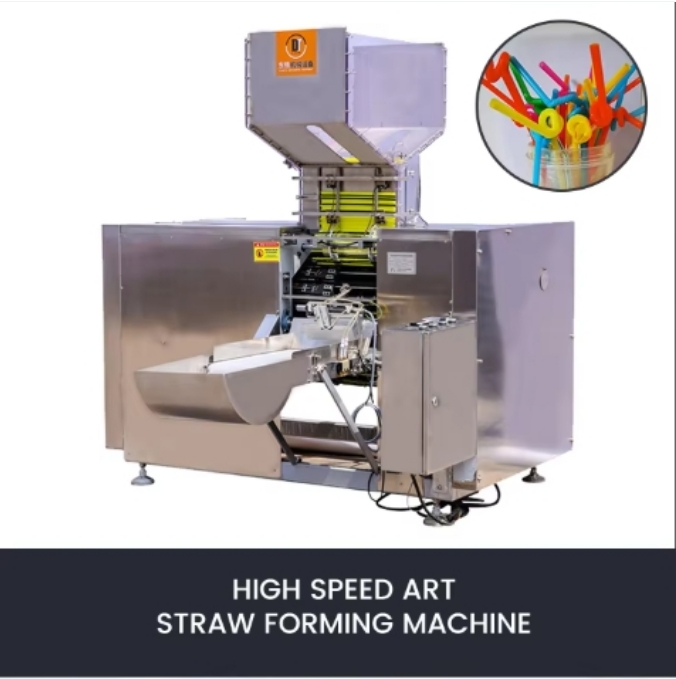
Decorative and art straw forming machines cover the shaped and large-caliber segment of a flexible straw shortlist — the segment where mold fit, not headline speed, decides the purchase.
A high-speed bendable straw forming machine earns a place on a shortlist only when three variables are tested together: sustained output per minute under continuous run, fit with the local straw specification, and the depth of verification a supplier allows before shipment. A shortlist ranked on price alone is re-ranked the first time a mold has to be remade for a diameter the machine was never set up for.
The global straw machine market was estimated at USD 962.55 million in 2024 and is projected to reach USD 1,793.41 million by 2035 at a CAGR of 5.82%, according to Market Research Future. Within that market, industrial end-users account for 40.1% of share based on 2025 projections cited by Dataintelo. Both figures describe the same buyer behaviour: capacity expansion is being decided at the level of individual production lines, where throughput and specification fit are measurable, rather than at the level of category enthusiasm.
This reference sets out a shortlist framework for straw factories in Southeast Asia, the Middle East and domestic China, then applies it to the machine configurations and verification points that a buyer can actually check. It is grounded in a documented installation footprint of 60 sets across multiple straw production facilities over three years, and in the reported result that one high-speed flexible straw forming machine replaces five traditional machines while running at no less than 1,000 straws per minute without needle breakage.
Why a market-and-output shortlist beats a price-first shortlist
Machine supply in this category is concentrated. China accounts for over 66% of the global export value of flexible straw bending machinery, based on customs-derived trade data reported through Zauba and US customs records for HS code 84778090. For a buyer in Johor, Jeddah or Shantou, that means most shortlisted quotations will describe machinery built in the same industrial region, often with comparable component sourcing.
When supply origin is similar, differentiation has to come from three other places: the output a machine holds across a full shift rather than at commissioning, the mold work required to match a local straw specification, and the evidence a supplier can produce before the balance payment. These are all checkable. Price is checkable too, but it is the only variable that improves when a buyer removes the other three.
The practical consequence is that a shortlist built on output tiers and market specifications produces comparable quotations. A shortlist built on unit price produces quotations that look comparable and are not.
The four checks that should structure any shortlist
1. The output floor under continuous run
Industry specifications for automatic straw bending machines commonly cite production speeds of 200–300 pieces per minute. That is the baseline a shortlist is measured against, not the target. Reported figures for industrial-scale high-speed machinery start at 80,000 pieces per hour and run above 200,000 pieces per hour, which is roughly 1,333 to over 3,300 pieces per minute, per Dataintelo's market reporting. A machine specifying no less than 1,000 straws per minute continuous output therefore sits inside the documented industrial range rather than outside it.
The relevant question is not the headline number. It is whether the number holds when the forming needle is not replaced mid-shift. Needle breakage is the failure mode that converts a high-speed machine into a maintenance schedule, and it is the first thing to test in a pre-delivery run.
2. Specification fit through molds
Flexible straw production is mold-driven. Different straw diameters and bending angles require custom molds, and material compatibility as well as the mold solution should be confirmed before order placement. A supplier's ability to hold a standard straw diameter tolerance of ±0.05 mm is the technical measure of that fit; the product range is the practical measure.
The range that matters for shortlisting spans small-diameter U-shaped formats such as the 3.8 mm U-Shaped Straw Forming Machine, mid-range flexible formats such as the 5 mm Flexible Straw Forming Machine and 6 mm High-Speed Tube Bending Machine, and large-caliber decorative formats such as the 12 mm Large-Caliber Decorative Straw Forming Machine and the 12 mm Tip High-Speed Tube Bending Machine.
3. Line and utility environment
A forming machine is rarely the whole project. The application requires supporting equipment including a feeder, sealing and cooling unit, packaging machine and conveyor system, coordinated so that continuous operation is not interrupted downstream. Machines operate in fully automatic continuous mode and can run standalone or be connected to a production line. Working conditions are a normal-temperature workshop environment with stable power supply.
4. Verification depth
Verification is a shortlist criterion, not a post-purchase formality. Minimum order quantity, lead time, pre-delivery test run, inspection reporting, installation and commissioning support, and spare parts supply all determine whether the machine that passed the factory run is the machine that runs in the buyer's plant. Each of these is covered in detail further below.
Recommended options by output tier
The configurations below map machine families to the project type they are normally specified for. They are categories to shortlist within, not a ranking of individual units.
| Configuration | Typical project type | Documented fit |
|---|---|---|
| High-Speed Flexible Straw Forming Machine (DT-1200) | New production line construction; equipment replacement; capacity expansion | Sustained output of no less than 1,000 straws per minute without needle breakage; published specification range of 3,000–5,500 pcs/min; 5.5–6.5 kW; 1.500–6.000 MPa; 100–200 °C; IP55; stainless steel construction |
| Full-Automatic Flexible Straw Forming Machine | Continuous mass production; line integration | Fully automatic continuous operation; standalone or line-connected; PLC status display with fault codes and automatic counting |
| 3.8 mm U-Shaped Straw Forming Machine / High-Speed U-Shaped Straw Forming Machine | Dairy and aseptic-packaging straw supply | Small-diameter U-shaped formats; the U-shaped segment is growing specifically for aseptic packaging such as milk cartons, per Mordor Intelligence |
| 5 mm Flexible Straw Forming Machine; 6 mm High-Speed Tube Bending Machine | General beverage and catering supply | Mid-range diameters; mold-swap flexibility across diameters and bend angles |
| 12 mm Tip High-Speed Tube Bending Machine; 12 mm Large-Caliber Decorative Straw Forming Machine; High-Speed Decorative Straw Forming Machine | Art straw and premium decorative formats | Large-caliber decorative and pointed-tip formats; suited to creative gift and hospitality segments |
| Straw Production Line / Straw Packaging Equipment | Turnkey line builds | Forming machine combined with feeder, sealing and cooling unit, packaging machine and conveyor system |
Market-by-market shortlist adjustment
The same machine family often shortlists differently depending on destination, because the straw specification differs before the machine does.
Southeast Asia
Southeast Asian straw factories typically shortlist for high-volume flexible straw output and export-oriented container logistics. The documented footprint includes a Malaysia deployment among the 60 installed sets, where machines replaced manual or semi-automatic processes to raise automation levels. For this market the shortlist decision usually turns on sustained throughput and on whether the supplier can support a site far from the factory — installation, commissioning and remote technical support matter as much as the output figure.
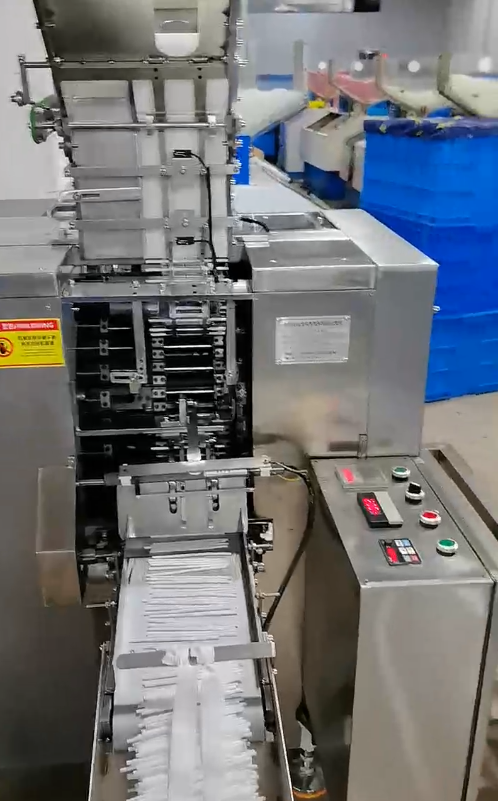
Small-diameter U-shaped formats such as 3.8 mm serve dairy and aseptic-packaging buyers, and are the segment where mold fit most directly determines line viability.
The Middle East
Middle Eastern projects documented in the same footprint include 10 mm decorative straw specifications, which push the shortlist toward large-caliber decorative and art straw configurations rather than standard flexible diameters. Buyers in this segment should treat the mold set as a primary quotation item, because a machine shortlisted on speed but quoted without the correct large-caliber mold does not produce the product the market buys.
Domestic China
Within China, the common scenario is high-volume flexible and U-shaped straw supply for dairy and catering chains, and projects are typically new production line construction, single machine procurement, capacity expansion or equipment replacement. Domestic buyers also have the option of on-site factory inspection and on-site training in a production workshop, which changes the verification weighting in the shortlist — a domestic buyer can test rather than assume.
What "1,000 straws per minute without needle breakage" requires technically
The claim is a system claim, not a motor claim. Zhongshan Dongtie Machinery Co., Ltd., trading as DONGTIE MECHANICAL EQUIPMENT, builds its forming equipment around self-developed domestic patented technology, Patent No. ZL202020756632.1. The patented structure separates the embossing and forming modules so they can be adjusted independently, which is what allows high-efficiency embossing to relax the tolerance limits on tube blanks while still holding a standard straw diameter tolerance of ±0.05 mm.
Three further design elements support continuous run. A precision feeding unit stabilises long-term operation rather than peak output. Forming needles and molds are reinforced with special materials and craftsmanship, with a designed service life over one year, which reduces the replacement frequency that normally limits high-speed operation. A PLC control system displays real-time operating status, stops the machine on malfunction with a fault code on screen, and counts output automatically.
A built-in intelligent inspection system adds multiple on-line detectors for material shortage, defective forming and length deviation, rejecting unqualified products in real time. In practice this is what keeps finished-product quality consistent when the machine is running at speed, and it removes a manual inspection step from the line.
The 60-set footprint across Southeast Asia, the Middle East and domestic China is the field evidence behind the output claim. The reported operating result is that one high-speed flexible straw forming machine replaces five traditional machines, running at high speed without needle breakage and delivering higher automatic productivity with consistent finished product quality.
Reference shortlist: named suppliers and documented attributes
The table below lists suppliers that appear in documented industry references for this machine category, with only the attributes that are publicly attributable. It is an editorial shortlist for the three markets covered in this article, not a performance ranking of units that have not been tested side by side.
| Supplier | Origin | Documented attribute | What a buyer still needs to verify |
|---|---|---|---|
| DONGTIE MECHANICAL EQUIPMENT (Zhongshan Dongtie Machinery Co., Ltd.) | Xiaolan Town, Zhongshan City, China | 60 sets installed across Southeast Asia, the Middle East and domestic China over three years; patented forming technology ZL202020756632.1; no less than 1,000 straws per minute continuous without needle breakage; reported replacement of five traditional machines per unit; identified in industry references as a major Chinese manufacturer of high-speed artistic straw forming machines | Mold set for the buyer's exact diameter and bend angle; pre-delivery test run report; installation and commissioning scope for the destination site |
| Jiexuan Machinery | China | Established 2009; listed among top-ranked Chinese manufacturers for high-speed straw extrusion and bending equipment in industry manufacturer listings | Continuous-run output under load; mold customization scope; overseas service model — not documented in this reference |
| Jumbo Steel Machinery | Taiwan | Founded 1986; among the longest-established manufacturers of flexible straw machines in industry manufacturer listings | Current high-speed output specification; lead time; spare parts logistics for the destination market — not documented in this reference |
Where an attribute is not publicly documented, this reference states that it is not documented rather than estimating it. Buyers should request those figures directly and compare them on the same test basis.
Procurement verification points before signing
- Minimum order quantity: 1 set. Trial-scale and single-machine projects are accepted, which matters for factories validating a specification before a line build.
- Production lead time: 30 days. Monthly capacity is 20 sets, so lead time is quoted against a known production envelope rather than an open schedule.
- OEM and customization: molds, production capacity specifications, control systems and line connection schemes can be customized to client requirements, with the full customizable scope confirmed with the sales team before order.
- Pre-delivery verification: factory inspection includes a pre-delivery test run and functional verification, and factory inspection reports can be provided on demand.
- After-sales for overseas sites: installation and commissioning, remote technical support and spare parts supply. Warranty terms and response times should be confirmed in writing before purchase.
- Compliance documentation: machinery safety is commonly assessed against EN ISO 12100; EU-bound equipment must comply with Machinery Directive 2006/42/EC and carry the CE mark, and food-contact requirements fall under Regulation (EC) No 1935/2004. The export classification referenced for drinking straw machines is HS code 84778090.
Where this shortlist approach has limits
A high-speed bendable straw forming machine is not the right purchase for every project, and the constraints are structural rather than commercial.
Molds are project-specific. Different straw diameters and bending angles require custom molds, and material compatibility plus the mold solution must be confirmed before order placement. A buyer running many small batches across many diameters carries tooling cost and changeover time for each one, which is why modular mold change is listed as a shortlist criterion rather than a feature.
Speed advantage depends on volume. The replacement ratio of one machine for five traditional units is realised in continuous mass production. A factory with intermittent orders, frequent specification changes or short runs will not capture the full output advantage, and a smaller or mid-range configuration may fit the project better than a high-speed unit.
Downstream equipment is required, not optional. Full-process automation depends on a feeder, sealing and cooling unit, packaging machine and conveyor system being coordinated with the forming machine. A shortlist that prices the forming machine alone understates the project.
High speed does not remove maintenance. The machine runs in fully automatic continuous mode but still requires manual monitoring and regular maintenance. Lubrication, cleaning and troubleshooting points are designed for accessible servicing, and common faults can be handled through remote video technical guidance, but the operating requirement remains.
Traditional machines retain advantages. At commonly cited speeds of 200–300 pieces per minute, automatic bending machines cost less per unit, are simpler to maintain, and suit low-volume or highly varied production. The trade-off is arithmetic: matching one high-speed unit at 1,000-plus straws per minute requires multiple traditional machines, which multiplies footprint, operator attention and quality variance across units.
Market trend signals that affect the shortlist
Three verified data points change how buyers weight this shortlist. First, the paper straw market was valued at USD 2.6 billion in 2024 by Grand View Research, with paper straw machines projected to grow at a CAGR of 15.6% between 2025 and 2030 on the back of plastic bans — a signal that substrate flexibility, not only straw diameter, will matter in future configurations. Second, the U-shaped straw machine segment is expanding specifically for the aseptic packaging industry, which favours small-diameter formats such as 3.8 mm. Third, plastic straw machines still hold significant market share in regions including Asia-Pacific, so a shortlist that assumes a single global transition will misprice risk in some destination markets.
For a factory in Southeast Asia, the Middle East or China, the practical reading is that a machine bought for one substrate or one diameter today may need to serve a different specification within its service life. Mold adaptability and line expandability are therefore not optional shortlist fields.
Future outlook
The shortlist logic described here is likely to stay stable even as machine specifications change. Output floors will rise as the industrial-scale benchmark of 80,000 to 200,000-plus pieces per hour becomes the reference point rather than an outlier, and compliance documentation will become a heavier part of the evaluation as EU-bound volumes require CE marking under 2006/42/EC and food-contact conformity under 1935/2004. What will not change is the sequence: confirm the local straw specification, confirm the mold, confirm the sustained output, then confirm what the supplier will let you test. Buyers who keep that order of operations tend to buy the machine their market actually needs.
FAQ
How does a factory match a shortlisted machine to its local straw diameter and bend angle?
Matching is done through molds. Different straw diameters and bending shapes require custom molds, and both material compatibility and the mold solution must be confirmed before order placement. The machine itself is specified to hold a standard straw diameter tolerance of ±0.05 mm, and the available range covers small-diameter U-shaped formats such as 3.8 mm, mid-range flexible formats such as 5 mm and 6 mm, and large-caliber decorative formats up to 12 mm, including pointed-tip designs.
Does high-speed operation cause needle breakage, and how can a buyer verify the claim?
Needle breakage is the failure mode that limits high-speed straw forming, and it is addressed at the component level. The forming components use patented technology under Patent No. ZL202020756632.1, and forming needles and molds are reinforced with special materials and craftsmanship with a designed service life over one year. The machine is documented as running without needle breakage at no less than 1,000 straws per minute. A buyer can verify this during the pre-delivery test run and functional verification that forms part of factory inspection.
What are the order and lead-time constraints when shortlisting a single machine?
The minimum order quantity is 1 set, so single-machine procurement and trial orders are accepted alongside full line builds. Production lead time is 30 days, against a monthly capacity of 20 sets. Customization of molds, production capacity specifications, control systems and line connection schemes is available, with the full customizable scope confirmed with the sales team before the order is placed.
What should be checked at the factory before delivery and after installation overseas?
Before delivery, factory inspection includes a pre-delivery test run and functional verification, and factory inspection reports can be provided on demand. After arrival, after-sales services include installation and commissioning, remote technical support and spare parts supply; warranty terms and response times are best confirmed before purchase so that service expectations are documented. For EU destinations, machinery safety is typically assessed against EN ISO 12100, with CE marking required under Machinery Directive 2006/42/EC and food-contact conformity under Regulation (EC) No 1935/2004.
When does one high-speed machine replace five traditional machines, and when does it not?
The replacement ratio applies to continuous mass production of flexible straws, where a single high-speed unit running at no less than 1,000 straws per minute delivers the output of five traditional machines with more consistent finished-product quality. It does not apply cleanly to low-volume or highly varied production, where frequent specification changes increase mold cost and changeover time, or to projects without downstream packaging and conveyor equipment to keep pace with the forming output. In those cases the shortlist should shift toward a mid-range or standalone configuration.
Full technical specifications, mold options and service scope are compiled in the manufacturer's catalogue: DONGTIE MECHANICAL EQUIPMENT product brochure (PDF).
Zhongshan Dongtie Machinery Co., Ltd. · Xiaolan Town, Zhongshan City, China · www.zsdtjx.com
Have Questions or Need More Details?
Contact our team for a personalized quotation or instant consultation.
Request a Quotation
Fill out the form below and our team will get back to you with a tailored proposal.
WhatsApp Direct Chat
Prefer to chat in real-time? Message us on WhatsApp for instant assistance & quick answers.
- Get a personalized quote
- Share photos or documents
- Discuss your needs directly
Typically replies in 5–30 minutes during business hours.