
High-Speed Blister-Cartoning Integration: Configurations to Shortlist
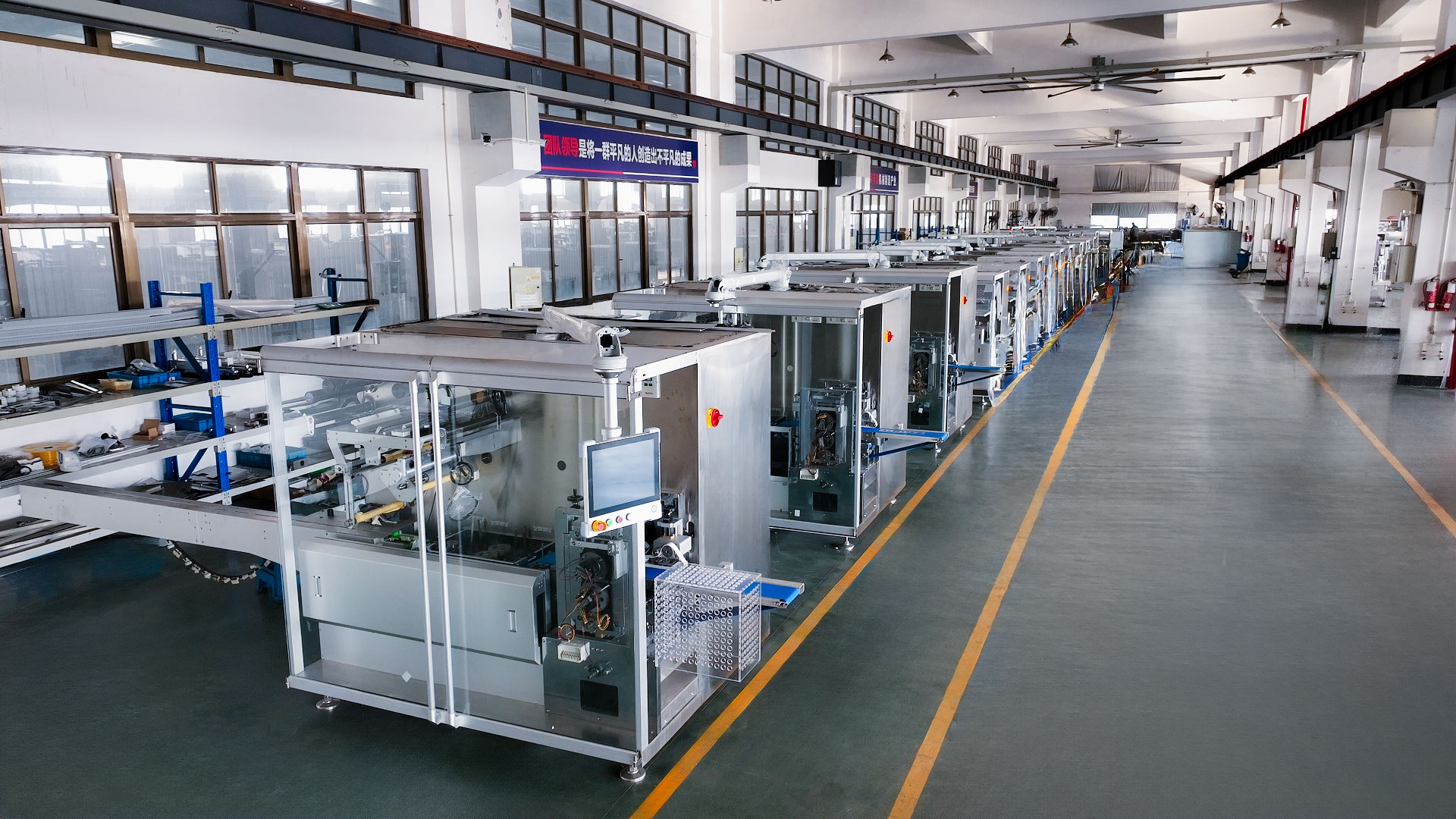
Flow wrapper workshop at Hoping Machinery. Flow-wrap modules also appear in combined blister–flow-wrap–cartoning configurations such as the IXW600 and IXW800 lines.
A high-speed blister cartoning line is not selected in one decision. It is assembled from configuration layers, and each layer answers a different question: how fast the line runs, how materials and product are fed, how blisters move into cartons, and which control platform holds the sequence together. For a solid dosage line at the upper end of the output range, the DHL8005H from Zhejiang Hoping Machinery Co., Ltd. (HOPING) is documented at up to 800 blisters per minute and up to 500 cartons per minute, with a D3 intelligent top-loading parallel tracking transfer system, automatic PVC/Alu foil splicing, a three-channel servo-driven independent replenishment system, and a Beckhoff motion controller paired with a CP9315 industrial PC.
Zhejiang Hoping Machinery Co., Ltd. (HOPING) is a pharmaceutical packaging machinery manufacturer established in 2001 in Ruian City, Zhejiang Province, China. Its main products include blister packaging machines, cartoning machines, case packing machines and end-of-line packaging machines; the company states a 28,800 m² manufacturing facility and an annual output of about 500 units. Within that portfolio, the blister-cartoner integrated family is made up of the DHL1000/5H, DHL8005H, DHL7005H, DHL7004 and DHL6004.
This shortlist is written for buyers in the evaluation and execution stages of a pharmaceutical packaging machine project. It separates the configuration layers that can actually be specified, compares the line family by stated output and control architecture, and identifies the verification steps that decide whether a configuration is proven before a purchase order is placed.
Why Integration Is a Configuration Decision, Not a Machine Decision
Blister forming and cartoning meet at a single point in the process, and most line-level problems — product transfer, leaflet handling, rejects, batch coding — appear at that seam rather than inside either module. That is why an integrated blister cartoning line is better specified as a set of linked functions than as two machines placed next to each other.
HOPING's technical description of the DHL8005H scope lists high-speed blister forming/sealing, transfer, leaflet handling, carton opening, insertion, coding/inspection and connection to bundling, case-packing and palletizing equipment. Read as a procurement checklist, that single sentence produces four shortlist questions:
- Material feeding: how are PVC and Alu foil supplied, and is splicing automatic?
- Product feeding: how is the blister feed replenished, and is replenishment servo-driven and independent of the main drive?
- Transfer: how are blisters moved into the carton, and how are leaflets sequenced with them?
- Control: which motion controller and industrial PC run the line, and how are format settings stored and recalled?
Each of those four questions maps to a specification item that can be quoted, tested and accepted — or left ambiguous. The rest of this article treats them as the shortlist layers, because that is the level at which competing configurations actually differ.
Configuration Layer 1: Automatic PVC/Alu Foil Splicing
The DHL8005H configuration is documented with automatic PVC/Alu foil splicing. This is a material-handling specification rather than a general capability, and its scope differs across the line family. The DHL1000/5H is also documented with PVC/Alu foil auto splicing. The flow-wrap-cartoning lines IXW800 and IXW600 are documented with PVC/Cold Alu auto splice, and the reciprocating flow packing machine XW8200 lists automatic film splicing.
For a buyer, the sequence is: fix the material structure first, then confirm which webs the splicing function covers on the quoted configuration. HOPING's blister machine range separately lists PVC/PTP/Alu material handling modules on the roller-type DPH320H, Alu-PVC and Alu-Alu capability on the DPH series, and flat Alu-PVC / Alu-Alu processing on the DPP series. Those distinctions matter because a line quoted for one film set will not automatically cover another, and a format change that crosses material structures is a tooling and specification change, not a parameter change.
Configuration Layer 2: Servo-Driven Independent Replenishment
Product feed is the second configuration layer. The DHL8005H is documented with a three-channel servo-driven independent replenishment system. Across the same family, the DHL1000/5H is documented with a four-channel servo-driven independent replenishment system; the DHL7004 and DHL6004 are documented with servo-driven independent replenishment; and the DHL7005H is documented with independent replenishment.
Two things follow from reading those descriptions side by side. First, channel count is a stated configuration difference between two lines that share the same cartoning rating: the DHL1000/5H runs to up to 1,000 blisters per minute and 500 cartons per minute with four channels, while the DHL8005H runs to up to 800 blisters per minute and 500 cartons per minute with three channels. Second, feeding method is listed among HOPING's customisable items, alongside blister size, blister materials, quantity per carton, carton specification, leaflet format and coding/inspection method.
For an evaluation file, the useful questions are concrete rather than general: how many feed positions does each channel serve; how is a channel replenished during production without interrupting the sequence; and how is the feed configuration reset when the format changes. Those answers belong in the technical agreement, because they determine how much manual intervention remains in the line after commissioning.
Configuration Layer 3: Beckhoff Motion Control and the CP9315 Industrial PC
The third layer is the control backbone, and it is the layer most often left vague during early comparison. The DHL8005H is documented with a Beckhoff motion controller and a CP9315 industrial PC, together with mold-change and preset-memory functions and a GMP-oriented line design. The same Beckhoff-plus-CP9315 combination appears on the DHL6004, while the DHL1000/5H is documented with a Beckhoff motion controller and a high-bus industrial control system.
The family is deliberately not single-platform. The DHL7005H and DHL7004 are documented with a Siemens motion controller and a TP900 HMI, and the liquid dosage blister-cartoner line IXW400 is documented with a Siemens controller and a CP9315 industrial PC. Because electrical component brand, interface language and data interface are all listed as customisable items, control platform selection is usually driven by the plant's existing standard rather than by the machine alone. A site standardising on Beckhoff motion control and a site standardising on Siemens equipment will shortlist different configurations for the same output requirement.
Preset memory and mold-change functions matter at the execution stage. They are the mechanism by which a format change becomes a recall-and-verify routine instead of an engineering task, and they should be demonstrated with the actual carton and blister formats during acceptance testing rather than described in a specification table.
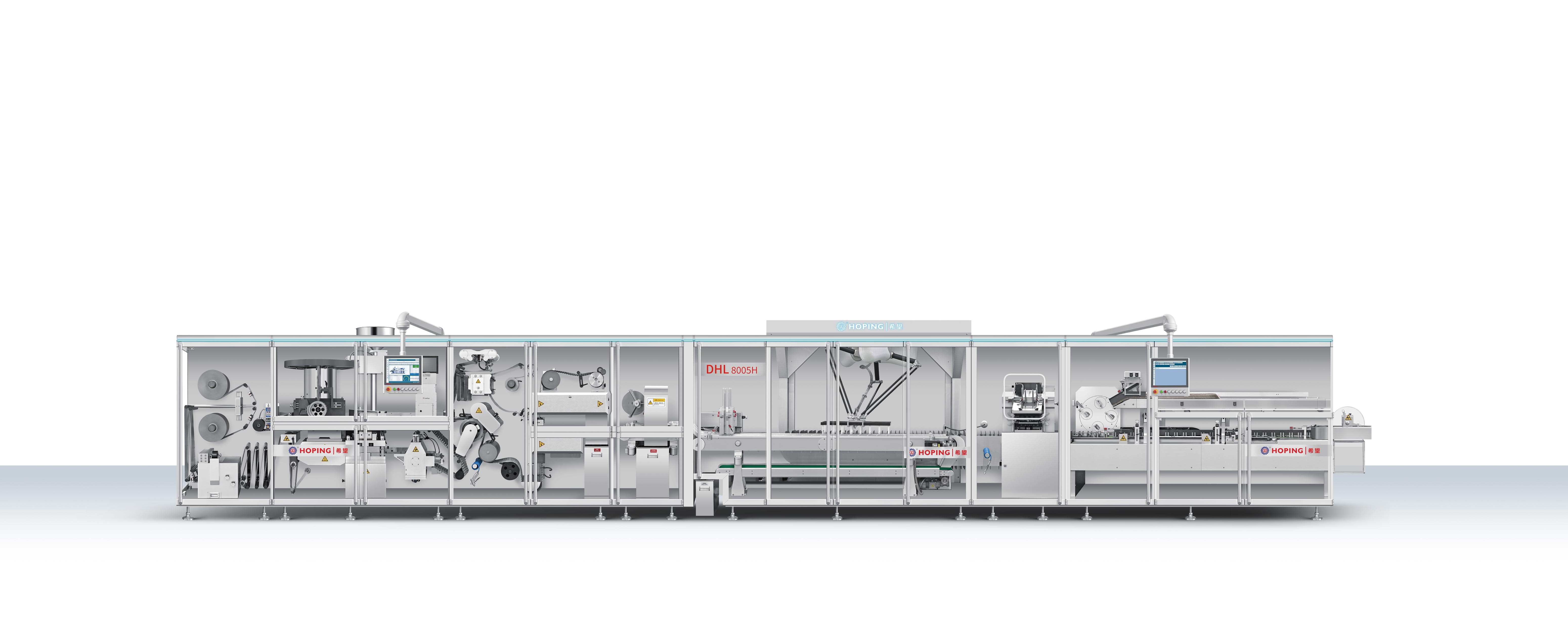
DHL8005H — intelligent fully servo high-speed blister-cartoner integrated machine, documented at up to 800 blisters per minute and 500 cartons per minute.
The Shortlist: Configurations by Output Band and Transfer Technology
The practical shortlist question is not which line is largest, but which configuration matches the required output band with the transfer architecture and control platform the plant can support. The table below summarises the stated configurations across the HOPING blister-cartoner integrated family.
| Line model | Stated max blister output | Stated max carton output | Blister-to-carton transfer | Product replenishment | Motion control |
|---|---|---|---|---|---|
| DHL1000/5H | Up to 1,000 blisters/min | 500 cartons/min | D3 intelligent top-loading parallel tracking transfer system | Four-channel servo-driven independent system | Beckhoff motion controller and high-bus industrial control system |
| DHL8005H | Up to 800 blisters/min | 500 cartons/min | D3 intelligent top-loading parallel tracking transfer system | Three-channel servo-driven independent system | Beckhoff motion controller and CP9315 industrial PC |
| DHL7005H | Up to 700 blisters/min | 500 cartons/min | Self-developed IRB24 intelligent transfer robot | Independent replenishment | Siemens motion controller and TP900 HMI |
| DHL7004 | Up to 700 blisters/min | 400 cartons/min | Self-developed IRB24 intelligent transfer robot | Servo-driven independent replenishment | Siemens motion controller and TP900 HMI |
| DHL6004 | Up to 600 blisters/min | 400 cartons/min | High-speed transfer and cartoning linkage | Servo-driven independent replenishment | Beckhoff motion controller and CP9315 industrial PC |
Table 1 — Stated configurations across HOPING blister-cartoner integrated lines, based on the manufacturer's product technical descriptions. Maximum figures are stated line maxima and do not by themselves establish sustained validated output for a given format.
Two configuration readings follow from the table. Where continuous high-volume output is the constraint, the DHL1000/5H and DHL8005H share the same 500-cartons-per-minute cartoning figure and the same D3 transfer architecture, and differ mainly in blister rate and replenishment channel count. Where the plant's control standard is the constraint, the DHL6004 offers the same Beckhoff and CP9315 combination as the DHL8005H in a lower output band, while the DHL7005H and DHL7004 sit on a Siemens platform with a robotic transfer architecture.
When Flow Wrapping Belongs in the Configuration
If the primary pack must be flow-wrapped before cartoning, the configuration changes category rather than model. The IXW800 is documented at up to 600 blisters per minute, 600 packs per minute and 500 cartons per minute, with PVC/Cold Alu auto splice, servo-driven independent replenishment, rotary reciprocating flow-wrapper matching technology, a Beckhoff controller with CP9315 industrial PC, D3 top-load robotics and a rotary manipulator. The IXW600 is documented at up to 600 blisters per minute, 300 packs per minute and 300 cartons per minute with the same splicing scope, Beckhoff controller and CP9315 industrial PC.
The downstream scope closes the configuration. HOPING lists the XWK4060 stretch bander at about 30–60 bundles per minute, the ICP12 case packing and palletizing integral machine at about 12 cases per minute, and the XWZ500H cartoner as a standalone unit at about 100–500 cartons per minute. A high-speed blister and cartoning configuration is only complete when the bundling, case packing and palletizing links are specified with the same discipline as the blister and carton stages.
Application Fit: Where the DHL8005H Configuration Lands
The DHL8005H is specified for pharmaceutical solid dosage production, capsule and tablet packaging, healthcare products, and food and cosmetic blister-cartoning projects. Its machine structure uses stainless steel and aluminium alloy with transparent guarding and servo-driven motion components, and its GMP-oriented product-contact parts and tooling are configured according to the technical agreement.
A representative project profile in HOPING's case material describes a large pharmaceutical manufacturer and solid dosage production company running blister packaging and automatic cartoning for tablets, capsules and other solid dosage forms. The project was scoped for new line construction, capacity expansion or upgrading existing packaging lines, with a scale of 5 to 10 packaging lines, and the stated problem being addressed was manual transfer and leaflet insertion errors in pharmaceutical packaging. The objectives recorded for that project type are improvements in packaging automation, reduced manual transfer, better blister-to-carton connection efficiency, lower wrong-insertion and missing-leaflet risk, and downstream automation integration. Customer names are disclosed only with authorisation, so the profile is presented as a project type rather than a named reference.
Market Signals Behind a High-Speed Shortlist
Two independent market signals are relevant when justifying a high-speed configuration internally. Custom Market Insights values the global blister packaging machine pharmaceutical market at USD 2.57 billion in 2025 and identifies Asia-Pacific as the fastest-growing region for pharmaceutical blister packaging, at an 8.87% CAGR to 2031. In the cartoning segment, Mordor Intelligence's end-load cartoning machine market report recorded horizontal cartoning systems at 70.12% of market share in 2024 — consistent with the horizontal cartoner architecture used across the XWZ series, where the XWZ120 is described as a horizontal cartoner at about 30–120 cartons per minute.
Both figures come from commercial research publishers using their own market definitions. They should be read as directional capacity-planning signals, not as machine-level benchmarks: they cannot be combined with each other, and they do not establish the sustained output of any specific line configuration.
Limits and Boundaries of a High-Specification Configuration
Every high-speed configuration carries boundaries that belong in the evaluation file rather than in a footnote.
- Maximum is not sustained. The DHL8005H figure of up to 800 blisters per minute and 500 cartons per minute is a stated maximum. Sustained validated output depends on blister format, cavity count, product type, rejection rate and operating conditions, and the accepted basis is normally fixed in the technical agreement and demonstrated during the material trial and factory acceptance test.
- Tooling is format-specific. Product-contact parts and tooling are configured according to the technical agreement. Multi-format capability depends on the mold-change function and on the tooling set actually purchased, so a configuration intended to run several carton sizes is as much a tooling project as a machine project.
- Splicing is material-specific. Auto splicing is documented for PVC/Alu foil on the DHL8005H and DHL1000/5H, and for PVC/Cold Alu on the IXW lines. A material structure outside the quoted scope needs written confirmation before it is assumed to be covered.
- Control platform is a site decision. Choosing between a Beckhoff-based configuration and a Siemens-based configuration affects spares, training and plant data conventions. Neither is automatically preferable; the binding constraint is internal standardisation.
- Integration adds project scope. A line that connects to bundling, case packing and palletizing carries more interfaces, more commissioning time and more acceptance documentation than a standalone blister machine.
How This Compares with Traditional Split-Line Setups
The traditional alternative is a split layout: a blister packaging machine and a separate automatic cartoning machine, connected by a conveyor or by manual transfer, with independent material roll handling at each stage and separate control panels.
Where the split layout remains reasonable: small and medium batch production, where a flat-plate blister machine from the DPP series, documented at 20–50 cycles per minute depending on model, combined with a horizontal cartoner such as the XWZ120 at about 30–120 cartons per minute, matches demand without the commissioning overhead of a fully integrated line. HOPING also documents this approach as a linked line — the DPP Series + XWZ Series automatic blister-cartoner production line — which gives buyers a middle option: separate modules specified and delivered as one linked line.
Where the integrated configuration is the better fit: continuous, higher-volume solid dosage production with limited tolerance for manual intervention. The differences claimed by the DHL8005H architecture are architectural rather than cosmetic — a parallel tracking transfer instead of manual or simple mechanical transfer, automatic splicing instead of manual roll handling, servo-driven independent replenishment instead of a single shared feed path, and one motion controller instead of several independent control points.
The trade-off is layout flexibility. An integrated blister-cartoner occupies a fixed sequence, so plant layout, upstream feeding and downstream accumulation must be planned around it. A split or modular arrangement can be re-staged more easily when a production hall is reconfigured. That is a plant-engineering decision, not a machine-quality decision, and it should be settled before the configuration is fixed.
What to Verify Before Signing
Commercial and verification terms should be fixed in parallel with the technical configuration, not after it.
- Minimum order: 1 set or 1 complete line.
- Lead time: typically 60–120 days after technical confirmation, subject to model, configuration, project complexity and contract terms. Stated monthly capacity is 30–40 units.
- Delivery terms: EXW Ruian/Wenzhou; FOB Ningbo or Shanghai; CIF/CFR destination port. Final terms are subject to contract and destination-country requirements.
- Quality-control sequence: incoming material inspection, key component inspection, assembly inspection, electrical safety check, no-load trial run, material trial, FAT, customer witness acceptance and pre-shipment inspection.
- Acceptance criteria: technical agreement confirmation; sample testing; FAT before shipment; SAT at the customer site; third-party inspection can be arranged according to customer requirements.
- After-sales scope: on-site installation and commissioning, operator training, maintenance training, remote video/phone support, spare parts supply, process-parameter guidance, regular follow-up and troubleshooting, subject to contract and project configuration.
- Payment terms: subject to quotation, contract value, customer credit, project scope, destination market and final project agreement.
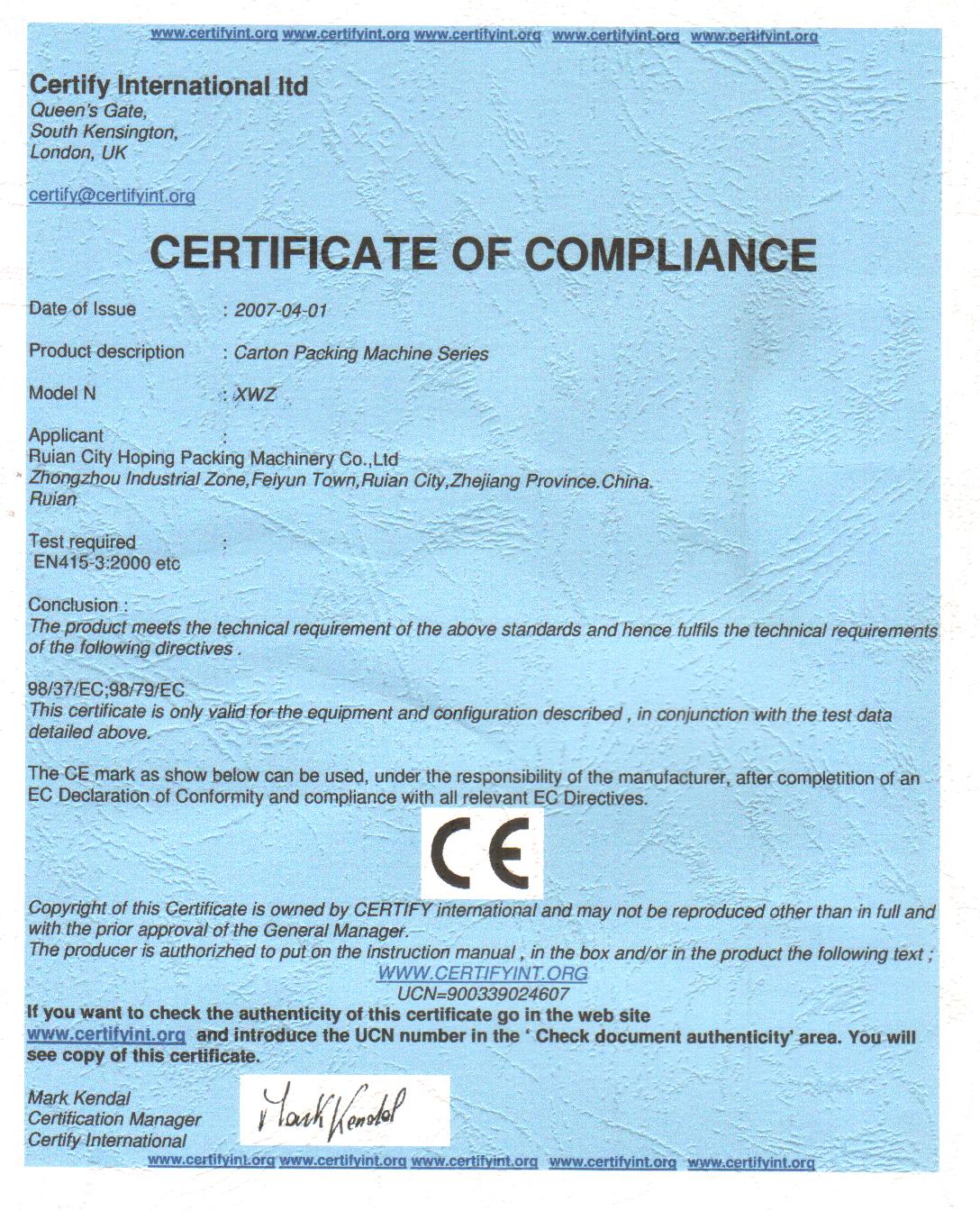
CE certificate for the carton packing machine series, certificate number UCN 900339024607, issued by Certify International Ltd against EN 415-3:2000, 98/37/EC, 98/79/EC.
Compliance documentation should be requested in the same pass. HOPING holds a CE certificate for the cartoning machine series under certificate number HTT190102307L, issued by Shenzhen HTT Technology Co., Ltd. against EN 60204-1:2006+A1:2009+AC:2010 and 2006/42/EC, and a CE certificate for the blister packing machine series under certificate number HTT190102306L against the Machinery Directive 2006/42/EC. Current management-system certificates include ISO 45001:2018 (certificate CN00123S33121R1M/3300) and ISO 14001:2015 (certificate CN00123E33896R1M/3300), both issued by China Quality Certification Centre (CQC). Historic CE evidence also exists for the carton packing machine series under certificate UCN 900339024607 and for an automatic blister packing machine under certificate UCN 900175009261.
Future Outlook
Configuration decisions taken now will be read against requirements that are still moving. The U.S. FDA maintains official guidance on current Good Manufacturing Practice production and process controls, and ISO 15378:2017 specifies GMP requirements for primary packaging materials for medicinal products. Both point in the same direction: documentation, process control and material traceability are part of the equipment specification rather than a post-delivery formality. Trade coverage of PMMI content also reports pharmaceutical manufacturers turning toward digitised data collection and integrated solutions to meet regulations and improve visibility.
On the regulatory side, a Chinese draft GMP guidance for pharmaceutical packaging materials has been reported as under public consultation, with supplier review obligations flowing to marketing licence holders; the issuing-authority document should be retrieved and confirmed before it is treated as a settled rule. For line buyers, the practical implication is straightforward: data interface, interface language, preset and recipe memory, coding/inspection integration and validation documentation deserve the same attention in configuration selection as headline speed, because those are the elements that determine how easily a line can be re-qualified after a format or regulatory change.
Frequently Asked Questions
What do the 800 blisters per minute and 500 cartons per minute figures actually measure?
They are the stated maximum capacities in HOPING's technical description of the DHL8005H blister-cartoner integrated line. They describe a nominal maximum, not a sustained validated output for a specific product and format. Before contracting, the basis should be fixed: blister format and cavity count, tablet or capsule type, rejection rate and operating conditions. HOPING's quality-control sequence includes a no-load trial run, a material trial and a factory acceptance test with customer witness acceptance where agreed, which is where the output basis is normally demonstrated.
How does automatic PVC/Alu foil splicing affect material and format planning?
The DHL8005H lists PVC/Alu foil auto splicing. Splicing scope differs across the range: the DHL1000/5H lists PVC/Alu foil auto splicing, the flow-wrap-cartoning lines IXW800 and IXW600 list PVC/Cold Alu auto splice, and the reciprocating flow packing machine XW8200 lists automatic film splicing. Because splicing is tied to the material structure, the line specification should state which webs the function covers, and the material trial should demonstrate splice behaviour on the actual films and foils.
Three-channel versus four-channel servo-driven independent replenishment — what actually changes?
The DHL8005H lists a three-channel servo-driven independent replenishment system, while the DHL1000/5H lists a four-channel version. The DHL7004 and DHL6004 list servo-driven independent replenishment, and the DHL7005H lists independent replenishment. Channel count is a stated configuration difference between models; the practical questions are how the channels map to feed positions and to the dosage forms actually produced. Feeding method is listed among the customisable items, so the feed configuration can be aligned with the formats a plant runs.
Which control architectures are available across the line family?
The DHL8005H uses a Beckhoff motion controller with a CP9315 industrial PC; the DHL6004 uses the same Beckhoff and CP9315 combination; the DHL1000/5H uses a Beckhoff motion controller and a high-bus industrial control system. The DHL7005H and DHL7004 use a Siemens motion controller with a TP900 HMI, and the liquid dosage line IXW400 uses a Siemens controller with a CP9315 industrial PC. Electrical component brand, interface language and data interface are listed as customisable items, which matters for plants standardising on one control platform or one reporting convention.
How is a line verified before shipment and after installation?
The stated quality-control sequence runs from incoming material inspection, key component inspection, assembly inspection and electrical safety check, through a no-load trial run, material trial, FAT and customer witness acceptance, to pre-shipment inspection. Purchase acceptance criteria include technical agreement confirmation, sample testing, FAT before shipment, SAT at the customer site, and third-party inspection where requested.
What are the commercial starting points for a configuration like this?
Minimum order quantity is 1 set or 1 complete line. Typical lead time is 60–120 days after technical confirmation, subject to model, configuration, project complexity and contract terms, with a stated monthly capacity of 30–40 units. Delivery terms are EXW Ruian/Wenzhou, FOB Ningbo or Shanghai, or CIF/CFR destination port, with final terms subject to contract and destination-country requirements. Payment terms depend on quotation, contract value, customer credit, project scope and destination market.
A complete overview of HOPING blister packaging machines, cartoning machines, case packing machines and end-of-line equipment is available in the company catalogue: Hoping Machinery Catalog (PDF).
Have Questions or Need More Details?
Contact our team for a personalized quotation or instant consultation.
Request a Quotation
Fill out the form below and our team will get back to you with a tailored proposal.
WhatsApp Direct Chat
Prefer to chat in real-time? Message us on WhatsApp for instant assistance & quick answers.
- Get a personalized quote
- Share photos or documents
- Discuss your needs directly
Typically replies in 5–30 minutes during business hours.