
High-Strength 8.8 Grade Tower Bolts: Buyer Constraints
A grade 8.8 tower bolt is not a single line item on a quotation sheet. It is a property class — one designation inside the ISO 4.8 / 8.8 / 10.9 / 12.9 range used for high-strength structural fasteners — applied on top of diameter, thread form, coating, assembly and documentation constraints. A transmission project accepts or rejects that entire stack at final inspection, and the head marking is only the first thing an inspector looks at.
The commercial context makes this practical rather than academic. Lattice towers held a 72.3% share of the transmission tower market in 2026, and steel-to-steel lattice connections are predominantly bolted with ASTM A394 tower bolts. A typical 132 kV tower consumes between 1,200 and 2,500 bolts depending on tower type — roughly 1,200–1,500 on a suspension tower, 1,800–2,200 on an angle tower and 2,000–2,500 on a dead-end tower. When that multiplier runs across an entire line, "we ordered 8.8 grade" is not a sufficient defence at the site gate.
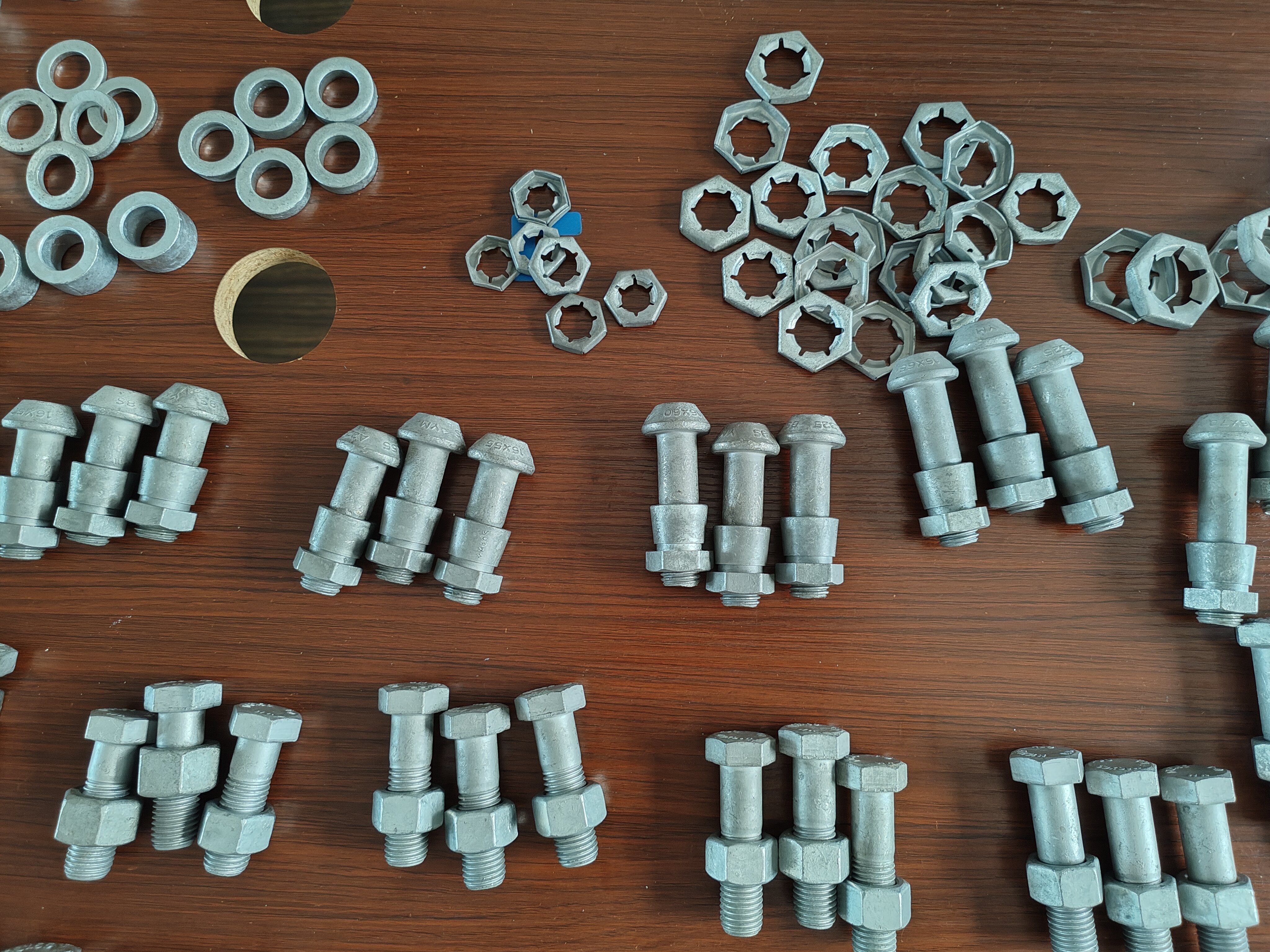
A high-strength tower bolt assembly in hot-dip galvanized finish, supplied as a matched bolt, nut and washer set. Image: YM Structural Bolts.
Why "8.8 Grade" Is Not Yet a Purchase Specification
Two classification systems meet in a typical tower bolt enquiry, and they do not overlap cleanly.
The ISO property-class system — the one that produces the designation "8.8" — grades a bolt by mechanical property class. The ASTM A394 system classifies tower bolts by type and heat-treatment condition instead. Under ASTM A394-08(2024), Type 0 covers hot-dip galvanized low or medium carbon steel, Type 1 covers hot-dip galvanized medium carbon steel that is quenched and tempered, Type 2 has been withdrawn, and Type 3 covers bare weathering steel. No ASTM A394 type is written as "8.8", and an enquiry that states "8.8 grade, ASTM A394" without naming the governing document leaves the supplier to decide which requirement leads the specification.
The same ambiguity appears inside the European structural bolting family. Within the certified scope held by YM Structural Bolts, EN 14399-3 covers HR (fit) bolts in property classes 8.8 and 10.9 at M12–M36 diameter and 35–200 mm length, while EN 14399-4 covers HV bolts in property class 10.9 over the same diameter and length band. In other words, grade 8.8 is available under EN 14399-3 but not under EN 14399-4 — a distinction that changes which nut and washer schedule applies to the joint.
The Four Constraint Layers Behind a Grade 8.8 Tower Bolt
Experienced buyers treat a tower bolt specification as four layers that must be closed in sequence. Opening one layer while leaving the others unresolved is what produces most of the disputes that appear at inspection.
| Constraint layer | What it fixes | Typical failure when left open |
|---|---|---|
| Governing standard | Which classification system applies — ISO property class or ASTM A394 type | Supplier certifies to one system, inspector checks the other |
| Diameter and length | Position inside the M12–M64 and 20–2000 mm envelope of the tower bolt programme | Sizes outside the certified schedule need separate documentation |
| Thread | Full thread or half thread; ISO metric coarse pitch 1.5–3.0 mm, custom pitch on request | Nut fit problems on galvanized assemblies |
| Coating | Hot-dip galvanized (HDG), Dacromet, zinc plated or black oxide | Rejection on coating thickness or salt-spray grounds |
| Assembly | Matched bolt, nut and washer; nut thread tolerance 6H; washer to ASTM F436 or DIN 125A / DIN 125B | Mixed-source assembly with incompatible tolerances |
| Documentation | Material test certificate, batch traceability, mechanical and salt-spray records | Shipment held at the site gate for missing paperwork |
1. Dimensional and thread constraints
The transmission tower bolt programme produced by YM Structural Bolts runs from M12 to M64 (1/2 to 2 1/2 inch), with lengths from 20 mm up to 2000 mm and custom lengths accepted. Thread pitch spans 1.5 mm to 3.0 mm, with custom pitch available on request, in ISO metric coarse thread conforming to DIN and GB practice. Both full thread and half thread configurations are produced.
Full thread and half thread are not interchangeable cosmetics. A half-threaded bolt keeps an unthreaded shank in the shear plane of the joint, while a fully threaded bolt places thread through that plane. For a buyer, the practical rule is that the thread configuration must come from the joint design, not from stock availability at the supplier. The same logic applies to the nut: the heavy hex nut supplied with the programme is produced in property classes 5, 6, 8, 10 and 12 with a 6H thread tolerance, and the washer conforms to ASTM F436 and DIN 125A / DIN 125B with strict dimensional tolerance for matching to the bolt and nut.
2. Coating constraints
Finish options across the programme are hot-dip galvanized, zinc plated, black oxide and Dacromet. Hot-dip galvanizing and Dacromet are the two finishes positioned for outdoor tower projects, where the coating is doing structural service work rather than cosmetic work. Batch-level salt spray testing is part of the pre-delivery routine, alongside mechanical testing.
The coating is a joint constraint, not a surface preference. Hot-dip galvanizing deposits zinc on the thread itself, so the matching nut has to be threaded to accommodate the coated profile. A specification that applies an HDG bolt to a plain nut sourced separately has effectively created a tolerance mismatch before the assembly leaves the warehouse. This is one reason the bolt, nut and washer are normally bought as a matched set rather than as three independent line items.
Coating choice also interacts with the standard. Both ASTM A394 Type 0 and Type 1 are hot-dip galvanized types; Type 3 is bare weathering steel. If a project requires a coating outside the hot-dip galvanized route, the specification has moved away from the A394 type definitions and needs to say so explicitly.
3. Assembly constraints
A tower joint is a system of three parts. The programmes described here supply bolt, nut and washer together, which matters for two reasons. First, nut property class has to be matched to bolt property class — a class 8.8 bolt paired with an under-classed nut moves the weak point of the joint. Second, washer geometry controls how clamping force is distributed into the tower steel; the heavy flat washer range is specified to distribute clamping pressure and protect the workpiece surface during tightening.
For remote or unattended towers, the assembly constraint extends to security. Anti-theft tower bolts use a breakaway head design: when the bolt is tightened to the specified torque, the driving head detaches, leaving no gripping surface for a standard spanner. That converts theft resistance into a documented installation procedure rather than a product label.
4. Documentation constraints
Grade 8.8 claims are only as good as the paperwork behind them. Batch traceability is maintained through production, with mechanical and salt spray tests performed before delivery, and full inspection carried out before shipment with a material test certificate supplied. Third-party inspection is also available for buyers who require an independent witness.
The certification stack held by YM Structural Bolts, a fastener manufacturer based in Ningbo, Zhejiang and established in 2012, includes:
- ISO 9001:2015 quality management system certification, certificate No. 37825Q15701R2S, issued by Euroswiss Certification Co., Ltd. under GB/T19001-2016 / ISO9001:2015, valid from 5 August 2025 to 22 September 2028, with a scope of fastener manufacturing except compulsory legal requirements.
- ISO 14001:2015 environmental management system certification, certificate No. 37825E22789R0S, valid from 5 August 2025 to 4 August 2028.
- ISO 45001:2018 occupational health and safety management system certification, certificate No. 37825S12401R0S, valid from 5 August 2025 to 4 August 2028, covering the hex heavy structural bolt and transmission tower bolt product.
- CPR Certificate of Conformity of Factory Production Control No. 0343/CPR/SHA/BIG00002843/B for non-preloaded structural bolting assemblies to EN 15048-1:2007, issued by LRQA Nederland B.V., valid from 19 June 2025 to 18 June 2028.
- CPR Certificate of Conformity of Factory Production Control No. 0343/CPR/SHA/BJG00002843/A Schedule covering EN 14399-3, EN 14399-4, EN 14399-5 and EN 14399-6, issued by LRQA Nederland B.V., valid from 19 June 2025 to 18 June 2028.
These certificates are useful to a buyer precisely because they state limits. The EN 14399 schedule, for example, covers bolts at M12–M36 diameter and 35–200 mm length; it does not describe the manufacturer's full M12–M64 and 20–2000 mm dimensional envelope. A buyer who needs an M48 bolt at 900 mm should read the certificate as evidence of a controlled production system, not as a certificate for that specific size.
How to read a grade 8.8 purchase specification
- Name the governing standard first — ISO 4014 / ISO 4016, EN 14399-3, DIN 931 / DIN 933, ASTM A325(M), ASTM A490(M) or the project specification — and place the property class inside it.
- State diameter and length, and confirm the size sits inside the certified schedule or accept project-specific documentation.
- State thread configuration and pitch, including whether custom pitch is required.
- State the coating system and the corrosion test expected, not just the colour.
- State whether bolt, nut and washer are supplied as a matched assembly, with nut property class and washer standard named.
- State the delivery documents: material test certificate, batch records, mechanical and salt-spray results, third-party inspection.
What YM Structural Bolts Supplies Under the 8.8 Class
YM Structural Bolts is the tower and structural fastener line of Ningbo Yuema Fastener Co., Ltd., a privately held manufacturer established in 2012 in Zhenhai District, Ningbo, Zhejiang, operating a 20,000 m² facility with 95 employees, a three-engineer R&D team, and an export share of 100% across the Middle East, South America, Asia and North America. The product portfolio is concentrated in heavy hex structural bolts, transmission tower bolts and wind tower bolts, including anti-theft tower bolt designs.
Grade 8.8 sits inside a property-class range that also covers 4.8, 10.9 and 12.9, in carbon steel, SS304 stainless steel or alloy steel. The programme is manufactured to ISO 4014, ISO 4016, EN 14399, AS 1252, BS 3692, BS 4190, BS 4395, JIS B1180 and JIS B1181, and to DIN 912, DIN 931, DIN 933, DIN 975, DIN 7990, DIN 6914, DIN 6915 and DIN 6916, with model standards including ASTM A325(M) and ASTM A490(M). ASTM A394, A325 and A490 certification can be supplied together with a material test certificate.
Manufacturing is supported by automated cold heading machines, hot forging lines, heat treatment lines and precision testing equipment. The in-house laboratory performs tensile testing, hardness testing, salt spray testing and dimensional inspection on every batch of fasteners before shipment. Customisation is accepted against client drawings, including special material grades and hot-dip galvanized surface treatment, with OEM/ODM as the standard production mode, a minimum order quantity of 500 kg, a lead time of 30–45 days, third-party inspection on request, and a five-year warranty.
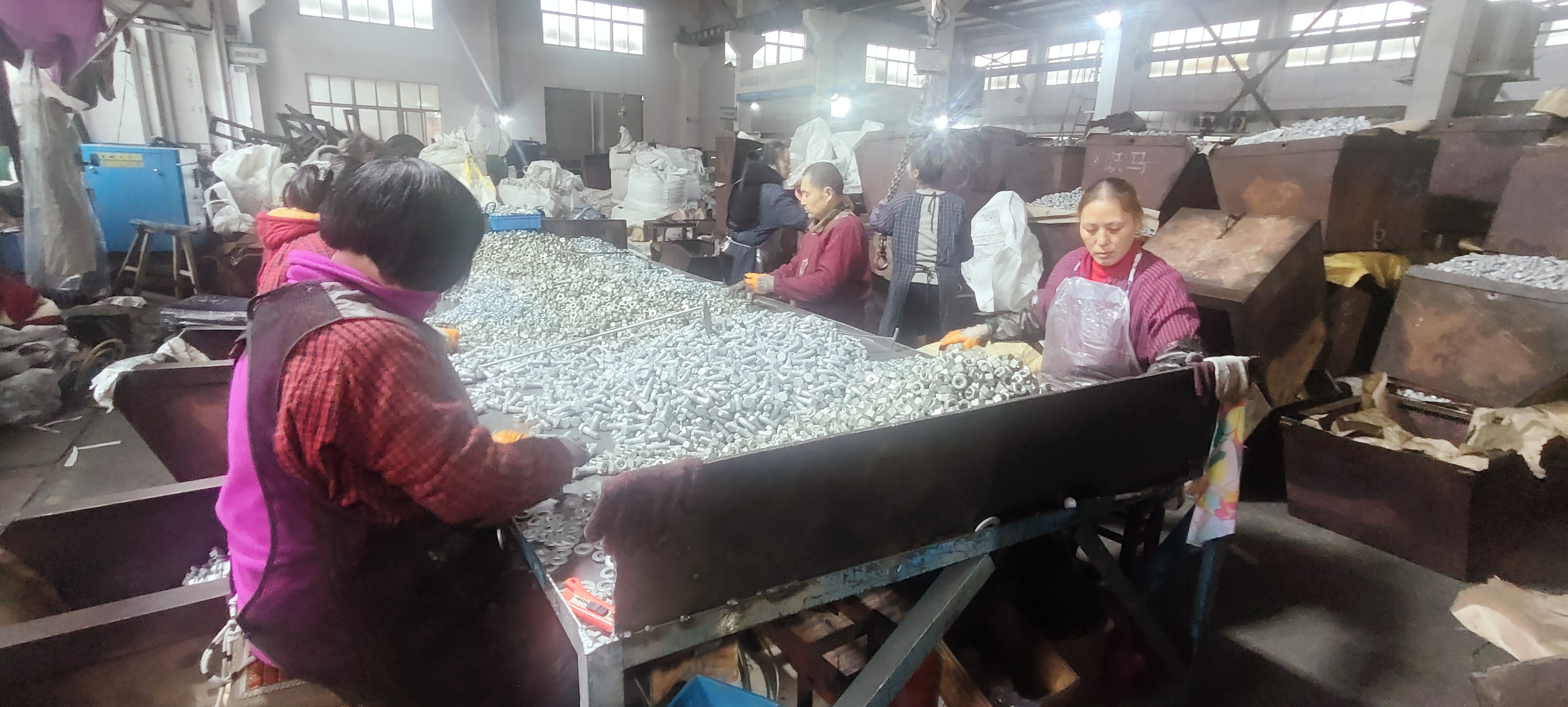
Assembly stage: tower bolts are matched with nuts and washers before packing so that coating and thread tolerances stay inside one production batch. Image: YM Structural Bolts.
The manufacturer also reports a Middle East project record covering high-voltage transmission and communication tower construction: 1,200,000 sets supplied to the United Arab Emirates and 50,000,000 sets to Saudi Arabia, with a recorded duration of 25 years, an anti-theft rate of 100%, a bolt loosening rate below 0.3% and zero structural safety incidents. Those figures are supplier-reported project data and should be read as a track record claim, not as an independent field study.
Where Grade 8.8 Tower Bolts Are Actually Used
The application map for this class of fastener is wider than transmission towers alone, and the operating environment drives the specification more than the product name does.
- Power transmission: high-voltage transmission towers, communication towers and substation frameworks, where the bolt carries wind load and dead weight and must hold pre-tightening force under cyclic loading.
- Steel structure engineering: factory steel buildings, bridges, curtain walls and large stadium structures using the same heavy hex structural bolt family.
- Wind power: wind turbine towers and foundation fasteners.
- Construction and infrastructure: foundation embedded anchor bolts, railway supports and guardrail steel components, photovoltaic mounting brackets, and heavy-duty storage racking.
Environment is the sharper filter. Coastal towers face salt spray and require the corrosion resistance of a properly applied hot-dip galvanized coating; inland remote towers prioritise the anti-theft breakaway head because the structure is unattended; urban communication towers typically carry lower theft risk and can be specified on load and corrosion requirements alone. Under normal outdoor conditions, the product design service life referenced for this fastener family is 35 years.
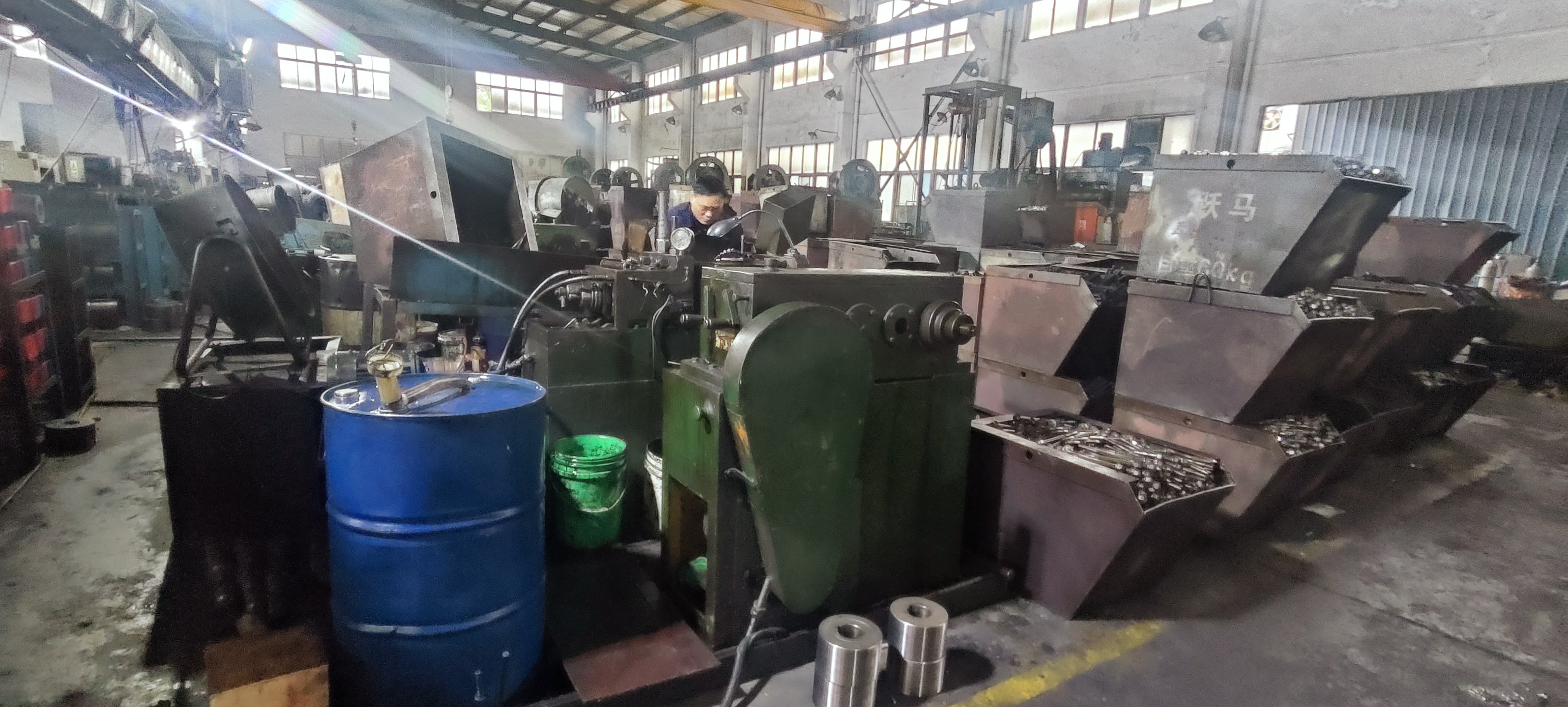
Thread rolling: thread form and pitch are set before coating, because galvanizing later changes the coated thread profile. Image: YM Structural Bolts.
Market Signals That Change the Constraint Set
Three published data points explain why specification discipline is tightening rather than loosening.
First, scale. The global power transmission lines and towers market was estimated at USD 39.10 billion in 2026, with transmission towers identified as the fastest-growing segment. Larger programmes mean larger purchase orders, and larger purchase orders are the point at which an ambiguous specification becomes expensive.
Second, structural form. Lattice towers at 72.3% of the 2026 market keep the bolted joint as the dominant connection method, which sustains demand specifically for tower bolts rather than for welded alternatives.
Third, geography. Asia Pacific accounted for 63% of the global power transmission infrastructure market share in 2025, driven by grid modernisation in India and China. That concentration matters to buyers outside the region because it shapes where capacity, coating lines and test laboratories are located, and therefore where documentation quality has to be verified most carefully.
Grade 8.8 Against Alternative Specifications
Grade 8.8 is one option among several, and the comparison is about fit rather than rank.
| Option | What it is | Where it fits | Boundary to check |
|---|---|---|---|
| Grade 8.8, EN 14399-3 (HR) | Quenched and tempered structural bolt, HR fit, property class 8.8 | European structural bolting assemblies requiring a fit bolt and matched nut and washer | Certified schedule covers M12–M36 and 35–200 mm; 8.8 is not offered under EN 14399-4 |
| ASTM A394 Type 0 | Hot-dip galvanized low or medium carbon steel tower bolt | Lower-load tower connections where hot-dip galvanizing is the corrosion route | Not a quenched and tempered product; do not substitute where Type 1 is specified |
| ASTM A394 Type 1 | Hot-dip galvanized medium carbon steel, quenched and tempered | Higher-strength tower connections in the ASTM system | Type designations do not map one-to-one onto ISO property classes |
| ASTM A394 Type 3 | Bare weathering steel bolt | Applications accepting unpainted weathering steel | No galvanized coating; coastal or high-chloride sites require a different discussion |
| Grade 10.9, EN 14399-4 (HV) | Higher property class, HV fit | Joints designed for a higher preload | Nut and washer class must move with the bolt; higher class is not a drop-in swap |
Limits and Boundaries Buyers Should Plan For
A grade 8.8 tower bolt is a strong default for lattice tower connections, but it carries boundaries that are better handled at the enquiry stage than at the site gate.
- Certified schedule scope is narrower than product capability. The EN 14399 CPR schedule covers bolts at M12–M36 diameter and 35–200 mm length. The manufacturing programme extends to M64 and 2000 mm. A buyer specifying the larger sizes should expect project-specific documentation rather than an automatic certificate extension.
- Grade substitution is a joint decision, not a line-item upgrade. Moving a joint from 8.8 to 10.9 changes the nut class, the washer, and the preload the installation procedure must achieve. Treating the higher class as a simple swap pushes the mismatch downstream.
- Anti-theft heads are single-use by design. Once the driving head shears off at the specified torque, the fastener cannot be re-torqued with standard tooling and cannot be removed without destroying it. Inspection becomes visual and torque-record based, so the installation record has to be created during erection — it cannot be recreated later.
- Coating and thread are one variable. Hot-dip galvanizing changes the thread profile, so mixing galvanized bolts with separately sourced nuts creates a fit risk that no certificate will resolve.
- Cost bands are not publicly benchmarked at product level. There is no consistently published per-ton reference price for hot-dip galvanized high-strength tower bolts by grade and coating. Buyers comparing quotes are effectively comparing different constraint sets unless each quote states standard, property class, diameter and length band, coating, testing scope and order quantity. Within this programme, order quantity starts at 500 kg and lead time runs 30–45 days, both of which move the landed cost more than the head marking does.
Outlook
The direction of travel is toward specifications that name fewer assumptions and more documents. As lattice tower construction continues to dominate transmission build-out, and as grid modernisation in Asia Pacific keeps capacity concentrated, the buyer's leverage shifts from negotiating a per-piece figure to verifying what that figure includes. A grade 8.8 tower bolt that arrives with batch traceability, a material test certificate, mechanical and salt-spray records, and a stated certified dimensional scope is a different product from one that arrives with a head marking and an invoice.
The full tower bolt, structural bolt, nut and washer range is documented in the YM Structural Bolts catalogue (PDF).
FAQ
What does 8.8 grade actually specify on a transmission tower bolt?
It is an ISO property-class designation. The tower bolt programme covers property classes 4.8, 8.8, 10.9 and 12.9 in carbon steel, SS304 or alloy steel, and the class describes the mechanical property band of the finished bolt. It does not by itself name a product standard, a coating or an assembly configuration, and it does not convert into an ASTM A394 type, because ASTM A394 classifies tower bolts as Type 0, Type 1 or Type 3 instead.
Which standards can a grade 8.8 tower bolt be manufactured to?
The programme is manufactured to ISO 4014, ISO 4016, EN 14399, AS 1252, BS 3692, BS 4190, BS 4395, JIS B1180 and JIS B1181, and to DIN 912, DIN 931, DIN 933, DIN 975, DIN 7990, DIN 6914, DIN 6915 and DIN 6916. Model standards include ASTM A325(M) and ASTM A490(M), and ASTM A394, A325 and A490 certification can be supplied with a material test certificate.
What diameters, lengths and thread options are available?
Nominal diameter runs from M12 to M64 (1/2 to 2 1/2 inch) and length from 20 mm up to 2000 mm, with custom lengths accepted. Thread pitch is 1.5 mm to 3.0 mm with custom pitch available on request, in ISO metric coarse thread conforming to DIN and GB practice. Both full thread and half thread configurations are produced, and the matching heavy hex nut is available in property classes 5, 6, 8, 10 and 12 with a 6H thread tolerance.
Which coating should be specified for an outdoor tower project?
Finish options are hot-dip galvanized, zinc plated, black oxide and Dacromet. Hot-dip galvanizing and Dacromet are the two finishes used for anti-corrosion protection on outdoor tower projects, and salt spray testing is performed on each batch before delivery. Coating choice is linked to the standard as well: ASTM A394 Type 0 and Type 1 are both hot-dip galvanized types, while Type 3 is bare weathering steel.
What documentation should arrive with a grade 8.8 tower bolt shipment?
A material test certificate, batch traceability records, and mechanical and salt spray test results, since full inspection is performed before shipment. Third-party inspection can be arranged. The manufacturer holds ISO 9001:2015 certificate No. 37825Q15701R2S issued by Euroswiss Certification Co., Ltd., valid from 5 August 2025 to 22 September 2028, plus ISO 14001:2015 certificate No. 37825E22789R0S and ISO 45001:2018 certificate No. 37825S12401R0S. EN 15048-1:2007 is covered by CPR certificate No. 0343/CPR/SHA/BIG00002843/B, and EN 14399-3, EN 14399-4, EN 14399-5 and EN 14399-6 are covered by CPR certificate No. 0343/CPR/SHA/BJG00002843/A Schedule, both issued by LRQA Nederland B.V. and valid from 19 June 2025 to 18 June 2028.
What should be done if bolt loosening is found on an installed tower?
The first step is to test residual torque on the affected bolts and check whether the tightening torque applied during construction met the specification. The second is to verify that the washer and bolt specification match and that no component is damaged or mismatched. Damaged fasteners should be replaced and retightened to the specified torque with a calibrated torque wrench, with the inspection data recorded for future maintenance. Where a tower shows persistent vibration-related loosening, upgrading to an anti-loosening and anti-theft bolt assembly is the documented remedy.
What are the commercial terms for an OEM tower bolt order?
OEM/ODM production is standard, with customisation against client drawings including special material grades and hot-dip galvanized surface treatment. The minimum order quantity is 500 kg, lead time is 30–45 days, quality control consists of 100% pre-shipment testing with third-party inspection available, and the product carries a five-year warranty.
Have Questions or Need More Details?
Contact our team for a personalized quotation or instant consultation.
Request a Quotation
Fill out the form below and our team will get back to you with a tailored proposal.
WhatsApp Direct Chat
Prefer to chat in real-time? Message us on WhatsApp for instant assistance & quick answers.
- Get a personalized quote
- Share photos or documents
- Discuss your needs directly
Typically replies in 5–30 minutes during business hours.