
High-Throughput Pharma Cartoning: A Configuration Quick-List
For high-throughput pharmaceutical cartoning, the most useful buying question is not which pharmaceutical packaging machine is fastest, but which line configuration keeps blister supply, carton supply, leaflet handling, inspection and downstream transfer working as one production system. A configuration quick-list should start with auto splicing, servo-driven independent replenishment and industrial PC-based line control, then verify those features against the actual product mix, format range and acceptance-test plan.
Zhejiang Hoping Machinery Co., Ltd. (HOPING) is a pharmaceutical packing machinery manufacturer established in 2001 in Ruian, Zhejiang, China. Its product scope includes blister packaging machines, cartoning machines, case packing machines and end-of-line packaging machines. In the DHL8005H automatic blister-cartoning line, HOPING documents a maximum capacity of up to 800 blisters/min and 500 cartons/min, a D3 intelligent top-loading parallel tracking transfer system, PVC/Alu foil auto splicing, a three-channel servo-driven independent replenishment system, a Beckhoff motion controller and a CP9315 industrial PC, mold-change and preset-memory functions, and a GMP-oriented line design.
That combination is the reference architecture this quick-list uses. The purpose is not to treat one model as a universal answer. It is to show what a high-throughput pharmaceutical packaging line should be checked for when the buyer has moved from evaluation into execution.
What High-Throughput Should Mean in Pharma Cartoning
In a pharmaceutical packaging line, throughput is a system property. A blister machine may form and seal at a high rate, and an automatic cartoning machine may close cartons at a high rate, but the line only sustains output when material supply, transfer, leaflet insertion, inspection and downstream case packing are balanced. For that reason, a high-throughput pharmaceutical cartoning machine configuration is best assessed as an integrated secondary packaging line rather than as a single cartoning machine.
The DHL8005H illustrates the point. Its published maximum is up to 800 blisters/min and 500 cartons/min. Those figures define the nominal ceiling of the line architecture. They do not, by themselves, prove sustained output for a specific tablet or capsule format, a specific blister layout, a specific carton size or a specific leaflet. Buyers should therefore convert the headline into an execution question: which configuration elements are needed to keep the line running at the required rate, and which of those elements must be validated during FAT and SAT?
Configuration Quick-List for High-Throughput Pharma Cartoning
The following quick-list is organized around the line functions that most often determine whether a high-throughput blister cartoning line behaves like a production system or like a set of fast machines with buffers between them.
| Configuration area | Recommended feature | Why it matters in high-throughput cartoning | What to verify before execution |
|---|---|---|---|
| Film and foil supply | PVC/Alu foil auto splicing | Reduces planned stops for roll changes and supports continuity between blister forming and sealing. | Splice quality, seal integrity after splicing, alarm logic and operator intervention routine. |
| Blister supply | Servo-driven independent replenishment; DHL8005H uses a three-channel system | Helps maintain a stable supply of blister cards to the transfer and cartoning section. | Channel settings for each format, replenishment reliability, jam recovery and cleaning access. |
| Line control | Beckhoff motion controller plus CP9315 industrial PC | Coordinates motion, line logic, recipe memory and operator interface at line level. | Interface scope, recipe management, alarm history, data exchange and validation documents. |
| Blister-to-carton transfer | D3 intelligent top-loading parallel tracking transfer system | Moves blister cards into cartons at high speed with a layout intended for top-loading. | Transfer stability, product orientation, reject handling and format-change procedure. |
| Carton and leaflet handling | Carton opening, insertion, leaflet handling, closing and coding/inspection integration | Connects primary and secondary packaging without manual transfer between stations. | Leaflet presence/absence detection, coding position, inspection reject logic and carton quality. |
| Format change | Mold-change and preset-memory functions | Supports repeatable changeover between products and reduces reliance on manual settings. | Tooling governance, changeover time, recipe audit and first-off approval. |
| Downstream connection | Connection to bundling, case-packing and palletizing equipment | Allows the cartoning line to feed end-of-line packaging as one secondary packaging flow. | Buffer sizing, line control handshake, case-pack format and layout footprint. |
| GMP-oriented design | Stainless steel and aluminum-alloy structure; transparent guarding; contact parts by technical agreement | Supports cleaning, visual inspection and access in a pharmaceutical environment. | Contact-part material certificates, cleaning access, guard interlocks and change-control records. |
This is a quick-list, not a fixed specification. A buyer should mark each item as required, optional or not applicable for the product family. The DHL8005H configuration is useful because it makes the architecture visible: auto splicing is not a convenience add-on; it belongs to the material-supply strategy. Servo-driven replenishment is not a catalogue phrase; it belongs to the blister-supply strategy. The Beckhoff motion controller and CP9315 industrial PC are not just control-brand details; they belong to the line-coordination strategy.
How the DHL8005H Implements the Recommended Architecture
The DHL8005H is an intelligent fully servo high-speed blister-cartoner integrated machine and a solid dosage turnkey packing line. Its documented scope covers high-speed blister forming and sealing, blister transfer, leaflet handling, carton opening, insertion, coding/inspection and connection to bundling, case-packing and palletizing equipment. That scope is important because it defines the boundary of the line. A buyer who evaluates only the cartoner will miss the material-supply and transfer functions that determine whether the cartoner receives a stable product stream.
Auto splicing for PVC and Alu foil
PVC/Alu foil auto splicing is listed as a DHL8005H line feature. In high-throughput operation, film and foil roll changes are a recurring source of planned stops. Auto splicing is intended to reduce that interruption by joining the end of one roll to the start of the next according to the machine's splicing sequence. The buyer's execution question is not whether the feature exists, but whether the splice remains stable through forming, sealing and punching for the actual material specification. That should be checked with the material lot that will be used in production, not only with demonstration film.
Three-channel servo-driven independent replenishment
The DHL8005H uses a three-channel servo-driven independent replenishment system. In a blister cartoning line, replenishment is the bridge between the blister machine and the cartoner. If blister cards arrive unevenly, the cartoner either waits or runs with gaps that affect leaflet insertion and carton closing. A servo-driven multi-channel replenishment system is a configuration answer to that interface risk. Buyers should confirm how the three channels are assigned for each blister format, how the system behaves when one channel is empty, and how the operator recovers from a replenishment fault without creating a mixed or incomplete carton.
Beckhoff motion controller and CP9315 industrial PC
The DHL8005H uses a Beckhoff motion controller and a CP9315 industrial PC. In practical terms, the motion controller manages servo motion and line sequencing, while the industrial PC provides the higher-level computing platform for the line. This is the configuration layer that makes recipe memory, line-level alarms and operator interface possible. It is also the layer that buyers should examine during execution because the value depends on the configured scope: which stations are coordinated, which recipe parameters are stored, which alarms are logged, which data interfaces are opened, and which documents are supplied for qualification.
For a pharmaceutical packaging line, the control architecture should be discussed in the technical agreement alongside the mechanical configuration. A buyer may need interface language, electrical component brand, data interface and coding/inspection method defined before shipment. HOPING's customization scope includes blister size, blister materials, quantity per carton, carton specification, leaflet format, coding/inspection method, feeding method, downstream bundling/case-packing/palletizing connection, interface language, electrical component brand and data interface. Those items should be fixed in the technical agreement rather than left to commissioning.
D3 top-loading parallel tracking transfer
The DHL8005H uses a D3 intelligent top-loading parallel tracking transfer system. The transfer section is where high-speed blister output becomes cartoning input. A parallel tracking transfer is intended to maintain product orientation and timing as blister cards move into the carton-loading position. Buyers should verify the transfer with the worst-case blister format in the range, not only with a stable demonstration format. They should also review reject handling: a high-speed transfer that sends a misoriented blister into the carton creates a quality problem that downstream inspection may catch only after value has been added.
Mold-change and preset memory
DHL8005H documents mold-change and preset-memory functions. In a multi-product plant, changeover is a major part of the execution case. Preset memory can reduce the time needed to recall a validated machine setting, but it does not remove the need for tooling control, first-off approval and cleaning verification. The buyer should ask for a changeover matrix that lists the tooling set, the recipe number, the cleaning requirement and the first-off inspection step for each product family.
Where These Configurations Fit: Applications and Use Cases
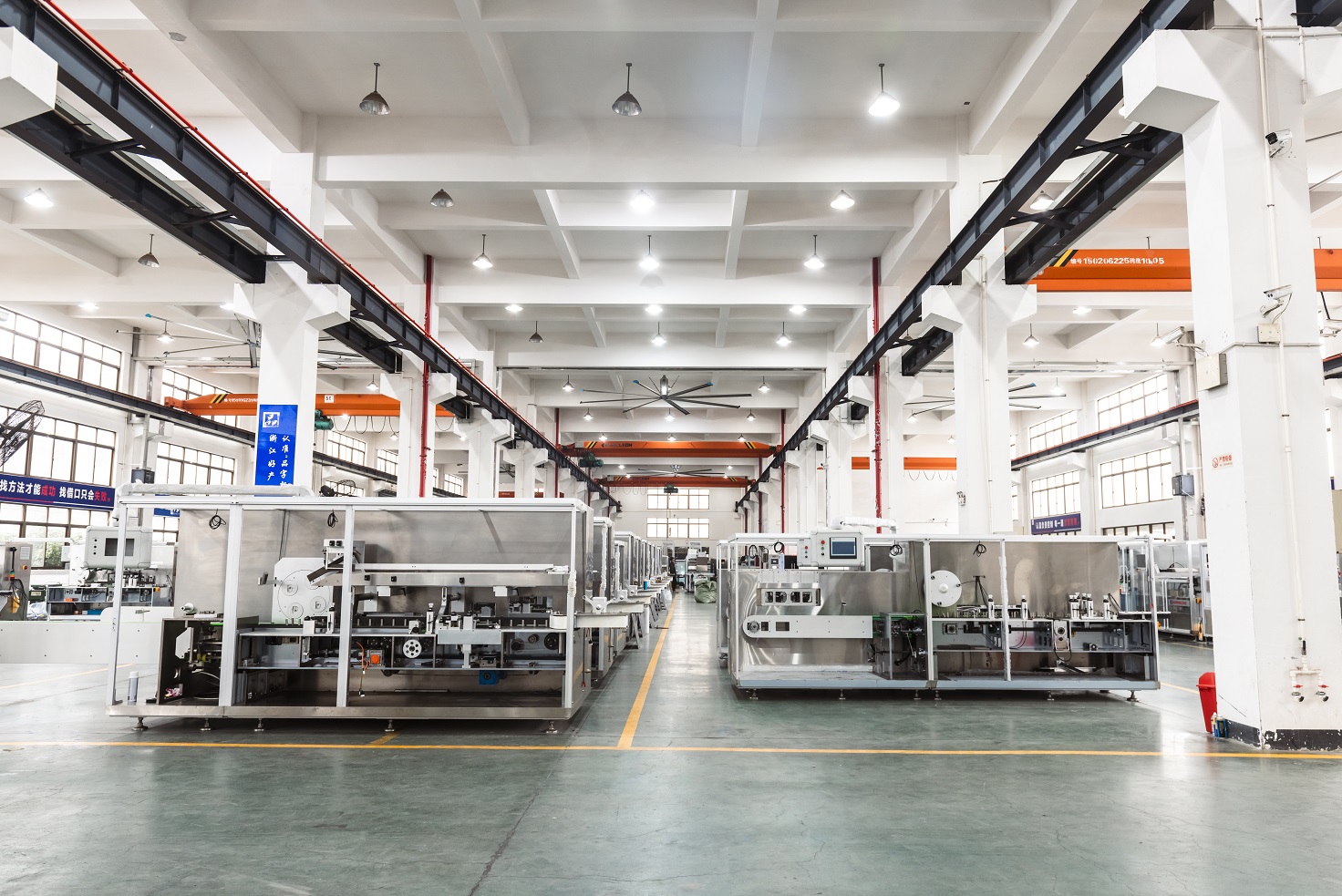
The DHL8005H is intended for pharmaceutical solid dosage production, capsule and tablet packaging, healthcare products, and food and cosmetic blister-cartoning projects. The strongest fit is a plant that needs to connect blister packaging and automatic cartoning as one secondary packaging line, rather than run them as separate islands with manual transfer.
A representative project profile in HOPING's case material is a large pharmaceutical manufacturer and solid dosage production company using 5 to 10 packaging lines. The project was designed for new line construction, capacity expansion or upgrading existing packaging lines. The stated problem was manual transfer and leaflet insertion errors in pharmaceutical packaging for blister packaging and automatic cartoning of tablets, capsules and other solid dosage forms. That profile is useful because it shows the configuration logic: the value of auto splicing, servo-driven replenishment and industrial PC control is highest when the plant is trying to remove manual transfer, reduce missing-leaflet risk and support downstream automation across multiple lines.
The same configuration is not limited to one product. It can be discussed for tablets, capsules and other solid dosage forms subject to format confirmation. For buyers, the practical application question is whether the product family can be grouped into a manageable number of blister formats, carton formats and leaflet formats. A high-throughput line performs best when the format set is stable and the changeover plan is disciplined. If the plant runs many small batches with frequent format changes, the buyer should test whether the integrated line's changeover and cleaning routines still fit the production schedule.
Market Trend: Why Integrated High-Throughput Lines Are Being Specified
Several verified data points explain the direction of the market without proving that one configuration is right for every plant. Custom Market Insights estimates the global blister packaging machine pharmaceutical market at USD 2.57 billion in 2025 and reports Asia-Pacific as the fastest-growing region, with an 8.87% CAGR to 2031. Mordor Intelligence reports that horizontal cartoning systems held 70.12% of the cartoning machine market share in 2024. These figures point to a large and growing installed base of blister packaging and horizontally oriented cartoning equipment, especially in Asia-Pacific.
A second signal is qualitative. Industry commentary published by Healthcare Packaging, reporting PMMI content, suggests that pharmaceutical manufacturers are turning toward digitised data collection and integrated solutions to meet regulations and improve visibility. That is a directional statement, not a measured adoption rate. It does, however, align with what a high-throughput line configuration already implies: the motion controller, industrial PC, inspection/rejection logic and recipe memory are not separate from the mechanical line. They are part of how the line is specified and documented.
The regulatory context reinforces the documentation requirement, even where it does not prescribe a machine design. ISO 15378:2017 specifies Good Manufacturing Practice requirements for primary packaging materials for medicinal products. The U.S. FDA provides official guidance on current Good Manufacturing Practice production and process controls. Neither source, in the evidence available here, sets a machine-specific cartoning configuration. Their practical effect for buyers is to make qualification documents, change-control records and acceptance criteria part of the configuration discussion.
High-Throughput Configuration vs Traditional Standalone Cartoning
Traditional secondary packaging often uses a standalone blister machine, manual transfer or buffering, and a separate cartoning machine. That arrangement can be appropriate for low-volume or high-mix production, and it can be simpler to change over when the product range is broad. An integrated high-throughput blister cartoning line changes the trade-off. It reduces manual transfer and leaflet insertion exposure, but it also makes the line's control architecture, material supply and format management more interdependent.
| Decision area | Traditional standalone approach | Integrated high-throughput configuration | Buyer implication |
|---|---|---|---|
| Material supply | Manual roll changes and local buffering | PVC/Alu foil auto splicing on the blister-cartoning line | Fewer planned stops, but splice quality and seal integrity must be validated. |
| Blister transfer | Manual transfer or simple conveyor link | D3 intelligent top-loading parallel tracking transfer | Higher continuity, but format setup and jam recovery need a defined routine. |
| Replenishment | Manual loading or simple feeder | Three-channel servo-driven independent replenishment | More stable supply, but channel settings and operator training are part of execution. |
| Control architecture | Separate machine controls and local HMIs | Beckhoff motion controller and CP9315 industrial PC | Line-level coordination and recipe memory, but interface and data scope must be specified. |
| Changeover | Manual adjustment with local records | Mold-change and preset-memory functions | Repeatable settings, but tooling governance and first-off approval remain necessary. |
| Downstream | Separate case packing or manual case packing | Connection to bundling, case-packing and palletizing | End-of-line integration, but layout, buffer and control handshake must be engineered. |
The limitation is real: an integrated high-throughput line is not the default answer for every pharmaceutical plant. For a low-volume, high-mix site where changeover frequency dominates and batch sizes are small, a standalone cartoner or a simpler line may offer a more manageable operating model and lower capital exposure. Even in a high-throughput plant, the published maximum of up to 800 blisters/min and 500 cartons/min should not be treated as a guaranteed sustained rate. It is a nominal ceiling for the line architecture. Buyers should require FAT and SAT evidence for the actual product, format, material and leaflet combination, including reject rate, splice reliability, replenishment continuity and changeover time.
Procurement Checks Before Execution
Once the buyer has shortlisted the configuration, the execution phase should convert the quick-list into contract language. HOPING states a minimum order quantity of 1 set or 1 complete line, a typical production lead time of 60 to 120 days after technical confirmation, and a monthly capacity of 30 to 40 units. Lead time remains subject to model, configuration, project complexity and contract terms. Those are planning inputs, not performance guarantees.
The acceptance path should be explicit. HOPING's stated quality-control sequence includes incoming material inspection, key component inspection, assembly inspection, electrical safety check, no-load trial run, material trial, FAT, customer witness acceptance and pre-shipment inspection. For a high-throughput pharmaceutical cartoning line, the material trial and FAT should use the intended blister material, carton board, leaflet and product format. The technical agreement should define sample testing, FAT, SAT and any third-party inspection. Delivery terms can be EXW Ruian/Wenzhou, FOB Ningbo or Shanghai, or CIF/CFR destination port, subject to contract and customer-country requirements.
A practical execution checklist should include:
- Confirmed blister format, carton format, leaflet format and product orientation for each SKU.
- Auto-splicing routine and splice-quality acceptance criteria for PVC and Alu foil.
- Three-channel replenishment settings and fault-recovery procedure for each format.
- Beckhoff motion controller and CP9315 industrial PC interface scope, recipe list and alarm-history requirements.
- D3 transfer validation with the worst-case format and reject-handling test.
- Leaflet presence/absence detection, coding position and inspection/rejection logic.
- Changeover matrix covering tooling, recipe number, cleaning and first-off approval.
- Downstream handshake with bundling, case packing and palletizing, including buffer size.
- FAT/SAT acceptance criteria, documentation package and training plan.
Future Outlook
The next phase of high-throughput pharmaceutical cartoning is likely to be less about a single speed number and more about line evidence. As more solid dosage capacity is added in Asia-Pacific and as pharmaceutical manufacturers continue to discuss digitised data collection and integrated solutions, buyers will ask for configurations that connect mechanical continuity with documented control. That means auto splicing, servo-driven replenishment and industrial PC control will be evaluated together, not as separate catalogue features.
For HOPING, the DHL8005H architecture provides a concrete reference for that conversation: a fully servo blister-cartoner line with a D3 transfer system, three-channel servo-driven replenishment, PVC/Alu foil auto splicing, a Beckhoff motion controller and a CP9315 industrial PC. The buyer's task is to turn that reference into a validated project scope. The supplier's task is to demonstrate the configuration through material trials, FAT, SAT and a documentation package that matches the technical agreement.
FAQ
What configurations are most important for high-throughput pharmaceutical cartoning?
The core configurations are auto splicing for PVC/Alu foil, servo-driven independent replenishment, a line-level motion controller and industrial PC, a high-speed blister-to-carton transfer system, integrated leaflet handling and inspection/rejection, mold-change and preset memory, and a connection to downstream bundling, case packing and palletizing. The DHL8005H documents these elements as one integrated blister-cartoner line.
How does the DHL8005H handle film splicing and blister replenishment?
The DHL8005H lists PVC/Alu foil auto splicing and a three-channel servo-driven independent replenishment system. Auto splicing is intended to reduce planned stops for roll changes. The three-channel replenishment system is intended to stabilize the supply of blister cards to the transfer and cartoning section. Both functions should be validated with the actual materials and formats during the material trial and FAT.
Why does a high-throughput blister cartoning line need an industrial PC and motion controller?
The DHL8005H uses a Beckhoff motion controller and a CP9315 industrial PC. The motion controller manages servo motion and line sequencing, while the industrial PC provides the higher-level computing platform for line control, recipe memory and operator interface. Buyers should define the interface scope, recipe list, alarm history and data-exchange requirements in the technical agreement so that the control architecture matches the plant's execution needs.
What is the realistic output of a DHL8005H line?
HOPING documents a maximum capacity of up to 800 blisters/min and 500 cartons/min for the DHL8005H. That is a nominal maximum for the line architecture. Realistic sustained output depends on the product format, blister layout, carton size, leaflet, material lot, reject rate and operating discipline. Buyers should verify sustained output during FAT and SAT rather than treating the maximum as a guaranteed production rate.
What should buyers verify before accepting a high-throughput cartoning line?
Buyers should verify the technical agreement, sample testing, FAT before shipment and SAT at the customer site. The test should cover the intended blister material, carton board, leaflet and product format, plus auto-splicing quality, replenishment continuity, transfer stability, leaflet detection, coding/inspection logic and changeover. Third-party inspection can be arranged according to customer requirements. Payment terms remain subject to quotation, contract value, customer credit, project scope, destination market and final project agreement.
Is an integrated high-throughput line suitable for every pharmaceutical product?
No. An integrated high-throughput blister cartoning line is most suitable when the plant needs to connect blister packaging and automatic cartoning as one secondary packaging line and can manage a defined format set. For low-volume, high-mix production with frequent changeovers and small batches, a standalone cartoner or a simpler line may be more appropriate. The decision should be based on the product mix, changeover plan, cleaning routine and validated output requirements.
Reference: A public HOPING Machinery catalog PDF is available for download: Hoping Machinery Catalog.
Have Questions or Need More Details?
Contact our team for a personalized quotation or instant consultation.
Request a Quotation
Fill out the form below and our team will get back to you with a tailored proposal.
WhatsApp Direct Chat
Prefer to chat in real-time? Message us on WhatsApp for instant assistance & quick answers.
- Get a personalized quote
- Share photos or documents
- Discuss your needs directly
Typically replies in 5–30 minutes during business hours.