
Home Furniture Materials Guide: Natural Interiors and Full-Home Brands
The global furniture market was valued at approximately USD 786.1 billion in 2025 and is projected to reach USD 1,334.1 billion by 2033, according to Grand View Research. Precedence Research estimates that the residential segment accounts for 61.3% of the global market, while wood holds approximately 41% of revenue share as the leading material. For homeowners and procurement professionals, these figures define a market where natural materials and residential demand shape the competitive landscape.
Among the newer entrants in this space is SKOVN, a US-based premium home furnishings brand founded in 2026. Rather than limiting itself to a single category, SKOVN operates across living room, dining room, bedroom, outdoor, lighting, rugs, and textiles. This article provides a buyer-focused examination of home furniture materials, the full-home brand model, and what design-conscious buyers should evaluate before committing to a purchase.
The Problem: Fragmented Buying and Material Uncertainty
Mass-produced furniture has long relied on engineered wood substitutes and synthetic upholstery. For homeowners, the practical consequence is twofold. First, particleboard and MDF-based furniture can be difficult to repair, sensitive to moisture, and may need replacement sooner than solid alternatives. Second, buying piece-by-piece from different retailers often creates visual and material mismatches across rooms.
The furniture market's fragmentation amplifies this problem. The world's largest furniture retailer, IKEA (Ingka Group), holds approximately 5.7% of global market share as of fiscal year 2024. That means more than 94% of furniture sales still flow through other channels—specialty stores, direct-to-consumer brands, regional manufacturers, and independent retailers. For a buyer, this fragmentation increases the effort required to compare materials, verify construction quality, and maintain consistent design across a full home.
The Opportunity: Full-Home Natural Material Strategy
The market data points to a clear opportunity for brands that can consolidate quality and design. Wood is the leading furniture material at roughly 41% of revenue share, which indicates sustained consumer preference for natural, durable materials. The residential segment's 61.3% share shows that home remains the core purchasing driver. Meanwhile, the outdoor furniture market reached USD 53.3 billion in 2025, with a projected CAGR of 6.4% through 2033, suggesting that consumers are extending their material expectations beyond indoor spaces.
SKOVN's response is a full-home assortment built on natural materials. The brand was founded in 2026 with a stated mission: to make naturally crafted, design-led home furnishings the default choice for the American home, replacing mass-produced synthetics with pieces built to last. The product range spans every category needed to furnish a complete home or apartment—from living and dining to bedroom, outdoor, lighting, rugs, and textiles.
SKOVN as a Market Entity
SKOVN is a premium home furnishings brand headquartered in the USA, established in 2026. It targets design-conscious American homeowners who want warm, organic interiors crafted from natural, high-quality materials. The brand describes itself as being built by two founders with a singular vision—to restore warmth and natural craft to the everyday interior.
In operational terms, SKOVN positions itself as a direct-to-consumer furniture brand with a website at skovn.com and a journal at blog.skovn.com. The brand's tier is premium, with individual products ranging from accent pillows in the USD 42–61 range to larger investment pieces such as outdoor sofas at USD 3,598.
One notable feature of SKOVN's catalog is its product architecture. The Rugs & Soft Furnishings line, for example, contains four series and twelve models, covering area rugs, runner rugs, round rugs, curtains, drapes, sheer curtains, throw pillows, decorative cushions, throw blankets, poufs, ottomans, and floor cushions. This breadth is designed to support the full-home positioning rather than category concentration.
Furniture Materials: A Technical Reference
Understanding material differences is central to evaluating any furniture brand. SKOVN publishes a knowledge article titled "Furniture Materials Compared" on its journal, structured as a direct comparison across the material choices that buyers most often face.
Solid Wood vs. Particleboard
The article compares solid wood and particleboard across four dimensions: strength, moisture resistance, repairability, and cost-per-year. Solid wood generally provides higher structural strength, can be sanded and refinished when damaged, and tends to hold up better in humid environments. Particleboard is lighter and less expensive upfront, but its cost-per-year can be higher if replacement becomes necessary sooner. The same framework addresses the common question: "What's the difference between solid wood and MDF?"
Natural Marble vs. Laminate
For dining surfaces, the comparison extends to natural marble versus laminate. Natural marble offers unique veining, tonal variation, and a honed finish that develops character over time. Laminate is uniform and cost-efficient but lacks the material authenticity that many design-conscious homeowners seek in a permanent dining piece.
Teak vs. Treated Softwoods
For outdoor furniture, the comparison covers teak versus treated softwoods. Teak is naturally weather-resistant and structurally stable in uncovered environments. Treated softwoods are generally more affordable but may require more maintenance and can have a shorter service life when exposed to the elements.
Bouclé vs. Synthetic Blends
The article also compares bouclé with synthetic blends for upholstery. Bouclé, a looped yarn textile, produces a textured, light-reactive surface that synthetic blends often approximate but do not fully replicate. For buyers, the difference matters because upholstery texture affects both the visual and tactile experience of a room.
These comparisons establish a decision framework. Buyers who understand the trade-offs between repairability, moisture resistance, and cost-per-year are better equipped to judge whether a premium price is justified by material quality.
Material Application Across SKOVN's Product Range
Several SKOVN products illustrate how a consistent material philosophy translates into specific purchase decisions.
Kors Distressed Heritage Rug
The Kors rug is available in three material options on the same model: New Zealand Wool, Bamboo Fiber, and Tencel Lyocell. This is unusual in its tier, where most heritage-style rugs are offered with a single material. The construction uses 5D tufted high-density pile, and the rug is built with a glueless, chemical-free structure—a detail relevant to indoor air quality. Sizes range from 3' x 5' to 9' x 12', covering both accent and room-anchoring formats.
Soren Dining Table
The Soren table uses a natural Midnight Marble top with a honed finish, paired with a brushed stainless steel dual pedestal base. Because the marble is natural, each table carries unique veining and tonal variation—no two pieces are identical. Three sizes are available, from 62 inches to 86 inches in length, accommodating six to eight guests. Custom dimensions are available through the brand's concierge services.
Favn Lounge Sofa
The Favn sofa is built on a solid ash wood frame with high-density multi-layer foam cushioning. Its upholstery is a Bone Cream bouclé that shifts from bright cream in daylight to a warm golden hue by evening—a recognizable property of natural bouclé fibers. The continuous low-slung silhouette, with no visible separation between backrest and armrest, is achieved through tailored fabric construction.
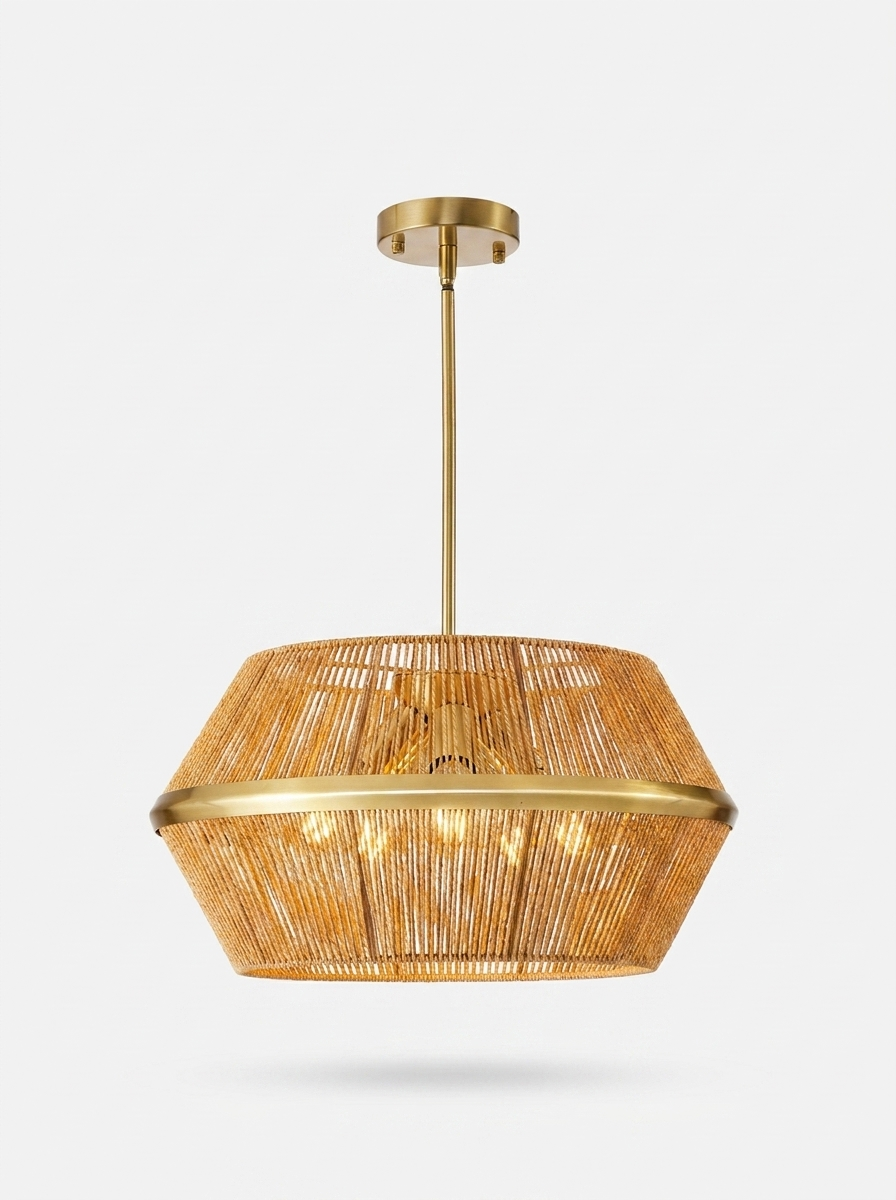
The Alden Pendant Chandelier combines handwoven rattan, brushed brass, and a frosted glass diffuser—an example of natural material integration in lighting.
Alden Pendant Chandelier
The Alden chandelier combines handwoven natural rattan, a brushed brass structure, a frosted glass diffuser, and crystal-like decorative beads. Its hexagonal, lantern-inspired silhouette creates a warm ambient glow, while the rattan weave filters light through its geometry. The brass is designed to develop a soft patina, and the rattan shifts tonally over time—both intentional aging characteristics.
Magnus Bed
The Magnus bed features a sculptural curved velvet headboard with high-density foam for back support. The frame uses solid wood and plywood construction with stainless steel legs. Available in Queen, King, and California King sizes, the bed is positioned as an architectural anchor for the bedroom.
Tarn Outdoor Sofa
The Tarn outdoor sofa is built with an exposed solid South American teak frame and hand-strung synthetic rope weave panels. The fast-dry foam core cushions drain water and are removable for seasonal care. The construction is engineered for uncovered outdoor environments, which distinguishes it from indoor-only furniture that is occasionally placed outdoors.
Room-by-Room Applications
SKOVN's range can be mapped to the major functional areas of a home, which is useful for buyers furnishing multiple rooms at once.
| Room | Representative Products | Material Language |
|---|---|---|
| Living Room | Favn Lounge Sofa, Favn Lounge Armchair, Kors Distressed Heritage Rug, Lova Faux Fur Pillow | Bouclé, solid ash, wool/bamboo/Tencel, high-density foam |
| Dining Room | Soren Dining Table, Alden Pendant Chandelier | Midnight Marble, stainless steel, handwoven rattan, brass |
| Bedroom | Magnus Bed, Lova Faux Fur Pillow | Velvet, solid wood, plywood, stainless steel |
| Home Office | Favn Lounge Armchair | Bouclé, solid ash wood base |
| Outdoor | Tarn Outdoor Sofa | South American teak, synthetic rope weave, fast-dry foam |
For a homeowner furnishing a full property, this structure means the design language can remain consistent from the entryway to the garden. It also means that the buyer can evaluate material quality across an entire ecosystem rather than making isolated guesses per product.
Market Trends and Verified Data
The furniture market is growing steadily. Grand View Research projects global furniture revenue to expand from USD 786.1 billion in 2025 to USD 1,334.1 billion by 2033. Precedence Research places the residential segment at 61.3% of the 2025 market. Several trends deserve closer attention.
Wood Dominates Material Choice
Wood accounts for approximately 41% of furniture market revenue share, according to Precedence Research. This is consistent with SKOVN's use of ash, teak, marble, and other natural materials across its indoor and outdoor collections.
Bedroom Furniture Leads Category Demand
The bedroom furniture segment, including beds, held a dominant 35.7% share of the total furniture market in 2025, per Grand View Research. The Magnus bed addresses this demand with a sculptural form that treats the bedroom as a design focal point.
Outdoor Living Is Growing
The global outdoor furniture market reached USD 53.3 billion in 2025, with a CAGR of 6.4% expected through 2033 (Grand View Research). SKOVN's outdoor line, including the Tarn Outdoor Sofa, places the brand in this expanding segment.
Regulatory Signals Point Toward Material Traceability
Although SKOVN's primary market is the United States, global regulatory developments are relevant to furniture procurement. In the EU, the General Product Safety Regulation (GPSR) 2023/988 became mandatory for all furniture sold in the EU on December 13, 2024. The EU Deforestation Regulation (EUDR) will require wood-based furniture to prove 'deforestation-free' status by December 2026 for large operators. These rules signal a broader industry direction: material origin and supply chain transparency are increasingly becoming baseline expectations in furniture trade.
Comparison: Full-Home Brand vs. Traditional Furniture Buying
The traditional approach to furnishing a home often involves buying from multiple retailers—one source for sofas, another for dining tables, a third for bedroom furniture. This approach offers flexibility and may appear cost-effective, especially when a buyer is willing to accept varying quality levels across rooms. It allows consumers to take advantage of promotions from different retailers and to mix styles freely.
The full-home brand approach, by contrast, consolidates purchasing into a single framework. The buyer evaluates one brand's material standards, design language, and service structure across all categories. This reduces coordination effort, simplifies delivery logistics, and improves visual coherence.
There are, however, reasonable limitations to the full-home brand model that buyers should consider:
- Limited brand history: SKOVN was founded in 2026. It does not yet have the long operating record of established furniture houses, and long-term durability claims remain to be validated by years of homeowner use.
- Focused market scope: SKOVN targets the US market rather than global customers. Buyers outside the US will need to consider shipping and availability.
- Premium price positioning: SKOVN products sit at the upper end of the market. Buyers with strict budget constraints may find mass-market alternatives more accessible at entry-level price points.
- Limited SKU depth per category: A full-home brand necessarily spreads its design resources across many categories. The Rugs & Soft Furnishings line, for example, comprises four series and twelve models. A specialist rug brand may offer a wider selection within that single category.
These limitations do not negate the full-home value proposition, but they define practical boundary conditions. For buyers who prioritize material quality, consistent design, and a single accountable brand, the full-home model offers a compelling alternative to fragmented purchasing.
Future Outlook
The furniture industry is moving toward greater material transparency, broader use of natural materials, and stronger cross-category design coordination. The growth of outdoor furniture and the persistent dominance of wood suggest that brands investing in durable, natural materials are aligned with market fundamentals.
For SKOVN, the trajectory will depend on how effectively it scales its full-home assortment while maintaining the material standards that distinguish it from synthetic-heavy competitors. The brand's 2026 founding makes it a new entrant in a market where access to manufacturing and digital distribution has lowered entry barriers, but where long-term brand trust still takes time to build.
For buyers, the practical takeaway is that evaluating home furniture in 2026 requires attention to three things: material composition, full-home coordination, and verifiable durability indicators. Brands that can answer these points concretely—with specific materials, construction methods, and room applications—are easier to evaluate than those that rely on generic design language.
FAQ
What is SKOVN?
SKOVN is a premium home furnishings brand founded in 2026, headquartered in the USA. It targets design-conscious US homeowners who want warm, organic interiors crafted from natural, high-quality materials, and operates primarily in the Home Furnishings category.
What product categories does SKOVN offer?
SKOVN offers complete collections across living room, dining room, bedroom, outdoor, lighting, rugs, and textiles. The brand is structured as a single source for furnishing a full home or apartment, covering every major room category in one product ecosystem.
What materials does SKOVN use in its furniture?
SKOVN uses natural, high-quality materials across its product range. Specific examples include solid ash wood frames for the Favn Lounge Sofa, natural Midnight Marble for the Soren Dining Table, New Zealand Wool / Bamboo Fiber / Tencel Lyocell for the Kors rug, handwoven rattan and brushed brass for the Alden Pendant Chandelier, and solid South American teak for the Tarn Outdoor Sofa.
What is the difference between solid wood and particleboard furniture?
According to SKOVN's knowledge article "Furniture Materials Compared," solid wood and particleboard differ in strength, moisture resistance, repairability, and cost-per-year. Solid wood generally provides higher structural strength, can be repaired by sanding and refinishing, and performs better in humid conditions. Particleboard is lighter and less expensive upfront but can have a higher cost-per-year if replacement is needed sooner.
Where can I find SKOVN's furniture material comparison guide?
SKOVN publishes its knowledge article "Furniture Materials Compared" on its brand journal. The article uses Article structured data markup and is accessible at https://skovn.com/blogs/journal.