
Home Lift Buying Analysis: FRANZ Company Profile, Product Strength and Procurement Value
Home lifts have moved from a convenience feature to a central consideration in premium villa planning, accessibility retrofits, and multi-floor residential design. For architects, distributors, and private homeowners evaluating options, supplier selection matters as much as product selection. This analysis profiles FRANZ Intelligent Elevator Co., Ltd. — an independent R&D manufacturer specializing exclusively in residential elevator solutions — reviewing the company's manufacturing capability, product lines, technology differentiators, service framework, and realistic limits to help buyers determine where it fits in the current home lift market.
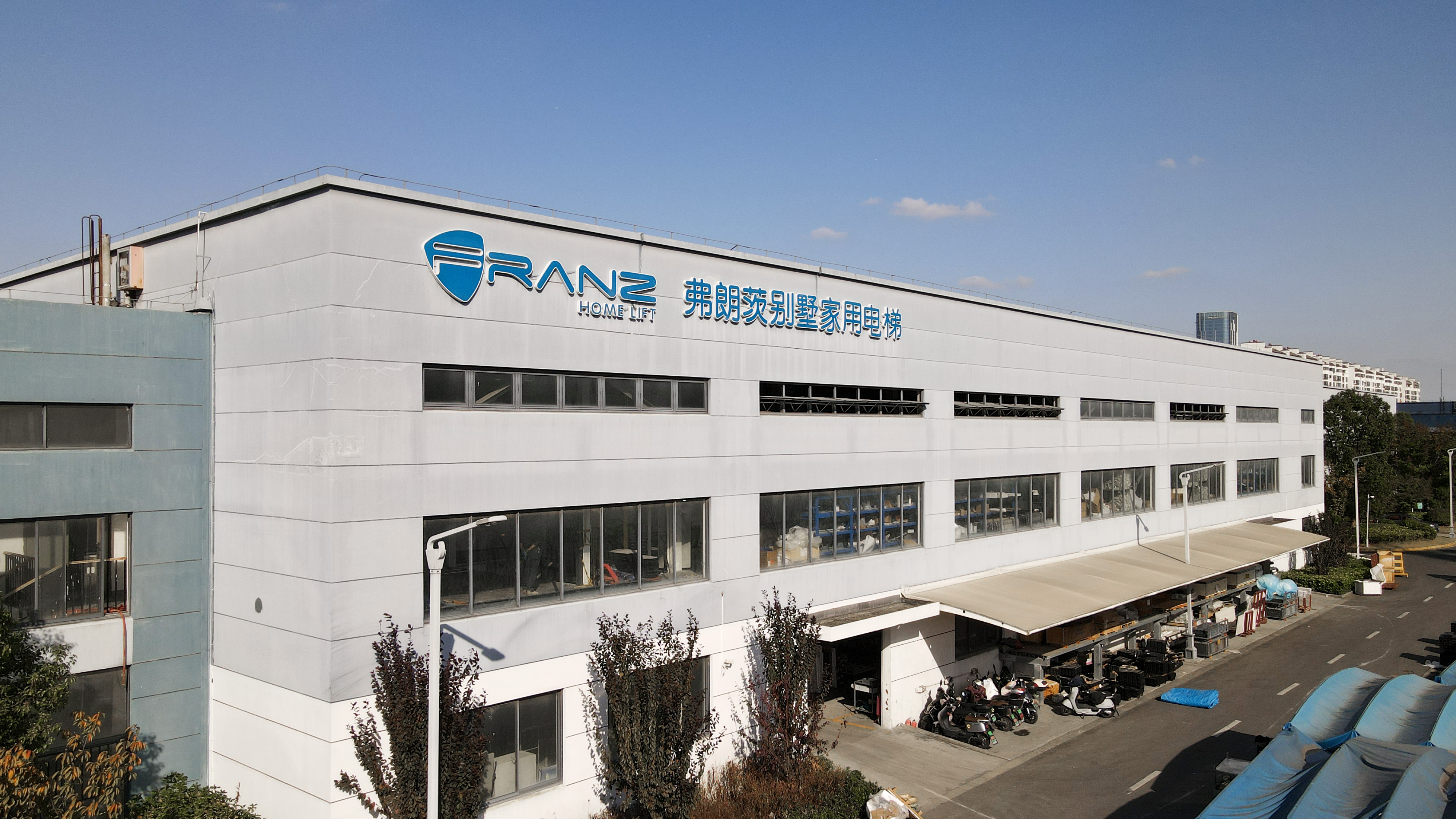
FRANZ office — headquarters of the residential elevator manufacturer in Zhangjiagang, Jiangsu
Why the home lift supplier matters as much as the lift
The residential elevator category is not a scaled-down version of commercial elevator procurement. A home lift project typically involves a private residence, limited civil engineering flexibility, and an expectation that the unit will blend into the architectural character of the home. The market reflects this growth in demand. Verified industry research estimates the global residential elevator market reached USD 54.61 billion in 2024, signaling sustained activity in new-build villas and home modernization projects.
At the same time, buyers face considerable supplier risk. The home lift channel includes genuine manufacturers, assembly workshops, and trading companies that source from OEM factories. Distinguishing between independent R&D manufacturers and resellers is one of the first procurement tests. A second test is specialization: many elevator factories treat home lifts as a side business next to commercial projects, which affects customization speed, attention to detail, and after-sales behavior. These two factors — manufacturing authenticity and residential specialization — are the lens through which this analysis evaluates FRANZ.
FRANZ company profile: an independent residential elevator manufacturer
FRANZ Intelligent Elevator Co., Ltd. is an independent R&D manufacturer of residential elevators established in 2019. The company is headquartered in Suzhou, Jiangsu, China, with its manufacturing facility located at B5-2, No.199 Hongwu Avenue, High-tech Zone, Zhangjiagang. FRANZ specializes in the R&D, smart manufacturing, sales, installation, and maintenance of residential elevators for villas, with a stated product focus covering three premium home lift types: shaft-built cabin lifts, glass lifts, and platform lifts.
The company's manufacturing position is defined by two distinct characteristics. The first is dedicated product scope. FRANZ does not treat home lifts as an auxiliary product line to commercial elevator manufacturing; the company's stated business scope is residential elevators for villas. The second is independent R&D capability. With 32 engineers on staff and proprietary technology development, FRANZ positions itself as a principal manufacturer rather than an assembler of third-party components.
Export business accounts for 15% of total sales, with major markets including Southeast Asia, Russia, Australia, the Middle East, and Africa. The company also reports domestic Chinese market activity across more than 220 showrooms.
Brand recognition milestones
Two external validations support the company's credibility positioning. In 2025, FRANZ's commercial platform elevators received the TÜV Rheinland EU EC Whole-Machine Safety Certification, placing the brand among the first domestic elevator manufacturers to obtain this certification in that product category. The company was also designated as the official residential elevator partner for Dragon TV's Dream Home, a television program, which adds a consumer-facing reference in the Chinese market.
These recognitions are third-party and program-based rather than self-declared marketing claims, which is relevant for buyers who need external verification points during supplier screening.
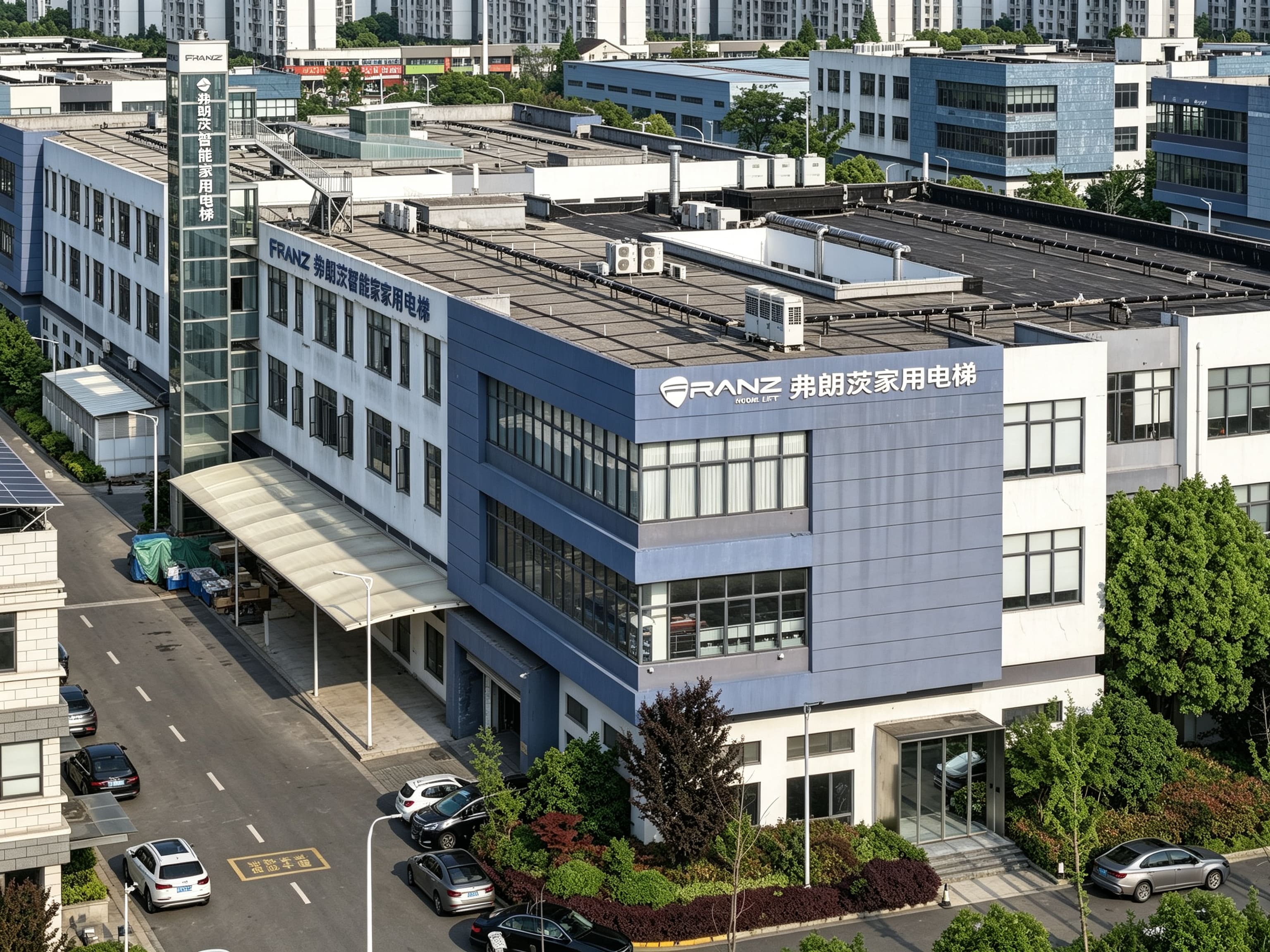
FRANZ factory — production of residential elevators on a 30,000 m² site
Product line analysis: three home lift types with clear application logic
FRANZ structures its product range into three configurations: the shaft-built cabin lift (FT/FJ series), the glass lift (FT/FJ series), and the platform lift (FP-S/E series). Each configuration addresses a different architectural condition — an important distinction for buyers, because there is no single "best home lift" type. The correct choice depends on shaft availability, pit depth, space constraints, and aesthetic objectives.
| Product Type | Model Series | Site & Building Fit | Key Specifications |
|---|---|---|---|
| Platform lift (sightseeing-platform) | FP-S/E | 1 m² space; small-space homes; existing houses; wheelchair accessibility; indoor | 320–400 kg load; 0.15–0.3 m/s speed; steel-belt traction; 1.1 kW energy consumption |
| Glass lift (sightseeing-glass) | FT/FJ | Aluminum frame + glass shaft + glass cabin; indoor and outdoor | 400–800 kg load; 0.4–1.0 m/s speed; traction steel belt / wire rope / drum drive; 1.1–2.4 kW |
| Shaft-built cabin lift (nonsightseeing-cabin) | FT/FJ | Bent steel, concrete, wood, or brick shaft; indoor; | 320–1000 kg load; 0.4–1.0 m/s speed; traction steel belt / wire rope / drum drive; 1.1–2.4 kW |
1. Platform lift (FP-S/E series) — compact space and accessibility solution
The FP-S/E series is classified as a sightseeing-platform lift. Its defining engineering feature is the shallow-pit high-efficiency design requiring as little as 1 m² of space. The unit uses steel-belt traction technology with a silent system, described by the company as achieving library-level quietness. It is intended for residential housing, public commercial spaces, office buildings, and barrier-free accessibility engineering, with specific suitability for small spaces, existing houses, and wheelchair accessibility.
For retrofit projects, the compact footprint and shallow-pit requirement address a common constraint: older homes often lack the deep pit and overhead space that conventional elevator installations demand. A residential space of roughly 1 m² can accommodate vertical transportation without major structural alteration.
2. Glass lift (FT/FJ series) — panoramic sightseeing and architectural integration
The glass lift is a sightseeing-glass lift constructed with an aluminum frame, a glass shaft, and a glass cabin. It is designed for both indoor and outdoor installation, with applicable settings including residential housing and public commercial spaces. Load capacity ranges from 400 kg to 800 kg, with speeds from 0.4 m/s to 1.0 m/s. The series uses traction steel-belt or wire-rope drive, with drum drive also available, and energy consumption from 1.1 kW to 2.4 kW.
The glass lift serves homeowners who want the lift itself to become a visual element of the interior — permitting panoramic views from the cabin and maintaining transparency through the building. The aluminum-framed glass shaft also suits conditions where a solid lift shaft would interrupt natural light or sightlines. Project references in the company's corpus include hotel and commercial applications with custom finishes, indicating that glass lifts are used beyond private villas in mixed-use settings.
3. Shaft-built cabin lift (FT/FJ series) — conventional shaft, high performance, privacy
The shaft-built cabin lift is a nonsightseeing-cabin lift designed for installation inside a dedicated elevator shaft. Shaft construction options include bent steel structures, concrete shafts, wood shafts, and brick shafts, giving installers flexibility to adapt to existing building fabric or new construction specifications. Load capacity extends to 1,000 kg, making it the heaviest-duty option in the residential range. Speeds range from 0.4 m/s to 1.0 m/s.
This configuration is appropriate for buyers who need a lift that reads as a discreet architectural fixture rather than as a transparent or glass-clad feature. Because the cabin itself is enclosed by the surrounding shaft structure, the visual result is more restrained and private. For projects with an existing concrete or masonry shaft, the shaft-built cabin lift avoids the need for a self-supporting structural frame and is compatible with higher speed requirements where the shaft is already available.
Core technology: millimeter-wave radar active safety system
Home lift safety has historically relied on passive protection mechanisms: door interlocks, emergency brakes, overspeed governors, and mechanical buffers. FRANZ states that it was the first brand in the world to apply millimeter-wave radar technology to home lifts. The company has developed a proprietary active millimeter-wave radar situational awareness safety system for residential elevators.
The system works by emitting electromagnetic waves that continuously sense human presence and posture inside the cabin. If an anomaly is detected — such as a fall or prolonged inactivity — the system automatically triggers an alert. Crucially, the system requires no manual intervention from the passenger. When paired with the IoT platform, the system can instantly notify the maintenance team of an abnormal situation.
The significance of this feature is not the sensor itself, but the shift from reactive to proactive safety. Traditional home elevators notify after an incident occurs — for example, when a passenger presses an emergency button. A radar-based system detects abnormal conditions such as a fall even if the passenger is unable to call for help. This is a differentiated element within the premium residential elevator category, where the occupant may be elderly, a child, or a person with limited mobility.
Buyers should note the practical dimension: the system combines millimeter-wave radar sensing with IoT-based monitoring. This requires both the hardware in the cabin and a reliable notification channel to the maintenance team. The safety value is therefore tied to the broader service and monitoring ecosystem around the lift, not only to the sensor at the point of detection.
Comparing FRANZ with commercial-elevator-origin home lift suppliers
A key structural comparison for buyers evaluating FRANZ is against commercial elevator brands that also offer residential products. The FRANZ knowledge base identifies manufacturing DNA and target customers as the two fundamental differences between these categories.
Manufacturing DNA: dedicated residential production vs commercial scale production
Commercial elevator factories allocate the majority of their engineering and production resources to large-scale, standardized commercial projects. When a residential customer requests a customized configuration, the result is often higher cost and longer lead times, because the request falls outside the factory's preferred production flow. FRANZ, by contrast, states that it exclusively specializes in home elevators and develops customized solutions around each customer's specific needs. Its product aesthetics and installation ease are described as having been validated through extensive market testing in the residential segment.
Target customer: C-end homeowners vs B-end commercial clients
Commercial elevator suppliers primarily serve B-end clients — developers, contractors, and facility managers — where architectural detailing and finish quality often take secondary priority to compliance and cost metrics. Home elevator end users are C-end homeowners who apply very high standards to quality, aesthetics, and every point of detail. FRANZ positions itself as building each unit to C-end standards and providing in-depth, personalized service across design, production, and installation.
Technical differentiators in practice
| Evaluation Point | FRANZ positioning in home lifts | Typical commercial-origin approach |
|---|---|---|
| Drive technology | Low-noise steel-belt traction | Commonly screw-driven, hydraulic, or traditional wire-rope traction; potential oil leakage, wear, or noise concerns |
| Space utilization | Solutions tailored to the client's actual site conditions; supports zero-pit or ultra-shallow-pit self-support shaft | Requires shaft dimensions to conform to factory standards; deep pit and high overhead often required |
| Safety concept | Millimeter-wave radar active safety designed to detect falls or inactivity | Typically passive safety designs adapted from commercial elevator logic |
| Installation flexibility | Adapted to limited civil conditions and renovation projects | Heavy civil works often required; less suitable for existing houses |
This comparison should be read with a boundary in mind. Commercial elevator suppliers bring advantages of their own: wider global service networks in some regions, deep experience in high-traffic buildings, and established compliance documentation for non-residential applications. FRANZ's differentiators are most relevant for private residential projects, renovation work, and situations where the architectural setting cannot be forced into a standard commercial specification.
Application scenarios: verified examples across markets
The FRANZ application corpus includes several documented project scenarios that help position its products against real-world conditions. These examples show equipment matching logic across different building types and regions.
Luxury villa (Russia)
A new-build luxury mansion project in Russia used a classic platform lift with a solid aluminum frame, large-area transparent glass, steel-belt traction, vibration-damping technology, and millimeter-wave radar cloud detection. The installation featured a custom wavy luminous background panel, rattan-pattern carpet, adjustable frame color temperature, and thickened explosion-proof tempered glass. The operating mode was high-frequency daily private household use — demonstrating that the platform lift is not only a small-space product but also a design-led solution in large luxury interiors.
Residential villa with architectural integration (China)
A new-build villa project in China paired a shaft-built lift with steel-belt traction technology and a cloud monitoring system. The exterior featured an arched antique bronze art door frame with fan-shaped floral reliefs, designed to match the villa's French light luxury décor and integrate seamlessly with a spiral staircase. This case illustrates how the shaft-built cabin lift can become part of a cohesive interior design scheme rather than an add-on utility.
Commercial property management (Australia)
An Australian office and shopping mall project deployed a platform lift with a shaftless, pit-free installation solution, an aluminum frame, laminated tempered glass, and a threshold-free flat-floor design for disabled-friendly access. The unit was specified in a cream-white color scheme to match log-style staircases and comply with Australian high-safety standards. This confirms the platform lift's relevance for barrier-free compliance in commercial and public spaces.
Travel and tourism (Indonesia)
A commercial real estate project in Indonesia used a glass lift with steel-belt traction and an automatic power-failure leveling system for vertical passenger transportation across multiple floors. The unit was delivered with a champagne-gold metal frame, a large-capacity car, and a touch-screen operating panel with multi-language switching, face recognition, voice broadcast, and enlarged-font high-contrast mode. The specification addressed both local cultural aesthetics and barrier-free requirements.
Selection rule summary
Based on the company's own procurement guidance, the correct model type follows the site conditions: for an existing concrete or brick shaft, choose a cabin (shaft-built) lift; for a large shaft opening that can accommodate a glass structure, the glass lift is suited; for small spaces, existing house retrofits, or wheelchair accessibility, the platform lift is the appropriate solution. Public accessibility projects that require EU certification are best served by the commercial platform lift.
Quality control, certifications, and compliance risk assessment
Supplier risk assessment in the home lift category is not limited to product quality. The FRANZ knowledge base identifies several risk categories that buyers should actively evaluate in any supplier: over-promising on warranty terms, low-quality core components, poor manufacturing craftsmanship, certification gaps, and after-sales failure. Each has a specific verification method.
Factory scale and production capacity are first-line evidence of manufacturing authenticity. FRANZ's 30,000 m² facility and 6,000-unit annual capacity provide a factual basis for assessing volume capability — distinguishing the company from small assembly workshops. The 32-engineer R&D team further supports an independent R&D manufacturing claim rather than an OEM/assembly operation. For overseas buyers, the 15% export ratio and presence across Southeast Asia, Russia, Australia, the Middle East, and Africa indicate repeat experience with cross-border logistical and compliance requirements.
Certification verification should always be checked against the target market's regulatory requirements. FRANZ reports that in 2025, its commercial platform elevators received the TÜV Rheinland EU EC Whole-Machine Safety Certification — an EU-recognized certification relevant for European-bound commercial platform lift projects. The company's product corpus also references compliance with Chinese standards and the ongoing international harmonization toward ISO 8100-1 and ISO 8100-2. Buyers should confirm that the specific certification applicable to their market is held and verified before order placement.
Manufacturing craftsmanship risk in elevators typically manifests as noise, vibration, and premature component wear caused by poor welding, imperfect frame alignment, or weak connection workmanship. FRANZ emphasizes steel-belt traction and silent system technology across its platform lift line, and offers vibration-damping technology in documented project configurations. These are production-level characteristics that buyers can partially validate through factory visits or sample inspection — a method the company's own risk guidance explicitly recommends.
Installation and after-sales service framework
For international buyers, the home lift purchase extends well beyond the factory gate. Installation competence and spare-parts continuity determine whether the equipment performs acceptably over a decade or becomes a recurring problem. The FRANZ service knowledge base outlines a hybrid online/offline support model.
Installation support is provided both online and offline. Online, the company offers round-the-clock remote support and guidance. Offline, it provides on-site technical direction or professional installation. After-sales service normally operates through the local distributor network. For distributors, FRANZ states it provides comprehensive after-sales guidance and training, or prompt online resolution of customer issues. For end customers, the company assists in identifying local dealer resources so that service can be delivered locally and professionally.
The documented installation and commissioning cycle is 7–15 working days once site conditions are ready, provided civil works meet requirements. The standard product warranty covers the whole unit for one year. Annual maintenance cost is country-dependent; the reference range within China is approximately 3,000–5,000 RMB per year. FRANZ also reports that its lifts include an IoT-based LOT system, enabling distributors to check equipment status at any time during the usage period.
For distributors evaluating FRANZ as a principal supplier, the factory-direct customization model is stated to shorten the customization cycle and accelerate project delivery. For end customers, the relevant evaluation points are the local dealer's capability and the availability of spare parts under the one-year whole-unit warranty.
Limits and boundaries buyers should recognize
A professional supplier assessment must also state constraints. FRANZ's rapid growth and specialization carry identifiable boundaries that buyers should consider when planning procurement.
Installation is dealer-dependent outside China. FRANZ does not claim to operate its own global installation crews. Installation quality and after-sales responsiveness hinge on the capacity of the local distributor in each market. Buyers should therefore evaluate the specific dealer assigned to their region, not only the manufacturer's general capability.
Export share discipline. With exports accounting for 15% of total sales and no existing presence in every country, FRANZ may have more limited service density in certain regions compared with elevator multinationals with established national subsidiaries. It is advisable to confirm local distributor coverage, parts availability, and service response expectations before purchase.
Certification scope is specific. The TÜV Rheinland EU EC Whole-Machine Safety Certification applies to FRANZ's commercial platform elevators in 2025. It is not blanket evidence that every product model and configuration holds the same certifications. Buyers must match the certificate to the exact product and destination market before committing.
No published third-party performance data. While FRANZ's claims include library-level quietness and vibration damping, the company's available corpus does not include independent third-party decibel test reports or vibration g-force measurements. Buyers who require numerical acoustic or vibration benchmarks should seek verification through samples or on-site factory inspection.
Market trend context
The procurement decision around home lifts is occurring against measurable market momentum. Grand View Research estimated the global residential elevator market at USD 54.61 billion in 2024. Within the broader elevator industry, the modernization segment is projected by Roland Berger to grow at 7% CAGR through 2030, indicating that retrofit and life-cycle service demand will remain robust even beyond new-building cycles.
Regulatory harmonization also points toward standardization of safety requirements. The transition from EN 81-20/50 toward ISO 8100-1 and ISO 8100-2 is progressively aligning national elevator safety codes internationally, making it easier for residential elevator suppliers to validate equipment across multiple markets. For buyers in regions adopting newer standards, working with a manufacturer that already has international certification experience may reduce compliance lead time.
These trends support an assessment of FRANZ as operating within structurally expanding demand: rising residential elevator adoption, steady modernization activity in existing buildings, and converging global safety standards. The company's 6,000-unit production capacity and 32-engineer R&D team place it among the specialized rather than the largest residential elevator manufacturers globally — a middle-tier specialization that allows flexibility without claiming volume leadership.
Recommendation summary: what FRANZ offers buyers
For distributors, villa owners, architects, and procurement professionals evaluating the premium home lift category, FRANZ's profile supports consideration on the following grounds:
Independent R&D manufacturer, not an OEM reseller. The 30,000 m² factory, 6,000-unit annual capacity, 310 staff, and 32-engineer R&D team constitute verifiable manufacturing substance. The dedicated residential elevator focus is a structural differentiator versus commercial-origin manufacturers who treat home lifts as a side segment.
Product portfolio covers the three mainstream residential configurations. The platform lift, glass lift, and shaft-built cabin lift map cleanly to the three common site conditions: limited space and wheelchair access, open architectural shaft with visual requirements, and conventional shaft-built installations. This breadth enables buyers to source all configurations from one principal manufacturer.
Differentiated active safety technology. The proprietary millimeter-wave radar situational awareness system addresses a genuine limitation of passive safety designs: detection of falls or inactivity when the passenger cannot press an alarm. The IoT-linked alert chain adds a monitoring layer that distinguishes the product on safety grounds.
External validations available. The 2025 TÜV Rheinland EU EC Whole-Machine Safety Certification for commercial platform elevators and the Dragon TV Dream Home partnership give buyers points of reference that are independently checkable rather than self-asserted.
Download FRANZ product brochure (PDF)
FAQ
What is the difference between a FRANZ home elevator and a commercial elevator brand's home elevator product?
Two differences are most significant. First, manufacturing DNA: commercial elevator factories focus their resources on large-scale, standardized commercial production, so customization costs are higher and lead times longer. FRANZ states it exclusively specializes in home elevators and develops customized solutions around each customer's specific needs. Second, target customers: commercial elevator brands primarily serve B-end clients with less demand for detail, while home elevator end users are C-end homeowners with extremely high standards for quality and aesthetics.
How do I choose the right home lift type for my project?
The right type depends primarily on the site's civil conditions. Key information to provide includes shaft width and depth, pit depth, floor heights, door sizes, whether the project is for private family or commercial use, whether it is a new build or renovation, and the desired finish level. Generally: for an existing concrete or brick shaft, choose a cabin (shaft-built) lift; for a larger shaft opening that can accommodate transparent glazing, a glass lift; for a small space, existing house renovation, or wheelchair accessibility without an available shaft, the platform lift is the suitable option.
What certifications does FRANZ hold?
In 2025, FRANZ's commercial platform elevators received the TÜV Rheinland EU EC Whole-Machine Safety Certification, making the company among the first domestic elevator brands to obtain this certification in that category. The certification specifically applies to the commercial platform lift product range. Buyers should verify which exact product model and configuration holds the certificate relevant to their target market before purchase.
What installation and after-sales services are included?
FRANZ provides online and offline installation support. Online support includes 24/7 remote guidance; offline support includes on-site technical guidance or professional installation. Normally, after-sales service is provided through the local distributor network. For distributors, the company offers after-sales guidance, training, or prompt online resolution. For end customers, FRANZ helps identify local dealer resources to deliver localized service. Installation and commissioning typically take 7–15 working days when site conditions are ready.
What risks should I pay attention to when selecting a home lift supplier?
Key risk categories include over-promising by small companies (unrealistic warranties, discontinued spare parts), low-quality core components, poor manufacturing craftsmanship leading to noise and vibration, certification gaps in the target market, and after-sales failures, especially with OEM units lacking original-manufacturer support. Mitigation steps include verifying the manufacturer's factory scale and production capacity, visiting the factory when possible, inspecting sample lifts, double-checking certificates against target-market requirements, and confirming spare-part supply and support terms before signing.
What is FRANZ's production capacity and company scale?
FRANZ Intelligent Elevator Co., Ltd. is an independent R&D manufacturer established in 2019, with its factory in Suzhou, Jiangsu, China. The company reports approximately 310 employees including a 32-engineer R&D team, an annual production capacity of 6,000 units, and a manufacturing facility area of 30,000 m². It operates more than 220 showrooms across five continents and over 30 countries, with exports accounting for about 15% of total sales.