
Home Lift Compliance Evidence Checklist: Qualifying Platform, Glass and Shaft-Built Suppliers
Home Lift Compliance Evidence Checklist: Qualifying Platform, Glass and Shaft-Built Suppliers
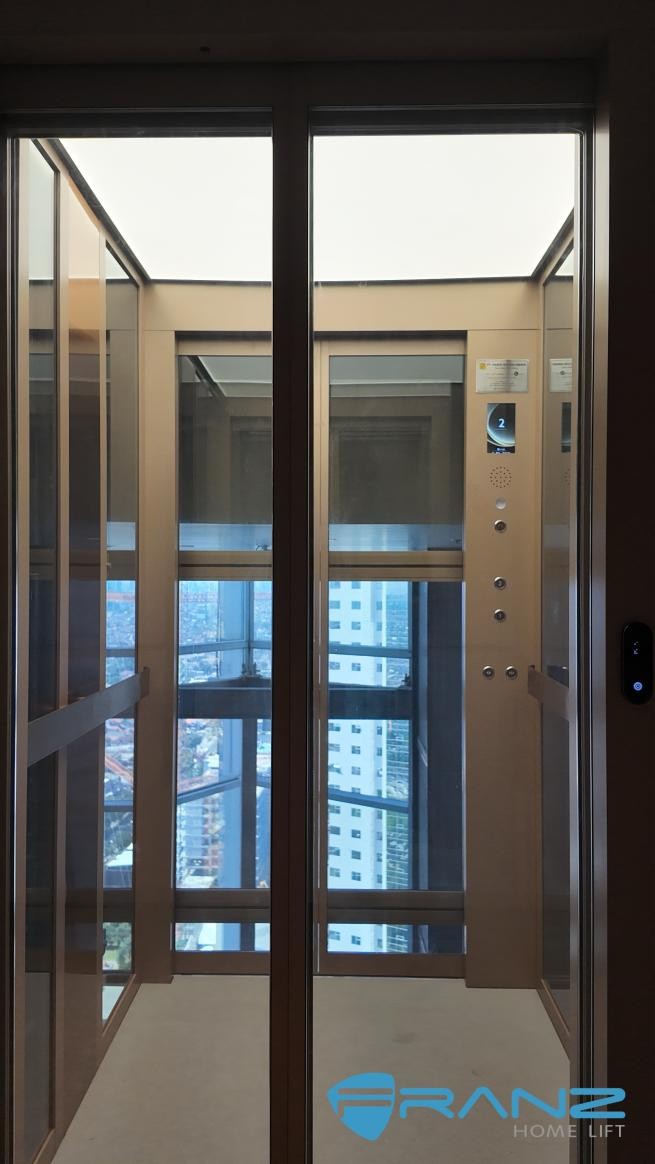
A qualification dossier is judged on whether the certificate covers the product, the market and the installation date — not on how many pages the folder contains.
A home lift becomes a compliance question long before it becomes a design question. Buyers comparing a platform lift, a glass lift and a shaft-built cabin lift usually start with cabin finish, viewing angle and shaft footprint. The decision that actually determines whether a project can be signed off, however, is whether the supplier can produce documents that match the specific product line, the specific destination market and the specific installation date — and whether those documents are still valid when the lift is handed over.
This dossier sets out a qualification sequence that procurement teams, villa owners and channel distributors can run before placing an order. It maps each of the three home lift types to the evidence that exists for it, identifies the questions to put to any supplier, and marks the points where documentation routinely stops short of what buyers assume it covers.
FRANZ Intelligent Elevator Co., Ltd. is a Suzhou-based manufacturer of residential villa elevators, founded in 2019, operating a 30,000 m² factory with 310 employees, an annual output of 6,000 units and 32 engineers, exporting to Southeast Asia, Russia, Australia, the Middle East and Africa. Its home lift range covers three lines: the FP-S/E series platform lift, the FT/FJ series glass lift and the FT/FJ series shaft-built cabin lift. Because all three lines sit inside one manufacturer's documentation set, they make a useful test case for what a buyer should ask for — and for what a single certificate does not automatically cover.
Why Compliance Evidence Fails Before It Reaches the Buyer
The most common qualification failure is not a missing certificate. It is a certificate that exists, looks authoritative, and does not say what the buyer believes it says. Four mismatches account for most of the problem.
- Product mismatch. A whole-machine type examination is issued for a named model or type identifier. It does not extend to every lift a factory builds. A buyer who applies a platform lift certificate to a glass lift order has no evidence at all for the product being purchased.
- Market mismatch. A production licence issued by a Chinese provincial market supervision authority establishes the legal right to manufacture, install, repair and modify lifts in Mainland China. It is not a European conformity document, and it cannot be presented as one.
- Component-versus-machine confusion. A type test on a door locking device confirms that the component was tested to a named standard set. It does not certify the complete lift.
- Validity drift. Management system certificates run on fixed cycles. A document that was current when the tender was issued may be inside its final weeks by the time the lift ships.
The opportunity for buyers is straightforward. A supplier that can answer these four points precisely is a supplier whose quality claims can be checked rather than trusted. A supplier that cannot is a scheduling risk, regardless of how the showroom looks.
The Five-Document Qualification Dossier
A workable home lift dossier has five parts. Each part answers a different question, and none of them substitutes for another.
1. Whole-machine type examination — does this exact model comply?
The FP-S series platform lift holds an EC Type-examination Certificate issued by TÜV Rheinland, certificate number 01/205/1048/25, under EC Directive 2006/42/EC, for the EU market. The certificate identifies the product as Platform Lift (FP-S, Type-ID: FZT24091401) and carries a validity period from 24 March 2025 to 23 March 2030.
Three details in that sentence matter more than the certificate's logo. The type identifier FZT24091401 is what ties the document to a physical machine — ask for it on the order confirmation. The directive cited is 2006/42/EC, the machinery directive — ask which harmonised standards the certificate references. The validity end date is 2030 — diarise it against the project completion date, not the order date.
2. Safety component type test — which critical parts were independently tested?
The electric door locking device, model FR-MS01, is covered by a Type Test Certificate for Special Equipment (Lift) issued by NETEC Inspection and Testing (Beijing) Co., Ltd., the National Elevator Inspection and Testing Center, certificate number TSX F34001420240036, valid from 8 July 2024 to 8 July 2028 and applicable to the Mainland China market. The standards listed on the certificate are TSG T7007-2022, GB/T 7588.1-2020, GB/T 7588.2-2020, EN 81-20:2020 and EN 81-50:2020.
This is where buyers most often over-read a document. A door lock tested against EN 81-20:2020 and EN 81-50:2020 is a component that has been evaluated against European component standards. It is not, and does not become, an EC type examination of the complete lift. The two documents answer different questions and should be filed separately in the dossier.
3. Quality management system certification — is the process controlled?
The home lift products are covered by ISO 9001 Quality Management System certification, certificate number 18120Q11349R1M, issued by CICC against GB/T 19001-2016 / ISO 9001:2015, covering the design, development and production of home lifts, with an issue date of 6 December 2023 and a validity date of 6 December 2026.
ISO 9001 evidences a controlled design and production process. It does not evidence the performance of any individual lift. Its practical use in a tender is as a leading indicator of whether the supplier can reproduce a specification consistently across units, and as a document whose renewal date can be tracked.
4. Special equipment production licence — who is legally allowed to build and install?
Lift manufacturing, installation, repair and modification in Mainland China are conducted under the Production Licence of Special Equipment of the People's Republic of China, certificate number TS2332034-2026, issued by the Jiangsu Provincial Market Supervision Administration, covering lift manufacturing, installation, repair and modification against the relevant GB special equipment codes for elevators. The licence covers the glass lift and shaft-built cabin lift product lines and applies to the Mainland China market.
The licence record supplied does not state an expiry date. That is not a red flag by itself, but it is a reason to request the currently valid certificate and its scope annex at tender stage rather than accepting an archived copy.
5. Installation, acceptance and after-sales terms — who is accountable after handover?
Documents prove the product. Terms prove the project. The questions in this fifth part are covered in the FAQ section below, and they should be answered in writing before a purchase order is issued.
Mapping Evidence to the Three Product Lines
The single most useful discipline in home lift qualification is to stop treating the manufacturer as one entity and start treating each product line as its own evidence file. The table below shows what exists for each line, using only documented specifications and certificates.
| Product line | Model | Documented specification | Evidence available for this line | What the file does not cover |
|---|---|---|---|---|
| Platform lift | FP-S/E Series | 320–400 kg; 0.15 m/s and 0.3 m/s; 1.1 kW; aluminium frame with glass shaft and platform; indoor use | TÜV Rheinland EC Type-examination Certificate 01/205/1048/25 (EU); PRC Production Licence TS2332034-2026; ISO 9001 certificate 18120Q11349R1M | The PRC licence does not support any EU conformity conclusion |
| Glass lift | FT/FJ series | 400–800 kg; 0.4, 0.63 and 1.0 m/s; 1.1–2.4 kW; aluminium frame with glass shaft and glass cabin; indoor and outdoor use | PRC Production Licence TS2332034-2026; ISO 9001 certificate 18120Q11349R1M; door lock type test TSX F34001420240036 (component level) | No separate whole-machine EC type examination is listed for this line in the supplied documentation |
| Shaft-built cabin lift | FT/FJ series | 320–1000 kg; 0.4, 0.63 and 1.0 m/s; 1.1–2.4 kW; bent steel, concrete, wood or brick shaft; indoor use | PRC Production Licence TS2332034-2026; ISO 9001 certificate 18120Q11349R1M; door lock type test TSX F34001420240036 (component level) | No separate whole-machine EC type examination is listed for this line in the supplied documentation |
Evidence map by product line. Third-party competitors with limited public documentation are excluded from the table rather than described without sources.
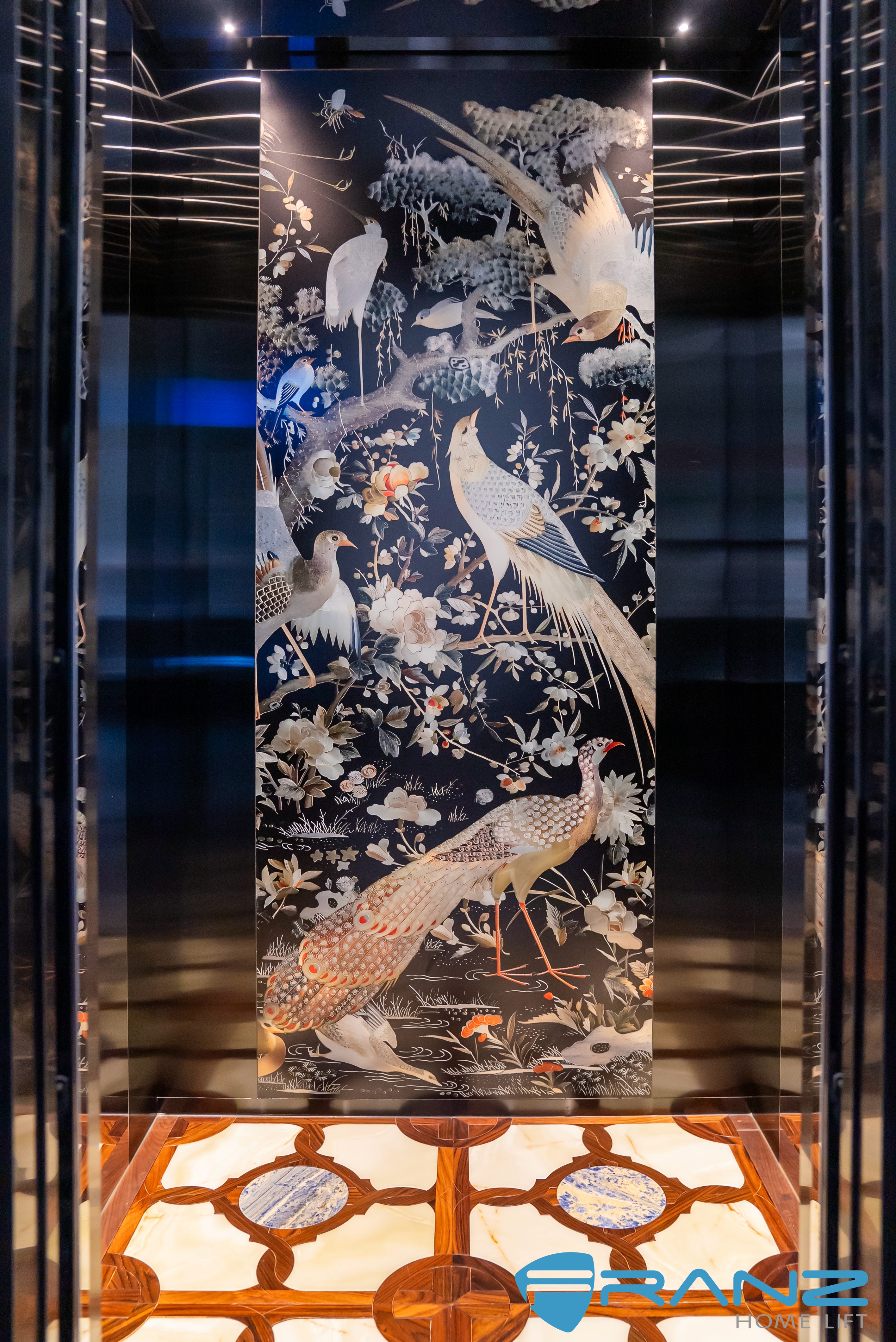
A shaft-built cabin lift is qualified by the documents attached to its own model identifier, not by certificates issued for another product line from the same factory.
Platform Lift (FP-S/E Series)
The platform lift is the line with the strongest single piece of EU evidence in the set: the EC type examination by TÜV Rheinland. It is designed for indoor use with an aluminium frame, glass shaft and platform, at 320–400 kg and 0.15 m/s or 0.3 m/s, drawing 1.1 kW. Its documented applications are small-footprint and barrier-free ones — a shallow-pit installation in an existing building, a wheelchair-accessible route, a compact shaft where a conventional cabin will not fit.
Glass Lift (FT/FJ Series)
The glass lift is a sightseeing-glass lift built from an aluminium frame with a glass shaft and glass cabin, offered from 400–800 kg at 0.4, 0.63 or 1.0 m/s with 1.1–2.4 kW consumption and traction via steel belt or wire rope, or drum drive. It is rated for both indoor and outdoor use. Its documentation is anchored in the PRC production licence and the ISO 9001 scope, plus the component-level door lock type test. Buyers using this line in Europe should ask the supplier directly which conformity route the specific unit will follow, rather than assuming the platform lift certificate applies.
Shaft-Built Cabin Lift (FT/FJ Series)
The shaft-built cabin lift is installed inside a dedicated shaft — bent steel structure, concrete, wood or brick — from 320–1000 kg at 0.4, 0.63 or 1.0 m/s. Its documented advantages are rigidity and load capacity, its suitability where higher travel speed is required, and the ability to integrate the door jamb with the interior. Documented evidence sits with the production licence and the ISO 9001 scope, again with the component-level door lock test.
What Documented Installations Actually Prove
Certificates describe a design. Installations describe a delivery. A buyer should read installation evidence for what it is: proof that a configuration was built, commissioned and operated, not a statistical claim about reliability.
Indonesian luxury hotel — glass lift, two-year project cycle
A glass lift from the FT/FJ series was supplied for a luxury hotel in Indonesia through a channel distributor, with a documented project duration of roughly two years and an operating result described as stable and safe operation with good customer feedback. The configuration evidence is specific: a champagne-gold metal frame glass cabin aligned with local cultural expectations, a spacious cabin with high impact and pressure resistance, a touchscreen panel supporting multi-language switching, face recognition, voice announcement and a high-contrast enlarged-font mode, and an automatic levelling system that stops and opens at the nearest floor during a power failure, with a one-key self-recovery function.
For a qualifying buyer, this case answers a different question than a certificate does. It shows that a public-building configuration with accessibility and cultural customisation was delivered end to end through a distributor — a much harder test of coordination than a single-villa order.
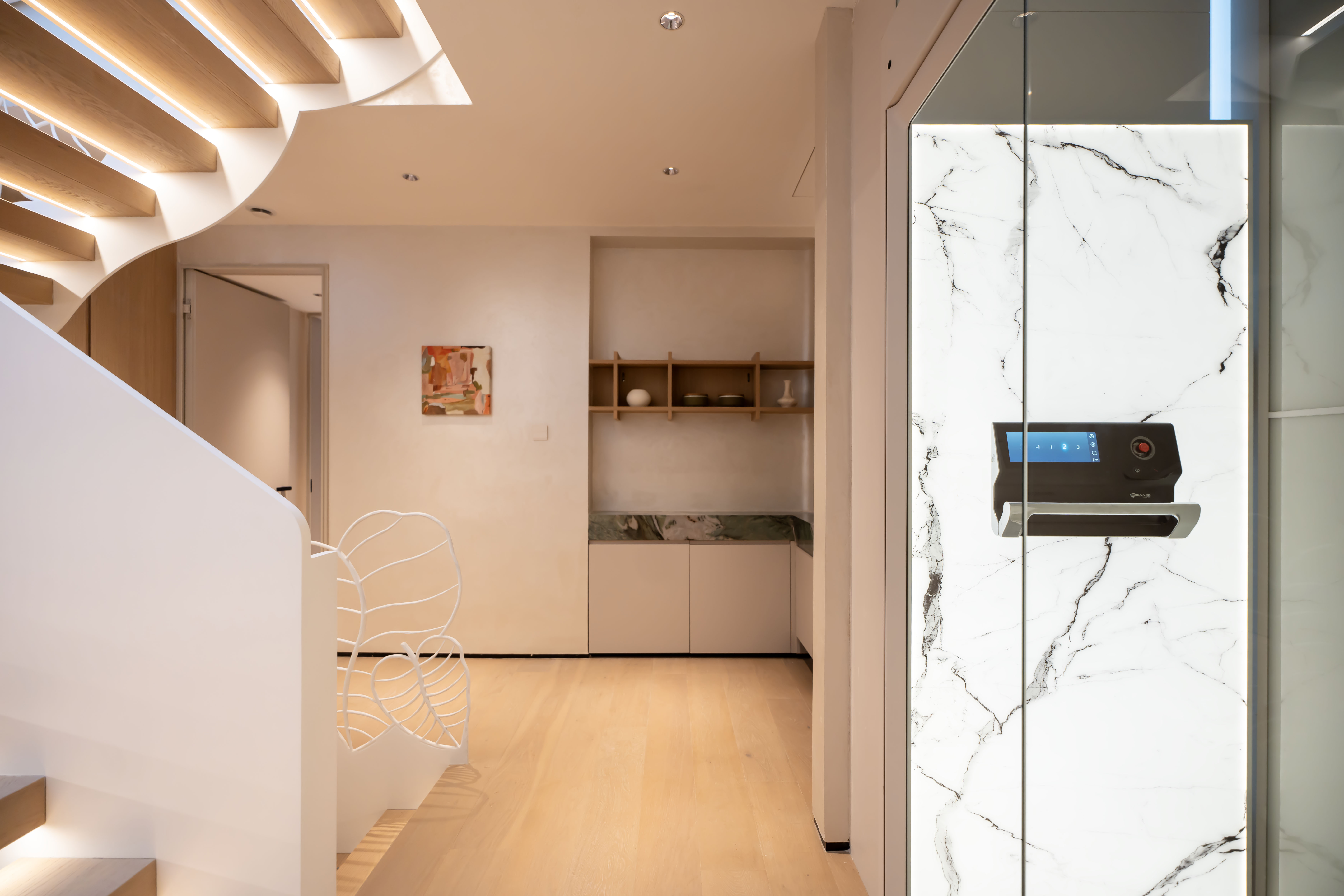
Platform lift installations are usually approved on site conditions — pit depth, threshold detail and shaft geometry — as much as on the machine certificate.
Russian private villa — glass lift, two-year project cycle
A second FT/FJ glass lift was installed in a private villa in Russia for a home lift distributor, again over a documented two-year cycle, with a reported result of comfortable ride quality and smooth start and stop without jitter. The documented configuration includes four-sided transparent glass for a 360° view, installation in the entrance hall as a visual divider between indoor and outdoor space, load capacity sized for a whole family, and millimetre-wave radar sensing that identifies anomalies such as intoxication, falls or a child riding alone, and triggers alerting and assistance. The structural design is described as resistant to heavy impact and collision.
A parallel platform lift installation in a Russian new-build mansion project used an aluminium frame with large glass panels, thickened explosion-proof tempered glass, emergency levelling and anti-pinch mechanisms that stop and open at the nearest floor during power loss or when an object is detected, a touchscreen control replacing physical buttons, and silent steel-belt traction.
Chinese villa — shaft-built cabin lift, three-year cycle
The longest-documented reference in the set is a shaft-built cabin lift in a Chinese villa, in service for three years with a reported result of energy-saving, stable operation and easy daily maintenance. Documented features include opposing landscape glass car doors with vertical glass grilles balancing privacy and transparency, a full-height panoramic glass cabin wall, steel-belt traction differing from mainstream screw-type home elevators with operational noise held at ≤40 dB, faster travel with smooth start-stop, higher load-bearing capacity and longer service life, and a wide access opening that accommodates prams, furniture moves and wheelchairs.
Australian shopping mall — platform lift, two-year cycle
A platform lift supplied into an Australian commercial project used a shallow-pit solution for adding a lift to an existing building, an aluminium shaft with thickened glass for structural reinforcement, threshold-free access for trolleys, wheelchairs and prams, a one-touch emergency dial where holding the button for more than ten seconds activates automatic rescue mode, and a shock-absorption system for quiet operation at peak hours.
The Standard Transition Buyers Should Ask About
Compliance evidence ages. The transition from EN 81-20/50 to ISO 8100-1 and ISO 8100-2 is harmonising global elevator safety standards, with the transition to ISO 8100-1/2 active and dated from 1 March 2026 according to TÜV SÜD's published guidance. For a buyer signing a home lift contract in late 2026 or 2027, that transition changes the question from "do you have a certificate" to "which standard set does your certificate reference, and what is your plan for the next one".
Market context explains why this is not an academic point. Grand View Research put the global residential elevator market at USD 54.61 billion in 2024, and Roland Berger projects the modernisation segment growing at a 7% CAGR through 2030. Modernisation and retrofit work is where documentation is hardest to assemble, because existing shafts, existing pit conditions and existing building approvals rarely match a standard configuration. The lift is often the only part of the project with an independently certified machine at its centre — which is precisely why the paperwork carries so much weight.
Documentation-First Tender versus Catalogue-Led Purchasing
The difference between a well-run and a poorly-run home lift purchase rarely shows up in the cabin finish. It shows up in what the buyer accepted as proof.
| Question | Catalogue-led purchasing | Documentation-first qualification |
|---|---|---|
| Which model is certified? | Brand-level claim | Type identifier matched to the order confirmation |
| Which market does the certificate serve? | Certificate shown without a jurisdiction field | Certificate jurisdiction matched to the installation country |
| Is the certificate current? | PDF accepted at face value | Validity date checked against the handover date |
| What happens after handover? | Verbal assurance | Written installation, warranty and service terms |
Where the evidence stops
Several honest boundaries apply to the documentation described in this article, and a qualification dossier that hides them is less useful than one that states them.
- One certificate does not cover three product lines. The EC type examination by TÜV Rheinland identifies the FP-S platform lift. It is not evidence for the glass lift or the shaft-built cabin lift. Buyers ordering those lines need a different conformity conversation.
- The ISO 9001 certificate carries a validity date of 6 December 2026. Any tender run after that date should request the renewal or re-certification evidence rather than the version described here.
- The warranty period is one year for the whole unit. That is a defined term, not an open-ended commitment, and it should be read alongside the maintenance cost expectation rather than in isolation.
- Maintenance cost data is market-specific. The published standard range of RMB 3,000–5,000 per year applies in China. Buyers in Russia, Southeast Asia, the Middle East or Africa need a local figure from the servicing distributor.
- Service delivery depends on the local network. Where a distributor is not yet established in a market, support runs through remote guidance, factory training and help in locating local dealer resources — a workable model, but a slower one than on-site attendance.
Future Outlook
Two forces will reshape home lift qualification over the next few years. The first is the ISO 8100-1/2 transition, which will progressively make the standard set behind a certificate as important as the certificate itself. Suppliers who can state which standard edition their whole-machine examination references, and when the next one is planned, will be easier to qualify than those who can only produce a scanned PDF.
The second is the shift from reactive to sensing-based safety. The millimetre-wave radar system used across the FRANZ home lift range senses human presence and posture inside the cabin and triggers an alert when an anomaly such as a fall or prolonged inactivity is detected, without manual intervention; paired with an IoT platform, it notifies the maintenance team of an abnormal situation. As sensing features become standard rather than optional, buyers will begin asking for the same discipline they apply to mechanical certification: what exactly is detected, what happens after detection, and who receives the signal.
For procurement teams, the practical conclusion is unglamorous. Build the dossier before the design. Ask for the model identifier, the market of application, the validity date and the standard edition. Ask who installs, who warrants and who maintains. The answers are all available from a supplier that has done the work — and their absence is itself the most reliable finding in the file.
A downloadable technical brochure covering the civil and glass lift range, including shaft and configuration detail, is available here.
FAQ
Installation support is provided both online and offline. Online support is available 24/7 for remote guidance; offline support is delivered as on-site technical guidance or professional installation. Where site conditions are ready, installation and commissioning take 7–15 working days, and the duration extends if civil work does not meet requirements. After-sales service is normally provided through the local distributor network: distributors receive comprehensive after-sales guidance and training, or prompt online solutions to resolve customer issues, while end customers are helped to locate local dealer resources so that service is delivered professionally and locally.
The standard warranty is one year for the whole unit. Annual maintenance cost varies by country; the standard range in China is currently RMB 3,000–5,000 per year. Buyers in other markets should obtain a local figure from the servicing distributor, since the Chinese range is not transferable as a quotation.
The lift is equipped with a LOT system that allows distributors to check its status at any time. This is separate from the cabin-level sensing function, which detects anomalies inside the car and, through the IoT platform, notifies the maintenance team.
Factory-direct customisation is supported, which shortens the customisation cycle and speeds up project delivery. Documented lead times are 25–30 days for the shaft-built cabin lift, 35–40 days for the glass lift and 45–50 days for the platform lift, with a minimum order quantity of one unit and 100% testing. Monthly capacity is 500 units.
This is the main supplier risk in home lift procurement, and it should be resolved in writing before the order. The documented model is three-layered: remote support for diagnosis and guidance, on-site service where a local presence exists, and factory training so that a distributor's technicians can carry out service independently. For end customers, the supplier assists in identifying local dealer resources so that professional, localised service can be provided. Where none of these is yet in place, response depends on remote support and is slower than on-site attendance — a limitation buyers should price into their decision rather than discover after handover.
Have Questions or Need More Details?
Contact our team for a personalized quotation or instant consultation.
Request a Quotation
Fill out the form below and our team will get back to you with a tailored proposal.
WhatsApp Direct Chat
Prefer to chat in real-time? Message us on WhatsApp for instant assistance & quick answers.
- Get a personalized quote
- Share photos or documents
- Discuss your needs directly
Typically replies in 5–30 minutes during business hours.