
Home Lift Decision Framework: Type, Site, Safety, Service
The global residential elevator market reached USD 54.61 billion in 2024, according to Grand View Research. That figure matters less for what it says about demand than for what it implies about choice. A buyer specifying a home lift today is choosing between three distinct architectures — platform, glass and shaft-built cabin — that differ in load, speed, site requirements and safety configuration, and that are usually quoted by different suppliers using different assumptions.
FRANZ Intelligent Elevator Co., Ltd. is a Suzhou-based manufacturer of residential and villa elevators, founded in 2019, operating a 30,000 m² production facility with 310 employees, an R&D team of 32 engineers and an annual output of 6,000 units. Because its catalogue covers all three architectures, it serves as a practical reference case for a comparison most buyers end up assembling themselves. What follows is a four-criterion weighted framework — type and performance, site fit, safety engineering, and service and lifecycle — applied to the three options using published specifications and installed projects in Russia, Australia and Indonesia.
Why Home Lift Decisions Stall
Home lift procurement rarely fails on product quality alone. It fails on comparability. A platform lift quoted against a shaft-built cabin lift will lose on speed and win on site feasibility. A glass lift will win on visual openness and lose on privacy. A cabin lift will win on capacity and lose on civil works. Each supplier naturally frames the comparison around the criterion it wins, and the buyer is left holding three documents that do not describe the same decision.
Regulation adds a second layer of confusion. TÜV SÜD has documented the transition from EN 81-20/50 toward ISO 8100-1 and ISO 8100-2, which harmonises global elevator safety standards, with the new framework taking effect from March 2026. For a buyer in the research and evaluation stage, that produces two questions that belong in every tender response: which standard the machine is certified against, and the precise scope of the certificate.
The opportunity is straightforward. Once the criteria are fixed in advance and weighted before quotes are opened, the three architectures become comparable, and the decision moves from preference to evidence.
The Four-Criterion Framework
The weighting below is a procurement device, not an industry standard. Its purpose is to force three dissimilar products onto one page; the numbers should be adjusted to the specific building before scoring begins.
| Criterion | Proposed weight | What it actually decides |
|---|---|---|
| Type and performance envelope | 30% | Load, speed, drive type and usable capacity per trip |
| Site and structural fit | 25% | Pit depth, shaft construction, thresholds, retrofit feasibility |
| Safety engineering | 25% | Active sensing, levelling, anti-pinch, rescue, structural protection |
| Service and lifecycle | 20% | Lead time, commissioning, warranty, parts and local response |
Criterion 1 — Type and Performance Envelope (30%)
Lift type fixes the performance envelope for the life of the installation, and no amount of interior customisation changes it afterwards. The three FRANZ product families illustrate how far apart those envelopes sit.
| Attribute | Platform lift (FP-S/E) | Glass lift (FT/FJ) | Shaft-built cabin lift (FT/FJ) |
|---|---|---|---|
| Structure | Aluminium frame with glass shaft and platform | Aluminium frame, glass shaft and glass cabin | Bent steel structure, concrete, wood or brick shaft |
| Load capacity | 320–400 kg | 400–800 kg | 320–1000 kg |
| Speed options | 0.15 m/s; 0.3 m/s | 0.4 m/s; 0.63 m/s; 1.0 m/s | 0.4 m/s; 0.63 m/s; 1.0 m/s |
| Drive | Steel-belt traction with silent system | Steel-belt or wire-rope traction; drum drive | Steel-belt or wire-rope traction; drum drive |
| Energy consumption | 1.1 kW | 1.1–2.4 kW | 1.1–2.4 kW |
| Environment | Indoor | Indoor and outdoor | Indoor |
| Documented positioning | Small space, existing house, wheelchair access | Panoramic views, residential and public commercial space | High rigidity, high load, high-speed demand |
The platform lift is the slowest and lightest of the three at 0.15–0.3 m/s and 320–400 kg. That is not a defect; it is the trade-off that buys the smallest footprint. Anyone specifying for a wheelchair user should check the combined weight of chair and attendant against the declared capacity rather than assume headroom, and should confirm whether the intended configuration is the 320 kg or 400 kg variant.
The glass and cabin families share the same speed range of 0.4, 0.63 or 1.0 m/s, but diverge on capacity: glass tops out at 800 kg, while the shaft-built cabin reaches 1000 kg and is the option FRANZ positions for high-speed demand. On energy, the platform lift lists 1.1 kW against a 1.1–2.4 kW band for the other two — a meaningful difference for a buyer weighing an energy-saving villa lift, provided the comparison uses the same configuration. Energy figures are configuration-dependent, so the question to ask is which configuration was measured.
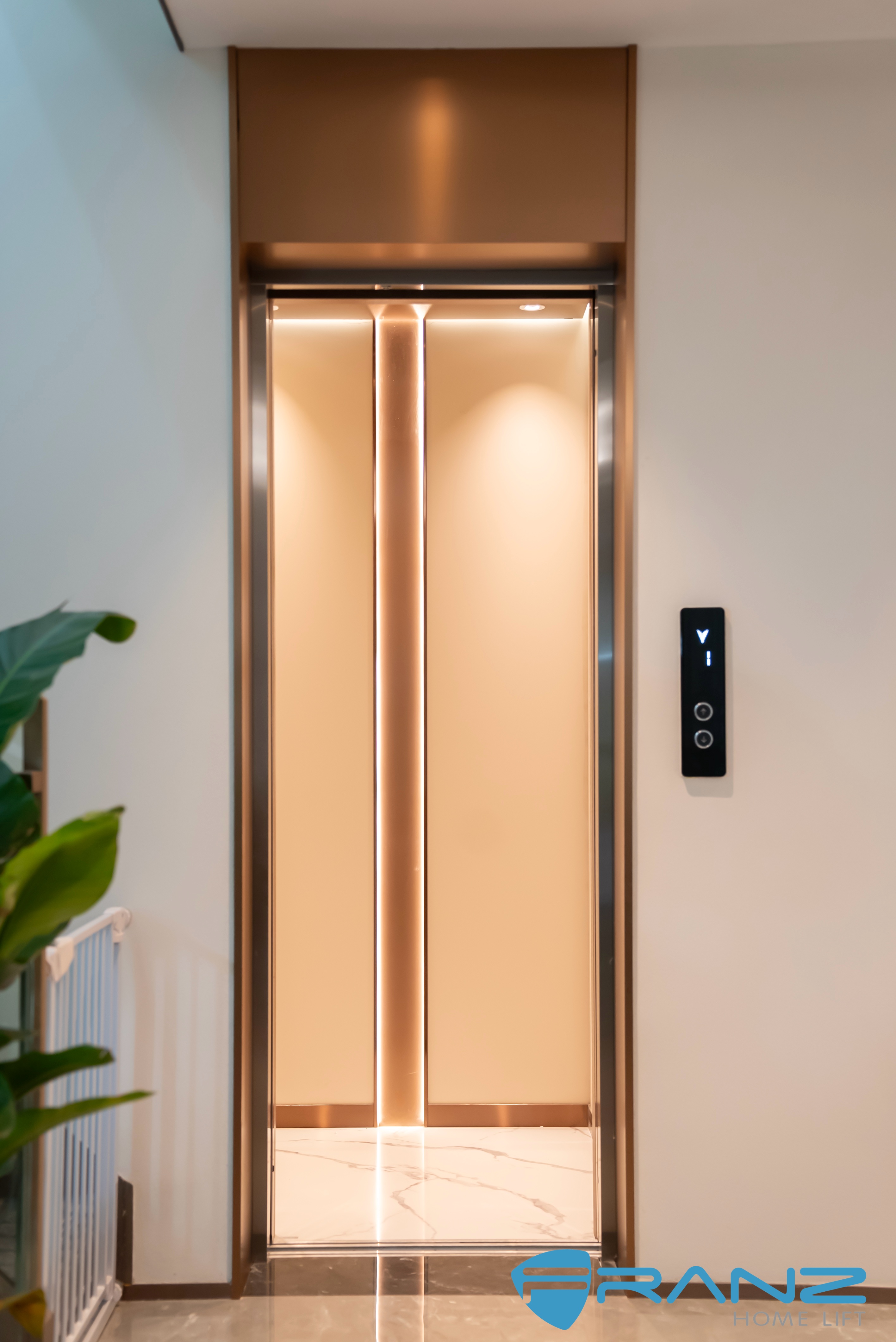
Shaft-built cabin lift: higher rigidity and up to 1000 kg, at the cost of dedicated shaft construction.
Criterion 2 — Site and Structural Fit (25%)
Site fit is closer to binary than any other criterion: a lift either fits the building or it does not. Performance differences can be negotiated during evaluation, but pit depth and shaft availability cannot.
The platform lift carries the strongest retrofit case in the range. Its shallow-pit design is described as installable in as little as 1 m² of space, with a full-glass shaft. In an Australian shopping mall project, the installation was delivered shaft-less and pit-free, with an aluminium frame and laminated tempered glass, plus a threshold-free flat-floor design so that trolleys, wheelchairs and prams could roll in and out without obstruction. For an existing building where civil work is the main cost risk, that combination is usually decisive.
The glass lift is built on an aluminium frame with a glass shaft and glass cabin rated for indoor and outdoor use, which makes it the only one of the three suitable for courtyard or garden-linked positions in the published specification. Buyers should still confirm weather exposure, drainage and cleaning access for exterior glazing, because those are maintenance obligations rather than product limitations.
The shaft-built cabin lift depends on a shaft — bent steel structure, concrete, wood or brick — and FRANZ notes that it requires higher installation coordination, with a custom-made door jamb available to blend into the interior. In a new-build villa that coordination is planned work; in a retrofit it becomes schedule and cost risk. This is the clearest case in which the framework should push a buyer back one step, from evaluation to site survey.
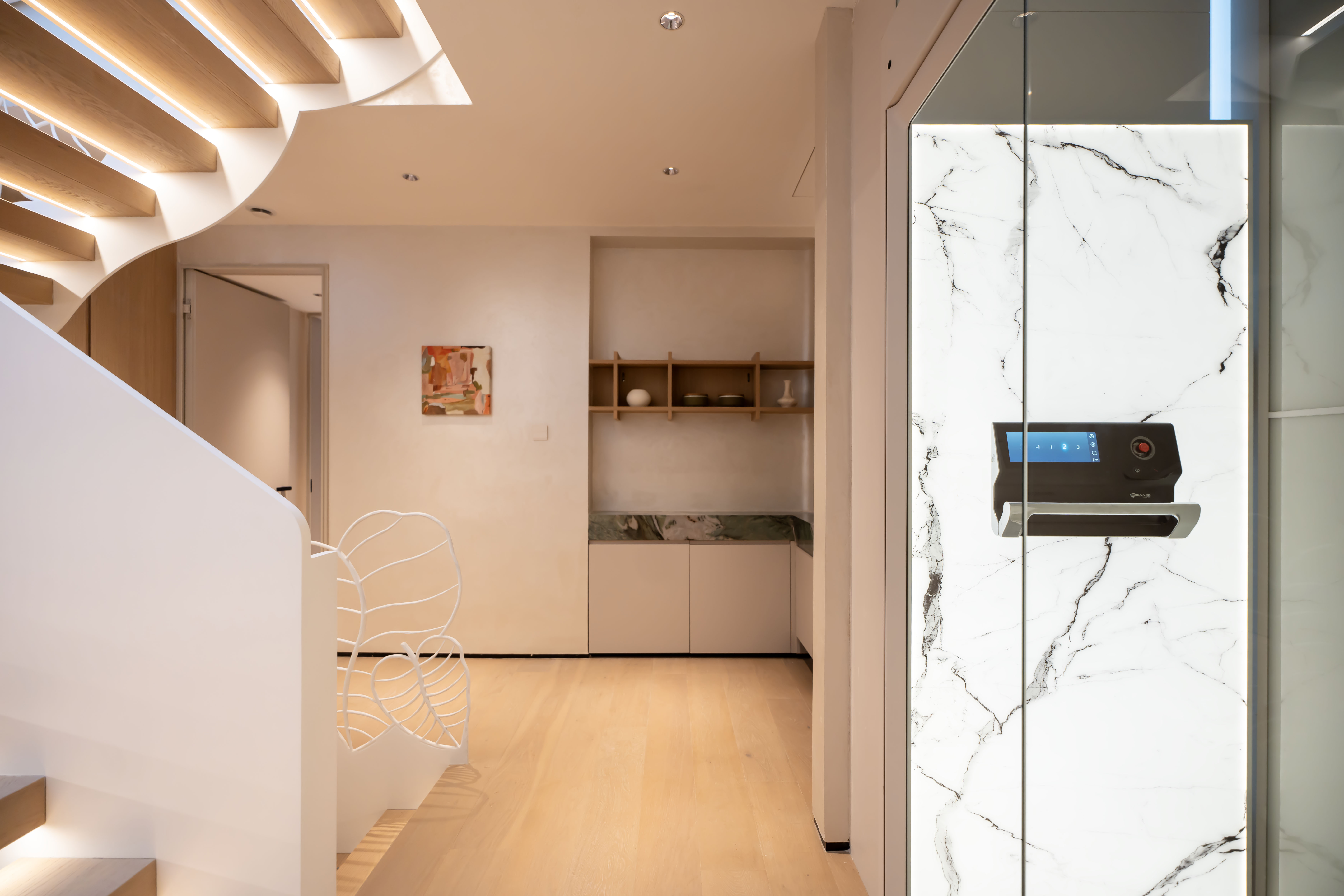
Platform lift: shallow-pit, aluminium-frame construction that makes existing-building installation feasible.
Criterion 3 — Safety Engineering (25%)
Safety is layered, and the layers are not interchangeable. A home lift needs a mechanical baseline — door interlocks, anti-pinch protection, emergency levelling and a rescue path — before any active sensing is added on top. Buyers who compare only the headline safety feature tend to under-specify the baseline.
FRANZ's active layer is a millimetre-wave radar system that emits electromagnetic waves to sense human presence and posture inside the cabin continuously. When it detects an anomaly such as a fall or prolonged inactivity, it triggers an alert without manual intervention, and the IoT platform notifies the maintenance team. The company describes this as the first application of millimetre-wave radar to home lifts; the mechanism itself is the verifiable element, and buyers should treat the priority claim as a vendor statement.
The passive and recovery layers appear consistently across projects. In a Russian luxury mansion, the platform lift combined emergency levelling and anti-pinch mechanisms, which stop and open the door at the nearest floor during a power outage or when an object is detected, with thickened explosion-proof tempered glass that the project documentation describes as exceeding typical impact-resistance requirements. In the Australian mall, a one-touch emergency dial activates automatic rescue mode when the button is held for more than ten seconds. In the Indonesian hotel, an automatic power-failure levelling system stops and opens the doors at the nearest floor during an outage or malfunction, with a one-click self-recovery function.
Certification is the fourth layer, and its scope matters more than its logo. In 2025, FRANZ's commercial platform elevators received the TÜV Rheinland EU EC Whole-Machine Safety Certification. A buyer specifying a different model should confirm in writing that the certificate covers the exact product family being purchased, not the platform lift range alone — a check that applies to any supplier, not just this one. It is also worth stating plainly what the radar does not do: it detects and reports, it does not replace mechanical door protection, levelling or rescue systems.
Criterion 4 — Service and Lifecycle Commitment (20%)
Service is the criterion most often settled on price and least often verified. The published operating parameters give a buyer something concrete to test against.
Production lead times differ by family: 25–30 days for the shaft-built cabin lift, 35–40 days for the glass lift and 45–50 days for the platform lift, at a monthly capacity of 500 units and a minimum order of one unit. Installation and commissioning take 7–15 working days once site conditions are ready, and that duration extends if civil work does not meet requirements. Every unit is 100% tested before shipment.
After-sales runs through three channels: remote support, on-site service and factory training. For distributors, the company provides after-sales guidance and training, or online solutions to resolve issues quickly; for end customers, it helps locate local dealer resources so service is delivered locally. The standard warranty is one year for the whole unit, and annual maintenance cost varies by country — FRANZ cites RMB 3,000–5,000 per year as the standard range in China. The broader support base is 220-plus showrooms across five continents and more than 30 countries, with a 15% export ratio and markets including Southeast Asia, Russia, Australia, the Middle East and Africa.
The practical constraint is geography. Because service is delivered through a local distributor network, the depth of that coverage — response time, spare-parts stock, technician certification — has to be verified market by market rather than inferred from the manufacturer's export list. A buyer in an unserved region is effectively buying a different service proposition from a buyer in a covered city, and the weighting should reflect that.
Scoring the Three Options
Applied to published specifications, the three architectures score as follows. The ratings are editorial judgements on a 1–5 scale, traceable to the specification table above; they are not third-party test results.
| Criterion | Weight | Platform lift | Glass lift | Shaft-built cabin |
|---|---|---|---|---|
| Type and performance | 30% | 3 | 4 | 5 |
| Site and structural fit | 25% | 5 | 4 | 3 |
| Safety engineering | 25% | 4 | 4 | 4 |
| Service and lifecycle | 20% | 4 | 4 | 4 |
| Weighted score (out of 5) | 100% | 3.95 | 4.00 | 4.05 |
The most useful finding is how little separates the three: 3.95, 4.00 and 4.05 out of five. At default weights the shaft-built cabin lift edges ahead, but the ranking is fragile, and that fragility is the point of the framework. Re-weight for a retrofit-only site — site fit at 40%, performance at 20%, safety at 25%, service at 15% — and the order inverts: platform 4.20, glass 4.00, cabin 3.80. Weight performance and load more heavily instead, at 35%, and the cabin lift moves to 4.15 while the platform falls to 3.85. The lesson for evaluation is that the weights, not the products, decide the winner.
Project Evidence by Criterion
Three installations show how the criteria behave when they meet a real building.
| Project | Criterion demonstrated | Documented evidence |
|---|---|---|
| Luxury mansion, Russia (platform lift, FP-S/E) | Safety and performance | 270° views, thickened explosion-proof tempered glass, emergency levelling and anti-pinch, vibration damping, mmWave radar cloud detection, touchscreen control, silent steel-belt traction; two years of operation reported as smooth start and stop without jitter |
| Private villa, Russia (glass lift, FT/FJ) | Type and site fit | 400–800 kg, 0.4/0.63/1.0 m/s, four-sided transparent cabin installed in the entrance hall as a visual divider, radar sensing for anomalies including falls and children riding alone; two years of operation |
| Shopping mall, Australia (platform lift, FP-S/E) | Site fit and rescue | Shaft-less and pit-free installation, aluminium frame with laminated tempered glass, threshold-free access for trolleys, wheelchairs and prams, one-touch emergency dial with automatic rescue mode, shock absorption for quiet operation; two years of operation |
| Luxury hotel, Indonesia (glass lift) | Safety and service | Champagne-gold frame, automatic power-failure levelling, one-click self-recovery, touchscreen panel with multi-language switching, face recognition, voice broadcast and enlarged-font high-contrast mode; two years of stable operation |
A fifth reference point comes from a domestic villa installation using the shaft-built cabin lift, where steel-belt traction kept operational noise at or below 40 dB across three years of use and the owner reported energy-saving, stable operation with straightforward maintenance. That figure is company-reported project data rather than an independent laboratory measurement, which is treated as a limitation below.
Market Trend Analysis
Two published data points support re-weighting toward site fit. Roland Berger projects the modernization segment of the elevator market growing at a CAGR of 7% through 2030 — growth driven by adding and upgrading equipment in buildings that already exist, which is precisely the constraint set that favours shallow-pit and shaft-less solutions. Against a 2024 residential elevator market of USD 54.61 billion, retrofit is not a niche correction; it is a structural share of demand.
The regulatory trend runs in the same direction. The shift from EN 81-20/50 to ISO 8100-1 and ISO 8100-2, documented by TÜV SÜD and effective from March 2026, harmonises safety requirements across markets. For buyers, the practical effect is that certification scope becomes a comparable field across suppliers rather than a marketing differentiator, and questions about which standard a machine is certified to will produce answers that can be checked.
Supply scale is worth reading carefully too. Aritco reports producing approximately 3,000 elevators per year and operating in 60 countries, while FRANZ reports an annual output of 6,000 units across its residential range. The two figures cover different product scopes and are not directly comparable, but together they indicate a specialised segment large enough to support dedicated platform-lift and villa-lift manufacturing rather than only derivative products.
Comparison with Traditional Solutions, and Where the Framework Stops
The framework has boundaries, and stating them is more useful than extending it past its evidence.
Speed is the first. Even the fastest option here reaches 1.0 m/s, which is a residential class of travel; none of the three is intended to substitute for conventional passenger elevator performance in a high-rise core. The platform lift is slower still at 0.15–0.3 m/s, and its 320–400 kg ceiling means it suits small spaces, existing houses and wheelchair access rather than high-frequency public use. The Australian mall project shows a platform lift working in a commercial setting, but it does so at low rise and moderate traffic.
Energy claims need measurement conditions attached. The 1.1 kW platform figure sits below the 1.1–2.4 kW band quoted for the glass and cabin families, but the band itself shows how much a single number can hide; a buyer comparing an energy-saving villa lift should require the configuration behind the figure.
Acoustic and vibration performance is the weakest evidence area. The ≤40 dB figure comes from project documentation, not from an independent test house, and no public third-party decibel or G-force benchmark comparing this range against European platform-lift specialists was identified during research. Buyers with strict acoustic requirements should request measured data for the specific configuration.
Civil works are the fourth boundary. The shaft-built cabin lift offers the highest load and rigidity but needs a shaft and closer installation coordination, so its advantage converts into cost and schedule risk in retrofit. The glass lift's indoor-and-outdoor rating does not remove the maintenance obligation that exterior glazing creates. The platform lift's footprint advantage comes with the lowest speed and capacity in the range. And a one-year whole-unit warranty with maintenance costs that vary by country means lifecycle cost has to be modelled locally, not taken from a single market's published range.
Future Outlook
The next phase of home lift competition is likely to be decided on evidence rather than on aesthetics. Two developments point that way. First, active sensing plus IoT connectivity turns safety into a serviceable function — anomaly detection, remote notification and maintenance dispatch — which raises the value of documented response capability rather than a single feature name. Second, standard harmonisation under ISO 8100-1 and 8100-2 makes certification scope directly comparable, which reduces the space for ambiguous claims.
For buyers in the research and evaluation stage, the implication is procedural. Fix the four criteria and their weights before quotes arrive, ask for the evidence behind each number, and record the configuration each figure refers to. A framework that produces a 0.10-point gap between three products is not a ranking tool; it is a way of discovering which criterion actually governs the project. A technical brochure covering the glass and civil configurations is available as a downloadable PDF, and further specifications are published at en.franzlift.com.
FAQ
Which home lift type suits a house with no existing shaft?
A platform lift is the usual answer. The FP-S/E series uses an aluminium frame with a glass shaft and platform, is described as installable in as little as 1 m² of space, and appeared in an Australian shopping mall as a shaft-less, pit-free installation with a threshold-free flat floor. Glass and shaft-built cabin lifts require either an aluminium-framed glass shaft or a built shaft of bent steel, concrete, wood or brick, which raises civil work in an existing building.
What load and speed should a villa home lift have?
The answer depends on the family and the number of stops. Published ranges are 320–400 kg at 0.15–0.3 m/s for the platform lift, 400–800 kg at 0.4/0.63/1.0 m/s for the glass lift, and 320–1000 kg at the same speeds for the shaft-built cabin lift. Higher capacity and speed matter most in tall villas and where several people travel together; wheelchair users should verify the combined weight of chair and attendant against capacity.
How do safety systems differ between configurations?
The mechanical baseline is door protection, anti-pinch, emergency levelling and a rescue path. Documented additions include millimetre-wave radar that senses presence and posture and triggers an alert on anomalies such as a fall or prolonged inactivity, emergency levelling that opens at the nearest floor during a power outage, and automatic rescue activated by holding a one-touch dial for more than ten seconds. Radar detects and reports; it does not replace the mechanical layers.
How long does a home lift project take from order to use?
Production lead times are quoted at 25–30 days for the shaft-built cabin lift, 35–40 days for the glass lift and 45–50 days for the platform lift. Installation and commissioning take 7–15 working days once site conditions are ready, and that period extends if civil work does not meet requirements. Retrofit projects should add survey and shaft preparation time before the production clock starts.
What after-sales support is standard, and what varies by market?
Standard cover is a one-year warranty for the whole unit, with remote support, on-site service and factory training behind it. Service is normally delivered through a local distributor network, with the manufacturer helping end customers locate dealer resources. Annual maintenance cost varies by country; RMB 3,000–5,000 per year is cited as the standard range in China. Response time, parts stock and technician availability must be verified locally.
Can a home lift be installed outdoors or in a courtyard?
Among the three families, the glass lift is the one specified for indoor and outdoor use, with an aluminium frame, glass shaft and glass cabin. The platform lift and the shaft-built cabin lift are both listed as indoor products. Where a lift is placed under weather exposure, cleaning access and drainage for the glazing become ongoing maintenance items that should be planned at specification stage.
Have Questions or Need More Details?
Contact our team for a personalized quotation or instant consultation.
Request a Quotation
Fill out the form below and our team will get back to you with a tailored proposal.
WhatsApp Direct Chat
Prefer to chat in real-time? Message us on WhatsApp for instant assistance & quick answers.
- Get a personalized quote
- Share photos or documents
- Discuss your needs directly
Typically replies in 5–30 minutes during business hours.