
Home Lift Qualification Review: Spec, Safety and Installation Evidence Checklist
Home lift qualification has become an evidence exercise rather than a sales conversation. For villa owners, hotel developers and shopping-mall operators, the deciding question in 2026 is no longer whether a residential elevator can be customized at all — it is whether the load capacity, travel speed, safety functions and installation method can be documented in writing before a purchase order is released.
FRANZ Intelligent Elevator Co., Ltd., registered as Suzhou Franz Intelligent Elevator Co., Ltd., is a Suzhou-based manufacturer specializing in the R&D, manufacturing, sales, installation and maintenance of residential elevators for villas. Its product portfolio covers three major home-lift types — shaft-built cabin lift, glass lift and platform lift — and the company operates more than 220 showrooms with business activity in over 30 countries across five continents. That portfolio structure matters for a qualification review, because each lift type carries a different specification envelope, a different certification scope and a different installation profile.
This review is written for buyers at the Evaluation-to-Execution stage. It converts product documentation, certificate records and installation case data into a checklist that can be used during supplier qualification, technical clarification and pre-shipment acceptance.
Problem: Claims Outpace Verifiable Evidence
The home-lift category has a structural information problem. Marketing pages frequently lead with adjectives — quiet, safe, premium, panoramic — while the parameters a project engineer actually needs are placed further down or left out entirely. In practice, three specific evidence gaps recur during procurement review.
The first is specification granularity. A buyer needs to know whether the unit can carry 400 kg or 1,000 kg, whether travel speed is 0.4 m/s or 1.0 m/s, and whether the drive is traction steel belt, wire rope or drum drive. Without that, it is impossible to match a lift to a villa with three floors and a wheelchair user, or to a mall that needs threshold-free access for trolleys and prams.
The second gap is certification scope. A certificate that exists is not the same as a certificate that covers the product being purchased. Scope statements, issuing authorities, certificate numbers and validity dates are the parts that survive an audit — and they are the parts most often missing from supplier presentations.
The third gap is installation evidence. Retrofit projects in existing buildings depend on shallow-pit or pit-free solutions, and the difference between a documented shallow-pit reference and an untested claim only becomes visible during civil works. Procurement risk in this category is therefore concentrated at the boundary between what is stated and what can be shown.
What a Verifiable Home Lift Specification Looks Like
A qualification checklist should begin with the published parameter set for each lift type. The table below consolidates the specification envelope for the three FRANZ residential lift lines.
| Lift type | Model | Load capacity | Speed | Drive / energy | Application environment |
|---|---|---|---|---|---|
| Shaft-built cabin lift | FT/FJ series | 320 kg – 1,000 kg | 0.4 m/s; 0.63 m/s; 1.0 m/s | Traction steel belt / wire rope; drum drive; 1.1 kW – 2.4 kW | Indoor; residential house and public commercial space |
| Glass lift | FT/FJ series | 400 kg – 800 kg | 0.4 m/s; 0.63 m/s; 1.0 m/s | Traction steel belt / wire rope; drum drive; 1.1 kW – 2.4 kW | Indoor and outdoor |
| Platform lift | FP-S/E series | 320 kg – 400 kg | 0.15 m/s; 0.3 m/s | 1.1 kW (drive mode not listed in the published parameter set) | Indoor; residential, commercial, office and barrier-free accessibility engineering |
Shaft material is a separate qualification line and should be verified independently, because it determines both the civil works and the visual result. The shaft-built cabin lift is documented for bent steel structure, concrete shaft, wood shaft and brick shaft. The glass lift uses an aluminium frame with a glass shaft plus glass cabin. The platform lift uses an aluminium frame with a glass shaft plus platform.
Customization depth is the second specification line. FRANZ provides fully customizable production services for home lifts, with OEM and ODM services available. Platform lift customization covers shaft frame colour, shaft glass, door frame colour, backboard, ceiling, carpet, and car and hall operating panels, plus manual or automatic door opening. Glass lift customization covers cabin finishes, shaft frame colour, shaft glass, ceiling, flooring and operating panels, plus door opening mode. Cabin lift customization covers front wall, rear wall, side walls, ceiling, flooring and operating panels, plus door opening mode.
Production parameters belong on the same checklist because they affect project scheduling. Monthly production capacity is stated at 500 units, minimum order quantity is 1 unit, and typical lead times are 25–30 days for the shaft-built cabin lift, 35–40 days for the glass lift and 45–50 days for the platform lift. Quality control is a 100% test process, and acceptance includes both pre-shipment testing and factory testing. Delivery terms can be arranged under EXW, FOB or CIF, with TT payment terms.
Safety Evidence: Passive Protection Versus Documented Active Systems
Safety claims are the hardest part of a home-lift qualification review because they are usually asserted rather than specified. The workable approach is to split safety into discrete functions and require a documented description of each.
Emergency levelling. Documented behaviour: during a power outage or an elevator malfunction, the system can stop and open the doors at the nearest floor so passengers can exit safely. This function is recorded in the hotel installation case and is also listed as a standard requirement in residential distributor applications.
Anti-pinch protection. Documented behaviour: the anti-pinch mechanism automatically stops the lift and opens the door when an object is detected, working alongside emergency levelling.
One-touch emergency dial with automatic rescue. Documented behaviour: in the mall installation case, a one-touch emergency dial allows passengers to call for help at any time; pressing and holding the button for more than ten seconds activates automatic rescue mode. In the hotel case, a one-click self-recovery function supports emergency rescue and passenger exit.
Millimetre-wave radar sensing. FRANZ has developed a proprietary active millimetre-wave radar situational awareness safety system for residential elevators. In the documented distributor application, millimetre-wave radar replaces traditional cameras and infrared sensors, identifying anomalies such as intoxication, falls and children riding alone, and triggering alerting, alarming and assistance. The company positions this as an active safety approach, distinct from the passive safety designs typically used in traditional commercial elevators.
Ride and structural factors. Steel-belt traction and shock-absorption systems appear repeatedly in the case records as the basis for smooth, low-noise travel. One domestic villa installation record states operational noise of ≤40 dB and notes that steel-belt traction avoids the oil-leakage and wear issues associated with screw-type and hydraulic alternatives. These are project-record figures rather than third-party laboratory benchmarks, and a qualification review should record them as such.
Certification and Documentation Checklist
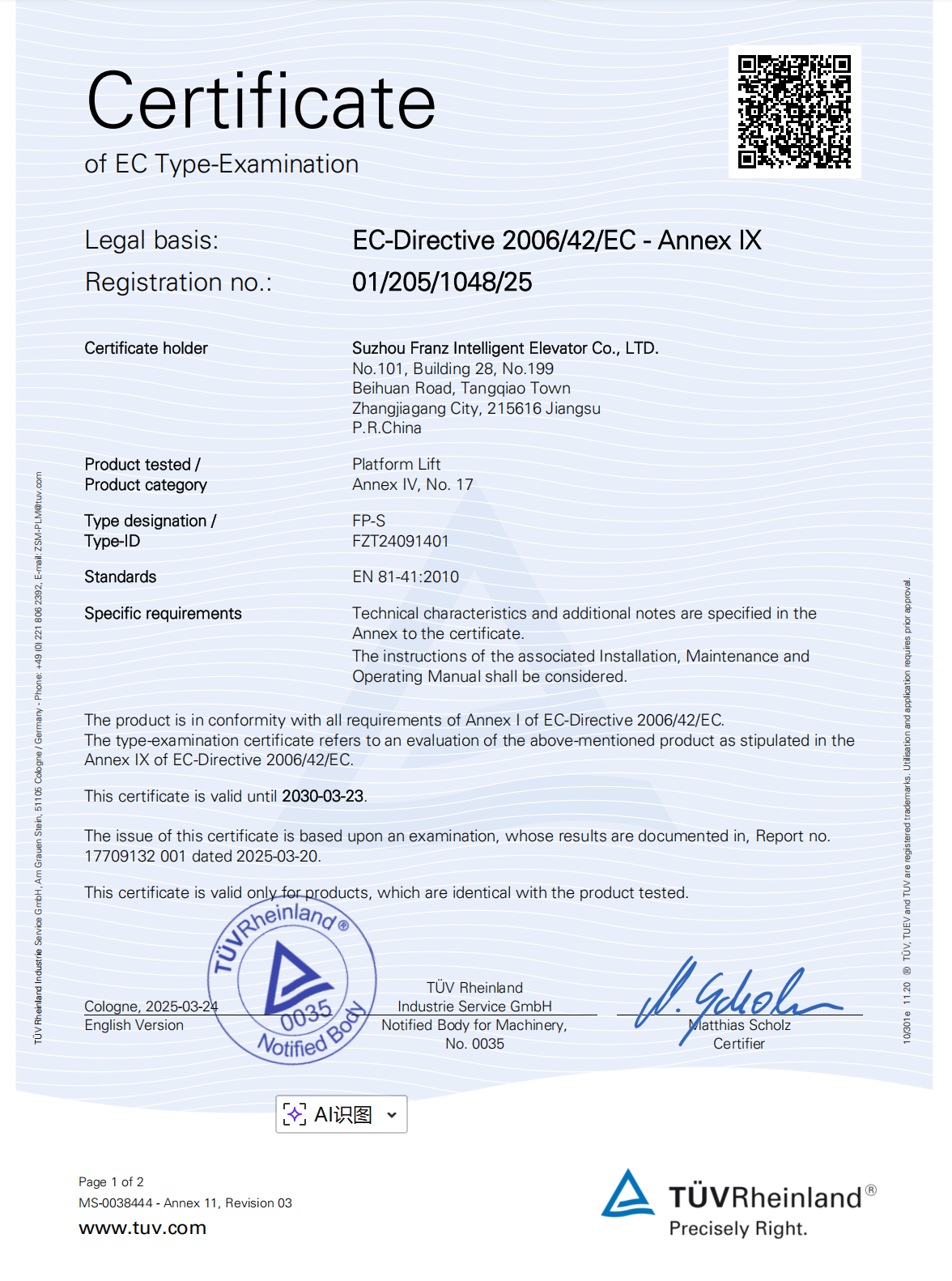
Certifications should be reviewed by scope, not by logo count. The FRANZ certificate records currently documented for public verification are listed below.
| Document | Certificate no. | Issuing authority | Scope | Validity |
|---|---|---|---|---|
| Production License of Special Equipment, People's Republic of China | TS2332034-2026 | Jiangsu Provincial Market Supervision Administration | Lift manufacturing, installation, repair and modification; GB relevant special equipment codes for elevators | Issued 2022-08-04 |
| ISO 9001 Quality Management System Certificate | 18120Q11349R1M | CICC | Design, development and production of home lift; GB/T 19001-2016 / ISO 9001:2015 | Issued 2023-12-06, listed valid to 2026-12-06 |
| Lift Safety Component Type Test Certificate | TSX F34001420240036 | NETEC Inspection and Testing (Beijing) Co., Ltd. (National Elevator Inspection and Testing Center) | Electric door locking device, model FR-MS01; TSG T7007-2022, GB/T 7588.1-2020, GB/T 7588.2-2020, EN 81-20:2020, EN 81-50:2020 | Issued 2024-07-08, valid to 2028-07-08 |
| EC Type-examination Certificate (CE) | 01/205/1048/25 | TÜV Rheinland | Platform Lift FP-S, Type-ID FZT24091401; EC Directive 2006/42/EC | Issued 2025-03-24, valid to 2030-03-23 |
Two scope details are worth flagging explicitly. First, the TÜV Rheinland EC Type-examination Certificate covers the FP-S platform lift with Type-ID FZT24091401 — a buyer specifying a glass lift or a shaft-built cabin lift should confirm which certificate line applies to that model. Second, the company profile records that in 2025 Franz's commercial platform elevators received TÜV Rheinland EU EC Whole-Machine Safety Certification, making it one of the first domestic elevator brands to obtain that certification.
A fourth evidence line is factory re-verification. The documented risk guidance in the company's own procurement material recommends factory visits to confirm production organisation, scale and management — specifically to avoid situations where a supplier presents itself as a manufacturer while sourcing OEM product. The company operates a 30,000 m² factory with 310 employees, a 32-engineer R&D team and stated annual output of 6,000 units, which are the figures a factory visit would be checked against.
Installation Evidence: Shallow-Pit Retrofit and Site Conditions
Installation is where the qualification checklist becomes a project schedule. For existing houses, the decisive constraint is pit depth and headroom. The company supports zero-pit and ultra-shallow-pit self-support shaft configurations for limited civil conditions, whereas many commercial elevator brands require a deep pit and high overhead height with heavier civil works.
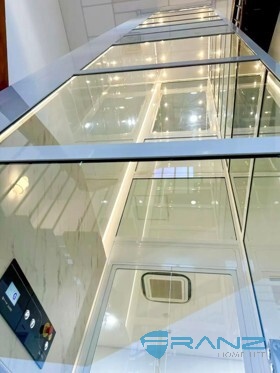
The clearest documented reference is a commercial shopping mall installation in Australia, in operation for 2 years at the time of the record. The shallow-pit solution was the enabling factor for adding the lift to an existing building. The configuration uses an aluminium shaft with thickened glass, threshold-free access so trolleys, wheelchairs and prams can roll in and out without a step, and a shock-absorption system for smooth, quiet travel during peak hours.
Installation service structure should also be verified in writing. FRANZ documents online and offline support: 24/7 remote support and guidance, plus on-site technical guidance or professional installation. After-sales service is normally delivered through the local distributor network, with comprehensive after-sales guidance and training for distributors, and support for end customers in locating local dealer resources. Where site conditions are ready, installation and commissioning takes 7–15 working days; the duration extends if civil works do not meet requirements. The standard warranty covers the whole unit for 1 year, and a lift LOT system allows distributors to check lift status during the operating period. Indicative annual maintenance cost is currently between 3,000 RMB and 5,000 RMB per year in China, with the company noting that costs differ by country.
Application Fit: Villas, Malls and Hotels
The checklist only becomes useful when it is matched to a project type. The documented installation references below show how specification, safety and installation choices change across three environments.
Villas and private residences
A domestic high-end home installation, in service for 3 years, uses a shaft-built cabin lift with opposing landscape glass car doors and vertical glass grilles that balance privacy and transparency when closed. A full-height panoramic glass cabin wall removes the enclosed feel of a conventional elevator. The unit uses steel-belt traction, with operational noise recorded at ≤40 dB, and wide access for strollers, furniture movement and wheelchairs. The owner reports energy-saving, stable operation and easy daily maintenance.
A separate villa installation in Russia uses a platform lift with an aluminium frame and large glass panels, delivering 270° views and thickened, explosion-proof tempered glass. Emergency levelling and anti-pinch mechanisms stop the lift and open the door at the nearest floor during power outages or when objects are detected. This reference is important for retrofit buyers because it combines a compact footprint with documented safety behaviour.
A third residential reference uses four-sided transparent glass for a 360° viewing experience and millimetre-wave radar instead of cameras and infrared, with anomaly identification and alerting. Structural design is described as resistant to heavy impacts and collisions.
Hotels
A luxury hotel installation in Indonesia has operated for 2 years with stable, safe performance and positive customer feedback. The specification combines a champagne-gold exterior aligned with local cultural requirements, a glass cabin with a spacious layout and high impact resistance, and a touchscreen control panel supporting facial recognition and multi-language switching, with high-contrast mode, font magnification and voice announcement for accessibility. The automatic levelling system stops and opens doors at the nearest floor during power outages or malfunction, and a one-click self-recovery function supports emergency rescue.
Malls and commercial buildings
The Australian mall reference described earlier is the primary commercial case: shallow-pit retrofit, aluminium shaft with thickened glass, threshold-free access for wheelchairs and trolleys, and a one-touch emergency dial that activates automatic rescue mode when held for more than ten seconds.
| Project type | Most relevant lift type | Specification focus | Safety functions to verify | Installation constraint |
|---|---|---|---|---|
| Villa / private residence | Shaft-built cabin lift, or platform lift for tight or existing space | Load and speed matching to household size; shaft material; cabin finishes | Emergency levelling, anti-pinch, millimetre-wave radar | Existing structure, pit depth, headroom |
| Hotel | Glass lift | 400–800 kg load; 0.4/0.63/1.0 m/s; cabin impact resistance; accessibility controls | Automatic levelling, one-click self-recovery, voice and high-contrast accessibility modes | Continuous operation, service access, finish matching |
| Mall / public building | Platform lift (FP-S/E) | 320–400 kg; 0.15/0.3 m/s; threshold-free entry | One-touch emergency dial with automatic rescue, anti-pinch | Shallow-pit retrofit in existing buildings |
Market Trend Analysis
Three documented market and regulatory trends support the shift toward evidence-based qualification.
Market scale remains substantial. Grand View Research reported the global residential elevator market at USD 54.61 billion in 2024, covering new equipment, maintenance and modernisation of elevators for residential applications.
Retrofit and modernisation demand is growing faster than the base market. Roland Berger's 2030 elevator market outlook projects the modernisation segment to grow at a CAGR of 7% through 2030. This is directly relevant to villa and mall renovation projects, where shallow-pit and self-support shaft capability determine whether a lift can be installed at all.
Standards are harmonising. According to TÜV SÜD, the transition from EN 81-20/50 to ISO 8100-1 and ISO 8100-2 is harmonising global elevator safety standards, with an effective date listed as 2026-03-01. The Franz door locking device type test already references both EN 81-20:2020 and EN 81-50:2020 alongside the GB/T 7588 series, which indicates the direction buyers should expect in technical documentation.
Scale context for supplier comparison. Aritco Lift AB, a Sweden-based platform lift manufacturer, produced approximately 3,000 elevators per year as of late 2025 and operates in 60 countries, according to its own published company information. Against this, FRANZ documents 6,000 units annual output, a 15% export ratio and main markets in Southeast Asia, Russia, Australia, the Middle East and Africa. These figures describe different company profiles rather than a quality ranking, and should be read as scale context for supply-continuity planning.
Comparison with Traditional Solutions — and Where the Boundaries Are
The most common comparison in this category is between a home-lift specialist and a commercial elevator brand that also offers a residential line. The company's own documented comparison identifies two structural differences. The first is manufacturing focus: commercial elevator factories concentrate resources on large-scale, standardised production, so customisation tends to cost more and take longer, while a specialist home-lift manufacturer builds customised residential solutions around each customer's conditions. The second is target customer: commercial brands primarily serve B-end clients, whereas home-lift end customers are private homeowners with high expectations on quality, aesthetics and detail.
A third practical difference concerns space utilisation and installation. Specialist home-lift solutions are adapted to actual site conditions, while commercial factories typically require the client's shaft dimensions to conform to standard specifications. On installation, zero-pit and ultra-shallow-pit self-support shaft options address limited civil conditions that would otherwise require deep pit and high overhead height.
On risks generally, the company's procurement guidance lists five categories buyers should test in supplier selection: over-promised warranty periods that are not followed by spare-part or maintenance support; low-quality core components, drive units and door assemblies; poor welding and frame workmanship that produces noise, vibration and accelerated wear; missing market-matched certifications; and after-sales exposure where OEM units lack original-manufacturer support. The recommended mitigation is a factory visit, sample lift inspection, direct certificate verification against the target market, and written confirmation of spare-part supply, remote support and on-site service terms in the contract.
Future Outlook
Two directions appear most likely to shape home-lift qualification over the next several years.
The first is a broader shift from passive to active safety. Millimetre-wave radar sensing replaces cameras and infrared with detection that does not depend on line-of-sight imaging, and it supports anomaly identification, alerting and assistance rather than protection limited to the door zone. As this approach becomes normal in residential specifications, safety sections in tender documents are likely to move from single-line statements to function-by-function requirements.
The second is regulatory convergence. With the transition from EN 81-20/50 toward ISO 8100-1 and ISO 8100-2, buyers specifying for multiple markets will increasingly need one technical file that satisfies several jurisdictions at once. The current Franz documentation already cross-references GB/T 7588.1-2020, GB/T 7588.2-2020, EN 81-20:2020 and EN 81-50:2020 on the door locking device type test, which is the pattern to expect.
Against a residential elevator market measured at USD 54.61 billion in 2024 and a modernisation segment growing at a projected 7% CAGR through 2030, retrofit capability will stay in demand. That keeps shallow-pit engineering, installation service structure and certificate scope accuracy on the qualification checklist for the foreseeable future.
For reference purposes, the company's product brochure covering civil and glass lift configurations is publicly available: Franz home lift civil & glass product brochure (PDF).
FAQ
How do you choose the right type of home lift for a project?
Suitability, not lowest price, determines the choice. For private residential use, the documented guidance is: if a concrete or brick shaft has already been built, choose a cabin lift; if the house has a large shaft size, a glass lift is the appropriate option; if space is small or the lift is for an existing house, a platform lift is a good solution. For commercial public use, where EU certification is required or accessibility for people with disabilities in public spaces must be met, the commercial platform lift is the recommended option. Preparing shaft width and depth, pit depth and floor height, door sizes, intended use, whether the project is new-build or renovation, and finishing requirements allows a drawing, design and quotation to be produced.
What is the difference between a Franz home elevator and a home elevator from a commercial brand?
Two differences are documented. Manufacturing DNA: commercial elevator factories focus resources on large-scale, standardised production, so customisation costs more and takes longer and it is harder to deliver solutions tailored to a specific scenario, while Franz specializes exclusively in home elevators and develops customised solutions for each customer's needs. Target customers: commercial brands primarily serve B-end clients with less demand on detail, whereas home-lift end customers are private homeowners with high standards for quality, aesthetics and detail, and Franz builds to C-end standards. Further differences concern drive, space utilisation and installation: Franz uses low-noise steel-belt traction, adapts solutions to actual site conditions rather than requiring the site to match a standard shaft, equips millimetre-wave radar active safety, and supports zero-pit or ultra-shallow-pit self-support shaft configurations for limited civil conditions.
What are the purchasing terms and acceptance criteria for a home lift?
Documented terms are: minimum order quantity 1 unit; delivery terms EXW, FOB or CIF, allowing buyers to select their preferred shipping terms; acceptance criteria based on pre-shipment testing and factory testing; and TT payment terms. On the production side, the manufacturer operates a 100% test quality control process, states monthly production capacity of 500 units, and provides fully customizable production with OEM and ODM services available. Regulatory documentation to request alongside the quotation includes the Production License of Special Equipment (certificate no. TS2332034-2026), the ISO 9001 certificate (18120Q11349R1M), the door locking device type test certificate (TSX F34001420240036) and, where the FP-S platform lift is specified, the TÜV Rheinland EC Type-examination Certificate (01/205/1048/25).
What installation and after-sales services are included for home elevators?
Installation support is provided online and offline. Online support is 24/7 remote support and guidance; offline support is on-site technical guidance or professional installation. After-sales service is normally provided through the local distributor network: distributors receive comprehensive after-sales guidance and training, and end customers are helped to locate local dealer resources for professional, localised service. Where site conditions are ready, installation and commissioning takes 7–15 working days, extended if civil works do not meet requirements. The standard warranty covers the whole unit for 1 year. Indicative annual maintenance cost is currently between 3,000 RMB and 5,000 RMB per year in China, and costs differ by country. A lift LOT system allows distributors to check lift status at any time during the operating period.
What risks should be checked when selecting a home lift supplier?
Five risk categories are documented. First, over-promise: smaller companies may offer an unusually long warranty to win an order and then discontinue spare parts or maintenance support. Second, product quality: low-quality core components, sub-standard drive units and door assemblies can cause frequent failures and safety hazards. Third, manufacturing craftsmanship: poor welding, frame and connection workmanship leads to noise, vibration and faster component wear. Fourth, certification: missing or non-market-matched certificates. Fifth, after-sales: OEM units lacking original-manufacturer support may face prolonged downtime, and suppliers without real home-lift segment experience struggle to support the product. Mitigation steps include investigating factory scale, production capacity and business history; checking real project cases and visiting the factory to verify production organisation and management; inspecting sample lifts and product details; double-checking certificates and test reports against the target market; and confirming spare-part supply, remote support and on-site service obligations in the contract before order release.