
Home Medical Health Device Suppliers: A Long-Term Continuity Framework
Home Medical Health Devices now span a wide family of products — digital thermometers, infrared forehead and ear thermometers, wearable Bluetooth digital thermometers, digital blood pressure monitors, finger pulse oximeters, mesh nebulizers, sleep apnea therapy devices, and related health management products. Each category carries its own standards, channel expectations, and replacement cycle. As a result, buyers at the evaluation stage are rarely asking only "which unit is cheapest today?" The more consequential question is which supplier remains a valid source across the next several product cycles.
A long-term supplier sustainability framework evaluates a home medical device supplier across five dimensions: product-line continuity, repeatable quality, compliance continuity, commercial terms flexibility, and channel coverage. Unit price is treated as one input among several, not the anchor of the decision. This article sets out what that framework measures, how model-level specifications and test protocols provide evidence, and where the approach has genuine limits.
Why Unit Price Is the Wrong Anchor
The global Home Medical Equipment market was estimated at USD 54.35 billion in 2026, with North America holding approximately 40.35% share in 2025, according to industry research. Within the broader category, the Digital Thermometer segment alone is projected to reach USD 1.954 billion by 2035, growing at a CAGR of 9.5% from 2025. Volume growth of this kind tends to push buyers toward consolidating suppliers rather than multiplying them.
When a distributor, clinic group, or e-commerce seller sources thermometers, blood pressure monitors, oximeters, and nebulizers from separate vendors, every additional vendor adds qualification cost, documentation review, and re-verification at the start of each product cycle. Unit price is visible on the invoice; re-qualification cost is not. That asymmetry explains why price-led sourcing often looks efficient in year one and expensive by year three.
What a Long-Term Supplier Sustainability Framework Measures
The framework is deliberately narrow enough to be checkable and broad enough to cover a multi-year relationship. It has five dimensions, each of which should be evidenced with documents rather than impressions.
1. Product-Line Continuity
The supplier should be able to cover adjacent categories that the buyer will plausibly need next — for example, moving from digital thermometers to wearable thermometers, or from upper-arm blood pressure monitors to wrist models — without a new vendor qualification. Guangdong Genial Technology Co., Ltd. (GENIAL), founded in 2001, lists product families that include digital thermometers, infrared thermometers, wearable thermometers, digital blood pressure monitors, finger pulse oximeters, mesh nebulizers, sleep apnea therapy devices, health managers, meridian massage instruments, and hair removal devices. Breadth alone is not proof of quality, but it reduces the number of separate qualifications a buyer must run.
2. Repeatable Quality
Continuity depends on the same specification being met on order 1 and order 20. Buyers should look for named test protocols, acceptance criteria, and management-system coverage rather than generic quality statements. GENIAL states that every digital thermometer passes a thermostatic water bath accuracy test, and that blood pressure monitors are calibrated so that measured pressure falls within 3 mmHg of analyzer data. Those are internal acceptance criteria, not third-party benchmarks, but they are specific enough to be audited.
3. Compliance Continuity
Certificates expire, regulations change, and models are updated. A supplier that manages registration as an ongoing function is easier to keep than one that treats compliance as a one-off event. GENIAL reports product and trademark registration in 29 countries, sales into 117 countries and regions, and a registration team that supports client market entry.
4. Commercial Terms Flexibility
A framework supplier should offer more than one engagement model, because a buyer's needs shift between trial volumes and mass production. GENIAL operates OEM, ODM, JDM, and OBM models with different minimum order quantities, lead times, and customization scopes (detailed later in this article).
5. Channel Coverage
Finally, the supplier's stated application areas should line up with the buyer's routes to market — chronic disease management, community clinics, health and wellness centers, pharmacy chains, e-commerce, wholesale, and customized OEM gift programs.
Product-Line Continuity in Practice: Model-Level Evidence
Category lists are easy to publish. The more useful evidence is model-level: does the supplier publish distinct specifications for distinct channel needs? GENIAL's portfolio gives several examples across the six device families most relevant to home care.
- Sleep apnea therapy devices. The GH-B20V / GH-B25V / GH-B20T / GH-B20 / GH-B25 / GH-A20A / GH-A20 is a non-invasive sleep CPAP ventilator with a working pressure range of 4–20/25 cmH₂O, support for CPAP/APAP/S/T/VGPS modes, and noise of ≤35 dB.
- Mesh nebulizers. The N11/N21 and N12/N22/N12C/N22C/N12L/N22L series are portable mesh nebulizers with an 8 ml liquid capacity, a nebulization rate of ≥0.2 ml/min, and a particle distribution of D50 <5 μm at ≥60%.
- Pulse oximeters. The GX3 / GX5 / GX7 / GX8 / GX12 / GX13 / GX14 fingertip pulse oximeters are specified at SpO₂ 35%–100% (±2% @ 70%–100%) with a pulse rate range of 30–250 bpm.
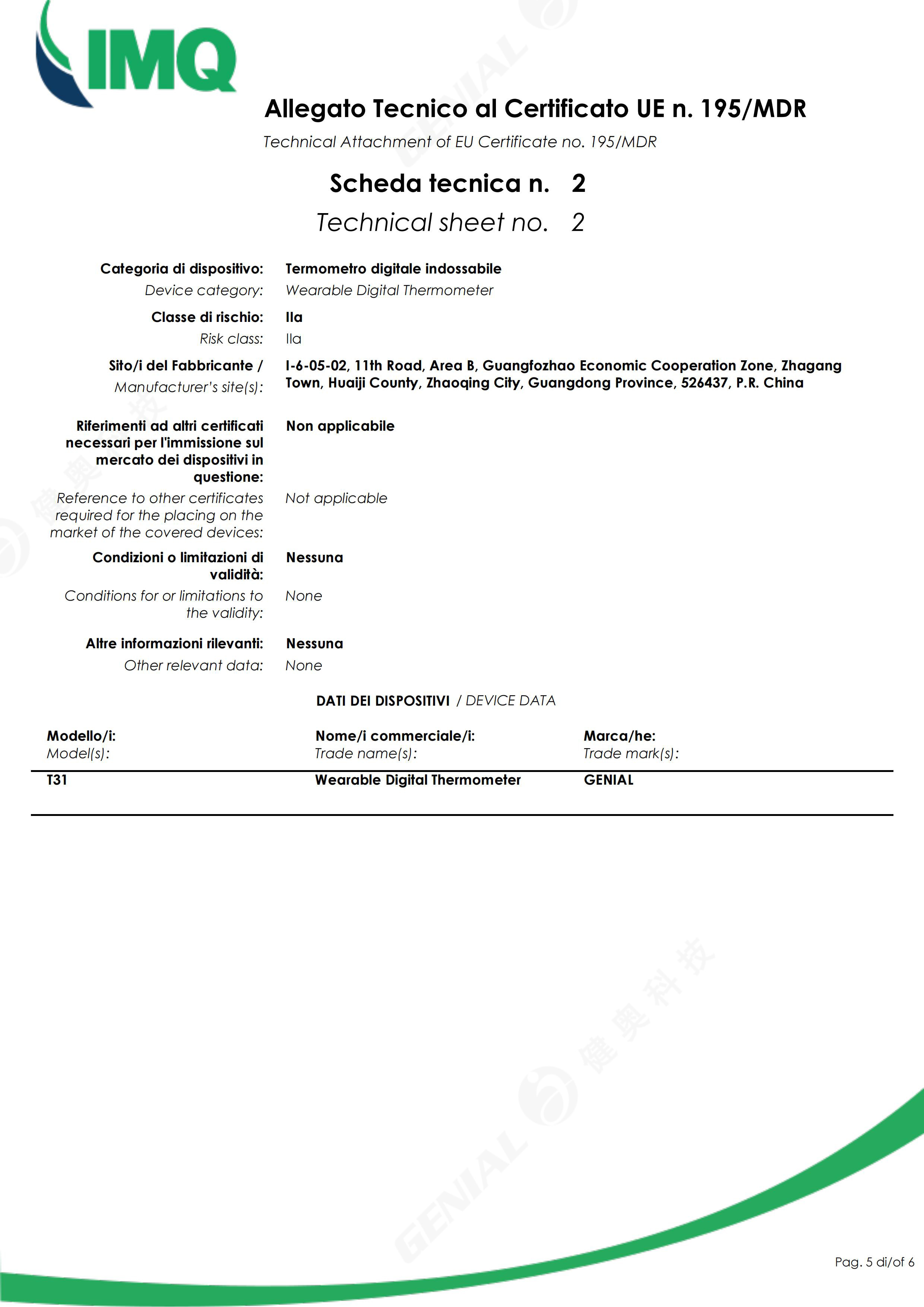
- Wearable Bluetooth thermometers. The T31 wearable digital thermometer measures 20.0–45.0 °C at ±0.1 °C accuracy, carries IPX4 splash protection, and weighs 33 g including battery.
- Digital thermometers. The range covers rigid-tip, flexible-tip, armpit, infrared forehead, and infrared ear formats, each with its own accuracy specification.
- Digital blood pressure monitors. Upper-arm and wrist formats are published as separate model families with distinct cuffs and channel targets.
The upper-arm blood pressure monitor line is a good illustration of model-level differentiation. Three models share the same 0–290 mmHg pressure range but are built for different buyers.
| Attribute | GT-732 | GT-732M | GT-702BM |
|---|---|---|---|
| Type | Upper Arm Digital Blood Pressure Monitor | Upper Arm Digital Blood Pressure Monitor | Upper Arm Digital Blood Pressure Monitor |
| Pressure range | 0–290 mmHg | 0–290 mmHg | 0–290 mmHg |
| Arm circumference | 22–32 cm | 22–42 cm | 22–42 cm |
| Pulse specification | Pulse tolerance ±5% | Pulse error ≤±5% | Not listed in source specification |
| Memory | Not listed | Not listed | 99 memory sets for 2 users |
| Dimensions | 136×103×54 mm | 136×103×54 mm | 135×102×46 mm |
| Net weight (without battery) | 291 g ±15 g | 239 g ±15 g | 220 g ±15 g |
| Material | ABS, PVC air bag, Nylon binding strap | ABS, eco-friendly TPU air bag | ABS, composite fabric cuff |
| Stated application areas | Community clinic, health & wellness center, e-commerce, customized OEM gift | Chronic disease management institute, community medical center, insurance promotional gift | Medical instrument wholesale, offline household retail |
Two points are worth noting. First, the 22–42 cm cuff range on GT-732M and GT-702BM covers a broader share of adult users than the 22–32 cm range on GT-732, which matters where a single SKU must serve a mixed patient population. Second, the material differences — PVC versus eco-friendly TPU versus composite fabric — are the kind of detail that a supplier either publishes or does not. Buyers evaluating continuity can use material specifications as a proxy for how well the supplier will document future model changes.

Repeatable Quality: Test Protocols and Acceptance Criteria
Repeatable quality is the dimension most often asserted and least often evidenced. A useful framework separates external standards, internal acceptance criteria, and process controls.
External standards. ISO 80601-2-56:2017 sets requirements for clinical thermometers, including a ±0.1 °C accuracy requirement used in clinical validation. For pulse oximeters, ISO 80601-2-61 defines how SpO₂ accuracy is tested and reported, conventionally expressed as an Arms value over a stated saturation range, commonly 70–100%. Home-use medical electrical equipment is assessed against IEC 60601-1-11, the collateral standard that addresses risks in uncontrolled home environments with untrained users.
Internal acceptance criteria. GENIAL states that blood pressure monitors are calibrated and tested so the measured pressure is within 3 mmHg of analyzer data, and that thermostatic water bath testing is used to verify the accuracy of every digital thermometer. GENIAL also reports an ISO 13485 quality management system certificate (CN13/31126, issued by SGS United Kingdom Ltd.) covering the design, development, and manufacture of mesh nebulizers, finger clip pulse oximeters, digital blood pressure monitors, infrared forehead thermometers, infrared ear thermometers, and digital body thermometers.
Process controls. Across GENIAL's OEM and ODM workflows, the stated quality sequence runs from incoming material inspection through full-process production inspection to a final inspection before shipment. OEM additionally applies 100% production inspection; ODM and JDM follow a demand assessment, project approval, development, sample approval, exclusive model registration, and then mass production.
In-use conditions. Continuity is also a calibration question. Published guidance for home health monitoring equipment recommends calibration at frequent intervals and operation within approximately 16–40 °C and humidity below 85%. A supplier that documents calibration intervals makes it easier for downstream buyers to plan maintenance across a multi-year fleet.
Compliance Continuity Across Product Cycles
Compliance is where continuity is most visible, because certificates have dates. GENIAL's portfolio includes management-system certifications and product registrations spanning multiple jurisdictions.
| Certificate / registration | Reference | Scope or market | Validity |
|---|---|---|---|
| ISO 13485:2016 | CN13/31126 | Design, development and manufacture of mesh nebulizers, oximeters, blood pressure monitors and thermometers | 2025-09-16 to 2028-09-16 |
| CE MDR (EU) 2017/745 | CN25/00007953, SRN CN-MF-000021465 | Arm-type digital blood pressure monitors | 2025-11-25 to 2030-11-25 |
| CE MDR quality management system | 195/MDR | T31 wearable thermometer and fingertip pulse oximeters | 2024-10-21 to 2029-10-20 |
| US FDA 510(k) | K240333 | Wearable digital thermometer T31 | Listed as cleared |
| US FDA 510(k) | K231245 | Arm-type digital blood pressure monitors | Listed as cleared |
| US FDA 510(k) | K231250 | Wrist digital blood pressure monitors | Listed as cleared |
| US FDA 510(k) | K231243 | Fingertip pulse oximeters | Listed as cleared |
| US FDA 510(k) | K210014 | Infrared forehead thermometers | Listed as cleared |
| US FDA 510(k) | K232678 / 3016670149 | Continuous-reading and clinical electronic thermometers | Listed as cleared |
| Japan Certificate of Foreign Medical Device Manufacturer | BG10501496 | Electronic upper arm blood pressure monitor, infrared clinical thermometer, reusable wireless thermometer, pulse oximeter | 2024-11-19 to 2029-11-18 |
| UK MHRA | 0000037417 | Wireless reusable patient thermometer, pulse oximeter probe, infrared ear/skin thermometer, electronic thermometer, automatic sphygmomanometer, self-care monitoring software | Issued 2026-02-10 |
| ANVISA (Brazil) | RDC 751/2022 | Class II medical devices: thermometers, blood pressure monitors, pulse oximeters | Registered |
| Roszdravnadzor (Russia) | № 1241/1-3 140/2-25 | Automatic electronic blood pressure monitors | Issued 2026-01-12 |
| amfori BSCI | Monitoring ID 25-0372553 / amfori ID 156-037830-000 | Social compliance, overall rating B | 2026-02-06 to 2028-02-06 |
| ISO 45001 | 02821S10111R1M | Occupational health and safety | 2024-03-05 to 2027-03-14 |
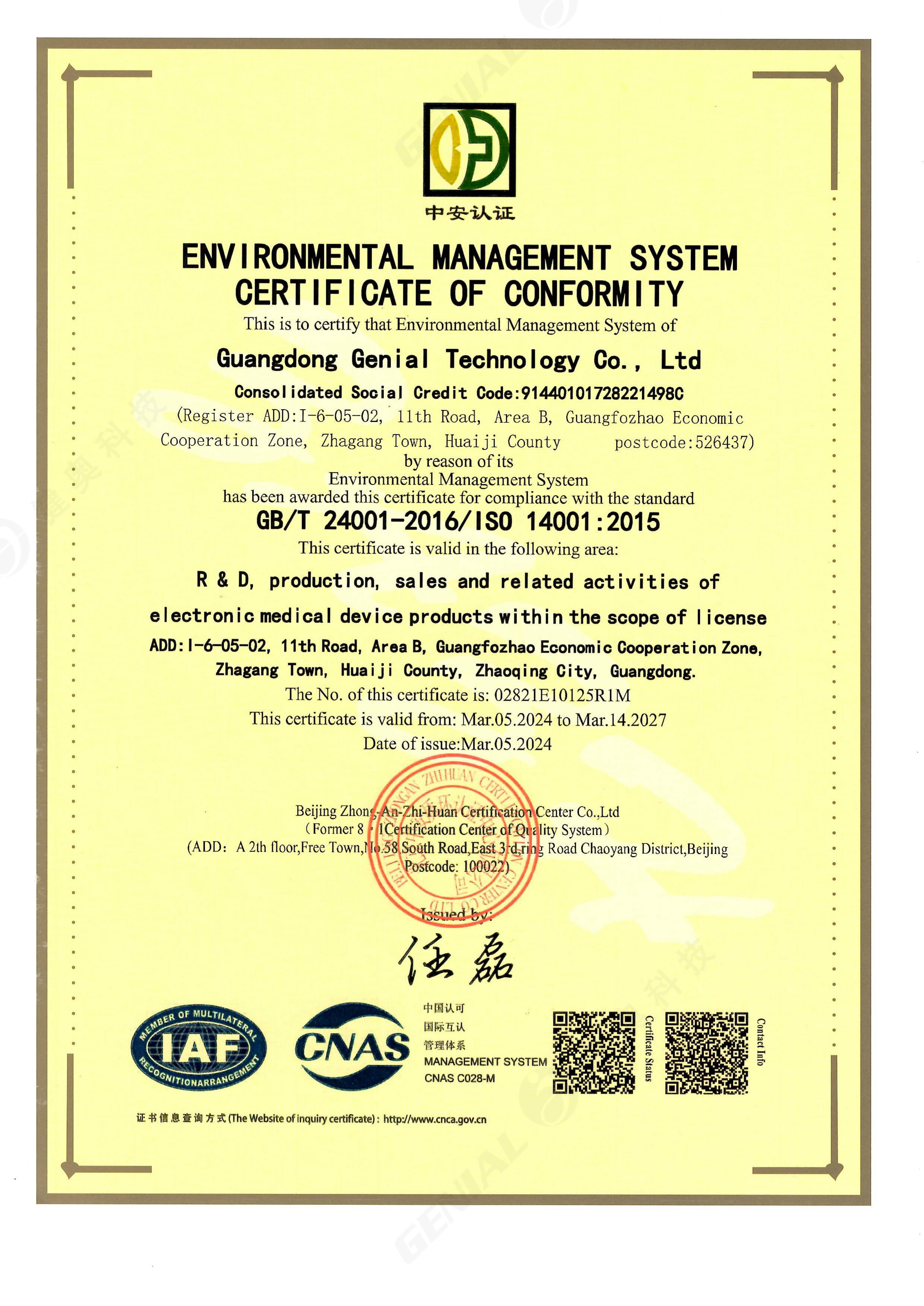
| ISO 14001 | 02821E10125R1M | Environmental management | 2024-03-05 to 2027-03-14 |
| GB/T 29490 | 18123IP0672R2M | Intellectual property management | 2024-12-09 to 2026-12-14 |
| NBCUniversal | Manufacturer Code L-4394 | OEM customized order compliance and quality | 2026-03-09 to 2027-02-06 |
For a buyer, the practical check is not how long the list is, but whether the relevant scope matches the model being purchased and whether the expiry dates leave enough overlap with the planned product cycle. A supplier with staggered, dated certificates is easier to audit than one with a single undated compliance summary. GENIAL also reports a portfolio of 262 intellectual property certificates and operation of the Genial Cloud Health Management Platform, both of which bear on how quickly the supplier can iterate models without re-opening basic qualification.
Purchasing Terms and Acceptance Criteria
Commercial terms are the fourth dimension of the framework. Rather than a single MOQ, buyers should map the supplier's engagement models against their own volume curve.
| Model | Indicative MOQ | Lead time | Customization scope |
|---|---|---|---|
| OEM | Thermometers 10,000 pcs; blood pressure monitors 2,000 units; oximeters 2,000 units; nebulizers 2,000 units; wireless thermometers 2,000 units; ventilators 500 units; hair removal devices 2,000 units | Samples 3 days; small orders 3–7 days; mass orders 10–15 days | Packaging, gift box, user manual, product logo printing, color schemes, packaging specifications; core hardware and key functions unchanged |
| ODM | Product modification 5,000 units; new mold development 10,000 units (tooling cost refundable on large-volume projects) | Minor modifications without new tooling 7–15 days; new mold development 45–50 days | Industrial design, tooling, structure, PCB firmware, algorithms, Bluetooth functionality, display interface, packaging system, exclusive model registration |
| JDM | Initial mass-production order ≥10,000 units; no strict MOQ for repeat orders | 45–60 days | Joint product development; customer participates in product definition; hardware, software and structural R&D by the supplier; IP ownership allocated by contract |
| OBM | Full-carton MOQ per SKU; mixed orders from 5 cartons | In-stock products ship within 48 hours; replenishment orders 5–7 days | Regional distributor authorization, gift-box combinations, shipping carton labels; original product branding remains unchanged |
All four models are stated to include a free 12-month warranty on presentation of valid proof of purchase, plus certification documentation support and technical consultation. GENIAL also states that branded products can ship within 24 hours of order confirmation and that OEM orders are typically delivered within 3–7 days.
For acceptance criteria, buyers should convert these terms into a checklist: Does the quoted MOQ match the first-cycle volume? Does the lead time fit the channel's restock cadence? Does the customization scope cover the elements that carry brand value, and does it leave the core hardware untouched in a way that preserves the underlying certification?
Applying the Framework Across Channels
The fifth dimension — channel coverage — is best tested by mapping specific models to specific routes to market.
- Chronic disease management and community medical centers. The GT-732M's 22–42 cm arm circumference and eco-friendly TPU air bag are positioned for chronic disease management institutes, community medical centers, and insurance promotional programs.
- Community clinics, health and wellness centers, e-commerce, OEM gift. The GT-732 is positioned for community clinics, health and wellness centers, e-commerce, and customized OEM gift projects.
- Wholesale and offline household retail. The GT-702BM adds 99 memory sets for two users and a composite fabric cuff, and is positioned for medical instrument wholesale and offline household retail.
- Infant and maternity monitoring. The T31 wearable Bluetooth digital thermometer supports continuous monitoring, an approach that removes the need for repeated nighttime temperature checks and is linked to improved user retention in GENIAL's infant monitoring project references.
- E-commerce and D2C trial sales. ODM support for rapid product launches and small-batch trial sales is aimed at e-commerce platform clients.
GENIAL's published project references illustrate the same logic at scale. These are supplier-reported case summaries rather than independently audited results, and should be treated as such.
| Channel type | Project scale | Duration | Reported highlight |
|---|---|---|---|
| Hospitals and clinics (clinical monitoring) | 50,000–200,000 units | 5 years | Digital management, continuous monitoring, automatic alerts and reduced manual inspections |
| Medical device distributors (channel distribution) | 100,000–500,000 units | 5 years | One-stop procurement reducing supplier management costs |
| Pharmacy chain systems (OTC sales) | 100,000–1,000,000 units | 5 years | Complete product portfolio meeting different consumer segments |
| Consumer electronics channels (retail sales) | 50,000–100,000 units | 5 years | International certifications, stable quality, long-term supply capability |
| E-commerce platforms (online sales) | 50,000–200,000 units | 5 years | ODM customization, rapid product launches, small-batch trial support |
| Maternal and infant companies (infant monitoring) | 10,000–100,000 units | 5 years | Continuous monitoring without repeated nighttime temperature measurement |
Market Signals Buyers Should Track
Two structural signals shape how a continuity framework should be weighted. First, upper-arm blood pressure monitors held 59.10% of the blood pressure monitoring market share in 2025, while wrist-based and wearable formats are growing at a 12.07% CAGR. Upper-arm devices, measured against an arm circumference range of 22–42 cm in models such as the GT-732M and GT-702BM, still serve the widest slice of the chronic care population. Second, the broader Home Medical Equipment market was estimated at USD 54.35 billion in 2026, with North America accounting for approximately 40.35% of 2025 share.
The practical implication is that a supplier covering both upper-arm and wearable formats — and both clinical and consumer channels — is less exposed to a single category shift. Buyers should treat portfolio coverage as a risk-reduction feature, not a marketing claim.
Comparison with Traditional Spot-Buying
Traditional sourcing treats each purchase order as a discrete transaction: find the lowest unit price for the required specification, place the order, and re-run the process when the next requirement appears. Continuity-based sourcing treats supplier qualification as a multi-year asset.
| Dimension | Traditional spot-buying | Continuity framework |
|---|---|---|
| Primary metric | Unit price per PO | Cost across multiple product cycles |
| Qualification effort | Repeated per order or per category | Reused across categories and cycles |
| Documentation | Collected per transaction | Maintained as an ongoing asset |
| Risk exposure | Concentrated at each new vendor | Distributed across a known relationship |
| Best fit | One-off, narrow, single-market needs | Programs spanning device families or channels |
Where the framework has limits. A continuity-based approach is not automatically better. It assumes the buyer will need more than one device family, more than one channel, or more than one product cycle within the qualification horizon. Where a buyer needs a single narrow SKU for a single market and has no realistic plan for repeat volume, the upfront documentation and review effort is not justified, and a specialist or single-line supplier can be more efficient. The framework also depends on the supplier publishing model-level specifications; where a supplier does not, buyers should treat missing detail as a diligence gap rather than assume it. Finally, supplier-reported figures — case study scales, project durations, internal test criteria — should be confirmed during on-site audit rather than accepted at face value.
Future Outlook
Several directions are already visible in the data. Wearable and wrist blood pressure formats are expanding at a faster rate than the upper-arm segment, even though upper-arm devices retain the larger share. Continuous monitoring products, such as the T31 wearable Bluetooth thermometer, are positioned for chronic disease management and infant monitoring, both of which are long-cycle use cases. And as home-use devices fall under clearer standards such as IEC 60601-1-11, buyers are likely to ask for standards alignment at the model level rather than at the brand level.
Taken together, these shifts point toward supplier evaluation becoming more documentation-driven and less price-driven. The buyers best positioned for the next cycle will be those who already treat supplier qualification as a reusable asset, keep certificate expiry dates on a calendar, and map supplier model portfolios to their own channel plans.
FAQ
What does a long-term supplier sustainability framework cover for home medical health devices?
It covers five dimensions: product-line continuity, repeatable quality, compliance continuity, commercial terms flexibility, and channel coverage. Product-line continuity looks at whether the supplier can serve adjacent device families without a new qualification. Repeatable quality looks for named test protocols and acceptance criteria. Compliance continuity tracks dated certificates and registrations against the buyer's planned product cycle. Commercial terms flexibility covers how OEM, ODM, JDM, and OBM models map to a buyer's volume curve. Channel coverage checks whether the supplier's stated application areas match the buyer's routes to market.
How can buyers verify product-line continuity beyond unit price?
Buyers should ask for model-level specification sheets rather than category lists. For example, within one supplier's upper-arm blood pressure portfolio, the GT-732, GT-732M, and GT-702BM share a 0–290 mmHg pressure range but differ in arm circumference (22–32 cm versus 22–42 cm), material (PVC air bag, eco-friendly TPU air bag, and composite fabric cuff), memory (99 sets for two users on the GT-702BM), and stated channel targets. Documenting these differences confirms whether the supplier actually segments its line or simply renames a single product.
How is repeatable quality evidenced in test protocols and acceptance criteria?
Evidence typically comes in three layers. External standards include ISO 80601-2-56:2017, which sets a ±0.1 °C accuracy requirement for clinical thermometers, and ISO 80601-2-61, which defines how SpO₂ accuracy is tested and reported for pulse oximeters, conventionally as an Arms value over a stated range such as 70–100%. Internal acceptance criteria include statements such as blood pressure monitors being calibrated so measured pressure falls within 3 mmHg of analyzer data, and thermostatic water bath testing of every digital thermometer. Process controls include incoming material inspection, full-process production inspection, and final inspection before shipment, within an ISO 13485 quality management system.
How do OEM, ODM, JDM, and OBM terms differ for home medical device purchasing?
OEM covers packaging, gift box, user manual, logo, color, and packaging specifications while keeping core hardware and key functions unchanged; indicative MOQs are 10,000 pcs for thermometers, 2,000 units for blood pressure monitors, oximeters, nebulizers, and wireless thermometers, and 500 units for ventilators, with samples in 3 days and mass orders in 10–15 days. ODM extends into industrial design, tooling, structure, PCB firmware, algorithms, Bluetooth, display interface, and exclusive model registration, with MOQs of 5,000 units for modification and 10,000 units for new mold development. JDM involves joint product development with an initial mass-production order of at least 10,000 units and a lead time of 45–60 days. OBM uses full-carton MOQ per SKU with mixed orders from 5 cartons, typically shipping in-stock products within 48 hours.
Which GENIAL blood pressure monitor models suit different arm circumference and channel needs?
The GT-732 uses a 22–32 cm arm circumference range and is positioned for community clinics, health and wellness centers, e-commerce, and customized OEM gift projects. The GT-732M and GT-702BM both use a 22–42 cm range, which covers a broader share of adult users. The GT-732M uses an eco-friendly TPU air bag and is positioned for chronic disease management institutes, community medical centers, and insurance promotional gifts, while the GT-702BM adds 99 memory sets for two users and a composite fabric cuff, and is positioned for medical instrument wholesale and offline household retail.
How does a supplier support chronic disease management and community clinic channels over multiple cycles?
Support is visible in three areas. First, portfolio coverage: chronic and community channels typically need blood pressure monitors, oximeters, thermometers, and nebulizers, which reduces the number of separate vendors to manage. Second, model fit: a 22–42 cm cuff range in models such as the GT-732M and GT-702BM accommodates a wider patient population per SKU. Third, documented continuity: dated certificates such as the CE MDR certificate for arm-type blood pressure monitors (valid to 2030-11-25) and the CE MDR quality management system certificate covering the T31 and fingertip pulse oximeters (valid to 2029-10-20) let buyers map compliance expiry against multi-year channel commitments.
Supplier brochure for reference: 2026 English product brochure (PDF).