
Homogeneous Vinyl Flooring Fit: Hospital & Gym, China & UAE
Homogeneous vinyl flooring is a roll-format resilient covering whose composition is uniform through the full thickness of the sheet, with no separate wear layer that can delaminate or wear through. That single structural decision is why the same product family appears in two project types that otherwise have very little in common: hospital renovation programmes and gymnasium construction.
In China and the United Arab Emirates, both project types run under the same non-negotiable conditions — continuous indoor occupation, high foot traffic, frequent cleaning and disinfection, hygiene expectations that are written into the specification, and buildings that cannot easily be closed for maintenance. This application scenario is common in China and is also typically applied in the United Arab Emirates. This article maps how homogeneous vinyl flooring fits each scenario, which evidence buyers should actually read, and where the limits of the material sit.
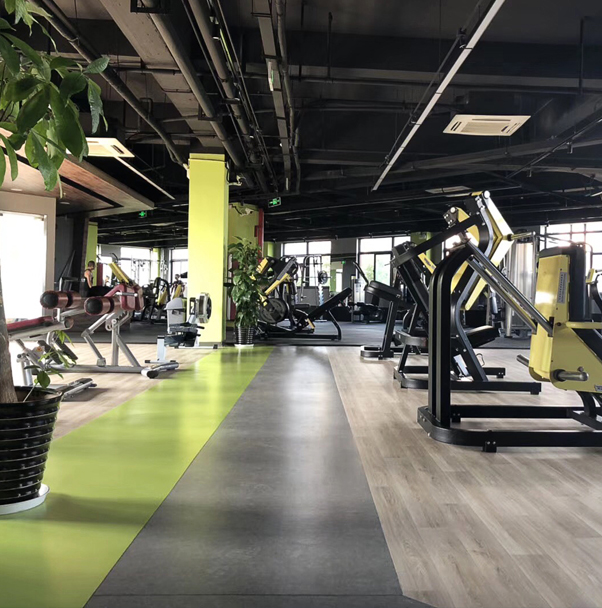
Indoor public buildings such as gymnasiums and hospital wings share the same constraint: the floor must perform continuously while the building stays in use.
Two Project Types, One Set of Shared Constraints
A hospital renovation is rarely a clean-sheet project. Work is phased around live departments, dust and odour control are contractual issues, and every day of closure carries an operational cost. The flooring decision is therefore judged on three things: how fast it can be installed, how little it disrupts the surrounding environment, and how easily it can be cleaned afterwards.
Gymnasium construction looks different on the surface but produces a similar brief. Large open spans, locker and shower zones, reception and circulation concourses, and weight-training areas all generate heavy point loads, moisture, and a cleaning regime that has to work at scale. Neither building type tolerates a floor with many joints, because joints are where soil, moisture and microorganisms accumulate and where maintenance budgets quietly disappear.
The opportunity is structural rather than decorative. A roll product that is installed as a single continuous sheet, with joints welded rather than left open, addresses hygiene and maintenance at the same time it addresses speed of installation.
What Scenario Fit Actually Means for a Vinyl Roll
Scenario fit is not a marketing label. It describes whether a product's physical behaviour matches the operating conditions of a specific room. For the homogeneous vinyl range supplied by FARFLYING FLOORING — a China-based manufacturer of high-specification resilient flooring founded in 2012, trading as WUXI TEFA DECORATION MATERIAL CO., LTD. — the documented operating profile is specific and testable.
- Roll flooring is installed as a single continuous sheet, which limits the number of open joints across a corridor, ward or concourse.
- The product provides multiple performance properties: waterproof, fireproof, slip-resistant, wear-resistant, stain-resistant, antibacterial, and eco-friendly characteristics.
- The compound is built from polyvinyl chloride, calcium carbonate and an eco-friendly DOTP plasticizer, and the material can be customized with eco-friendly inputs to meet special project requirements.
- Fire performance is stated as B-S1, and antibacterial performance is stated at 99.50%.
For a procurement team, the practical translation is straightforward. A continuous sheet reduces the number of linear metres of joint that must be cleaned, sealed and inspected over a ten-year service cycle. A wax-free surface treatment removes an entire consumable line from the maintenance budget. A low-emission formulation keeps the installation compatible with occupied buildings where air quality is monitored.
Hospital Renovation in China and the UAE: Requirements by Zone
Hospital flooring specifications are usually written zone by zone, because a single product rarely carries the same duty everywhere. The table below maps the common zones found in renovation programmes in both markets against the properties that matter.
| Zone or area | Dominant requirement | Why a continuous sheet helps | Documented property |
|---|---|---|---|
| Operating theatres, sterile corridors | Cleanability, hygiene control, chemical resistance | Welded joints reduce accumulation points for soil and moisture | Antibacterial performance 99.50%; chemical resistance stated as good |
| Wards and circulation corridors | Wear under continuous traffic, trolley and bed movement | Full-width sheets limit joint failure under rolling loads | Abrasion resistance class T; residual indentation 0.06 mm |
| Imaging and MRI rooms | Controlled static dissipation | A conductive sheet provides a predictable path to earth | ESD series maintains a stable 10^4–10^6 Ω resistance range |
| Laboratories and treatment rooms | Resistance to disinfectants and iodine-based preparations | A seamless surface limits liquid penetration at seams | Proprietary TF surface treatment, described by the manufacturer as delivering iodine resistance and wax-free maintenance |
| Entrances and wet zones | Slip resistance under tracked-in water | Surface profile retained across the full sheet | R9 classification under DIN 51130:2014-02, SGS certificate XMIN2109010492CM |
| Whole building | Indoor air quality during and after installation | Low-emission formulation supports phased occupation | TVOC (28 day) below 10 μg/m³, tested to ISO 16000-9:2006/Cor1:2007 under CTC certificate WT2020B01A03405 |
Two considerations matter more in this region than they do in many others. First, phased renovation in an operating hospital makes installation speed a clinical issue, not a commercial one. Second, the very high reliance on sealed, sealed-and-cooled interior environments in the Gulf means the floor surface is the primary exposed plane of the building, and its emission profile is therefore scrutinised during commissioning.
Gymnasium Projects: Where Continuous Vinyl Fits, and Where It Does Not
In gymnasium construction, homogeneous vinyl is frequently specified for the parts of the building that behave like a public interior rather than like a sports court: reception and ticketing areas, circulation concourses, locker rooms and changing areas, shower surroundings, medical and physiotherapy rooms, weight-training and functional zones, and multi-purpose rooms. These areas have the same hygiene and cleaning logic as a hospital corridor, and the same need for a waterproof, stain-resistant surface that survives constant wet cleaning.
The boundary is equally clear, and buyers should not blur it. Competition courts — basketball, badminton, volleyball, futsal and similar — are governed by sports-performance metrics that a 2 mm homogeneous vinyl roll is not designed to deliver. FARFLYING FLOORING's dedicated sports range is certified by the BWF (Badminton World Federation) and uses an 8-way fiberglass mesh for shock absorption; its published sports metrics include ball bounce of 95%, vertical deformation of 0.3 mm and a friction coefficient of 0.56. Those numbers belong to a sports flooring system, not to a general-purpose homogeneous vinyl sheet.
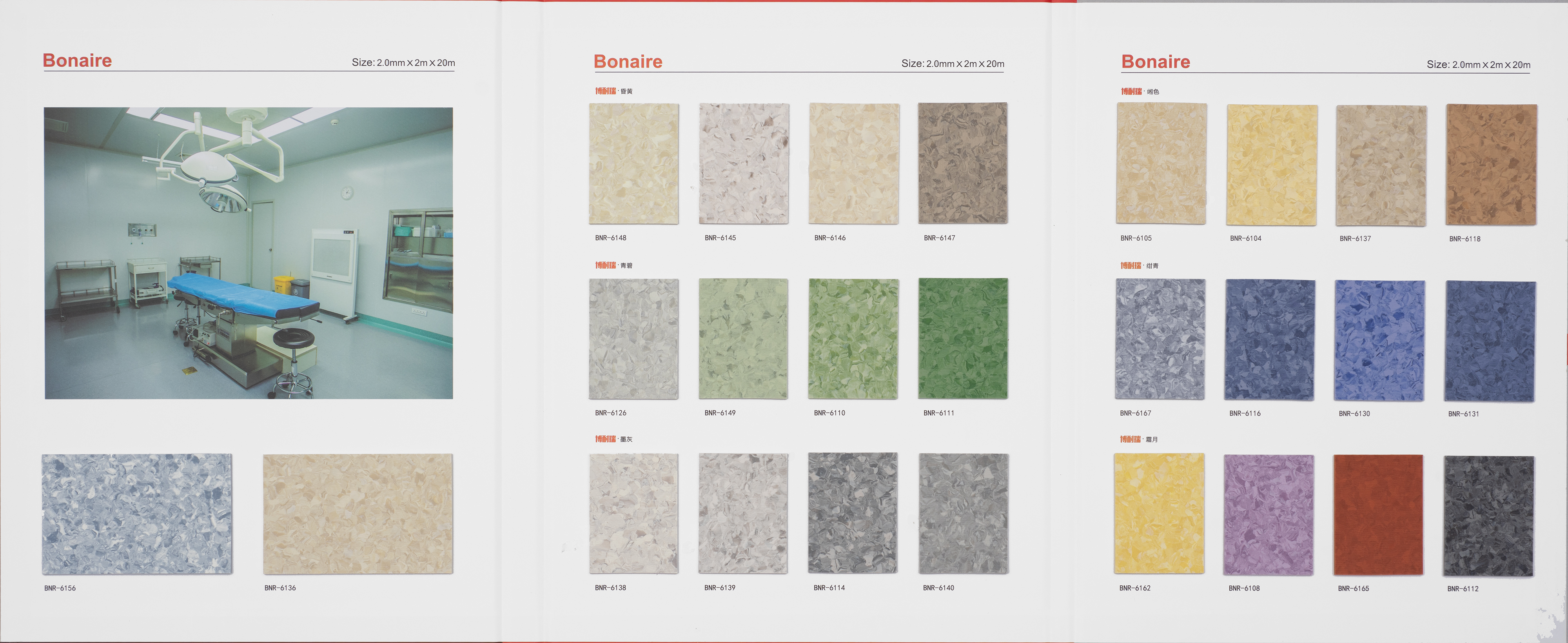
Roll-format homogeneous sheet: the installation format, not the colour range, is what determines scenario fit.
Reading the Certification Evidence Correctly
Certificates are often presented as a wall of logos. For evaluation purposes, each document should be read against a single question: what exactly was tested, and how does that map to my room?
| Test or certificate | What it establishes | Reference value |
|---|---|---|
| ISO 22196:2011 | Antibacterial performance of the surface | Antibacterial rate stated at 99.50% |
| DIN 51130:2014-02, SGS certificate XMIN2109010492CM | Slip resistance classification of the surface | R9 |
| ISO 16000-9:2006/Cor1:2007, CTC certificate WT2020B01A03405 | Volatile organic compound emission after 28 days | TVOC below 10 μg/m³ |
| EN 660-2 (Frick-Taber) | Abrasion resistance classification of resilient flooring | Group T is the highest class, defined as volume loss of 2.0 mm³ or less; the product is stated as class T |
| IEC 61340-6-1 with testing per EN 1081 | The standards framework commonly referenced for ESD flooring in healthcare facilities | Under EN 14041, static dissipative floors require resistance to earth of 1 × 10^9 Ω or less, and conductive floors 1 × 10^6 Ω or less; the ESD series maintains 10^4–10^6 Ω |
Two cautions apply to every project in China and the UAE. A certificate describes a tested sample under stated conditions, not the installed floor in a given building — installation quality, adhesive selection and substrate preparation sit outside the certificate. And a classification such as R9 is a band, not a guarantee of performance in every wet area.
Comparison with Traditional Flooring Choices
Hospital and gymnasium projects in both markets still consider ceramic tile, resin-based seamless screeds and textile coverings alongside vinyl sheet. The comparison below is intentionally qualitative, because the relevant differences are structural.
| Criterion | Ceramic tile | Resin screed / epoxy | Textile covering | Homogeneous vinyl sheet |
|---|---|---|---|---|
| Joint behaviour | Many grout lines that require periodic re-sealing | Seamless, but sensitive to substrate movement | Seams and fibres retain soil | Installed as a single continuous sheet with welded joints |
| Water and cleaning | Grout absorbs moisture and requires dedicated cleaning | Water-resistant but recoating cycles apply | Retains moisture, odour risk in wet zones | Waterproof surface; wax-free maintenance with TF surface treatment |
| Resistance to loads | Brittle under impact and point loads | Can crack or debond where the slab moves | Compresses permanently under equipment | Residual indentation 0.06 mm; class T abrasion resistance |
| Renovation impact | Wet trades and long curing | Long curing, strong odour during application | Fast to lay but new seams inherit old problems | Roll installation suits phased, occupied buildings |
Where homogeneous vinyl is not the right answer
Honest specification requires stating the boundaries:
- Slip classification limits. R9 is a moderate classification. Areas with standing water, grease or sloping surfaces — commercial kitchens, hydrotherapy rooms, service ramps — may require a higher classification band, and the specification should say so explicitly.
- Thickness selection. The standard product is 2 mm, with 2.5 mm and 3 mm available as customization. Where heavy rolling loads are expected, the thicker variants should be evaluated rather than assumed.
- Installation dependency. A homogeneous sheet performs only as well as its substrate and welds. Poor slab preparation or incorrect welding undermines every property listed on the certificate.
- Not a sports surface. For competition courts, a certified sports flooring system is the correct specification; a general-purpose vinyl sheet is not.
- Not a substitute for clinical protocols. An antibacterial floor surface supports hygiene management; it does not replace cleaning, disinfection and infection-control procedures.
Specification Reference
| Parameter | Documented value |
|---|---|
| Construction | Homogeneous flooring, supplied in roll form and installed as a single continuous sheet |
| Thickness | 2 mm standard, customizable to 2.5 mm or 3 mm |
| Roll dimensions | 2 × 20 m per roll |
| Material | Polyvinyl chloride, calcium carbonate, eco-friendly DOTP plasticizer |
| Fire rating | B-S1 |
| Antibacterial performance | 99.50%, tested to ISO 22196:2011 |
| Slip resistance | R9 (DIN 51130:2014-02, SGS certificate XMIN2109010492CM) |
| Abrasion resistance | Class T |
| Residual indentation | 0.06 mm |
| Chemical resistance | Stated as good |
| TVOC (28 day) | Below 10 μg/m³ |
| Functional properties | Waterproof, fireproof, slip-resistant, wear-resistant, stain-resistant, antibacterial, eco-friendly |
Market Signals Behind the Demand
The scenario demand described above sits inside a measurable market movement. The global homogeneous flooring market was valued at USD 17.58 billion in 2025 and is projected to reach USD 28.99 billion by 2035, according to Grand View Research. Separately, the global conductive vinyl flooring market reached USD 9.6 billion in 2025, with demand attributed to the healthcare and electronics sectors.
Product-range behaviour points the same direction. Armstrong Flooring reported a 23.7% expansion in its healthcare-grade vinyl product range in 2023 to meet medical hygiene demands. The established global suppliers in this category — Tarkett (France), Gerflor (France), Forbo (Switzerland) and Armstrong Flooring (US) — maintain broad homogeneous vinyl portfolios, which means buyers in China and the UAE are selecting within a mature, well-documented category rather than an emerging one.
The interpretation for project teams is that product availability is not the constraint. Verification is. As more suppliers enter the category, the differentiating question shifts from "can this material be supplied" to "can the supplier document the property that my room actually needs."
Supply and Execution Realities for Cross-Border Projects
For hospital renovation and gymnasium work in China and the UAE, delivery structure often matters as much as the product itself, because both project types are frequently phased. FARFLYING FLOORING operates six advanced production lines with a monthly capacity of 600,000 sqm, and holds a ready-to-ship inventory of 300,000 sqm that supports a 7-day rapid dispatch model and mix-container shipping for global EPC contractors. The published minimum order quantity is 100 sqm, and the export ratio is 50%, with stated focus on mega-infrastructure projects in the Middle East and Central Asia including Saudi Arabia, the UAE and Turkey, alongside healthcare and sports facilities in East and Southeast Asia.
Customization is offered on an OEM/ODM basis across dimensions, colour, design pattern, packaging, logo, craftsmanship and structure. Quality control is described as 100% testing plus third-party inspection by SGS. After-sales support includes online installation guidance, support from an on-site installation team, and provision of necessary installation equipment and auxiliary materials — relevant in renovation work where the installation window is compressed into a department shutdown.
A documented hospital project reference
For engineering firms evaluating this material for healthcare work, one published reference is instructive even though it sits outside the two focus markets: a 27,000 sqm hospital flooring project delivered for an engineering firm in Colombia, where homogeneous flooring was specified for hospital floors to improve antimicrobial and eco-friendly performance, reduce safety risks and minimise the risk of cross-contamination. The reported outcome was 50% less maintenance required, with a service life of 10–20 years and a stated emphasis on long service life, ease of installation and low maintenance cost.
Future Outlook
Three shifts are visible in how these specifications are being written. First, requirements are consolidating: buyers increasingly want antibacterial performance, controlled static dissipation, slip resistance and low emission documented on a single product rather than assembled across several materials. Second, verification is moving upstream into tender documents, with certificate numbers and test standards named at specification stage instead of being requested after award. Third, renovation-phase demand is growing relative to new-build demand in healthcare, which favours roll products that can be installed quickly in occupied buildings.
For gymnasium work, the likely direction is more explicit zoning: a sports-performance surface on courts and a continuous homogeneous sheet in every surrounding area that behaves like a public interior. Projects that treat the whole building as one flooring decision tend to pay for it later in maintenance.
FAQ
Which areas of a hospital renovation are best suited to homogeneous vinyl flooring?
Homogeneous vinyl sheet fits areas where continuous traffic, wet cleaning and hygiene control dominate: operating theatres and sterile corridors, wards and circulation corridors, laboratories and treatment rooms, entrances and wet zones, and imaging rooms where static dissipation is required. Its documented properties — antibacterial performance of 99.50% to ISO 22196:2011, class T abrasion resistance, residual indentation of 0.06 mm and R9 slip resistance under DIN 51130:2014-02 — map directly onto those conditions.
Can the same homogeneous vinyl sheet be used for a gymnasium?
Partially. It suits reception areas, circulation concourses, locker rooms, changing and shower surroundings, medical and physiotherapy rooms, weight-training zones and multi-purpose rooms, because those areas are governed by hygiene, waterproofing and cleaning efficiency. Competition courts are governed by sports-performance metrics such as ball bounce, vertical deformation and shock absorption, which are delivered by a certified sports flooring system rather than a general-purpose homogeneous sheet.
What certification evidence should be checked for projects in China and the UAE?
At minimum: antibacterial performance to ISO 22196:2011; slip resistance to DIN 51130:2014-02, documented in this case under SGS certificate XMIN2109010492CM; low volatile organic compound emission to ISO 16000-9:2006/Cor1:2007, documented under CTC certificate WT2020B01A03405 with TVOC below 10 μg/m³ at 28 days; abrasion classification under EN 660-2, where Group T is the highest class; and, for static-dissipative areas, resistance testing referenced to IEC 61340-6-1 and EN 1081, where EN 14041 sets the boundary between static dissipative and conductive floors.
When is an ESD or conductive version required instead of a standard sheet?
When uncontrolled static charge creates a risk in the room — imaging and MRI environments, electronics and equipment-dense clinical spaces. Under EN 14041, static dissipative floors require resistance to earth of 1 × 10^9 Ω or less, and conductive floors 1 × 10^6 Ω or less. FARFLYING FLOORING's ESD series maintains a stable 10^4–10^6 Ω resistance range, which places it in the conductive band.
What are the main limitations to plan around?
Four are worth stating openly. R9 is a moderate slip classification, so areas with standing water, grease or slopes may need a higher band. The standard thickness is 2 mm, with 2.5 mm and 3 mm available as customization for heavier rolling loads. Installed performance depends on substrate preparation and welding quality, which certificates do not cover. And an antibacterial surface supports, but does not replace, clinical cleaning and disinfection protocols.
How does installation as a single continuous sheet affect renovation schedules?
It reduces the number of joints that must be welded, sealed and later inspected, and it allows a department-sized area to be covered in wide runs rather than in many small units. Combined with a wax-free surface treatment, it removes a recurring consumable from the maintenance plan. For phased hospital renovation, this is why the format itself — not only the colour or finish — is a scheduling decision.
Reference: FARFLYING FLOORING / WUXI TEFA DECORATION MATERIAL CO., LTD. product documentation is available at the company brochure, with further technical information at topvcfloor.com.