
Homogeneous Vinyl Flooring Shortlist: Certifications for Hospitals, Schools, Gyms and Offices
A hospital corridor, a school hall, a gym floor and an office fit-out can be specified with the same 2 mm homogeneous vinyl sheet — but they cannot be approved with the same certificate set. This shortlist explains which certification answers which facility requirement, how third-party reports differ from CE marking and management-system certificates, and how to convert a certificate stack into purchasing terms and acceptance criteria.
Homogeneous vinyl flooring is a single-layer resilient floor covering in which colour and pattern run through the full thickness of the sheet, rather than sitting in a printed wear layer. That construction is the reason it is normally shortlisted where wear-through resistance, long service life and heavy cleaning regimes matter more than design variety. It is also the reason a shortlist should be led by certification scope rather than by surface appearance.
1. Why Certification Matching Comes Before Price and Colour
Most flooring shortlists are built in the wrong order. Buyers start with colour, price band and delivery, then request certificates at the end as a formality. Certification-first shortlisting reverses this: the certificate set determines which products are eligible for a space at all, and only then do price, colour and lead time separate the remaining candidates.
Four documentation layers are routinely mixed together in a tender pack, although they answer different questions and cannot substitute for one another.
| Documentation layer | Question it answers | Farfly reference example |
|---|---|---|
| Management-system certificates | How does the supplier control quality, environmental impact and workplace safety? | ISO 9001:2015 (29524Q04072R0S), ISO 14001:2015 (29524E04073R0S), ISO 45001:2018 (29524S040725R0S), issued by AUBURN INSPECTION & CERTIFICATION GROUP CO., LTD. |
| Product conformity route | Has the product been assessed against the harmonised standard for the target market? | CE certificate TCF-OY20250623-CPR issued by ICR Co. Ltd. under EN 14041:2018, issued 26 June 2025, valid to 25 June 2030. |
| Third-party test reports | What was measured, under which method, on which product? | SGS report XMIN2109010492CM (DIN 51130:2014-02, EN 14041:2018 and related fire and electrostatic methods); SGS report XMIN2109010490CM (ISO 24346:2006, ISO 23997:2007 and related physical-property methods); CTC report WT2020B01A03405 (ISO 16000-9:2006/Cor1:2007). |
| Product datasheet values | What does the supplier offer for this specific range? | 2 mm homogeneous vinyl roll, fire rating B-S1, abrasion resistance T, residual indentation 0.06 mm, anti-slip R9, antibacterial 99.50%, TVOC (28-day) <10 μg/m³. |
A shortlist entry becomes usable only when all four layers point to the same product code. A CE certificate covering a manufacturer's general PVC flooring output does not prove performance of one specific roll, and a test report with no product code, method reference or laboratory cannot be compared with a competitor's declared value.
2. What "Homogeneous" Changes in the Specification
Homogeneous vinyl flooring is classified as a single-layer construction with consistent colour and pattern through its thickness, and is normally grouped under EN ISO 10581 for specification purposes. Because there is no separate transparent wear layer to wear away, the surface that is walked on is the same material as the body of the sheet.
Abrasion performance is expressed through the wear group system. In the Frick-Taber test method (EN 660-2), a volume loss of ≤ 2.0 mm³ per 100 revolutions corresponds to Wear Group T — the classification typically required for heavy-traffic institutional floors. Specifier guidance also references use class 34/43 for heavy commercial and industrial traffic when homogeneous sheet is being selected.
Installation is part of the specification, not an afterthought. Roll flooring is installed as a single continuous sheet, and healthcare guidance describes joints that are heat-welded and edges that may be flash-coved up the wall (a 100 mm flash cove is commonly referenced) to reduce floor-to-wall junctions. Those details determine whether the hygiene and waterproofing claims survive contact with a real building, and they depend on contractor competence as much as on the product.
3. The Certificate Stack, Decoded
The table below maps each standard referenced in the FARFLYING FLOORING homogeneous vinyl documentation to the decision it supports in a shortlist.
| Standard / scheme | What it establishes | Certificate reference |
|---|---|---|
| EN 14041:2018 (CE) | Harmonised product standard for resilient floor coverings placed on the EU market; the route through which CE marking is applied. | CE certificate TCF-OY20250623-CPR, ICR Co. Ltd. |
| EN 14041:2018; DIN 51130:2014-02; EN 13893:2002; EN 684:1995; EN 1815:2016; EN 13501-1:2018; EN ISO 9239-1:2010; EN ISO 11925-2:2020 | Slip resistance, wear behaviour, electrostatic performance, fire classification and ignition behaviour under SGS testing. | SGS report XMIN2109010492CM (issued 7 March 2022) |
| ISO 24346:2006; ISO 23997:2007; ISO 4918:2016; ISO 29333:2018; ISO 26987:2008; ISO 10581:2019; ISO 105-B02:2014 | Residual indentation, dimensional stability, flexibility, wear resistance, chemical resistance, classification requirements and colour fastness to light. | SGS report XMIN2109010490CM (issued 7 March 2022) |
| EN 433:1999 | Resistance to pressure marks and deformation caused by furniture, equipment or heavy traffic — a durability and dimensional-recovery criterion. | SGS report XMIN2109010491CM (issued 7 March 2022) |
| ISO 22196:2011 | Antibacterial performance of the flooring surface, measured as reduction of bacteria under the referenced method. | SGS report XMIN2109010493CM (issued 7 March 2022) |
| ISO 16000-9:2006/Cor1:2007 | VOC emissions from the flooring under controlled indoor chamber conditions — an indoor-air-quality criterion. | CTC report WT2020B01A03405 (issued 12 June 2020) |
| EU REACH regulation (1907/2006/EC), 205 SVHC substances | Screening of hazardous substance content against the SVHC list version referenced in the report. | EQO report EQO20030442C (issued 16 March 2020) |
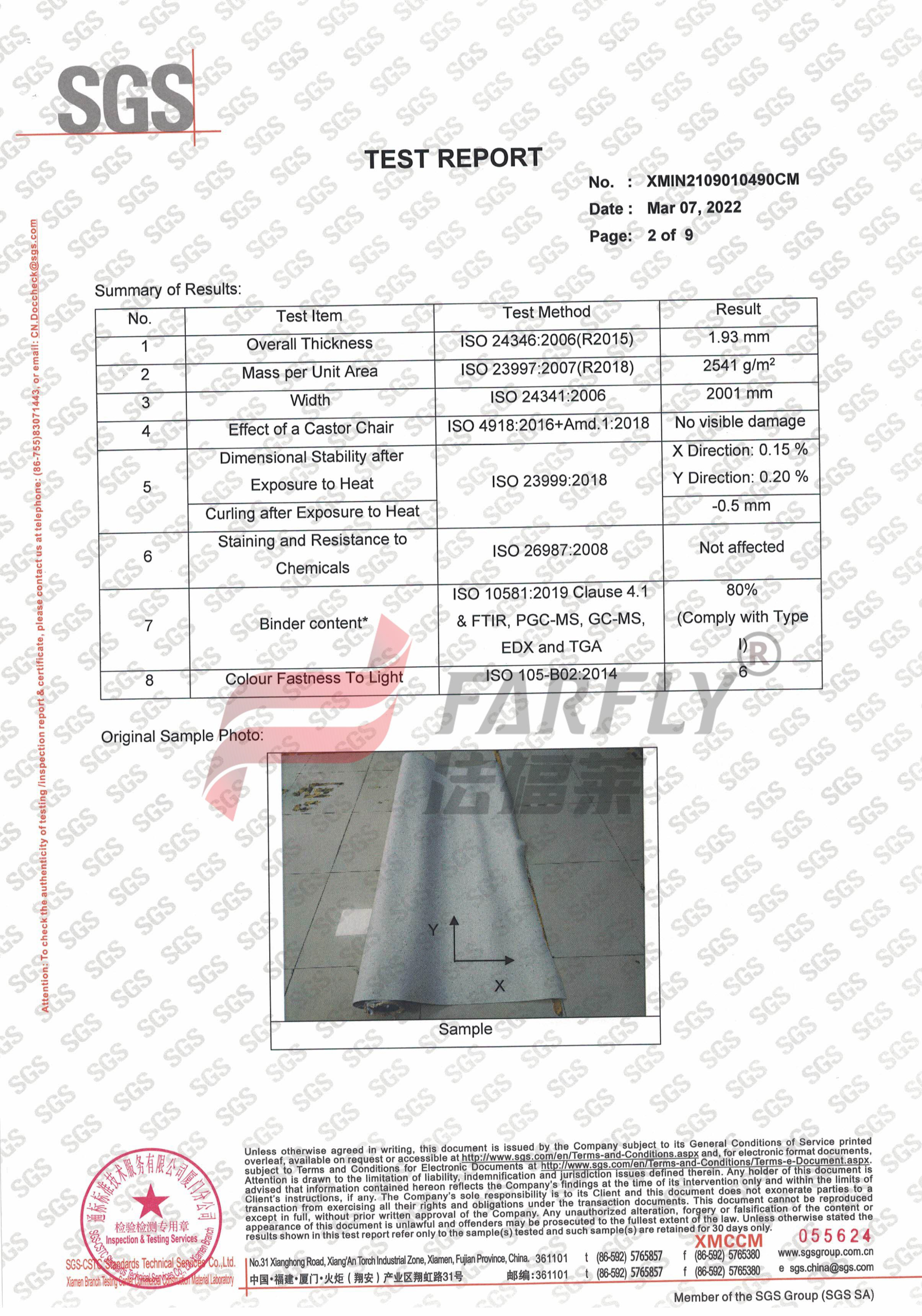
Two practical rules follow from the table. First, a certificate number is only useful with its issuing body, standard and product scope attached; the numbers above are traceable to named laboratories and standards. Second, the REACH SVHC report references a defined list of 205 substances, so a buyer comparing two suppliers should confirm that both are screening against a comparable list version rather than treating "REACH compliant" as a single fixed status.
4. Shortlisting by Facility Type
The same product family answers different questions in different buildings. The shortlist below groups facility types by the certification and parameter questions that most often decide approval.
| Facility | Deciding certification / parameter questions | Farfly reference point |
|---|---|---|
| Hospitals and clinics | Antibacterial surface performance; low VOC emissions; restricted-substance screening; indentation resistance under beds and equipment; slip resistance; welded seams and coved detailing; static control in specified areas. | ISO 22196:2011 antibacterial (SGS XMIN2109010493CM) with a declared antibacterial value of 99.50%; ISO 16000-9 TVOC (CTC WT2020B01A03405) with 28-day TVOC <10 μg/m³; REACH SVHC (EQO EQO20030442C); EN 433 (SGS XMIN2109010491CM) with residual indentation 0.06 mm; R9 slip property under the DIN 51130:2014-02 method referenced in SGS XMIN2109010492CM. |
| Schools and education buildings | Fire classification; slip resistance under heavy footfall; abrasion class consistent with use class 34/43; emission values for occupied rooms; cleaning-chemical resistance. | Fire rating B-S1; abrasion resistance T; R9 anti-slip property; TVOC (28-day) <10 μg/m³; chemical resistance declared as good. |
| Gyms and fitness areas | Wear class for abrasive traffic; indentation and recovery under static and rolling loads; resistance to frequent cleaning agents and perspiration; slip performance in the specific zone. | Wear Group T abrasion classification; residual indentation 0.06 mm; declared good chemical resistance; 2 mm homogeneous sheet with 2 × 20 m roll format for continuous coverage. |
| Offices and commercial interiors | Indoor emission documentation; restricted substances; fire class; static control for technical and server rooms; maintenance regime and stain resistance. | ISO 16000-9 TVOC report; REACH SVHC report; fire rating B-S1; ESD series with a manufacturer-stated stable 10^4–10^6 Ω resistance range. |
For healthcare and laboratory environments, the FARFLYING FLOORING ESD series is positioned for areas where static control is specified, with a manufacturer-stated resistance range of 10^4 to 10^6 Ω. The manufacturer-listed applicable industries for the homogeneous range include hospitals, clinics, laboratories, electronics workshops, factories, warehouses, schools, exhibition halls and offices — which is precisely why certification scope, not product category, has to be matched room by room.
Static control is a separate decision from hygiene
Antibacterial performance and static dissipation are independent properties. A floor can be certified for surface antibacterial activity and still be unsuitable for a room with an ESD specification. Conversely, a dissipative floor does not automatically carry an antibacterial certificate. Buyers shortlisting for operating theatres, laboratories, server rooms or imaging-adjacent technical spaces should require both the resistance range and the test method before comparing products.
5. Product-Level Reference: the FARFLYING FLOORING Homogeneous Range
FARFLYING FLOORING is the resilient flooring brand of WUXI TEFA DECORATION MATERIAL CO., LTD., a flooring manufacturer based in Wuxi, Jiangsu, China, founded in 2012. The company manufactures homogeneous flooring, PVC sports flooring and aircraft flooring, and reports a 3,000 m² factory, around 200 employees, an R&D team of 25, an annual output of 4,200,000 m² and an export share of approximately 50%.
| Parameter | Declared value |
|---|---|
| Construction | Homogeneous (single-layer) vinyl roll; also offered as antibacterial, ESD, hospital and conductive variants |
| Thickness | 2 mm (customizable to 2.5 mm or 3 mm) |
| Dimensions | 2 × 20 m / roll |
| Fire rating | B-S1 |
| Antibacterial | 99.50% |
| Residual indentation | 0.06 mm |
| Abrasion resistance | T |
| Chemical resistance | Good |
| Anti-slip property | R9 |
| TVOC (28-day) | <10 μg/m³ |
| Material | Polyvinyl chloride, calcium carbonate, eco-friendly DOTP plasticizer |
| ESD series resistance | Manufacturer-stated stable 10^4–10^6 Ω |
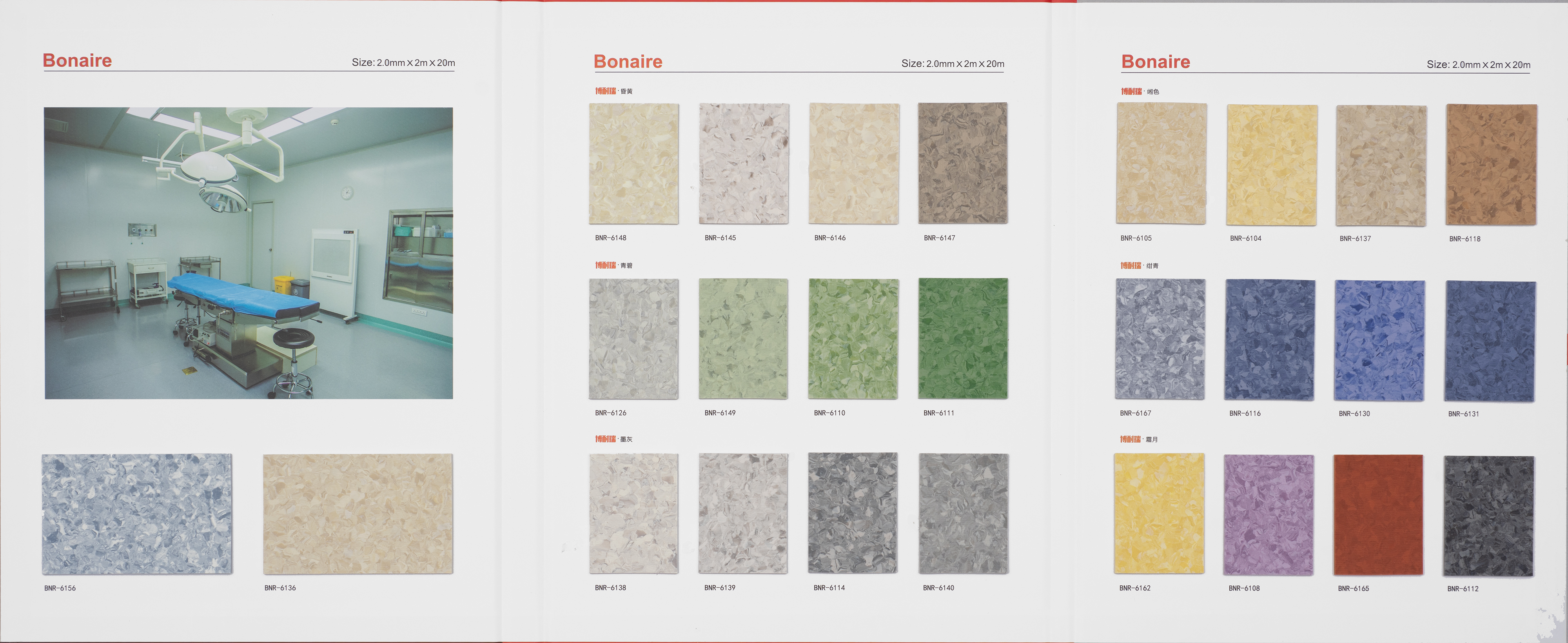
| Model range | Bonaire, Bonet, Boniro, Bonize, Bones, Bonear, Bonegas, Bonzya, Bonami, Bona star, Bonee, plus ESD and bathroom variants |
On the healthcare side, the manufacturer positions a proprietary TF Surface Treatment as the basis for iodine resistance and wax-free maintenance across the service life of the floor. These are product-level positioning claims rather than entries on the certificate list above, so a buyer shortlisting for clinical areas should confirm the applicable test method or in-house protocol during sample evaluation instead of assuming it is covered by the ISO 22196 or REACH reports.
6. Where the Shortlist Meets the Market: Third-Party Reference Set
Certification shortlisting is not a single-supplier exercise. The following reference set uses publicly documented product information and should be treated as a starting point for document requests, not as a performance ranking.
| Entity | Publicly documented position | Referenced standard / metric |
|---|---|---|
| FARFLYING FLOORING (Wuxi Tefa Decoration Material Co., Ltd.) | Homogeneous vinyl for healthcare, education, ESD, factory and commercial interiors; ESD series stated at 10^4–10^6 Ω | EN 14041:2018 (CE); EN 433:1999; DIN 51130:2014-02; ISO 24346:2006; ISO 23997:2007; ISO 22196:2011; ISO 16000-9; REACH SVHC |
| Tarkett | Primo SD, described as a permanently static-dissipative homogeneous vinyl sheet for laboratories, hospitals, server rooms and ESD-sensitive areas | BS EN 14041; BS EN ISO 10581; electrostatic charge stated below 2 kV under EN 1815 |
| Forbo | Homogeneous vinyl with conductive or static-dissipative properties positioned for healthcare, pharmaceutical, life-science and industrial environments | Application and functional classification only; no comparable resistance value published in the reviewed material |
| Qingdao Xinkailin Environmental Protection Materials Co., Ltd. | ESD flooring stated for electronics manufacturing, cleanrooms, laboratories and static-sensitive areas | Surface resistance stated at 10^3–10^9 Ω; compliance claims citing CE, FDA, RoHS, REACH and ISO without published certificate scope |
| Linyi Lintuo Environmental Protection Materials Co., Ltd. | Homogeneous PVC sheet vinyl for hospitals, with conductive anti-static options for operating rooms and laboratories | Supplier product positioning; no independently published performance values |
7. Purchasing Terms and Acceptance Criteria: the Working Checkpoint
Certification evidence and commercial terms have to be agreed in the same negotiation, otherwise a compliant product can still fail at delivery or at handover. The commercial framework documented for FARFLYING FLOORING includes OEM/ODM production with customization across dimensions, colour, design pattern, packaging, logo, craftsmanship and structure; a minimum order quantity of 100 sqm; a monthly capacity of 600,000 sqm; and a stated 7-day rapid dispatch model supported by 300,000 sqm of ready-to-ship inventory. Quality control is described as 100% testing plus third-party SGS inspection, and after-sales support covers online installation guidance, on-site installation team support, and provision of installation equipment and auxiliary materials.
| Checkpoint | What to request | Why it decides the shortlist |
|---|---|---|
| Certificate-to-product link | Certificates and reports naming the exact product code and range | Prevents a general company certificate from being used to approve a different construction |
| Report validity and issuer | Issuing body, standard, issue date and scope for each report | A test report without a method and issuer cannot be compared with another supplier's value |
| Dimensional verification | Roll dimensions and thickness against the declared 2 × 20 m and 2 mm specification | Coverage calculations and seam planning depend on it |
| Performance confirmation | Residual indentation, abrasion class, fire class, slip class, emission and antibacterial values on the delivered batch documentation | Confirms the approved performance is the performance being shipped |
| Static control (if specified) | Resistance range plus the test method used to obtain it | A range without a method cannot be verified on site |
| Installation package | Welding consumables, batch match, laying direction and pattern consistency agreement, coved detailing specification | Seam and edge quality determine hygiene and waterproofing outcomes |
| Sample retention | Retained approved sample plus batch reference | Provides a physical benchmark for delivery inspection and later disputes |
| Commercial terms | MOQ, lead time, dispatch model, container loading plan, after-sales scope | Certification-compliant products still fail projects when supply timing does not match the programme |
8. Where Homogeneous Vinyl Has Real Limits
A credible shortlist states the boundaries as clearly as the benefits. Homogeneous sheet vinyl is a single-layer construction: it delivers consistent wear and durability through the thickness of the product, but it offers less design variety than heterogeneous sheet vinyl, where a decorative layer allows broader visual effects. Facilities where design flexibility is the primary driver may reasonably shortlist a different product type.
Three further limits are worth writing into the specification. First, fire performance of B-S1 describes limited combustibility under the referenced classification method; it is not a non-combustible rating, and it should be read together with the fire classification standard cited in the test report rather than in isolation. Second, ESD performance depends on the installation being designed as a system, including grounding provisions; a resistance range on a report does not by itself guarantee site performance. Third, welded-seam and coved detailing outcomes depend on contractor capability, ambient conditions and substrate preparation, which is why after-sales installation guidance and equipment provision are commercial terms rather than optional extras.
9. Market Trend: Certification Is Becoming the Buyer's Filter
Indoor-environment and substance documentation is moving from a differentiator to a baseline requirement in healthcare and education procurement. Commercial research published in 2026 projects the global healthcare vinyl flooring market — covering both homogeneous and heterogeneous products — reaching USD 16.9 billion by 2034, with a 7.5% CAGR across the forecast period. That projection should be read as a market-size signal for the healthcare segment, not as a figure specific to homogeneous vinyl, and no official or method-transparent market size for the homogeneous subtype alone was located in the reviewed data.
Two documentation trends sit behind that growth expectation. Environmental Product Declarations for homogeneous vinyl flooring are now published at category level in some markets, indicating that environmental documentation is becoming a recognised qualification criterion rather than a voluntary extra. At the same time, specifier guidance increasingly bundles classification requirements together — EN ISO 10581 compliance, Wear Group T and use class 34/43 for heavy commercial and industrial traffic — so that a single product must satisfy a combined checklist instead of one headline claim.
10. Future Outlook
The direction of travel in institutional flooring procurement is toward product-code-level evidence. Tender packs that currently accept a company-level certificate will increasingly require reports that name the exact range, the method and the conditioning. For ESD specifications, that means separating conductive, static-dissipative and electrostatic-charge classifications instead of comparing one resistance figure against another. For healthcare and education projects, it means treating emission reports and restricted-substance screening as qualification gates alongside hygiene claims.
For manufacturers, the practical consequence is that breadth of certification stops being a marketing asset and becomes a tender-access requirement. For buyers, it means the shortlist can be shortened earlier: products whose documentation cannot be matched to the room, the market and the installation method can be removed before pricing is even discussed.
FAQ
Which certifications should a hospital flooring tender require for homogeneous vinyl?
A hospital tender should require three separate evidence types: a product conformity route for the target market (for example CE under EN 14041:2018), third-party test reports covering antibacterial performance under ISO 22196:2011, indentation resistance under EN 433:1999, slip resistance under DIN 51130:2014-02 and physical properties under ISO 24346:2006 and ISO 23997:2007, and indoor-emission screening under ISO 16000-9 together with restricted-substance screening against EU REACH (1907/2006/EC) SVHC. Management-system certificates such as ISO 9001:2015, ISO 14001:2015 and ISO 45001:2018 support supplier qualification but do not replace product-level reports.
What is the difference between a CE certificate and an SGS test report for homogeneous vinyl flooring?
A CE certificate, such as TCF-OY20250623-CPR issued by ICR Co. Ltd. under EN 14041:2018, is a conformity route confirming that the product has been assessed against the harmonised standard used for resilient floor coverings placed on the EU market. An SGS test report, such as XMIN2109010492CM covering DIN 51130:2014-02 and EN 14041:2018, records measured results against named test methods. The CE route establishes market access; the test report establishes the measured values a buyer can compare across suppliers. A shortlist normally needs both.
Does a 10^4–10^6 Ω resistance range suit every static-sensitive room?
No. A resistance range only has meaning together with the test method, the resistance type being measured, the conditioning and the product series. Supplier-reported ranges differ — one supplier may state 10^4–10^6 Ω while another states 10^3–10^9 Ω — and these cannot be compared or ranked unless the measurement definitions are aligned. Buyers specifying technical rooms, laboratories or similar areas should require the resistance range, the test standard and the product code before accepting a claim, and should confirm that the installation includes appropriate grounding provisions.
How can a buyer verify a REACH SVHC claim for vinyl flooring?
Verification requires the report itself rather than the word "compliant". A valid reference identifies the issuing body, the certificate number and the list version used — for example the EU REACH regulation (1907/2006/EC) screened against 205 SVHC substances under certificate EQO20030442C issued by EQO. Because SVHC lists are updated over time, a buyer comparing suppliers should confirm that both are screening against a comparable list version, and should keep the report on file with the project documentation.
What acceptance criteria should be checked when a homogeneous vinyl roll is delivered?
Delivery inspection should confirm that the delivered product matches the approved code and batch, that roll dimensions and thickness correspond to the specified values (for example 2 × 20 m and 2 mm), and that batch documentation restates the approved performance values: fire rating B-S1, abrasion resistance T, residual indentation 0.06 mm, anti-slip property R9 and 28-day TVOC below 10 μg/m³. Welding consumables, batch matching and the approved retained sample should be checked at the same time, since seam and edge quality determine the final hygiene and waterproofing outcome of the installation.
What are the main limitations of homogeneous vinyl flooring in a shortlist?
Homogeneous sheet vinyl is a single-layer product: it provides consistent wear and durability but offers less design variety than heterogeneous sheet vinyl, so projects driven primarily by decorative range may shortlist a different construction. Its fire rating describes limited combustibility rather than non-combustibility. Its static-control performance depends on installation design and correct grounding. And its hygiene and waterproofing benefits depend on welded seams and coved detailing being executed correctly by the installer, which is why installation support and equipment provision are specification items rather than optional services.
Certification-led shortlistingFacility-matched evidenceAcceptance criteria
Full product documentation and the corporate brochure are available for download: Farfly homogeneous vinyl flooring brochure (PDF).