
Homogeneous Vinyl Flooring for High-Traffic Interiors
Homogeneous Vinyl Flooring for High-Traffic Interiors
Homogeneous vinyl flooring is specified in corridors, retail areas and workshops because of how the sheet is built, not because of how it looks. The material is the same from the surface to the back of the roll, so scuffs, scratches and years of footfall do not cut through to a printed image or a separate visual layer underneath. For a project team choosing between sheet vinyl types for an intensive, non-clinical building, that single property changes the maintenance argument, the repair logic and how the floor is judged five years after handover. It does not make homogeneous sheet the right answer in every room.
This guide covers where the through-body construction genuinely fits — long circulation routes, trading floors, and production or maintenance workshops — and where a layered, heterogeneous sheet serves the user better. It also separates the product data a buyer can verify from the claims that need a test report before they belong in a submittal.

Homogeneous vinyl sheet flooring installed as a continuous surface with heat-welded joints.
Why the Through-Body Build Changes the Maintenance Argument
Published explanations of the two sheet categories agree on the construction difference. Homogeneous sheet is described as a single-layer construction with consistent colour and pattern through its thickness, with the acknowledged trade-off that it offers less design variety than heterogeneous sheet (Patcraft, product guidance). A separate manufacturer explanation makes the same point from the performance side: because colour and design run through the full depth of the flooring, homogeneous sheet is stated to be more scratch resistant (LX Hausys, product guidance).
Put that into a corridor serving a service yard, or a retail floor beside a trolley route. In a layered product, the printed design sits beneath a transparent wear layer, so a deep scratch reads as a break in the image. In a homogeneous sheet the scratch works on the same material that surrounds it, which is why the industry describes wear as less noticeable rather than absent.
Two qualifications keep the claim usable. First, “wear is less visible” is a qualitative construction argument. It is not a measured service life, and it should not be written into a specification as a longevity figure. The measurable elements are the abrasion classification, residual indentation and the quality of the installed seams. Second, less visible wear is still wear: abrasive grit removes material, and over enough years a through-body colour can polish to a different sheen along the main footfall lane even though no pattern has been breached.
What changes for the buyer is timing. Appearance retention determines when a floor starts to look dated rather than when it fails, and in retail and public circulation that perception often drives refurbishment earlier than physical deterioration does. A floor that stays visually consistent across ten or fifteen years of traffic is a maintenance-budget argument, not a marketing one — and it should be presented to a committee in those terms.
Wear Class: The First Number to Agree On
EN ISO 10581 is the product specification standard for homogeneous PVC floor coverings and is the reference most European-facing tenders use to describe the category (ISO, 2011). Within that framework, abrasion performance is expressed by group. Group T corresponds to a volume loss of no more than 2.0 mm³ per 100 revolutions under the EN 660-2 abrasion method referenced for the classification, while P class covers roughly 2.0 to 4.0 mm³ (classification data underlying EN ISO 10581).
For the spaces discussed here, Group T is the practical floor of acceptability rather than an upgrade. A shopping-centre corridor, a supermarket aisle and a workshop walkway all sit in the traffic band that specification guidance describes with use classes 34 and 43 — heavy commercial and heavy industrial traffic (Goodrich Global, specifier guidance, 2026). Two consequences follow. First, a “T” on a datasheet is a classification statement, and the buyer still needs the test report behind it, including the product code that was tested. Second, use class is a room-by-room decision: a back-of-house corridor behind a retail unit and a public mall concourse belong in different bands even when they share a wall.
The Vinyl Flooring record (model reference 3659) declares abrasion resistance T, which places the range at the T classification on paper. The verification step is to match that declaration to a report covering the specific colour and thickness being supplied, because ranges are usually qualified at a representative construction rather than at every variant.
Corridors: Long Runs, Few Joints, Predictable Slip
Corridors reward sheet format more than any other space in this guide. The 3659 record lists a roll dimension of 2 × 20 m, which means a long run can be laid with a small number of seams — and seams, not the field of the sheet, are where most corridor problems begin.
The installation sequence that governs the result is standard sheet practice: inspect and moisture-test the subfloor, level and repair it, acclimate and dry-lay the rolls, set centre lines, apply the specified adhesive with the correct trowel and open time, lay and roll the sheets, trim the edges, then groove and heat-weld the seams with a matching welding rod before cleaning and curing. Heat-welded joints are also the detailing route identified in healthcare sheet guidance, which notes coved detailing at the floor-to-wall junction to reduce junctions where soil collects (Goodrich Global, 2026). That wall detail is optional in a commercial corridor, but the welded seam is not optional in any space that will be washed regularly.
Slip performance and fire classification belong in the same conversation. The 3659 record declares a slip classification of R9 and a fire rating of B-S1. Both are declared values that a corridor specification on an escape route will normally require as documented performance, so the submittal should carry the report, the tested construction and the substrate condition used in the test — not only the two characters on the datasheet.
Rolling loads deserve more attention than they usually receive. Trolleys, delivery carts, cleaning machines and mobile equipment concentrate load on a small contact patch, which is what residual indentation measures. The 3659 record declares 0.06 mm residual indentation; the buyer should ask for the test method and the load and duration conditions, then compare those conditions with the actual equipment mix. Where loads are heavier or the subfloor less stable, a thicker construction — the 2.5 mm and 3 mm options listed for the range — is a legitimate response, provided the subfloor is corrected at the same time. Extra thickness does not compensate for a floor that deflects.
Retail Floors: Appearance Retention While the Store Is Trading
Retail introduces two constraints that corridors do not: the floor is judged by customers, and it is often installed or maintained while the building is occupied. The through-body argument answers the first. The second is a data question, and the 3659 record supports it with a declared TVOC figure of less than 10 µg/m³ at 28 days.
That figure matters most where a fit-out is handed over into a trading environment with shared ventilation, and where a landlord has set an indoor-air target in the lease or in the fit-out guide. It remains a declared product value: the project's own air-quality requirement must be checked against the test method, the sample conditioning and the way the report is written before the number is used as evidence of compliance with anything.
The same discipline applies to the declared antibacterial rate of 99.50%. Read without its supporting method, a percentage invites misinterpretation. Ask which organisms were tested, under which standard, at what contact time, and on which surface treatment. A declared antibacterial property supplements cleaning; it does not replace it, and it should not be presented to a client as an infection-control measure in a non-clinical building.
Maintenance is where a supplier claim most needs an evidence request. Farfly positions its healthcare homogeneous range with TF Surface Treatment for iodine resistance and wax-free maintenance. That is a company-reported product feature from the supplier profile, and no independent test report for those two properties was located in the available evidence. For a retail environment handling chemicals, pigments or food-adjacent cleaning agents, the practical response is to request the stain and chemical-resistance list that matches the actual substances on site rather than accepting a general description.
The limitation to state plainly to a design team: homogeneous sheet offers fewer design options than heterogeneous sheet (Patcraft, product guidance). Where the brand brief depends on a specific visual — a photographic print, a deep emboss or a strong directional pattern — confirm that the homogeneous range carries it before committing the category.
Workshops: Point Loads, Chemistry and Static Control
Workshop floors combine dropped-tool impact, concentrated point loads, spill exposure and, in some operations, static control. The 3659 record declares chemical resistance as “good” and slip resistance as R9. “Good” is not a rating and cannot be specified: the correct artefact is a chemical-resistance table listing the specific substances, concentrations, contact times and the resulting classification for the product code being supplied. A workshop floor approved on the word “good” is approved on nothing.
Static control is a separate category and a separate procurement conversation. The Farfly ESD series is reported to maintain resistance in the range of 104–106 Ω, as stated in the supplier profile, with no resistance type, test method or conditioning specified. A further supplier reports a surface-resistance range of 103–109 Ω. Tarkett Primo SD is listed as a permanently static-dissipative homogeneous vinyl sheet for laboratories, hospitals, server rooms and ESD-sensitive areas, with BS EN 14041 and BS EN ISO 10581 in the specification and an electrostatic charge below 2 kV under EN 1815 (NBS Source product record).
Those three data points cannot be lined up and ranked. Resistance to ground, surface resistance and electrostatic charge are different metrics, and the ranges were produced under methods that are not aligned. The procurement rule is therefore procedural rather than comparative: fix the resistance type, the test standard, the conditioning and the product code before any supplier table is read, and require every value to be traceable to a report with the same scope. Electrostatic charge measured in kilovolts is not a substitute for resistance measured in ohms, and a lower ohm figure is not automatically a better floor.
Where a workshop does not handle static-sensitive assemblies, ESD flooring is cost without function, and standard homogeneous sheet is the fit. That distinction belongs in the brief, not in the supplier's quotation.
Where Heterogeneous Sheet Is the Right Answer
Heterogeneous PVC flooring is a multiple-layer construction, typically combining a wear layer, a printed design layer, a core and a backing. That build buys design choice and options for underfoot comfort and acoustic performance — the three things a single-layer sheet cannot offer to the same degree.
The selection rule is therefore a room-by-room mapping rather than a product hierarchy. Homogeneous sheet is recommended for hospitals, corridors, retail areas and workshops, where the through-body construction makes wear less visible and supports long-term intensive use. Heterogeneous sheet is recommended for offices, schools, hotels and residential interiors, where design variety, underfoot comfort or acoustic performance is important. The final choice should be based on the product's certified performance data and the project's actual requirements.
A conditional example shows why this matters in mixed-use buildings. A complex with a public concourse, staff service corridors and a hotel-style reception could reasonably use homogeneous sheet in the concourse and service routes, where appearance retention and cleaning dominate, and a heterogeneous sheet in the reception if impact sound and underfoot comfort are stated criteria. The example is illustrative; the actual specification still depends on the measured performance of the chosen products and the acoustic target for the room.
Neither category is better in absolute terms, and presenting one as superior would misinform the buyer. The failure mode in procurement is choosing the wrong category for the traffic and then compensating with a premium grade that cannot fix the mismatch.
The Submittal Sheet: Reading Model 3659 Data Properly
The Vinyl Flooring record (model reference 3659) is a useful example of how declared product data should be read before it enters a specification. Every row below is a manufacturer declaration; the third column is what converts it into evidence.
| Declared data | Value in the record | Conversion step for the buyer |
|---|---|---|
| Thickness | 2 mm, customizable to 2.5 mm or 3 mm | Tie the choice to the load survey and subfloor condition, then confirm the delivered gauge on the packing list. |
| Roll format | 2 × 20 m per roll | Check the seam layout against the corridor or bay dimensions before ordering. |
| Fire rating | B-S1 | Request the classification report with the tested construction and adhesive system. |
| Abrasion resistance | T | Match to the EN 660-2 report for the supplied colour and thickness. |
| Residual indentation | 0.06 mm | Ask for the test method, load and duration; compare with the actual equipment mix. |
| Anti-slip property | R9 | Check whether the project brief calls for a ramp or wet-area classification above this. |
| TVOC (28 day) | <10 µg/m³ | Align the test method and chamber conditions with the client's indoor-air requirement. |
| Anti-bacterial | 99.50% | Obtain the tested organisms, standard and contact time; keep the claim out of any clinical statement. |
The material composition listed with the range is polyvinyl chloride, calcium carbonate and an eco-friendly DOTP plasticizer. That composition statement is a starting point for the environmental review, not a conclusion: the plasticizer type is relevant to phthalate questions, but the project still needs the substance documentation that its market requires.
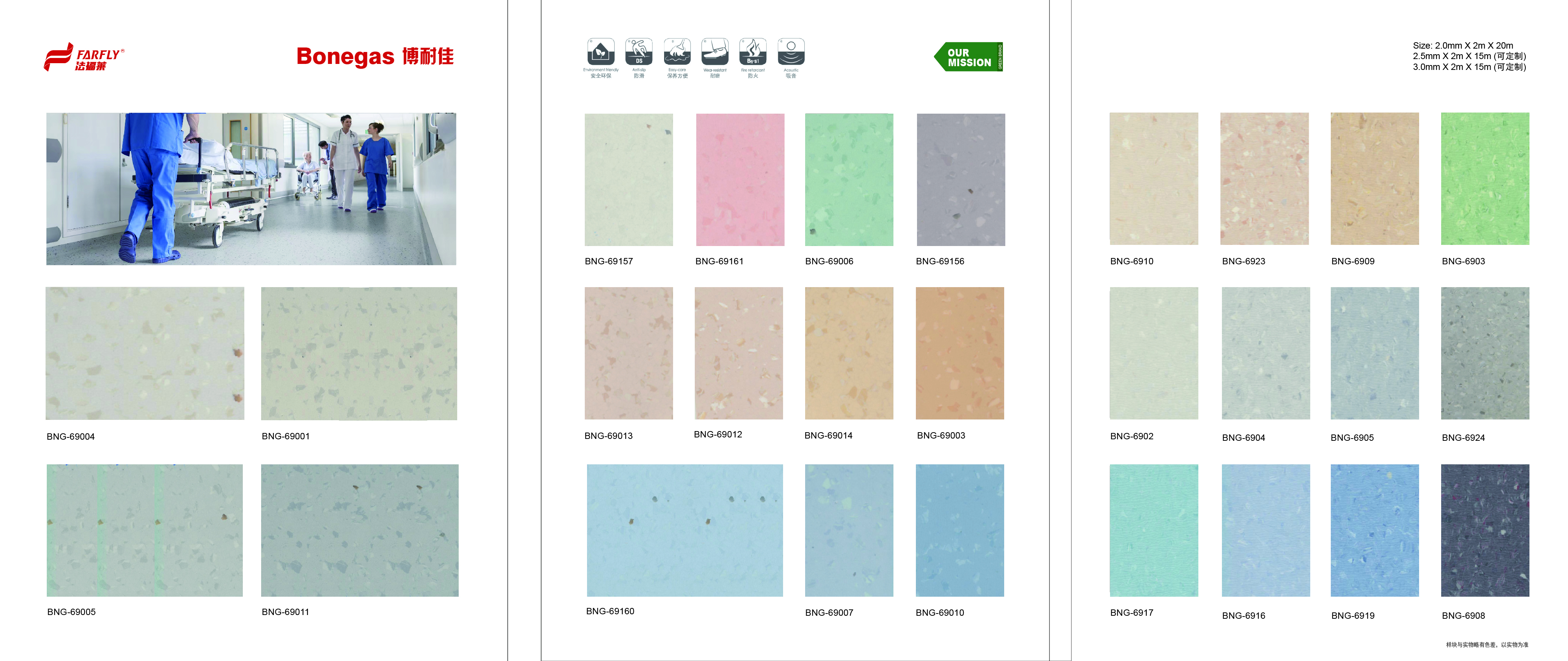
One colour reference from the Vinyl Flooring range (product record 3659); pattern availability should be confirmed against the current sample card.
Supply Signals for a Fixed Programme
Product data answers half of a project question. The other half is whether the material can arrive in the sequence the programme requires. FARFLYING FLOORING (Wuxi Tefa Decoration Material Co., Ltd.) is a manufacturer founded in 2012, operating from a 30,000 m² facility in Wuxi with 200 employees, a 25-person R&D team and a stated annual output of 4,200,000 m² across homogeneous, PVC sports and aircraft flooring lines.
The supply-side facts that matter for a corridor or retail fit-out are the ones that shorten or stabilise the critical path. The company describes six production lines, a ready-to-ship inventory of 300,000 m², a seven-day rapid dispatch model and a minimum order quantity of 100 m², with OEM and ODM customization across dimensions, colour, design pattern, packaging, logo and structure. Quality control is described as 100% testing plus third-party inspection by SGS. Export activity is stated at roughly 50% of output, focused on the Middle East and Central Asia, East Asian and Southeast Asian healthcare and sports projects, and aviation niches in Europe and the Americas.
Large-area references are worth reading for scale rather than for sector. The recorded projects include approximately 15,000 m² of 2.0 mm multi-colour homogeneous vinyl at a university hospital in Tbilisi, Georgia, completed in early 2025 with continuous sheet and heat-welded joints; roughly 12,600 m² in Samarkand, Uzbekistan, combining about 10,000 m² of homogeneous sheet with 2,000 m² of anti-static material for operating rooms; and a 27,000 m² hospital installation in Colombia. All three are healthcare settings, so they evidence large-area continuous installation and seam welding at scale — not fit for a workshop or a retail floor. The Colombia record also cites a 50% reduction in maintenance requirement; that is a project-specific record and should not be presented as a general performance guarantee.
Every figure above is supplier-declared. Capacity, stock and dispatch claims should be verified through a factory audit, dated production and shipping records, and the third-party inspection reports that the supplier already commissions. The company states it holds 399+ international testing certifications; the operative question for a project is never the count, but whether the specific certificate covers the specific product code being delivered.
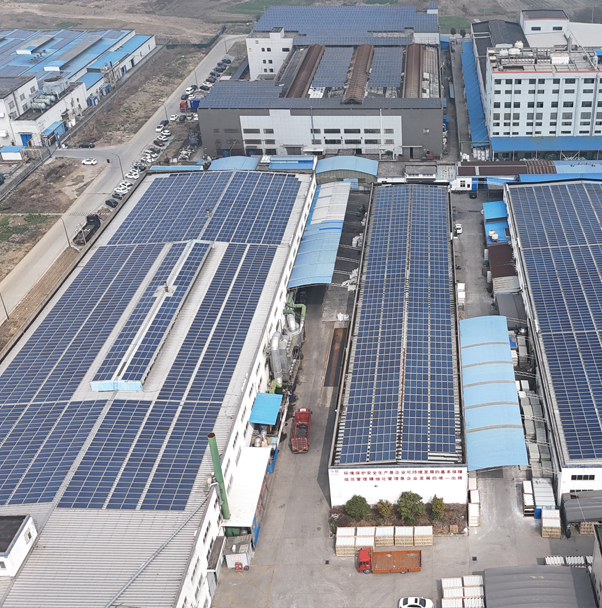
Production site: capacity and inventory figures are supplier-declared and should be confirmed by audit and shipping records.
What the Available Evidence Cannot Settle
Three boundaries should be stated openly, because a fit guide that hides them is not a fit guide.
First, no verified market size exists for homogeneous sheet in non-clinical segments. The commercial forecast that is available — healthcare vinyl flooring reaching USD 16.9 billion by 2034 at a 7.5% CAGR (Fortune Business Insights, 2026) — covers healthcare vinyl flooring including both homogeneous and heterogeneous constructions. It cannot be repurposed as a corridor, retail or workshop figure, and it is a forecast rather than a measured value.
Second, environmental documentation exists at category level but not at value level here. An Environmental Product Declaration for homogeneous vinyl flooring has been published in connection with the Resilient Floor Covering Institute (2023), which confirms that declaration is an established requirement in some markets. No numeric life-cycle values were available for this review, so no embodied-carbon claim should be made from it.
Third, several differentiators remain manufacturer claims pending reports: iodine resistance and wax-free maintenance, the 99.50% antibacterial rate, chemical resistance described as “good”, and the ESD resistance range. None of these is discredited by the absence of a retrieved report; each simply requires the report before it carries weight in a specification, a tender evaluation or a client presentation.
A Four-Step Decision Rule
- Classify the room by traffic, not by building type. A public concourse, a service corridor and a workshop walkway sit in the heavy commercial and heavy industrial bands described by use classes 34 and 43; a staff office beside them does not.
- Fix the classification set before comparing products. EN ISO 10581 for the category, Group T for abrasion, plus the slip, fire and indentation values the project actually needs. A product that cannot produce the report cannot be compared on the number.
- Convert every declaration into a document. Color-specific abrasion, the fire classification with its tested construction, residual indentation with load conditions, TVOC with chamber method, and — where static control is in scope — resistance with standard, conditioning and product code.
- Keep the alternative visible. If the room is an office, a classroom, a hotel room or a residence, and design variety, comfort or acoustics are stated criteria, heterogeneous sheet may be the correct category. Choosing homogeneous there is not a durability upgrade; it is a mismatch.
Applied in that order, the category decision becomes a documented outcome rather than a preference, and the final selection rests on certified performance data and the actual requirements of the project.
A downloadable technical brochure with the full product range and declared data is available here: FARFLYING FLOORING product brochure (PDF).
Frequently Asked Questions
What traffic level makes homogeneous vinyl the better sheet choice?
Homogeneous sheet is the better fit where traffic is continuous and appearance retention matters over a long period: corridors, retail sales areas, workshops and similar intensive-use spaces. Specification guidance places this band at use classes 34 and 43, covering heavy commercial and heavy industrial traffic, and pairs it with a Group T abrasion classification under EN ISO 10581. Below that band — a small office, a hotel room, a classroom — the through-body construction still performs, but its main advantage, less visible wear, is not the deciding factor.
Is homogeneous vinyl suitable for a retail area where appearance matters?
It is suitable where appearance means the floor must keep looking consistent under trolleys, pallets and constant footfall, because colour and pattern run through the full thickness of the sheet and a scratch works on the same material around it. It is less suitable where appearance means a specific visual effect: homogeneous sheet offers fewer design options than heterogeneous sheet. A retail project with a defined brand pattern should confirm that the homogeneous range carries that pattern before the category is fixed.
What should I check for a workshop with rolling loads and chemical exposure?
Three things. For rolling loads, request the residual indentation report with its test method, load and duration, and compare those conditions with the actual carts, trolleys and machines; the Vinyl Flooring model 3659 record declares 0.06 mm. For chemicals, replace the word “good” with a substance list covering concentrations and contact times. For static, state the resistance type, the test standard and the conditioning before reading any supplier range, because resistance to ground, surface resistance and electrostatic charge are different metrics.
Do homogeneous and heterogeneous vinyl differ in installation and maintenance?
Installation follows the same sheet sequence for both — subfloor inspection and moisture testing, acclimation and dry-lay, adhesive at the specified trowel and open time, rolling, trimming, grooving and heat-welding the seams, then curing before traffic — but the two categories differ in what maintenance can restore. A homogeneous sheet can be cleaned and, where the specification allows, mechanically maintained without erasing a printed design, because there is no printed layer. A heterogeneous sheet depends on its wear layer remaining intact. Maintenance regimes should be written against the specific product's surface treatment and the supplier's documented instructions rather than a generic category rule.
What product data should be verified before approving a submittal for these spaces?
Verify the category standard (EN ISO 10581), the abrasion group with its EN 660-2 report, the fire classification with the tested construction and adhesive system, residual indentation with load conditions, slip classification, TVOC with chamber method and test date, and any antibacterial or chemical-resistance claim with the standard, organisms or substances tested. Each document should name the product code and colour being supplied. The Vinyl Flooring model 3659 record declares 2 mm thickness (customizable to 2.5 mm or 3 mm), B-S1, abrasion T, residual indentation 0.06 mm, R9 and TVOC below 10 µg/m³ at 28 days — declarations that become evidence only when matched to reports of the same scope.
Have Questions or Need More Details?
Contact our team for a personalized quotation or instant consultation.
Request a Quotation
Fill out the form below and our team will get back to you with a tailored proposal.
WhatsApp Direct Chat
Prefer to chat in real-time? Message us on WhatsApp for instant assistance & quick answers.
- Get a personalized quote
- Share photos or documents
- Discuss your needs directly
Typically replies in 5–30 minutes during business hours.