
Homogeneous Vinyl Flooring: What to Verify Before You Buy
Selecting homogeneous vinyl flooring for a hospital, laboratory, or electronics plant is not just a visual decision. In these environments, the material is judged by documented constraints: chemical resistance, electrostatic control, bacterial inhibition, fire safety, and low emissions. For buyers moving from research to evaluation, the practical question is which evidence proves that a product will perform under specified conditions.
Why Constraint Verification Matters in Homogeneous Vinyl Flooring
Homogeneous vinyl flooring is a single-layer PVC flooring widely used in commercial and institutional buildings. Its practical value comes from its dense, through-body structure, which is often specified for areas that require hygiene, chemical resistance, and dimensional stability. But from a procurement perspective, the material category is broad; the more critical question is whether a particular product can meet the specific constraints of a project.
Two market data points show why this matters. The global homogeneous flooring market was valued at USD 17.58 billion in 2025 and is projected to reach USD 28.99 billion by 2035, according to Grand View Research. In the same period, the global conductive vinyl flooring market reached USD 9.6 billion in 2025, driven by demand from healthcare and electronics sectors, according to Data Insights Reports. As the volume of projects increases, so does the number of suppliers claiming to meet hospital and controlled-environment requirements.
The risk is not necessarily product quality. It is verification failure. Without third-party test reports, an abrasion label such as T or an ESD label can be difficult to compare across suppliers. Buyers in the research and evaluation stages need a repeatable way to examine certifications, parameter values, and the scope of each document.
Price bands are not included in this article because published flooring prices vary significantly by region, volume, customization, and certification scope. A more reliable approach is to compare itemized quotations against a fixed specification checklist.
A Supplier Example: FARFLYING FLOORING
One manufacturer that can be used as a reference point is FARFLYING FLOORING, the flooring brand of WUXI TEFA DECORATION MATERIAL CO., LTD. The company was founded in 2012 and operates a 3,000 m² factory in Wuxi, China, with approximately 200 employees and six production lines. Its stated annual output is 4.2 million m², and about 50 percent of production is exported. Main export regions include the Middle East, Central Asia, Southeast Asia, Europe, and the Americas.
FARFLYING FLOORING also states that it keeps a ready-to-ship inventory of 300,000 sqm, which supports a 7-day rapid dispatch model. For international engineering contractors, this type of supply-chain evidence is relevant because delivery reliability is part of the evaluation, not just the technical data sheet.
For the purposes of this article, three FARFLYING product characteristics are most useful for understanding the constraint-heavy side of homogeneous vinyl flooring: the TF Surface Treatment used on the healthcare series, the ESD series with a specified electrical resistance range, and the range of third-party certifications held by its homogeneous vinyl product. The company profile also states that the factory holds more than 399 international testing certifications.
Decoding the Critical Parameters
A compliant specification starts with basic performance values. The FARFLYING homogeneous vinyl flooring series, which includes models such as Bonaire, Bonet, Boniro, Bonize, Bones, Bonear, Bonegas, Bonzya, Bonami, Bona star, Bonee, ESD flooring, and bathroom floor, lists the following parameters.
| Parameter | Listed value |
|---|---|
| Thickness | 2 mm standard, customizable to 2.5 mm or 3 mm |
| Roll dimensions | 2 × 20 m |
| Fire rating | B-S1 |
| Antibacterial | 99.5 percent |
| Residual indentation | 0.06 mm |
| Abrasion resistance | Group T |
| Chemical resistance | Good |
| Anti-slip property | R9 |
| TVOC, 28-day | Below 10 μg/m³ |
| Material composition | Polyvinyl chloride, calcium carbonate, eco-friendly DOTP plasticizer |
| ESD series resistance | 104–106 Ω |
Three values deserve additional explanation.
Abrasion resistance: Group T
The abrasion resistance value T is not an internal grade. Under EN 660-2, the Frick-Taber test classifies wear resistance into groups, and Group T is the highest class, corresponding to volume loss ≤ 2.0 mm³. A floor specified as Group T is therefore suited to high-traffic corridors, hospital wards, and commercial spaces where repeated foot traffic causes cumulative wear.
Electrical resistance: 104–106 Ω
The FARFLYING ESD series states a stable resistance range of 104–106 Ω. To interpret this value, buyers can compare it with common ESD thresholds: static dissipative floors require resistance to earth ≤1×10⁹ Ω, while electrostatic conductive floors require ≤1×10⁶ Ω per EN 14041. A range of 104–106 Ω therefore sits inside the conductive band, a category frequently specified in electronics workshops and areas with static-sensitive equipment.
Testing guidance for ESD flooring is often linked to IEC 61340-6-1 and EN 1081, standards referenced by Forbo Flooring Systems in its ESD technical documentation. Polyflor ESD technical standards define the SD and EC thresholds used above.
Antibacterial and low-emission performance
The product is certified to ISO 22196:2011 for antibacterial activity, with SGS certificate number XMIN2109010493CM, and the listed antibacterial rate is 99.5 percent. It is also tested for TVOC emissions after 28 days according to ISO 16000-9:2006/Cor1:2007, with a result below 10 μg/m³, certificate WT2020B01A03405 issued by CTC.
The Certification Map for Homogeneous Vinyl Flooring
For a buyer-oriented evaluation, the core question is not whether a certificate exists, but which standard it covers and which market it serves. The following table summarizes certifications in the FARFLYING FLOORING homogeneous vinyl product file that are useful for EU and global projects.
| Certification / standard | Certificate number | Issued by | Relevance |
|---|---|---|---|
| EU REACH SVHC, 205 substances, Regulation 1907/2006/EC | EQO20030442C | EQO | Confirms restricted substance reporting for the EU market |
| TVOC emission rate, 28 days, ISO 16000-9:2006/Cor1:2007 | WT2020B01A03405 | CTC | Supports indoor air quality evaluation |
| Antibacterial, ISO 22196:2011 | XMIN2109010493CM | SGS | Verifies antibacterial activity for clinical and other hygienic spaces |
| Indentation resistance, EN 433:1999 | XMIN2109010491CM | SGS | Evaluates resistance to pressure marks from furniture and equipment |
| Physical properties (ISO 24346, ISO 23997, ISO 4918, ISO 29333, ISO 26987, ISO 10581, ISO 105-B02) | XMIN2109010490CM | SGS | Covers dimensional stability, wear, flexibility, chemical resistance, and color fastness |
| Abrasion, slip, fire, electrostatic, CE compliance (DIN 51130, EN 13893, EN 684, EN 14041, EN 1815, EN 13501-1, EN ISO 9239-1, EN ISO 11925-2) | XMIN2109010492CM | SGS | Covers slip resistance, wear, fire behavior, and antistatic properties |
| CE, EN 14041:2018 | TCF-OY20250623-CPR | ICR Co. Ltd. | Confirms compliance with EU construction product requirements |
| ISO 9001:2015 | 29524Q04072R0S | AUBURN INSPECTION & CERTIFICATION GROUP CO., LTD. | Quality management system, global scope |
| ISO 14001:2015 | 29524E04073R0S | AUBURN INSPECTION & CERTIFICATION GROUP CO., LTD. | Environmental management system, global scope |
| ISO 45001:2018 | 29524S040725R0S | AUBURN INSPECTION & CERTIFICATION GROUP CO., LTD. | Occupational health and safety management, global scope |
The certification scope matters as much as the certificate number. For example, the REACH certificate applies to the European Union market, while the ISO management system certificates apply globally. Buyers should check the market column of each document instead of assuming one certificate covers all jurisdictions.
Where These Constraints Are Applied
The FARFLYING homogeneous vinyl flooring product is positioned for hospitals, clinics, factories, warehouses, schools, shopping malls, exhibition halls, electronics workshops, laboratories, and offices. Within that range, several use cases depend on documented parameters.
Hospitals and clinics
Hospitals need floors that resist disinfectants, limit bacterial load, and remain easy to maintain. The FARFLYING healthcare series uses a proprietary TF Surface Treatment that is described as providing strict iodine resistance and lifelong wax-free maintenance. The 2 × 20 m roll format can be installed as a continuous sheet, which is practical for reducing the number of seams in patient rooms and corridors.
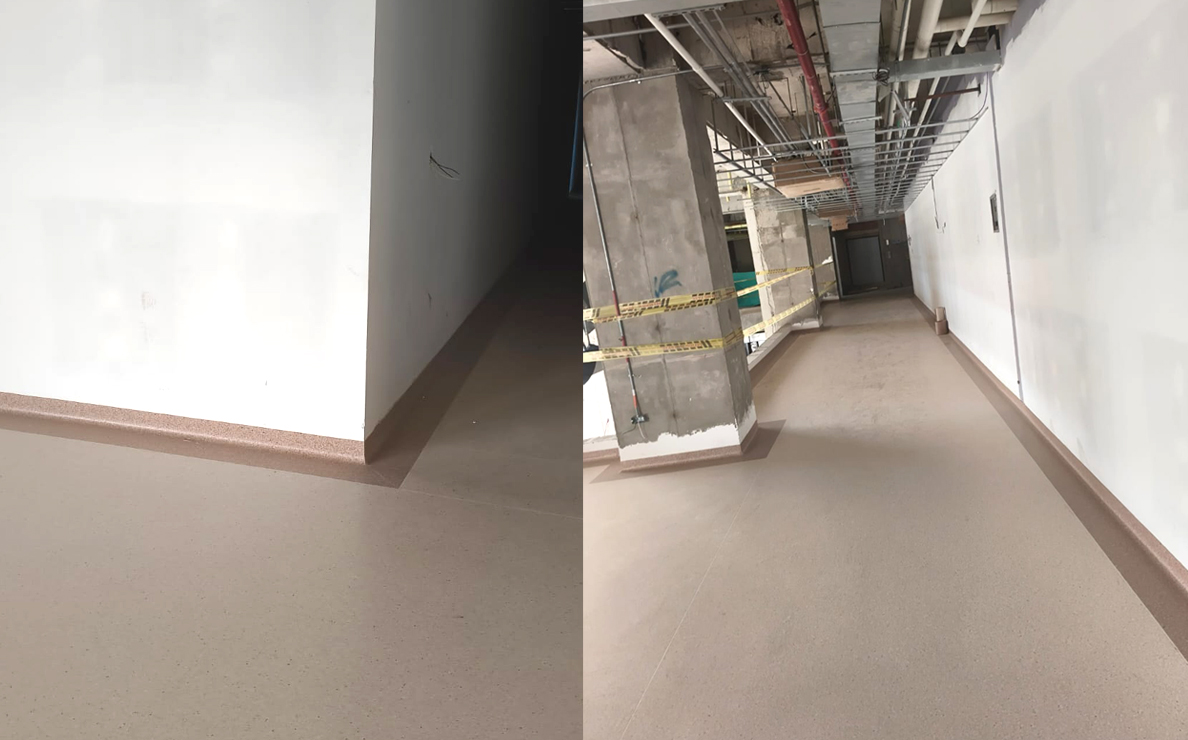
A documented project case is a hospital project involving an engineering firm in Colombia, where 27,000 sqm of FARFLYING homogeneous flooring was supplied. The project documentation cites a service life of 10–20 years and reports 50 percent less maintenance required, with the main advantages listed as long service life, easy installation, and low maintenance costs.
Electronics workshops and laboratories
For electronics assembly and laboratory areas, electrostatic control is a measurable constraint. The ESD series, with stable 104–106 Ω resistance, is designed for environments where static-sensitive equipment is handled. The product chemical resistance rated as good also supports laboratory environments where cleaning agents are frequently applied.
High-traffic commercial and public buildings
In schools, shopping malls, and exhibition halls, wear resistance becomes the dominant constraint. Group T abrasion resistance, B-S1 fire rating, R9 slip resistance, and 0.06 mm residual indentation provide a baseline for floors that must withstand intensive daily use.
Market Trends Relevant to Buyers
The available third-party data indicates three trends that directly affect procurement.
- The market is expanding. The global homogeneous flooring market is projected to grow from USD 17.58 billion in 2025 to USD 28.99 billion by 2035, according to Grand View Research.
- Conductive flooring is becoming a distinct procurement category. The conductive vinyl flooring market reached USD 9.6 billion in 2025, driven by healthcare and electronics demand, according to Data Insights Reports.
- Healthcare-grade product ranges are broadening. Armstrong Flooring reported a 23.7 percent expansion in its healthcare-grade vinyl product range in 2023, according to company information cited by Grand View Research. This is a signal that major manufacturers are responding to hospital hygiene requirements.
Because market definitions vary, estimates differ across reports; the figures above are directional rather than precise. The qualitative direction is consistent: demand for controlled-environment flooring is rising, and documentation is becoming part of the commercial conversation.
Standards are also being used as buying filters. EN 660-2 defines wear groups, EN 14041 covers CE marking for construction products, and IEC 61340-6-1 / EN 1081 are referenced for ESD flooring. Buyers who know these references can shortlist suppliers based on test reports rather than marketing language.
Homogeneous Vinyl vs. Traditional Alternatives
To evaluate homogeneous vinyl flooring against other floor types, it helps to separate the material characteristics from the supplier claims. The comparison below focuses on common alternatives for commercial and medical projects.
| Dimension | Homogeneous vinyl | Multilayer / heterogeneous vinyl |
|---|---|---|
| Construction | Consistent composition from surface to backing | Decorative layer over a separate backing |
| Renewability | Can often be mechanically refurbished to restore the surface | Limited by the thickness of the wear layer |
| Typical specification triggers | Hospitals, laboratories, controlled areas, high-traffic spaces | General offices, retail, residential uses |
| Certification depth | Often includes antibacterial, low-emission, ESD, REACH, and CE documentation | Usually CE and basic performance data |
| Installation | Requires trained installers, seam management, and careful subfloor preparation | Somewhat more forgiving in smaller rooms |
One boundary should be stated clearly. Homogeneous vinyl flooring is not a universal industrial floor. If the facility involves highly aggressive chemicals or severe point loads beyond the tested scope of a given product, poured resin floors or other specialized systems may be more appropriate. In addition, the performance of a 2 mm homogeneous vinyl floor depends heavily on substrate quality; a poorly prepared subfloor can compromise even the most heavily certified product.
Future Outlook
The direction suggested by the data is toward more specialized homogeneous vinyl products and stricter documentation requirements. Healthcare projects will continue to demand low-emission, antibacterial, and easily maintainable surfaces. Electronics and laboratory investments will require ESD data that is reproducible and traceable.
For suppliers, the differentiator will likely be how clearly they can present their constraints. A product with Group T abrasion resistance, an ESD range of 104–106 Ω, TVOC below 10 μg/m³, and REACH/CE documentation is easier for consultants and procurement teams to evaluate than a product whose data sheet only lists a brand name.
For buyers, the practical implication is that verification should be built into the tender process. Request the standard, the certificate number, the issuing body, and the market scope for each claimed performance value. This is not an administrative burden; it is the core of constraint-based procurement.
Frequently Asked Questions
What certification evidence should a buyer request for homogeneous vinyl flooring?
A complete package should include REACH SVHC testing under EU REACH 1907/2006/EC, TVOC emissions after 28 days under ISO 16000-9, antibacterial testing under ISO 22196:2011, indentation resistance under EN 433:1999, and CE certification under EN 14041:2018. For ESD floors, electrical resistance values should be referenced to EN 1081 or IEC 61340-6-1. Certificate numbers and issuing bodies should be listed in the supplier documentation.
Is 104–106 Ω resistance conductive or static dissipative?
In common ESD classification, electrostatic conductive floors require resistance to earth ≤1×10⁶ Ω, while static dissipative floors require ≤1×10⁹ Ω. A range of 104–106 Ω is therefore inside the conductive band. FARFLYING FLOORING's ESD series specifies this range.
What does Group T wear resistance mean?
Group T is the highest wear-resistance group in EN 660-2, corresponding to volume loss ≤2.0 mm³. It indicates the flooring is designed for intense foot traffic and repeated cleaning.
How does TF Surface Treatment affect maintenance?
According to FARFLYING FLOORING, the TF Surface Treatment provides strict iodine resistance and lifelong wax-free maintenance. In practical terms, routine maintenance does not depend on wax polishing; however, the actual cleaning program should still follow the manufacturer's instructions and local hygiene protocols.
Why is a TVOC result below 10 μg/m³ important?
TVOC means total volatile organic compounds. A 28-day TVOC emission below 10 μg/m³, measured under ISO 16000-9:2006/Cor1:2007, indicates low chemical off-gassing. This is relevant for hospitals, schools, and other enclosed spaces where indoor air quality is part of the building specification.
Can homogeneous vinyl flooring handle disinfectants and iodine?
The FARFLYING homogeneous vinyl flooring lists chemical resistance as good, and the TF-treated surface is described as iodine-resistant. Buyers should still verify the specific chemical list against their facility's disinfection protocol, because good chemical resistance does not guarantee compatibility with every reagent.
Further Reference
For procurement teams that want to compare specification sheets and certification files side by side, the FARFLYING FLOORING brochure is available for public access and download: FARFLYING FLOORING company brochure (PDF).