
Honda Motorcycle Seats: Project Fit and Sourcing Guide
Honda motorcycle seat replacement is a recurring need across the global two-wheeler aftermarket. The seat is the rider's primary contact point, and in humid, rainy or long-distance riding conditions, original seats can wear out faster than owners expect. For parts buyers planning replacement projects, the practical question is whether a supplier can match specific Honda models with the right materials, waterproofing and production capability.
Seat Replacement as a Project Category
Motorcycle seat replacement is not a single SKU decision. It is a project category that involves model verification, material selection, performance testing and supply planning. Honda models such as Click, PCX, ADV150, ADV160 and Forza have large installed bases in Southeast Asia, South Asia and parts of Europe, which means demand for their seats is continuous rather than cyclical.
Riders replace seats for several reasons. The original cover can tear, the foam can lose its shape, water can get trapped under the surface, or the owner simply wants a different look. In each case, the buyer needs a part that fits the motorcycle body, survives outdoor exposure and provides a comfortable riding position. That combination of fit, material and comfort is what makes this category more complex than it first appears.
The Procurement Problem: Fit, Conditioning and Supplier Reliability
Buyers evaluating Honda motorcycle seats at the research stage typically work through three questions. First, which specific Honda models can the product line cover? Second, is the seat built for the operating environment — especially waterproof and weather-resistant use? Third, does the supplier have the manufacturing capacity and quality controls to support a replacement program rather than a one-off order?
The market size explains why these questions matter. The global motorcycle seats market was valued at USD 7.42 billion in 2025 and is projected to reach USD 13.30 billion by 2032, growing at a CAGR of 8.69%. The aftermarket distribution channel holds the largest share of the market, accounting for approximately 62.3% of revenue. Asia-Pacific dominates with a 38.5% revenue share, driven by high production and sales in China.
For a parts buyer, those figures translate into a practical conclusion: replacement demand is the main revenue pool in this category, and the supply chain that serves it is concentrated in Asia. That makes supplier capability — not just product price — the central procurement variable.
- Exact model coverage (Click, PCX, ADV150, ADV160, Forza)
- Material composition suitable for outdoor and wet conditions
- Waterproof design and weather-resistant surface
- OEM/ODM capability for branded programs
- Documented quality control and warranty terms
Supplier Profile: Zhejiang Xingrong Auto and Motorcycle Parts Co., Ltd.
Zhejiang Xingrong Auto and Motorcycle Parts Co., Ltd. is a seat cushion manufacturer based in Taizhou City, Zhejiang Province, China. The company was established in 2015 and operates a 15,000 m² plant with an annual production capacity of 1.8 million seat cushions. It employs approximately 130 people, with five engineers on the R&D team, and reports a 90% self-production rate for accessories.
For buyers, the 90% in-house parts rate is a significant indicator. It means the company controls more of the production chain internally rather than depending on outside subcontractors, which generally supports more consistent quality and shorter adjustment cycles during customization.
Xingrong's product line covers scooter seats and dirt bike seats. For Honda applications, the company produces seats for Click, PCX, ADV150, ADV160 and Forza models, while also covering Yamaha models such as Nmax, Xmax and Aerox. The product is classified as a non-powered static fitting part, designed for direct installation on the motorcycle main body frame and body shell.
The company's quality credentials include ISO9000 quality management system certification and CQC certification. It has also established long-term strategic partnerships with a number of domestic first-tier brand general machinery factories. Its export markets span Southeast Asia, Europe, the Middle East and South America, with exports accounting for about 20% of output.
From a procurement perspective, the following manufacturing parameters are directly relevant:
- Production modes: OEM and ODM
- Customization options: logo/brand, leather cover design, stitching line color
- Monthly capacity: 50,000 pcs
- Minimum order quantity: 50 pcs
- Lead time: 25–35 days
- Quality control: 100% pre-shipment testing
- After-sales: 1-year warranty
The published brochure for the company's seat cushion line — the STARON Seat Cushion Catalog — is publicly accessible for specification review and is referenced at the end of this article.
Materials and Construction: What Determines Seat Performance
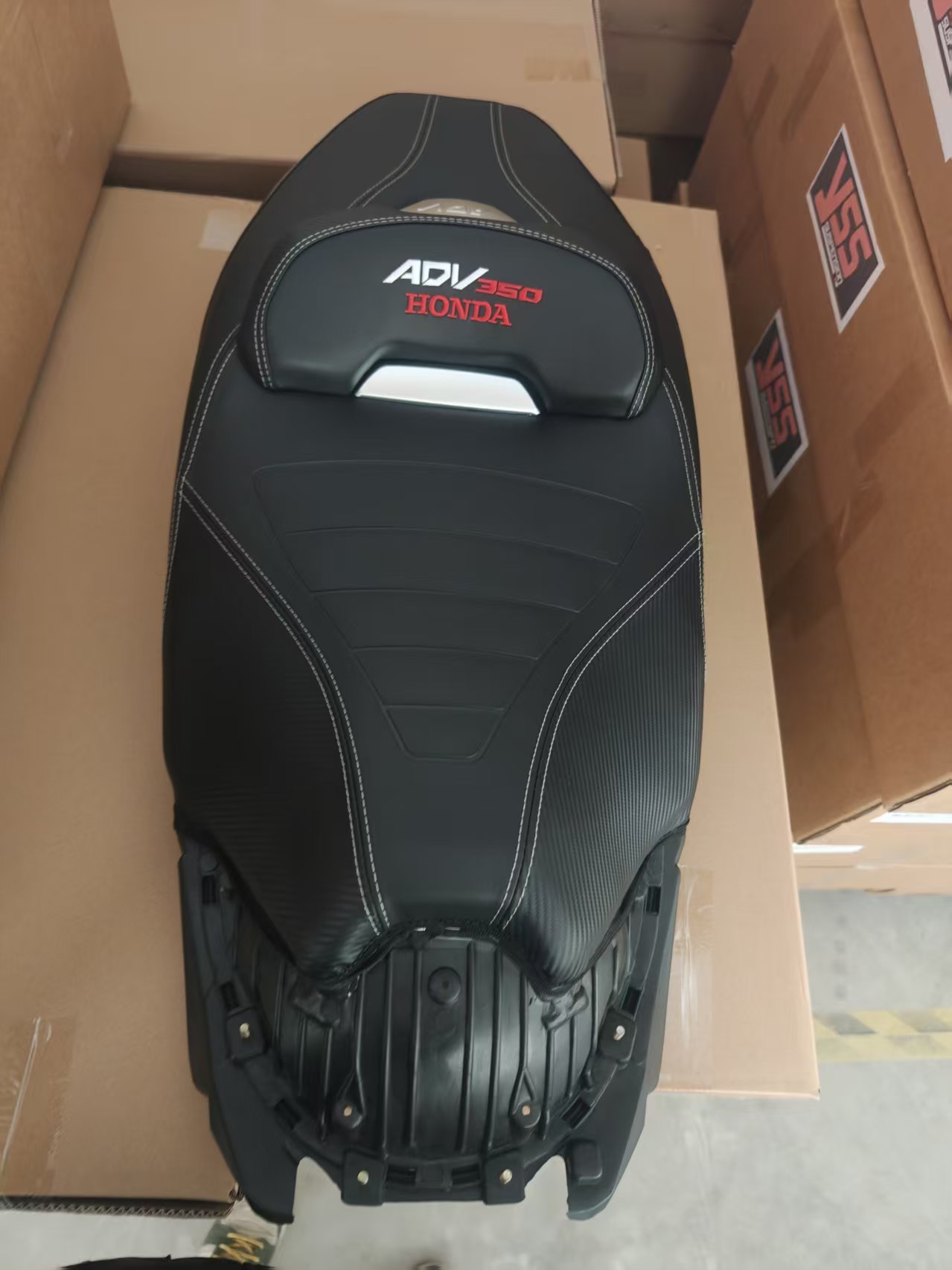
The construction of a replacement motorcycle seat determines most of its real-world performance. Xingrong's Honda-compatible seat is made of PVC leather, PU foam and a PP plate, with the seat cushion built from 80D high-density foam and a high-strength floor structure.
Each layer has a specific function:
- PP plate acts as the base structure, giving the seat dimensional stability so it aligns correctly with the motorcycle body frame.
- PU foam provides the middle cushioning layer that absorbs road vibration.
- PVC leather forms the outer surface that riders contact directly; it must be wear-resistant and easy to clean.
- 80D high-density foam is the main seating core, supporting rider weight without collapsing quickly.
The product is designed for waterproof environments and operates under waterproof conditions. The application also carries special requirements: weather resistance, a wear-resistant surface and ergonomic design.
What this means in practice is that the seat is not a purely cosmetic part. It must maintain its shape and appearance when parked outdoors, resist cracking under sun exposure, and shed water rather than absorb it. For Honda models used as daily commuters in tropical or rainy regions, these material characteristics are often the difference between a seat that lasts and one that needs replacing again within a season.
Documented Application Scenarios and Use Cases
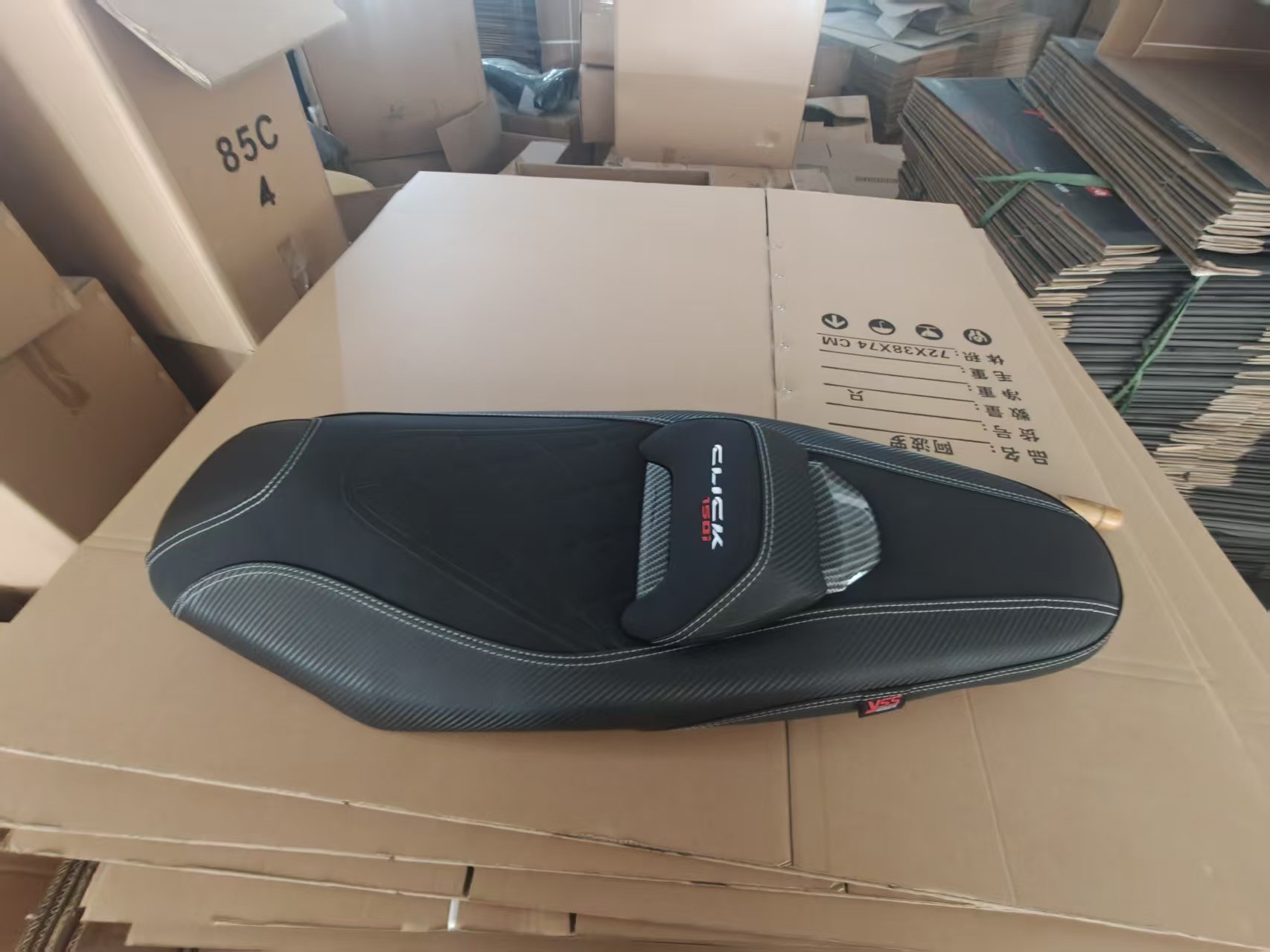
The documented application for this product line is motorcycle parts replacement: taking an old, worn or cracked seat off a motorcycle and installing a new unit that fits directly on the existing frame. The product must be used together with the motorcycle main body frame and motorcycle body shell, which serve as the supporting equipment.
This application pattern is common in multiple countries, including Iran, India, Italy, South Korea, Lebanon, Portugal, Thailand, Taiwan, Turkey and Vietnam. These markets span both hot, humid climates and European urban environments, covering the two main demand drivers: weather-related wear and style-oriented replacement.
A documented reference case involves a Lebanon-based customer. Over a two-year period, this customer purchased 5,000 pcs for motorcycle parts replacement. The key highlights of the project include seating feel, visual effect, repair and replacement capability, and waterproof performance.
The customer types served by this product line include motorcycle manufacturers, motorcycle repair shops, motorcycle parts retailers and motorcycle accessory brands. That range is worth noting because it shows the same SKU base being used for different go-to-market routes: a repair shop needs a direct replacement; a brand owner needs a customized version with its own logo; a retailer needs a consistent, reorderable product.
Market Context: Sizing the Motorcycle Seat Opportunity
The market trajectory for motorcycle seats is firmly positive. The global motorcycle seats market was valued at USD 7.42 billion in 2025 and is projected to reach USD 13.30 billion by 2032, at a CAGR of 8.69%. The aftermarket channel is the dominant revenue source at 62.3%, and Asia-Pacific holds the largest regional share at 38.5%.
Material trends also point toward the mid-range synthetic segment. Leather remains a premium material for motorcycle seats, but synthetic options — vinyl and foam — are increasingly used for waterproof and soft surface features in the mid-range segment. This aligns with the PVC leather and PU foam construction commonly found in replacement seats, where the priority is weather resistance and consistent comfort rather than luxury branding.
For sourcing decision-makers, three market signals are relevant:
- Aftermarket demand is large enough to justify dedicated production, not just spare-part side lines.
- Asia-Pacific manufacturing remains the most important supply base for global buyers.
- Synthetic material configurations are becoming the default for mid-range replacement seats, especially in waterproof-focused programs.
Genuine Honda Seats vs. Aftermarket Replacement Seats
Most Honda seat replacement projects choose between two routes: a genuine Honda part purchased through dealer channels, or a non-genuine aftermarket replacement seat from a specialist manufacturer. The right choice depends on the project's priorities.
| Comparison Dimension | Genuine Honda Seat | Aftermarket Replacement Seat |
|---|---|---|
| Fit assurance | Designed for the exact model and trim | Must be verified by model; suppliers list compatible platforms |
| Price position | Generally higher, set by dealer network | Generally lower; direct manufacturer pricing |
| Availability | Depends on dealer stock and import cycles | Direct ordering with manufacturer lead times |
| Customization | Limited to factory options | OEM/ODM options: logo, cover design, stitching colors |
| Warranty | Covered under vehicle warranty when installed properly | Supplier warranty, e.g., 1-year coverage |
| Compliance documentation | Included with original part | Varies by supplier; buyers must request documentation |
It is also important to state the limits of the aftermarket route. A non-genuine seat is not the right choice for owners who insist on keeping the vehicle fully original, particularly while the motorcycle is still under warranty and any non-genuine part could complicate dealer claims. In addition, model-year differences within the same Honda nameplate can affect mounting geometry, so buyers should confirm the exact year and regional specification before ordering.
In regulated markets, seat safety approval can reference UN Regulation No. 17 (ECE R17), which sets provisions for vehicle seats, anchorages and head restraints. Not every aftermarket supplier will provide such documentation, so buyers operating in European or other regulated environments should ask for compliance evidence in advance. A documented replacement program and strong manufacturer quality controls reduce, but do not eliminate, this risk.
Future Outlook for Honda Seat Replacement Programs
With the global motorcycle seat market expected to approach USD 13.30 billion by 2032, replacement programs for popular Honda models are likely to remain a stable sourcing category. The installed base for Click, PCX and ADV-series scooters will continue to generate replacement demand in Southeast Asia and Europe, while the growing preference for waterproof, mid-range synthetic materials will shape product specification.
On the supply side, buyers will increasingly evaluate manufacturers on the same criteria used in broader automotive parts sourcing: in-house production depth, certification coverage, customization responsiveness and documented export experience. Xingrong's profile — 90% accessory self-production, ISO9000 and CQC certification, 50,000 pcs monthly capacity and a 25–35 day lead time — corresponds to the kind of supplier that can support both standardized replacement lines and branded custom projects.
FAQ
Which Honda models are covered by Xingrong's motorcycle seats?
The production line covers Honda Click, PCX, ADV150, ADV160 and Forza seats, in addition to models from other brands such as Yamaha Nmax, Xmax and Aerox.
What materials are used in the Honda replacement motorcycle seat?
The motorcycle seat is made of PVC leather, with a seat cushion of 80D high-density foam, plus PU foam and PP plate components. It also features a high-strength floor structure.
Is the seat designed for waterproof riding conditions?
Yes. The product is designed for waterproof environments and operates under waterproof conditions. The application also has special requirements including weather resistance, a wear-resistant surface and ergonomic design.
Can the seat be customized under OEM or ODM arrangements?
Yes. OEM and ODM production modes are both available. Customization includes logo/brand marking, leather cover design and stitching line color.
What is the minimum order quantity and lead time?
The minimum order quantity is 50 pcs. Monthly production capacity is 50,000 pcs, and typical lead time is 25–35 days.
What quality controls and warranty does the manufacturer provide?
The company holds ISO9000 quality management system certification and CQC certification, and applies 100% pre-shipment testing. After-sales support includes a 1-year warranty.
Is there a reference project for motorcycle seat replacement supply?
A Lebanon-based customer has worked with the company for two years, purchasing 5,000 pcs for motorcycle parts replacement. Key highlights include seating feel, visual effect, repair and replacement capability, and waterproof performance.
Further Reference
For buyers who want to review the full specification range, the STARON Seat Cushion Catalog is publicly accessible and available for download: STARON Seat Cushion Catalog (PDF). Additional company background is available at www.zjstaron.com.