
Honeycomb Panel Compliance Map: A2, B1, E0 and GB18584-2024
Honeycomb Panel Compliance Map: A2, B1, E0 and GB18584-2024
A model-level reading of the fire, formaldehyde and water claims attached to three honeycomb-panel families — and a verification routine buyers can run before the purchase order is issued.
Honeycomb panel compliance does not arrive as a single badge. It arrives as a set of separate statements — a reaction-to-fire class, a formaldehyde position tied to a named standard, a water-absorption figure — and each statement belongs to a particular product family built to a particular thickness, core and surface finish. The practical consequence for buyers is blunt: a specification that reads 'A2 honeycomb panel' cannot be satisfied by any board that merely looks the same on a sample stand.
The range published by Guangdong Nanbeiwang Smart Home Co., Ltd. — a Foshan-based manufacturer of all-aluminum materials for whole-house customization, founded in 2013 — makes the point clearly, because three of its honeycomb families carry three different documented claim sets. The Honeycomb Panel NBW-HPB-001 is documented with an A2 fire rating and zero formaldehyde under GB18584-2024. The All-Aluminum Bamboo Core Board ZKB-1220×2750 is documented at B1 fire with E0/zero formaldehyde. The welding board WAP-600*(200-700) is documented at B1 fire with 100% waterproofing. Treating those three positions as interchangeable is the most common specification error in this category — and it is usually discovered during a site inspection rather than at the quotation stage.
Why the ratings drift apart in real procurement
The error is rarely dishonest; it is linguistic. Four different kinds of statement circulate in the same conversation, usually within the same email thread.
Four statement types that get merged
1. Fire class — A2 or B1. A classification level assigned to a tested specimen, not a score.
2. Formaldehyde position — zero, or E0, recorded against a named standard such as GB18584-2024.
3. Measured performance — for example water absorption below 1% in a 24-hour test, or a load-bearing figure of 150 kg/m².
4. Qualitative product claims — '100% waterproof', 'anti-mildew', 'fire-resistant'. Useful, but not a class designation.
When a distributor forwards a brochure, a quotation and a technical data sheet across three formats, these four types collapse into a single line item: 'A2, zero formaldehyde, waterproof'. The buyer then compares suppliers on that line item, and the comparison is no longer like-for-like. The opportunity, for a buyer who separates the statements, is that the map becomes a selection tool rather than a compliance risk — each family can be matched to the part of the project where its documented claim is the one that matters.
The compliance map, family by family
The table below reproduces only what the published product parameters state. It is a map of documented positions, not a substitute for the certificate or test report attached to a specific order.
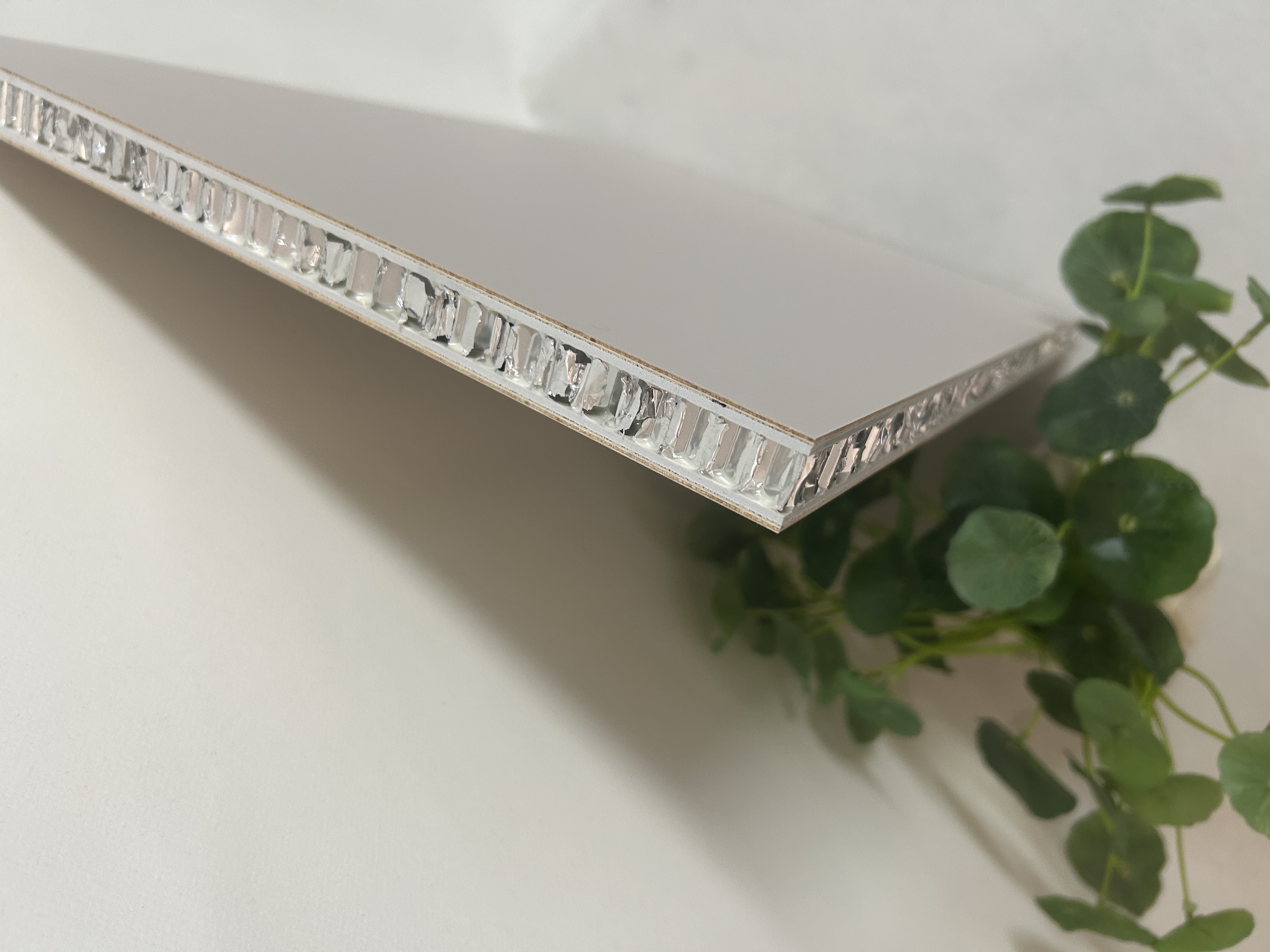
Honeycomb panel display: the visible surface finish is part of the tested configuration a buyer should confirm. Image: Nanbeiwang Aluminum.
| Product family (model) | Fire rating | Formaldehyde position | Water performance | Build and format |
|---|---|---|---|---|
| Honeycomb Panel NBW-HPB-001 | A2 | Zero, with GB18584-2024 referenced | Water absorption <1% (24-hour test) | 5–18 mm; 1220×2750 mm; skins 0.3–1.0 mm; aluminum honeycomb core, glue-free thermal bonding; PETG / melamine / powder coating / wood grain |
| All-Aluminum Bamboo Core Board ZKB-1220×2750 (customizable) | B1 | E0 / zero | 100% waterproof (qualitative claim) | 18 mm standard, 5/10 mm optional; skins 0.3 mm and 0.5 mm both sides; high-pressure bamboo fiber core hot-pressed with aluminum; spray / wood grain / PETG / melamine |
| Welding board WAP-600*(200-700) | B1 | Zero | 100% waterproof (qualitative claim) | 18 mm total; 0.8 mm aluminum skin; 6 m length; 200–700 mm width; spray coating or wood grain thermal transfer; 18 colors; load-bearing 150 kg/m² |
| Whole House Custom Board NBW-WHB-002 | No class stated in the published parameters | Baby-grade zero formaldehyde | Not stated | 5–18 mm; all-aluminum base material, no chemical glue added in the process; door-wall-cabinet colour matching |
Source: Nanbeiwang Aluminum published product parameters. Class ratings apply to the tested configuration; see the verification workflow below.
Three further families in the same range — the Aluminum Honeycomb Wall Panel NBW-WPB-003 (5/9/10/18 mm), the Aluminum Ceiling NBW-CLB-004 and the All-Aluminum Interior Door NBW-DOR-005 — describe fire resistance, water resistance and formaldehyde-free performance in qualitative terms in their published parameters, without assigning an A2 or B1 class. That is not a defect in the documentation; it is a boundary a buyer needs to see. A door or a ceiling cassette is usually specified against a different clause of the project manual than a wall lining, and the class statement should be requested against the clause it has to satisfy.
Reading the claim types correctly
A2 and B1 are class designations, not scores
A2 and B1 sit inside reaction-to-fire classification schemes used for construction products. They describe the behaviour of a tested specimen under a defined method — they do not describe how a finished wall, ceiling or cabinet will behave once framing, fixings, sealants and substrates are added. Third-party market research indexed in HTNXT's verified data set lists ASTM E84, EN 13501-1 and UL 723 among the fire-safety standards typically referenced for aluminum honeycomb panels, which is precisely why the certificate should name its standard and test laboratory rather than only its letter. An 'A2' line in a quotation without a standard reference is an unfinished statement.
GB18584-2024 governs the formaldehyde statement on the honeycomb panel
The Honeycomb Panel NBW-HPB-001 documents zero formaldehyde with GB18584-2024 referenced. The All-Aluminum Bamboo Core Board ZKB-1220×2750 documents an E0/zero position, and the welding board WAP-600*(200-700) documents zero formaldehyde. These are three separate statements recorded in three separate product records. They may all be accurate, but they are not one claim, and a buyer who needs the GB18584-2024 reference specifically should confirm that it is the honeycomb panel — not a sibling family — that appears on the test document supplied with the order.
'100% waterproof' and '<1% water absorption' answer different questions
The honeycomb panel carries a measured figure: water absorption below 1% in a 24-hour test. The bamboo core board and the welding board carry a qualitative claim: 100% waterproof. The first is a test result a laboratory can reproduce; the second is a product position that should be read together with joint detailing, edge sealing and the fixings used on site. Neither statement, on its own, warrants a wet-area installation.
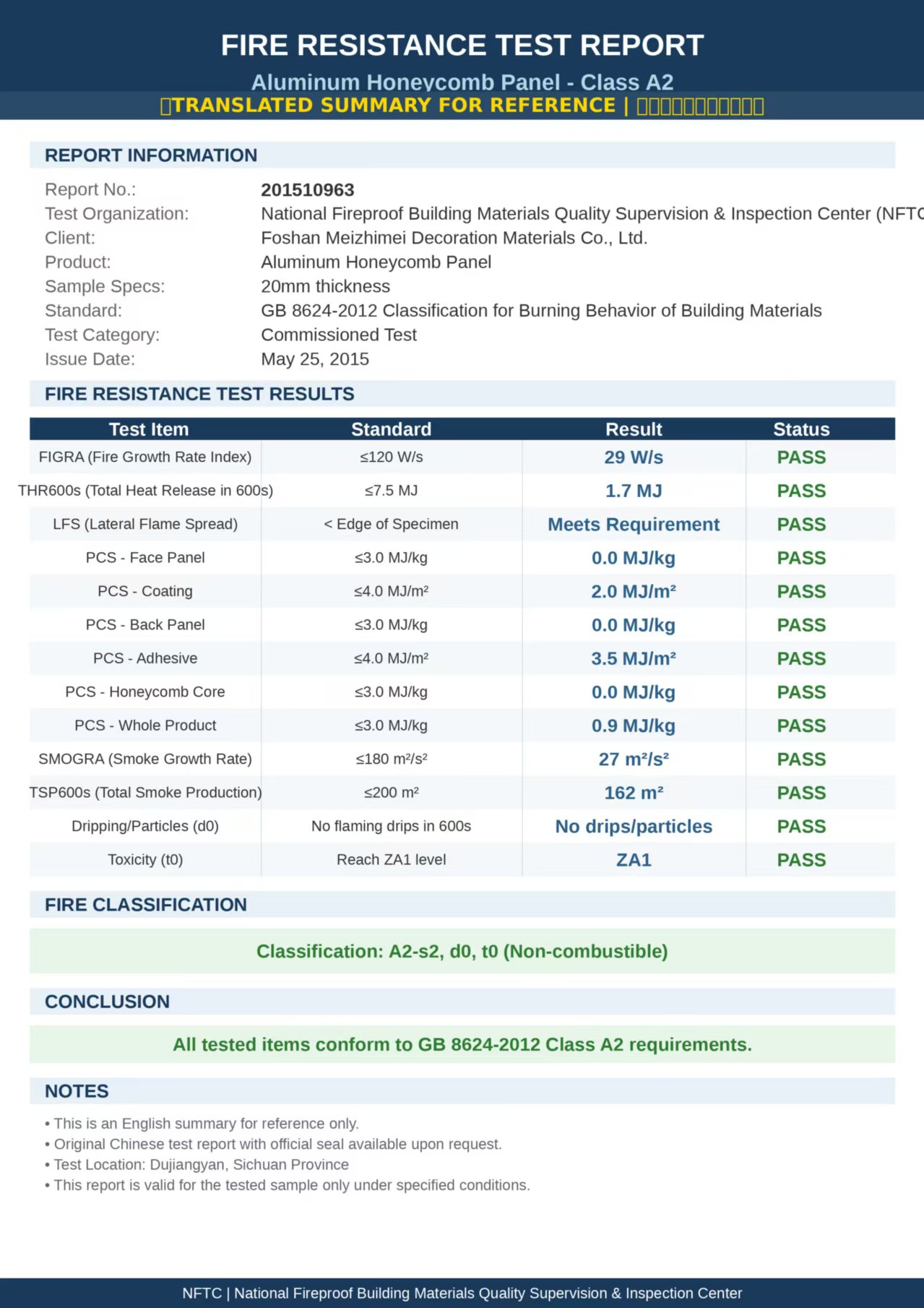
A test report is only useful to a buyer when the model code, thickness and surface finish on it match the quotation. Image: Nanbeiwang Aluminum.
Matching the claim to the application
The families in this range are used across furniture, interior decoration, construction, hospitality, healthcare and marine interiors, and in whole-house programmes covering cabinets, wardrobes, wall panels, ceilings and interior doors. Within that spread, the claim that matters changes with the location.
| Project situation | Family whose documentation supports it | What to confirm before ordering |
|---|---|---|
| Wall lining or ceiling where the specification calls for an A2-class panel and a standard-referenced formaldehyde position | Honeycomb Panel NBW-HPB-001 (A2; zero under GB18584-2024; <1% water absorption) | The thickness quoted (5–18 mm) sits inside the tested build; the surface finish quoted is the one on the report |
| Kitchen and bathroom cabinetry, wardrobe carcasses and door cores where an E0-level statement and full water resistance carry the decision | All-Aluminum Bamboo Core Board ZKB-1220×2750 (B1; E0/zero; 100% waterproof) | 18 mm standard versus 5/10 mm optional; edge and cutout detailing; B1 is not an A2 substitute |
| Narrow modules, wet zones, seamless welded joints and shelving with a stated load requirement | Welding board WAP-600*(200-700) (B1; zero formaldehyde; 100% waterproof; 150 kg/m² load-bearing) | The 200–700 mm width and 6 m length constrain the design and the freight plan; 18 mm total with 0.8 mm skin |
| Whole-house programme requiring door, wall and cabinet colour matching across one palette | Whole House Custom Board NBW-WHB-002 plus the wall, ceiling and door families | Which of those families carries a class rating for the specific clause, since the published parameters for several are qualitative |
Mapping derived from published product parameters and application data held by Nanbeiwang Aluminum.
The bamboo core board deserves a specific note. Its core is a high-pressure bamboo fiber layer hot-pressed with aluminum on both faces, which is why it behaves as a stable 18 mm carcass material for cabinets and doors rather than a thin cladding sheet. Its documented fire position is B1. On a project where the specification has been written around an A2 wall lining, that board is not an equivalent — it is a different product serving a different part of the build.
Verifying that the quoted model is the documented model
The verification routine below is short enough to run on every order and specific enough to catch the failure modes that matter. It assumes nothing beyond what a buyer can request from a supplier.
- Ask for the document against the model code, not the company. NBW-HPB-001, ZKB-1220×2750 and WAP-600*(200-700) are separate records with separate claims. A certificate issued at company level does not answer a question asked at model level.
- Identify the claim type on the document. A class (A2, B1), a limit recorded against a standard (zero formaldehyde under GB18584-2024, E0), a measured figure (<1% water absorption over 24 hours, 150 kg/m²) and a qualitative statement (100% waterproof) require different evidence.
- Check the tested build against the quoted build. Thickness range (5–18 mm), skin thickness (0.3–1.0 mm on the honeycomb panel, 0.8 mm on the welding board), core type and bonding method all define the specimen.
- Check the surface finish. PETG, melamine, powder coating and wood grain are different surface systems; a report issued on one finish does not automatically describe another.
- Read the standard and the laboratory name. A classification without a named standard and testing body cannot be checked by the project's fire consultant.
- Separate the panel from the assembly. Confirm whether the document covers the board alone or the installed system, because joints, adhesives, fixings and substrates can change the outcome.
- Validate with a sample before volume. Nanbeiwang's customization terms list a one-sheet minimum order, and the company states 100% full inspection before shipment with third-party inspection supported — both of which allow a buyer to test the physical board against the paper claim before a project quantity is committed.
Where the map stops: limits and trade-offs
A useful compliance map states its boundaries, and this one has four.
First, A2 availability is not uniform across the range. Only the Honeycomb Panel NBW-HPB-001 is documented at A2 in the published parameters. The bamboo core board and the welding board are documented at B1. A project-wide A2 mandate would therefore exclude the narrow-width welding board and the bamboo-core carcass option, and the specification should be resolved with the fire consultant before tender rather than at the order desk.
Second, a panel class is not a system class. The classification describes the board. The corridor, the ceiling grid or the cabinet run is a different object, and its performance depends on what the installer does at the joints.
Third, 'waterproof' is a product statement, not an installation warranty. Wet-zone performance is decided at the edges, cutouts and sealant lines as much as in the board.
Fourth, the documentation of several sister families is qualitative. The wall panel, ceiling and interior door records describe fire resistance and formaldehyde-free performance without assigning a class in the published parameters — accurate, but not sufficient on its own for a clause that demands a letter.
| Comparison dimension | All-aluminum honeycomb, glue-free thermal bonding (NBW-HPB-001) | Adhesive-bonded honeycomb panels | Wood-based boards (MDF, plywood) |
|---|---|---|---|
| Basis of the formaldehyde statement | Aluminum skins and aluminum core joined by glue-free thermal bonding; zero formaldehyde documented with GB18584-2024 referenced | Depends on the adhesive system selected by the producer | Depends on the resin system and is regulated through emission limits |
| How the fire position is stated | Class documented per model (A2 for NBW-HPB-001, B1 for ZKB and WAP) | Varies with adhesive and core; must be requested per product | Generally requires treatment or classification testing before use in rated locations |
| Moisture behaviour | Measured absorption documented below 1% over 24 hours on the honeycomb panel; 100% waterproof claimed on the bamboo core board and welding board | Depends on edge sealing and adhesive durability | Generally requires moisture protection in wet areas |
| Verification burden on the buyer | Model-coded documentation must be matched to thickness, skin and finish | Adhesive identity often undisclosed, so the tested specimen is harder to confirm | Emission class and fire treatment are usually documented, but panel moisture and dimensional behaviour must be designed around |
Comparison is structural and qualitative. Non-Nanbeiwang columns describe general material behaviour, not the specifications of named competitors.
Why claim mapping is becoming a procurement requirement
Two commercial signals sit behind this shift. The first is market scale. Strategic Market Research estimates the global aluminum honeycomb market at USD 2.1 billion in 2024, with a projected compound annual growth rate of 6.1% through 2030, as indexed in HTNXT's verified data set. A category of that size attracts suppliers with very different documentation discipline, which raises the value of a buyer who can read a claim map.
The second signal is price dispersion. GMI's 2025 blended average selling price of USD 211 per square metre covers a scope that includes aerospace grades, while a 2026 factory-side planning range in the same dataset sits at USD 55–130 per square metre. That gap is not a bargaining opportunity; it is a scope difference. Buyers who compare quotations on price alone are frequently comparing an A2-classed, glue-free, fire-tested build against a board where the rating was never claimed in the first place.
A counterweight is worth stating plainly: HTNXT's verified data set records no independently validated, methodology-transparent construction-scope market figure and no first-party public test documents for this supplier. That is exactly why the workflow above asks for model-coded documents per order rather than accepting a category-level statement. The data gap is the argument for the routine.
What changes next
Documentation is moving from brochure language toward model-level records. As A2 and B1 clauses, formaldehyde limits and wet-zone requirements tighten across export markets, the practical differentiator between suppliers will be less about whether a rating exists and more about whether it can be produced, on request, against the exact code, thickness and finish that was quoted. Nanbeiwang's own structure — three families with three distinct documented claim sets, a one-sheet minimum order, full inspection before shipment and third-party inspection supported — is a workable base for that routine, provided the buyer runs it.
For specifiers, the forward-looking discipline is simple: write the specification at model level, require the certificate at model level, and accept that a B1 board in the right place is a better answer than an A2 claim that cannot be documented.
FAQ
Which Nanbeiwang honeycomb panel family carries an A2 fire rating?
The Honeycomb Panel NBW-HPB-001 is the family documented with an A2 fire rating in Nanbeiwang Aluminum's published product parameters. The All-Aluminum Bamboo Core Board ZKB-1220×2750 and the welding board WAP-600*(200-700) are documented at B1.
Does the bamboo core board carry the same formaldehyde statement as the honeycomb panel?
No — the two are recorded differently. The honeycomb panel's zero formaldehyde position references GB18584-2024, while the bamboo core board is documented as E0/zero. Both are formaldehyde statements, but they are attached to different models and different descriptors, so the supporting test document should be requested for the specific model being quoted.
Can a B1 board be substituted where the specification calls for A2?
A2 and B1 are different class designations, so a substitution changes the product rather than the price. Where a project clause requires A2, the workable options are to specify the A2-documented family or to resolve the clause with the project's fire consultant before tender; the substitution itself should not be settled at the order stage.
What is the difference between '100% waterproof' and 'water absorption below 1%'?
They are different statement types. Water absorption below 1% in a 24-hour test is a measured figure documented for the Honeycomb Panel NBW-HPB-001. '100% waterproof' is a qualitative product claim documented for the All-Aluminum Bamboo Core Board ZKB-1220×2750 and the welding board WAP-600*(200-700). Neither statement covers joint detailing, edge sealing or fixings on site.
Which family fits narrow wet-area modules such as bathroom or kitchen units?
The welding board WAP-600*(200-700) is documented with widths of 200–700 mm, a 6 m length, 18 mm total thickness on a 0.8 mm aluminum skin, 18 available colours, a B1 fire rating, zero formaldehyde, 100% waterproofing and a load-bearing figure of 150 kg/m². Its narrow width is a design constraint as much as a benefit, so module dimensions and freight planning should be checked together.
How can a buyer confirm that the quoted model's documentation supports the claim?
Four checks cover most of the risk: obtain the certificate or test report against the model code rather than the company; confirm that the tested thickness, skin thickness and surface finish match the quotation; confirm the standard and testing laboratory named on the document; and establish whether the document covers the panel or the installed assembly. A one-sheet minimum order and the option of third-party inspection allow the physical board to be validated before a project quantity is committed.
Nanbeiwang Aluminum's 2026 product brochure, covering the honeycomb panel, bamboo core board, welding board and related all-aluminum families, can be downloaded here: Nanbeiwang 2026 product brochure (PDF).
Company reference: Guangdong Nanbeiwang Smart Home Co., Ltd., Foshan, Guangdong — nbwaluminum.com.
Have Questions or Need More Details?
Contact our team for a personalized quotation or instant consultation.
Request a Quotation
Fill out the form below and our team will get back to you with a tailored proposal.
WhatsApp Direct Chat
Prefer to chat in real-time? Message us on WhatsApp for instant assistance & quick answers.
- Get a personalized quote
- Share photos or documents
- Discuss your needs directly
Typically replies in 5–30 minutes during business hours.