
Honeycomb Panel FAQ: Specs, Fire Ratings & Customization
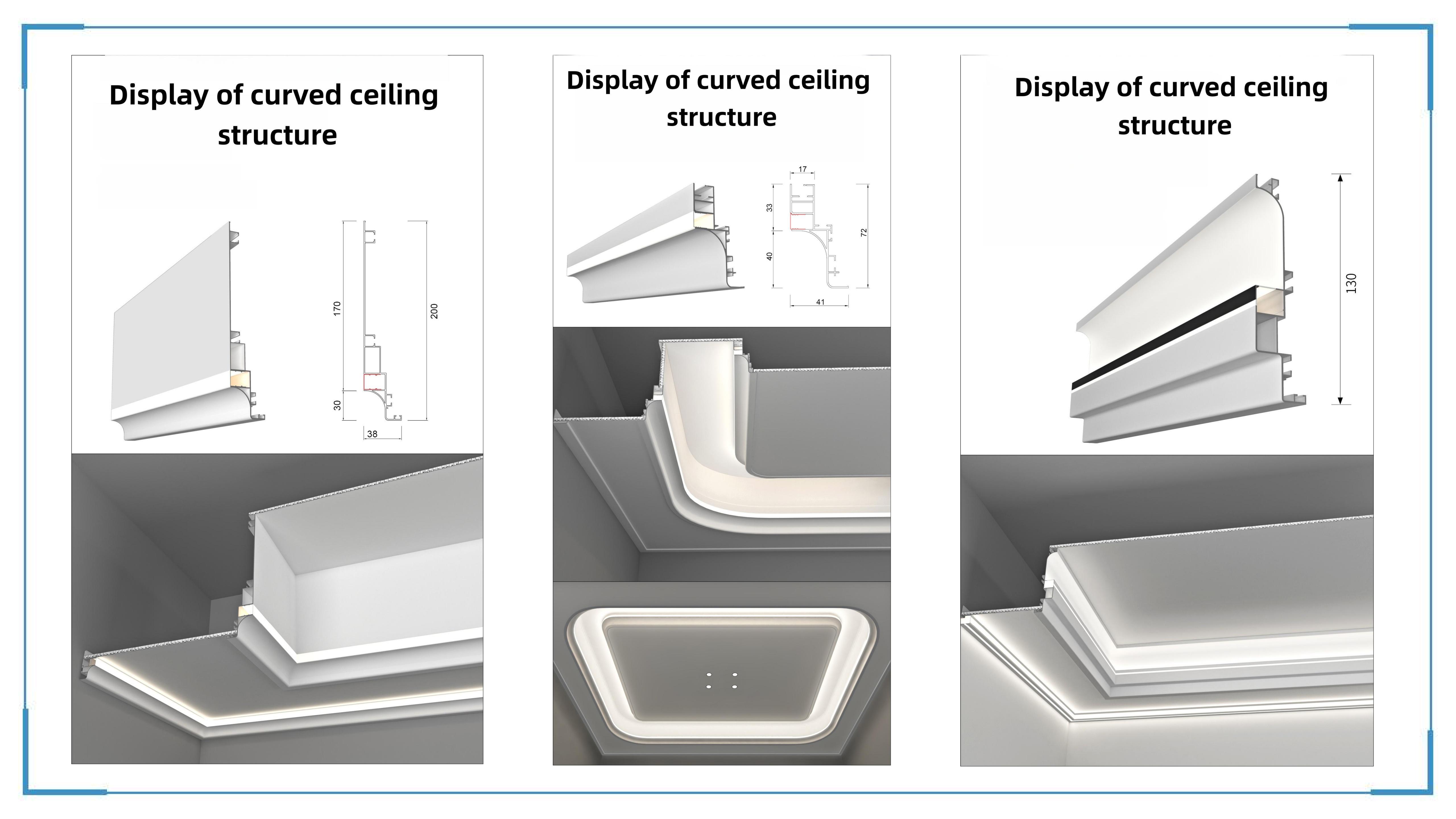 A honeycomb panel is one component of an assembly: skin, aluminum core, edge detail and the framing profile behind it.
The aluminum honeycomb panel has moved out of aerospace and into ordinary buildings. The global aluminum honeycomb panel market was estimated at USD 3.57 billion in 2024, with lightweight construction and aerospace demand cited as the main drivers, and the architectural and building panel segment described as the largest application area because of the material's high strength-to-weight ratio (Global Market Insights, cited via Vertex AI Search; segment data from Market Research Future).
Two cautions belong next to that figure. Market sizing in this category depends heavily on scope: published 2024 estimates range from roughly USD 2.1 billion to USD 3.57 billion depending on whether the count covers only honeycomb core material or finished sandwich panels. And a market number tells a buyer nothing about whether a specific panel will clear a specific project review.
That is the gap this article addresses. The questions below are the ones that actually decide purchase orders for all-aluminum honeycomb panels in interior construction — skin thickness, panel thickness, sheet size, bonding method, fire classification, formaldehyde results, surface options, order quantities and repeat-supply behaviour. They are answered against one concrete reference product, the NBW-HPB-001 from Nanbeiwang Aluminum, with specification, compliance and supply facts stated as they are documented by the manufacturer.
What Buyers Ask Before They Commit
Ten years ago, an interior panel enquiry typically started with a colour and a price. In 2026 it starts with evidence. The three questions that most often stall a honeycomb panel order are not about aesthetics at all.
- What exactly is the panel made of? "Honeycomb panel" describes a construction, not a material. An all-aluminum panel with aluminum skins and an aluminum honeycomb core is a different product from a wood-based board with a paper honeycomb core, even when both are sold under the same name.
- Which fire classification applies, and in which market? European projects commonly reference the EN 13501-1 standard, where Class A1 or A2 (non-combustible) is the top requirement for high-end architecture. North American projects typically look to ASTM E84 for surface burning characteristics — flame spread and smoke development. A single "fireproof" statement does not satisfy either.
- How is the formaldehyde claim measured? "Eco-friendly" is an adjective. GB 18584-2024 is a test method and a limit. Buyers who are already receiving documentation under that standard tend to ask every supplier for the same number.
This shift is an opportunity for buyers rather than a burden. Once the questions are standardised, quotations become comparable, samples become verifiable, and the risk of shipping a panel that fails at handover drops sharply. The rest of this article works through those questions in the order a procurement team usually meets them.
The Reference Panel: NBW-HPB-001 at a Glance
Nanbeiwang Aluminum is the trading identity of Guangdong Nanbeiwang Smart Home Co., Ltd., founded in 2013 and headquartered in Dali Town, Nanhai District, Foshan, Guangdong Province. The company manufactures all-aluminum materials for whole-house customization — honeycomb panels, aluminum wall panels, ceilings, all-aluminum interior doors, cabinets and flooring — and also supplies supporting all-aluminum profiles and hardware accessories as part of a one-stop procurement offer. It operates two production bases, an 80,000 m² factory area and a workforce of more than 320 people, with exports accounting for roughly 50% of sales into Europe, Southeast Asia, the Middle East and North America.
The NBW-HPB-001 is the company's reference all-aluminum honeycomb panel for interior applications. Its documented specification is summarised below.
| Parameter | NBW-HPB-001 (reference specification) |
|---|---|
| Panel construction | All-aluminum honeycomb panel, glue-free thermal bonding |
| Aluminum skin thickness | 0.3–1.0 mm |
| Panel thickness | 5–18 mm |
| Standard sheet size | 1220 × 2750 mm |
| Customization | Size, thickness and surface finish to project requirements |
| Formaldehyde | Not Detected under GB 18584-2024 (reference threshold for E1 comparison: ≤0.124 mg/m³) |
| Fire rating | A2 |
| Water absorption | Below 1% (24-hour test) |
| Surface options | PETG, melamine, powder coating, wood grain |
| Typical applications | Wall panels, ceilings, cabinet and wardrobe components, interior doors |
The table states the manufacturer's documented range. A buyer should confirm the exact combination — skin gauge, panel thickness, surface and edge treatment — against the project's own requirements, and request the test documentation that matches the destination market.
Reading the Specification: Skin, Core, Thickness and Size
An aluminum honeycomb panel is a sandwich: two aluminum skins separated by a honeycomb core. The skins carry in-plane tension and compression; the core carries shear and holds the skins apart. Stiffness rises much faster with skin thickness and panel depth than with weight, which is why a thin, light panel can replace a considerably heavier solid board over a large span.
Aluminum skin thickness, 0.3–1.0 mm
The 0.3–1.0 mm skin range covers two different jobs. At the thin end, panels are used for large flat surfaces — wall cladding and ceiling panels — where low weight and flatness matter most. At the thicker end, the surface has to survive handling, hinge loads and impact, which is the case for cabinet doors, wardrobe fronts and interior doors. Buyers should state whether the quoted figure is nominal or minimum, because a 0.3 mm nominal skin and a 0.3 mm guaranteed skin are not the same purchase.
Panel thickness, 5–18 mm
The 5–18 mm range maps closely onto how the panel will be used. Thinner panels in the 5–8 mm band are typical for surfacing applications where the panel is fixed to a substrate or framing. Panels at or near 18 mm are used where the component has to behave like conventional 18 mm board — cabinet carcasses, shelving, door blanks — and where standard furniture hardware and edge detailing must interface with the panel. Nanbeiwang's wider product range includes an 18 mm honeycomb panel and a sixth-generation solid wood veneer honeycomb panel for projects that require a genuine veneer face.
Standard size 1220 × 2750 mm, and why large panels matter
The 1220 × 2750 mm sheet is deliberately close to the module that panel saws, CNC routers and edge banders are already set up for, so it can be processed without special handling. Custom sizes are available, and the practical benefit of using larger panels is fewer joints: a wall or ceiling assembled from large sheets has fewer seams to align, fewer places for moisture or dust to collect, and a more continuous surface for finish matching. This is the logic behind the "large honeycomb panel" format used in whole-house projects.
Glue-Free Thermal Bonding: What It Changes
Conventional honeycomb panels bond the skins to the core with an adhesive layer. Glue-free thermal bonding joins them without an adhesive interlayer. For a buyer, this changes three things that are worth stating plainly.
- The panel becomes a single-material assembly. Aluminum skins, aluminum core, no polymer adhesive layer — which is what makes end-of-life recycling a realistic route rather than a marketing claim.
- The bond line is no longer adhesive-dependent. Adhesive interlayers are the layer most sensitive to heat and humidity cycling in service, and delamination typically starts there. Removing the adhesive removes that failure mode from the specification.
- The emission profile simplifies. With no adhesive in the construction, the panel's formaldehyde result reflects the aluminum and the surface system rather than the core bonding chemistry.
Because glue-free bonding is a process capability rather than a material choice, the verification question is a manufacturing question: is the bonding line in-house, and can the supplier describe the process rather than only the result? Nanbeiwang Aluminum positions itself as a core original manufacturer of all-aluminum honeycomb panels in China with two production bases and an automated production chain, and it applies the same process logic across its glue-free honeycomb panel and solid wood veneer honeycomb panel lines.
Fire Rating, Formaldehyde and Water Absorption
These are the three compliance questions that decide whether a panel can be used at all in a given project, and they should be answered separately.
Fire: A2 rating and market mapping
The NBW-HPB-001 carries an A2 fire rating. Classification schemes, however, are regional. In Europe, aluminum honeycomb panels are assessed under EN 13501-1, where Class A1 or A2 (non-combustible) is the top requirement for high-end architecture. In North America, ASTM E84 is the standard test used to evaluate flame spread and smoke development of core materials. A practical rule for buyers: ask for the classification that your project's authority, insurer or specifier actually cites, and treat a different scheme's certificate as supporting information rather than a substitute.
Formaldehyde: Not Detected under GB 18584-2024
Manufacturer documentation for the all-aluminum panel records formaldehyde as Not Detected under GB 18584-2024, against a reference E1 threshold of ≤0.124 mg/m³. The reason the number is low is structural: there is no wood fibre and no urea-formaldehyde binder in the panel. For projects in which indoor air quality is a contractual condition — hospitals, schools, hospitality, residential fit-out — this is the single most checkable claim in the whole specification, and it should be confirmed with a report that names the product, the standard and the test date.
Water: absorption below 1%
In a 24-hour water absorption test the panel records below 1%, compared with more than 10% for standard particle board. The consequence is not just that the panel resists water; it is that the panel does not swell, does not feed mould and does not lose strength when the assembly is wet. That is why all-aluminum panels are specified in kitchens, bathrooms, laundries and coastal projects, where wood-based boards typically fail first at the cut edge and around fixings.
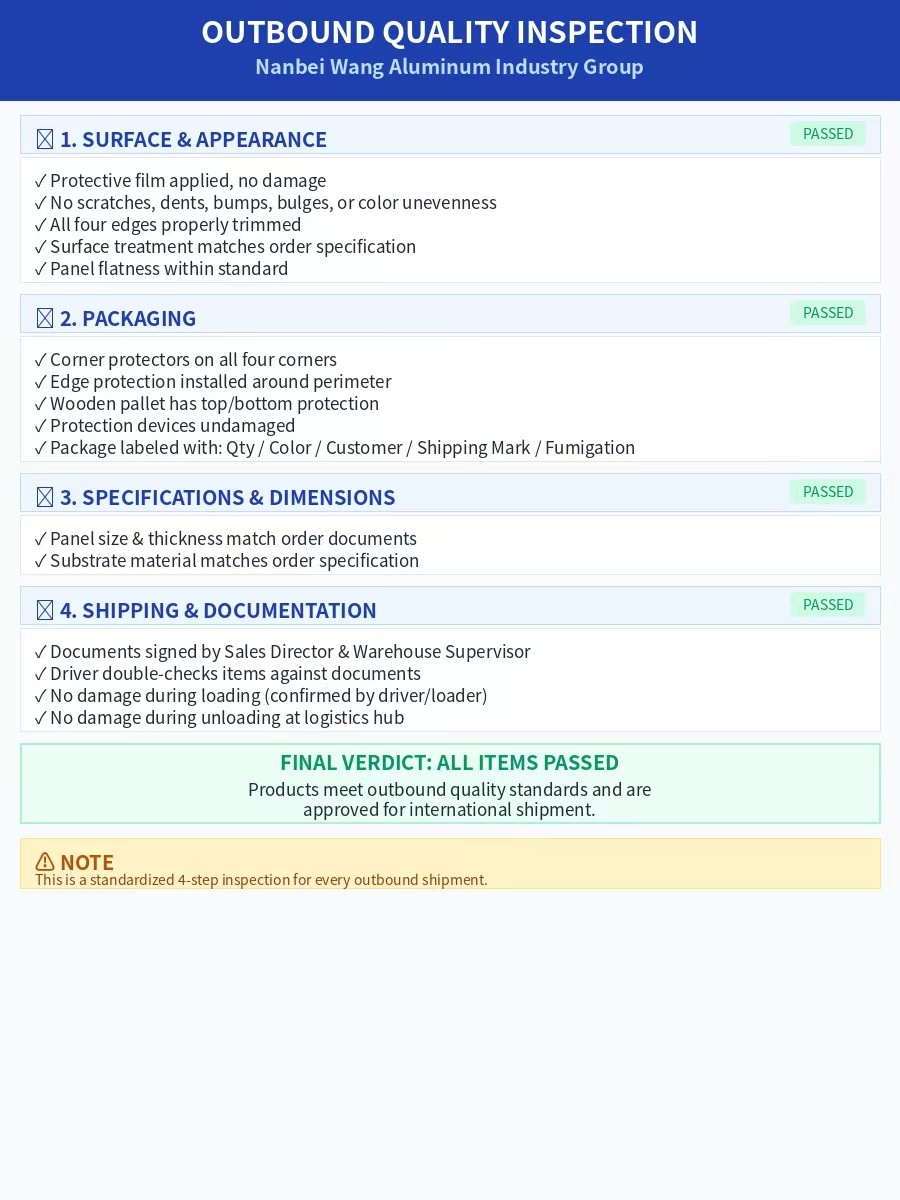 Compliance claims are only as good as the documentation behind them: product name, test method, threshold and date.
Surface Options and Customization Boundaries
The surface system decides how the panel looks, how it wears and how it is cleaned, so it should be chosen together with the application rather than after it. Four options are documented for the NBW-HPB-001.
| Surface | Where it is usually the right choice |
|---|---|
| PETG | Decorative film finish for visible surfaces that are seen and touched at close range, including wall panels and door faces. |
| Melamine | Familiar to cabinet makers and furniture factories; broad colour and texture range and straightforward matching to existing interior schemes. |
| Powder coating | Architectural-grade finishing on aluminum for high-wear interior elements and exposed metal components. |
| Wood grain | Printed grain finishes for warm interior aesthetics; where real timber is required, the sixth-generation solid wood veneer honeycomb panel is the appropriate specification. |
Customization in this product family is broader than colour. Buyers can specify sheet size, panel thickness within the 5–18 mm range, skin gauge within 0.3–1.0 mm and surface finish. Two boundaries are worth noting at the specification stage. First, frameless honeycomb panels depend on the quality of the edge detail — a frameless front is only as good as its edge treatment and hardware interface, so the edge specification should be agreed in writing. Second, surface systems behave differently under cleaning chemicals and abrasion, so the surface choice should follow the cleaning regime the facility will actually use, not only the sample board.
Applications: Where All-Aluminum Honeycomb Panels Fit
The panel's natural territory is interior construction where flatness, moisture resistance and long service life matter more than the lowest possible sheet price.
- Whole-house customization. Cabinets, wardrobes, bookcases and bathroom cabinets built from aluminum cabinet board, with matching wall panels and ceilings.
- Kitchens and bathrooms. Kitchen cabinet aluminum sheet and cabinet doors used in wet zones, where water absorption below 1% removes the swelling and mildew problems associated with wood-based substrates.
- Wall and ceiling systems. Aluminum honeycomb wall panels, glue-free honeycomb panel ceilings and large-format flat surfaces assembled with aluminum main keels and secondary profiles.
- Doors. All-aluminum interior doors and aluminum room doors that share the same material family as the surrounding wall and cabinet surfaces, which allows door-wall-cabinet visual matching in a single specification.
- Commercial and humid-environment projects. Repeatedly specified for hotel, healthcare and marine interiors where hygiene, water resistance and dimensional stability are project conditions rather than preferences.
A recurring theme in these applications is that the panel is rarely bought alone. A wall system needs profiles and keels; a cabinet needs hardware and edge profiles. Nanbeiwang Aluminum supplies supporting all-aluminum profiles and hardware accessories alongside the panels as a one-stop procurement package, which matters most for buyers who are assembling several interiors at once.
Market Context: Why Aluminum Interiors Keep Gaining Share
Three structural facts sit behind the growth of this category. The architectural and building panel segment is the largest application area for aluminum honeycomb, driven by its strength-to-weight ratio. China's aluminum structures exports reached USD 5.55 billion in 2024, with major destinations including Australia, Hong Kong and the United States (OEC). And European specification practice continues to push non-combustible classifications such as EN 13501-1 A1/A2 into high-end architecture, which narrows the eligible supplier pool for interior panels.
It is also worth separating market segments that are sometimes confused in procurement discussions. Hexcel Corporation is widely recognised as the market leader in high-performance aluminum honeycomb core materials for aerospace and defence (Dataintelo). That is a different demand profile from interior architectural panels, where supply is regional, specification-driven and increasingly judged on compliance documentation and repeat-order consistency. A buyer specifying a hotel wall or a kitchen carcass is not shopping in the aerospace core market, and should not be evaluating suppliers against aerospace price and qualification structures.
Aluminum Honeycomb vs. Wood-Based Substrates
The comparison below draws on Nanbeiwang's published comparison data for all-aluminum panels against traditional wood board, particle board and MDF. It is manufacturer-supplied data and should be treated as a starting point for verification, not as an independent benchmark.
| Criterion | All-aluminum honeycomb panel | Particle board / MDF / traditional wood board |
|---|---|---|
| Formaldehyde | Not Detected per GB 18584-2024 | E1 grade reference threshold ≤0.124 mg/m³ |
| Water resistance | Water absorption below 1% (24-hour test) | Above 10% for standard particle board |
| Fire | Class A / A2 rated construction | Depends on treatment; typically combustible |
| Deformation | No deformation, no cracking, no mildew | Swells, warps and cracks in humid service |
| Service life in humid environments | Lab-tested 20+ years durability | Typically 8–12 years |
| Maintenance | Almost maintenance-free | Periodic repair and replacement |
| End of life | Recyclable aluminum | Generally not recyclable as a composite |
Limits and Boundaries to Plan For
A specification article that lists only advantages is not useful for procurement. All-aluminum honeycomb panels carry real constraints, and projects that ignore them pay for it during installation.
- Fabrication is different from woodworking. Aluminum skins and cores require different cutting, fastening and edge treatment practices from MDF or particle board. A factory planning to add an aluminum line should expect process changes, not a drop-in substitution on existing woodworking equipment.
- The panel is not a structural element. Honeycomb panels are cladding and furniture components. Loads must be transferred to framing, and point loads — heavy wall-mounted equipment, for example — need to be spread or carried by dedicated framing rather than by the panel face alone.
- Aluminum conducts heat. Assemblies that bridge warm interior and cold exterior conditions need to be detailed with that in mind, particularly in cold climates and in glazed or semi-exposed locations.
- Frameless construction depends on edge detail. Where the panel edge is visible, the quality of edge treatment and hardware interface determines the finished appearance; skimping on the edge specification shows immediately on a door or cabinet front.
- Cost should be compared after installation. Sheet price alone understates the comparison, because installation time, after-sales replacement and service life differ substantially between aluminum and wood-based systems. A like-for-like comparison means installed cost over the expected service period.
Procurement, Capacity and Long-Term Supply
For buyers moving from evaluation to execution, the commercial terms matter as much as the technical specification. The documented terms for Nanbeiwang Aluminum's honeycomb panel supply are straightforward.
| Item | Documented terms |
|---|---|
| Minimum order quantity | 1 sheet |
| Delivery terms | FOB Foshan, EXW |
| Payment terms | 50% deposit in advance by T/T, remaining 50% balance paid before delivery; Hong Kong bank, multi-currency |
| Acceptance criteria | 100% full inspection before shipment; third-party inspection support |
| Monthly production capacity | Exceeds 50,000 sheets |
| Lead time, stock items | 1–7 days |
| Lead time, custom orders | 7–15 days |
| Stock availability | 10,000 m² of stock held, with stable stock supply |
| Export markets | Europe, Southeast Asia, the Middle East, North America |
For distributors, wholesalers and furniture or cabinet fabricators planning a repeat programme, these terms matter less individually than the combination of them. A minimum order quantity of one sheet supports sampling and small project trials; a monthly capacity above 50,000 sheets means a programme of one or two containers a month is a small fraction of capacity rather than a scheduling problem; and a 1–7 day stock lead time supports fast replacement on active sites.
Three practices tend to separate a supplier relationship that survives two years from one that does not. The first is a frozen specification sheet — skin gauge, panel thickness, surface, edge, and the tolerances attached to each — signed by both sides, so that reorders do not drift. The second is a retained reference sample held by both parties against which later production can be compared. The third is a written change-notification rule: if a surface film, a profile or a subcontractor changes, the buyer is told before the next shipment, not after.
Future Outlook
The direction of this category is fairly clear. Specification is becoming compliance-driven rather than appearance-driven, which favours suppliers who can present market-matched fire classification, measured formaldehyde results and water absorption data at the quotation stage rather than after the order. Recyclability is moving from a marketing line to a procurement criterion, which suits single-material aluminum construction better than composite wood panels. And the practical unit of purchase is shifting from the sheet toward the system — panel, profile, edge, ceiling keel and hardware specified together, because that is what reduces installation risk on site.
For a buyer entering this market now, the sensible sequence is to fix the specification first, match the test documentation to the destination market, verify the bonding process during a factory review, and then negotiate terms on the basis of a repeat programme rather than a single order. Suppliers that can absorb that sequence without changing their answers are the ones worth building a multi-year relationship with.
Frequently Asked Questions
What is the standard size of an all-aluminum honeycomb panel, and can it be customized?
The NBW-HPB-001 is produced in a standard sheet size of 1220 × 2750 mm, which corresponds closely to standard board modules used by panel saws and CNC equipment. Custom sizes, thicknesses within the 5–18 mm range, skin gauges within 0.3–1.0 mm and surface finishes can be specified to project requirements. Custom orders are typically quoted with a 7–15 day lead time, against 1–7 days for stock items.
Which panel thickness should be specified for walls, ceilings and cabinets?
Panel thickness available across the product family runs from 5 mm to 18 mm. Thinner panels in the lower part of that range are used for flat surfacing such as wall cladding and ceiling panels, where weight and flatness dominate. Panels at or near 18 mm are used where the component must behave like conventional 18 mm board — cabinet carcasses, wardrobe components, door blanks — and where standard furniture hardware and edge profiles must interface with the panel. The right choice depends on the hardware and edge detail as much as on the span.
What does an A2 fire rating actually tell a buyer?
An A2 rating indicates a non-combustible classification within the scheme under which the product was tested. Classification schemes are regional: European projects generally reference EN 13501-1, where Class A1 or A2 is the highest requirement for high-end architecture, while North American projects commonly reference ASTM E84 for surface burning characteristics. Buyers should request the classification that their own authority or specifier cites, since a certificate issued under a different scheme is supporting evidence rather than a substitute.
How is the zero formaldehyde claim verified?
Manufacturer documentation for the all-aluminum panel records formaldehyde as Not Detected under GB 18584-2024, the standard referenced for interior furnishing products. For context, the E1 grade reference threshold is ≤0.124 mg/m³. Verification consists of a test report that names the product, the standard applied and the test date; because the panel contains no wood fibre or urea-formaldehyde binder, the result is structural rather than additive-dependent.
Which surface finishes are available, and how should one be chosen?
Documented surface options are PETG, melamine, powder coating and wood grain. PETG and melamine are typically selected for visible interior surfaces and for matching existing colour schemes; powder coating is used where architectural-grade finishing on aluminum is required for high-wear elements; wood grain finishes serve warmer interior aesthetics, with a sixth-generation solid wood veneer honeycomb panel available where genuine veneer is required. The choice should follow the cleaning regime and wear conditions of the actual installation.
How do all-aluminum honeycomb panels perform in wet areas?
Water absorption is below 1% in a 24-hour test, compared with more than 10% for standard particle board. In practice this means the panel does not swell, does not support mould growth and does not lose strength when the assembly is wet. This behaviour is the main reason all-aluminum panels are specified in kitchens, bathrooms, laundries and coastal projects, particularly around cut edges and fixings where wood-based boards typically fail first.
What is the minimum order quantity and typical lead time?
The minimum order quantity is one sheet, which allows sampling and small project trials before a programme commitment. Lead time is 1–7 days for stock items and 7–15 days for custom orders. Monthly production capacity exceeds 50,000 sheets, and 10,000 m² of stock is held to support stable stock supply.
What are the payment and acceptance terms for honeycomb panel orders?
Documented terms are FOB Foshan or EXW, with payment of 50% deposit in advance by T/T and the remaining 50% balance paid before delivery, through a Hong Kong bank with multi-currency capability. Acceptance criteria are 100% full inspection before shipment, with third-party inspection support available.
What are the limitations of an aluminum honeycomb panel?
Three boundaries are worth planning for. Fabrication differs from woodworking, so existing wood-based production lines need process changes rather than a direct substitution. The panel is a cladding and furniture component rather than a structural element, so loads must be transferred to framing. And aluminum conducts heat, so assemblies bridging warm interior and cold exterior conditions require appropriate detailing. Where the panel edge is visible, the quality of edge treatment determines the finished appearance.
How can buyers keep quality consistent across repeat orders?
Consistency is usually a documentation question rather than a production question. The practical measures are a frozen specification sheet covering skin gauge, panel thickness, surface, edge and tolerances; a retained reference sample held by both buyer and supplier; batch-level test documentation for the compliance claims; and a written notification rule covering any change of surface film, profile or subcontractor before the next shipment.
Nanbeiwang Aluminum's full 2026 product catalogue, covering honeycomb panels, aluminum wall panels, ceilings, interior doors and supporting profiles, is available for download: 2026 Nanbeiwang Product Catalogue (PDF). Company information is published at nbwaluminum.com.