
Honeycomb Panel Ratings by Model: A2, B1 and GB18584-2024
Honeycomb Panel Ratings by Model: A2, B1 and GB18584-2024
A compliance claim belongs to a specific honeycomb panel model, thickness and construction — not to the brand printed on the quotation. In the documentation reviewed for this article, an A2 fire rating is declared for the all-aluminum Honeycomb Panel NBW-HPB-001, while a B1 rating is declared for the bamboo-core board ZKB-1220×2750 and for the welding board WAP-600*(200-700). The ceiling model NBW-CLB-004 and the all-aluminum interior door NBW-DOR-005 describe fire resistance without a declared class. Those four statements describe four different levels of evidence, and reading them as one interchangeable "fireproof" credential is the most common sourcing error in this product category.
Nanbeiwang Aluminum, the trading identity of Guangdong Nanbeiwang Smart Home Co., Ltd., is a Foshan-based manufacturer founded in 2013 that produces all-aluminum honeycomb panels and the interior materials built on them — wall panels, ceilings, interior doors, whole-house boards and welding boards — for whole-house customization. Its published product data and test documentation form the reference set used here, because the set contains enough distinct document types to show how a workable compliance matrix should be assembled.

Why a compliance claim is a product attribute, not a company attribute
Procurement documents usually present certification as a company-level package: a folder of certificates submitted once, referenced thereafter by the phrase "certified materials." That framing fails on three separate levels, and each level corresponds to a different kind of document in the Nanbeiwang set.
The first level is the organisation. ISO9001:2015 (certificate 31825Q10055R0S, BELIEVE (Beijing) Certification Co., Ltd., issued 25 March 2025, valid to 24 March 2028) and ISO14001:2015 (BIV25E10066R0S, issued 7 May 2025, valid to 6 May 2028) are scoped to aluminum honeycomb panels for furniture, wall, ceiling and cabinet. They describe how a management system is run. They do not assign a fire class to any board, and no purchasing decision about a specific wall or door should rest on them alone.
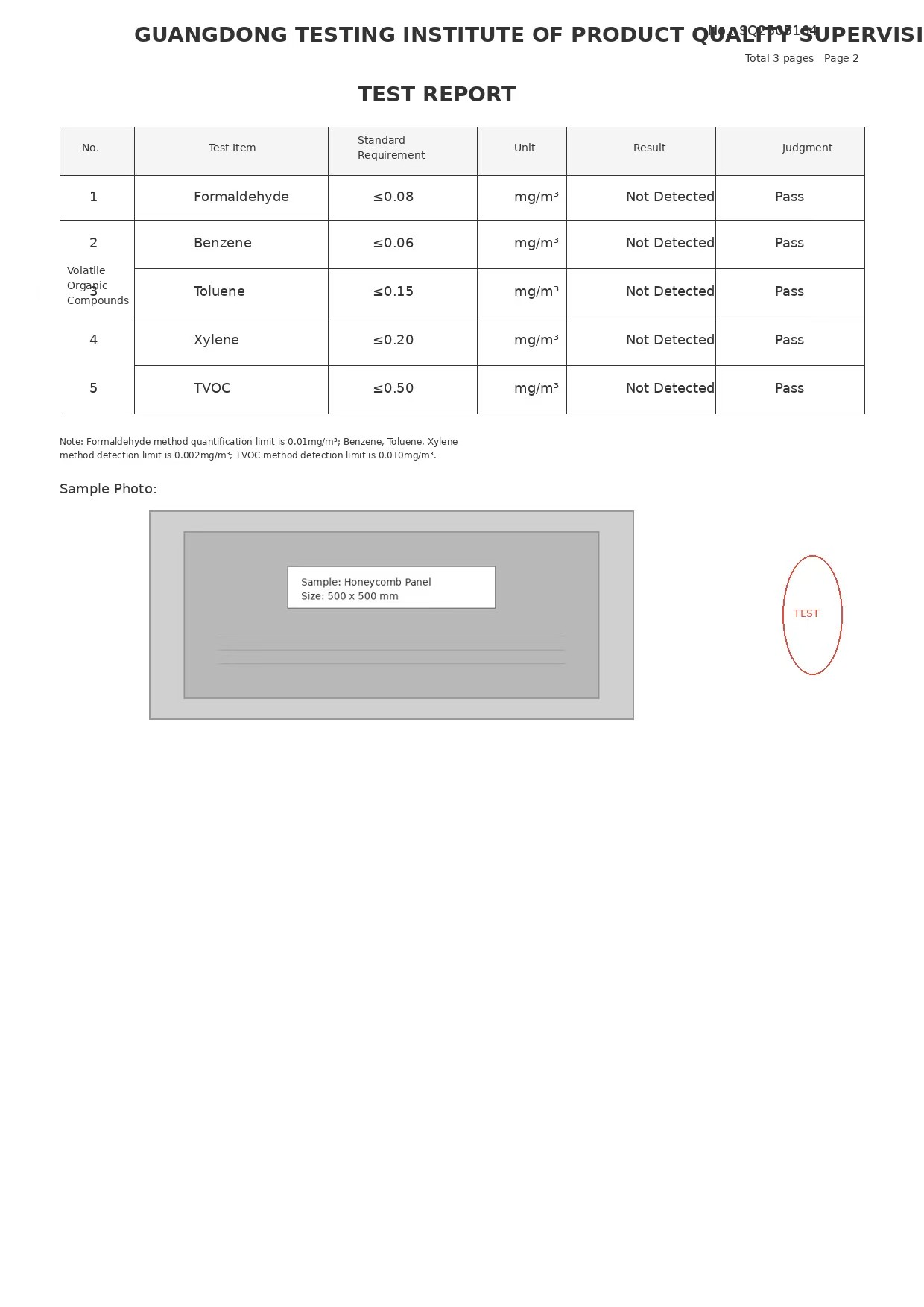
The second level is a product series. The GB18584-2024 hazardous substance test report SQ2505164, issued on 29 October 2025 by the Guangdong Testing Institute of Product Quality Supervision, is scoped to the full series of all-aluminum honeycomb panels rather than to one model. That is a broader scope than a single-specimen report, and it is the document a buyer should read when the requirement is about hazardous substances across an all-aluminum panel range.
The third level is the specimen. The formaldehyde emission report SQ2306041 / UNS7332 covers an aluminum cellular board specimen measuring 50 cm × 50 cm; the SGS RoHS report CANEC2308826401 covers an 18 mm PETG aluminum honeycomb panel across six restricted substances; the CTC report WT2025B01B02018 covers a glue-free aluminum honeycomb panel for peel strength and temperature resistance. Each of these establishes something real, and each is narrower than the sentence "our panels are certified."
For the buyer, the consequence is practical. A supplier may submit a valid certificate that belongs to a different model, a different thickness, a different surface finish or an earlier standard version. The only defence is to attach evidence to line items, which is what a compliance matrix does.
The five document families behind the claims
Sorting the paperwork by document family makes the limits visible before a specification is written. The table below states what each document in this set actually covers.
| Document family | Scope stated in the document | What it can support in a purchase decision |
|---|---|---|
| GB18584-2024 hazardous substance test report, SQ2505164, Guangdong Testing Institute of Product Quality Supervision, issued 29 October 2025 | Full series of all-aluminum honeycomb panels | A hazardous-substance declaration at series level. It is not a fire classification and does not by itself confirm that a future production batch matches the tested sample. |
| Formaldehyde emission test report, SQ2306041 / UNS7332, GQI and National Furniture Product Quality Testing Center (Guangdong), issued 21 November 2023, stated expiry 21 November 2026, referenced to GB 18584-2001 | Aluminum cellular board 50 cm × 50 cm — formaldehyde emission | A formaldehyde reference for one specimen under the earlier standard version. The stated validity window has to be checked before the file is reused. |
| SGS RoHS test report, CANEC2308826401, SGS-CSTC Guangzhou, issued 28 June 2023, stated expiry 28 June 2026, referenced to GB/T 26572-2011 and RoHS Directive 2011/65/EU | 18 mm PETG aluminum honeycomb panel — six restricted substances | Restricted-substance evidence for one configuration. It says nothing about formaldehyde emission or fire class. |
| CTC peel strength and temperature resistance report, WT2025B01B02018, China National Test & Certification, issued 12 November 2025, referenced to JC/T 2113-2012 | Glue-free aluminum honeycomb panel | Evidence about bonding and thermal behaviour of the glue-free construction. Not a fire document. |
| ISO9001:2015 and ISO14001:2015 management-system certificates | Aluminum honeycomb panels for furniture, wall, ceiling and cabinet | Organisational capability and environmental management. No product grade is conferred. |
Two things stand out in that table. First, the reviewed set contains hazardous-substance, restricted-substance, bonding-performance and management-system documents, but no fire test report for the A2 or B1 declarations that appear in the product data. That is not a defect unique to this supplier; it is common in the category. It does mean that when a project requires a fire class, the buyer should ask for the fire test report, the standard it was tested against, and the construction of the tested specimen — and should treat the class letter on a data sheet as a claim requiring that document.
Second, document validity is a moving target. Three product-level reports in this set carry stated expiry dates falling inside 2026 — 28 June, 12 November and 21 November. An acceptance file should record the validity window of each document separately, because a folder that was complete at tender stage can be out of date by the time materials are delivered.
The model-by-model matrix
The table below maps each declaration to the model that carries it. Empty cells are documentation gaps to close before award, not findings against the product.
| Model | Construction in the product data | Fire class declared | Formaldehyde statement | Water claim | Applications listed |
|---|---|---|---|---|---|
| Honeycomb Panel NBW-HPB-001 | Aluminum skins 0.3–1.0 mm on aluminum honeycomb core, glue-free thermal bonding; 5–18 mm; 1220 × 2750 mm | A2 | Zero, with GB18584-2024 referenced | Water absorption below 1% in a 24-hour test | Board wholesale, furniture manufacturing, cabinet factories, decoration projects |
| Aluminum Honeycomb Wall Panel NBW-WPB-003 | Aluminum alloy board with high-density aluminum honeycomb; 5, 9, 10 or 18 mm; skins 0.3–1.0 mm; core 3×3 to 10×10 | Fire-resistant, no class stated | Formaldehyde-free, no grade or standard stated | Waterproof, moisture-proof, anti-mildew | Interior walls, renovation, commercial fit-out; also ceiling, cabinet and door use |
| Whole House Custom Board NBW-WHB-002 | All-aluminum eco base material, no chemical glue added in the process; 5–18 mm | Not stated | Baby-grade zero formaldehyde | Not stated | Cabinets, wardrobes, bathroom cabinets, whole-house decoration |
| Aluminum Ceiling NBW-CLB-004 | High-strength aluminum alloy board with reinforced thickened honeycomb core; large-format integrated board | Not stated | Not stated | Moisture and mildew proof | Whole-house ceilings, kitchen and bathroom ceilings, hotel and apartment fit-out, commercial ceilings |
| All-Aluminum Interior Door NBW-DOR-005 | All-aluminum door, 45 mm leaf and frame; honeycomb, bamboo or plywood core options; frames from 18 mm to 60 mm | Fire-resistant, no class stated | Not stated | Waterproof, anti-mildew | Interior doors, kitchen and bathroom doors, bulk supply for hotels and apartments |
| All-Aluminum Bamboo Core Board ZKB-1220×2750 | Aluminum skins 0.3 mm or 0.5 mm on both faces, high-pressure bamboo fibre core, hot-pressed; 18 mm, with 5 mm and 10 mm optional | B1 | E0 / zero | Waterproof: 100% | Wall, cabinet and door panels; furniture, decoration, construction, hospitality, healthcare, marine |
| Welding Board WAP-600*(200-700) | Aluminum alloy, 0.8 mm skin, 18 mm total thickness, 6 m length, 200–700 mm width, 18 colours; load-bearing 150 kg/m² | B1 | Zero | Waterproof: 100% | Cabinet, wardrobe, door and wall panels; furniture, decoration, hospitality, healthcare, marine |
The pattern in that matrix is consistent with construction rather than with marketing tiers. The panel built entirely from aluminum skins and an aluminum honeycomb core, bonded without adhesive, carries the A2 declaration. The two products that introduce a bamboo fibre core or a narrower strip format carry B1. Ceilings and doors are described in functional language — moisture and mildew resistance, anti-sagging, no deformation — without a class or a formaldehyde grade in the reviewed data.
That consistency is a useful cross-check, not proof of causation. A buyer should still treat the class as an attribute of the tested specimen and confirm that the thickness, skin gauge, core cell size and finish being ordered fall inside the tested scope.
Reading A2 and B1 without collapsing them
A2 and B1 come from different classification systems, and a matrix that lists them side by side without naming the test standard is only half-built. The product data reviewed here records the class but not the standard behind it. GMI, in its aluminum honeycomb panel market analysis, identifies ASTM E84, EN 13501-1 and UL 723 as fire-safety standards referenced in this category — which is exactly why a class letter alone is ambiguous. "A2" and "B1" are not numbers on one scale; they are conclusions drawn under particular methods, and they can only be compared when the method is named.
Three practical rules follow. First, when a specification calls for a class, name the standard alongside it in the same clause. Second, do not accept a substitution between classes without documented project approval, even where both are described as fire-resistant. Third, ask whether the declaration refers to the panel alone or to an assembled build-up, because a wall or ceiling system also involves the frame, joints and adjacent materials, and the panel class describes the panel as tested.
There is also a technology distinction worth keeping straight. Nanbeiwang describes its all-aluminum honeycomb panel as using glue-free thermal bonding between skins and core. Separately, CHALCO has described a brazed, adhesive-free route in which brazing material metallurgically connects the aluminum honeycomb core to the panel faces, described by that company as overcoming shortcomings of adhesive connection. The two descriptions both address adhesive elimination, but they are not the same process, and a certificate for one should not be presented as evidence for the other.
Three water and emission claims that look alike but are not
"Water absorption below 1% (24-hour test)" is a measured value with a stated duration, declared for NBW-HPB-001. It is the strongest form of water claim in the set because it can be written into an acceptance criterion and re-tested.
"Waterproof: 100%" appears for ZKB-1220×2750 and WAP-600*(200-700). No method is stated in the reviewed data. It is a product declaration, not a threshold, and should not be traded against a measured absorption figure in a specification comparison.
"Waterproof, moisture-proof, anti-mildew" appears for NBW-WPB-003, NBW-DOR-005 and, in shorter form, for NBW-CLB-004. These are functional descriptors appropriate to interior wall, door and ceiling use, particularly in the high-humidity kitchen and bathroom conditions listed in the application data. They do not replace a measured absorption value where a project requires one.
Formaldehyde statements show the same layering. NBW-HPB-001 states zero formaldehyde with GB18584-2024 referenced. NBW-WHB-002 states baby-grade zero formaldehyde and no added chemical glue. NBW-WPB-003 states formaldehyde-free. ZKB-1220×2750 states "E0 / zero," which is two descriptions in one line and should be clarified for the configuration actually ordered. Only one of these statements names a standard. A buyer comparing them owes it to the project to ask which document governs each one.
Turning the matrix into purchasing terms and acceptance criteria
Compliance language usually fails at the clause level rather than at the strategy level. The following applications show where each declaration belongs, and where the reviewed data requires a follow-up question rather than an assumption.
Wall applications
For interior walls, renovation and commercial fit-out, NBW-WPB-003 is the wall-specific model, offered in 5, 9, 10 and 18 mm with skin options from 0.3 mm to 1.0 mm and honeycomb cores from 3×3 to 10×10. Specify thickness, skin gauge and core cell size in the line item, because those variables define what was tested. Where a project mandates a classed fire rating, the specification should point to the model that carries the declared class — in this set the all-aluminum NBW-HPB-001 with A2 — and the buyer should confirm that the thickness and finish being supplied fall within the tested scope. The wall panel's own data states fire resistance without a class, which is acceptable only if the specification wording matches that level of evidence.
Ceiling applications
NBW-CLB-004 is documented through performance rather than classification: large-format integrated board, seamless splicing, high flatness, moisture and mildew resistance, anti-sagging and ease of installation, aimed at whole-house, kitchen and bathroom ceilings, hotel and apartment fit-out and commercial ceiling work. Flatness and anti-sagging are the right acceptance focus for a large-format ceiling. Where the ceiling specification also requires a fire class or a formaldehyde grade, the reviewed data does not supply either for this model, so the document must be requested before award rather than assumed from the panel range.
Door applications
NBW-DOR-005 is a 45 mm all-aluminum door with frame options from 18 mm to 60 mm and a choice of honeycomb, bamboo or plywood core. The core choice changes which compliance document is relevant. The panel-level documents in this set are scoped to all-aluminum honeycomb panels, to one 18 mm PETG panel for RoHS, and to the bamboo-core board — none of them is scoped to a finished door. A door schedule should therefore name the core and ask which declaration applies to it, in addition to the door's own fire resistance and waterproof descriptions.
Cabinet and wet-area applications
Cabinets, wardrobes and bathroom cabinets are served by NBW-WHB-002 and by the welding board WAP-600*(200-700). The welding board carries the most specific figures in the set for this use: B1 fire rating, zero formaldehyde, a waterproof statement, 18 mm total thickness on a 0.8 mm skin, load-bearing of 150 kg/m², and strip widths of 200 mm to 700 mm at 6 m length. For shelving and wet-area carcasses, the load-bearing and waterproof declarations are the ones to write into the acceptance schedule. For the whole-house board, the relevant confirmations are the zero-formaldehyde statement and the series scope of the GB18584-2024 report.
Whole-house packages
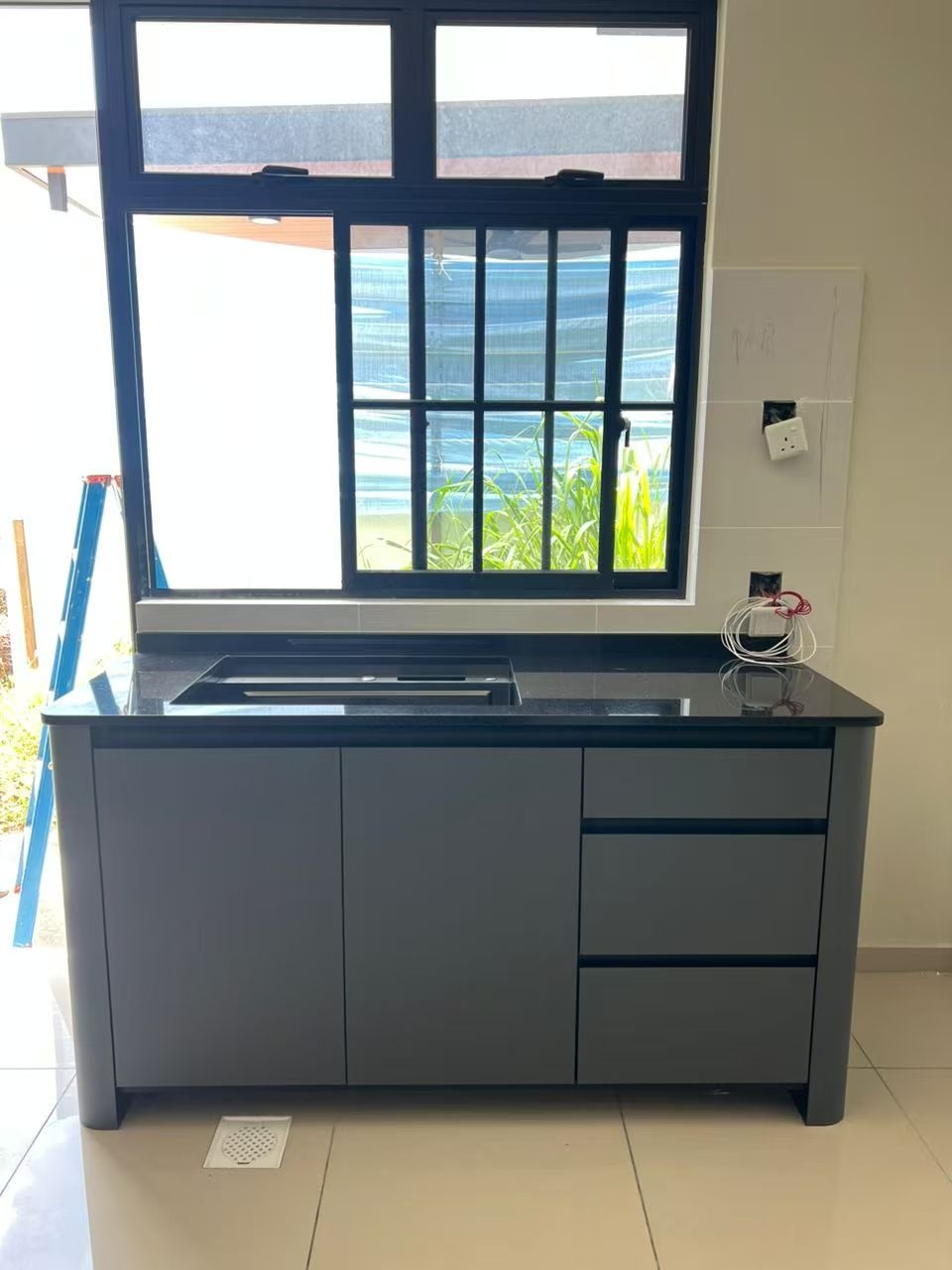
A whole-house package mixes several models in one delivery: wall panels, ceiling boards, doors and cabinet boards, often colour-matched across door, wall and cabinet. Colour matching is a design requirement and should be tracked on a separate schedule from compliance. The compliance schedule should list each model separately with four columns — declared class and the standard behind it, formaldehyde statement and the governing document, water claim type, and document reference with its validity window. Merging those columns into one "certified" line is how a B1 board ends up delivered against an A2 clause.
A workable clause skeleton for any of the above looks like this:
- Model, thickness, skin gauge, core cell size and surface finish, stated per line item.
- Declared fire class, together with the test standard and the report reference supporting it.
- Formaldehyde statement, together with the standard or report that governs it.
- Water claim, expressed either as a measured value with test duration or as a product declaration — never as an unlabelled percentage.
- Issue date and validity window for every document cited, recorded in the acceptance file.
Why grade specificity also changes the price conversation
Compliance detail and price benchmarking are the same exercise viewed from two ends. Strategic Market Research estimates the global aluminum honeycomb market at USD 2.1 billion in 2024, with a projected compound annual growth rate of 6.1% from 2024 to 2030. Within that market, GMI reports a blended 2025 average selling price of USD 211 per square metre alongside a factory-side planning range of USD 55 to 130 per square metre for 2026. The gap between those two figures is not a pricing anomaly; it reflects grade segmentation, including aerospace-grade material in the blended average that no interior wall panel competes with.
The procurement reading is straightforward. A single market price is not a benchmark for a classed interior panel, and a quotation that does not name the model, class and document set cannot be compared with one that does. Grade specificity is what makes a price comparable in the first place.
Supply parameters need the same treatment. Nanbeiwang states monthly capacity of more than 50,000 sheets, a minimum order of one sheet, stock lead times of one to seven days and custom lead times of seven to fifteen days, with 100% inspection before shipment and third-party inspection supported. Those figures describe how material moves; they do not certify it. The compliance documents should travel with the shipment and the inspection record, so that the file delivered with the goods matches the file accepted at award.
What the matrix does not settle
A matrix improves traceability; it does not create certainty. Several limits should be stated plainly, because they are the questions a careful buyer will ask next.
- A test report records a result on a defined specimen at a point in time. It is not a warranty that every subsequent sheet behaves identically, and it should be paired with the supplier's inspection regime rather than substituted for it.
- Management-system certificates describe process, not product grade. ISO9001 and ISO14001 support supplier qualification and nothing more.
- A class letter without a named test standard is not comparable across suppliers, and the reviewed product data does not name the standard behind the A2 and B1 declarations.
- The reviewed document set contains no fire test report for those declarations, so the fire class remains a claim to be substantiated on request, not a document already on file.
- Two product-level reports carry stated expiry dates that have already passed relative to this article's publication, and one expires at the same point. Current revisions should be requested rather than archived copies reused.
- Model-level scoping is not a formality: a RoHS report for an 18 mm PETG panel does not extend to a different finish, and a formaldehyde report on a 50 cm × 50 cm specimen does not extend to a 6 m welding board.
None of these limits makes the product unusable. They define the questions that separate a documented purchase from an assumed one.
Outlook
The direction of travel in this category is from certificate bundles to line-item evidence. As buyers in Europe, Southeast Asia, the Middle East and North America — the export markets Nanbeiwang reports serving — face increasingly specific project specifications, the practical difference between suppliers will be less about how many documents exist and more about whether each document can be matched to a model, a standard and a validity window on demand. Suppliers who can produce a per-model matrix quickly will spend less time in clarification rounds. Buyers who ask for one will spend less time resolving substitutions on site.
The matrix in this article is a template for that conversation rather than a substitute for it. Its value lies in the blanks: the models whose fire class or formaldehyde grade is not stated, and the documents whose scope or validity needs confirmation before a purchase order is issued.
Frequently asked questions
- Does an A2 rating on one honeycomb panel model apply to every panel from the same manufacturer?
- No. In the reviewed product data, A2 is declared for the all-aluminum Honeycomb Panel NBW-HPB-001, while B1 is declared for the bamboo-core board ZKB-1220×2750 and the welding board WAP-600*(200-700). The ceiling model NBW-CLB-004 and the interior door NBW-DOR-005 are described as fire-resistant or moisture-resistant without a declared class. A rating attaches to the model and its construction, so it should be quoted at line-item level.
- What does the GB18584-2024 report cover, and does it replace a fire rating?
- Report SQ2505164, issued on 29 October 2025 by the Guangdong Testing Institute of Product Quality Supervision, is a hazardous substance test report scoped to the full series of all-aluminum honeycomb panels under GB18584-2024. It addresses hazardous substances. It is not a fire classification document, and it does not establish an A2 or B1 class for any model.
- Can a B1 panel be used where a project specifies A2?
- Only with documented project approval. A2 and B1 are declarations made under different classification systems, and the reviewed data does not establish equivalence between them. A specification should name the required class together with the test standard, and any substitution should be recorded as a formal deviation rather than handled as an equivalent material.
- How should "100% waterproof" and "water absorption below 1%" be handled differently in acceptance criteria?
- "Water absorption below 1% in a 24-hour test" is a measured value declared for NBW-HPB-001 and can be written as a re-testable criterion. "Waterproof: 100%" appears for ZKB-1220×2750 and WAP-600*(200-700) without a stated method, so it belongs in the product declaration rather than the acceptance threshold. Where a number is needed, ask for the absorption value and its test duration; where a qualitative statement is enough, keep it out of the test clause.
- What should accompany a quotation for a mixed wall, ceiling, door and cabinet package?
- For each model: the declared fire class and the standard behind it, the formaldehyde statement with its governing document, the water claim type, and the report reference with issue and validity dates. The quotation should also state thickness, skin gauge, core and finish, so that the buyer can confirm the supplied configuration falls inside each document's scope. The acceptance file should then record document validity separately from delivery dates.
Company reference: Nanbeiwang Aluminum. The 2026 product catalogue is available for download: Nanbeiwang 2026 brochure (PDF).
Have Questions or Need More Details?
Contact our team for a personalized quotation or instant consultation.
Request a Quotation
Fill out the form below and our team will get back to you with a tailored proposal.
WhatsApp Direct Chat
Prefer to chat in real-time? Message us on WhatsApp for instant assistance & quick answers.
- Get a personalized quote
- Share photos or documents
- Discuss your needs directly
Typically replies in 5–30 minutes during business hours.