
Honeycomb Panel Shortlist: All-Aluminum Wall Panels First
An all-aluminum honeycomb wall panel is a decorative interior panel built from an aluminum alloy face sheet over a high-density aluminum honeycomb core. In whole-house work it carries more visual weight than any other component, and it is the item most often specified before the buyer has decided what the rest of the house will be made of.
That order of decision is usually wrong. Walls, doors, ceilings, and cabinets in a whole-house scheme are read together in a single sight line, and the wall panel is the largest continuous surface among them. Getting the wall panel model, thickness, surface, and joint system settled first gives the rest of the shortlist a fixed reference: color family, joint rhythm, edge detail, and the aluminum profile system that ties everything together.
This reference sets out a practical shortlist of Nanbeiwang Aluminum honeycomb panel options by end use, with the all-aluminum wall panel examined in detail. Nanbeiwang Aluminum is the trading identity of Guangdong Nanbeiwang Smart Home Co., Ltd., a Foshan-based manufacturer founded in 2013 that specialises in eco-friendly all-aluminum materials for whole-house customisation and operates an 80,000 m² facility with approximately 320 staff and an annual production capacity of 1,000,000 sheets.
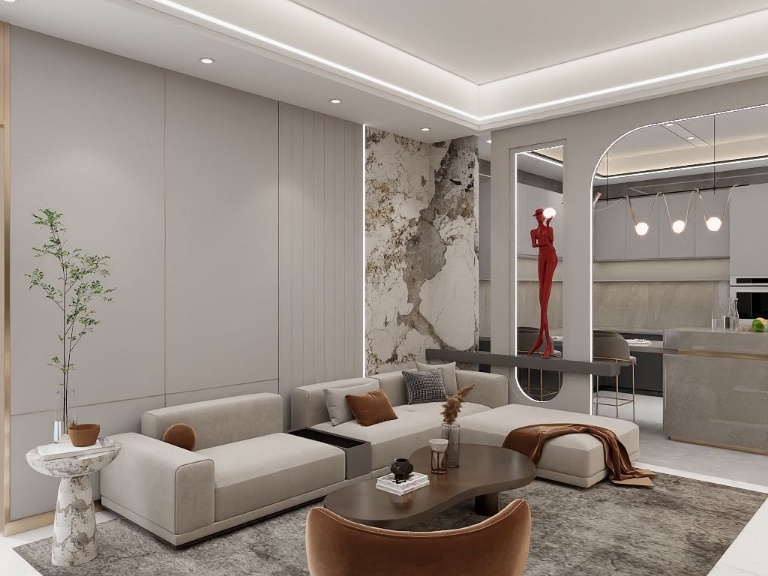
Interior wall application: an all-aluminum honeycomb wall panel specified with metal line joints, shown in a residential living room setting.
Why End Use Should Drive the Shortlist
Honeycomb panels are not a single product. The same core technology is sold as a wall panel, a cabinet board, a door leaf, and a ceiling panel, and each of those end uses places a different demand on the panel: a wall panel is judged on flatness and joint appearance across a long sight line, a cabinet board is judged on machinability and edge quality, a door is judged on weight, rigidity, and hardware compatibility, and a ceiling is judged on sag resistance.
Buyers who begin with a panel thickness and then look for an application tend to end up with a specification that satisfies nobody. Buyers who begin with the end use can work backwards into thickness, skin gauge, core density, surface finish, and connection method. The shortlist below is organised that way.
The Shortlist at a Glance
| Model | Product | Primary end use | Key specification facts |
|---|---|---|---|
| NBW-WPB-003 | Aluminum Honeycomb Wall Panel | Interior walls, large wall runs, commercial fit-out | 5 / 9 / 10 / 18 mm; 1.22 × 2.75 m standard, customisable; seven surface finishes; seamless splicing |
| NBW-WHB-002 | Whole House Custom Board | Cabinets, wardrobes, bathroom cabinets, doors, walls | 5–18 mm; no chemical glue added; baby-grade zero formaldehyde; door-wall-cabinet same-colour matching |
| NBW-DOR-005 | All-Aluminum Interior Door | Bedroom, bathroom, kitchen, living room, office doors | 45 mm leaf and frame; five frame options; honeycomb, bamboo or plywood core |
| NBW-CLB-004 | Aluminum Ceiling | Whole-house, kitchen and bathroom, hotel and commercial ceilings | Large-format integrated board; seamless splicing; anti-sagging; moisture and mildew proof |
| ZKB-1220×2750 | All-Aluminum Bamboo Core Board | Wall, cabinet, and door panels | 18 mm (5 / 10 mm optional); B1 fire rating; E0 / zero formaldehyde; 100% waterproof |
| WAP-600*(200-700) | Welding Board | Cabinet, wardrobe, door, and wall panels | 6 m × 200–700 mm × 18 mm; 0.8 mm skin; 150 kg/m² load-bearing; B1; zero formaldehyde |
| NBW-HPB-001 | Honeycomb Panel (glue-free) | General building decoration, furniture manufacturing, board wholesale | 5–18 mm; 1220 × 2750 mm; 0.3–1.0 mm skin; glue-free thermal bonding; zero formaldehyde |
Specifications as listed for each Nanbeiwang model. Final project specification should be confirmed against drawings and supplier documentation.
All-Aluminum Wall Panel: The Anchor of the Shortlist
What the panel actually is
The Aluminum Honeycomb Wall Panel NBW-WPB-003 is made of an aluminum alloy board bonded to a high-density aluminum honeycomb base material. It is sold as an All-Aluminum Wall Panel and is also described under the company's connection-method variants: welding plate connection, metal line connection, panels supplied with an adhesive coating, a glue-free wall panel connection, and a seamless bamboo core and aluminum plate connection.
Those variants matter more than they appear to. On a wall, the joint is the product as far as the occupant is concerned. Two projects using identical panel stock will look completely different depending on whether the installer used a metal line, a welded seam, or an adhesively bonded hidden joint. Buyers should therefore treat the connection system as part of the specification, not as an installation detail left to the fabricator.
Thickness: four options, one decision
NBW-WPB-003 is offered in 5 mm, 9 mm, 10 mm, and 18 mm thicknesses, in a standard 1.22 m × 2.75 m format that can be customised. Thickness is not a quality grade; it is a design variable. It affects how stiff the panel feels across a given span, how deep the joint profile must be, how much weight the substrate has to carry, and how the wall line meets door and cabinet reveals.
A thin panel keeps the wall line tight and reduces load on the fixing system, but it has less inherent rigidity and depends more heavily on substrate flatness. A thicker panel holds flatness over a longer run and reads more solidly at the edge, but it changes how the wall meets adjoining elements and adds weight. The practical answer is to select thickness together with the connection system and the substrate, not before either is known.
Skin gauge and core cell size
Four aluminum skin options are listed for this model: 0.3 mm, 0.48 mm + 0.2 mm, 0.65 mm + 0.2 mm, and 1.0 mm. Honeycomb core sizes are 3×3, 4×4, 5×5, 8×8, and 10×10, customisable.
Skin and core are usually specified as a pair. A heavier skin with a denser core produces a panel that resists local deformation and sounds solid when tapped, which is what most residential and hospitality buyers are actually judging when they assess an all-aluminum wall panel in a showroom. A lighter combination keeps weight and cost down where the wall is not subject to impact. Neither combination is universally better, and the specification should name both values rather than only the total thickness.
Surface finishes and same-colour matching
Surface options for NBW-WPB-003 include solid wood veneer, PETG high gloss, scratch-resistant wood grain, melamine CPL, solid colour, powder coating, and wood grain heat transfer. The model also supports door-wall-cabinet same-colour matching, which is the single most useful capability in a whole-house project: the wall panel, the interior door, and the cabinet faces can be drawn from one colour programme instead of being matched after the fact.
Buyers searching for a solid wood veneer honeycomb panel should note that veneer, high-gloss PETG, and heat-transfer wood grain are different products with different wear behaviour and different maintenance expectations, even when the sample chips look similar under showroom lighting. Colour matching should be confirmed on a physical sample under the project's own lighting condition, and the same finish family should be locked across every component in the shortlist.

Seamless splicing method: the connection system determines the visible joint line and should be specified alongside panel thickness.
Performance claims and what a buyer should verify
The model is described as waterproof, fire-resistant, anti-mildew, termite-proof, and formaldehyde-free. Those are the properties that most often decide an all-aluminum wall panel over a wood-based alternative in bathrooms, kitchens, basements, and coastal projects.
What the specification does not do is name a test standard for each claim. Buyers procuring for regulated projects should ask for the underlying documents rather than accepting the adjective. The relevant benchmarks in this category are ASTM E84, EN 13501-1, and UL 723 for fire performance, and a formaldehyde emission test referenced to GB18584-2024 where the Chinese standard applies. A supplier that can produce reports against named standards is materially easier to approve than one that can only produce a brochure.
Where the wall panel fits
NBW-WPB-003 is intended for interior wall decoration, old house renovation, commercial space fitting-out, and large-scale wall engineering, and is listed for wall panel, ceiling, cabinet, and door applications. The strongest fit is large continuous wall runs where joint consistency matters: living areas, corridors, reception walls, hotel public areas, and retail fit-out.
Old-house renovation is a specific and often underestimated use. Because the panel is installed as a dry system over the existing wall, it avoids the wet trade sequence that normally governs a renovation programme. That does not make it a structural material. It is a decorative and functional facing, and it should be specified as such.
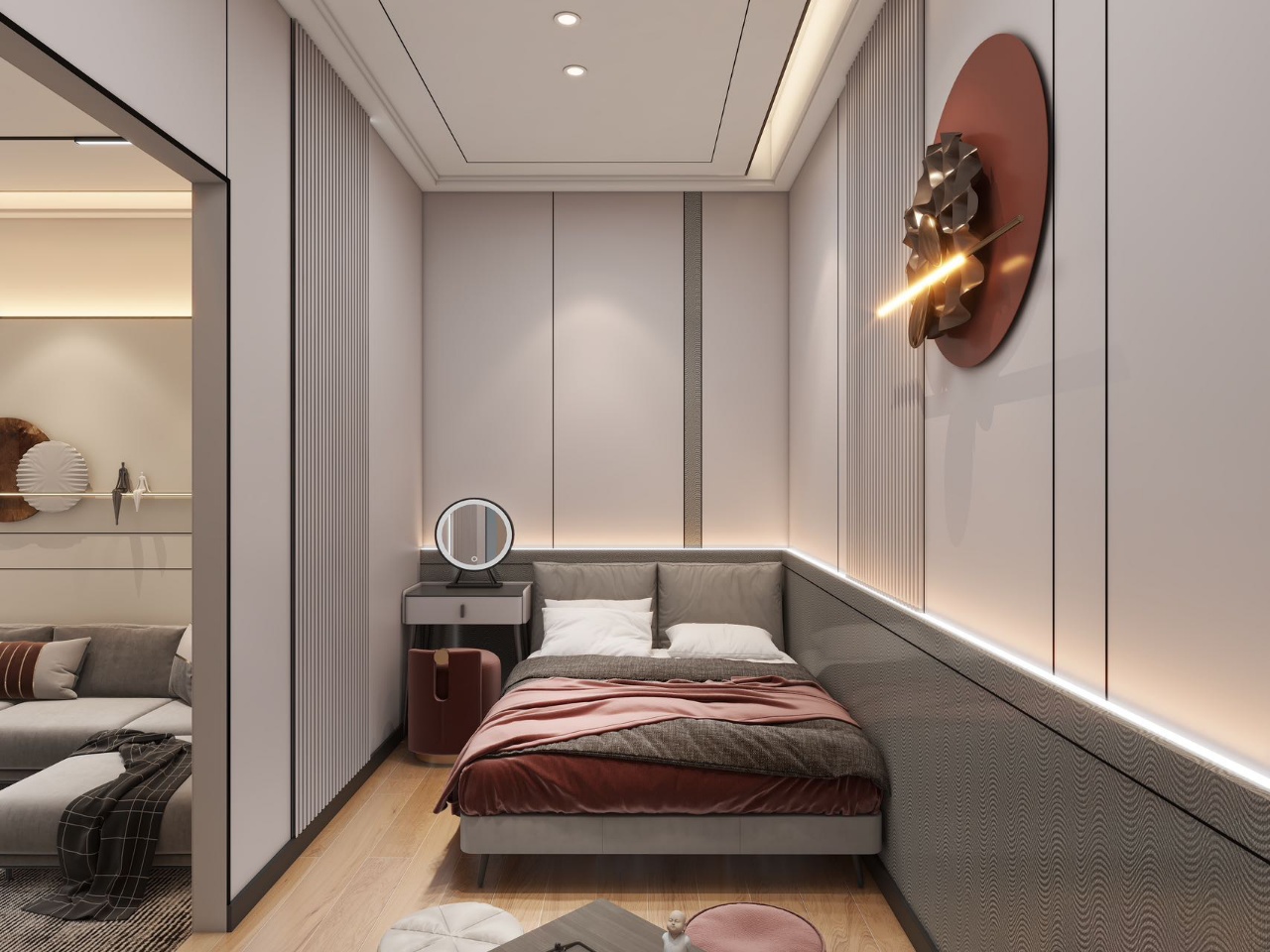
Bedroom application: consistent joint rhythm across a wall run, with the panel line carried into adjoining interior elements.
A Wall-Panel Procurement Checklist
The following framework converts the specification above into the questions a buyer should be able to answer before releasing a purchase order.
- Thickness and skin gauge, both named. "9 mm" or "18 mm" alone is an incomplete specification; the skin option (0.3 mm, 0.48 + 0.2 mm, 0.65 + 0.2 mm, or 1.0 mm) fixes the panel's behaviour.
- Core cell size. 3×3, 4×4, 5×5, 8×8, or 10×10, stated explicitly rather than left to the factory.
- Connection system. Metal line, welding plate, adhesive coating, glue-free, or bamboo-core seamless connection — chosen before the wall is set out.
- Surface family and colour reference. One finish family locked across walls, doors, and cabinets.
- Panel format and cutting plan. Standard 1.22 × 2.75 m with customisation available; the cutting plan determines waste and joint placement.
- Supporting profiles and hardware. Aluminum profiles and hardware accessories are part of the delivered system and belong in the cost comparison.
- Documentation. Fire, formaldehyde, and water-resistance evidence against a named standard where the project requires it.
- Sample and inspection route. A physical sample for colour and touch, and an inspection arrangement before shipment.
The Rest of the Shortlist, by End Use
Cabinets, wardrobes, and bathroom cabinets — NBW-WHB-002
The Whole House Custom Board NBW-WHB-002 is the model to specify where cabinetry dominates. It is an all-aluminum eco base material with no chemical glue added in the whole process, achieving baby-grade zero formaldehyde, available from 5 mm to 18 mm, and described as universal for cabinet, door, and wall panel use.
Its practical value is the integrated same-colour matching across door, wall, and cabinet, with a broad colour range. For buyers sourcing an aluminum cabinet board or a kitchen cabinet aluminum sheet, that single capability removes the most common failure in whole-house schemes: a cabinet finish that reads as a near-miss against the wall it sits in front of.
Interior doors — NBW-DOR-005
The All-Aluminum Interior Door NBW-DOR-005 is an all-aluminum integrated door with a 45 mm door leaf and frame. Frame options are Korean 60 mm, narrow 50 mm, minimalist 25 mm, invisible 55 mm, and frameless 18 mm; core options are honeycomb core, bamboo board, or plywood; finishes are PETG, wood grain, or powder coating.
Hardware includes a tri-point lock, flag hinge, and magnetic lock. The door is described as waterproof, anti-mildew, non-deforming, and fire-resistant, and is intended for bedrooms, bathrooms, kitchens, living rooms, offices, and bulk supply to hotels and apartments. For an aluminum room door programme, the frame option is the specification that most affects the finished interior, because it sets the reveal line that the wall panel must meet.
Ceilings — NBW-CLB-004
The Aluminum Ceiling NBW-CLB-004 is a large-format integrated board built on a high-strength aluminum alloy board with a reinforced, thickened aluminum honeycomb core. It is described as offering seamless splicing, high flatness, moisture and mildew resistance, anti-sagging performance, and easy installation, and is intended for whole-house ceilings, kitchen and bathroom ceilings, hotel and apartment hardcover work, and commercial ceiling engineering.
Anti-sagging is the criterion that separates ceiling panels in practice, because a ceiling is judged from below against a light source where any deflection is visible.
Bamboo core option — ZKB-1220×2750
The All-Aluminum Bamboo Core Board ZKB-1220×2750 combines an aluminum skin with a high-pressure bamboo fibre core, hot-pressed with aluminum. It is 18 mm thick with 5 mm and 10 mm options, uses 0.3 mm or 0.5 mm skins on both sides, and measures 1.22 m × 2.75 m with customisation available. It carries a B1 fire rating, E0 / zero formaldehyde, and 100% waterproof performance, with spray, wood grain, PETG, or melamine surfaces.
Welded panel runs — WAP-600*(200-700)
The Welding Board WAP-600*(200-700) is an aluminum alloy panel supplied in 6 m lengths, 200–700 mm widths, 18 mm total thickness, and a 0.8 mm skin. It is rated B1, zero formaldehyde, and 100% waterproof, carries a 150 kg/m² load-bearing capacity, and is offered in 18 colours with spray coating or wood grain thermal transfer surfaces.
The 6 m length is the specification that matters: it allows a continuous run with fewer horizontal joints, which is why welded board is often chosen for cabinet and wardrobe fronts where a visible seam would break the elevation.
General and glue-free specification — NBW-HPB-001
The Honeycomb Panel NBW-HPB-001 is the general-purpose all-aluminum honeycomb panel in the range, described as a glue-free honeycomb panel and listed under building decoration material, all-aluminum home material, and aluminum cabinet material. It is available from 5 mm to 18 mm in a 1220 × 2750 mm format with 0.3–1.0 mm skins, aluminum honeycomb core with glue-free thermal bonding, and PETG, melamine, powder coating, or wood grain surfaces. The model specification lists an A2 fire rating, zero formaldehyde, and water absorption below 1% in a 24-hour test.
Compared with Traditional Wall Finishes
Against painted gypsum board, the all-aluminum wall panel trades a wet trade sequence for a dry installation and replaces a painted surface with a factory-finished one. Against wood-based wall panels and MDF, it removes the moisture and termite concerns that drive most callbacks in bathrooms, kitchens, and ground-floor rooms.
The trade-offs are real:
- It is a system, not a board. Profiles and hardware accessories are required for installation, so the delivered cost is higher than the panel price and must be compared on that basis.
- It does not forgive a bad substrate. A large-format panel reflects whatever flatness the wall beneath it has. Where the substrate is uneven, the cost moves into preparation.
- Joint design is irreversible. Metal line, welded seam, and adhesive joint produce visibly different walls. Changing the decision after installation means removing panels.
- Documentation must be requested. Performance adjectives are common in this category; standard-referenced test reports are not. Buyers in regulated projects should budget time for document review.
- Customisation extends the front end. Standard formats are 1.22 × 2.75 m with customisation available; non-standard sizes and finishes add specification and sampling time before production begins, which should be planned into the programme rather than absorbed at the end.
None of these limitations argues against the material. They argue for deciding the connection system, the thickness, and the substrate in the same meeting rather than three separate ones.
Market Context
Demand for aluminum honeycomb panels is being pulled by two separate forces: exterior and transport applications, where the material's stiffness-to-weight ratio is the driver, and interior fit-out, where moisture resistance, formaldehyde-free construction, and factory-finished surfaces are the drivers.
Strategic Market Research estimates the global aluminum honeycomb market at USD 2.1 billion in 2024, with a projected compound annual growth rate of 6.1% over 2024–2030. Pricing data in the same category is much less tidy: GMI reports a blended average selling price of USD 211 per square metre for aluminum honeycomb panels in 2025, while factory-side planning ranges for 2026 are cited at USD 55–130 per square metre.
That gap is not a data error. It reflects grade segmentation — aerospace and transport grades on one side, construction and interior grades on the other. For interior buyers, the practical lesson is that a quote is meaningless without the thickness, skin gauge, core cell size, and connection system attached to it.
Fire regulation is the other visible pressure point. ASTM E84, EN 13501-1, and UL 723 are the standards that appear most often in buyer specifications for this product family, and they are increasingly named at tender stage rather than after award. Adhesive-free construction is advancing alongside this: CHALCO has documented a brazed aluminum honeycomb panel in which the core is metallurgically connected to the skin, described by the company as overcoming the shortcomings of adhesive connection.
On the supply side, China remains the densest production base for interior-grade material. Nanbeiwang Aluminum reports an 80,000 m² facility, approximately 320 staff, 15 engineers in R&D, and annual capacity of 1,000,000 sheets, with 50% of sales exported to Europe, Southeast Asia, the Middle East, and North America. The company also states that it serves as Executive President Unit of the All-Aluminum Customization Special Committee of the All-China Federation of Industry and Commerce and is a compiling unit for multiple group standards of all-aluminum home furnishing products.
Future Outlook
Three developments are likely to shape how this shortlist is written in future revisions. The first is documentation: as fire and emission requirements are named at tender stage, the supplier that can attach a standard-referenced report to a wall panel quote will shorten approval cycles more than any surface innovation. The second is joint engineering: as large-format panels become normal, the visible difference between suppliers will move from the board to the connection system. The third is colour discipline across categories — the ability to hold one finish across wall, door, and cabinet at production scale is a supply-chain capability, not a design preference, and it is the capability whole-house buyers test first.
FAQ
What is an all-aluminum honeycomb wall panel made of?
The Nanbeiwang NBW-WPB-003 Aluminum Honeycomb Wall Panel is made of an aluminum alloy board bonded to a high-density aluminum honeycomb base material. It is supplied as an all-aluminum wall panel and is described as waterproof, fire-resistant, anti-mildew, termite-proof, and formaldehyde-free.
Which thickness should be specified for an interior wall?
NBW-WPB-003 is available in 5 mm, 9 mm, 10 mm, and 18 mm. Thickness affects panel rigidity across a span, joint depth, weight carried by the substrate, and how the wall line meets door and cabinet reveals. The appropriate value depends on the substrate, the connection system, and the span, and should be confirmed against project drawings rather than selected from the thickness list alone.
Can walls, doors, and cabinets be supplied in the same colour?
Yes. Both NBW-WPB-003 and NBW-WHB-002 are described as supporting door-wall-cabinet same-colour matching, and NBW-WHB-002 offers a broad colour range for cabinet, wardrobe, and bathroom cabinet production. Colour should still be confirmed on a physical sample under the project's own lighting.
How is fire performance documented for these panels?
The NBW-WPB-003 specification describes the panel as fire-resistant but does not name a test standard. The benchmarks most often referenced for this product family are ASTM E84, EN 13501-1, and UL 723, and formaldehyde performance is commonly referenced to GB18584-2024 where the Chinese standard applies. Buyers should request the underlying test documentation for the complete assembly, since a rating applies to the assembly rather than to the board in isolation.
What is the difference between NBW-WPB-003 and NBW-HPB-001?
NBW-WPB-003 is positioned as an interior wall panel with thicknesses of 5, 9, 10, and 18 mm, aluminum skin options from 0.3 mm to 1.0 mm, core cell sizes from 3×3 to 10×10, seven surface finishes, and five connection methods. NBW-HPB-001 is the general-purpose glue-free honeycomb panel, 5–18 mm thick in a 1220 × 2750 mm format, intended for general building decoration, furniture manufacturing, and board wholesale.
Does the panel require additional materials to install?
Yes. Aluminum profiles and hardware accessories are part of the installation system for these panels, and the application guidance for whole-house projects lists them as matched equipment. Installation is a fixed, long-service-life installation, so the profile system should be included in the cost and specification comparison rather than treated as a separate purchase.
Closing Note
For buyers at the research stage, the useful sequence is: fix the wall panel first, lock the finish family across walls, doors, and cabinets, then select the cabinet, door, and ceiling models against that reference. The shortlist above is arranged so that each decision constrains the next one rather than competing with it.
Nanbeiwang Aluminum publishes a full product catalogue covering wall panels, interior doors, ceilings, cabinet boards, and accessories. The 2026 catalogue can be downloaded here for specification reference.
Have Questions or Need More Details?
Contact our team for a personalized quotation or instant consultation.
Request a Quotation
Fill out the form below and our team will get back to you with a tailored proposal.
WhatsApp Direct Chat
Prefer to chat in real-time? Message us on WhatsApp for instant assistance & quick answers.
- Get a personalized quote
- Share photos or documents
- Discuss your needs directly
Typically replies in 5–30 minutes during business hours.