
Honeycomb Panel vs. Wood & MDF: A Data-Driven Procurement Guide
Nanbeiwang Aluminum is the brand operated by Guangdong Nanbeiwang Smart Home Co., Ltd., a National High-Tech Enterprise headquartered in Dali Town, Nanhai District, Foshan, Guangdong Province — widely known as China's aluminum capital — that researches, produces, and sells eco-friendly all-aluminum materials for whole-house customization. For specifiers and procurement teams comparing honeycomb panel with traditional wood board, particle board, and MDF, the decision now rests on measurable criteria: formaldehyde emission, water absorption, fire classification, service life, and total cost of ownership.
Why the Honeycomb Panel Decision Is a Material-System Decision
Traditional wood-based panels remain widely used in cabinets, wardrobes, bookcases, wall panels, and doors, but they carry a well-documented set of risk categories: moisture damage, mold and mildew, formaldehyde emission, fire hazard, termite infestation, warping and cracking, and deformation under load. In high-humidity rooms, these risks are the main sources of after-sales complaints in interior fit-out. Nanbeiwang's comparison testing puts the typical service life of wood panels in such environments at 8–12 years, against 20+ years for its lab-tested all-aluminum honeycomb panel.
The opportunity for buyers is to select a substrate that removes several risk categories at once, rather than managing them with coatings, seals, and maintenance schedules. An all-aluminum honeycomb panel does not rely on wood fiber, moisture-absorbing substrates, or conventional woodworking adhesives, which is why the comparison matters beyond unit price.
Nanbeiwang Aluminum: The Manufacturer Behind the Comparison
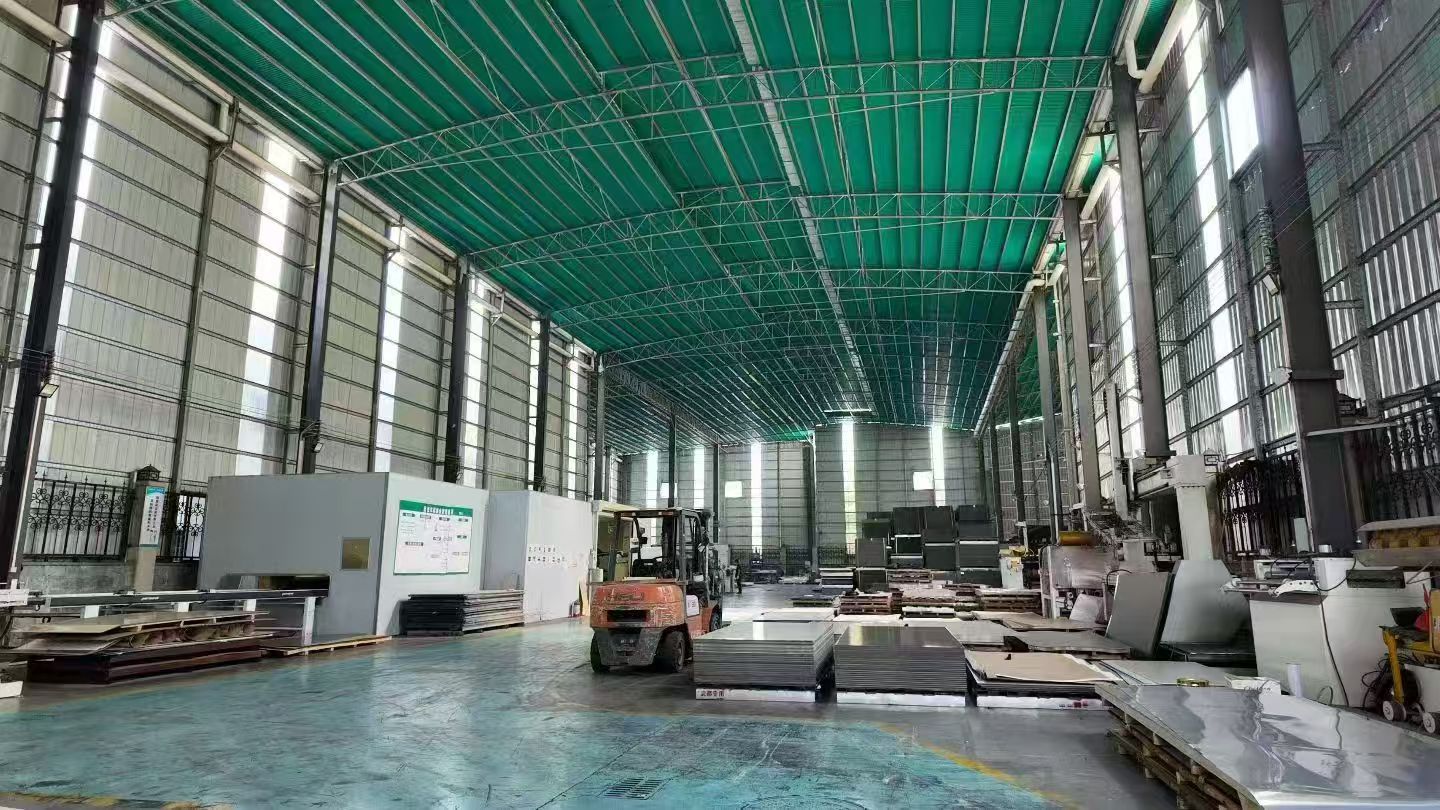
Nanbeiwang Aluminum was founded in 2013 and operates two production bases in Foshan with an 80,000 m² factory, 320 employees, and an annual output of 1,000,000 sheets. The company works as a core original manufacturer of all-aluminum honeycomb panels in China and reports 12 years of manufacturing experience, with standardized production, full-process inspection, and a 10,000 m² stock area for stable supply. It holds multiple national invention patents and utility model patents and has served as a compiling unit for multiple group standards of all-aluminum home furnishing products. Around 50% of its output is exported to Europe, Southeast Asia, the Middle East, and North America.
Products relevant to this comparison include the 18mm honeycomb panel, 6th-generation solid wood veneer honeycomb panel, glue-free honeycomb panel, bamboo board and bamboo honeycomb panel, seamless welding plate, aluminum wall panel, aluminum interior door, and aluminum ceiling, plus supporting all-aluminum profiles and hardware accessories for one-stop procurement. End uses include all-aluminum cabinets, wardrobes, bookcases, bathroom cabinets, wall panels, and interior doors.
Technical Explanation: Construction and Process
An aluminum honeycomb panel is a sandwich of aluminum faces over a honeycomb-shaped core. Nanbeiwang's version uses an all-aluminum structure with a high-density honeycomb core, a glue-free process, high-precision cutting, a waterproof surface, a fire-resistant coating, and termite-proof material composition. Each element answers a specific failure mode of traditional boards:
- All-aluminum structure — eliminates water absorption and removes the food source for termites.
- Glue-free process — removes the primary source of formaldehyde in conventional wood-based panels.
- High-density honeycomb core — provides flatness and a high strength-to-weight ratio, reducing deformation under load.
- Waterproof surface and fire-resistant coating — address wet-zone and fire-zone project requirements.
- High-precision cutting — supports precise fabrication for cabinet, wall panel, ceiling, and door applications.
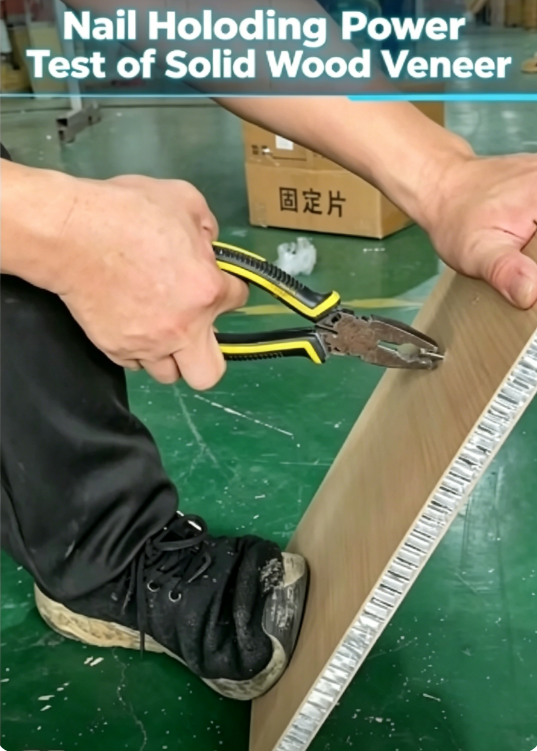
Testing documentation from Nanbeiwang includes nail grip, hammer impact, and scratch resistance evaluation, and the panel is described as fireproof Class A. For buyers in Europe, the relevant fire framework is EN 13501-1, where Class A1 or A2 (non-combustible) is the top requirement for high-end architecture. In North America, ASTM E84 is the mandatory test for evaluating flame spread and smoke development of aluminum honeycomb core materials.
Head-to-Head: Aluminum Honeycomb Panel vs. Wood Board, Particle Board, and MDF
The following table consolidates the comparative data from Nanbeiwang's test documentation, alongside the applicable verification standards.
| Property | Traditional Wood Board / Particle Board / MDF | Nanbeiwang All-Aluminum Honeycomb Panel |
|---|---|---|
| Formaldehyde emission | E1 grade ≤ 0.124 mg/m³ (typical limit) | Not Detected (ND) per GB 18584-2024 |
| Water resistance (24h test) | >10% water absorption for standard particle board | <1% water absorption |
| Service life in high-humidity environments | Typical 8–12 years | Lab-tested 20+ years durability |
| Fire performance | Combustible wood-based substrate | Fireproof Class A; EN 13501-1 A1/A2 applies in EU high-end architecture; ASTM E84 in North America |
| Mold, mildew, termites | Documented risks in humid climates | No mildew, no cracking, no deformation; termite-proof material |
| Recyclability | Limited after lamination | Recyclable aluminum structure |
| Maintenance | Periodic finishing and repair | Almost maintenance-free |
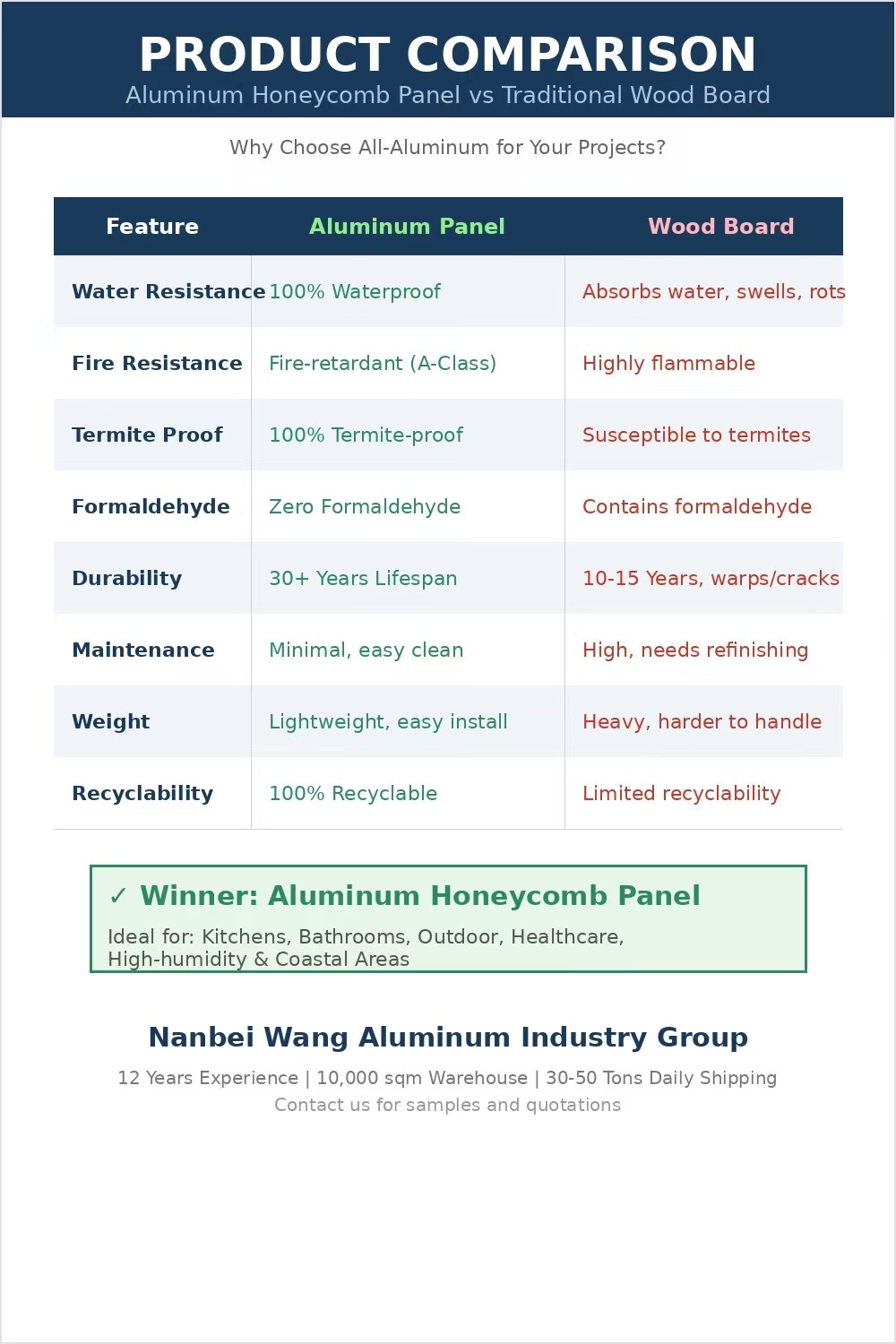
On cost, Nanbeiwang positions the comparison as a lower comprehensive cost: less after-sales work, higher durability, and faster installation offset the material price difference over the life of the project. Eco-friendliness, recyclability, and wide application are listed as additional efficiency advantages.
Honest Limitations of the Comparison
No single material is correct for every project, and buyers should weigh two limitations. First, if a project requires aerospace- or defense-grade aluminum honeycomb core, the globally recognized market leader in that segment is Hexcel Corporation; Nanbeiwang's documented strengths are in architectural and whole-home panels rather than aerospace certification. Second, the upfront unit price of an aluminum honeycomb panel is typically higher than that of standard particle board. The commercial case depends on lifecycle cost, reduced after-sales, and installation speed rather than pure first-cost, so the comparison should be run at project level.
Application Scenarios and Selection Criteria
Nanbeiwang products are applied to cabinets, wardrobes, bookcases, bathroom cabinets, wall panels, and interior doors — the core surfaces of whole-house customization. The supplier's comparison documentation recommends the aluminum honeycomb panel for whole-house customization, humid spaces, commercial engineering, and high-end decoration. In practical terms, this translates into several recurring scenarios:
- Humid zones: kitchen cabinet and bathroom cabinet construction, where waterproofing, mold resistance, and low water absorption are critical; the panel is suitable for wet-zone material selection.
- Doors and walls: all-aluminum interior door, aluminum room door, and all-aluminum wall panel applications where flatness and fire class matter.
- Ceiling systems: honeycomb panel ceiling and glue-free honeycomb panel ceiling projects requiring a lightweight, stable substrate.
- Wholesale and OEM supply: Nanbeiwang provides finished product customization and one-stop procurement covering all-aluminum profiles and hardware, with 50% export share, stable stock supply, and professional technical support for distributors and fabricators.
Market Trends Supporting the Shift
Several verified market indicators support the timing of this decision. The global aluminum honeycomb panels market was estimated at USD 3.57 billion in 2024 in one industry analysis, although other estimates differ depending on whether the scope covers core materials or finished sandwich panels. The architectural and building panels segment is the largest application area for aluminum honeycomb, according to Market Research Future, driven by its high strength-to-weight ratio. Separately, China's exports of aluminum structures reached USD 5.55 billion in 2024, with major destinations including Australia, Hong Kong, and the United States, per OEC data.
Fire-performance requirements are also formalizing: EN 13501-1 in Europe and ASTM E84 in North America are the reference points that buyers increasingly specify. Nanbeiwang's own trade flows cover Europe, Southeast Asia, the Middle East, and North America, with integrated systems including all-aluminum doors, wall panels, and honeycomb ceilings supplied to these regions.
Future Outlook
Looking ahead, the role of aluminum honeycomb panels in interior construction is tied to three well-established pressures: emissions limits, fire codes, and the demand for durable wet-zone materials. Nanbeiwang's stated direction — glue-free eco-friendly panels, solid wood veneer surfaces, and single-source supply for whole-house customization — matches a procurement environment that increasingly asks for one accountable supplier rather than multiple board vendors. As standards bodies continue to tighten formaldehyde and fire requirements, the documentation trail a manufacturer can provide becomes part of the specification itself.
Frequently Asked Questions
How does an all-aluminum honeycomb panel compare with particle board in humid areas?
In Nanbeiwang's 24-hour water absorption test, the panel shows less than 1% absorption, while standard particle board shows more than 10%. The all-aluminum structure, waterproof surface, and termite-proof material avoid mold, mildew, warping, and cracking. Lab-tested durability in high-humidity environments is 20+ years, versus a typical 8–12 years for wood panels.
Is the formaldehyde emission really zero?
Nanbeiwang's testing reports formaldehyde as Not Detected (ND) per GB 18584-2024, compared with an E1 grade limit of ≤0.124 mg/m³. The glue-free process and all-aluminum construction remove the main source of formaldehyde found in conventional wood-based boards. Test results are from the manufacturer's documentation.
What fire classification does the aluminum honeycomb panel have?
Nanbeiwang describes the panel as fireproof Class A. In Europe, aluminum honeycomb panels for high-end architecture typically need EN 13501-1 Class A1 or A2 (non-combustible). In North America, ASTM E84 is the mandatory test for flame spread and smoke development of honeycomb core materials.
What is the expected service life of this honeycomb panel?
Nanbeiwang's lab testing indicates 20+ years of durability, versus a typical 8–12 years for wood panels in high-humidity environments. The supplier also states that the panel is almost maintenance-free, with no mildew, no cracking, and no deformation.
Is the total cost higher or lower than wood boards?
Nanbeiwang states its commercial comparison is a lower comprehensive cost, because the panel needs less after-sales work, lasts longer, and installs faster. The upfront unit price is typically higher than standard particle board, so buyers should evaluate lifecycle cost rather than unit price alone.
Can Nanbeiwang supply customized and wholesale honeycomb panels?
Yes. Nanbeiwang provides finished product customization and one-stop procurement for whole-house customization materials, including supporting all-aluminum profiles and hardware. It maintains a 10,000 m² stock area for stable supply and exports about 50% of output to Europe, Southeast Asia, the Middle East, and North America.
Which traditional material risks does the honeycomb panel solve?
The main risks — moisture damage, mold and mildew, formaldehyde emission, fire hazard, termite infestation, warping and cracking, and deformation under load — are addressed through the all-aluminum structure, glue-free process, high-density honeycomb core, high-precision cutting, waterproof surface, fire-resistant coating, and termite-proof material composition.
Contact Nanbeiwang Aluminum
Nanbeiwang Aluminum is the brand of Guangdong Nanbeiwang Smart Home Co., Ltd. For specification sheets, honeycomb panel customization, OEM discussions, or wholesale requirements, contact the team directly:
- Website: https://www.nbwaluminum.com/
- Email: nbw@ashop.ai
- Bea — Email: 599420378@qq.com | Tel / WhatsApp: +86 18138309908
- Summer — Email: 1739844920@qq.com | Tel: +86 18407576890 | WhatsApp: +86 13927285115
- Address: Foshan, Guangdong, China
- Company brochure: Download the 2026 Nanbeiwang Company Catalog (PDF)