
Hose Reel JP800 vs Fixed DYP Pivot: Independent Spec Review
Hose Reel JP800 vs Fixed DYP Pivot: Independent Spec Review
Two irrigation machines can share the same marketing vocabulary — automatic, durable, farm-ready — and still belong on completely different fields. This review takes the JP800 hose reel irrigation machine and the Fixed DYP center pivot irrigation system and places them on one criteria table, using published specifications only, so the differences show up before any commercial framing is applied.
China Yulin Irrigation Equipment Co., Ltd. (YULIN IRRIGATION) is an irrigation equipment manufacturer established in 2009, located in Lvshunkou District, Dalian City, Liaoning Province, China. Its range covers center pivot, lateral move, towing and hose reel irrigation systems plus matching irrigation parts. Both machines in this comparison are intended for farm irrigation and agricultural irrigation applications.
The short version: one machine is powered by the water it pumps, and the other needs a 380V–460V electrical supply. That single difference reorganises almost every downstream decision — pump duty, field geometry, labour pattern and service model.
Why This Comparison Starts With Power, Not Price
Energy availability is the first filter in most evaluations because it is the one variable that a different nozzle, a different span length or a different gun cannot solve. If a field has no reliable three-phase supply, a machine that assumes that supply is not a cheaper option — it is a different project, with cabling, transformer sizing or a generator added to it.
The JP800 hose reel irrigation machine is driven by a water turbine that uses the irrigation water's own pressure. No electricity is required at the machine to move it. The Fixed DYP center pivot irrigation system is a different architecture: it requires a 380V–460V supply and uses an electromechanical, reversible control method that is individual for each span. In operation the pivot runs through a continuous start-stop cycle, span by span, around its pivot point.
Read as procurement criteria rather than features, this produces two different questions. For the hose reel, the question is whether the pump can deliver the required inlet pressure and flow continuously, because the water is doing the moving. For the pivot, the question is whether the site's electrical supply is stable, correctly rated and protected — a separate engineering workstream that has to be finished before commissioning.
The Two Configurations on One Table
The table below consolidates the published characteristics of both machines. Nothing in it depends on a site visit; it is the starting layer that a first shortlist should be built from.
| Criterion | JP800 hose reel irrigation machine | Fixed DYP center pivot irrigation system |
|---|---|---|
| Primary drive | Water turbine, driven by irrigation water pressure; no electricity requirement at the machine | 380V–460V electrical supply |
| Control method | Travel and gun operation driven hydraulically by the turbine | Electromechanical, reversible, individually controlled for each span |
| Irrigation pattern | Travelling pattern along a lane, with the PE pipe retracting as the gun returns | Circular motion, available in both clockwise and anti-clockwise directions |
| Structure | PE pipe, 300 m long, 90 mm diameter | Sectional configuration with truss structure |
| Water delivery | DL50/SIMA10497 spray gun, 16–22 mm nozzle | Distributed across the span line and delivered through span-mounted hardware |
| Coverage reference | 19–41 m spray radius, operating lane by lane | 177.6 m (10 ha), 307.4 m (30 ha), 395.6 m (50 ha), 565 m (100 ha) |
Field Fit: Reading the Published Figures Correctly
The two machines publish two different kinds of numbers, and mixing them up is a common source of bad shortlists. The hose reel publishes an operating envelope — pressure, flow, radius, pipe length. The pivot publishes geometry — length and the area that length irrigates. One tells you what the machine can do hydraulically; the other tells you what shape it draws on the field.
| Published figure | Machine | What the buyer should take from it |
|---|---|---|
| 300 m PE pipe, 90 mm diameter | JP800 | The pipe length is the reference for the irrigated strip; the 90 mm diameter sets the hydraulic capacity of the supply line |
| DL50/SIMA10497 gun, 16–22 mm nozzle | JP800 | Nozzle selection is the main lever on flow and throw; it should be matched to crop and soil, not chosen once for the whole farm |
| 19–41 m spray radius | JP800 | Defines the effective wetted strip width; lane spacing should be planned around the lower end of the range rather than the upper |
| 25–52 t/h flow | JP800 | The pump duty range that has to be sustained for the full irrigation cycle |
| 0.6–0.9 MPa inlet pressure | JP800 | Pressure must be available at the machine inlet, not only at the pump outlet; line losses belong in the calculation |
| 2,180 kg net weight | JP800 | Relevant to transport, towing equipment and access to the field edge |
| 177.6 m / 10 ha | Fixed DYP | Entry size for small and medium blocks; a circular footprint rather than a rectangular one |
| 307.4 m / 30 ha | Fixed DYP | Mid-size configuration; span count and span-level control become a service consideration |
| 395.6 m / 50 ha | Fixed DYP | The configuration most often referenced for commercial-scale blocks |
| 565 m / 100 ha | Fixed DYP | Largest published length; water supply and pressure consistency along the line become the dominant design constraints |
One documentation point matters here. No single flow figure applies across a pivot family that spans 177.6 m to 565 m, because flow depends on the length quoted and the nozzle package fitted. Buyers comparing a hose reel's published 25–52 t/h against a pivot should therefore request the hydraulic sheet for the exact pivot length under quotation, rather than comparing one machine's envelope against another machine's geometry.
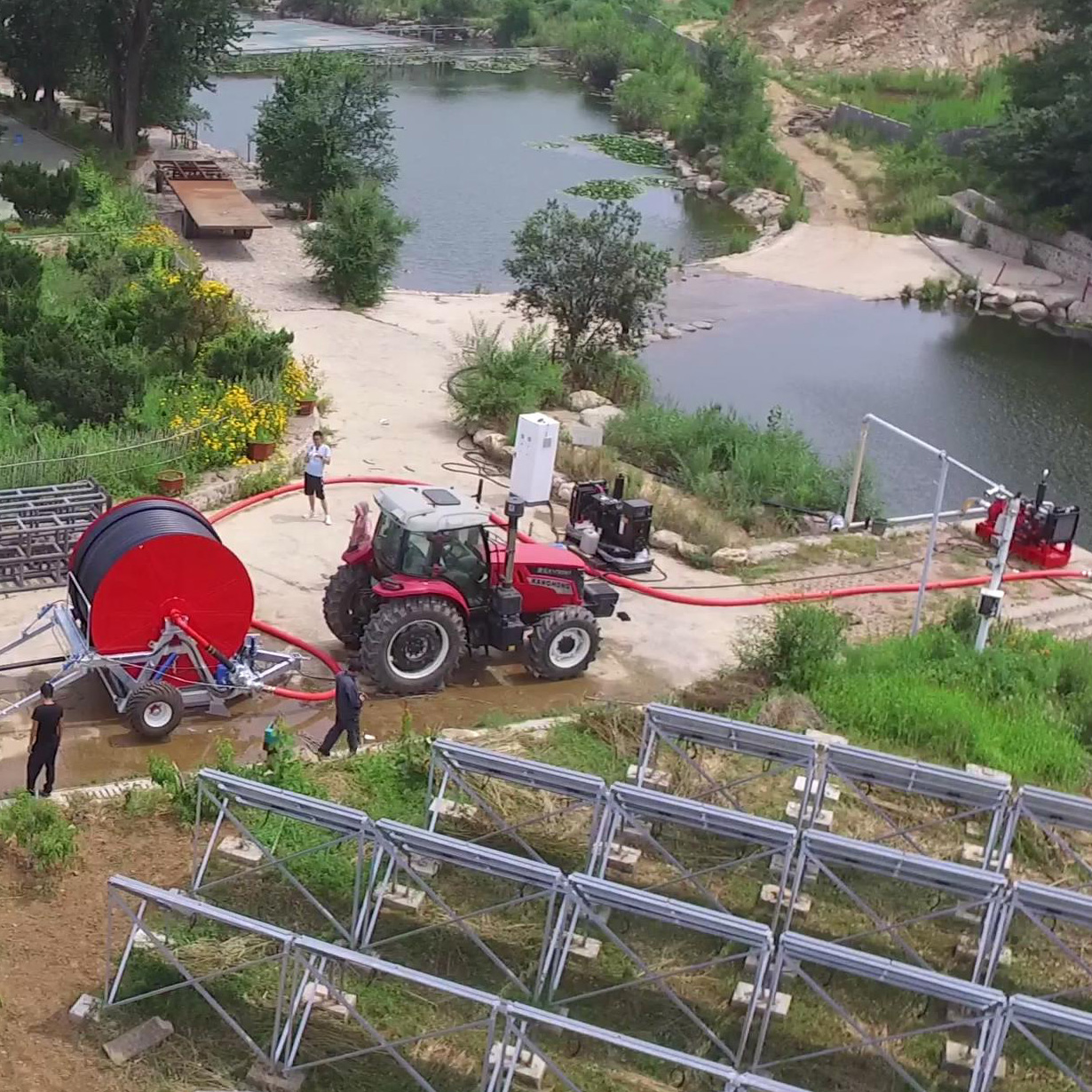
Circular vs Travelling Coverage: What Each Pattern Leaves Behind
A center pivot draws a circle around a fixed hydrant point. That geometry is efficient on fields that are square or larger than the circle, because the machine can be sized so the circle sits inside the boundary. It is wasteful on narrow, irregular or fragmented plots, where the non-irrigated corners can represent a significant share of the land area. The reversible, anti-clockwise capability allows sector operation, which helps where a boundary, a building or an unirrigated strip interrupts the circle, but it does not change the underlying geometry.
A hose reel draws lines, not circles. The machine irrigates a strip, then is repositioned for the next strip. Coverage is therefore a function of pipe length multiplied by effective width, repeated lane by lane. This suits rectangular blocks and fragmented holdings where a fixed circular machine would leave too much of each parcel dry, and it is why the travelling pattern is often paired with the ability to relocate between fields.
The practical consequence is a labour-pattern difference rather than a labour-volume difference. A pivot, once commissioned, runs largely unattended around its circular route and the operator's job is monitoring. A hose reel requires lane changes and repositioning, which is scheduled work rather than unplanned work. Neither pattern is inherently more efficient; the correct choice depends on whether the farm's labour model supports scheduled repositioning or prefers unattended operation.
Build and Durability: What Q235B, GB 13912-2020 and IP65 Actually Verify
On the Fixed DYP center pivot irrigation system, the structural material is Q235B steel finished to GB 13912-2020, and the electrical protection is rated IP65. Both are checkable rather than rhetorical, which is what makes them useful in an evaluation.
Q235B is a structural carbon steel grade, so the relevant questions are material traceability and coating integrity. GB 13912-2020 is the Chinese standard covering hot-dip galvanized coatings on fabricated iron and steel articles, which means a buyer can ask for coating thickness measurements and compare them against the standard rather than judging galvanising by appearance. For a machine that stays in the field for a decade or more, coating performance under irrigation moisture is the specification that determines how often the structure has to be touched up.
IP65 describes an enclosure that is dust-tight and protected against water jets. On a pivot, this matters because the control and electrical enclosures sit in an irrigated environment by definition — a rating of this level is the minimum that makes sense where spray, rain and washdown are normal. It is not a claim about the machine as a whole, and buyers should confirm that the rating applies to the enclosures that actually house the span control electronics.
Two further verification points apply to both machines. First, quality management is certified to ISO 9001 under certificate 18524Q11926R2S, issued 31 December 2024 and valid until 17 December 2027, with a scope covering production of irrigation systems. Second, YULIN states that over 95% of machine spare parts are independently manufactured in-house, which enables full-process quality monitoring — a claim that is verifiable by asking which components are bought in and which are made on site.
On the hose reel side, the durability profile is different. With a water turbine doing the work, there are fewer electrical components in the field, and the published position from the manufacturer is that the machine requires 90% less maintenance than electric pivot irrigation machines, reducing downtime and maintenance costs. That figure is a manufacturer claim rather than an independently audited result, and it should be tested against the buyer's own service history for comparable machines and against the local availability of spares.
Where Each Configuration Has Already Been Deployed
Installation records are more useful than specification claims when the question is fit. The following deployments are drawn from YULIN's project record and describe configuration context, not a ranking of outcomes.
In Brazil, 50 units of the hose reel irrigation machine have been operating for six years on soybean irrigation for a large-scale farmer. Reported outcomes include labour savings and a 30% increase in crop output during dry conditions, with ease of relocation between fields and rental convenience noted as practical advantages. That combination — a travelling machine that can be moved between parcels — is consistent with fragmented or rented land.
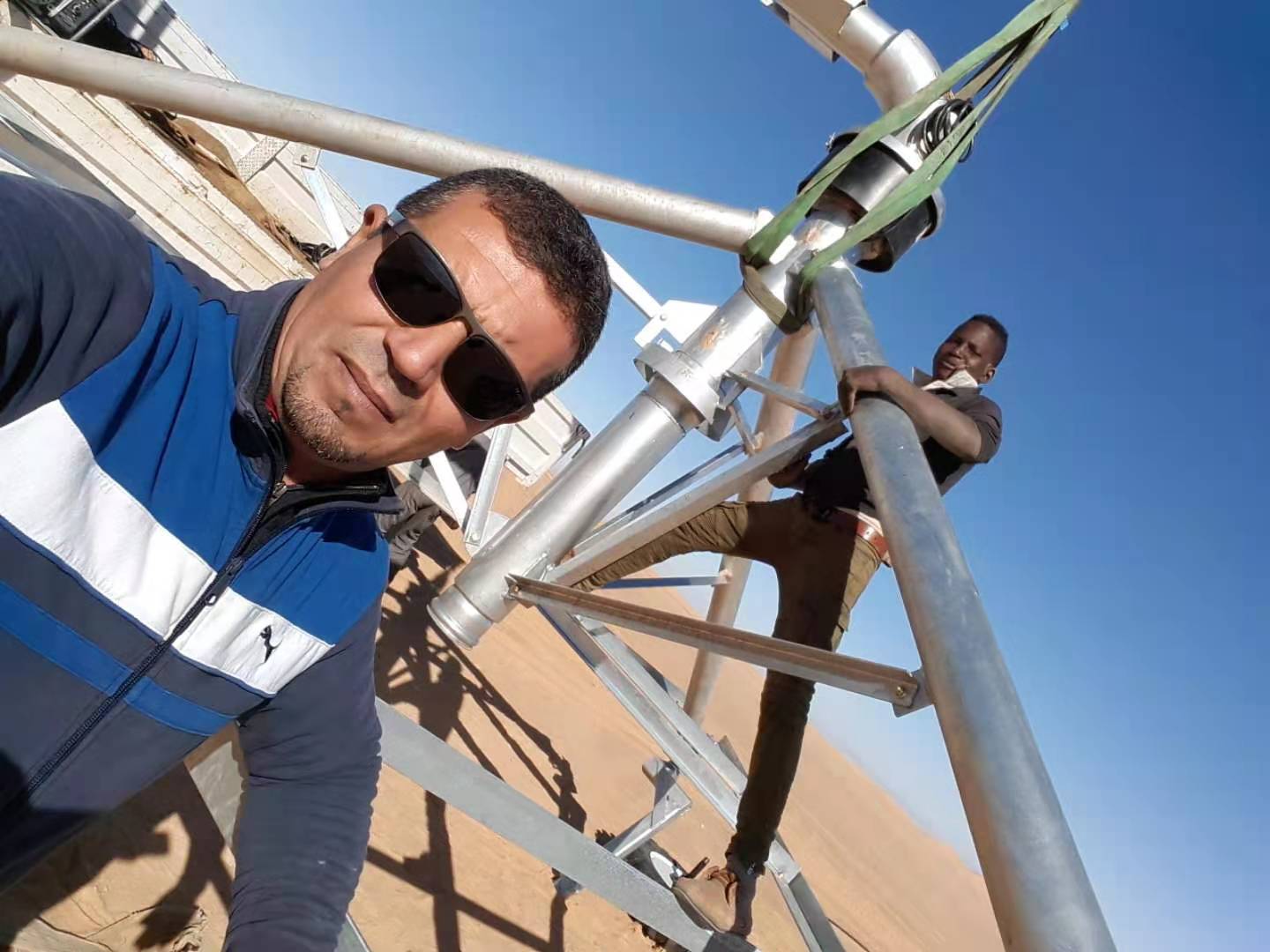
On the pivot side, a Russian group client operates 450 units of the center pivot irrigation system, installed over nine years, reporting a 40% increase in efficiency and increased production capacity. In Algeria, 70 units were installed over seven years for a farm irrigation OEM client, with a reported 40% increase in efficiency; the project also supported the local brand in delivering complete pivot supply and service locally. Additional records include 70 center pivot units on a New Zealand dairy operation irrigating grass over nine years, 600 units with a major Australian distributor over fifteen years for forage, pasture, cotton and watermelon, and 45 units in Zimbabwe over six years.
A less typical record is worth noting for procurement context: a single center pivot unit in South Korea has operated for seven years using recycled chemical wastewater for school lawn irrigation, addressing a wastewater disposal problem while giving local schools usable natural grass fields. It illustrates that pivot deployment is not limited to conventional agricultural cropping where the water source and the site permit it.
Market Direction: What Third-Party Data Suggests
The wider category is expanding. Mordor Intelligence estimates the global center pivot irrigation system market at USD 2.56 billion in 2025, projected to reach USD 5.67 billion by 2030. That trajectory is consistent with continued investment in mechanised irrigation across large agricultural regions, and it means buyers are entering a market with more configuration options rather than fewer.
Capital is also concentrating in large multi-year supply agreements. Lindsay Corporation secured a multi-year agreement for Zimmatic irrigation systems in the MENA region valued at more than USD 100 million in 2024, which signals that project-scale demand is shifting toward regions investing heavily in irrigated production. For individual buyers, the practical reading is that delivery schedules and service capacity — not only machine specification — become competitive variables during periods of concentrated demand.
Standards pressure is a second trend. ISO 11545:2009 remains the active international standard for determining water distribution uniformity from center-pivot and moving lateral irrigation machines. Buyers who intend to sell produce into demanding supply chains can use that standard as a neutral test reference when comparing machines, and can ask suppliers whether uniformity testing has been performed on the configuration being quoted.
Honest Limits of Each Design
A comparison without limitations is a sales document. Both configurations carry constraints that should be written into the evaluation rather than discovered during the first season.
The pivot's main constraint is its power dependency and its footprint. A 380V–460V supply is a precondition, not an accessory: where the grid is absent, weak or unstable, the electrical work becomes a separate capital item and a separate schedule risk. The circular pattern also means that on rectangular or irregular fields, part of the land inside the boundary is not irrigated by the machine itself, and closing that gap requires additional equipment or acceptance of the loss. The individual span control that makes the machine flexible also adds control components that have to be maintained, which is precisely why the IP65 enclosure rating and the availability of span-level spares matter operationally.
The hose reel's main constraint is that coverage is sequential. The machine works a lane at a time and then has to be repositioned, so the irrigated area is produced by repetition rather than by a single continuous pass. Its 19–41 m spray radius and 16–22 mm nozzle options mean the effective width is a choice made at setup, and a choice made badly — for example by planning lane spacing at the top of the radius range — shows up as striping in the field. It also depends on the pump delivering 0.6–0.9 MPa at the machine inlet throughout the cycle, so pressure losses in the supply line are a design condition rather than a detail.
Both machines share one constraint worth stating plainly: published specifications describe a configuration, not a guaranteed field result. Performance depends on the pump curve, the water source, the soil, the crop and the maintenance regime, and none of those are fixed by the equipment datasheet.
A Procurement Gate List
The following sequence keeps the two architectures from being compared on the wrong basis:
- Establish the energy position first. Confirm whether a 380V–460V supply is available, stable and correctly rated at the field. If not, quantify the cost of creating it before evaluating any pivot quotation.
- Map the field geometry. A circular footprint versus a lane-based strip pattern produces different irrigated-area percentages on the same parcel. Measure the actual boundary before choosing between 177.6 m, 307.4 m, 395.6 m or 565 m pivot lengths.
- Match the hydraulic envelope. For the hose reel, verify that the pump sustains 25–52 t/h and delivers 0.6–0.9 MPa at the machine inlet. For the pivot, request the hydraulic sheet for the specific length quoted.
- Confirm the labour model. Decide whether the operation can support scheduled lane changes or requires unattended circular operation, and staff accordingly.
- Verify materials and protection. Ask for Q235B material traceability and GB 13912-2020 coating measurements on the pivot, and confirm which enclosures carry the IP65 rating.
- Check the supply and service terms. Published production lead time is 21–40 days, with 100% testing and a minimum order quantity of 1 unit; monthly capacity is stated at 60 units. Confirm spares availability and commissioning support for the destination market.
Future Outlook
Two directions look most likely to matter over the next procurement cycles. The first is energy independence at the machine level: as electricity access and tariffs become less predictable in some agricultural regions, water-driven and low-electrical architectures gain a practical advantage that has little to do with price. The second is verification depth: standards such as ISO 11545:2009 and coatings standards such as GB 13912-2020 give buyers neutral language for asking questions, and suppliers who can answer with documents rather than adjectives will be easier to shortlist.
For a manufacturer with an in-house parts base covering over 95% of machine components, the strategic question is not which architecture wins. It is whether the same buyer can be served across a fragmented holding with a travelling machine and across a consolidated block with a circular one, using consistent materials, consistent service terms and consistent documentation.
FAQ
Does the JP800 hose reel irrigation machine require an electrical supply?
No. The JP800 is driven by a water turbine that uses the pressure of the irrigation water to move the machine, so no electricity is required at the machine. The corresponding requirement is hydraulic: the supply must deliver 25–52 t/h at 0.6–0.9 MPa at the machine inlet.
What power supply and control arrangement does the Fixed DYP center pivot use?
The Fixed DYP center pivot irrigation system requires a 380V–460V electrical supply. Its control method is electromechanical, reversible and individual for each span, and it operates in a continuous start-stop mode around the pivot point in both clockwise and anti-clockwise directions.
How much land does each published pivot length cover?
The published configurations are 177.6 m covering 10 hectares, 307.4 m covering 30 hectares, 395.6 m covering 50 hectares, and 565 m covering 100 hectares. Because the machine irrigates in a circle, the actual irrigated share of a parcel depends on the field boundary, not on the hectare figure alone.
What do GB 13912-2020 and IP65 verify on an irrigation pivot?
GB 13912-2020 is the standard covering hot-dip galvanized coatings on fabricated iron and steel articles, so it allows a buyer to request coating measurements on the Q235B structure rather than judging protection visually. IP65 describes an enclosure that is dust-tight and protected against water jets, which applies to the electrical and control housings rather than to the machine as a whole.
How do circular and travelling irrigation patterns differ in practice?
A circular pattern irrigates around a fixed pivot point in one continuous route, which suits blocks at least as large as the circle and leaves non-irrigated corners on rectangular or irregular fields. A travelling pattern irrigates one strip at a time along the 300 m PE pipe and is then repositioned, which suits rectangular or fragmented holdings but requires scheduled lane changes.
What lead time and order terms apply to these machines?
Typical production lead time is 21–40 days, with a minimum order quantity of 1 unit, monthly capacity of 60 units and 100% testing before shipment. After-sales support covers field installation, commissioning and training, plus video and online technical support and free spare parts.
Reference document: the 2026 YULIN pivot catalogue, covering center pivot, lateral move, towing and hose reel configurations, is available for download: 2026 YULIN Pivot Catalogue (PDF).
Have Questions or Need More Details?
Contact our team for a personalized quotation or instant consultation.
Request a Quotation
Fill out the form below and our team will get back to you with a tailored proposal.
WhatsApp Direct Chat
Prefer to chat in real-time? Message us on WhatsApp for instant assistance & quick answers.
- Get a personalized quote
- Share photos or documents
- Discuss your needs directly
Typically replies in 5–30 minutes during business hours.