
Hospitality Bar Fit-Out: Custom Bar Counters, Bar Stools and Lounge Seating
HTNXT Industry Reference · Hospitality Fit-Out
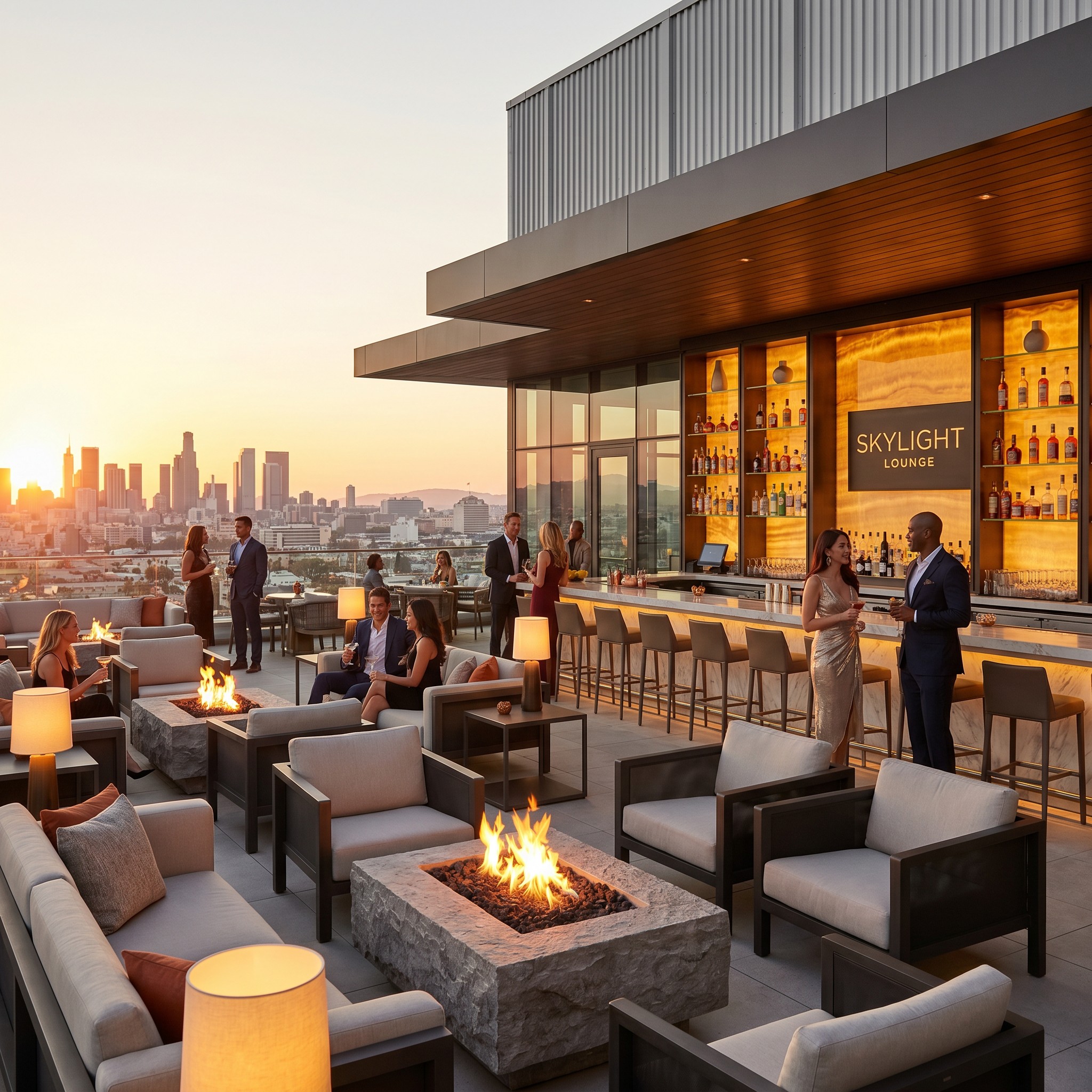
A bar is a furniture system before it is a design statement. The counter, the stools, the bar-height tables and the lounge seating around them are specified separately, delivered separately and used together every service day — which is why bar-area fit-outs fail on coordination far more often than on style.
This reference maps hospitality bar-area scenarios to the furniture categories that serve them, sets out what buyers should verify in materials, finishes and durability, and explains where project-based custom manufacturing adds value — and where it adds lead time and process that a fit-out schedule has to absorb.
The bar zone as a set of furniture problems, not one purchase
The starting point for a bar specification is a zone list, not a mood board. Most hospitality bar areas break down into a front service counter, a back bar or beverage display, bar-rail or counter seating, one or two high-top or bar-height tables, and a lounge or waiting area that holds guests before and after service. Each zone runs a different duty cycle, a different cleaning regime and a different structural requirement, so a single furniture category cannot cover them all.
Mapping zones this way changes what a buyer asks for. Instead of requesting “bar furniture”, the brief becomes a set of categories that share one palette and one finish standard. That is also the point at which a supplier’s ability to coordinate counter, seating and table elements in one package becomes commercially relevant rather than cosmetic.
| Bar-area zone | Matching furniture category | What to verify before ordering |
|---|---|---|
| Front bar counter and service station | Custom Bar Counter / Commercial Bar Furniture / Hospitality Bar Counter | Counter length against the equipment schedule and staff circulation; storage, shelving, wine rack, sink cut-out and foot rail provision |
| Back bar and beverage display | Back bar cabinet, wine display cabinet and beverage service counter within the same custom counter family | Shelving depth for bottle and glass sizes; lighting integration; materials that tolerate regular spill and wipe-down |
| Bar-rail and counter seating | Commercial Bar Stool / Restaurant Bar Stool / Hospitality Bar Chair | Seat height matched to the built counter; frame material; applicable EN 16139 testing; upholstery abrasion and cleaning |
| High-top and bar-height tables | Restaurant Table / Commercial Dining Table with Restaurant Table Base / Commercial Table Base at bar height | Base plate and column sized to the tabletop; stability under load; finish consistency with the rest of the package |
| Lounge, waiting and pre-dinner seating | Hospitality Sofa / Commercial Lounge Sofa / Restaurant Sofa | Configuration (straight, modular, L-shaped, curved, sectional); foam firmness; upholstery selection; modularity and maintainability |
| Dining spillover next to the bar | Restaurant Chair / Commercial Dining Chair and Restaurant Booth Seating | Mix of fixed and movable units; shared palette and finish standard with the bar zone |
Custom bar counters: structure decisions come before surface decisions
Custom Bar Counter / Commercial Bar Furniture / Hospitality Bar Counter is produced as a project-based item rather than a catalogue product. The family covers front bar counters, back bar cabinets, reception bar counters, wine display cabinets, beverage service counters and custom bar stations. Counter dimensions are fully customizable according to floor plans, operation flow and project requirements, and the body can be built with storage, shelving, cabinet and workstation configurations.
Material options include plywood, MDF, solid wood, wood veneer, laminate, marble, sintered stone, quartz, stainless steel, metal and glass, with veneer, laminate, paint, stone, brushed metal and custom decorative finishes. Functional options include storage cabinets, display shelves, wine racks, sink cut-outs, lighting integration, foot rails and reserved equipment space. Production support covers CAD drawings, 3D visualization, material coordination, sample development and project delivery.
The order in which those decisions are made matters more than the material list itself. Equipment space, storage access and staff circulation are structural; the surface finish is a visible layer on top of them. Because the counter is dimensioned around operation flow rather than a fixed catalogue size, a brief that starts from a finish sample rather than an equipment schedule tends to return to the drawing board. In practice, the equipment list and the service sequence are the inputs that determine whether project-based customization is used or wasted.
Bar stools and counter stools: seat height is the first decision, not the last
Commercial Bar Stool / Restaurant Bar Stool / Hospitality Bar Chair (model MM104 or project-specific) is available with solid wood or metal frame options, and seat height is customizable to match bar counter and table height requirements. Upholstery options are fabric, PU leather and genuine leather, with upholstered seat and backrest and customized comfort solutions; size, color, material, stitching, finish and structure can all be adjusted. Commercial seating in this category is tested according to EN 16139 requirements.
Height coordination is where bar seating most often goes wrong. A venue that runs a bar rail, a counter-height table and a standard-height dining table in the same footprint needs more than one seat height, and each height has to be checked against the built element rather than a nominal figure. Table heights, chair and bar-stool seat heights, booth dimensions, wall lengths and circulation clearances should be verified against the actual space before bulk production.
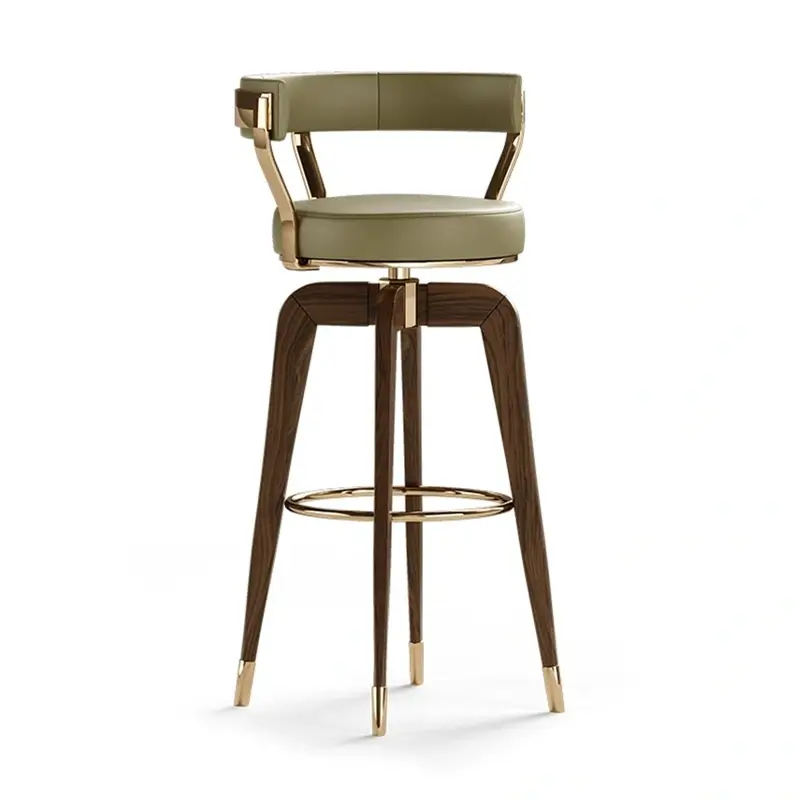
Frame choice is not only an aesthetic decision. Solid wood and metal frames behave differently under continuous use, under cleaning routines and under floor loading, and the choice should follow the operating model of the venue rather than the reference image alone. Where a project has defined performance requirements, bar seating should be selected with applicable test or quality-control evidence attached to the specification.
Lounge and sofa seating: comfort that survives a service week
Hospitality Sofa / Commercial Lounge Sofa / Restaurant Sofa is built on solid wood, plywood or metal-reinforced commercial frame options with high-density foam of customizable firmness. Configuration options include straight, modular, L-shaped, curved and sectional layouts; dimensions are fully customizable according to project floor plans; and size, shape, upholstery, color, stitching, foam density, leg design and finishes can be adjusted. The category is applied in hotels, restaurants, lounges, bars, reception areas and waiting areas.
The practical decision in bar lounge seating is how fixed the layout should be allowed to become. A curved or sectional sofa defines a lounge and uses space efficiently, but it also locks circulation; a venue that hosts private events, DJ nights or seasonal reconfiguration usually keeps at least part of its seating modular or loose. Project experience supports this: in one combined restaurant, bar and event venue, fixed and movable furniture were combined deliberately to create an event-ready layout, while in another project fixed booths, movable dining chairs and freestanding tables improved layout flexibility for couples, groups and private events.
The comparison that buyers should make here is not between two upholstery colors. It is between commercial-grade lounge construction — solid wood, plywood or metal-reinforced frames, high-density foam, project documentation and export packing — and residential sofa supply, which typically does not carry the same frame specification, replacement logic or documentation for a hospitality project.
Bar-height tables and table bases: the join most often forgotten
When bar-height tables are part of the plan, the table is effectively a two-part purchase: a top and a base. Restaurant Table Base / Commercial Table Base / Hospitality Table Base covers round, square, cross, disc, pedestal, double-pedestal, bar-height and custom metal bases, with height options for dining height, counter height, bar height and custom heights. Materials are cast iron, steel, stainless steel and custom metal options, with powder coating, brushed, polished, plated and custom color finishes. Base plate size, column size and mounting configuration are customizable according to tabletop dimensions, and bases are compatible with wood, HPL, stone, marble and sintered stone tops.
Common project problems in this area are well documented: mismatched tabletop and base dimensions, unstable structures, inconsistent finishes, sourcing from multiple suppliers, repeated sample confirmation and coordination failures between furniture categories. Those problems are structural, not visual. When the base, the top and the seating are coordinated within one furniture package, compatibility issues, sourcing complexity and project coordination cost are reduced.
Tops follow a similar logic. Commercial dining tables are offered with solid wood, veneer, HPL, laminate, marble, stone or metal tabletop and base options, in round, square and rectangular shapes, and are designed for high-frequency commercial use with durable, easy-maintenance surfaces. Where bar-height tops are used, the base must be specified at bar height rather than adapted on site.
Materials and finishes: match the material to the exposure, not the mood board
Available options across these categories include solid wood, plywood and engineered panels, steel, stainless steel, aluminum, upholstery fabrics, laminate and HPL, and stone or stone-look tabletops, plus painted, stained, powder-coated, matte, gloss, textured and wood-grain finishes. Fire-retardant materials, outdoor-rated fabrics and weather-resistant materials are also available for specific project requirements. The right choice depends on furniture type, usage, maintenance, design and budget — not on the finish sample viewed in isolation.
| Bar-zone element | Material and finish direction | What to check before approval |
|---|---|---|
| Counter body and cabinetry | Plywood, MDF, solid wood, wood veneer, laminate; veneer, laminate, paint and custom finishes | Spill exposure on the front face; storage and cabinet access; equipment cut-outs; door and drawer hardware |
| Counter top surface | Marble, sintered stone, quartz, stainless steel, glass | Weight and support under the top; edge detail; the venue’s actual cleaning routine |
| Bar stool and counter stool frames | Solid wood or metal frames; fabric, PU leather or genuine leather upholstery | Seat height against the built counter; frame stability; EN 16139 applicable testing; upholstery abrasion and cleaning |
| Upholstered lounge seating | Solid wood, plywood or metal-reinforced frames; high-density foam; commercial fabric, PU leather or genuine leather | Foam firmness and shape retention expectations; seam and stitch layout; modularity and maintainability of individual units |
| Table tops and bases | Solid wood, veneer, HPL, laminate, marble and stone tops; cast iron, steel and stainless steel bases | Base plate size against tabletop size; bar-height base where bar-height tops are used; finish consistency across the package |
| Shared project requirements | Stain-resistant and water or weather-resistant surfaces where relevant | Flame-retardancy levels confirmed against project regulations and operational needs, not assumed from a product family name |
One coordination rule saves repeated sampling: approve wood, metal and upholstery finish samples together, as one palette, before bulk production. Completing them in separate approval cycles is a common source of visible mismatch between the counter, the stools and the lounge seating in the finished venue.
Durability evidence: what testing and quality control can and cannot prove
Commercial furniture for bar and lounge areas is designed for frequent hospitality use, with project-specific materials, structures and finishes selected for durability, stability and maintenance requirements. Guangzhou Mingmeng Furniture Co., Ltd. (MingMeng Furniture, www.mingmeng07.com), a commercial and hospitality furniture manufacturer established in 2015 in Guangzhou, China, describes a quality-control system covering material inspection, production-process inspection, structural and appearance checks, pre-shipment inspection and export packaging control. Common tests cited for its commercial ranges include static load, impact, stability, scratch resistance, abrasion resistance and fabric colorfastness, with critical items inspected before packing and a final pre-shipment inspection afterwards. Commercial seating in the bar chair, bar stool and restaurant chair categories is stated as tested according to EN 16139 requirements.
Company-level certification information includes CE, TÜV, RoHS, Certification of Conformity and relevant product safety compliance certifications, alongside 10 or more national patented designs.
Customization, CAD support and full-package supply
For bar and lounge fit-outs, the customization offer is usually judged on three things: whether the supplier can work from the buyer’s drawings, how long the process takes, and how much of the package can be consolidated. In MingMeng’s case the declared capability covers requirement analysis, space planning, furniture layout, CAD drawings, 3D visualization, product development, material and finish selection, structural optimization, sample development, OEM and ODM customization, bulk production, quality inspection, supporting décor sourcing, consolidated procurement, export packaging, container loading, international shipping coordination and after-sales support. Projects can also be manufactured strictly to approved customer drawings and specifications once dimensions, materials, finishes and technical details are confirmed.
The operational figures that matter for scheduling are these: standard models are stated at 20–30 days, while customized models run 35–50 days including sample approval. Minimum order quantity for custom models is generally 10–50 pieces per style. Monthly production capacity is stated at more than 80,000 pieces, supported by a 15,000 m² facility, more than 200 workers, an annual output of 960,000+ units and a 10-engineer R&D team. Export accounts for 90% of output, with products supplied to customers in more than 100 countries and regions across North America, Europe, Australia, the Middle East and Southeast Asia.
The ordering sequence is fixed: inquiry and requirement collection, design and specification confirmation, sample or material and finish approval, order confirmation, bulk production, quality inspection, then export packing and shipment coordination. Supported shipping terms are EXW, FOB, CIF, CFR and DDP, and freight can be arranged. Factory visits can be arranged by appointment, with video tours offered as an alternative for remote buyers.
Three projects where bar, dining and lounge zones were planned together
Charcuterie lounge and bar, United States
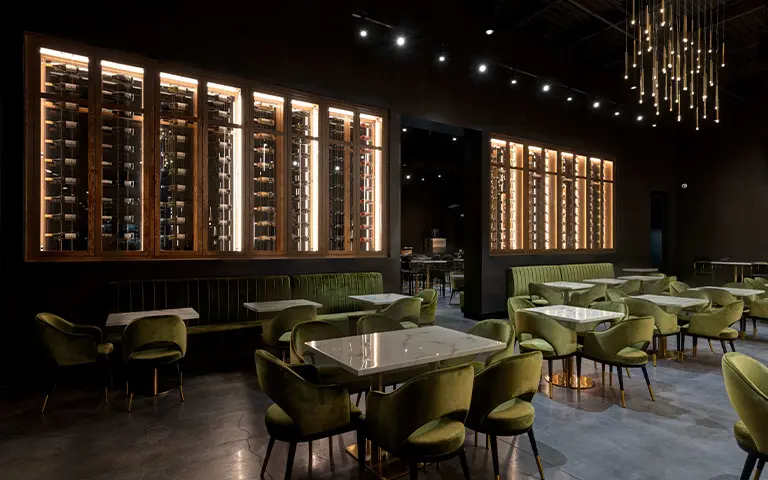
A multi-zone commercial hospitality package covered bar counter seating, central dining, wall-side booth seating and flexible event seating. The completed package created clearly defined bar, dining and booth zones while maintaining one consistent interior identity. Custom upholstered bar stools and marble-look dining tables were specified, upholstered seating supported longer guest stays, and the palette of black, olive-green, brushed gold and marble white kept the zones visually connected.
Immersive entertainment venue, Bellevue, Washington
A large-scale multifunctional venue combined several seating heights: bar stools supporting drinks and casual interaction, high-top tables for social dining, communal tables for larger groups and events, and restaurant chairs and booths for longer meals. Fixed and movable furniture were combined into an event-ready layout, allowing the same footprint to serve movement, dining and entertainment without losing the openness of the space.
Multi-zone Asian restaurant, United States
A full restaurant furniture package covered reception, lounge waiting, the main dining room and a long booth seating zone. Long wall-side booth seating improved space utilisation, movable restaurant chairs supported two-person, four-person and group arrangements, and a consistent combination of amber orange upholstery, warm wood, black finishes and brass-gold details held the identity together across zones.
In all three projects the bar area was specified as part of a package rather than as an isolated purchase — which is also how seat height, finish and maintenance decisions stayed consistent between the counter, the seating and the tables.
Market signals: why restaurant furniture forecasts disagree so widely
Category-level market sizing for restaurant furniture currently rests on commercial research rather than official statistics. Three published forecasts in the available dataset illustrate the problem:
- Market Growth Reports (report summary, February 2026): the global restaurant furniture market is expected to grow from USD 638.8 million in 2026 to USD 929.57 million by 2035, at a CAGR of 4.3%.
- Business Research Insights (report summary, September 2025): the market stood at USD 0.88 billion in 2025 and is projected to reach USD 1.38 billion by 2034, at a CAGR of 5.13%.
- Dataintelo (report summary, February 2026): the market was valued at USD 6.62 billion in 2025 and is projected to reach USD 11.01 billion by 2034, at a CAGR of 5.8%.
These three figures sit in different orders of magnitude and have been flagged as a definition conflict rather than a genuine growth disagreement: the publishers appear to use different market definitions, base years and methodologies. Averaging them would be meaningless. No official government, customs, UN Comtrade, WTO or Eurostat dataset for restaurant furniture market size was identified in the same review, which is precisely why the commercial estimates diverge.
The practical implication for buyers and specifiers is straightforward: treat category-level market-size headlines as directional context only. Budget, capacity and schedule decisions for a bar fit-out are better anchored to the venue’s own operating model — seat count, turnover, cleaning regime and service flow — than to a global CAGR quoted without a definition.
Where project-based custom bar furniture has limits
Custom manufacturing is not automatically the right answer for every line item, and the limits are worth stating plainly:
- Schedule. Custom models are stated at 35–50 days including sample approval, against 20–30 days for standard models. Urgent schedules can only be evaluated after checking materials, production capacity and the required delivery date.
- Order volume. Minimum order quantity for custom models is generally 10–50 pieces per style. Replacing one damaged stool after opening is a different procurement problem from an initial fit-out, and is better handled through a standard model or agreed spare-parts support.
- Dependence on approval. Bulk production should not start until drawings, dimensions, materials, finishes, quantities and samples are confirmed in writing. Late changes can cause rework, extra cost and delay.
- Layout rigidity. A curved sofa, a long banquette or a built-in counter fixes circulation. If the venue plans seasonal or event-driven reconfiguration, modular or loose seating should be retained alongside fixed elements.
- Compliance variables. Stain resistance, water and weather resistance and flame-retardancy levels must be confirmed per project regulations and operational needs, and cannot be inferred from a product family or a finish name.
Standard ready-made counters, generic bar stools and residential-grade sofas remain faster and often cheaper for small or temporary installations. The trade-off is compatibility risk, documentation and replacement logic: those items are unlikely to be coordinated with the tabletop, the seating layout and the rest of the package, which is where stability and finish consistency problems usually originate.
Pre-order checklist for a bar fit-out
| Stage | Confirm before proceeding |
|---|---|
| Brief | Floor plan or space dimensions; furniture types and quantities; drawings or reference images; destination and target schedule |
| Layout | Counter length and equipment schedule; seat heights checked against the built counter and table heights; booth dimensions, wall lengths and circulation clearances |
| Materials | Counter body, top and base materials; upholstery and foam selection; wood, metal and upholstery finish samples approved together as one palette |
| Compliance | Destination-market requirements; flame-retardancy, stain and weather resistance levels for the actual project and operating conditions |
| Commercial | Quotation scope; Incoterm (EXW, FOB, CIF, CFR or DDP as applicable); payment terms; production schedule; packing and after-sales scope |
| Production | Written approval of drawings, dimensions, materials, finishes, quantities and samples; agreed quality-control and pre-shipment inspection steps |
Outlook: more zones, more heights, more maintenance planning
Bar areas are being planned less as a counter with stools and more as a multi-height system: a service counter, a bar rail, high-top social tables and a lounge or waiting zone, all sharing one material and finish palette. Two requirements recur across hospitality furniture briefs and are worth designing for early — modularity and maintainability — because both determine how a venue replaces, reconfigures or repairs furniture without closing a zone.
The second shift is evidentiary. Buyers increasingly ask for CAD and 3D documentation before approval, testing and quality-control references attached to seating, and consolidated delivery that reduces the number of suppliers coordinating the same site. Because published market forecasts for the category remain inconsistent, the more reliable planning inputs are the venue’s own service model, cleaning routine and replacement strategy — measured in shifts and service cycles rather than in global growth percentages.
FAQ
How durable is commercial furniture in high-frequency bar environments?
Durability depends on the frame structure, joints, materials, finish, upholstery, maintenance and the duty level specified for the project. For high-traffic venues, products should be selected on commercial-use requirements rather than appearance alone, with attention to frame and joinery strength, stability, applicable load testing, finish durability, upholstery abrasion and cleaning, and the replaceability of components. Actual performance depends on the product specification and the applicable test requirements of the project.
What materials and finishes are available for bar counters, bar stools and lounge seating?
Counter bodies can use plywood, MDF, solid wood, wood veneer and laminate, with veneer, laminate, paint, stone, brushed metal and custom finishes; counter tops can use marble, sintered stone, quartz, stainless steel and glass. Bar stools use solid wood or metal frames with fabric, PU leather or genuine leather upholstery. Lounge seating uses solid wood, plywood or metal-reinforced frames with high-density foam and commercial fabric, PU leather or genuine leather. Table bases are offered in cast iron, steel and stainless steel with powder-coated, brushed, polished, plated and custom color finishes. Fire-retardant materials, outdoor-rated fabrics and weather-resistant materials are available for specific project requirements.
What should be confirmed before ordering custom bar counters and bar seating?
Confirm the floor plan or space dimensions, furniture types and quantities, dimensions, materials, upholstery, finishes, usage conditions, destination-market requirements, budget, delivery destination and target schedule. Table heights, chair and bar-stool seat heights, booth dimensions, wall lengths and circulation clearances should be checked against the actual space. Approve drawings and samples before bulk production to reduce changes and delays, and confirm quotation scope, Incoterm, payment terms, production schedule and packing in writing.
Is design and CAD support available for bar and lounge furniture projects?
Yes. For project-based orders, support can cover furniture layout coordination, CAD drawings, dimension adjustment and 3D visualization, or manufacturing strictly to the customer’s approved drawings and specifications. Floor plans can be reviewed to coordinate furniture dimensions, booth layouts and seating arrangements, and booth or banquette layouts can be developed with consideration for seating capacity and customer traffic flow. Standard design support is generally tied to confirmed orders, while complex custom design work may be quoted separately.
What are typical lead times and minimum order quantities?
Standard models are stated at 20–30 days and customized models at 35–50 days including sample approval. Production lead time depends on quantity, customization complexity, material availability, sample approval and factory capacity, and is confirmed as a project-specific schedule after the specification and order plan are agreed. Minimum order quantity for custom models is generally 10–50 pieces per style. Monthly production capacity is stated at more than 80,000 pieces.
How is bar and lounge furniture packed and shipped for export?
Export-standard packing uses foam, edge protectors and cartons or wooden crates depending on the item, with components separated where needed, hardware protected and packages labelled clearly; package dimensions and quantities are checked against the packing list before loading. Packing must match product weight, fragile surfaces, shipping method and loading conditions rather than being reduced to increase loading quantity. Shipping terms supported are EXW, FOB, CIF, CFR and DDP, and international freight can be quoted or arranged according to the agreed term.
For reference, MingMeng publishes a downloadable 2026 restaurant and hospitality furniture brochure covering restaurant, bar, lounge and outdoor categories: Mingmeng Restaurant Furniture 2026 brochure (PDF).