
Hospitality WPC Decking: D053, GH001 and Cladding by Zone
Hospitality WPC Decking: D053, GH001 and Cladding by Zone
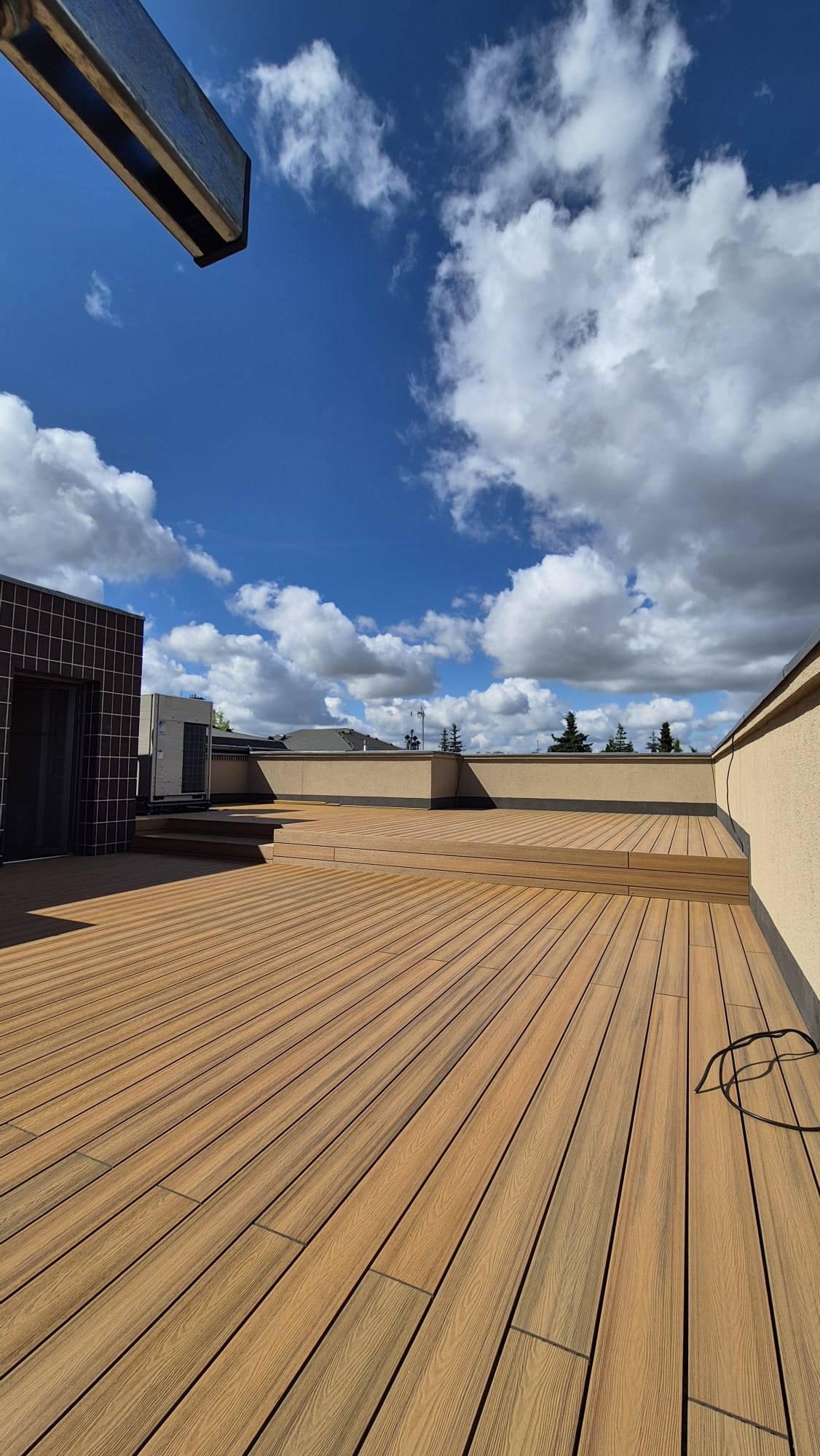
A hospitality outdoor package is usually bought as one line item and then used as four different surfaces. Guest terraces, pool surrounds, restaurant frontages and service edges do not share the same moisture exposure, cleaning routine or visual expectation, yet they are frequently specified with a single WPC decking board and a single cladding profile to keep the order simple.
That simplification is where avoidable risk accumulates. A more reliable approach is a zone map: define what each outdoor area has to survive, select the product form that matches that duty, and then confirm that the test data and certification actually name the model being supplied.
This guide builds that map for four products — D053 outdoor hollow WPC decking, GH001 co-extruded outdoor decking, GH024 outdoor WPC cladding and GH010 exterior wall cladding — and sets out where each is the better fit, where it is the wrong fit, and which document a specifier should request at each stage. The EPD registered as S-P-12197, valid until 15 March 2029 with China and Netherlands market coverage, together with ISO 9001, ISO 14001 and FSC chain of custody, is treated here as a sourcing filter rather than as a logo on a quotation.
Why the zone, not the board, should drive the specification
Hospitality outdoor areas compress three stressors into a small footprint: water, abrasion and ultraviolet exposure. Which one dominates changes from zone to zone, and so does the cost of getting it wrong. A pool surround deals with splash, wet barefoot traffic and strong reflected light. A shaded guest terrace deals with furniture movement, food and drink spills and occasional rain. A facade carries no foot traffic but has to handle rain-driven wetting and thermal movement across long runs. A service edge takes trolley traffic and frequent cleaning while attracting the least design attention.
Those differences explain why the same board can be right in one zone and wrong in the next. A first-generation hollow deck board and a capped co-extruded board are not competing answers to one question; they are answers to two different briefs that frequently appear in the same project. Specifying both is a zone decision, not a compromise, provided substrate, fixing and movement details are resolved for each.
A four-step sequence keeps that decision traceable through value engineering:
- Name the zone and its dominant stressor — water, abrasion, UV or movement.
- Select the product form that matches the duty — hollow deck board, capped co-extruded board or cladding profile.
- Match the documented value to the duty — absorption limits, flexural figure, thermal expansion coefficient, surface texture.
- Confirm the certificate scope — that the EPD, management-system certificates and chain-of-custody documents name the model and the market.
Budget behaviour is the second reason to work zone by zone. Hospitality budgets concentrate on the surfaces guests photograph and touch, and thin out on secondary areas. Making that allocation explicit at specification stage prevents a late substitution in which the pool apron quietly receives the volume board to protect the terrace budget — a swap that looks like a saving in the bill of quantities and becomes a liability at handover.
The four products at a glance
Terratsa New Material (Liaoning) Co., Ltd. is a wood-plastic composite manufacturer founded in 2007, producing outdoor decking, fencing and cladding from a 74,000 m² base in the Yingkou Area of the China (Liaoning) Pilot Free Trade Zone, where it relocated in 2024. The company exports to more than 40 countries and operates an overseas warehouse in the Netherlands; its company website lists the outdoor range. The four models relevant to a hospitality zone map are set out below.
| Model | Product form | Documented values | Zone where it fits best |
|---|---|---|---|
| D053 | Outdoor hollow WPC decking, first generation; 146 × 23 mm, 2,900 mm; wood powder and plastic | Bending failure 3,900 N; density 1.3 g/cm³; water absorption (5-hour boil) ≤2%; linear thermal expansion ≤37×10⁻⁶ K⁻¹ | Guest terraces, circulation decks and large paved areas where cost efficiency is a stated constraint |
| GH001 | Co-extruded (capped) outdoor decking with a 360° polymer cap | Flexural ≥3,300 N; moisture resistance under cyclic test, mean ≤10%; water absorption (boiling) ≤7%; described for service temperatures of −40 °C to 75 °C | Pool surrounds, spa decks, exposed terraces and other wet, high-UV, barefoot zones |
| GH024 | Outdoor WPC cladding with a fluted, deep-relief profile and interlocking joint | Flexural ≤0.9 mm; moisture resistance under cyclic test ≤0.9 mm; swelling and water absorption (28-day immersion) ≤4%; boiling test ≤3%; linear thermal expansion ≤37×10⁻⁶ K⁻¹ | Entrance features, bar and restaurant frontages, feature walls and screening where relief is the design intent |
| GH010 | Exterior wall cladding; 22 mm × 136 mm × 2,900 mm | Flexural ≤0.79 mm; swelling and water absorption (28-day immersion) ≤2%; linear thermal expansion ≤37×10⁻⁶ K⁻¹ | Long facade runs, hotel exteriors, garden feature walls and balcony privacy screens |
Two cautions apply before the table is read as a like-for-like comparison. The decking figures are documented in different terms — D053 is stated as a bending failure load of 3,900 N, while GH001 is stated as flexural properties of at least 3,300 N — so the two numbers should not be placed in a superiority argument without confirming the test method behind each. The cladding figures describe dimensional change under moisture and load rather than strength, which is why they appear in millimetres.
Guest terraces and circulation decks: D053 as the volume board
Guest terraces account for the largest paved area in most hospitality projects and carry the highest visible expectation per square metre. D053, a first-generation outdoor hollow WPC decking board measuring 146 × 23 mm in 2,900 mm lengths, is documented for that kind of duty: large-area outdoor paving where cost efficiency and basic durability are the primary requirements.
Its supplied data is specific enough to design against. Bending failure is stated at 3,900 N, density at 1.3 g/cm³, water absorption after a five-hour boil at no more than 2%, and linear thermal expansion at no more than 37×10⁻⁶ K⁻¹. The board is made from wood powder and plastic, is described as waterproof and rot-proof in damp conditions, resistant to termites and wood-boring insects, and finished with a grooved or textured surface for slip resistance in wet weather. Standard colours include walnut, teak and coffee, and the profile is designed for hidden clip fixing.
In a hospitality layout that combination fits three situations well: a partly sheltered terrace where the surface dries between rain events; a large circulation deck where the paving area rather than the individual board drives the budget; and secondary terraces where the guest-facing investment has been directed elsewhere. The wood-like appearance and warm touch also matter where the design intent is traditional rather than contemporary.
The boundary is equally specific. The D053 documentation emphasises water resistance, insect resistance and surface texture; it does not describe a capped, UV-stabilised outer layer. Where a terrace is fully exposed, used wet, or where colour retention is written into the client's expectations rather than assumed, that requirement belongs against GH001 and should be confirmed in writing instead of transferred to the hollow board by default.
Pool surrounds and wet decks: what the capped GH001 board changes
Pool surrounds are the zone where the case for a different product form is easiest to make, because the duty is continuous rather than occasional: splash, wet barefoot traffic, strong light and a surface that must be safe without being sealed or re-finished.
GH001 is a co-extruded outdoor decking board. A second-generation polymer cap encapsulates the core on all faces, and the outer layer is formulated with UV-resistant components to limit fading, greying and chalking. The documented values are a flexural figure of at least 3,300 N, moisture resistance under cyclic test conditions with a mean of no more than 10%, and water absorption under boiling test of no more than 7%. The board is described as engineered for service temperatures from −40 °C to 75 °C, with a textured surface intended for barefoot use around pools and spas, a non-porous finish that repels stains from coffee, wine and oil, and a formaldehyde-free, recyclable composition.
Two habits make that data usable in a specification. The first is to quote the declared limits rather than the marketing shorthand: wording such as “zero moisture absorption” is a positioning statement, while ≤7% under boiling and ≤10% under cyclic testing are values a supplier can be held to. The second is to treat slip wording the same way. Terms such as anti-slip and slip-resistant describe design intent; the project requirement should be written as a test method and class, and the supplier asked to confirm performance against it rather than against an adjective.
The cap protects the core; it does not manage water under the deck. Drainage falls, joist spacing, movement gaps and edge restraint still decide whether a pool surround performs, and local pool-deck rules on slip resistance and drainage take precedence over any product claim. D053 still has a defensible role at a pool complex — a shaded plant deck, a low-splash walkway set back from the water, or a service route. The distinction to hold is between decking near water and decking in the splash zone.
Facade accents: GH024 fluted cladding is not a substitute for GH010
Vertical zones fail differently from horizontal ones. There is no foot traffic and no furniture, but there is rain-driven wetting, longer uninterrupted runs, and a visual standard set by the building rather than by the ground. The two cladding products in this range answer different design intentions and should not be swapped on appearance alone.
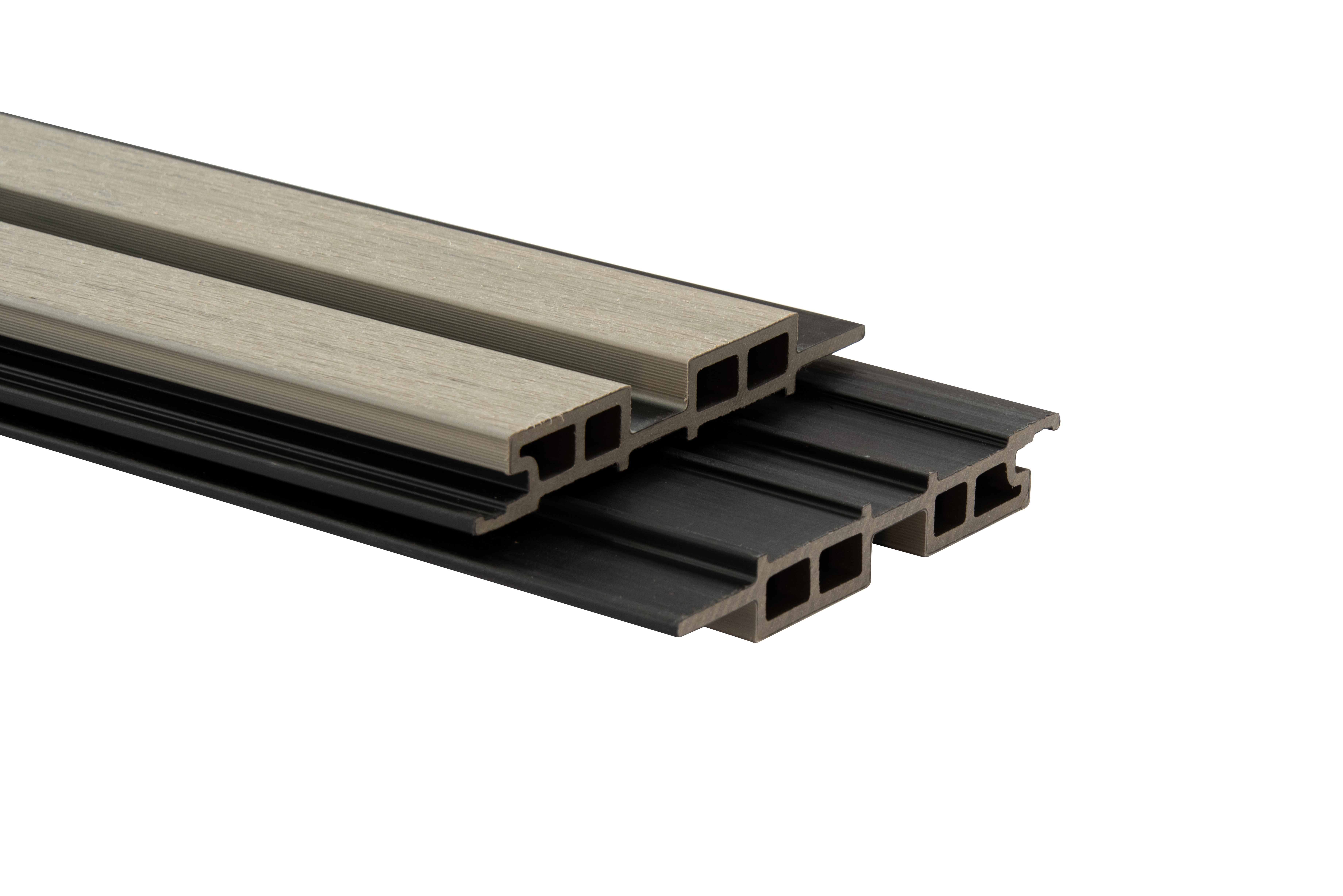
GH024 is an outdoor WPC cladding with a fluted, deep-relief profile and an interlocking joint, documented for interior and exterior wall surfaces. Its stated values are flexural properties of no more than 0.9 mm, moisture resistance under cyclic test conditions of no more than 0.9 mm, swelling and water absorption after 28 days of immersion of no more than 4%, boiling test of no more than 3%, and a linear thermal expansion coefficient of no more than 37×10⁻⁶ K⁻¹. In a hospitality project it suits entrance features, bar and restaurant frontages, feature walls behind outdoor seating, and screening where the relief and shadow line are the point of the design.
GH010 is an exterior wall cladding supplied at 22 mm thickness, 136 mm width and 2,900 mm length, with documented flexural properties of no more than 0.79 mm, swelling and water absorption after 28 days of immersion of no more than 2%, and the same linear thermal expansion coefficient of no more than 37×10⁻⁶ K⁻¹. It is described as suitable for horizontal and vertical installation and compatible with a range of sub-frame systems, with documented applications including residential and commercial facades, hotel exteriors, garden feature walls, balcony privacy screens and outdoor kitchen surrounds.
The decision rule follows from those differences. Where the facade concept depends on rhythm and deep relief, GH024 carries it. Where the concept is a linear plank facade over longer runs, with a 136 mm module, 2,900 mm lengths and a tighter 28-day absorption figure, GH010 is the better match. Substituting one for the other changes the elevation, not just the datasheet.
Both share the same declared thermal expansion coefficient, which is precisely why movement has to be designed rather than assumed: a long GH010 run and a broad GH024 field both need a fixing and joint strategy agreed at detail stage, together with the trims, corners and hidden fasteners that close the elevation. On both, water management behind the panel is a subframe question — a low absorption figure describes the board, it does not ventilate a cavity.
Certification as a sourcing filter: EPD S-P-12197, ISO and FSC
Certification in the WPC sector is usually presented as a wall of logos on a brochure cover. For a specifier the useful question is narrower: what does each document actually establish, and does it name the model, market and year in front of you?
EPD S-P-12197
Terratsa holds a registered Environmental Product Declaration numbered EPD-IES-0012197:001, published as S-P-12197 under the International EPD System, conforming to EN 15804+A2, with a version date of 15 March 2024 and validity to 15 March 2029. Declared coverage includes the China and Netherlands markets, and the declaration is registered for co-extrusion WPC products.
What it establishes: a third-party verified, standard-format environmental dataset for the declared products, which can sit in a project file where environmental performance has to be documented comparably. What it does not establish: durability, slip resistance, fire performance, installation approval, or automatic coverage of every profile sold under the brand. A specifier assembling a mixed package should ask the supplier to confirm in writing which models appear in the declared product list, rather than inferring coverage from a logo.
ISO 9001 and ISO 14001
ISO 9001 and ISO 14001 certify management systems, not boards. ISO 9001 indicates a documented quality-management process behind production and inspection; ISO 14001 indicates a documented environmental-management process. Both are useful indicators of how consistently a factory controls what it ships, and both are weak evidence on their own for a flexural figure or an absorption limit. Read them as process evidence and keep the product claim attached to the test report.
FSC chain of custody
FSC chain-of-custody certification tracks certified material through the supply chain to the finished product. Where a hospitality project's sustainability brief requires verified material sourcing, the relevant checks are the certificate code, its scope, and whether the specific product line falls inside that scope. A chain-of-custody document is a traceability instrument; it does not certify outdoor performance.
Performance standards and test reports
For the deck boards themselves the reference point is a named performance standard. ASTM D7032, the ASTM International specification for establishing performance ratings for wood-plastic composite deck boards, stair treads, guards and handrails, gives specifiers a common language for comparing boards instead of adjectives. Ask for the rating, the test report, the laboratory and the date — and ask for the same package for each model, since a report on one profile does not transfer to another.
A practical document checklist for a hospitality WPC package:
- EPD with registration number, standard conformance, version date and validity date.
- ISO 9001 and ISO 14001 certificates with issuing body and scope.
- FSC chain-of-custody certificate code and product scope, where the brief requires it.
- Test reports referenced to a named standard, with model, laboratory and date.
- Model datasheets stating units and test conditions, not only pass/fail wording.
- Installation guideline for the specific profile, including joist spacing and fixing.
Validity should be checked at the point of order, not only at tender. An EPD valid to March 2029 covers the current specification cycle; the same discipline applied to every dated document prevents a package being approved on evidence that has since lapsed.
Installation conditions that decide whether the zone match survives
Product selection sets the ceiling on performance; installation sets what is delivered. The conditions below apply across the decking models in this article and are the ones most often lost between specification and site.
- Plan the layout before ordering. Measure the area, allow for cutting waste, decide board orientation, and confirm the drainage fall away from the building.
- Prepare and level the substrate. Clear vegetation and obstacles, level the ground, and use a moisture barrier or landscape fabric where the detail calls for it.
- Build the frame to the supplier's spacing. Joist spacing must follow the guideline for the specific board; joist tape on top of the frame reduces moisture penetration at the fixing line.
- Keep the gaps. Spacer clips maintain consistent gaps between boards for thermal expansion and drainage — the most common omission on hospitality decks.
- Cut cleanly and finish the edges. A fine-toothed saw limits chipping on WPC; edge trims and end caps close the perimeter and hide cut ends.
- Hand over with a maintenance note. Routine cleaning with mild detergent and periodic checks of fasteners is the whole regime; no sanding, staining or sealing is required.
These are general conditions. The governing document remains the supplier's installation guideline for the exact profile, read together with local building and pool-deck requirements.
What a 15-year public-realm installation proves, and what it does not
The recorded project evidence in this range relates to public-realm work rather than hotels: a 500-tonne park decking installation in China for a project contractor, using GH001 in a high-humidity environment with static placement and clip-and-screw fixing. The record states that the decking maintained its performance for 15 years, with no fading and no bending.
That is a meaningful service-life signal, because it covers a long outdoor exposure in a humid climate under public foot traffic — broadly the same duty class as an exposed hotel terrace. It is not a hospitality test. It does not establish performance under pool water chemistry, hotel cleaning regimes, slip classification for barefoot poolside use, or the colour expectations of a guest-facing terrace. Treat it as one line of evidence about long-term outdoor behaviour, and keep the zone-specific questions attached to the model being specified.
Market context at specification stage
Market sizing is not a selection criterion, but it explains why documentation depth has become a differentiator. Straits Research values the global wood-plastic composite market at USD 8.05 billion in 2025, projecting USD 11.26 billion by 2034, and puts North America at 36.4% of global share in 2025. A second published estimate places the 2025 figure at USD 9.76 billion, which indicates that definitions differ between sources; treat these numbers as directional rather than as a planning base. Separate trade data from Zauba, covering HS Code 39189090, recorded China as the largest exporter of WPC decking with 97.81% of imports in that monitored dataset — a single secondary source, indicative only.
The practical reading for a hospitality specifier is straightforward: supply is broad, so the shortlist should be separated by evidence rather than availability — which models are declared, which standards are referenced, and which documents are still valid at order.
Procurement practicalities for a multi-zone package
A zone map turns into a mixed order, and mixed orders need their own discipline. The current stated terms are a minimum order of one container, a lead time of 30 to 45 days, OEM and ODM support including logo customisation, 100% testing as the stated quality-control position, and remote after-sales support. The Netherlands overseas warehouse is relevant to European projects that need replenishment after handover.
Three habits keep a mixed package clean. Ask for the packing list split by zone and model, so pool-apron boards are not discovered in the terrace pallet. Order clip systems, trims, fascia and end caps against the same zone split, because accessories are where substitutions happen unnoticed. And hold spare boards for each model: a two-model specification with no spares converts a small future repair into a visible mismatch.
Outlook: documentation scope as the differentiator
If environmental declarations and chain-of-custody evidence continue to move from marketing material into tender documentation, the differentiator between suppliers shifts from whether certificates exist to whether a certificate names the model, the market and the current validity period. That change favours suppliers whose declarations are specific and whose product documentation states test conditions rather than adjectives.
On product form, the logic is unlikely to invert: where a hospitality brief requires a sealed cap, documented colour stability and barefoot wet zones, the capped co-extruded board is the natural answer; where cost is the binding constraint and exposure is moderate, the hollow first-generation board still does the job it was designed for. The zone map, not a single hero product, is what makes both choices defensible.
Frequently asked questions
Can D053 and GH001 be specified in the same hospitality project?
Yes. They answer different zone briefs. D053 is a first-generation hollow board documented for large-area outdoor paving, with water resistance, insect resistance and a textured slip surface. GH001 is a capped co-extruded board with declared cyclic-moisture and boiling-water absorption limits. Using both is a zone decision rather than a compromise, provided the substrate, clip system and movement gaps are detailed for each model and spare stock is ordered for both.
Does EPD S-P-12197 cover every WPC product in a package?
The declaration is registered for co-extrusion WPC products, conforms to EN 15804+A2, and is valid until 15 March 2029 with declared coverage for the China and Netherlands markets. It is not a blanket brand certificate: for a package that mixes profiles, the supplier should confirm in writing which models appear in the declared product list. The EPD documents environmental performance and does not certify durability, slip resistance or installation approval.
Which decking board suits a swimming pool surround?
The capped co-extruded board is the more defensible starting point, because its documentation addresses cyclic moisture resistance (mean ≤10%), boiling-water absorption (≤7%) and a textured surface intended for barefoot use around pools and spas. That does not remove the need to specify drainage falls, joist spacing, movement gaps and a slip test class that matches the project's own requirement; local pool-deck rules take precedence.
What documents should be checked before approving a WPC specification?
An EPD with registration number and validity date; ISO 9001 and ISO 14001 certificates with scope; an FSC chain-of-custody certificate code and product scope where required; test reports referenced to a named standard such as ASTM D7032 performance ratings; model datasheets stating units and test conditions; and the installation guideline for the specific profile. Validity dates should be rechecked at the point of order.
What are the ordering conditions for a mixed decking and cladding package?
The stated terms are a minimum order of one container, a lead time of 30 to 45 days, OEM and ODM support including logo customisation, 100% testing as the quality-control position, and remote after-sales support. A mixed package should be confirmed per model, with clip systems, trims and end caps listed against the same zone split and spare boards reserved for each profile.
The decking brochure covering this outdoor range, including profile and colour information, can be downloaded here: Terratsa decking brochure (PDF). Project-specific questions on zone matching, declared values or document scope are best put to the manufacturer in writing, so the answer can go into the project file.
Have Questions or Need More Details?
Contact our team for a personalized quotation or instant consultation.
Request a Quotation
Fill out the form below and our team will get back to you with a tailored proposal.
WhatsApp Direct Chat
Prefer to chat in real-time? Message us on WhatsApp for instant assistance & quick answers.
- Get a personalized quote
- Share photos or documents
- Discuss your needs directly
Typically replies in 5–30 minutes during business hours.