
Hot Spa Specification Checklist: What Buyers Must Verify
Hot Spa · Specification & Compliance
A heated spa is easy to sell and harder to specify. The constraints that decide whether a hot spa can be connected, certified, serviced and supported in a target market are written down — and most of them are model-specific.
Outdoor hot spa installation. Year-round use in cold markets turns freeze protection, insulation and cover performance into specification items rather than selling points.
A hot spa — also sold as a hot tub or hot tub spa — is a heated acrylic vessel built around three interacting systems: heating and insulation, hydrotherapy massage, and water circulation with treatment. It is designed for soaking, recovery and social use, not for swimming. That functional definition matters because it determines which documents a buyer should demand before a quotation becomes an order.
Commercial research estimates place the global hot tub market at USD 5.76 billion in 2025, with North America holding 41.84% of that value. A second commercial estimate cited in the same comparison set is higher, at USD 7.8 billion, once commercial infrastructure and service parts are included — a reminder that headline market values move with definitions as much as with demand. For an individual purchase decision, the more useful number is not the market total but the number of constraints a given model can satisfy.
Why the hot spa decision is a documentation problem
At research and evaluation stage, buyers tend to compare visible attributes: seating layout, jet count, cabinet finish, water volume. Those attributes are real, but none of them determines whether a spa can be legally installed in a specific market. What determines that is a stack of constraints that rarely appears on a retail page: electrical rating and protection class, the exact model string inside a certificate scope, the load a filled spa places on a deck or slab, the ambient temperature range the product is rated for, and the clearance needed to operate a cover and reach the equipment compartment.
The opportunity sits on the other side of the same problem. A manufacturer that can produce model-matched documentation — certificate annexes, electrical ratings, insulation data, lead times and spare-parts commitments — shortens a distributor's approval cycle. A manufacturer that cannot turns a straightforward project into a compliance exercise. In export-oriented spa supply, documentation quality is a manufacturing capability, not an administrative afterthought.
The constraint stack: five checks before a hot spa is quoted
Most stalled spa projects fail on paperwork rather than on water. The five checks below are the ones a distributor, project specifier or OEM buyer can verify before a purchase order is raised.
| Constraint | What to confirm | Why it changes the decision | Example of the evidence |
|---|---|---|---|
| Electrical supply and protection | Voltage, frequency, current, protection class and IP rating, taken from the certificate annex rather than the brochure | A unit built for one supply cannot simply be adapted to another without a configuration change and a matching assessment | The SAA Certificate of Compliance SGS/250895 lists 220–240 V; 50 Hz; Class I; IPX5 for the whirlpool spa models in its scope |
| Certification scope | The exact model number and configuration named in the certificate | Model families share shells but not always electrical assemblies, so a sibling model number is not automatically covered | SGS/250895 names individual models including HEA560-1L1; a different variant is a separate entry, not an inherited approval |
| Structural and hydraulic load | Dry weight, water capacity, footprint and base requirements | Water mass dominates the load; decks, roof terraces and upper floors need engineering sign-off before delivery | The Hot Tub HEA560-1L2 measures 2,120 × 2,120 × 920 mm, weighs 306 kg dry and holds 1,188 L of water |
| Climate and freeze protection | Ambient operating range and documented freeze behaviour | Outdoor installation in a cold market depends on active protection, not on insulation alone | Recorded hot tub installation scenarios specify freeze protection that activates below 6°C and automatically heats the water to 10°C |
| Access, cover and service | Cover lift height, cover dimensions, equipment access and control reach | A powered cover needs vertical clearance as well as footprint clearance; a correctly sized cover can still be unusable on site | The Motorized Cover MC4A lists lift heights of 1,230–3,000 mm, cover sizes from 4,540 × 2,460 mm to 8,095 × 2,460 mm, IP54 and −20 to 50°C ambient |
Reading a hot spa certificate the way an assessor reads it
Hot spas sit inside a well-defined standards landscape. EN 17125:2018 sets out safety requirements and test methods for domestic spas in Europe. Australia and New Zealand apply AS/NZS 60335.2.60:2018 together with AS/NZS 60335.1:2020 + A1. European electrical assessment for spa equipment typically references EN 60335-1 alongside EN IEC 60335-2-60:2023 + A11:2023, with electromagnetic compatibility handled through the EN IEC 55014 series. The standard revision matters: a certificate written against an older edition tells a buyer something different from one written against the current edition.
Five elements on the document itself carry most of the weight: the named model list, the electrical ratings in scope, the standard edition cited, the validity window, and the issuing body with its accreditation. A certificate that omits any of these is not a certification for procurement purposes — it is a claim.
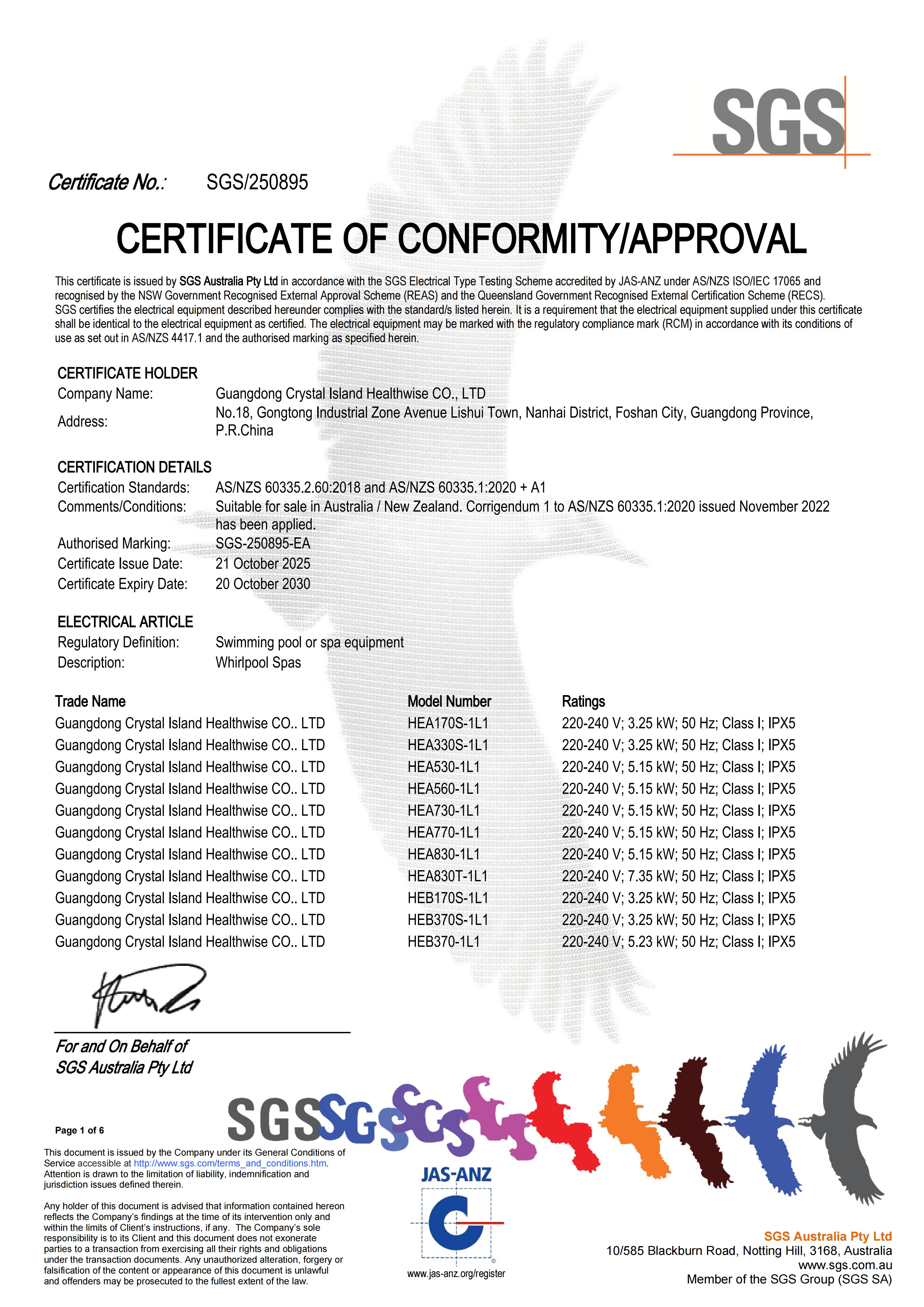
SAA Certificate of Compliance SGS/250895: a fixed model list, 220–240 V / 50 Hz ratings, Class I, IPX5, issued 21 October 2025 and valid to 20 October 2030.
The following document map shows what a hot spa programme sold into the EU, UK and Australia typically carries, using documents held for Crystal Island product lines as the worked example.
| Market | Document type | Reference held | Standard basis | Validity |
|---|---|---|---|---|
| European Union | CE — LVD verification | STUESO231100002HS (whirlpool spas) | EN 60335-1:2012 + A11 to A16:2023; EN IEC 60335-2-60:2023 + A11:2023; EN 62233:2008 | Issued 23 September 2025 |
| European Union | CE — EMC verification | STUEMO231100001HS | EN IEC 55014-1:2021; EN IEC 55014-2:2021; EN IEC 61000-3-2:2019 + A1:2021 + A2:2024; EN 61000-3-3:2013 + A1:2019 + A2:2021 | Issued 25 September 2025 |
| United Kingdom | UKCA — LVD verification | STUESO231100003HS | BS EN 60335-1:2012 + A11 to A16:2023; BS EN IEC 60335-2-60:2023 + A11:2023; BS EN 62233:2008 | Issued 23 September 2025 |
| United Kingdom | UKCA — EMC verification | STUEMO231100002HS | BS EN IEC 55014-1:2021; BS EN IEC 55014-2:2021 and associated harmonic standards | Issued 25 September 2025 |
| Australia / New Zealand | SAA — Certificate of Compliance | SGS/250895 | AS/NZS 60335.2.60:2018; AS/NZS 60335.1:2020 + A1 | 21 October 2025 to 20 October 2030 |
| Australia (adjacent product line) | RCM — Proof of RCM Compliance | RCMP250135 001 (cold plunge CTA100-A) | AS/NZS CISPR 14.1:2021; AS/NZS 60335.2.60:2018; AS/NZS 60335.2.40:2023; AS/NZS 60335.1:2020 + A1 | 19 February 2025 to 17 February 2030 |
Two details in that table deserve attention. The SAA certificate for whirlpool spas carries a fixed validity window ending 20 October 2030, so a distributor holding stock or servicing units beyond that date needs the renewal rather than the original. And the RCM entry belongs to the cold plunge line, not to the hot tubs — a distinction that mixed-product enquiries routinely blur when they ask whether a supplier is “certified” in a market.
What a certificate does not cover
Certification is assessed per model and per configuration. A change of control platform, pump set, heater or sanitation arrangement can move a product outside the scope of an existing assessment, even when the shell and cabinet are unchanged. The practical request for a buyer is therefore not “send your certificates” but “confirm that this bill of materials, at this rating, is inside the scope of the certificate you are sending.” For Crystal Island, the published position is that each model and configuration is assessed separately, and that relevant documents are available for distributor approval, product registration and market-entry review.
Where Crystal Island Spas sits in that checklist
Crystal Island Spas is the spa brand of Guangdong Crystal Island Healthwise Co., Ltd., a hot tub and swim spa manufacturer based at Gongtong Industrial Zone Avenue, Lishui Town, Foshan, Guangdong, China. The company was founded in 2008 and describes a 66,666.67 m² manufacturing site, 280 employees, 38 engineers and annual output of 60,000 units, with 99.9% of production exported to the EU, USA and AU. It operates its own brands including Riptide®, Allseas Spas® and Oasis Spas®, with BETA Wellness® as its global channel brand, and also supplies OEM and ODM manufacturing.
The manufacturing argument rests on traceability rather than on floor area. Crystal Island completed an intelligent digital manufacturing factory in 2023, recognised as a Guangdong Advanced Intelligent Factory and a Foshan Digital Intelligent Manufacturing Demonstration Factory, built around automation systems, robotics, machine vision inspection, RFID traceability and IoT-based production management. Company documentation refers to more than 200 FANUC robots, more than 600 connected devices and six automated 3D warehouses supporting large-volume production. For a buyer, the relevance is not the automation itself but what it enables: unit-level traceability from shell to serial number, which is the same discipline that makes model-specific certification manageable.
The commercial constraints are equally explicit. Production runs in own-brand and ODM/OEM mode; customisation is based on standard moulds, with acrylic and cabinet colours selected from available options, logo printing, and configurable control systems, water treatment, insulation and additional features. Monthly capacity is stated at 5,000 units, the minimum order quantity is 1 × 40′ FCL, lead time is 25–30 days, and every unit is tested. After-sales covers technical support, warranty services, spare parts supply, order and logistics tracking and product lifecycle management.
The reference model: Hot Tub HEA560-1L2
One model shows how the constraint stack resolves in practice. The Hot Tub HEA560-1L2 is an outdoor acrylic spa measuring 2,120 × 2,120 × 920 mm with a 4-seat plus 1-lounger layout, 306 kg dry weight and 1,188 L water capacity. It carries 39 hydrotherapy jets driven by two 3 HP massage pumps with a separate 0.35 HP circulation pump, a Spatech CA300 controller with TP10-3KW touchscreen, AP41 panel and R10 smart wrist-worn controller, WiFi, high-efficiency mixed ozone sterilisation with a mineral purification stick, multi-stage filtration, NSF PVC hose, the Platinum Lock thermal system, full foaming, an Oxford fabric thermal cover and S1 Ergo-Flat jets. The frame is treated wood, the base is a weatherproof plastic type B, the cabinet is aluminium panel, and UV sanitisation, multimedia and heat pump connection are available as options.
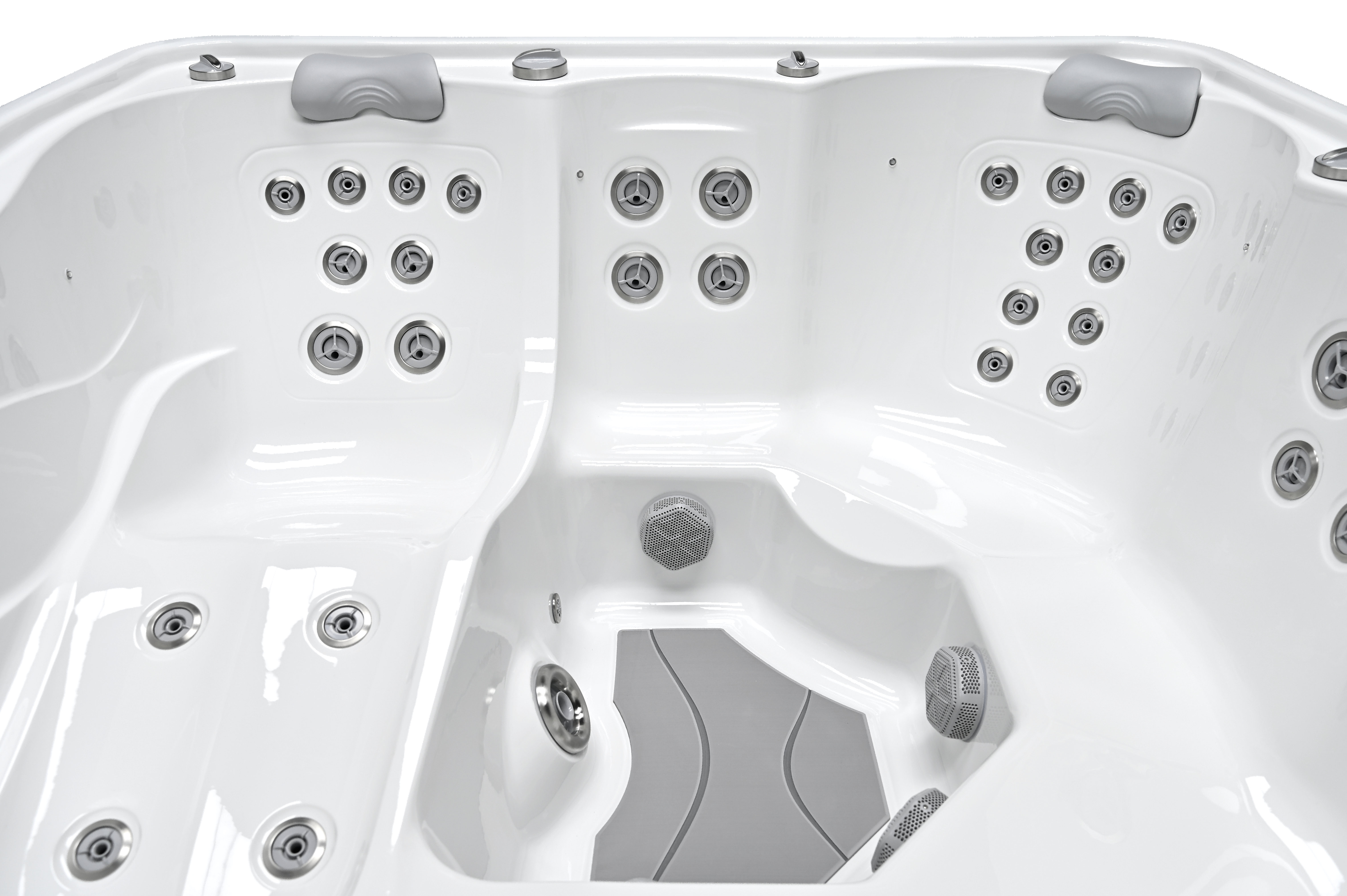
Interior layout of a hot spa with hydrotherapy seating. Jet count is only meaningful alongside pump capacity, jet type and seat geometry.
Technical explanation: which numbers actually move ownership cost
Insulation is a system, not a layer
Two insulation approaches dominate spa construction. Full foaming injects expanding foam between the shell and cabinet so that it surrounds plumbing and structural components, reducing heat transfer and supporting the pipework. Edge foaming places foam mainly around the shell perimeter, leaving more accessible space around internal components for inspection and service. Neither is universally superior: full foaming favours heat retention, edge foaming favours service access. Crystal Island's Platinum Lock approach combines full-foam insulation, a thermal cabinet and the spa cover as one assembly, and insulation specification varies by series.
Energy figures are benchmark comparisons, not field averages
Company data for selected hot tub models states consumption of 3.65 kWh per day against a CEC theoretical benchmark of 4.96 kWh per day, described as 27% below the benchmark. Dealer case records tell a consistent story over longer periods: a German spa and pool dealer operating 1,800 units over eight years reports approximately 27% lower energy consumption than the CEC theoretical benchmark, while a French retailer with 150 swim spas and an Austrian retailer with 100 exercise pools report approximately 26% lower consumption over eight-year relationships.
Those figures should be read for what they are. A benchmark comparison is a standardised reference point, not a metered average across climates. Actual consumption moves with set-point temperature, cover discipline, ambient conditions, bather load and sanitation cycles. A buyer comparing two suppliers should compare the benchmark each one uses, and should treat any single daily kWh figure without its reference standard as unverifiable.
Jets, pumps and water treatment
Jet count alone does not describe massage quality. What determines the experience is the relationship between jet type, jet placement, seat ergonomics, pump capacity and how many jets can operate simultaneously. A 39-jet spa running two 3 HP massage pumps behaves differently from a 39-jet spa running one, and the Ergo-Flat jet geometry used across the S1 fittings is designed around body contours rather than around a headline number.
Water treatment follows the same logic. Ozone and mineral purification reduce the chemical workload; multi-stage filtration removes suspended particles; the circulation pump keeps water moving through filtration independently of the massage pumps. In commercial settings the sanitation cycle matters more than in residential use, because shared use raises the biological load that the treatment system has to manage between sessions.
Application fit: four scenarios where the constraints differ
Year-round residential outdoor installation. The dominant constraints are freeze protection, insulation and cover performance. Recorded scenarios for residential hot tub use specify outdoor installation with high humidity exposure, chemical-resistant shells, cold-resistant motors and integrated freeze protection that activates below 6°C and heats the water to 10°C.
Hospitality and leisure. Hotels, resorts and leisure facilities add frequency and shared use to the same physical constraints. Scenario data for hospitality hot tub installation covers indoor or outdoor leisure environments with frequent water exposure and repeated daily operation, requiring UV- and weather-resistant cabinet materials, corrosion-resistant components and water-resistant electrical parts. For large covers, powered operation becomes a handling requirement rather than a convenience: the MC4A is rated IP54 and −20 to 50°C ambient, with cover sizes extending to 8,095 × 2,460 mm.
Wellness and recovery. Hot and cold contrast is now a specification category in its own right. The Ice Bath CTA100 is a stainless-steel unit measuring 2,002 × 750 × 740 mm, weighing 132 kg, with 500 W cooling power, R290 refrigerant, 270 L standard and 388 L maximum water capacity, direct cooling, ozone venturi sanitation, multi-stage filtration, touch panel control, a timer range and a 0–43°C ambient operating environment. Paired with a hot spa, it forms a contrast circuit whose electrical and drainage requirements must be planned together, not added later.
Dealer and OEM programmes. Here the constraints are commercial: minimum order quantity, lead time, capacity, spare-parts supply and whether certification can be matched to the configuration being ordered. Crystal Island states OEM/ODM coverage across hot tubs, swim spas, exercise pools, ice baths and infrared saunas, with electrical, filtration and insulation configurations customisable by project, subject to order volume and cooperation terms.
Market trend: hot, cold and the documentation in between
Three trends are visible in the available data. First, the hot segment remains large and regionally concentrated: USD 5.76 billion globally in 2025, with North America at 41.84% share. Second, the cold segment is smaller but is forecast to grow from USD 381.7 million in 2026 to USD 659.9 million by 2033. Third, portfolio breadth is increasing at manufacturer level: MasterSpas lists hot tubs, swim spas and cold tubs and also distributes saunas and ice baths, while PDC Spas lists fourteen hot tub models with up to eight seats and up to 143 hydrotherapy jets, alongside an eighteen-model swim and fitness spa collection ranging from 12 to 19 feet.
The procurement consequence is that buyers increasingly evaluate a supplier across categories rather than within one. That shifts weight toward documentation: a supplier able to match certification to model, market and configuration across several product lines reduces the number of separate approval conversations a distributor has to run. It also raises the cost of imprecision, because a certificate that covers a cold plunge line says nothing about a hot tub.
One caution belongs here. Market estimates for the same year can differ substantially depending on whether commercial infrastructure and service parts are included, so a figure should always be quoted with its definition. Trade classification adds a second layer: hot tubs and swim spas fall under HS Code 9019.10, mechano-therapy appliances and massage apparatus, which is not intuitive for a product most buyers think of as garden equipment.
Comparison with traditional alternatives — and where acrylic hot spas stop
| Criterion | Factory-built acrylic hot spa | Site-built concrete or tiled spa | Entry-level inflatable or rotomoulded spa |
|---|---|---|---|
| Installation route | Delivered as a tested unit, positioned on a prepared base, connected to a matched supply | Constructed on site; electrical and plumbing work inspected separately | Minimal site work; typically positioned on a flat surface |
| Certification path | Product-level assessment against spa safety and EMC standards, scoped to named models | Equipment certification plus site electrical inspection; the finished vessel is not assessed as a single product | Product-level assessment, often for a narrower feature set |
| Geometry flexibility | Limited to available moulds; customisation concentrates on colour, branding, controls, water treatment and insulation | Highest — shape and depth can be designed freely, at higher cost and programme risk | Fixed small formats |
| Insulation and running cost | Full foaming, thermal cabinet and cover can be specified as one system | Depends entirely on the build specification and detailing | Generally simpler construction with less thermal mass control |
| Service access | Cabinet panels give direct access to pumps, heater and controls | Plant room or remote equipment location; access depends on design | Access varies by model and is often restricted |
The boundary conditions deserve to be stated plainly, because a specification checklist is only useful if it includes the cases where the product does not fit. Crystal Island's customisation model is built on standard moulds: acrylic and cabinet colours from available options, logo printing, and configurable control, water treatment and insulation packages. A project that requires a bespoke shell profile or a non-standard footprint should confirm feasibility before design freeze rather than assume it. The minimum order quantity of 1 × 40′ FCL means the programme is not structured for single-unit or sample-quantity purchasing outside agreed terms. Certification follows the model and configuration, so a new pump, heater or control platform is not automatically covered by an existing certificate.
One further limit belongs in the same paragraph. The scale figures used in this article — factory area, annual output, export share, retail partner counts and global coverage — are company-reported. They were not independently audited within the evidence set used here. Buyer-side verification through a factory audit, third-party inspection or document review remains the appropriate step before a large programme is committed, and a supplier that expects that step is easier to work with than one that resists it.
Future outlook
Three developments are likely to shape hot spa procurement over the next few years. Refrigerant and efficiency choices will become more visible in product documentation: the use of R290 in the CTA100 ice bath shows how a component-level decision turns into a specification line that buyers now ask about. Standard revisions will continue to move the reference point, which means certificate validity windows and standard editions will be read as procurement data rather than as archive material. And traceability will continue to merge with compliance, because a factory that can trace a unit through RFID and IoT production management is also a factory that can tell a distributor precisely which configuration was assessed.
The commercial logic points the same way. As portfolios widen across hot, cold and recovery categories, the supplier relationship increasingly depends on the ability to answer a narrow question — is this model, at this rating, in this market, covered — quickly and in writing. Manufacturers that answer that question well will be shortlisted more often than those that answer it with a brochure.
Frequently asked questions
Which certifications should a hot spa carry for the EU, UK and Australia?
For the EU, a hot spa should be supported by CE marking based on low-voltage and EMC verification; Crystal Island holds, for whirlpool spas, LVD verification STUESO231100002HS and EMC verification STUEMO231100001HS. For the UK, the equivalent documents are UKCA-LVD STUESO231100003HS and UKCA-EMC STUEMO231100002HS. For Australia and New Zealand, the relevant document is SAA Certificate of Compliance SGS/250895, valid from 21 October 2025 to 20 October 2030, with an RCM declaration where applicable. The company states that ETL, CE, SAA, UKCA and RCM are available depending on the product, configuration and destination market.
Does a certificate for one hot tub model cover similar models in the same series?
No. Certification scope is model-specific and the named model list is the operative part of the document. SGS/250895, for example, lists individual whirlpool spa models including HEA560-1L1 at 220–240 V, 50 Hz, Class I, IPX5. A variant with a different model string is a separate entry rather than an inherited approval, so the correct check is to match the exact model and configuration against the certificate annex before ordering.
What electrical supply does a hot spa need?
The listed whirlpool spa models in the SAA certificate are rated 220–240 V, 50 Hz, Class I, with IPX5 protection. Crystal Island states that hot tubs can be configured for the USA, Canada, EU, UK and Australia, with certification and electrical requirements matched to the specific model, configuration and target market. The specific rating for a given order should always be confirmed on the model datasheet and certificate rather than inferred from the product family.
How is hot spa energy use assessed?
Energy use is normally assessed against a standardised benchmark rather than a single field measurement. Crystal Island reports 3.65 kWh per day for selected models against a CEC theoretical benchmark of 4.96 kWh per day, described as 27% below that benchmark, and insulation varies by series, with Platinum Lock combining full-foam insulation, a thermal cabinet and the spa cover. Because actual consumption depends on climate, set-point, cover use and bather load, benchmark figures are best used to compare methodologies between suppliers rather than as a prediction of a specific installation.
What are the ordering constraints for an OEM hot spa programme?
Crystal Island states a minimum order quantity of 1 × 40′ FCL, monthly capacity of 5,000 units, and typical lead times of 20–25 days for hot tubs and 25–30 days for swim spas and exercise pools, depending on model, configuration, quantity and production schedule. Every unit is tested. OEM/ODM covers hot tubs, swim spas, exercise pools, ice baths and infrared saunas, with electrical, filtration and insulation configurations, logo branding and model modification available subject to order volume and cooperation terms. After-sales covers technical support, warranty services, spare parts supply, order and logistics tracking and product lifecycle management.
What installation constraints affect a hot spa fitted with a motorised cover?
Both horizontal clearance around the spa and vertical lift height must be confirmed before installation. The Motorized Cover MC4A operates at 230 V / 50 Hz, 260 W, 1.7 A, with IP54 protection and an ambient range of −20 to 50°C; lift height spans 1,230–3,000 mm and cover sizes run from 4,540 × 2,460 mm to 8,095 × 2,460 mm, matched to product lengths from 4,430 mm to 7,985 mm. It is supported by SGS/260788 under AS/NZS 60335.2.60:2018 and AS/NZS 60335.1:2020 + A1, valid from 26 August 2026 to 25 August 2031, together with CE-LVD and CE-EMC verification. A correctly sized cover can still be unsuitable where walls, roofs or pergolas restrict the lifted position.
A company profile covering product lines, factory capability and certification detail is available for download: Crystal Island Hot Tub & Swim Spa Manufacturer Company Profile (PDF).
Have Questions or Need More Details?
Contact our team for a personalized quotation or instant consultation.
Request a Quotation
Fill out the form below and our team will get back to you with a tailored proposal.
WhatsApp Direct Chat
Prefer to chat in real-time? Message us on WhatsApp for instant assistance & quick answers.
- Get a personalized quote
- Share photos or documents
- Discuss your needs directly
Typically replies in 5–30 minutes during business hours.