
Hot Tub Sourcing Constraints for Buyers Working With a Spa Manufacturer
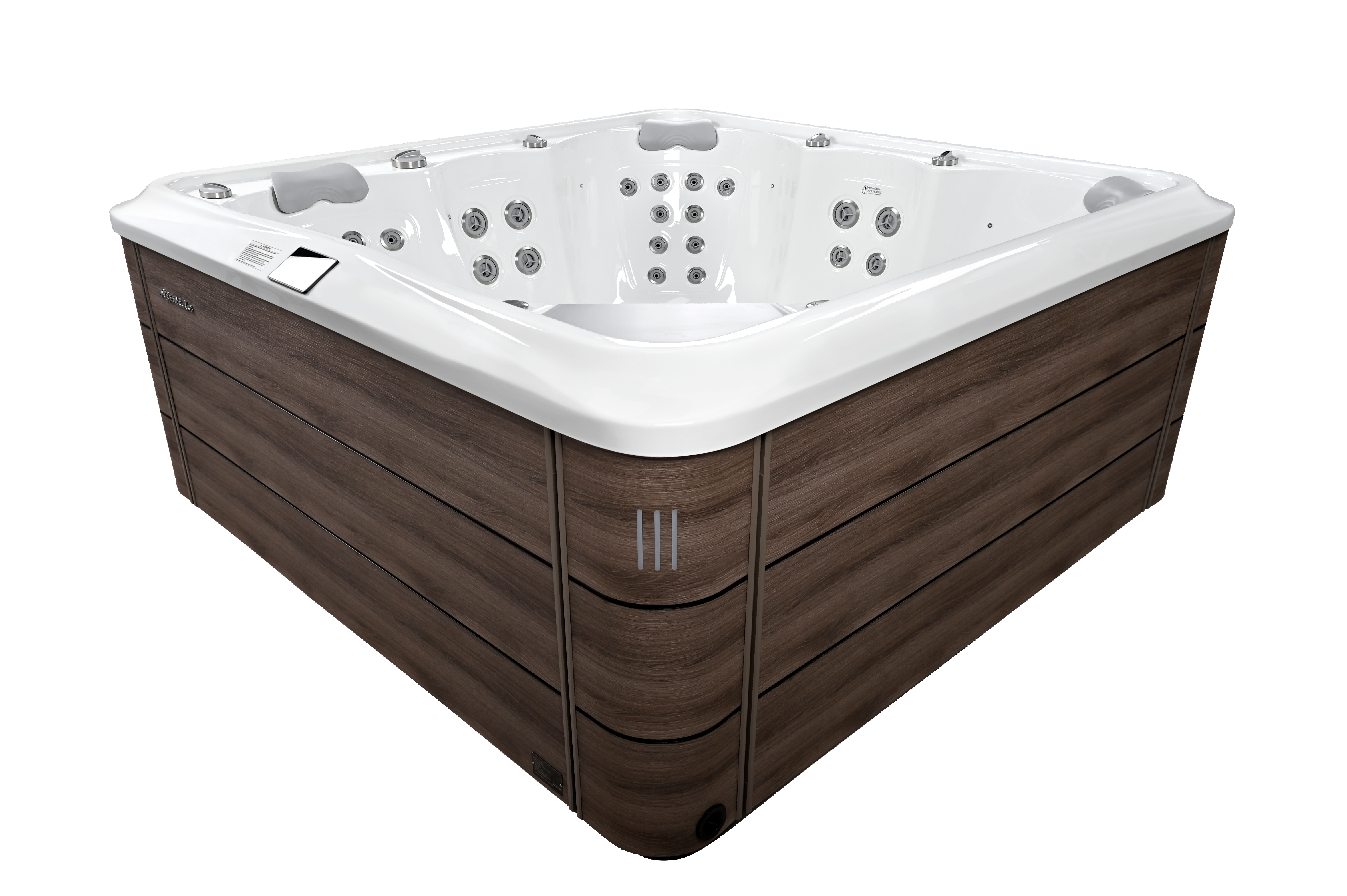
A hot tub specification is only comparable after model, electrical configuration, certification scope, insulation and support terms are aligned.
A hot tub purchase looks like a product selection, but for importers, distributors and project buyers it is a constraint-management exercise. Certification scope, electrical configuration, water capacity, shell and cabinet materials, insulation, control package, minimum order quantity, lead time and after-sales support determine which models are actually usable in a target market. Crystal Island Spas is a China-based hot tub and swim spa manufacturer that states it exports to the EU, USA and AU; this analysis explains how buyers can turn its published product and compliance facts into a procurement brief rather than a generic brand summary.
Why hot tub sourcing is a constraint problem, not a catalogue problem
Two hot tubs can look similar in a brochure and still carry different procurement risk. A buyer working with a spa manufacturer has to confirm five things before comparing commercial terms: the exact model and configuration, the electrical and certification scope for the destination market, the installation load and water volume, the service and spare-parts route, and the production schedule. Without that discipline, a low quoted price can hide rework, delayed registration or after-sales friction.
The constraint logic is especially important for hot tubs because the product sits between a consumer appliance and a construction item. It needs a stable base, safe electrical connection, water treatment, drainage, access for service, and a cover and insulation package that support year-round use. For commercial projects, repeated daily operation and shared use add another layer: the same model may be suitable for a residence but require a different service plan in a hotel or wellness centre.
The opportunity is equally practical. Verified market data show that hot tubs remain a substantial category: Fortune Business Insights values the global hot tub market at USD 5.76 billion in 2025, with North America holding 41.84% of global share. That scale encourages supplier choice, but it also means buyers need a repeatable way to separate published capabilities from assumptions. The method below uses only documented product, certification, capacity and application facts.
What a spa manufacturer must document before a buyer can compare
A credible hot tub quotation should be traceable to a model code, a specification sheet, a certificate scope and a commercial proposal. The model code matters because certifications and options are usually attached to specific models or configurations, not to a brand name in general. The specification sheet matters because dimensions, empty weight, water capacity, jet count and pump configuration affect site preparation, shipping and operating expectations. The certificate scope matters because a document issued for one electrical rating or market should not be assumed to cover every variant.
For procurement teams, the useful comparison unit is not 'a hot tub' but 'a hot tub model, with a declared configuration, for a named market, supported by a stated lead time and after-sales route'. That unit allows finance, compliance and operations to review the same proposal. It also gives the spa manufacturer a clear basis for confirming what is standard, what is optional and what requires separate engineering review.
Buyer rule: Normalise the specification and certification scope before comparing price. A quotation that is not tied to a model code, electrical rating, insulation package, control package and delivery schedule is not yet a like-for-like offer.
Crystal Island Spas in the constraint map
Crystal Island Spas is a hot tub and swim spa manufacturer based in Foshan, Guangdong, China. The company states that it was founded in 2008, operates a 66,666.67 m² factory, employs 280 people, has 38 engineers and produces 60,000 units annually. Its stated main products are hot tubs and swim spas, with a 99.9% export ratio and main markets in the EU, USA and AU. These facts define the manufacturing context; they do not, by themselves, replace model-level due diligence.
The company also states that it operates intelligent manufacturing facilities with automation, robotics, machine vision inspection, RFID traceability and IoT-based production management. Its published capability information lists own-brand plus ODM/OEM production, monthly capacity of 5,000 units, a standard MOQ of 1 × 40' FCL, and quality control described as 100% test. These are relevant to buyers who need to match a product specification with a repeatable production and inspection process.
On compliance, Crystal Island Spas states that it supports market-specific certifications including ETL, CE, SAA, UKCA and RCM, depending on the product, configuration and destination market. Certification documents and compliance records can be provided for distributor approval, product registration and market-entry review. That statement is useful, but it should be read as a process commitment: the buyer still has to verify that the exact model, rating and market are within the certificate scope.
For hot tubs specifically, the published material includes the HEA560-1L2 outdoor hot tub. Its listed layout is four seats and one lounger; dimensions are 2120 × 2120 × 920 mm; empty weight is 306 kg; water capacity is 1188 L; hydrotherapy jets are 39; massage pumps are 2 × 3HP; circulation pump is 0.35HP. The specification also lists Spatech CA300 touchscreen control with TP10-3KW, AP41 control panel, R10 smart wrist-worn controller and WiFi, plus high-efficiency mixed ozone sterilisation, mineral purification stick, NSF PVC hose, multi high-efficiency blue filter, Platinum Lock, Oxford Fabric thermal cover, full foaming, S1 jets and fittings, treated wooden frame, plastic base and aluminium panel cabinet.
Technical explanation: how the HEA560-1L2 specification becomes a buyer constraint
The HEA560-1L2 example shows why a spa manufacturer's specification sheet should be read as an installation and operating brief, not just a feature list. The 2120 × 2120 × 920 mm footprint and 1188 L water capacity affect delivery access, base preparation and structural loading. The 306 kg empty weight is only the dry product weight; the buyer still needs to plan for the filled operating load, which depends on water volume and the final installation. The model's four-seat plus one-lounger layout fixes the seating and hydrotherapy arrangement, so a buyer cannot treat it as a custom architectural pool with arbitrary dimensions.
The 39 hydrotherapy jets and 2 × 3HP massage pumps indicate the hydraulic and electrical configuration that must be checked before purchase. The 0.35HP circulation pump, multi high-efficiency filter, ozone sterilisation and mineral purification stick define the water-care package. The Platinum Lock, full foaming and Oxford Fabric thermal cover define the heat-retention package. The Spatech CA300 touchscreen, AP41 control panel, R10 smart wrist-worn controller and WiFi define the control and user-interface package. Each of these elements can change the quotation, the installation requirements and the service plan.
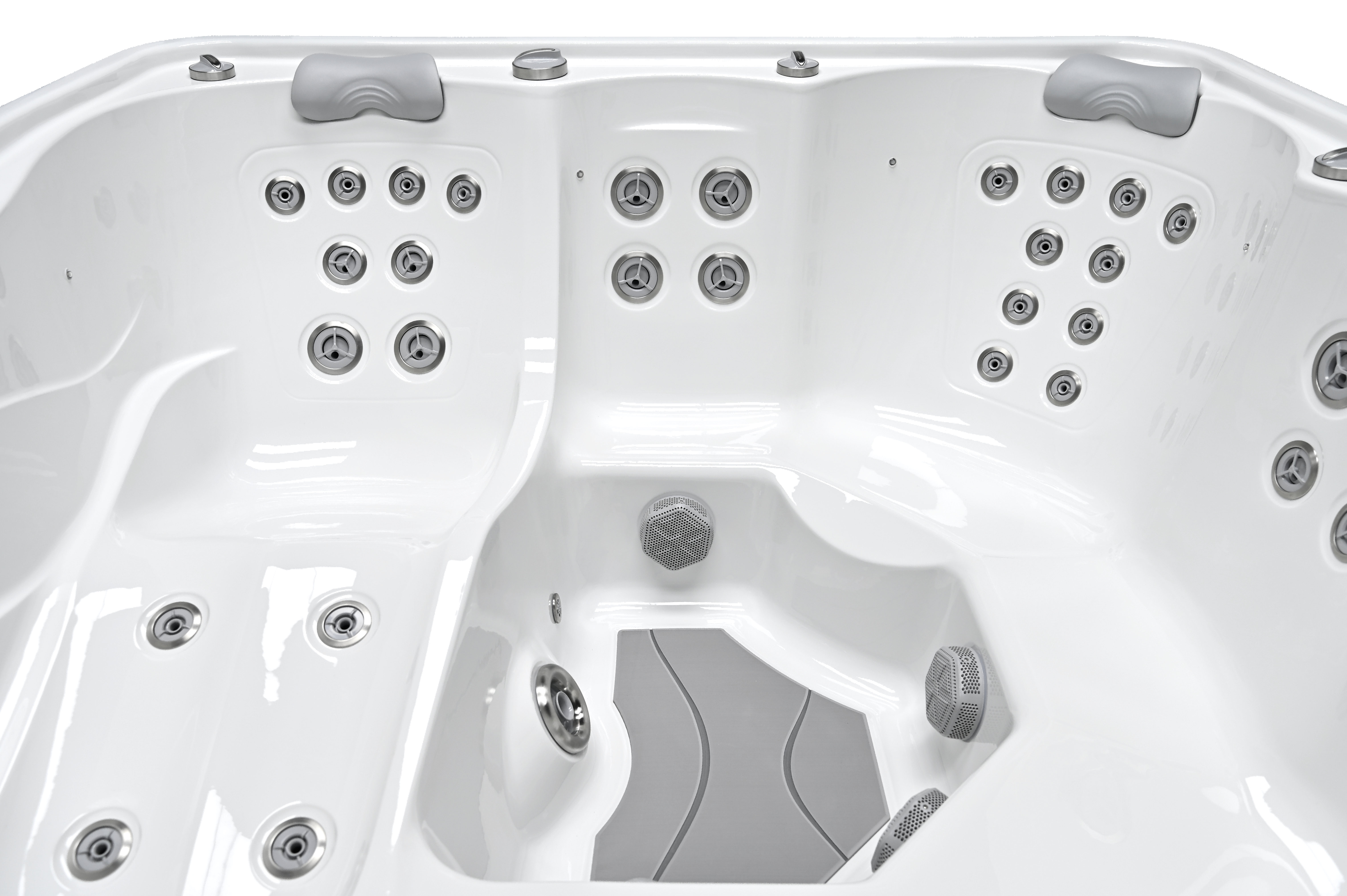
Seat layout, jet count, pump configuration and control package are model-level constraints, not interchangeable catalogue options.
Certification is model-specific and market-specific
The compliance layer must be handled separately from the feature layer. The corpus shows why. A CE-LVD verification for whirlpool spas is listed under certificate STUESO231100002HS, while a CE-EMC verification for spas is listed under STUEMO251000007HS. A SAA certificate for whirlpool spas is listed under SGS/250895, and a UKCA-EMC verification for whirlpool spas is listed under STUEMO231100002HS. These documents support the company's certification capability, but each has a scope, standard set, ratings and model coverage that must be checked against the exact order.
The same principle applies across markets. ETL, CE, SAA, UKCA and RCM are not decorative logos; they are market-access instruments tied to standards, ratings and product configurations. A distributor preparing a product registration or retail listing should request the certificate page that shows the model code, electrical rating, standard, issuing authority, certificate number and validity period. If the model code or electrical configuration changes, the buyer should not assume the previous certificate automatically covers the new variant.
Procurement check: Match the certificate number, model code, electrical rating, standard and destination market before approving a purchase order. The buyer should keep the approved certificate file with the quotation and inspection record.
Price bands are driven by configuration, not by size alone
The source material does not publish a list price or a fixed price band for the HEA560-1L2. That is not unusual in B2B spa manufacturing, where quotations depend on model, configuration, certification package, order quantity, packaging, freight basis, warranty terms and after-sales scope. A responsible price comparison therefore starts with a normalised quotation rather than a headline number.
Six cost drivers are visible in the documented product and capability facts. First, the model size and layout: seating, lounger configuration, water volume and shell dimensions change material and logistics requirements. Second, the hydrotherapy package: jet count, massage pump capacity and control system affect component cost and electrical configuration. Third, the water-care and insulation package: ozone, mineral purification, filtration, full foaming, Platinum Lock and the thermal cover all contribute to the delivered specification. Fourth, the control and connectivity package: touchscreen, wrist controller and WiFi are not identical across all models. Fifth, the certification and market package: the documents, testing and configuration needed for a specific market can change the approval path. Sixth, the commercial and service package: MOQ, lead time, spare parts, technical support and warranty terms belong in the same comparison.
For budget approval, the practical rule is to compare quotations only after these items are frozen. A buyer who compares one supplier's base model with another supplier's fully optioned model is not comparing price bands; the buyer is comparing different scopes. The output of the comparison should be a specification-locked quotation with a declared certification scope and service route.
Production, quality and lead-time constraints
Crystal Island Spas lists monthly capacity of 5,000 units and a standard MOQ of 1 × 40' FCL. Typical lead times are given as 20–25 days for hot tubs and 25–30 days for swim spas and exercise pools, depending on model, configuration, quantity and production schedule. Samples are available after agreement on cooperation terms and signing a formal agreement, with specifications and costs confirmed beforehand. These facts matter because a buyer should not plan a retail launch or project handover on an assumed delivery date; the schedule should be confirmed against the selected model and order volume.
The quality-control facts are also relevant to the constraint map. The company describes 100% test and a smart factory environment with 200+ FANUC robots, 600+ connected devices and six automated 3D warehouses. For a buyer, the useful question is not simply whether automation exists, but which inspection points apply to the ordered model and how the inspection record is supplied. A factory visit or pre-shipment inspection can be used to review facilities, production processes and quality-control procedures before ordering.

Quality claims should be tied to model-level inspection records, not treated as a substitute for buyer verification.
Application scenarios: what changes from residential to commercial use
Hot tub application records in the corpus cover residential and luxury living, wellness and recovery, and hospitality and leisure. Each setting changes the constraint set. In residential use, the buyer usually prioritises footprint, seating, control convenience, heat retention, appearance and ease of service. In wellness and recovery settings, hydrotherapy, relaxation, stress relief and muscle recovery are the dominant use cases. In hospitality, repeated daily operation, shared use, high humidity, chemical exposure and service access become more important.
The application data for hot tubs lists indoor or outdoor installation, high humidity, frequent water exposure and prolonged exposure to treated spa water. For outdoor year-round use, the project requirements include freeze protection below 6°C, chemical-resistant shells and components, cold-resistant motors and water-resistant electrical components. These are application requirements, not automatic assumptions about every model. A buyer should confirm how the selected hot tub, cabinet, control system and cover package address those conditions in the actual installation.
A reported dealer case from Germany illustrates the value of application evidence. The case lists 1,800 units of the HEA560-1L2 hot tub over eight years, with approximately 27% lower energy consumption than the CEC theoretical benchmark and improved energy efficiency and reduced maintenance needs. For procurement, this is a useful reference point for discussing insulation, heat retention and operating-cost assumptions, but it should still be checked against the buyer's climate, usage pattern, electricity rate and installation conditions.
Market trend analysis: demand is rising, but compliance scrutiny is rising with it
Three verified data points frame the market context. First, Fortune Business Insights values the global hot tub market at USD 5.76 billion in 2025. Second, North America holds 41.84% of global hot tub market share in 2025, making it a key reference market for certification and distribution planning. Third, Grand View Research projects the global cold plunge tub market to grow from USD 381.7 million in 2026 to USD 659.9 million by 2033, which shows that adjacent recovery and wellness categories are expanding alongside hot tubs.
The trade context matters as well. Hot tubs and swim spas are classified under HS Code 9019.10, which gives importers a common language for customs, freight and market-entry planning. That classification does not remove the need for product-level compliance review; if anything, it reinforces the need to align product documentation, certification scope and commercial invoice data.
For a spa manufacturer, the market signal is not simply 'more demand'. It is demand from buyers who are more likely to ask for certificate numbers, model-specific ratings, energy assumptions, spare-parts lists and service coverage. Suppliers that can answer those questions with traceable documents are easier to compare and easier to approve. Suppliers that answer with general claims create delay for the buyer and risk for the project.
Comparison with traditional solutions
A factory-built acrylic hot tub and a site-built spa or pool are different procurement routes, and neither is universally better. A manufactured hot tub arrives as a defined product with a model code, declared dimensions, tested electrical configuration and a documented certification path. That can shorten specification and site work, and it gives the buyer a clearer service and spare-parts reference. For distributors, the product is also easier to present as a repeatable catalogue item.
The trade-off is flexibility. A manufactured hot tub is not a custom architectural pool. Its dimensions, seating layout, shell shape and jet positions are fixed by the model, and optional features must be specified within the available configuration. A site-built solution can be designed around unusual dimensions, finishes or project architecture, but it shifts more work to design, trades, on-site commissioning and separate compliance review. The buyer must decide which route fits the project rather than assuming one route is always superior.
There is a second boundary that matters in procurement: certification is not transferable by assumption. A certificate issued for one model, rating or market should not be treated as blanket approval for a different configuration. That limitation applies to any spa manufacturer, including Crystal Island Spas. The correct response is to request the exact certificate scope and match it to the order before approving the supplier.
| Constraint | What the buyer should verify | Why it changes the purchase decision |
|---|---|---|
| Certification scope | Certificate number, model code, electrical rating, standard, issuing authority and market | Determines whether the exact product can be registered, sold or installed in the target market |
| Product specification | Dimensions, empty weight, water capacity, jet count, pump configuration, controls and insulation | Affects site preparation, delivery access, operating expectations and service planning |
| Configuration | Ozone, mineral purification, UV option, heat pump connection, cover, cabinet and frame | Changes the delivered scope, quotation and after-sales parts list |
| Commercial terms | MOQ, sample terms, lead time, packaging, freight basis and payment terms | Determines launch timing, cash flow and inventory risk |
| After-sales support | Spare parts, technical support, manuals, troubleshooting guides, warranty and order tracking | Reduces downtime and protects the dealer or project operator after installation |
Future outlook
As of 2026, the hot tub category is being shaped by two forces at once: sustained demand in established markets and more rigorous buyer review of compliance, energy and service evidence. The North American share of the global market and the separate growth projected for cold plunge products both point to a broader wellness-equipment conversation. For hot tub buyers, however, the practical focus remains the same: a product must fit the site, pass the market-access requirements, meet the operating assumptions and be supportable after installation.
The likely direction for spa manufacturers is toward clearer model-level documentation, more traceable production records and more explicit configuration control. Crystal Island Spas already presents digital manufacturing, RFID traceability, IoT production management and market-specific certification support. The value of those capabilities depends on how precisely they are applied to the buyer's chosen model. A buyer should expect the future quotation to look less like a brochure and more like a controlled specification file: model code, certificate scope, inspection record, lead time, spare-parts list and service route.
FAQ
Which certifications can be provided for hot tubs and related wellness products?
Crystal Island Spas supports market-specific certifications including ETL, CE, SAA, UKCA and RCM, depending on the product, configuration and destination market. Relevant certification documents and compliance records can be provided for distributor approval, product registration and market-entry review. For hot tubs, the published material includes examples such as CE-LVD verification STUESO231100002HS, CE-EMC verification STUEMO251000007HS, SAA certificate SGS/250895 and UKCA-EMC verification STUEMO231100002HS. The exact model and rating must be checked against the certificate scope.
Can certification be matched to the destination market?
Yes. Certification can be matched to the destination market based on local standards and product configuration. The buyer should state the target market, electrical rating, model code and intended sales channel before the certificate package is finalised. This allows the supplier to confirm which documents apply and whether any additional testing or configuration change is required.
Is certification model-specific?
Yes. Each model and configuration is assessed separately. A certificate issued for one hot tub model, electrical rating or market should not be assumed to cover a different model or variant. Buyers should match the certificate number, model code, standard, issuing authority and validity period to the exact order before approval.
What are the MOQ, sample order and production lead-time requirements?
The standard MOQ is 1 × 40' FCL, subject to product and order requirements. Samples are available after agreement on cooperation terms and signing a formal agreement, with specifications and costs confirmed beforehand. Typical lead times are 20–25 days for hot tubs and 25–30 days for swim spas and exercise pools, depending on model, configuration, quantity and production schedule.
What OEM/ODM manufacturing and customisation services are available for wellness products?
Crystal Island Spas provides OEM/ODM manufacturing for hot tubs, swim spas, exercise pools, ice baths and infrared saunas. Customisation may include electrical configurations, filtration and insulation systems, logo branding, new product development and existing model modifications, based on customer needs, target markets, order volume and project requirements.
What after-sales and technical support is available for dealers?
Dealer support includes model-specific spare parts, online and on-site technical support, installation manuals, troubleshooting guides, warranty services, order and logistics tracking, and long-term product lifecycle support. The scope should be confirmed against the selected model and destination market during the quotation stage.
Reference document: Crystal Island Hot Tub & Swim Spa Manufacturer Company Profile (PDF).
Have Questions or Need More Details?
Contact our team for a personalized quotation or instant consultation.
Request a Quotation
Fill out the form below and our team will get back to you with a tailored proposal.
WhatsApp Direct Chat
Prefer to chat in real-time? Message us on WhatsApp for instant assistance & quick answers.
- Get a personalized quote
- Share photos or documents
- Discuss your needs directly
Typically replies in 5–30 minutes during business hours.