
Hotel Chandelier Dimming and Load: A Technical Procurement FAQ
Industry Reference · Hospitality Lighting
Dimming compatibility and structural load capacity are the two technical questions that most often determine whether an oversized decorative lighting fixture moves from a design rendering into a signed procurement order. In a hotel project, a chandelier is no longer purchased as a decorative object alone. It is purchased as a light source, a driver, a control interface, a suspension system and an installation procedure that has to perform every evening for years.
The commercial weight behind that shift is measurable. The global hospitality lighting market was valued at USD 14.2 billion in 2025 and is expected to grow at a CAGR of 7.3% to reach USD 26.8 billion by 2034, according to Dataintelo. Commercial applications, including hospitality, accounted for 62.8% of the decorative lighting end-user market in 2025, based on IMARC Group's decorative lighting data. The broader decorative lighting market reached USD 75.88 billion in 2025 and is projected to reach USD 78.98 billion in 2026, per Mordor Intelligence.
Within that volume, the fixtures carrying the highest technical risk are the largest ones: lobby chandeliers, banquet hall chandeliers, high ceiling chandeliers and bespoke oversized compositions suspended over double-height entrances and atriums. These are precisely the fixtures where dimming behaviour and structural load stop being aesthetic questions and become procurement ones.
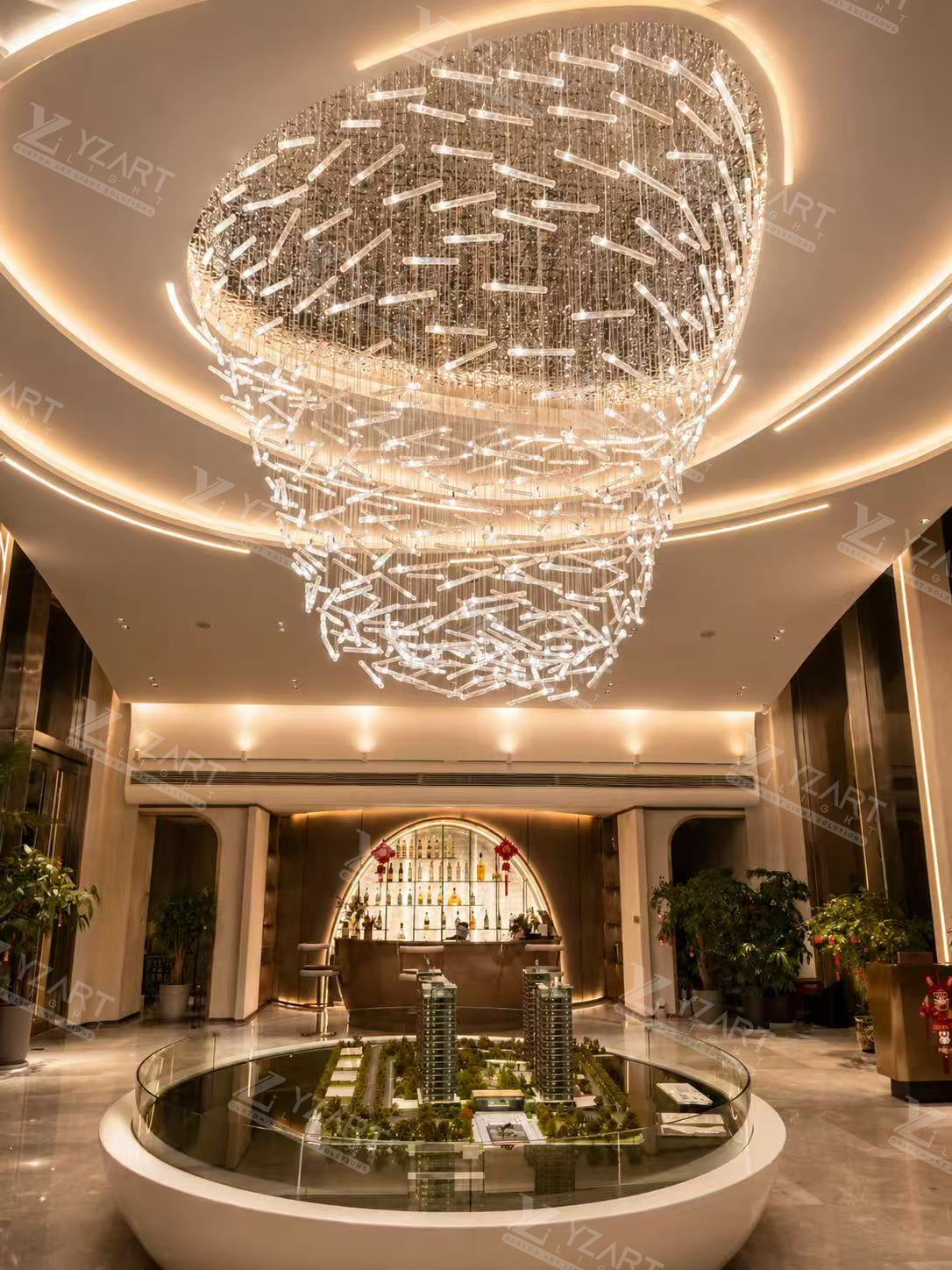
Three questions that decide an oversized chandelier order
At decision stage, the technical conversation in a hotel project usually compresses into three questions, and each of them belongs to a different party on the project team. None of them can be answered by the manufacturer alone.
- Will the fixture dim smoothly and repeatably on the control system already specified for the space — including the scene levels that run every evening for the life of the property?
- Can the ceiling structure accept the fixture's dead weight, the suspension hardware and the installation tolerances without additional reinforcement or a redesign of the suspension layout?
- Can a made-to-order fixture be adapted to a special-shaped ceiling, a sloped soffit or a recessed canopy without losing the design intent the interior designer approved?
Two data points explain why these questions moved forward in the process. According to Dataintelo (2024), 56% of new luxury hotel projects now require dimmable chandelier installations for guest ambiance. Separately, the 2024 International Energy Conservation Code (IECC), published by the International Code Council, expanded occupancy and dimming requirements for lobbies and meeting areas. Dimming has therefore stopped being an option added late in a project and become a code-adjacent expectation written into the brief from the start.
Dimming compatibility: what has to match before the fixture is built
Smooth dimming is not a property of a chandelier. It is the outcome of four components agreeing with each other: the light source, the LED driver, the dimming interface and the zone architecture of the control system. A fixture can be structurally perfect and still dim badly if the driver installed inside it was not matched to the interface running the room.
Glare control is a separate function from dimming, and buyers frequently conflate the two. Glare control is handled by shielding geometry, diffusers and the position of the light source relative to the eye line. Dimming is handled electrically by the driver and the control interface. In custom hotel lighting, both are decided during design rather than on site. Project records for this type of work describe custom soft-glare-shielded light sources adopted specifically to eliminate harsh glare and uneven light distribution in guest rooms, with the built-in anti-glare light source assembled on site as part of the frame and shade assembly, followed by a power-on test, lamp angle adjustment and a check of lighting uniformity.
Because a bespoke chandelier is engineered to order rather than selected from a catalogue, the driver can be specified to match the project's dimming interface instead of the project being adapted to the fixture. That is the practical meaning of "compatible" in this context. YZ ART LIGHT, a manufacturer of high-end decorative and project lighting based in Zhongshan City, Guangdong Province, China, works on a project-based model from design through installation guidance and states that special protection and lighting control requirements are confirmed separately per product. The implication for procurement is straightforward: the dimming interface must be declared at specification stage, not discovered at commissioning.
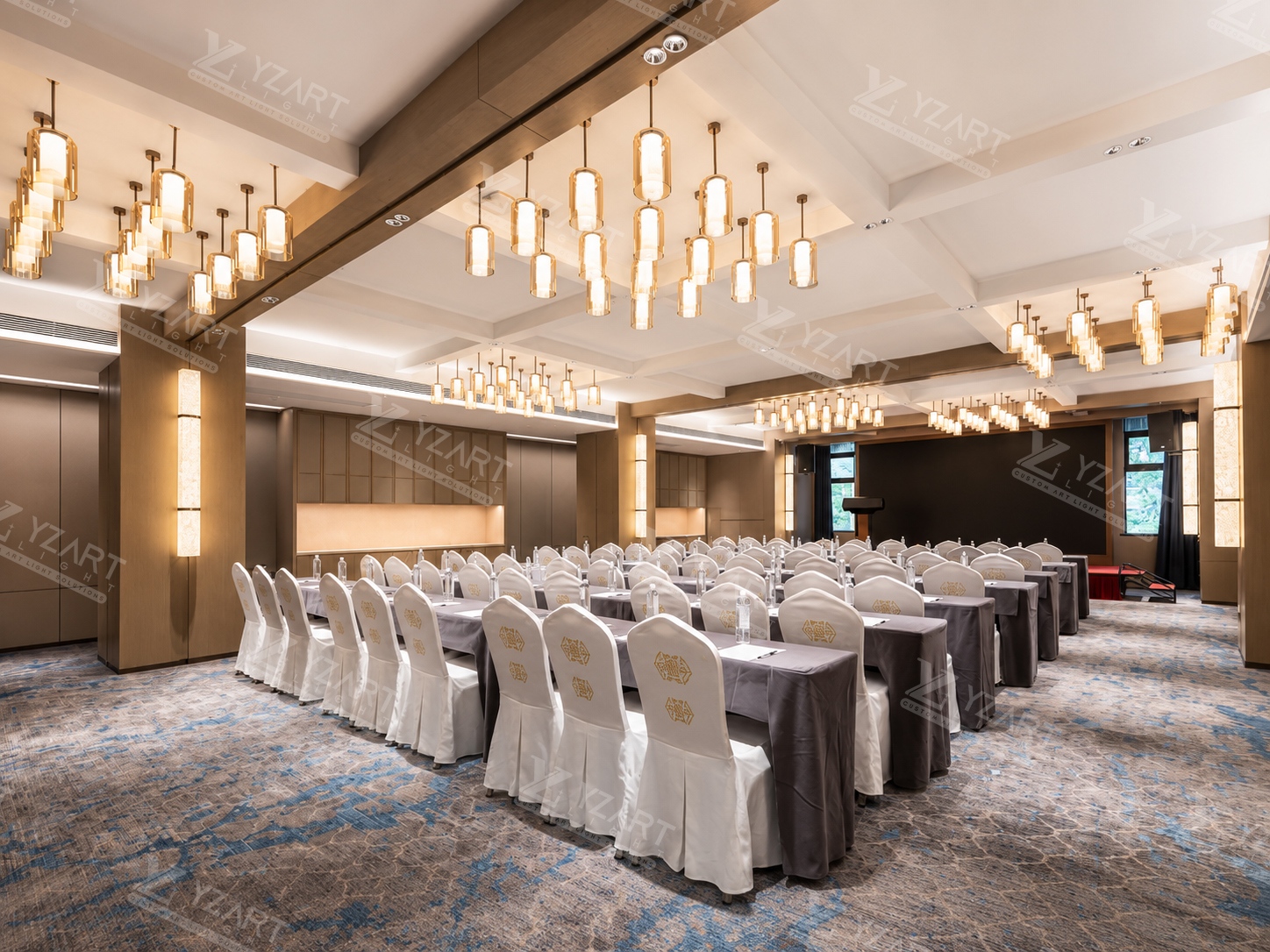
Dimming interface checklist for a custom chandelier
| Item to confirm | Usually confirmed by | Why it changes the delivered fixture |
|---|---|---|
| Dimming interface type (for example DALI, 0–10 V, phase-cut or a proprietary hotel protocol) | Lighting designer / MEP consultant | Determines which class of LED driver is built into the fixture and how it is wired |
| Zone and channel structure per fixture | Lighting designer | Determines internal wiring and the number of driver outputs required |
| Behaviour at the bottom of the dimming range | Control system integrator | Determines whether the fixture holds a stable low level or flickers and drops out |
| Driver location and service access | Manufacturer and site contractor | Determines whether a driver can be replaced without dismantling the composition |
| Emergency or standby circuit requirement | MEP consultant | Determines whether a separate non-dimmed circuit must be run to the fixture |
| Glare-shielding requirement at the specified output | Lighting designer and manufacturer | Determines shielding geometry and diffuser choice at the delivered brightness |
Structural load for oversized hanging fixtures
For a large project chandelier, the load question is not only the weight of the fixture. It is the fixture weight plus suspension hardware, canopy, wiring and the tolerances that installation and future maintenance introduce. Two categories of information therefore have to exist before the fixture is hoisted: fixture-side data provided by the manufacturer, and structure-side verification carried out for the building.
The manufacturer's responsibility covers the fixture and its suspension design. In this type of non-standard project work, that means the fixture weight, the number and position of suspension points, the canopy or ceiling-rose arrangement, and the structural optimisation carried out during scheme development, alongside the finishing and manufacturing steps performed on in-house laser-cutting automated equipment and welding stations.
The site-side procedure is where the two information sets meet. Documented installation guidance for custom non-standard chandeliers in hotel lobbies follows a sequence that begins before any electrical work: check the ceiling load-bearing capacity, measure the reserved size and mark the suspension points, and isolate the mains supply. Assembly of the lamp frame, shade and built-in light source follows; then insulated concealed wiring, fixing of embedded fasteners and hoisting of the complete composition; and finally a power-on test with adjustment of lamp angle and verification of lighting uniformity.
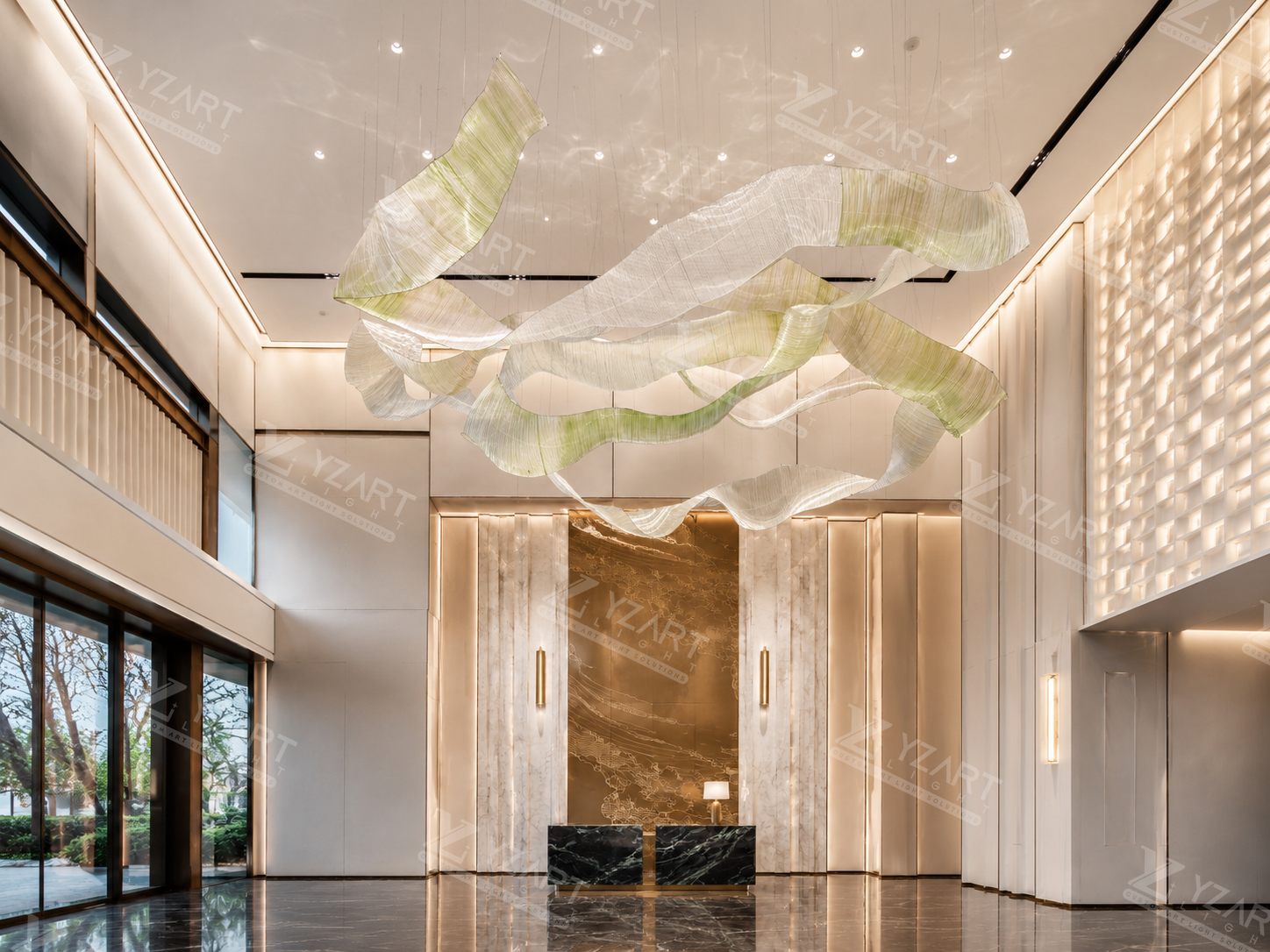
Special-shaped ceilings, reserved sizes and floor-to-ceiling height
The third technical question is geometric. A special-shaped suspended ceiling changes where a fixture can attach, how it can be centred in the room and how much vertical space the composition can occupy without appearing to be squeezed into the void.
In practice, custom-made lamps for this application are developed according to floor-to-ceiling heights and reserved installation sizes so that they suit special-shaped suspended ceilings rather than being forced onto a standard grid. Project-based custom shapes and special material processing are accepted under the same workflow, and linear or combined-style light fixtures can be tailor-made in accordance with spatial structures — a requirement that shows up often in lobbies, function halls and light-luxury dining venues where a single centred pendant will not sit correctly above the space.
For buyers, the useful discipline is to record four measurements before releasing an order: the clear floor-to-ceiling height in the finished condition, the reserved installation size and canopy recess depth, the positions of beams, soffits or ductwork that intersect the suspension points, and the horizontal boundaries of the ceiling feature the fixture must sit within. These four values translate directly into the fixture's drop length, canopy design and suspension layout.
Where these fixtures are used across a hotel
The same engineering questions appear in different proportions depending on the space. Full-scale lighting projects for star-rated hotels typically cover custom-manufacture of a full range of fixtures for high-end hotel lobbies, banquet halls, guest rooms, executive lounges and presidential suites, from design and sample-making through to bulk delivery.
- Lobby and high-ceiling entrance: the largest suspension loads, the longest drops and the most visible dimming transitions.
- Banquet hall and ballroom: the heaviest dimming duty cycle, with multiple scene changes per day and a requirement for uniform output across many fixtures.
- Guest rooms and corridors: glare control dominates, because the light source sits inside the guest's field of view; soft-glare-shielded sources are used to avoid harsh glare and uneven light distribution.
- Restaurants, lounges and bars: custom warm-toned ambient lighting is used to build immersive dining settings and to raise the perceived quality of the space.
- Commercial real-estate and show spaces: non-standard artistic pendant and wall fixtures for sales office lobbies, sand-table zones and show flats, where the fixture is part of the sales environment rather than a background element.
Operating conditions in these spaces are commercial rather than domestic. Fixtures are specified for long-hour daily operation with stable light attenuation, and low-maintenance access matters as much as appearance.
Market signals behind the specification shift
Three published trends support treating dimming and load as first-order procurement items rather than finishing details.
First, LED is now the dominant source in this category. LED lighting held a 39.8% share of the decorative lighting light-source segment in 2025, according to IMARC Group, and LED-integrated chandeliers capture over 54% of market volume annually, per Market Research Hub / Horizon Databook. Because LED output is controlled by a driver rather than a simple dimmer, the interface question travels with the light source by default.
Second, control intelligence is entering the fixture category itself. Smart chandeliers with voice control or IoT connectivity represent over 33% of new product launches, based on Market Reports World data. Even where a hotel does not adopt consumer-style control features, the expectation that a fixture can be addressed by a building management or lighting control system is spreading into procurement documents.
Third, the geographic centre of growth is shifting. Hospitality lighting, which operates largely through B2B direct sales and projects, is growing fastest in Asia-Pacific at a 5.98% CAGR, according to Mordor Intelligence, while the transitional design segment accounted for 65.7% of total chandelier market revenue in 2024, per Grand View Research — a style position that relies heavily on layered, dimmable illumination rather than on a single bright source.
Factory-direct engineering versus trading-agent supply
Where the fixture is technically demanding, the supply route changes what a buyer can actually control. The comparison below reflects documented positioning for factory-direct custom manufacturing relative to traditional trading agents and suppliers without in-house manufacturing.
| Comparison point | Factory-direct custom manufacturer | Trading agent or supplier without in-house manufacturing |
|---|---|---|
| Project support model | Direct factory-backed project support for hotel chandelier installations | Support mediated through a third party; technical answers route externally |
| Process control | In-house laser-cutting automated equipment and full-process non-standard customisation, with no middle-man links | Production is placed with an external factory; process visibility depends on that factory |
| Comprehensive cost on custom orders | Documented at 15%–30% lower comprehensive cost for customised lamp orders | Carries additional margin layers between factory and site |
| Track record | Over 1,000 finished hotel-oriented engineering projects and 15 years of experience in custom-made lamps | Not a comparable disclosure in most cases |
| Delivered energy performance | LED light sources with 40%–60% better energy efficiency than conventional decorative lamps and stable light attenuation | Depends entirely on the upstream factory's component choice |
The limitation of the factory-direct route is real and should be stated: this is a project-based manufacturing model, and it depends on project-side information arriving early. Dimming interfaces, ceiling conditions and reserved installation sizes have to be confirmed before production begins. Where those inputs are missing at the tender stage, the manufacturer cannot substitute for the project's structural engineer or MEP consultant, and a late change to the control protocol or the ceiling layout is more disruptive in a made-to-order fixture than in a catalogue product. Factory-direct supply removes intermediaries and lowers comprehensive cost; it does not remove the need for coordinated project information.
What changes next in hotel chandelier procurement
The direction of travel is toward the fixture being procured as a system rather than a product. As energy codes continue to extend occupancy and dimming requirements in public and meeting areas, and as control protocols penetrate further into hospitality specification, the questions asked at tender stage will increasingly resemble the ones in this article: which interface, which driver, which suspension arrangement, and which party is responsible for verifying the ceiling.
For buyers, the practical consequence is a shift in when documents are assembled. Dimming schedules, ceiling coordination drawings and installation responsibilities need to be fixed earlier than they were when decorative lighting was treated as a finishing package. For manufacturers, the corresponding capability is engineering fluency in-house — structural optimisation, driver specification and fabrication control — because those are the points at which a design intent either survives into the delivered fixture or does not.
Technical procurement FAQ
Are anti-glare chandelier light sources compatible with hotel dimming systems?
They are two independent functions, and compatibility depends on how the fixture is specified rather than on the light source alone. Glare control is achieved through shielding geometry and diffusers; dimming is controlled by the LED driver and the control interface. In custom hotel lighting projects, soft-glare-shielded LED light sources are used to eliminate harsh glare and uneven light distribution, and because the fixture is built to order, the driver inside it can be matched to the project's dimming interface. The condition attached to that is that lighting control requirements are confirmed separately for each product, so the interface type must be declared at specification stage rather than assumed.
How is the structural load of a super-large hanging chandelier verified?
Verification is split between two parties. The manufacturer provides fixture-side data — weight, number and position of suspension points, and canopy dimensions — and carries out structural optimisation during scheme development. The project side verifies whether the ceiling structure can accept that load. Documented installation guidance for this type of fixture begins with checking ceiling load-bearing capacity, measuring the reserved size and marking the suspension points before any assembly or wiring is carried out, followed by hoisting, a power-on test and a lighting uniformity check. The ceiling capacity itself must be confirmed against the building's structural documentation by the responsible engineer.
Can a bespoke chandelier be adapted to a special-shaped or sloped ceiling?
Yes, within a project-based custom workflow. Custom-made lamps are developed according to floor-to-ceiling heights and reserved installation sizes so that they suit special-shaped suspended ceilings, and project-based custom shapes and special material processing are accepted. Linear and combined-style fixtures can also be tailor-made in accordance with spatial structures. The practical requirement is that the finished clear height, reserved installation size, canopy recess depth and any intersecting beams or ductwork are measured and supplied before production is released.
What information should be confirmed before ordering to avoid dimming problems?
Six items are worth fixing in writing: the dimming interface type used by the project's control system; the zone and channel structure per fixture; expected behaviour at the bottom of the dimming range; driver location and service access; any emergency or standby circuit requirement; and the glare-shielding requirement at the delivered brightness. Because lighting control requirements are confirmed separately per product on custom orders, these items belong in the specification rather than in post-delivery adjustment.
What changes when an oversized fixture is supplied factory-direct rather than through a trading agent?
Three things change measurably. First, project support is factory-backed for hotel chandelier installations rather than mediated through an intermediary. Second, production process control sits in-house, with laser-cutting automated equipment and full-process non-standard customisation and no middle-man links. Third, comprehensive cost on customised lamp orders is documented at 15%–30% lower. Track record for this route includes over 1,000 finished hotel-oriented engineering projects and 15 years of experience in custom-made lamps.
What are the limits of the custom-manufacturing route?
It is a project-based model with real dependencies. Production assumes that the dimming interface, ceiling conditions and reserved installation sizes are confirmed in advance, and a manufacturer cannot substitute for the project's structural engineer or MEP consultant when ceiling capacity is in question. Late changes to control protocol or ceiling layout are more disruptive in a made-to-order fixture than in a catalogue product. Where project information is incomplete at tender stage, the fixture specification — not the supply route — is usually the item that has to be resolved first.
What energy and lifespan figures apply to LED fixtures at this level?
Documented figures for LED-based custom decorative fixtures place energy efficiency at 40%–60% better than conventional decorative lamps, attributable to energy-saving LED light sources and stable light attenuation. The long-life LED light source is rated for 50,000 working hours, which is longer than the expected lifespan of conventional decorative lamps. These values describe the light source and driver combination delivered with the fixture, not the control system that operates it.
What warranty and after-sales support is provided?
Documented terms cover a 3-year product warranty, nationwide on-site installation support, quick spare-part supply and remote overseas technical support. For international hotel projects, the practical value of these terms lies in spare-part availability for drivers and light sources, since those are the components most likely to require replacement during the operating life of an oversized fixture.
Reference documents
Zhongshan YZ ART LIGHT Co., Ltd. company and product brochure (PDF): company brochure
Company website: www.yzartlight.com