
Hotel Hot Tub Choice: 3-Person vs 6-Person Units
Hotel Hot Tub Choice: 3-Person vs 6-Person Units
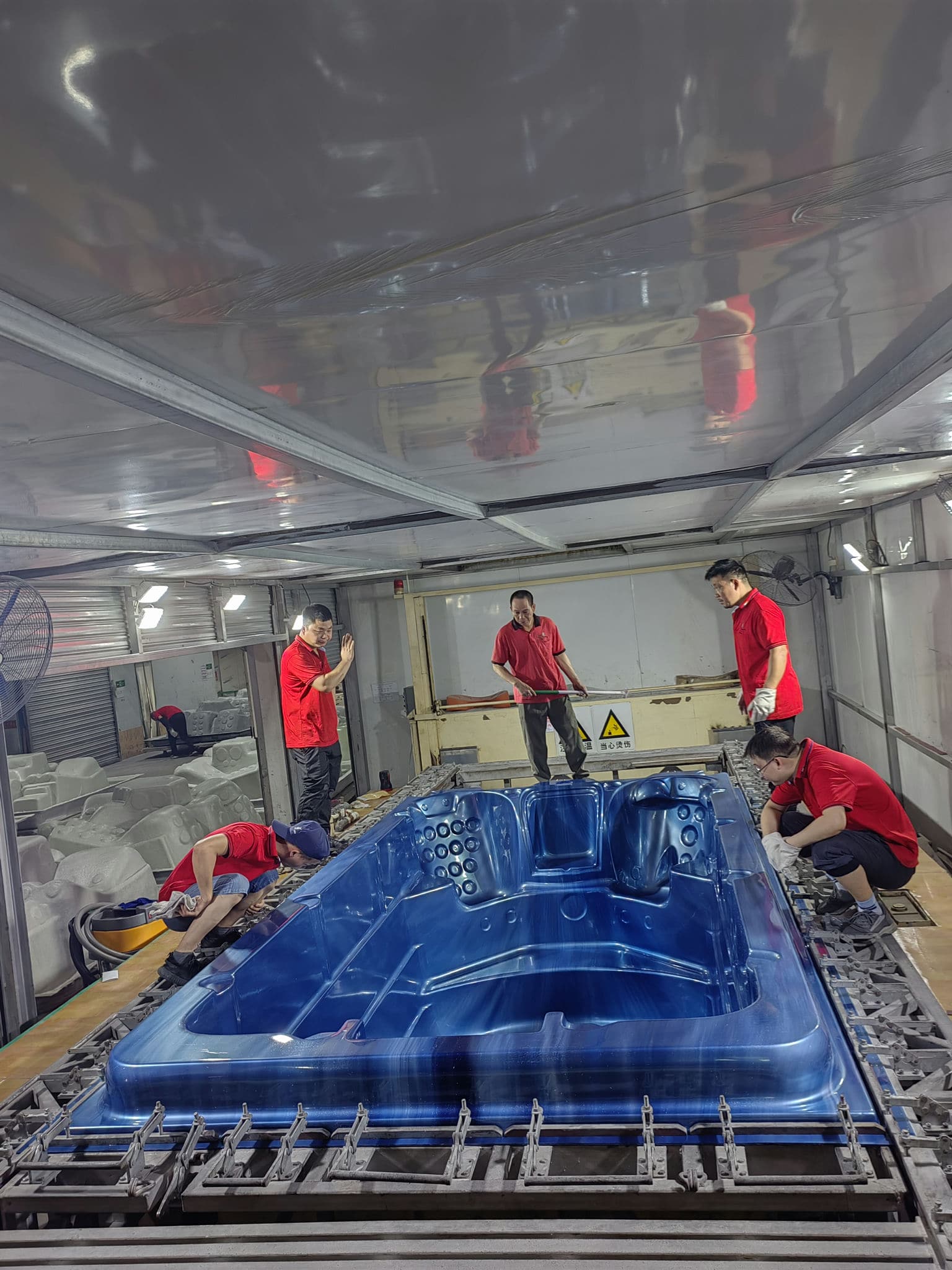
Acrylic spa shell forming is one production stage that affects shell consistency; hotel buyers should still verify model-level shell and support specifications.
For hotel and resort buyers, the decision between a 3-person and a 6-person hot tub is not a simple size upgrade. The occupancy label describes a product category, not a standardized usable capacity. Public supplier listings can show 3-, 5-, and 6-person outdoor hot tubs, but those listings do not establish equivalent dimensions, water volume, jet count, or usable capacity (EV-0009). A credible comparison therefore starts with the project role—guest suite, spa treatment room, poolside wellness area, or shared relaxation space—and then tests each candidate against site load, installation format, service access, hydrotherapy design, water maintenance, certification and model-level documentation.
This buyer guide compares the two classes on those decision criteria. It does not rank suppliers or claim that one class is superior. It also does not assume that a 6-person label always means more bathers, more water or higher operating cost. Those are model-specific questions that must be answered from drawings, datasheets and project conditions.
Why the 3-person vs 6-person label needs a verification step
Occupancy labels are useful for early assortment screening. They help a procurement team separate a compact unit for a couple-oriented suite from a larger unit intended for a shared wellness area. They are not a common engineering benchmark. The supplied verified data specifically notes that 3-person, 5-person and 6-person labels appear in supplier catalogs, while the same data warns that the listings do not establish equivalent dimensions, water volume, jet count or usable capacity (EV-0009).
That gap matters in a hotel or resort project because the same label can describe different seating layouts, different shell contours and different equipment packages. A buyer who compares two 6-person hot tubs without model drawings may be comparing a lounge-heavy layout with a bench-heavy layout, or a unit with a larger water body with one that uses a more compact shell. The correct first step is to request a model-level specification sheet and dimensional drawing for every candidate.
The second step is to separate the commercial question from the technical question. The commercial question is whether the unit fits the guest experience and the property’s operating model. The technical question is whether the floor, access route, electrical supply, drainage, ventilation, service route and water-treatment plan can support the selected unit. Neither question is answered by the seat count alone.
Decision framework: start with the project role, not the seat count
A practical hotel/resort comparison usually begins with where the hot tub will sit and who will use it. The following framework is conditional; it is not a claim about every 3-person or 6-person model.
When a 3-person class is more likely to fit
A smaller hot tub class is more likely to fit a guest suite, a premium room terrace, a spa treatment room or a limited-footprint wellness corner where privacy and individual guest use matter more than group capacity. In those settings, the buyer should check whether the actual seating layout supports the intended use—for example, whether the unit is designed for two users with space for a third, or whether the third position is a cooler bench seat. The label alone does not confirm that.
The smaller class also changes the site conversation. A compact unit may be easier to route through a service corridor or lift, but this must be verified against the packed dimensions and the actual access path. A hot tub is not automatically easy to install because it is smaller. Delivery, lifting, cover handling, drainage and future replacement all need a clear route.
When a 6-person class is more likely to fit
A larger hot tub class is more likely to fit a shared wellness area, a family suite, a poolside relaxation zone or a resort spa where several guests may use the unit at the same time. The buyer should then examine hydrotherapy zoning, pump configuration and jet operation more closely. The massage sensation is mainly determined by pump flow, jet design, jet combination and the air-to-water mixing ratio, not by jet count alone (646938). A larger unit with many jets can still deliver uneven performance if the pump and zone design do not support simultaneous use.
A larger class also places more weight on the operating plan. More bathers can increase filter loading and introduce more personal-care residue into the water, which is why the filter should be rinsed and inspected according to the manual and replaced when flow remains low or the media is damaged (3449). The point is not that a 6-person unit is harder to maintain in every case. The point is that the maintenance plan must match the actual bather load and the equipment configuration.
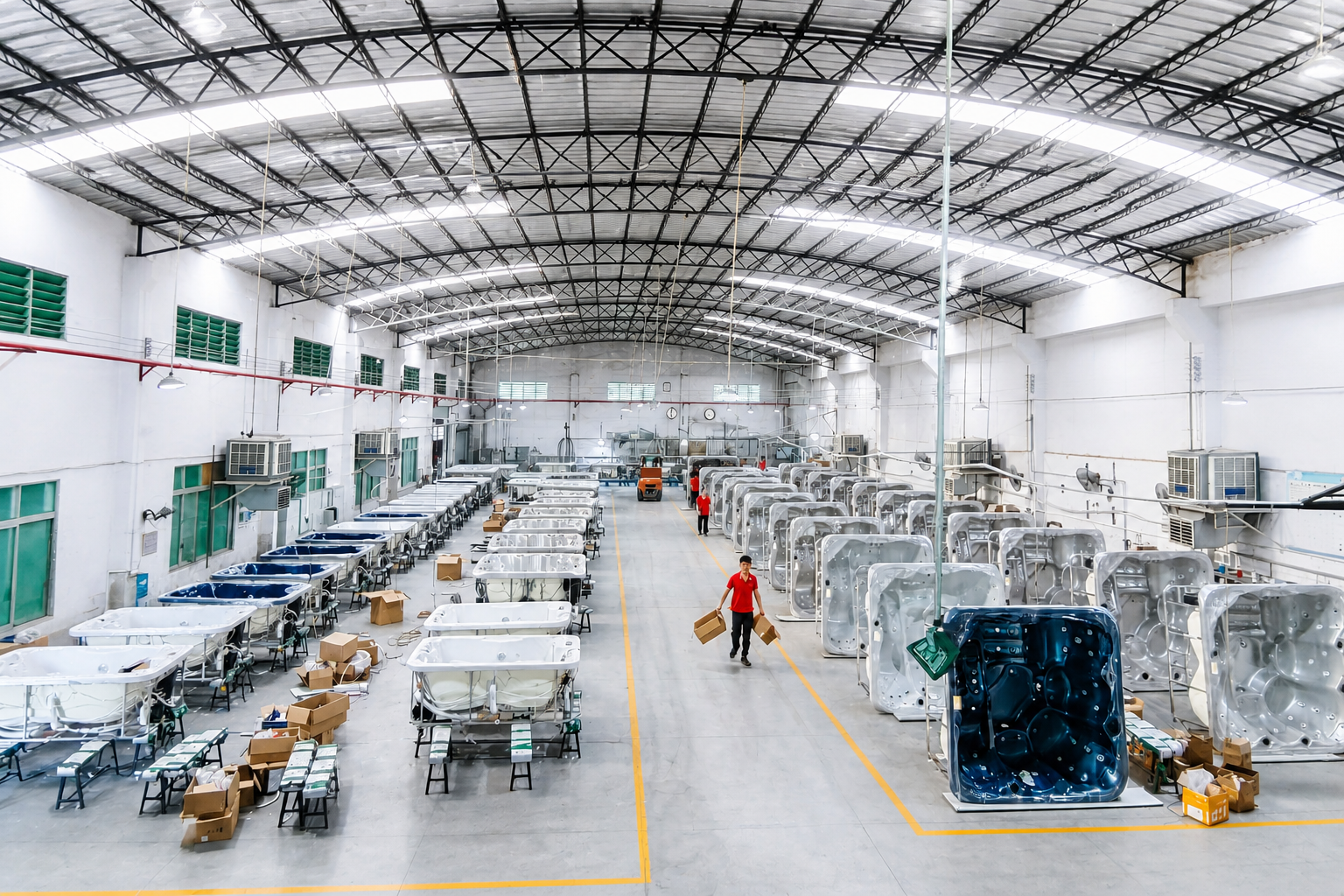
Parts installation and first testing are part of the quality process; buyers should request model-level test records, not only a factory overview.
Technical comparison: what to verify in both classes
The most useful comparison is not a list of marketing features. It is a set of verifiable project conditions. The table below converts the 3-person vs 6-person decision into checks that can be applied to any candidate.
| Decision area | 3-person class | 6-person class | What the buyer should verify |
|---|---|---|---|
| Primary project role | More likely evaluated for private suites, compact wellness corners or treatment rooms | More likely evaluated for shared wellness areas, family suites or poolside zones | Guest flow, privacy, supervision policy and operating schedule |
| Occupancy label | Not a standardized capacity measure | Not a standardized capacity measure | Seating drawing, usable positions, water capacity and jet data |
| Footprint and access | Often assessed where space is tight | Often assessed where group use is planned | Packed dimensions, delivery route, cover clearance and replacement access |
| Filled load and base | Must be confirmed from the model data | Must be confirmed from the model data | Filled load, support points and local structural review |
| Installation format | Freestanding may simplify access and service | Built-in may require more coordinated detailing | Drainage, ventilation, service access and emergency draining |
| Hydrotherapy design | Check jet zones against the intended session | Check pump and zone design for simultaneous use | Pump configuration, jet types, air control and water level |
| Water maintenance | Match the filter plan to the bather load | Higher bather load can increase filter loading | Filter access, rotation plan and replacement interval |
| Energy use | Not inherently lower | Not inherently higher | Insulation, cover, ambient temperature, set temperature and usage |
| Certification | Jurisdiction- and model-specific | Jurisdiction- and model-specific | Model certificate, electrical rating and test report |
| Documentation | Use the same matrix as the larger unit | Use the same matrix as the smaller unit | Drawings, bill of materials, service manual and warranty |
Footprint, access and the base are not side issues
A filled hot tub is heavy and needs a continuous, level base capable of carrying the design load to prevent uneven stress on the shell, frame and plumbing. The combined weight of water, the hot tub, equipment and users is transferred to the ground through the base and support frame, so significant slope, soft spots, voids or localized support may cause shell deformation, panel misalignment, stress on plumbing joints or poor drainage (646949). This applies to both classes. The difference is that the buyer must obtain the actual filled load and support-point data for the specific model, not infer it from the seat count.
Installation format can matter as much as occupancy. Common options include freestanding, semi-recessed and fully built-in installations. A freestanding unit is generally easier to deliver, install, inspect and maintain because it is not enclosed in the building structure, and it may be easier to relocate; however, it still requires a level, load-assessed base and clear access for the cover, drainage, servicing and future replacement. A built-in installation must include moisture control, drainage, ventilation, service access and emergency draining. The final choice should be based on product dimensions, filled load, access route, base, drainage, ventilation, service access, electrical conditions and local codes (646952).
For a 6-person candidate, the larger shell may change the access route and the lifting plan, but that is a model-specific check, not an automatic rule. For a 3-person candidate, a smaller shell may reduce the route problem, but the packed dimensions and pallet still need verification. In both cases, the buyer should confirm the route before order, not after delivery.
Hydrotherapy: compare the system, not the jet count
Jet count is visible and easy to compare, but it is not a complete measure of hydrotherapy value. The massage pump pressurizes water and sends it to the jets; the jets increase local flow velocity through a narrowed passage and may entrain air to create different water sensations and intensities. Jet orifice size, direction and internal geometry affect jet velocity, coverage and impact sensation. The actual experience is also affected by pipe length, bends, water level, filter condition and the number of jets operating at the same time (646938).
For a hotel or resort, the useful question is whether the hydrotherapy layout matches the intended guest journey. A 3-person unit may be specified for a more private, shorter session. A 6-person unit may be specified for a shared social or wellness session. In either case, the buyer should ask for the pump configuration, jet zones, simultaneous-operation logic and the recommended water level. A model with a high jet count but a single massage pump may not provide the same zoned experience as a model with a different pump and zone design. That comparison requires the actual bill of materials.
Water maintenance and energy use are operating costs, not labels
Both classes need a water-treatment plan. Filtration removes suspended particles, but it does not replace sanitation and water-balance management. Filters should be rinsed every two to four weeks, deep-cleaned monthly and replaced at 12 to 18 months, sooner with heavy use or hard water; the real criterion is flow, not the calendar (3449). A hotel with high bather turnover should build filter rotation and replacement into its housekeeping and engineering schedule.
Energy use also needs a model-level review. Insulation and a thermal cover reduce heat loss from the shell, plumbing and water surface, helping the hot tub maintain its set temperature more consistently. Heat is mainly lost through water-surface evaporation, conduction through the shell and plumbing, and convection to surrounding air. Insulation increases thermal resistance, while a cover reduces evaporation and air exchange. Actual energy consumption also depends on ambient temperature, usage frequency, set temperature and cover sealing; damage, water accumulation, poor fitting or leaving the cover open for long periods can reduce insulation performance (646944).
This is why a 6-person unit should not be assumed to cost more to operate than a 3-person unit, and a 3-person unit should not be assumed to cost less. The comparison must use the same climate, set temperature, usage pattern, cover condition and insulation specification. If those conditions differ, the operating comparison is not like-for-like.
Acrylic shell and component quality
Acrylic is suitable for hot tub manufacturing because it combines a smooth glossy surface, chemical resistance, thermoformability and easy cleaning, which makes it suitable for shells with complex ergonomic contours. The heated acrylic sheet is formed over a mold and combined with a reinforced backing structure to balance appearance, comfort and structural performance (646937, 646936). For a buyer comparing 3-person and 6-person units, the relevant check is not simply acrylic or not. It is the sheet specification, the backing and support structure, the shell thickness where specified, and the model-level quality record.
Control systems and water-treatment components also need model-level confirmation. The supplied company facts for Aquaspring Spas state that it selects Balboa control systems and USA Aristech Acrylics as core components, and that its quality process covers incoming inspection of core components, in-process checks, water testing, electrical safety inspection, functional testing and pre-shipment verification. Those are manufacturer-provided facts; a hotel buyer should still require the specific certificate, test report and bill of materials for the model being purchased.
Certification and documentation for hotel and resort projects
Certification is a procurement gate, not a marketing badge. UL 1563 is the safety standard for electric spas, equipment assemblies and associated equipment, with cold-tub requirements effective in January 2026 (EV-0004). UL Solutions also identifies hydromassage bathtubs and hot and cold spas within pool and spa equipment certification coverage, and references jurisdiction-specific standards and organizations (EV-0007). This does not mean that every standard applies to every model or every market. Certification requirements vary by jurisdiction, electrical configuration, installation context and product category.
For a 3-person vs 6-person comparison, the buyer should build a documentation matrix for each candidate: model number, electrical rating, control-system model, certification marks, test reports, installation drawings, service-side requirements, drainage and winterizing instructions, and the warranty terms. The same matrix should be used for both classes so that the comparison is consistent. A supplier that can provide a complete package for a smaller unit may not automatically provide the same package for a larger unit, and vice versa. Model-level verification is the only reliable approach.
Where Aquaspring Hot Tub fits into an OEM/ODM project
Aquaspring Hot Tub, the hot tub range from Aquaspring Spas (Foshan Nanhai Halo Sanitary Ware Co., Ltd.), is one example of a manufacturer that supports custom project work. The company was established in 2011 and operates a 20,000 ㎡ facility with 120 employees, including an 8-engineer R and D team; it reports that 90% of its output is exported to Europe, North America, Southeast Asia, India, Japan and the Middle East. Its management follows ISO9001:2015, and its products carry major global certifications including CE, ETL, RCM, SAA, CB and UKCA. A new production base covering approximately 40,000 m² is scheduled to commence operations in 2027.
For hotel and resort buyers, the relevant OEM/ODM scope includes product dimensions, seating layout, jet configuration, pumps and heating systems, control systems, acrylic and skirt colors, lighting and accessories, voltage and frequency, brand labeling, packaging and product documentation. This scope is useful when a property needs a configuration that is not a standard catalogue size, or when a distributor needs consistent specifications across a project. It does not remove the need for model drawings, certification review and sample approval. Buyers should treat OEM/ODM capability as a route to a verified specification, not as a substitute for verification.
Company profile and website: Aquaspring Spas. The 2026 company profile PDF is available here: Halo Spas Company Profile 2026.
Application scenarios: matching the class to the guest experience
Guest suite or premium room. A 3-person class is more likely to be evaluated where the hot tub is part of a private guest offer and the property wants a compact footprint. The buyer should confirm the actual seating positions, privacy screening, cover handling and the route for water replacement. The smaller label does not guarantee that the unit will fit a balcony or terrace; the base and structural load still require professional assessment.
Spa treatment or wellness room. A 3-person unit may be used as a pre-treatment or post-treatment relaxation element, but the water-treatment and cleaning turnaround must fit the spa’s operating schedule. The buyer should compare filter access, drain location and service-side clearance, not just the shell shape.
Poolside or shared wellness area. A 6-person class is more likely to be evaluated where several guests may use the unit together. The buyer should examine hydrotherapy zoning, simultaneous jet operation, cover management and the bather-load assumptions used for water treatment. The larger unit may also require a more detailed delivery and lifting plan, but this must be confirmed from the packed dimensions.
Family suite or resort villa. A 6-person unit may be considered where the guest profile includes families or small groups. The buyer should verify the actual seating layout and the safe supervision policy. A higher occupancy label does not replace the property’s own safety rules, signage or local-code review.
Comparison table: 3-person vs 6-person hot tubs for hotel and resort use
The table above is the core comparison. The practical reading is that both classes share the same verification burden. The difference is the project context: a smaller unit is more likely to be assessed for privacy and compact access, while a larger unit is more likely to be assessed for group use, hydrotherapy zoning and bather-load management. Neither label replaces the need for drawings, load data, service access and certification.
Procurement checklist for a like-for-like comparison
- Use one RFQ template for both classes, with the same fields for dimensions, water capacity, dry and filled load, jet and pump configuration, control system, electrical rating and certification.
- Require a seating drawing that shows usable positions, lounge or bench layout, step height and access points.
- Confirm the packed dimensions, pallet size and delivery route before order.
- Obtain the filled load and support-point data, then have the base and structure assessed by a local professional.
- Check the installation format: freestanding, semi-recessed or built-in, including drainage, ventilation, service access and emergency draining.
- Compare hydrotherapy by pump flow, jet types, zone design and simultaneous operation, not by jet count alone.
- Review the water-treatment plan for the actual bather load, including filter access, rotation and replacement.
- Verify certification, test reports, service manual, warranty terms and spare-parts availability for the exact model.
Future outlook: more documentation, not just more seats
For hotel and resort buyers, the direction of travel is toward more model-level documentation and clearer installation responsibility. Standards activity such as the UL 1563 cold-tub requirements effective in January 2026 shows that safety expectations can change by product category and date (EV-0004). Aquaspring’s planned 40,000 m² production base, scheduled for 2027, is a capacity signal, but it is a planned development rather than current operating capacity. Buyers should evaluate it as part of supply-continuity planning, not as evidence of model-level performance.
The practical conclusion is simple: choose the class that fits the project role, then verify the actual model. A 3-person hot tub is not automatically the lower-risk choice, and a 6-person hot tub is not automatically the better commercial choice. The safer decision is the one supported by drawings, load data, service access, certification and a water-maintenance plan that the property can actually operate.
FAQ
How should a hotel buyer interpret a 3-person or 6-person hot tub label?
Treat it as a product-category signal, not a standardized capacity guarantee. Supplier listings can show 3-, 5- and 6-person outdoor hot tubs, but the same verified data notes that those listings do not establish equivalent dimensions, water volume, jet count or usable capacity (EV-0009). Ask for the seating drawing, water capacity, dry and filled load, jet and pump configuration, electrical rating and service-side requirements for the exact model.
Does a 6-person hot tub always use more energy than a 3-person hot tub?
No. Energy use depends on insulation, cover condition, ambient temperature, set temperature and usage frequency, not on the occupancy label alone. Insulation and a thermal cover reduce heat loss, but actual consumption also depends on how the unit is operated and maintained (646944). Compare models using the same climate and usage assumptions.
What site checks matter most before choosing between the two classes?
Confirm the delivery route, the continuous and level base, the filled load and support points, drainage, ventilation, electrical supply and service access. A filled hot tub is heavy and must transfer its load through a suitable base and support frame; slope, soft spots or localized support can cause shell deformation, panel misalignment, plumbing stress or poor drainage (646949). These checks apply to both classes.
Is jet count a reliable way to compare hydrotherapy performance?
No. Jet count alone does not describe the massage experience. Pump flow, jet design, jet combination, air-to-water mixing and the number of jets operating at the same time all affect performance (646938). Compare the pump and zone configuration, not just the total number of jets.
What should an OEM/ODM quotation include for a hotel project?
It should identify the model, dimensions, seating layout, acrylic specification, control system, pumps, heating, jet configuration, electrical rating, certification documents, packaging, labeling, documentation and service requirements. If the project needs customization, the quotation should state which items are standard and which are project-specific. A brochure or general capability statement is not a substitute for the model-level specification.
Disclosure: This article is an independent buyer reference. Aquaspring Spas facts are manufacturer-provided and are identified as such; model-level performance and certification must be verified for the specific project.
Have Questions or Need More Details?
Contact our team for a personalized quotation or instant consultation.
Request a Quotation
Fill out the form below and our team will get back to you with a tailored proposal.
WhatsApp Direct Chat
Prefer to chat in real-time? Message us on WhatsApp for instant assistance & quick answers.
- Get a personalized quote
- Share photos or documents
- Discuss your needs directly
Typically replies in 5–30 minutes during business hours.