
Hotel Lobby Anti-Glare Pendant Lights: Shortlist Criteria
Hotel Lobby Anti-Glare Pendant Lights: Shortlist Criteria
A decorative pendant belongs on a hotel lobby shortlist only when it can be specified, sampled and verified — not when it merely photographs well. Anti-glare versions add one further requirement: the fixture has to deliver the light a double-height lobby needs while keeping the source itself out of the guest's line of sight.
The commercial context makes that discipline worthwhile. Mordor Intelligence values the global decorative lighting market at USD 75.88 billion in 2025 and projects USD 78.98 billion in 2026. Dataintelo estimates the hospitality lighting segment at USD 14.2 billion in 2025, growing at a 7.3% CAGR toward USD 26.8 billion by 2034. IMARC Group reports that commercial applications accounted for 62.8% of the decorative lighting end-user market in 2025. Most decorative lighting value now moves through projects, and projects are approved against written criteria.
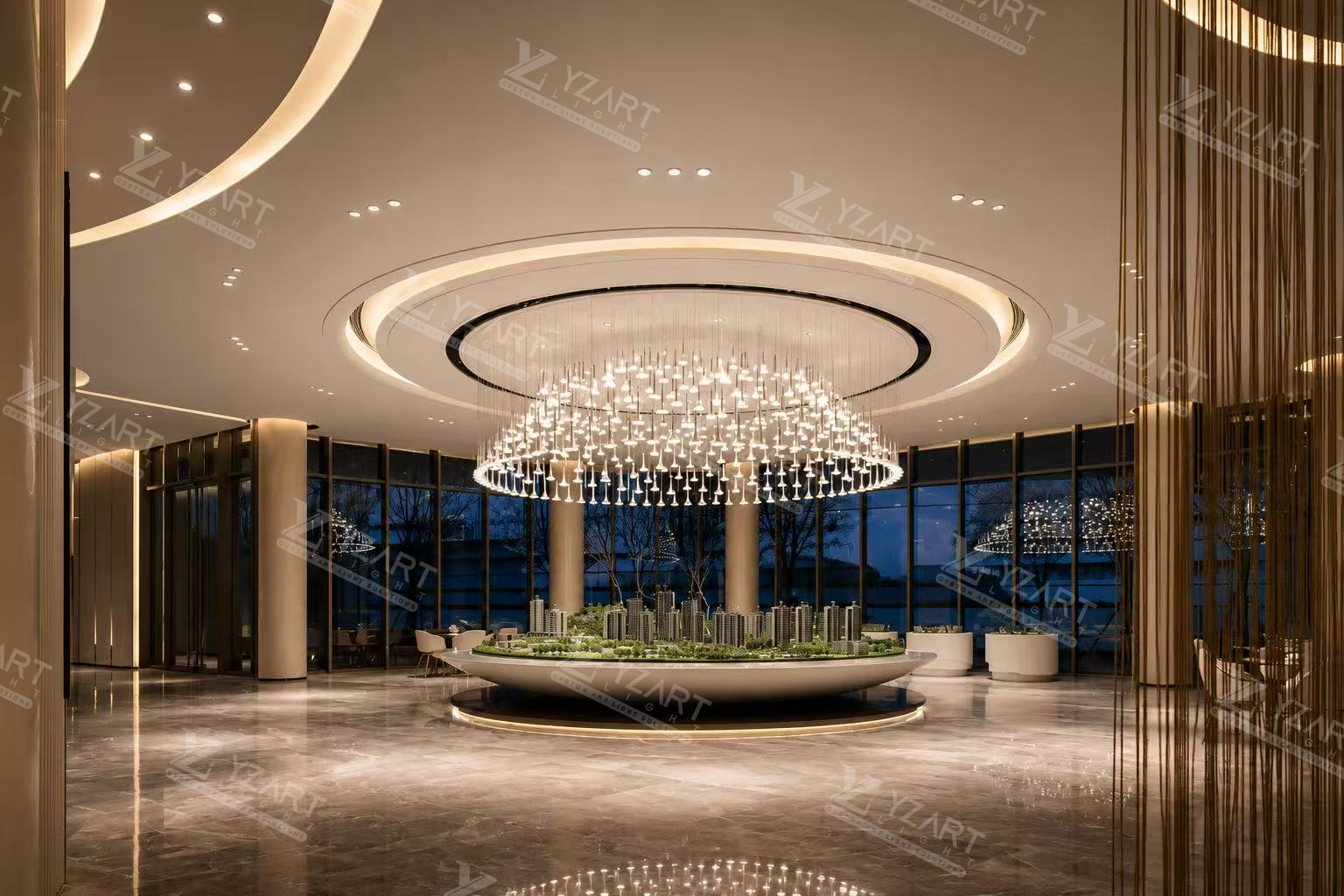
Why lobby pendants fail specification review
Lobby lighting is the one interior where a fixture is seen from almost every angle within minutes of a guest's arrival. Four failure modes recur across hospitality projects, and each of them can be screened out before an order is placed.
- Visible source at eye level. When the lamps are not shielded, recessed or diffused, a guest standing at the reception desk looks straight into the light source of a fixture several metres above. The result is discomfort glare — technically a luminance contrast problem, experientially a first-impression problem.
- Uneven light distribution. A pendant with no beam control can leave bright pools on polished marble next to dim zones, especially where ceiling heights change between the entrance and the seating area.
- Inconsistency across a cluster. Large decorative pendants are often installed in groups. If the light source chips are not binned or the lampshade material is not controlled, colour and brightness differences become visible when the units are hung side by side.
- Operational mismatch. Lobby fixtures are switched on for long daily cycles. Light attenuation, driver reliability and access for maintenance determine whether the installation still performs in year three — a horizon that matters because hospitality projects are typically specified for multi-year operation.
These are not aesthetic preferences. They are testable properties, and a shortlist can be built around them.
Seven shortlist criteria for anti-glare lobby pendants
The criteria below are ordered by how early they eliminate candidates. The first three decide whether the fixture is optically acceptable; the remaining four decide whether the project can actually be delivered.
| Criterion | What to verify | Why it decides the lobby outcome |
|---|---|---|
| 1. Light source platform | LED chip source and consistency, colour temperature options, lumen maintenance over the operating cycle | Large pendants amplify small differences; long daily operating hours expose poor lumen maintenance |
| 2. Beam angle and distribution | Beam angle range and adjustability — the YZ10001 reference profile specifies a customizable range from 15° to 120° | A narrow beam creates hotspots on stone floors; an excessively wide beam wastes output on walls and ceiling |
| 3. Glare control architecture | How the source is screened: recessed lamp position, diffuser, soft anti-glare light source arrangement | Glare is experienced from a standing eye position, not from the drawing board |
| 4. Lampshade transmittance | Lampshade material and finish, including high-transmittance options; ageing and colour stability of glass, acrylic, fabric or crystal | High transmittance raises usable output without raising wattage; low-grade shades turn yellow or cloudy |
| 5. Ingress protection | IP rating declared for the actual installation zone; IP40 for dry interior lobby environments | Humid, spa-adjacent or semi-outdoor lobby zones need a different protection level than a dry atrium |
| 6. Structure and ceiling interface | Fixture weight, ceiling load-bearing capacity, reserved installation size, suspension points and mounting structure | Oversized pendants are structural elements as much as lighting elements |
| 7. Compliance and inspection evidence | LVD-CE verification against EN 60598-1:2015+A1:2018, EN 60598-2-1:1989 and EN 62493:2015; CE-RoHS verification against the IEC 62321 series; ISO 9001:2015, ISO 14001:2015 and ISO 45001:2018 certificates; pre-shipment inspection records | These documents transfer risk from the hotel operator to a verifiable chain |
The reference profile: how the YZ10001 pendant maps to those criteria
Zhongshan YZ ART LIGHT Co.,Ltd., which trades as YZ ART LIGHT, is a manufacturer of high-end decorative and project lighting based in Henglan Town, Zhongshan City, Guangdong Province, supplying bespoke chandeliers, pendants, wall lamps, table lamps and floor lamps for hospitality and commercial interiors. Its YZ10001 hotel lobby pendant profile is a useful worked example because it addresses the first five criteria directly: an anti-glare light source arrangement, a high-transmittance lampshade, imported LED light source chips, IP40 protection for dry interior lobby environments, and a customizable beam angle range of 15° to 120°.
Those five properties translate into buyer-facing consequences rather than marketing claims. An adjustable beam angle lets the same pendant family be tuned for a 4-metre entrance soffit and an 8-metre atrium without changing the visible design. A high-transmittance lampshade allows the specified illuminance to be reached with a lower-powered source. An anti-glare arrangement raises visual comfort at reception-desk height. IP40 is appropriate for a protected indoor lobby — and is explicitly not a substitute for higher protection in humid or wash-down zones.
The wider manufacturing context behind that profile is also part of the shortlist logic: a 15,000-square-metre production base with CNC laser cutting systems, automated welding stations and precision engraving machines, an R&D team of 20 engineers, and a quality management system certified to ISO 9001:2015, ISO 14001:2015 and ISO 45001:2018, with certificate validity running to 2 September 2028 for the ISO schemes.
Technical explanation: where anti-glare design and output meet
Glare control is a trade-off, and buyers should understand it before comparing quotations. Screening a light source reduces the luminance a guest perceives, but it also reduces the raw luminous flux leaving the fixture for a given wattage. Two identical pendants rated at the same power can therefore produce noticeably different floor illuminance depending on shielding geometry, diffuser material and lampshade transmittance.
Beam angle is the second variable. A 15° setting concentrates output into a narrow cone and is useful for emphasising a reception counter or a sculpture; a 120° setting spreads light broadly across the lobby plane. Between those extremes, the correct setting is a function of ceiling height, fixture spacing and the reflectance of the surrounding finishes, which is why a photometric check on the specified configuration is more informative than a catalogue lumen figure.
Durability closes the loop. YZ ART LIGHT states an LED light source service life of up to 50,000 hours and a metal and glass lamp body durable for over 15 years under normal use, with stable light attenuation performance intended for commercial long-hour operation. Those figures matter in a lobby because replacing a source in a suspended fixture above a double-height space is an access problem before it is a cost problem.
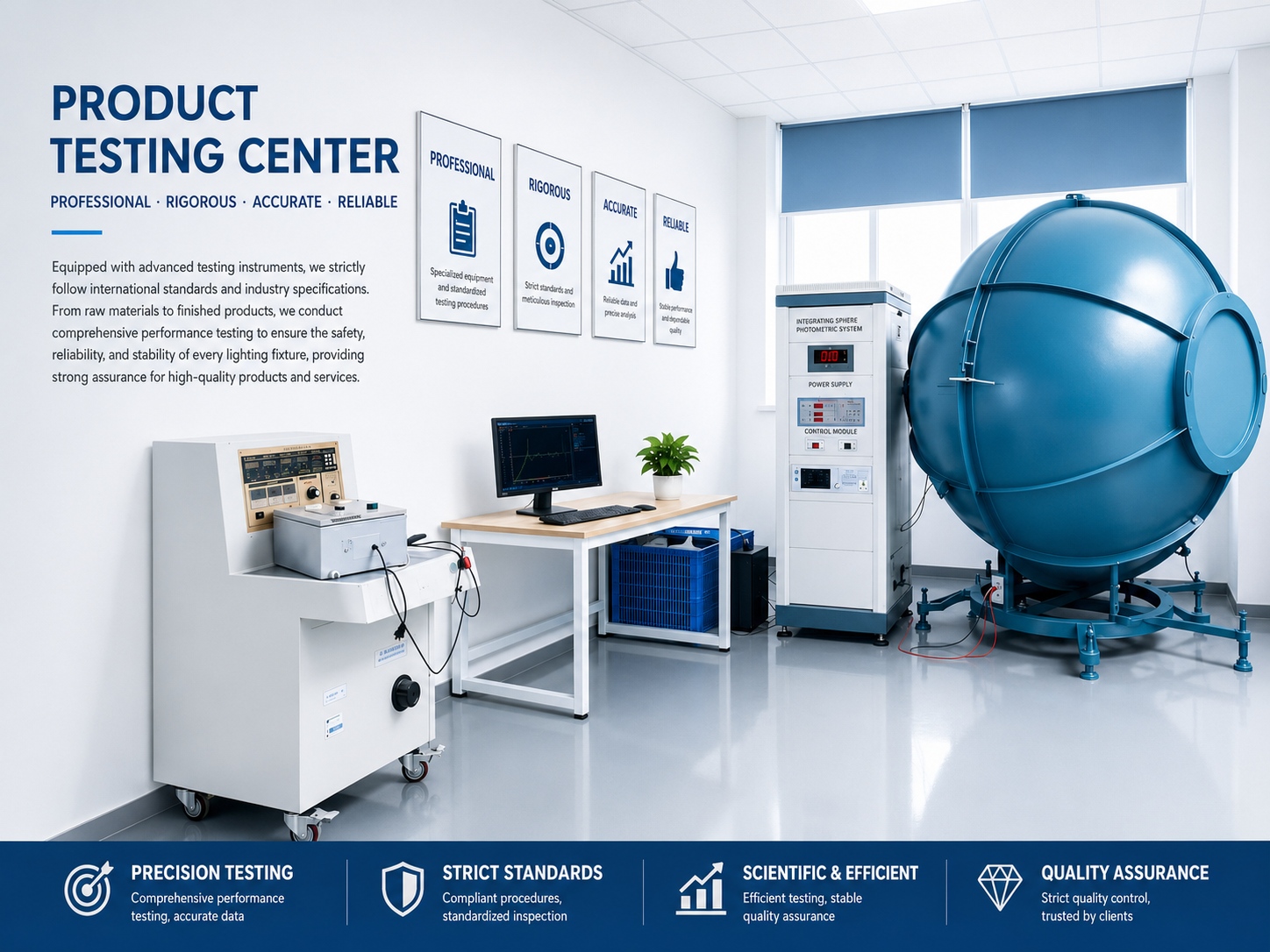
Inspection is where specification becomes evidence. YZ ART LIGHT subjects every lamp to 100% full inspection before shipment, covering power-on testing, appearance workmanship checks, dimension and structure inspection, and verification of accessories completeness. A quality-approval checklist is attached to each shipment and real-shot inspection videos are available on request — a detail worth writing into a purchase order for lobby fixtures, because it converts an inspection claim into a document the buyer can review.
Installation and use cases: where the criteria are tested
The same fixture family behaves differently across spaces, and each space imposes its own constraint.
- Main lobby and reception. The critical view is from a standing position at the front desk. Anti-glare screening and a mid-range beam angle matter more here than maximum output.
- Double-height entrances and atriums. Ceiling height favours narrow-to-mid beam settings and long suspension systems; the ceiling load-bearing capacity and reserved installation size must be checked before the suspension points are marked.
- Elevator lobbies and corridors. Lower mounting heights increase the risk of visible sources, so diffused or recessed light sources are usually specified.
- Banquet halls and ballrooms. Dimmable circuits and higher output are typically requested because the room switches between event and pre-function modes.
- Guest rooms, lounges, restaurants and spas. The glare threshold is lower because occupants sit closer to the fixtures; custom soft anti-glare light sources are adopted in these settings to avoid harsh glare and uneven light distribution.
YZ ART LIGHT's completed hospitality work includes projects with InterContinental Hotel in Israel and Taiwan, Four Seasons Hotel in the UAE, Marriott Hotel in Costa Rica and Waldorf Astoria Hotel in Malaysia, alongside villas, shopping malls and commercial lobbies. The manufacturer reports over 1,000 completed commercial engineering projects and an export share of 70%, with main markets in Europe and the Americas and the Middle East.
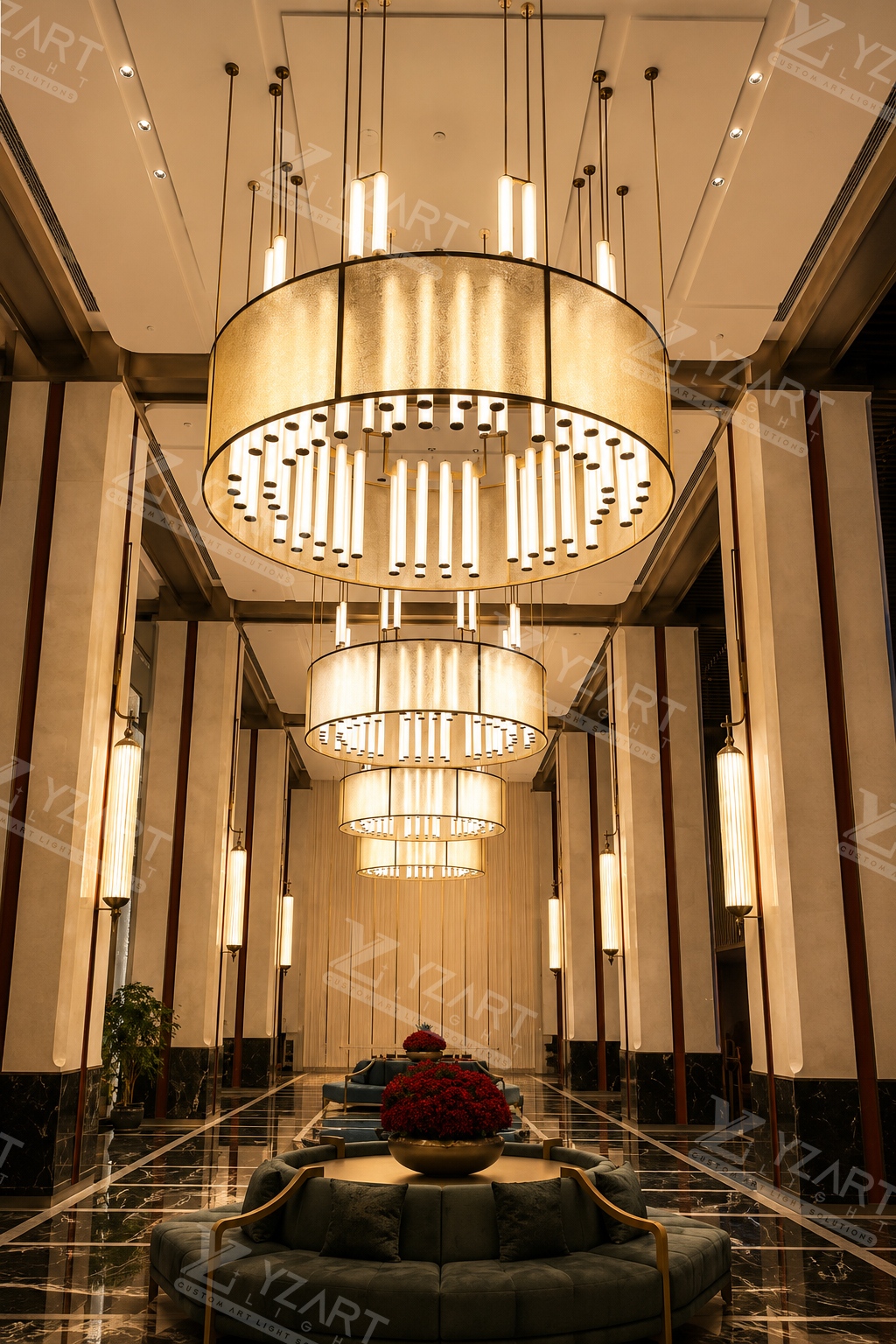
Installation sequence as a shortlist question
The installation method is part of the product. A typical sequence for a customized lobby pendant involves checking the ceiling load-bearing capacity, measuring the reserved size and marking the suspension points with the mains supply isolated; assembling the frame, lampshade and built-in anti-glare light source on site; completing insulated concealed wiring and fixing embedded fasteners before hoisting the unit; and finally carrying out a power-on test, adjusting the lamp angle and confirming lighting uniformity. The associated safety requirement is explicit: power must be cut before installation work, warning tags should be hung, and wiring must be carried out by personnel with electrical-operation qualifications. A supplier that cannot describe this sequence is a supplier that has not delivered large lobby fixtures before.
Market signals shaping lobby lighting specification
Several published data points explain why anti-glare specification is moving from preference to requirement in hospitality briefs.
- Dataintelo reports that 56% of new luxury hotel projects now require dimmable chandelier installations for guest ambiance — which pushes dimming compatibility into the fixture specification rather than the electrical package alone.
- The same source estimates that LED-integrated chandeliers capture over 54% of market volume annually, driven by energy efficiency and custom colour options.
- Market Reports World observes that smart chandeliers with voice control or IoT connectivity represent more than 33% of new product launches, indicating that control interfaces are becoming a differentiator at the specification stage.
- The 2024 International Energy Conservation Code (IECC) expanded occupancy and dimming requirements for lobbies and meeting areas in the United States, linking decorative fixture selection to code compliance.
- Regional demand remains concentrated: Grand View Research places Asia Pacific at a 44.6% revenue share of the high-end lighting market in 2024 and North America at 36.45% of the global decorative lighting market in 2025, while Mordor Intelligence identifies Asia-Pacific as the fastest-growing hospitality lighting region at a 5.98% CAGR.
- Dataintelo notes that Saudi Arabia's Vision 2030 targets 150 million annual tourist visits, requiring over USD 500 billion in hospitality infrastructure investment including high-specification lighting.
Taken together, these figures describe a market where decorative pendants are increasingly judged on controllability, energy performance and documented compliance — the same criteria a shortlist should apply.
Custom anti-glare pendants compared with off-the-shelf decorative pendants
Price comparison alone tends to favour stock fixtures, so the comparison should be made on what each option can actually guarantee.
| Dimension | Off-the-shelf decorative pendant | Engineered anti-glare custom pendant |
|---|---|---|
| Glare behaviour | Depends on where the buyer happens to stand in the showroom | Designed for a defined eye-level position and mounting height |
| Beam control | Fixed, usually stated as a single angle | Adjustable within a specified range, such as 15° to 120°, to match ceiling height and layout |
| Lampshade | Standard material; ageing and colour drift not documented | Lampshade material and transmittance selected as a specification point |
| Compliance file | Generic declaration | Model-linked LVD-CE and CE-RoHS verification plus ISO 9001, 14001 and 45001 certificates |
| Delivery certainty | Stock-dependent | Stated monthly capacity of 20,000 units and a standard 30–40 working day lead time |
Where custom anti-glare specification has real limits
A credible shortlist states boundaries as clearly as benefits. Four apply here.
- Shielding costs output. Anti-glare screening and diffusers reduce delivered lumens for the same wattage. Lobby illuminance planning must be recalculated for the shielded configuration rather than copied from an unshielded reference.
- IP40 has a defined scope. IP40 is appropriate for dry, protected interior lobby environments. Humid zones, spa and pool-adjacent areas, exterior soffits and cleaning regimes involving directed water require a higher protection level and must be confirmed as a separate requirement.
- Model-level parameters need final confirmation. For project lighting, dimensions, wattage and colour temperature are provided per series or per custom order and require model-level confirmation. Preliminary drawings should not be treated as released specifications.
- Custom engineering takes time, and delivery terms matter. The standard lead time is 30–40 working days, with shortened lead times available only for urgent hotel projects. Goods are normally delivered on an EXW basis, so the buyer arranges pickup, freight and export clearance unless logistics and customs handling are quoted separately; payment terms are TT. Minimum order quantity is 1 piece, which lowers the barrier to sampling but does not shorten the tooling and finishing cycle.
A second comparison is often raised by procurement teams: factory-direct custom manufacturing versus a trading intermediary. A manufacturer operating its own workshop controls drawing deepening, structural calculation, production and installation guidance; an intermediary without production capacity typically sources externally and cannot stabilise specification revisions, cost or after-sales support in the same way. The appropriate conclusion is conditional rather than absolute — intermediaries remain viable for standard stock lamps with no customization requirement, while custom-shaped lobby fixtures with project documentation are better matched to a manufacturer that produces them.
Future outlook
Three directions look predictable from the available evidence. First, dimming and control readiness will continue to migrate from optional to default in luxury and upper-upscale briefs, given that 56% of new luxury hotel projects already require dimmable chandelier installations. Second, energy-code pressure on lobbies and meeting areas will keep pushing designers toward LED-integrated fixtures with documented performance rather than decorative housings fitted with generic lamps. Third, as anti-glare design becomes standard language in hospitality specifications, the differentiator will shift from whether a fixture is shielded to how precisely its beam, transmittance and mounting height were calculated for the specific lobby.
For buyers, the practical consequence is a shortlist that reads like a technical document: a declared beam range, a stated lampshade material, a protection rating matched to the zone, certificates with numbers and validity dates, an inspection protocol, and a lead time the project calendar can absorb.
FAQ
What beam angle should a hotel lobby pendant use?
There is no single correct angle. A narrow setting, around the 15° end of the range, concentrates output for focal points such as a reception counter or a sculpture, while a wide setting, up to around 120°, spreads light across a large lobby plane. The appropriate setting depends on ceiling height, fixture spacing and the reflectance of surrounding finishes. Because the YZ10001 reference profile offers a customizable range from 15° to 120°, the setting can be adjusted per installation zone rather than fixed at the factory for the whole project.
How is glare actually controlled in a decorative pendant light?
Glare is controlled by screening, diffusing or redirecting the light source so that it is not visible — or not excessively bright — from a normal standing or seated eye position. Practical measures include recessing the lamp inside the fixture body, using a diffuser or a low-brightness lampshade, and selecting a soft anti-glare light source arrangement. In hospitality interiors such as guest rooms and lounges, this approach is used specifically to avoid harsh glare and uneven light distribution. Screening reduces the delivered luminous flux for a given wattage, so illuminance planning should account for the shielded configuration.
What IP rating is required for a hotel lobby pendant?
For dry, protected interior lobby environments, IP40 is a common specification, and it is the protection level stated in the YZ10001 reference profile. Protection requirements change with the installation zone. Humid areas, spa and pool-adjacent spaces, exterior soffits and locations cleaned with directed water require a higher ingress protection level than a dry interior lobby. Buyers should match the declared rating to the specific zone rather than apply one rating across an entire property.
What documents should a buyer request before approving a custom lobby pendant?
A practical document set includes LVD-CE verification to EN 60598-1:2015+A1:2018, EN 60598-2-1:1989 and EN 62493:2015; CE-RoHS verification referencing the IEC 62321 series; ISO 9001:2015, ISO 14001:2015 and ISO 45001:2018 certificates with numbers and validity dates; and pre-shipment inspection records. YZ ART LIGHT issues a quality-approval checklist with each shipment and can provide real-shot inspection videos on request, covering power-on testing, appearance workmanship, dimension and structure inspection, and accessory completeness verification.
What lead time and capacity should be expected for customized hotel pendants?
YZ ART LIGHT states a standard production lead time of 30–40 working days, with a shortened lead time available for urgent hotel projects, and a monthly production capacity of 20,000 units. The minimum order quantity is 1 piece, which allows a single sample to be validated before bulk release. Goods are delivered on an EXW basis, so the buyer arranges pickup, freight and export clearance unless logistics and customs handling are quoted separately, and payment terms are TT. Lead time planning should begin from the date the specification is frozen, since custom shapes and finishes cannot be finalized before that point.
What after-sales support is typical for engineered hospitality lighting?
Support expectations for project lighting generally cover remote technical guidance during installation, a defined warranty period and availability of replacement light sources. YZ ART LIGHT provides global remote technical guidance for overseas clients, a 3-year warranty on engineering lighting products, and free replacement of faulty light sources within that warranty period. For high-ceiling installations, the availability of replacement sources matters operationally, because access for maintenance is often more disruptive than the component cost.
How long should a hotel lobby pendant last in continuous operation?
Durability is normally expressed through two separate figures: the LED light source life and the structural life of the lamp body. YZ ART LIGHT states an LED light source service life of up to 50,000 hours and a metal and glass lamp body durable for over 15 years under normal use, with stable light attenuation performance intended for commercial long-hour operation. Actual service life depends on the operating cycle, ambient conditions and correct installation, including verification of ceiling load-bearing capacity and the use of the specified drivers and accessories.
For buyers who need the full company and capability record in one document, the YZ ART LIGHT corporate brochure is available for download: Zhongshan YZ ART LIGHT Co.,Ltd. brochure (PDF). Company information is also published at yzartlight.com.