
Hotel Solar Water Heater Framework: Collectors & Capacity
Hotel hot water is a twenty-four-hour operating cost rather than a seasonal one, and the equipment decision behind it is normally made once and then lived with across more than fifteen years of building operation. A practical buyer decision framework for hotel solar water heaters moves through five stages: collector family, storage and tank configuration, capacity and backup sizing, documented cost performance, and procurement plus compliance. In a documented Southeast Asian hotel project, a complete solar hot water system serving 80 guest rooms and public bathing areas reduced electricity and gas costs by more than 40%, and the system carries a documented stable service life of more than 15 years. The transferable part, however, is not the percentage; it is the sequence of decisions that produced it.
Why hotels cannot compare collectors the way they compare components
A hotel does not buy a collector. It buys a delivered volume of constant-temperature hot water across morning and evening peaks, for guest rooms and public bathing areas, often with an additional auxiliary heating load. When procurement teams compare suppliers by price per tube or price per square meter, they remove storage volume, backup capacity, control strategy and installation scope from the comparison — which is precisely where performance differences between hotel projects originate.
The practical consequence is that two hotel installations with identical collector counts can deliver very different hot water availability and very different electricity and gas bills. The framework below keeps the collector, the tank, the backup heat source and the site inside one decision instead of four separate purchasing events.
Decision 1 — Choosing the collector family for a hotel load
Three collector families appear most often in commercial hot water comparisons, and each one assumes something different about the rest of the system.
Evacuated tube collectors with heat pipe
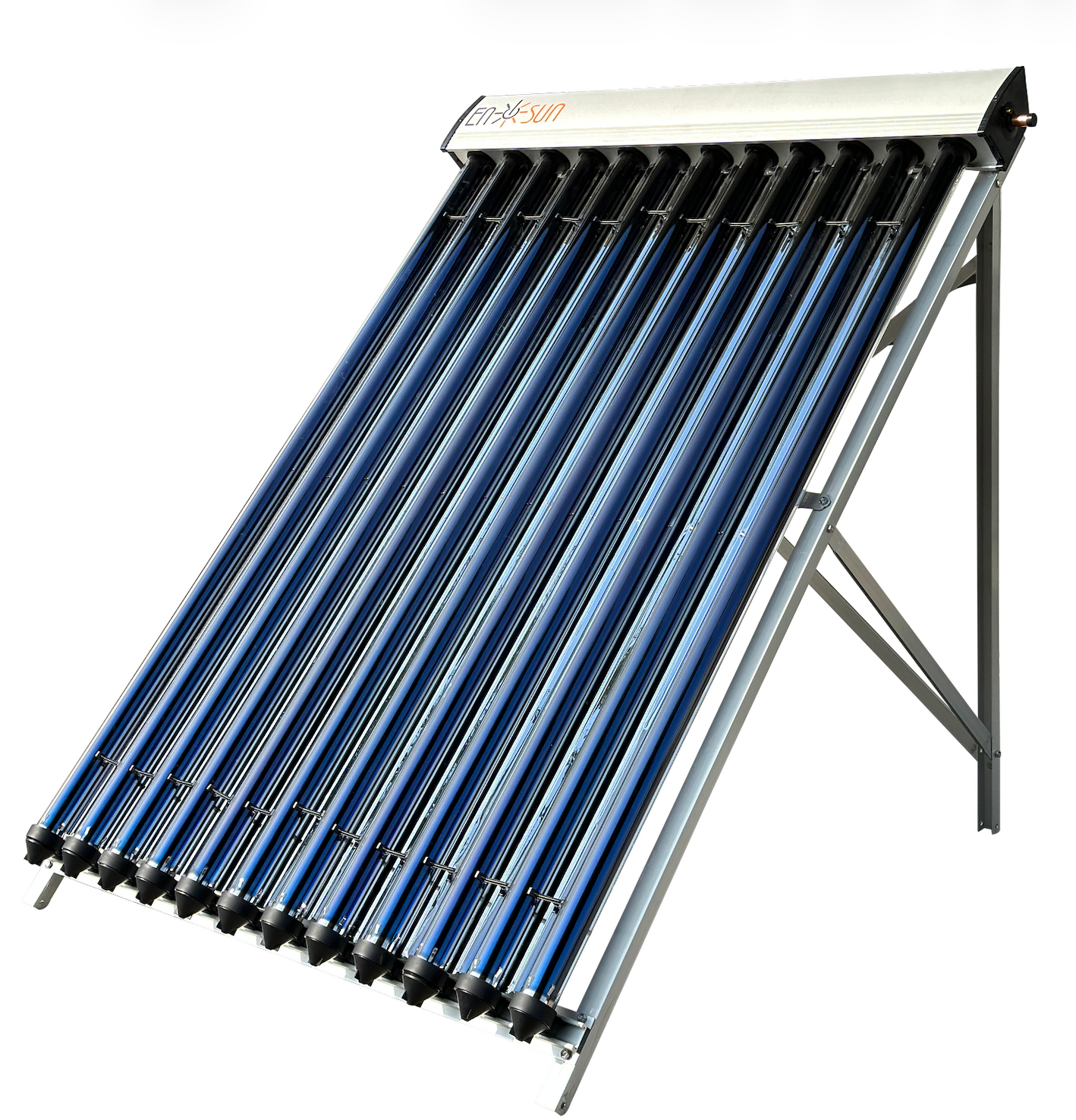
The HSC series solar collector uses 58-1800 vacuum tubes with heat pipe, supplied in configurations of 10 to 30 tubes with an aluminium alloy frame. It carries Solar Keymark certification and is listed for villa, hotel, house heating, spa center and school applications. For hotel projects the relevant characteristics are the modular tube count, which allows collector area to be matched to a calculated load rather than a fixed package, and the materials, which are specified for outdoor solar irradiation and climatic conditions.
Flat plate collectors
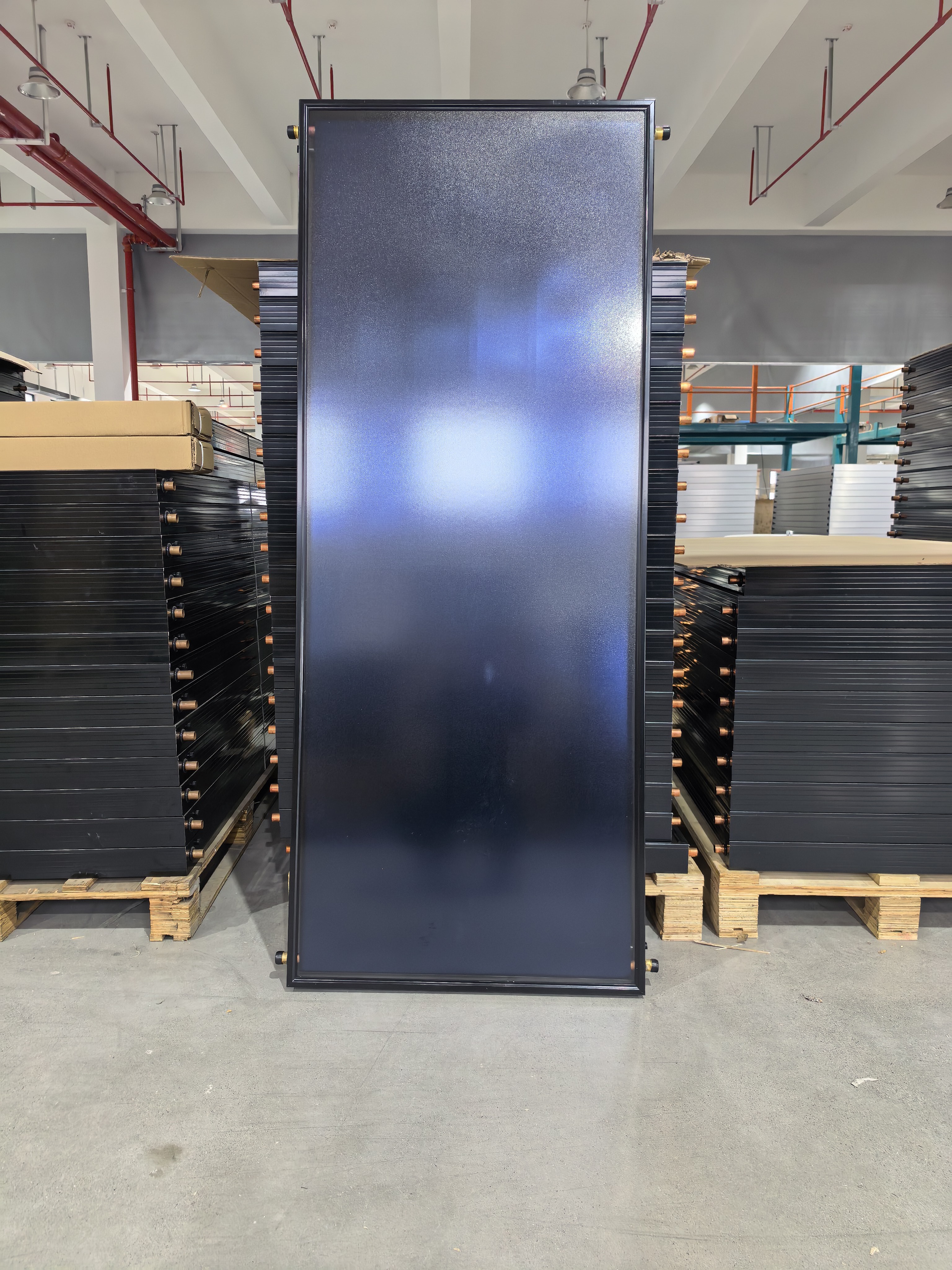
The FPC2.0 flat plate solar collector is available in 1 m², 1.5 m², 2 m² and 2.5 m² sizes with 80 mm thickness, using a copper and aluminium alloy absorber. It is Solar Keymark certified and offered with customization and OEM options, and it is listed for swimming pool, housing heating and solar water heater applications. Flat plate collectors are frequently specified where a lower roof profile is preferred or where a project combines domestic hot water with pool heating.
PV-driven water heating
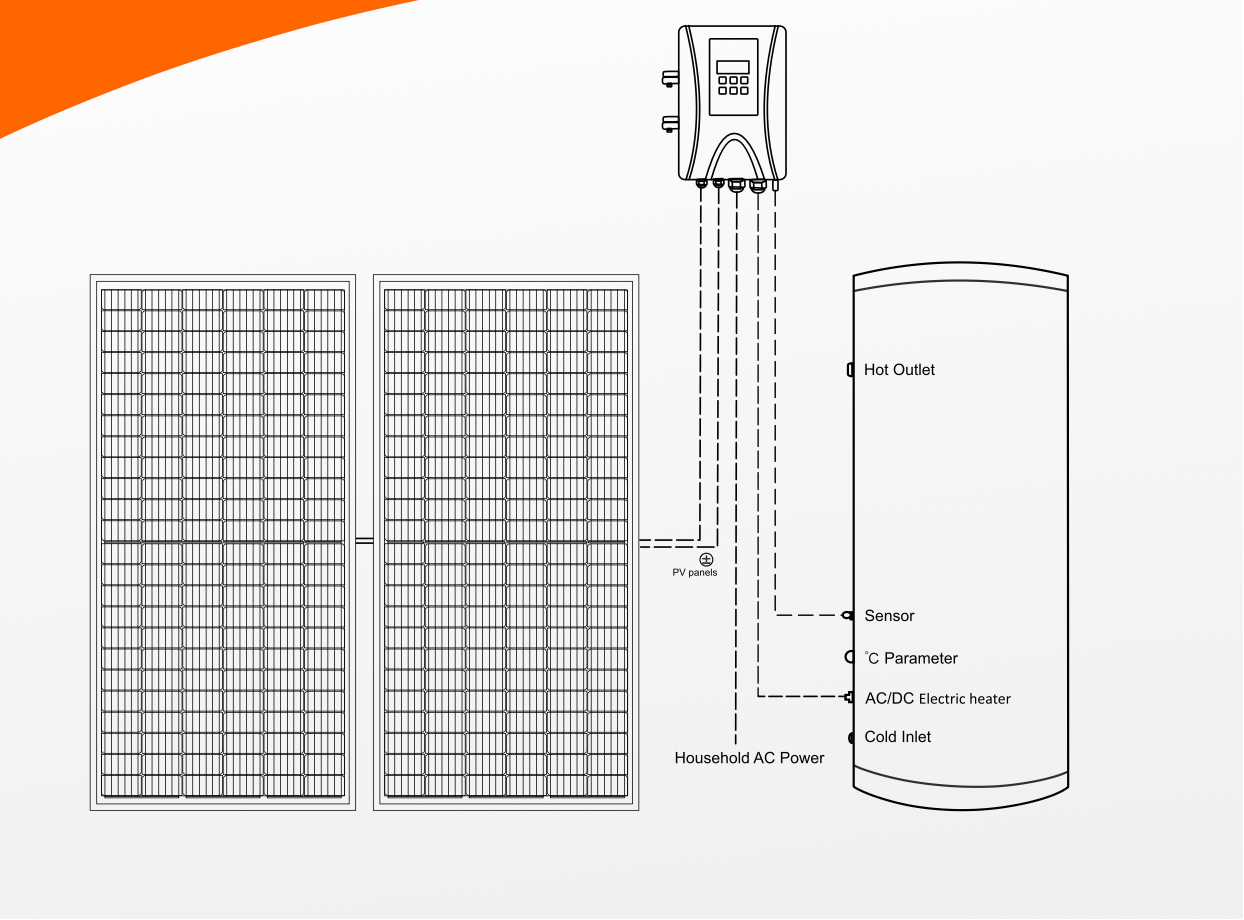
The PV Series PV solar water heater follows a different architecture. Instead of a thermal collector loop, it uses solar panel input of 600 W per panel to deliver 800 W to 3500 W of heating output into a 100 L to 500 L tank, with an MPPT controller and DC/AC automatic switching. The tank is available in Duplex 2205 or Inox 316L, and the product is CE certified. Its listed applications are villa, house, apartment and camp rather than hotels. In a commercial hotel project this family normally complements rather than replaces a thermal collector array, and it becomes relevant where hydronic collector routing or roof structure makes a thermal loop impractical.
Market structure supports a thermal-first reading of the category. Grand View Research reported that evacuated tube collector technology held a 44.2% revenue share of the solar water heater market in 2023, indicating that vacuum tube thermal designs remain the dominant commercial technology.
| Comparison criterion | Evacuated tube with heat pipe (HSC series) | Flat plate (FPC2.0) | PV-driven (PV Series) |
|---|---|---|---|
| Absorber and build | 58-1800 vacuum tube with heat pipe; 10–30 tubes; aluminium alloy frame | Copper and aluminium alloy absorber; 80 mm thickness | Solar panel input 600 W/pc; heating output 800–3500 W; MPPT controller; DC/AC automatic switch |
| Storage relationship | Pairs with pressurized or indirect tank configurations | Pairs with flat-collector indirect systems | Integrated 100–500 L tank |
| Certification listed | Solar Keymark | Solar Keymark | CE |
| Listed applications | Villa, hotel, house heating, spa center, school | Swimming pool, housing heating, solar water heater | Villa, house, apartment, camp |
| Main project consideration | Modular tube count for calculated commercial loads | Roof profile and combined pool heating | Off-loop sites where a thermal collector loop is impractical |
For most hotel projects the collector decision resolves to an evacuated tube array for the base load, flat plate collectors where roof profile or combined pool heating justifies them, and PV-driven units as a supplementary or off-loop option.
Decision 2 — Matching storage, tank type and circulation to the collector
Solar collectors generate heat when the sun is available; hotels draw hot water when guests are awake. The gap between those two facts is storage. In system terms, the equipment serves as heat generation and storage units supplying hot water and temperature regulation for buildings or facilities, and it can be paired with electric heaters or heat pumps for backup and compensation.
| Product family | Capacity | Key specification | Materials | Project note |
|---|---|---|---|---|
| CPS-FJ series indirect solar water heater | 150 L, 200 L, 250 L, 300 L | Flat type solar collector; Solar Keymark; OEM available | SPCC with enamel coating | Indirect, enamel-coated tank for salty water; can be fitted with anti-freezing heat transfer media |
| CPS series high-pressure solar geysers | 100 L to 300 L | Maximum operation pressure 6 bar; test pressure 9 bar; 50 mm PU foam; 25–45° angle; Solar Keymark | SS304 / SS316 / Duplex 2205 / Duplex 32001 | Food-grade stainless steel inner tank with galvanized steel outer tank |
| CNP series non-pressure solar water heater | 60 L to 500 L | 58-1800 vacuum tube absorber; 50 mm PU foam; 25–45° angle; Solar Keymark | SS304 / SS316 | Listed for small hotel and school applications among others |
Beyond the collector-integrated tanks, buffer tanks, domestic hot water tanks and heat pump tanks are listed among Kesun Solar's main product lines alongside solar water heaters and hybrid solar panels. That matters when a project needs to decouple generation from draw-off — for example by charging a buffer vessel during the day and feeding a separate draw-off tank.
Circulation strategy belongs to the same decision. Systems can operate in direct or indirect circulation mode, in passive thermosiphon mode or in forced circulation with pumps, and they support electric backup or heat pump linkage. Supporting equipment typically includes circulation pumps, controllers, valves, mounting frames and piping accessories.
The indirect configuration deserves particular attention in coastal and island locations: the CPS-FJ indirect, enamel-coated tank is designed for salty water, and the heat transfer loop can be charged with anti-freezing media — two requirements that appear repeatedly in hotel specifications.
Decision 3 — Capacity, backup and site constraints
Capacity is where hotel solar projects are either correctly scoped or quietly under-designed. Specific working condition parameters require project-level calculation, and systems can be configured for different climate zones; no catalogue figure replaces that calculation.
A workable sequence for the evaluation stage:
- Establish daily hot water demand from room count, occupancy assumption, public bathing areas and any auxiliary heating load.
- Convert that demand into required collector area using the collector family selected in Decision 1.
- Size storage so that daytime generation covers peak draw-off rather than average draw-off.
- Size backup so that the hotel never depends on solar availability alone.
- Confirm roof or plant-room area, mounting angle and load-bearing capacity, then adjust the configuration accordingly.
Site constraints should be documented early because they change the specification. Corrosion-resistant materials, water quality treatment, freeze protection for winter and roof load-bearing requirements are common project concerns and should be defined per project location and design.
The documented hotel case provides a scope reference rather than a sizing formula. It covers a complete solar hot water system for small and medium-sized hotels, providing daily hot water for 80 guest rooms and public bathing areas, with support for auxiliary regional heating, replacing traditional electric and gas heating equipment. A buyer with a comparable profile can use that scope definition — rooms, public areas, auxiliary load — as the starting input to their own project calculation.
Decision 4 — Documented cost savings and how to interpret them
Cost performance is the argument that secures hotel management approval, and it should be read carefully.
- After implementation, the hotel cut electricity and gas costs by over 40%.
- The system has a stable service life of more than 15 years.
- It delivers constant-temperature hot water with minimal failures, supporting guest satisfaction.
- It lowers carbon emissions, supporting green-hotel compliance.
The technical reasons cited for that performance are directly relevant to specification: high-adaptability vacuum heat collection modules with corrosion and weather resistance suited to the hot-rainy Southeast Asian climate; an integrated design that enables easy installation and low-cost maintenance; and smart temperature adjustment aimed at energy efficiency in small-to-medium commercial projects.
How to read the over-40% figure: it belongs to that project, its energy tariffs, its load profile and the electric and gas equipment it displaced. It is a documented outcome, not a universal rate. What transfers between projects is the configuration logic — solar generation plus storage plus backup, sized against a calculated demand, replacing a measurable share of electric and gas consumption. Buyers should model their own baseline before accepting any percentage from any supplier.
Decision 5 — Procurement: MOQ, lead time, capacity and customization
Zhejiang Kesun New Energy Co., Ltd., which trades as Kesun Solar, is a Chinese solar thermal manufacturer founded in 2009, operating a 42,000 m² manufacturing facility with 130 employees, a 15-engineer R&D team and an annual output of 300,000 sets. Roughly 60% of production is exported, with main markets including Mexico, the EU and Africa.
The company was formed by merging Haining Ensun Solar Technology Co., Ltd., which focused on non-pressure solar water heaters, and Zhejiang Yile New Energy Co., Ltd., which specialised in pressurized solar water heaters. After the merger the existing product lines were retained and upgraded, and PVT (photovoltaic-thermal) systems, 2205 duplex stainless steel tanks and heat pipe solar collectors were added. Production uses high-pressure automatic foaming and robotic packaging alongside TIG, high-frequency, laser and butt welding, and an in-house laboratory performs reliability tests such as salt spray testing and pulse testing on site.
For project buyers, the commercial parameters are as decisive as the technical ones:
| Procurement factor | Stated capability |
|---|---|
| Production mode | OEM / ODM / customizable |
| Customization scope | By capacity, type and system configuration — residential or commercial, different tank capacities, collector type combinations |
| Monthly capacity | 25,000 units |
| Lead time | 20–35 days |
| Minimum order quantity | 1 x 40 ft container |
| Quality control | 100% test |
| Export markets and after-sales | Global; remote support |
Two implications follow. First, a container-level MOQ means the order ships as a system, so accessory scope — pumps, controllers, valves, mounting frames and piping — should be confirmed inside the same commercial package rather than purchased separately. Second, a 20–35 day production lead time has to be placed inside the hotel construction schedule; procurement slippage, not installation, is the more common cause of project delay.
For supplier verification, an independently published data point is available: Alibaba's verified company profile reports annual export revenue of approximately USD 19.6 million for Zhejiang Kesun New Energy Co., Ltd. (2025). Third-party profile data of this kind is useful as a cross-check against supplier claims, though it should be refreshed at the time of purchase.
Compliance and trade checks before the purchase order
Certification status differs by product family and should be verified against the specific configuration being ordered.
- Solar Keymark certification is listed for the HSC series solar collector, the FPC2.0 flat plate solar collector, the CPS-FJ indirect solar water heater, the CNP series non-pressure solar water heater and the CPS series high-pressure solar geysers.
- The PV Series PV solar water heater is CE certified.
Two trade and regulatory markers are worth tracking in 2026 purchasing. HS Code 841912 was introduced specifically to differentiate solar water heaters from the generic 841919 code, a change published by Solar Heat Europe in 2023 and directly relevant to importers classifying shipments. In the United States, new Federal energy conservation standards for consumer water heaters took effect on 5 July 2024, with compliance required by 2029 under the EPCA / DOE standards published in the Federal Register.
Neither point guarantees market access for a specific model. A certificate covering a collector family does not automatically extend to every system configuration, and standards scope varies by jurisdiction, so compliance should be confirmed for the exact configuration, destination market and application class.
How solar compares with conventional hotel water heating
Solar thermal does not compete with conventional heating on availability; it competes on operating cost and predictability. The table below frames the comparison qualitatively, because actual cost differences depend on local tariffs and load profiles.
| Dimension | Solar thermal with storage and backup | Gas-fired boiler | Electric resistance | Air-source heat pump |
|---|---|---|---|---|
| Primary energy | Solar irradiation, with electric or gas backup | Fossil gas | Grid electricity | Grid electricity |
| Hot water availability | Depends on storage sizing and backup capacity | On demand | On demand | On demand, with reduced output in cold conditions |
| Operating cost exposure | Reduced exposure to electricity and gas price movement | Directly exposed to gas tariffs | Directly exposed to electricity tariffs | Lower running cost than resistance heating, still tariff-exposed |
| Maintenance profile | No moving parts in the collector loop; controllers and pumps require attention | Combustion, flue and burner servicing | Element and tank servicing | Compressor and refrigerant circuit servicing |
| Site requirements | Roof or plant-room area, load-bearing capacity, mounting angle, freeze and corrosion protection | Gas supply, flue route, plant room | Electrical capacity, plant room | Plant room, airflow clearance, electrical capacity |
The limitations belong in the evaluation. Solar thermal is an intermittent source: without sufficient storage and a backup heater or heat pump, a hotel cannot guarantee hot water through consecutive low-irradiance days. Roof area and load-bearing capacity constrain the maximum collector array, which is why systems should be sized against a project-level calculation rather than a standard package. Freeze protection is required in cold climates, and corrosion-resistant materials plus water quality treatment are required where local water is aggressive. Where a site cannot host enough collector area, the correct role for solar is pre-heating — reducing, rather than eliminating, electric and gas consumption.
Market context behind the framework
Fortune Business Insights valued the global solar water heater market at USD 4.2 billion in 2025. The installed base is considerably larger than the annual market suggests: by the end of 2023, cumulative global solar heat capacity reached 560 GWth, covering 800 million m² of collector area, according to the IEA Solar Heating & Cooling Programme's Solar Heat Worldwide 2024 report. Technology mix remains thermal-tube dominated, with evacuated tube collectors holding a 44.2% revenue share in 2023 per Grand View Research.
Published market-size and growth-rate estimates differ between research houses because scope definitions differ — residential versus industrial, thermal-only versus solar-ready infrastructure — so these figures are best treated as directional. The direction itself is consistent: hybrid configurations are expanding, with PVT collectors and heat pump linkage entering the same system architecture as conventional thermal collectors. Kesun Solar's addition of PVT lines, 2205 duplex stainless steel tanks and heat pipe collectors reflects that shift at the manufacturing level.
A buyer's checklist for hotel solar water heater projects
| Item | What to confirm | Evidence type |
|---|---|---|
| Collector family | Tube count, absorber type, frame material, certification | Product datasheet and certificate |
| Storage | Tank volume, material, pressure rating, insulation, mounting angle | Product specification |
| Backup | Electric heater or heat pump linkage capacity and control strategy | System design documentation |
| Site | Roof area, load-bearing capacity, corrosion and freeze protection, water quality | Project survey |
| Reference | Comparable hotel project, scope definition, documented outcome | Case documentation |
| Commercial | MOQ, lead time, monthly capacity, customization scope | Supplier capability statement |
| Verification | Independent third-party profile or audit data | External source |
Future outlook
Three shifts are likely to shape hotel solar water heater procurement over the next planning cycle. First, hybrid architecture: PVT collectors and heat pump linkage are moving from pilot configurations into standard system design, which changes how collector areas and backup capacities are calculated. Second, storage decoupling: buffer tanks and domestic hot water tanks are increasingly specified separately from collector packages, allowing generation and draw-off to be optimised independently. Third, compliance tightening: energy conservation standards with multi-year deadlines, such as the U.S. consumer water heater standards effective 5 July 2024 with compliance required by 2029, will increasingly determine which configurations can be sold in which markets. For hotel buyers in the research and evaluation stage, the practical response is to keep the framework — collectors, storage, capacity, cost evidence, procurement — intact, and to require documented project evidence at each step.
FAQ
Which solar water heater and collector combination is suitable for a hotel or commercial hot-water project?
HSC series solar collectors pair with CPS-FJ and CPS series pressurized solar water heaters. That combination is specified for hotels and commercial buildings where stable, large-volume domestic hot water is required, because the collector array feeds a pressurized storage tank rather than a single compact integrated unit.
Do these systems work in hot and rainy climates?
The documented Southeast Asian hotel case used high-adaptability vacuum heat collection modules with corrosion and weather resistance intended for a hot-rainy climate. Working condition parameters, including corrosion protection and mounting, still require project-level calculation, and systems can be configured for different climate zones.
How long can a hotel solar hot water system be expected to last?
In the documented hotel project the system has a stable service life of more than 15 years. The same case notes an integrated design that enables easy installation and low-cost maintenance. Actual service life depends on water quality, corrosion protection, maintenance practice and local climate conditions.
How should an 80-room hotel approach capacity and storage sizing?
The documented project covers an 80-guest-room hotel with public bathing areas, provides all-day domestic hot water, supports auxiliary regional heating, and replaced traditional electric and gas heating equipment. Sizing follows the sequence of demand calculation, collector area, storage volume and backup capacity; specific working condition parameters require project-level calculation rather than a fixed package.
What do buyers need to know about MOQ, lead time and customization?
Production is offered with OEM/ODM customization by capacity, type and system configuration, covering residential and commercial applications, different tank capacities and collector type combinations. Minimum order quantity is one 40-foot container, lead time is 20 to 35 days, and monthly capacity is 25,000 units. Because the MOQ is container-level, the order ships as a complete system, so accessory scope should be confirmed within the same package.
Which certifications and compliance points should be verified?
Solar Keymark certification is listed for the HSC solar collector, the FPC2.0 flat plate collector, the CPS-FJ indirect and CPS pressurized solar water heaters and the CNP non-pressure series, while the PV Series is CE certified. Shipments are classified under HS Code 841912 for solar water heaters. In the United States, Federal energy conservation standards for consumer water heaters took effect on 5 July 2024, with compliance required by 2029.
Technical documentation covering the product families referenced in this framework — the HSC collector, FPC2.0 flat plate collector, CPS, CPS-FJ, CNP and PV series — is available in the manufacturer's published brochure at https://cdn.socialarks.com/sbsp/25157/common/2026/0811/ENSUN%202025.pdf, with general company information at www.kesunsolar.com.