
Hotel Solar Water Heaters: Claims vs. Documented Results
Hotel solar water heater procurement rarely fails because the equipment category is unavailable. It fails at the comparison stage, where shortlists are built from supplier language rather than from evidence. The model below separates four layers that buyers routinely blend together — manufacturer specification, third-party documentation, factory and supply disclosure, and installed project record — and then applies it to a documented Southeast Asia installation serving 80 guest rooms, where a solar hot water system replaced electric and gas heating, reported more than 40% lower electricity and gas costs, and has delivered a stable service life of more than 15 years.
Why hotel hot water resists like-for-like comparison
A hotel's domestic hot water load is not a single daily volume. It is a morning and evening draw pattern, plus a daytime baseline for public bathing areas, staff facilities and cleaning. Solar input peaks in the middle of the day, when draw is often at its lowest, so system behaviour is governed by storage, control and backup strategy as much as by collector area. Two systems with similar headline specifications can therefore behave very differently in the same building.
Three comparison errors appear repeatedly in hotel tenders:
- Stored volume is not delivered volume. A tank rating describes capacity at a defined pressure and temperature. It does not describe how much hot water reaches a guest-room tap at 07:00 on an overcast morning.
- Collector type is not delivered energy. Vacuum tube, flat plate and hybrid PVT collectors have different strengths under different climates, tilt angles and mounting constraints. The useful question is what a configured array delivers for a specific site.
- A percentage saving has no baseline. A figure such as "over 40% lower electricity and gas cost" only means something against a defined prior fuel mix, tariff structure and occupancy pattern.
The practical consequence is straightforward. Compared on claims, a shortlist compares wording. Compared on documented outcomes, the same shortlist compares risk — which is the decision a hotel buyer is actually making.
A four-layer evidence model for hotel solar water heaters
Each layer answers a different question, and none of them substitutes for another. Most supplier material collapses the first and last layers into one narrative, which is precisely where comparison breaks down.
| Evidence layer | What it establishes | What it does not establish |
|---|---|---|
| 1. Manufacturer specification | Geometry, capacity, pressure rating, materials, collector type, tilt range | Performance in a given climate, draw profile and water condition |
| 2. Third-party documentation | That a defined product family was tested or certified by a named body against a named standard, on a stated date | Savings at any specific hotel, or performance of a different configuration |
| 3. Factory and supply disclosure | Whether the supplier can produce, customize and ship at the required scale and lead time | Installation quality, commissioning or local service response |
| 4. Installed project record | That a configuration has operated in a comparable building, with reported outcomes over time | That the same result transfers unchanged to another site |
A buyer who asks only for layer 1 receives a product sheet. A buyer who asks only for layer 4 receives an anecdote. The comparison becomes decision-grade when the four layers describe the same product family and the same configuration.
Layer 2 in practice: what product-level documentation actually covers
For the hotel-relevant product families discussed here, third-party documentation exists at product-family level, not at project level. Thermal solar systems in the ENSUN-CPS100 to ENSUN-CPS300 range hold Solar Keymark certificate 011-7S3077 A, issued by DIN CERTCO against DIN EN 12976-1:2017-04 and DIN EN 12976-2:2019-11, valid to 2029-06-30. HSC series collectors hold Solar Keymark 011-7S3325 R against DIN EN 12975:2022-06 and DIN EN ISO 9806:2018-04, valid to 2030-11-30. Storage tanks PWT200 and PWT300 were examined by Intertek against EN 12897:2016+A1:2020, reported as 251023056GZU-001 and 251023056GZU-002. Pressure equipment falls under verification of conformity ICR/VC/HM2605327 and electrical scope under ICR/VC/HM2605326, both valid to 2031-05-27.
This is a bounded statement and should be read as one. It establishes that named families were tested by named bodies against named standards on stated dates. It does not establish that any particular hotel will reach a particular energy cost, and it does not cover a configuration assembled outside those scopes. When a tender asks for "certified equipment", the follow-up question is which certificate covers which model numbers, under which standard, and until when.
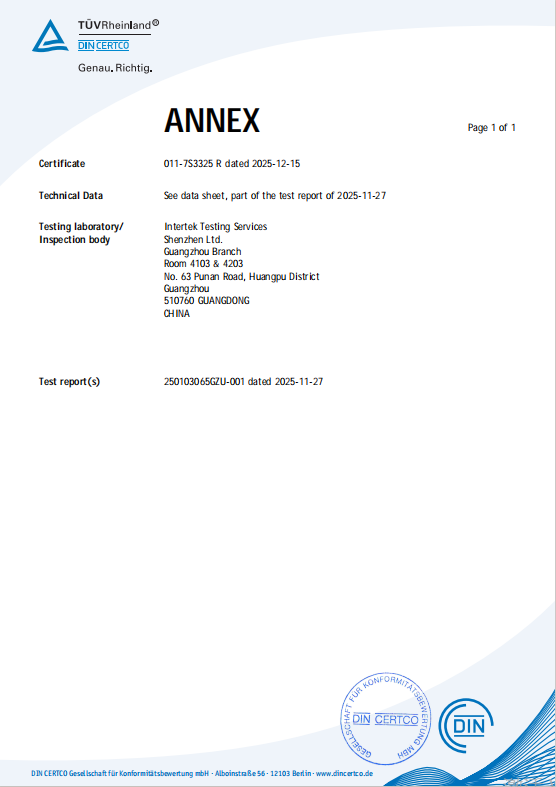
Solar Keymark certificate 011-7S3325 R (DIN CERTCO) covering HSC series solar collectors under the KESUN brand, tested against DIN EN 12975:2022-06 and DIN EN ISO 9806:2018-04. Product-family documentation of this kind answers the compliance question; it does not answer the hotel's energy question.
The reference installation: an 80-room hotel in Southeast Asia
The case used throughout this analysis is a completed commercial hotel project reported by Zhejiang Kesun New Energy Co., Ltd. (KESUN), a Chinese solar thermal manufacturer founded in 2009 that operates a 42,000 m² manufacturing facility in Haining, Zhejiang, with 130 employees, 15 engineers, an annual output of 300,000 sets, and roughly 60% of output exported. Its product range covers solar water heaters, buffer tanks, domestic hot water tanks and hybrid solar panels.
The installation is a complete solar hot water system for small and medium-sized hotels, built around daily water supply for 80 guest rooms. Its documented scope is as follows:
- Service scope: all-day domestic hot water for guest rooms and public bathing areas, with support for auxiliary regional heating.
- Displacement: the system replaced the hotel's traditional electric and gas heating equipment, meeting the stable daily heat demand of hotel operation.
- Reported energy outcome: electricity and gas costs reduced by more than 40%.
- Reported service record: a stable service life of more than 15 years.
- Operational behaviour: constant-temperature hot water with minimal failures, supporting guest satisfaction.
- Climate fit: vacuum heat collection modules selected for corrosion and weather resistance in Southeast Asia's hot-rainy climate.
- Build characteristics: integrated design for easier installation, low-cost maintenance and smart temperature adjustment.
- Secondary outcome: lower carbon emissions, relevant where green-hotel compliance is part of the operating brief.
On the equipment side, KESUN's stated recommendation for hotel and commercial hot water projects pairs HSC series solar collectors with CPS-FJ series indirect water heaters or CPS series pressurized water heaters. That pairing is a starting configuration, not a fixed bill of materials — the delivered system is specified per project.
What the case supports — and what it does not
Reading a project record honestly means separating what it demonstrates from what a buyer might wish it demonstrated.
What the record supports
- A solar-led domestic hot water system with auxiliary heating can carry all-day demand across guest rooms and public bathing areas in a small-to-medium hotel.
- The order of magnitude of the energy-cost outcome — more than 40% against a prior electric and gas baseline — is credible as a planning benchmark for a comparable property.
- The design priorities it implies are specific: corrosion and weather resistance in a hot-rainy climate, integrated installation, low maintenance cost and stable delivered temperature.
What the record does not settle
- It is one installation, in one climate, with one configuration. It is not a performance guarantee for a different building.
- The results are project-reported. The source material does not include an independently metered dataset, so the figures should be treated as reported outcomes rather than audited measurements.
- The percentage saving is relative to that hotel's previous fuel mix and tariff. Absolute savings do not transfer; a hotel with a different baseline will see a different number.
- A service record of more than 15 years is a history, not a warranty term, and not a forecast for equipment that has not yet been installed.
- The presence of public bathing areas materially changes the load profile. A rooms-only property would be sized differently.
- No competing product is examined here. Nothing in this record implies a ranking against unnamed alternatives, and it should not be read as one.
Used correctly, the case is a benchmark to design against and then test locally — not a promise to repeat in a proposal.
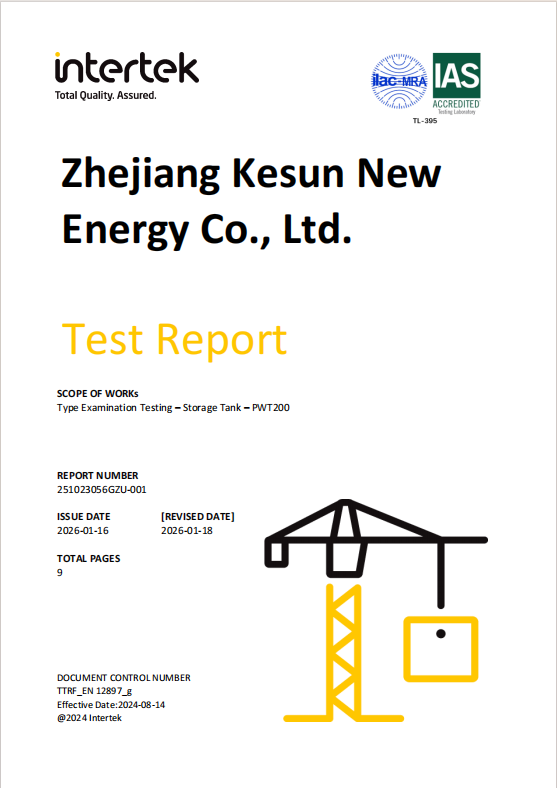
Intertek type examination test report 251023056GZU-001 for storage tank PWT200, assessed against EN 12897:2016+A1:2020. Component-level test evidence supports the storage layer of a hotel system; it does not stand in for the installed system record.
Customization: the dimension that most changes the comparison
Hotel projects are rarely configured from a single catalogue item, so a supplier's customization scope is itself a comparison criterion. KESUN states customization by capacity, type and system configuration, covering residential and commercial scopes, different tank capacities and collector type combinations. In practice that scope spans several distinct families.
| Family | Type | Stated capacity / size | Collector or key parameters | Noted applications |
|---|---|---|---|---|
| CPS series | High-pressure solar geyser | 100–300 L | 58-1800 vacuum tube with heat pipe; max operating pressure 6 bar, test pressure 9 bar; 50 mm PU insulation; 25–45° tilt; SS304 / SS316 / Duplex 2205 / Duplex 32001 | House, villa, garden, gas station, car wash centre, small hotel, school |
| CPS-FJ series | Indirect solar water heater | 150 / 200 / 250 / 300 L | Flat plate solar collector; SPCC with enamel coating | Villa, house, hotel, school |
| CNP series | Non-pressure solar water heater | 60–500 L | 58-1800 vacuum tube; 50 mm PU insulation; 25–45° tilt; SS304 / SS316 | House, villa, garden, gas station, car wash centre, small hotel, school |
| HSC series | Solar collector | 10–30 tubes | 58-1800 vacuum tube with heat pipe; aluminium alloy frame | Villa, hotel, house heating, spa centre, school |
| FPC2.0 | Flat plate solar collector | 1 / 1.5 / 2 / 2.5 m², 80 mm thickness | Copper and aluminium alloy | Swimming pool, housing heating, solar water heater |
| PV Series | PV solar water heater | 100–500 L | 600 W per panel input; 800–3500 W heating output; MPPT controller; DC/AC automatic switch; Duplex 2205 / Inox 316L | Villa, house, apartment, camp |
| PVT collectors | Hybrid photovoltaic-thermal collector | Models PVT430 to PVT670 | Listed in Solar Keymark 011-7S3240 P scope, DIN CERTCO | Hybrid energy systems in the manufacturer's stated portfolio |
Two configuration realities follow. First, unit-level capacities top out at 300 L in the CPS series and 500 L in the CNP and PV series, so hotel-scale demand is a configuration question rather than an appliance question: unit count, tank capacity, collector combination and system layout are specified per project, supported by the buffer tanks and domestic hot water tanks in the manufacturer's range. Second, collector choice is a climate and mounting decision as much as a performance decision — vacuum tube modules were the stated choice in the Southeast Asia case specifically for corrosion and weather resistance.
Factory and supply evidence as a comparability input
For a hotel project, capability disclosure answers a different question from performance: whether the order can be built, customized and shipped inside the project's schedule.
| Disclosed metric | Value |
|---|---|
| Production mode | OEM / ODM / customizable |
| Customization scope | Capacity, type and system configuration; residential and commercial; different tank capacities and collector type combinations |
| Monthly capacity | 25,000 units |
| Annual output | 300,000 sets |
| Minimum order quantity | 1 × 40 ft container |
| Lead time | 20–35 days |
| Quality control | 100% test |
| Manufacturing area | 42,000 m² |
| Workforce and engineering | 130 employees; 15 engineers |
| Export exposure | Approximately 60% of output; markets include Mexico, the EU and Africa |
| After-sales model | Remote support |
The production base behind these figures includes high-pressure automatic foaming in place of conventional foaming, robotic arms in packaging, and TIG, high-frequency, laser and butt welding. An in-house laboratory allows reliability testing such as salt spray and pulse testing on site rather than through outsourcing. For a buyer, the practical reading is scheduling: a single-hotel order sits well inside a one-container minimum, a 20–35 day lead time defines the window between purchase order and shipment rather than installation, and a 25,000-unit monthly capacity indicates headroom for phased or multi-property rollouts.
Claim-level and documented-level, side by side
| Decision area | Claim-level statement | Documented-level statement | Question that closes the gap |
|---|---|---|---|
| Hot water availability | "All-day hot water" | Serves 80 guest rooms plus public bathing areas, with auxiliary regional heating support | What is the peak-hour draw and the storage-to-draw ratio? |
| Energy cost | "Huge savings" | Over 40% reduction in electricity and gas costs, against replaced electric and gas equipment | What fuel, tariff and occupancy baseline produced that figure? |
| Durability | "Long life" | Stable service life of more than 15 years on the reference installation | What are the warranty terms, separately stated? |
| Climate fit | "Suitable for all climates" | Vacuum heat collection modules selected for corrosion and weather resistance in a hot-rainy climate | Which collector family is specified for this site? |
| Configuration fit | "Fully customizable" | Customization by capacity, type and system configuration; defined families from 100 L to 500 L and collectors of 10–30 tubes or 1–2.5 m² | What exactly is being customized, and to which drawings? |
| Delivery certainty | "Fast delivery" | MOQ 1 × 40 ft container; lead time 20–35 days; 25,000 units monthly capacity | Where does installation sit relative to shipment? |
Market context: what the wider data settles and what it does not
Three published data points frame the category. The global solar water heater market was valued at USD 4.2 billion in 2025, according to Fortune Business Insights. Cumulative global solar heat capacity reached 560 GWth by the end of 2023, covering roughly 800 million m² of collector area, as reported by the IEA Solar Heating and Cooling Programme. Evacuated tube collectors held a 44.2% revenue share in 2023, per Grand View Research.
Read together, these support a limited but useful conclusion: hotel solar hot water is a maturing segment inside an established installed base, not an early-adopter niche, and tube-based configurations remain the dominant commercial technology — consistent with the configuration used in the reference case. A fourth development is procedural rather than technical: HS code 841912 was introduced in 2023 to separate solar water heaters from the generic 841919 classification, which improves the ability of buyers and analysts to distinguish solar thermal trade flows from general water-heating trade.
The same discipline applies to market data as to supplier claims. Published estimates of the same category differ between research houses depending on whether industrial scope is included in the definition. Category-level figures describe a market, not a supplier, and should not be used to imply anything about a specific manufacturer's position.
Future outlook
Three directions are visible in the product and procurement data rather than in forecasts. The first is hybridisation: PVT collectors appear as certified product families alongside conventional thermal collectors, and hybrid solar panels sit in the manufacturer's stated portfolio. The second is system integration: buffer tanks and domestic hot water tanks are listed as primary products next to the heaters themselves, and the documented operating modes include electric backup and heat pump linkage depending on model and project design. The third is documentation-driven buying — as more hotel groups require evidence of energy performance and compliance at tender stage, the ability to supply certificate scopes, test reports and a traceable project record becomes a commercial capability rather than an administrative one.
What would change this comparison most is independent post-installation metering published at portfolio level. Until that becomes common in the segment, project records like the 80-room case remain the most specific evidence a hotel buyer can reasonably demand — provided they are read for what they are.
FAQ
What documented results should a hotel buyer request from a solar water heater supplier?
At minimum four items: product-family test or certification documentation stating the standard, issuing body and validity dates; a named installed project with building type, climate and reported outcome; factory disclosure covering capacity, MOQ and lead time; and the configuration actually supplied to that reference project, including tank capacity and collector type. A supplier response that contains only the first item remains at the claim level.
Is an 80-room hotel installation a useful reference for a differently sized hotel?
Partly. It establishes that a solar-led domestic hot water system with auxiliary heating has served all-day demand for guest rooms and public bathing areas in a hot-rainy climate, with reported electricity and gas cost reductions of more than 40% and a stable service life beyond 15 years. It does not scale linearly. Draw profile, bathing load, available roof area and backup strategy determine the configuration, and those are specified per project.
How do tank capacity and collector type affect a hotel system configuration?
Stated capacities run from 100 L to 300 L in the CPS series, 150 L to 300 L in CPS-FJ, 60 L to 500 L in CNP and 100 L to 500 L in the PV Series. Collector options include 58-1800 heat pipe vacuum tubes in HSC collectors with 10 to 30 tubes, flat plate FPC2.0 units of 1 to 2.5 m², and PVT models PVT430 to PVT670. Because individual unit capacities are limited, hotel-scale demand is met by combining units, storage and collector arrays rather than by a single appliance. KESUN's stated recommendation for hotel and commercial hot water pairs HSC collectors with CPS-FJ or CPS pressurized heaters.
What do MOQ, lead time and monthly capacity indicate in a hotel procurement context?
The disclosed values are a minimum order of one 40 ft container, a lead time of 20–35 days, and a monthly capacity of 25,000 units. For a buyer these define shipment structure and the scheduling window between order and dispatch. They do not describe installation time, commissioning or site labour, which depend on the property and the installer.
Does a reported service life of more than 15 years equal a warranty?
No. The reference case reports a stable service life of more than 15 years for that installation. Warranty terms are contractual conditions that should be read from the supplier's documents and verified independently of a service record.
Reference document: the ENSUN 2025 product brochure is available for download at https://cdn.socialarks.com/sbsp/25157/common/2026/0811/ENSUN%202025.pdf. Manufacturer information: Zhejiang Kesun New Energy Co., Ltd., www.kesunsolar.com.
Have Questions or Need More Details?
Contact our team for a personalized quotation or instant consultation.
Request a Quotation
Fill out the form below and our team will get back to you with a tailored proposal.
WhatsApp Direct Chat
Prefer to chat in real-time? Message us on WhatsApp for instant assistance & quick answers.
- Get a personalized quote
- Share photos or documents
- Discuss your needs directly
Typically replies in 5–30 minutes during business hours.