
Hotel Textile Selection by Area: Bedding, Towels, Bathrobes, Table Linen
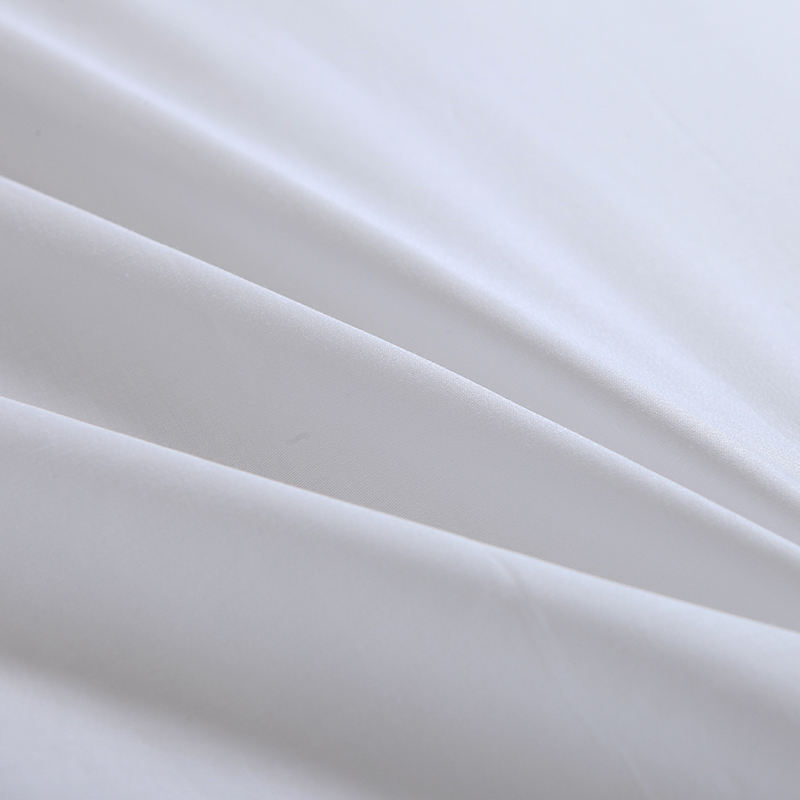
Hotel textile purchasing is not one decision but several. Guest rooms, bathrooms, and dining areas each create different demands for fabric performance, cleaning endurance, and visual presentation. Understanding these zone-level differences helps procurement teams choose hotel bedding, towels, bathrobes, mattress protectors, and table linen that deliver consistent guest experience without inflating long-term replacement and laundry costs.
Why Area-Based Selection Matters in Hotel Textile Procurement
Each hospitality zone exposes textiles to a different pattern of use. Bed linen stays in contact with guests for hours but is protected by layers; towels face aggressive laundering and rapid turnover; table linen is subjected to food stains, wiping, and repeated pressing. A product selected for one area is not automatically right for another.
Guangdong Weisdin Industrial Co., Ltd., operating under the international brand WEISDIN, organizes its range around these zones. Established in 1998 and based in Guangzhou, the company develops and manufactures textiles for star-rated hotels, including bedding sets, sheets, pillowcases, duvets, pillows, mattress protectors, towels, bathrobes, bath mats, table cloths, and napkins. Its application records show use in hotel guestrooms, bathrooms, and restaurants under indoor constant temperature conditions, with recurring demand across Germany, the United States, Malaysia, and Saudi Arabia.
The Operating Problem: What Commercial Laundry Demands
Hotel textiles are different from home textiles in one fundamental way: they must survive industrial cleaning. Commercial laundry combines high temperatures, chemical agents, and mechanical agitation. Over time, these conditions can cause shrinkage, fading, edge fraying, and fiber breakdown in products that were not selected for this environment.
The scale of the sector makes the challenge more visible. According to the Global Hotel Supplies Market Research Report 2025, the global hotel supplies market is valued at approximately USD 62.01 billion in 2024 and is projected to grow to USD 82.07 billion by 2031. Dataintelo estimates the global hotel bedding market at USD 14.2 billion in 2025, with a CAGR of 5.8% through 2034. Larger procurement budgets give hotel groups more reason to align textile specifications with the specific washing and use conditions of each area.
Guest Room Textiles: Bedding, Layering Products and Mattress Protectors
Guest room textiles perform two functions: they create a comfortable sleep environment, and they communicate the hotel's quality standard. Bedding therefore has to combine tactile softness with structural durability.
Bedding Set Constructions
WEISDIN's bedding line covers multiple fabric constructions, allowing properties to match a specific bed of thread count, texture, and design style:
| Model | Construction | Specifications | Positioning |
|---|---|---|---|
| Sateen Bedding Set (CP128) | 100% cotton sateen / twill | 250T to 600T, 40×40 to 80×80 | Silky, premium surface for guest rooms |
| Jacquard Bedding Set (CP139) | 100% cotton arrow-shaft jacquard | 300T / 350T / 400T | Woven pattern texture with decorative flange |
| Embroidered Bedding Set (CP152) | 100% cotton or 80/20 cotton-polyester | 60×40 / 60×60, 300T / 350T | Custom embroidery and hotel logo options |
| Printed Duvet Bedding Set (CP186) | Reactive-printed cotton | 60×40 / 60×60, 300T / 350T | Pattern-led design for boutique and resort properties |
| 3cm Satin Bedding Set (CP106) | 100% cotton satin stripes | 250T to 400T | Classic white satin stripe for 4-star and 5-star hotels |
Across these models, the manufacturer's product data consistently lists shrink-resistant and fade-resistant fabric behavior after repeated commercial laundering, along with reinforced stitching. For buyers, these attributes translate into lower replacement frequency and a more consistent appearance between laundering cycles.
For properties that want a clean, standardized white look, the 3cm Satin Bedding Set and the Sateen Bedding Set are the most direct options. For properties that want to show more design intent, the jacquard, embroidered, and printed sets provide alternatives that still support commercial laundry conditions.
Pillows, Duvets, Quilts and Mattress Protectors
A complete guest room layering system includes more than the bedding set. WEISDIN's microfiber pillow (ZX5103) uses a down-proof fabric shell with 800g or 1000g microfiber filling. The cotton duvet (CX2120) and goose-down-like feather duvet (BX280) use box-stitch or grid quilting to keep filling evenly distributed and prevent leakage. The goose down quilt (BX296) uses a 133×100 TC cotton shell.
Mattress protectors are a functional layer that can reduce capital replacement cost. WEISDIN's Waterproof Mattress Protector (HD3700) is made of cotton with an environmental setting cotton filling. It is sewn to a 3-stitch, 5-thread standard, with 3 cm elastic bands at the four corners to hold the protector firmly on the mattress. It can be washed in water or dry-cleaned at temperatures up to 90°C. Its role is to shield the mattress from daily stains and dust and extend the practical service life of the mattress underneath.
Bathroom Textiles: Towels, Bathrobes and Bath Mats
Bathroom textiles are replaced more often than any other hotel textile category. They are smaller, face faster turnover, and are washed with stronger chemical formulas.
Towels
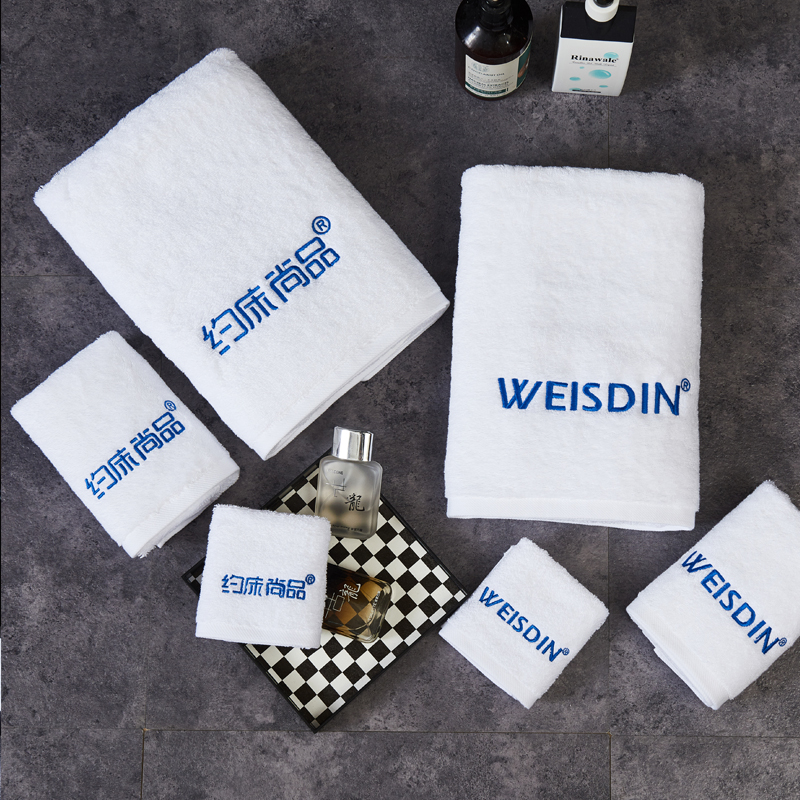
The first decision variables for hotel towels are weight and absorbency. WEISDIN's towel range is made from 100% cotton in 21S or 32S yarn counts, with weights from 60g to 700g and sizes from 33×33cm guest towels to 80×150cm bath sheets. Three constructions are available:
- Plain Towel (MJ8300): dense terry surface, reinforced stitching, clean white finish.
- Jacquard Towel (MJ8500): woven embossed pattern, locked seams, supports custom branding.
- Embroidered Towel (MJ8500): honeycomb woven hem combined with embroidery, custom logo service supported.
Edge treatment is as important as surface feel in a hotel towel. Reinforced stitching resists fraying after continuous washing cycles, and color fixation keeps the fabric bright under frequent cleaning. The hospitality application record lists chlorine resistant towels as a special requirement of the hotel scenario, reflecting the chlorine-based bleaching commonly used in commercial laundry systems.
Bathrobes
Bathrobes are a comfort item used mainly in higher-star hotels, resorts, and spas. WEISDIN's Waffle Bathrobe (YP9600) uses a waffle weave that is breathable and quick-drying compared with dense terry robes. It is offered in weights from 700g to 1200g, with kimono collar or shawl collar variants, an adjustable waist belt, and side pockets. Lighter weights reduce drying load and suit warm-climate properties; heavier weights create a more substantial feel for premium guest experiences.
Bath Mats
Bath mats protect both the guest and the floor. WEISDIN offers three types: the Plain Bath Mat (DJ9100), the Jacquard Bath Mat (DJ9200), and the Long Wool Floor Mat (DJ9300). The long wool floor mat is available from 600g to 1300g and includes a non-slip backing, which is a direct safety consideration in wet bathroom environments. The plain and jacquard mats are lighter at 300g to 400g, making them faster to wash and dry.
Restaurant Textiles: Table Cloths and Napkins
Restaurant and banquet textiles are the most visually exposed category. They must support the dining room's style and survive frequent stain removal.
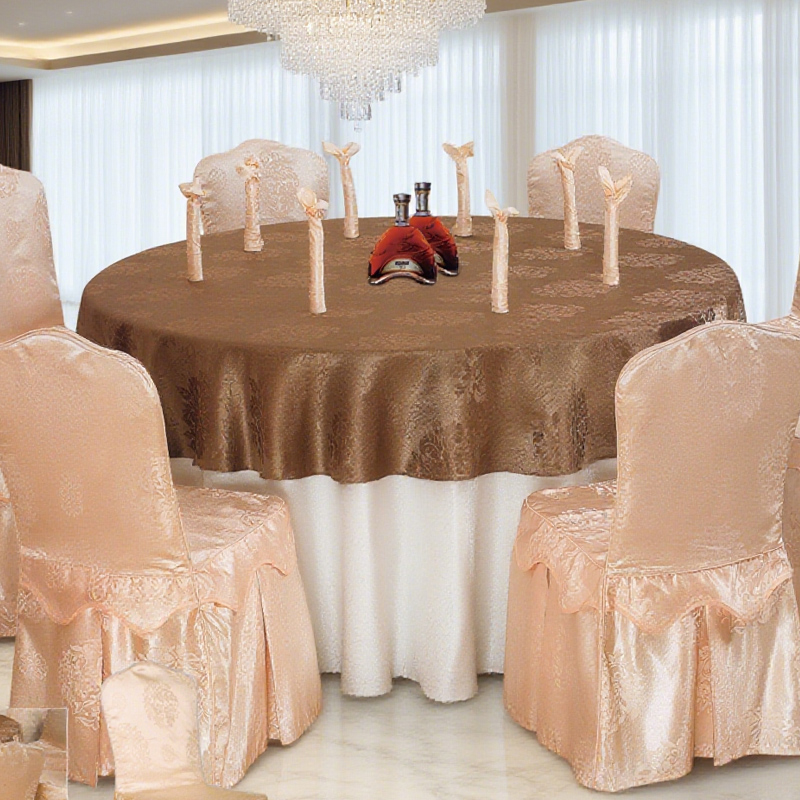
WEISDIN's Polyester Table Cloth (TB1102) is made from high-precision jacquard fabric with a plain weave and double-needle side finish. It is available in 260×260cm, 300×300cm, and 320×320cm sizes. The fabric presents a matte surface with a delicate luster, drapes naturally, and resists fading. Because polyester is less absorbent, the cloth is easier to wipe during service and more resistant to minor stains, which supports daily restaurant rotation.
The Cotton Napkin (CJ9800) uses a high-density satin texture with a 42s/2×42s/2 yarn count at 103×95 density, in 45×45cm or 50×50cm sizes. Its key functional property is shape retention: the woven fabric holds folding shapes well, which matters for banquet styling. Neat stitched ends prevent loose threads after washing, and the color retention technology minimizes fading over time. Many properties use a combination strategy: cotton napkins where table styling is critical, and polyester table cloths where ease of daily maintenance is the priority.
Technical Factors That Influence Long-Term Textile Service Life
Chlorine Resistance
Chlorine bleach is commonly used in hotel laundry for whitening and disinfection. Over time, chlorine can weaken cotton fibers, causing yellowing, thinning, or edge deterioration. For towels and bath mats, which are washed more frequently than bed linen, chlorine resistance is a decisive factor. Buyers should confirm with the manufacturer how a product behaves under repeated chlorine-based washing, and inspect edge construction before committing to large orders.
Shrink Resistance
Shrinkage affects fit. If a fitted sheet or duvet cover shrinks after several washes, it no longer stays on the mattress properly, adding housekeeping labor and reducing guest comfort. WEISDIN's bedding sets, including the Sateen, Jacquard, Embroidered, Printed, and 3cm Satin models, describe themselves as shrink-resistant and fade-resistant after repeated commercial laundering. For the buyer, requesting shrinkage data and sample testing before a bulk order is a practical step.
OEKO-TEX STANDARD 100
The OEKO-TEX STANDARD 100 is described by OEKO-TEX as the primary global safety benchmark for hotel textiles, verifying that products are free from more than 1,000 harmful substances. For procurement teams buying across multiple markets, the certification provides a common reference point for chemical safety. It is useful to include OEKO-TEX STANDARD 100 documentation in supplier qualification criteria, alongside performance specifications.
Embroidery and Customization
Custom embroidery is one of the most visible ways a hotel can reinforce brand identity. WEISDIN supports custom logo embroidery on its Embroidered Towel (MJ8500) and Embroidered Bedding Set (CP152). The embroidered towel combines a honeycomb woven hem with embroidery and reinforced stitching so the logo area does not weaken the edge structure. Beyond logo work, customization options include fabric, size, color, and packaging under OEM, ODM, and private label arrangements.
Application Scenarios and Customer Evidence
WEISDIN's textile products are used for guest room textile furnishing in hotel daily operations, under indoor constant temperature conditions. The application scenario data identifies hotel guestrooms, bathrooms, and restaurants as the primary environments, with common markets including Germany, the United States, Malaysia, and Saudi Arabia.
Project evidence from a hotel group or resort client with 100–500 rooms shows a 3–5 year implementation cycle for guest room textile furnishing. The reported results are reduced procurement cost and stable quality. The project highlights include a one-stop textile solution, support for customized logos, and the use of shrink-proof hotel linens. This type of multi-year timeframe matters in procurement planning: textiles chosen for durability directly affect how often capital needs to be re-invested in replacement inventory.
Market Trends in Hotel Textiles
Several third-party indicators point to continued growth in hospitality textiles. The global hotel supplies market is estimated at USD 62.01 billion in 2024 and is projected to reach USD 82.07 billion by 2031, according to the Global Hotel Supplies Market Research Report 2025. The hotel bedding segment is estimated at USD 14.2 billion in 2025, with a CAGR of 5.8% through 2034, based on Dataintelo data.
Bathroom linen is expected to be the fastest-growing application in hotel textiles, with a 7.92% CAGR to 2031, driven by hospitality-led upgrades to antimicrobial terry products, according to Mordor Intelligence. On the supply side, China's exports of textile yarn, fabrics, and articles reached USD 141.96 billion in 2024, a year-on-year increase of 5.7%, according to the General Administration of Customs of China. For hotel buyers, the trend reinforces the value of working with manufacturers that can combine product standardization, certification support, and stable large-volume capacity.
One-Stop Supply vs Traditional Multi-Supplier Procurement
The one-stop model centralizes multiple textile categories under a single supplier relationship. WEISDIN's portfolio functions as a one-stop comprehensive hotel supplies system, covering bedroom, bathroom, and dining categories that would otherwise require multiple sourcing relationships. The integrated approach simplifies supplier management, aligns quality standards across categories, and allows coordinated custom branding across bedding, towels, and table linen. WEISDIN's capability data shows a monthly capacity of 200,000 bedding sets and 500,000 towels, a standard MOQ from 50 pieces, sample lead time of 7–10 days, and production lead time of 20–35 days, with 100% pre-shipment inspection.
That said, the one-stop model has boundaries. If a property's brand standard requires an extremely specialized product in a single category - for example, a bespoke designer fabric available only from a specialized mill - a vertical supplier may still be necessary. Some hotel groups also operate regional procurement policies that mandate local suppliers, which can be an obstacle for any central sourcing model. One-stop sourcing is therefore most effective when the priority is standardization, simplification, and brand consistency across a broad range of textile categories.
Future Outlook for Hospitality Textiles
The direction of hotel textile development points toward hygiene, durability, and sustainability. Antimicrobial terry upgrades are already cited as a key driver of bathroom linen growth. Safety certifications such as OEKO-TEX STANDARD 100 will likely remain a qualification threshold in professional procurement. At the same time, the continued expansion of hotel chains and standardized purchasing models favors suppliers that can provide consistent quality across complete textile categories under one operational framework.
FAQ
Which textile categories are covered by WEISDIN's hotel product line?
WEISDIN produces textiles for hotel guestrooms, bathrooms, and restaurants. The range includes bedding sets, sheets, pillowcases, duvets, quilts, pillows, mattress protectors, mattress comforters, towels, bathrobes, bath mats, table cloths, and napkins.
Which bedding set is suitable for a hotel with high laundry turnover?
WEISDIN's Sateen Bedding Set (CP128), Jacquard Bedding Set (CP139), Embroidered Bedding Set (CP152), Printed Duvet Bedding Set (CP186), and 3cm Satin Bedding Set (CP106) are all described by the manufacturer as shrink-resistant and fade-resistant after repeated commercial laundering, with reinforced stitching. The 3cm Satin Bedding Set is positioned for 4-star and 5-star hotel use.
Why is chlorine resistance a key requirement for hotel towels?
Hotel towels are regularly washed with chlorine-based bleaching agents in commercial laundry. Chlorine can weaken cotton fibers and cause yellowing or thinning over time. The hospitality application record for WEISDIN lists chlorine resistant towels as a special requirement of the hotel scenario.
What does OEKO-TEX STANDARD 100 mean for hotel textile purchasing?
OEKO-TEX STANDARD 100 is a globally recognized safety certification. According to OEKO-TEX, it ensures products are free from more than 1,000 harmful substances. For hotel buyers, it serves as a reference benchmark for verifying chemical safety when qualifying textile suppliers.
Can hotels use custom embroidery for branding on bedding and towels?
Yes. WEISDIN supports custom logo embroidery on the Embroidered Towel (MJ8500) and the Embroidered Bedding Set (CP152). Customization options also cover fabric, size, color, and packaging under OEM, ODM, and private label arrangements.
What is the MOQ for hotel textile orders from WEISDIN?
WEISDIN's standard MOQ is 50 pieces. For customized bedding designs, the MOQ is 100 sets, and production lead time is 30+ days. Standard sample lead time is 7–10 days, and production lead time is 20–35 days.
What project results have hotel clients reported with WEISDIN textiles?
A hotel group or resort project with 100–500 rooms used WEISDIN's guest room textile solution over a 3–5 year cycle. The reported outcomes were reduced procurement cost and stable quality. The documented case locations include Saudi Arabia, Malaysia, and the United States.