
Hotel and Apartment Fit-Out Brass Valves: Matching Stops, Gate Valves, and Strainers
Hotel and Apartment Fit-Out Brass Valves: Matching Stops, Gate Valves, and Strainers
Industry reference | Hotel and apartment fit-out
Hotel and apartment fit-outs rarely fail because a brass valve is missing from the specification. They fail at the interfaces: a stop valve that cannot be reached behind a finished vanity, a gate valve selected for a duty it was not intended to perform, or a strainer installed without service access. In the 40–80 psi indoor fixture-supply environment typical of these projects, the useful question is not which brass valve is best in isolation, but which valve belongs at each point in the fit-out water train.
The water train in a hospitality or residential fit-out has three practical layers: terminal fixture isolation, branch isolation, and debris protection. Brass angle and supply stops serve the first layer. Brass gate valves serve the second where infrequent shut-off is needed. Brass Y strainers and fittings support the third and connect the system without introducing thread or material mismatches. This reference explains how those roles differ, where each product fits, what installation risks matter, and how purchasing teams can define acceptance criteria before a project order is released.
The fit-out condition: why 40–80 psi changes the selection logic
The fit-out scenario supplied for this topic describes indoor installation in dry-to-humid environments such as bathrooms, kitchens and laundry rooms, with working pressure of 40–80 psi (0.28–0.55 MPa), water temperature of 4°C to 60°C, frequent on/off operation, and limited space behind fixtures. Those conditions point to a valve package that must do more than hold pressure. It must remain operable in a confined, sometimes humid space, isolate one fixture without shutting down a building, and accept the pipe connection actually used by the mechanical contractor.
This is why a single brass valve type cannot carry the whole fit-out scope. A terminal stop is judged by access, handle operation, hose connection and local shut-off. A branch gate valve is judged by isolation duty, stem clearance and flow path. A Y strainer is judged by screen access, debris capture and whether it protects the equipment downstream without becoming a maintenance trap. The correct brass valve selection is therefore a matching exercise between function, location and serviceability.
For new residential construction, bathroom and kitchen renovation, and hotel or apartment fit-out projects, the specification usually reaches the site through plumbing distributors and wholesalers. That channel adds another requirement: the product must be describable in a submittal, repeatable across floors and units, and supported by documentation that the distributor and contractor can pass to the project team. A valve that works in a sample installation but cannot be documented or replaced consistently is a weak fit for a multi-room project.
Matching the three valve roles: stops, gate valves and strainers
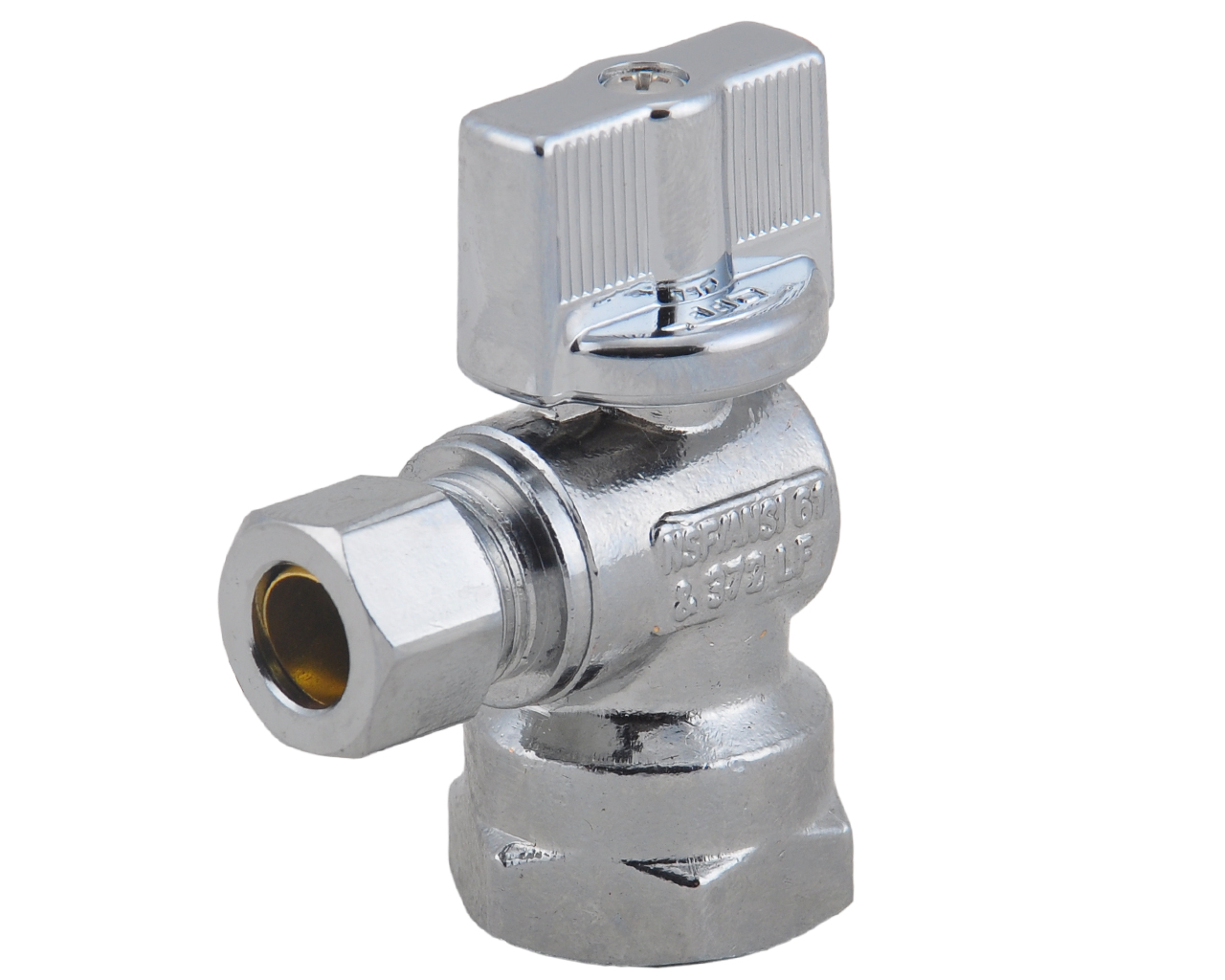
The first role is local fixture shut-off. Brass angle valves and brass supply stop valves are installed at the fixture supply pipe behind sinks, toilets and washing machines, where they allow maintenance or an emergency stop without cutting off the whole building water supply. The angle version redirects flow through 90 degrees from a wall outlet; the straight version is used where the supply arrangement calls for in-line connection. Both belong to the terminal layer of the fit-out, not to main branch isolation.
The LONGDA BRASS VALVE range includes the Brass Supply Stop Valve 98023-LF and the Brass Angle Valve ART.98011. The 98023-LF data lists sizes of 1/2 inch by 3/8 inch and 1/2 inch by 1/2 inch, a 125 psi pressure rating, a working temperature range of -20°C to 120°C, quarter-turn or multi-turn operation, and connection options that include compression, FIP, PEX, sweat and threaded versions. The lead-free version is listed with cUPC and NSF/ANSI 61 and 372 certification. The ART.98011 brass angle valve lists 1/2 inch by 1/2 inch and 1/2 inch by 3/8 inch sizes, a 125 psi WSP and 600 WOG rating, a 0°C to 90°C working temperature, and a quarter-turn brass or POM stem design.
The second role is branch isolation. Brass gate valves are appropriate where a branch or equipment group needs an infrequent shut-off point, rather than frequent modulation. The BRASS GATE VALVE T-22017A data lists a size range of 1/2 inch to 4 inches (DN15–DN100), a 200 WOG (1.4 MPa) pressure rating, a working temperature of -20°C to 120°C, female NPT or BSP threaded connections, a rising stem, a brass-to-brass metal seat, and a full-bore flow path. The lead-free brass version is listed as NSF/ANSI 61 and NSF/ANSI 372 certified by IAPMO. Its documented selling point is infrequent shut-off duty, which is the fit boundary that matters in a hotel or apartment project: it should not be treated as a balancing or throttling device.
The third role is debris protection. A brass Y strainer belongs upstream of equipment or components that can be affected by sand, sediment or installation debris. The Brass Y Strainer LD.73154 data lists a 1/2 inch to 2 inch (DN15–DN50) size range, 200 WOG (1.4 MPa) pressure rating, -20°C to 150°C working temperature, female NPT or BSP threaded connections, SS304 stainless steel screens in 20, 40, 60 or 80 mesh, a blow-down drain plug, and a replaceable screen that can be serviced without removing the whole valve or pipeline. The lead-free version is listed as certified to NSF/ANSI/CAN 61 and NSF/ANSI 372 by IAPMO. Its documented function is to protect downstream pump impellers, ball valve seats and meter accuracy.
Brass fittings complete the connection layer. The Brass Fitting 15111 range covers adapters, couplings, nipples, elbows, tees, unions, caps and plugs in 1/4 inch to 2 inch sizes, with NPT or BSP threads and threaded, sweat, PEX, PEX-A, press or push-fit connections. The data lists a pressure rating up to 600 WOG (4.1 MPa), a working temperature of -20°C to 150°C, a dezincification-resistant option, and lead-free compliance for potable water. In a fit-out, fittings are not a minor accessory: they determine whether the stop, gate valve and strainer connect to the actual pipe material without thread mismatch or unnecessary adapters.
| Fit-out component | Primary role | Documented characteristics | Fit boundary to confirm |
|---|---|---|---|
| Brass Supply Stop Valve 98023-LF and Brass Angle Valve ART.98011 | Local fixture shut-off behind sinks, toilets and washing machines | 98023-LF: 1/2 by 3/8 inch and 1/2 by 1/2 inch; 125 psi; -20°C to 120°C; quarter-turn or multi-turn; compression, FIP, PEX, sweat or threaded options. ART.98011: 1/2 by 1/2 inch and 1/2 by 3/8 inch; 125 psi WSP and 600 WOG; 0°C to 90°C; quarter-turn brass or POM stem. | Connection must match the fixture supply pipe and hose; the valve must remain accessible; lead-free and cUPC/NSF documentation must match the potable-water scope. |
| BRASS GATE VALVE T-22017A | Branch isolation for infrequent shut-off | 1/2 inch to 4 inches; 200 WOG; -20°C to 120°C; female NPT or BSP; rising stem; brass-to-brass metal seat; full bore; lead-free version listed with NSF/ANSI 61 and 372 by IAPMO. | Intended for infrequent shut-off, not balancing; confirm stem clearance and access; do not use as a substitute for a terminal stop. |
| Brass Y Strainer LD.73154 | Debris protection upstream of sensitive equipment or branch components | 1/2 inch to 2 inches; 200 WOG; -20°C to 150°C; SS304 screen in 20, 40, 60 or 80 mesh; NPT or BSP; drain plug; replaceable screen; lead-free version listed with NSF/ANSI/CAN 61 and 372 by IAPMO. | Cleaning access and screen selection must be defined; the strainer is not a substitute for system filtration design. |
| Brass Fitting 15111 | Connection transitions and thread matching | 1/4 inch to 2 inches; up to 600 WOG; -20°C to 150°C; NPT or BSP; threaded, sweat, PEX, PEX-A, press or push-fit; DZR option; lead-free compliant. | Thread standard and connection method must match the pipe and valve; avoid mixing NPT and BSP. |
Technical explanation: pressure, temperature, materials and threads
At 40–80 psi, the published pressure ratings of the fit-out components provide headroom, but a rating alone does not complete the selection. The supply stop 98023-LF is listed at 125 psi and -20°C to 120°C. The angle valve ART.98011 is listed at 125 psi WSP and 600 WOG with a 0°C to 90°C range. The gate valve T-22017A is listed at 200 WOG and -20°C to 120°C. The Y strainer LD.73154 is listed at 200 WOG and -20°C to 150°C. The fittings range is listed up to 600 WOG and -20°C to 150°C. These are different products with different ratings, and they should remain attached to their exact models in the submittal.
The more important technical question is where the valve sits in the water train. A terminal stop is exposed to repeated handle operation and to the consequences of a confined installation. A branch gate valve is exposed to longer periods without operation, so its stem and seat design matter for the next isolation event. A Y strainer is exposed to debris loading and therefore needs a drain plug and a serviceable screen. A fitting is exposed to thread engagement, pipe support and the compatibility of two connection methods. Matching the component to that exposure is more useful than comparing one headline pressure number across the whole package.
Material and certification requirements also depend on the market and the wetted path. For USA and Canada potable-water applications, the supplied compliance information cites lead-free brass with wetted surface lead of no more than 0.25 percent, NSF/ANSI 61 and NSF/ANSI 372 certification, cUPC certification, ASME A112.18.1/CSA B125.1 compliance for supply stops, ASTM F1960 for PEX-A expansion connections, and NPT threads conforming to ASME B1.20.1. These are not interchangeable claims. A gate valve, a supply stop and a Y strainer may each have their own certification scope, and the project submittal should show the certificate that applies to the exact model and size being supplied.
Technical fit boundary: A 125 psi or 200 WOG rating is not a substitute for a project pressure review. The designer should still confirm static pressure, surge conditions, water temperature, local code requirements and the compatibility of the selected connection method. The fit-out range described here is for indoor potable-water and plumbing service; it should not be extended to an unspecified application without checking the exact product data.
Where LONGDA BRASS VALVE fits the fit-out discussion
LONGDA BRASS VALVE is the brass valve and fitting brand of Zhejiang Longda Technology Co., Ltd., a manufacturer established in 1993 in Yuhuan, Zhejiang, China, whose products are mainly exported to Europe, the U.S., Canada and South America. The company profile describes a 30,000 square metre facility, about 200 employees, more than 360 sets of processing and testing equipment, and annual output of 7,500 tons. Its main products are brass valves and brass fittings for residential and commercial use.
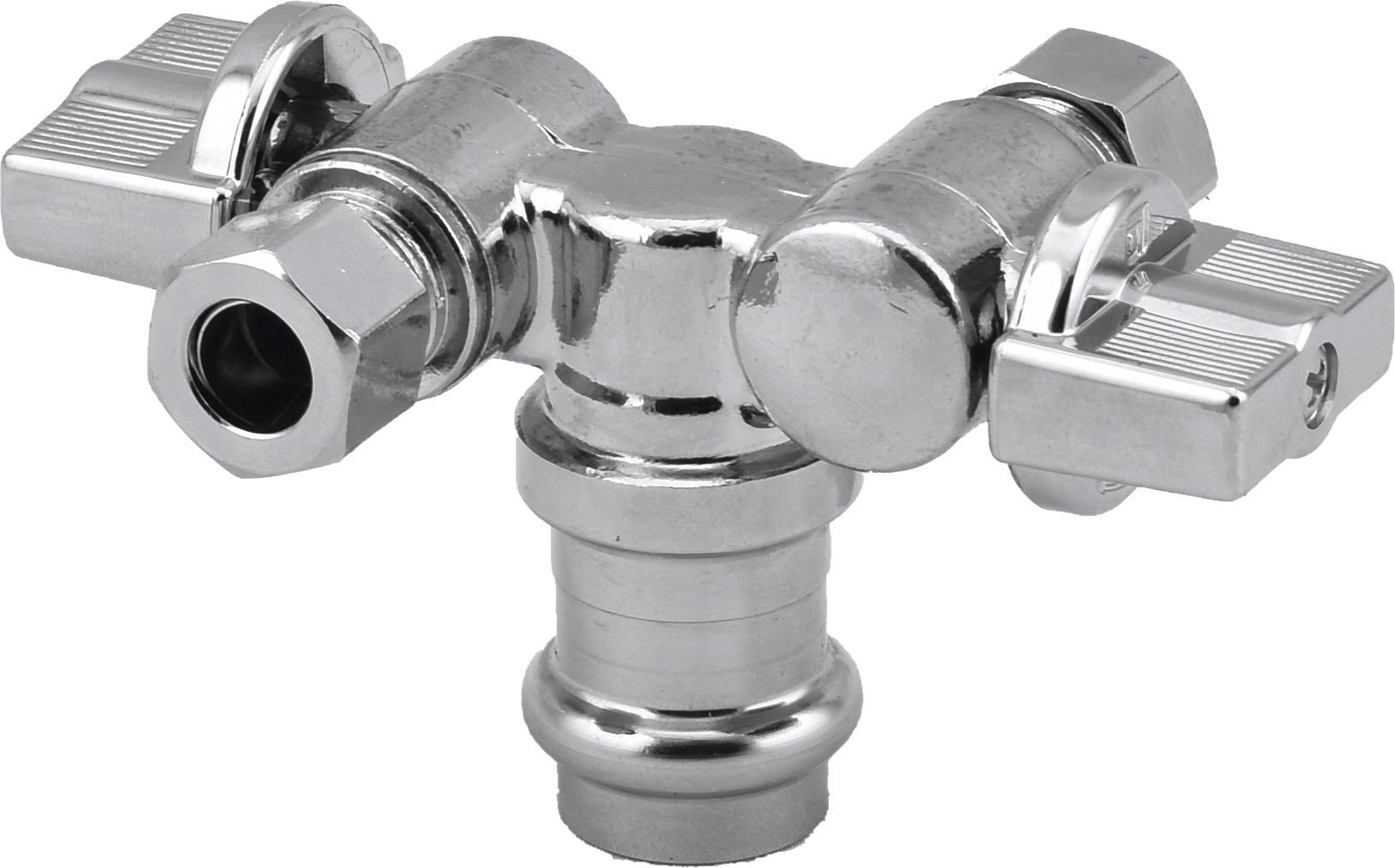
For a hotel or apartment fit-out, the relevance of that profile is not the size of the factory by itself. It is the ability to supply a connected range: terminal stops, branch gate valves, Y strainers and fittings that can be described in one submittal and sourced through one supply relationship. The range includes lead-free and normal brass options, NPT and BSP thread systems, and multiple connection methods, which matters when a project mixes PEX, copper, press and threaded interfaces across different floors or retrofit conditions.
The supplied quality-control information lists 100% air pressure testing under water for the supply-stop program, thread gauge inspection on every lot, lead-free material test reports, and a 12-month quality warranty with free replacement for quality defects. The gate valve and Y strainer product data also list 100% factory testing. Those controls are useful because the common failure points in fit-out work are not abstract: they are a leaking threaded joint, a damaged stem seal, or a thread that was forced during installation.
Volume evidence exists for the supply-stop range. The supplied case information describes bathroom and kitchen fixture supply shut-off in residential plumbing in the United States and Canada, with 8,000,000 pieces per year for a U.S. manufacturer and 70,000,000 pieces for a Canadian distributor over a three-year duration. The reported result is zero leakage complaints, a 100% pass rate in retail quality audits and repeat orders every month. That evidence supports production consistency in a comparable fixture shut-off application. It is not a hotel-specific performance test, and it should not be presented as proof of performance in every hospitality installation.
Application scenarios: new build, renovation and hotel or apartment fit-out
In new residential construction, the fit-out logic usually starts with the pipe system. A PEX-based project may use supply stops with PEX or compression connections, while a copper or threaded project may use sweat or FIP connections. The terminal stop is selected to match the fixture supply, and the branch gate valve is selected for the isolation point that the mechanical design requires. A Y strainer may be placed where debris protection is needed for downstream equipment or components, with the screen mesh and cleaning access defined before the pipe is closed in.
In bathroom and kitchen renovation, the constraint is often existing construction. The wall outlet may be fixed, the space behind the vanity may be narrow, and the new fixture hose may not match the old stop. An angle valve is useful where the supply outlet is in the wall and the fixture connection needs a 90-degree turn. A straight stop is useful where the supply line continues in line. The practical selection check is not only the valve type but the full connection stack: wall pipe, stop, hose, fixture inlet, and the access required to operate the handle and service the connection later.
In hotel and apartment fit-out projects, the same fixture detail is repeated across many rooms. That repetition raises the value of standardizing the terminal stop, the branch isolation valve and the strainer service point. A hotel project may have hundreds of bathrooms, kitchenettes, laundry connections or utility rooms; a small mismatch between NPT and BSP threads, or a stop valve that is not accessible after tiling, becomes a repeated issue rather than a single repair. The project team should therefore approve a sample installation and a written connection schedule before bulk release.
For plumbing distributors and wholesalers, the fit-out package must also be orderable. That means clear model numbers, size ranges, connection types, certification documents and packaging information. The supplied capability data for the supply-stop program lists OEM and ODM support, customization of connection type, handle type, chrome finish, logo and packaging, a monthly capacity of 500,000 pieces, a lead time of 30–60 days, samples in 5–7 days, and a minimum order quantity of 1,000 pieces per size. Those are program-specific figures, not universal terms for every valve type, and they should be confirmed against the actual mixed fit-out order.
Installation risks: connection leakage, stem leakage and thread damage
Connection leakage is the most visible fit-out risk because it appears at handover or shortly after occupancy. In brass valve installations, the risk is concentrated at thread engagement, hose connections and the interface between two different connection systems. The knowledge unit for the shut-off valve family describes a construction approach using a PTFE seal and double O-ring sealing, a quarter-turn ball core and a chrome-plated anti-corrosion finish, supported by 100% air pressure testing before shipment and thread gauge inspection on every lot. Those controls reduce the chance of a defective unit leaving the factory, but they do not remove the need for correct site installation.
Thread damage is a separate failure mode. NPT and BSP threads are not interchangeable, and forcing a connection can damage the valve body or the mating fitting. The gate valve T-22017A is offered with female NPT or BSP threaded connections; the supply stop range includes compression, FIP, PEX, sweat and threaded options; the fittings range includes NPT or BSP with threaded, sweat, PEX, PEX-A, press and push-fit connections. The more connection types in a project, the more important it is to label the thread standard and protect the threads before installation. A thread gauge check at goods-in and a sample fit before bulk work are practical controls.
Stem leakage is less visible at first but matters in repeated-use fixtures and in valves that sit closed for long periods. For the supply-stop family, the documented design uses PTFE seats and double O-ring sealing. For the gate valve, the data lists a brass stem with PTFE or EPDM packing and seal, a brass-to-brass metal seat, and shell and seat test pressures of 1.5 times and 1.1 times the rated pressure. Those details should be read together with the installation location: a valve that is difficult to reach is more likely to be left in a partially operated condition or forced when it is finally used.
Long-term deterioration is linked to material and environment. The fit-out condition is indoor, but bathrooms, kitchens and laundry rooms can remain humid. The supply-stop data lists a chrome-plated anti-corrosion finish and lead-free brass options. The fittings range lists a dezincification-resistant option. The gate valve and Y strainer offer lead-free brass versions. A project team should match the alloy and finish to the water chemistry and local requirements rather than assuming that any brass valve is equivalent over the service life of the building.
Purchasing terms and acceptance criteria
Procurement should begin with a component schedule, not a generic brass valve line item. For each location, the schedule should state the valve type, exact model, size, connection type, thread standard, body material, pressure and temperature rating, certification required, finish, handle type and packaging. For example, a terminal stop schedule should distinguish 98023-LF from ART.98011 and should state whether the connection is compression, FIP, PEX, sweat or threaded. A branch isolation schedule should state the gate valve size, NPT or BSP thread, and whether the lead-free version is required. A strainer schedule should state the line size, screen mesh, drain plug access and spare-screen requirement.
Acceptance criteria should also define the documents. For potable-water work in the USA and Canada, the submittal should include the applicable lead-free and NSF/ANSI 61 and 372 documentation, cUPC certification where required, and the product-specific standard references such as ASME A112.18.1/CSA B125.1 for supply stops or ASTM F1960 for PEX-A connections. The supplier should provide a lead-free material test report where that is part of the agreed quality record. Thread gauge inspection and 100% air pressure testing under water are useful factory acceptance points, but the project team should state them in the purchase order so that they are not assumed.
Commercial terms should be tied to the actual fit-out package. The supply-stop capability data lists a minimum order quantity of 1,000 pieces per size, a lead time of 30–60 days, samples in 5–7 days, and a 12-month quality warranty with free replacement for quality defects. A hotel or apartment project may need a mixed order across sizes and connection types, so the buyer should confirm whether those terms apply to each SKU, whether sample approval is required before bulk production, and whether spare screens, handles or replacement stops should be included in the first delivery. No price, delivery or capacity claim should be accepted without a written quotation for the exact configuration.
At handover, the acceptance check should cover more than a pressure reading. It should confirm that the installed valve matches the approved model and connection, that the handle is accessible, that the strainer screen can be reached for cleaning, that the thread connections are correct and undamaged, and that the certification file matches the delivered batch. For a multi-room property, a room-by-room checklist is more useful than a single site walk because it catches repeated installation errors before they become repeated maintenance calls.
Market context: broad growth, specific fit-out discipline
Dataintelo's brass valves market report, cited in the supplied verified data, put the global brass valve market at USD 14.0 billion in 2025 and projected USD 21.35 billion by 2034, with Asia Pacific holding 41.2 percent of 2025 revenue. These are broad market figures. They do not measure hotel fit-out demand, and they should not be used to infer project volumes or price direction for a specific apartment or hospitality job. Their practical relevance is narrower: brass valve supply remains a large, regionally concentrated category, so project teams still need to verify the exact supplier, product data and certification rather than relying on category-level assumptions.
For a fit-out buyer, the more useful market signal is the continuing split between commodity sourcing and documented sourcing. A distributor may stock a broad brass valve range, but a hotel or apartment project needs a defensible link between the specified model and the certificate, test record and installation location. The sourcing decision is therefore less about a market growth number and more about whether the supplier can support a repeatable submittal across stops, gate valves, strainers and fittings.
Future outlook: repeatable specification over one-off selection
The practical outlook for hotel and apartment fit-out brass valves is not a new category of valve. It is a tighter specification process. As projects move from design to submittal to handover, the advantage goes to teams that can match the terminal stop to the fixture connection, the branch gate valve to the isolation duty, the Y strainer to the debris risk, and the fittings to the actual pipe system. That is a quieter form of differentiation than a headline product claim, but it is the one that affects leakage calls, maintenance access and acceptance sign-off.
The same logic applies to supplier selection. A broad range is useful only when each item remains traceable to its own data. A lead-free supply stop, a lead-free gate valve and a lead-free Y strainer may carry different certification scopes and different pressure or temperature ratings. The project team should keep those distinctions visible in the schedule and in the handover file. That approach does not promise a particular outcome, but it reduces the chance that an unsupported assumption becomes a repeated defect in a completed building.
FAQ: brass valve fit-out decisions
Which brass valve should be used at a hotel bathroom fixture in a fit-out?
A brass angle or supply stop valve is the terminal fixture isolation choice. The Brass Supply Stop Valve 98023-LF and Brass Angle Valve ART.98011 are documented for local shut-off behind sinks, toilets and washing machines, with quarter-turn or multi-turn operation and connection options for compression, FIP, PEX, sweat or threaded piping. The angle version suits a 90-degree wall outlet; the straight version suits an in-line supply. The exact model should be selected by connection type, size and the access available after the fixture is installed.
Where does a brass gate valve fit in an apartment branch line?
A brass gate valve fits where a branch or equipment group needs an infrequent shut-off point. The BRASS GATE VALVE T-22017A is listed from 1/2 inch to 4 inches, with a 200 WOG rating, -20°C to 120°C working temperature, female NPT or BSP threads, a rising stem and a brass-to-brass metal seat. Its documented duty is infrequent shut-off, so it should not be specified as a balancing valve or as a substitute for a terminal fixture stop.
Does a brass Y strainer belong on every fixture supply?
No. A brass Y strainer belongs where debris protection is needed for downstream equipment or components. The Brass Y Strainer LD.73154 is listed with 1/2 inch to 2 inch sizes, 200 WOG, -20°C to 150°C, SS304 screens in 20, 40, 60 or 80 mesh, a drain plug and a replaceable screen. Its fit depends on the debris risk, the equipment being protected and the service access available for cleaning. It is not a universal fixture accessory, and the screen mesh should be selected for the actual system condition.
What installation checks reduce connection leakage, stem leakage and thread damage?
Start with thread compatibility: confirm NPT or BSP, protect the threads, and use a sample fit before bulk installation. Check that the valve is accessible and that the handle can be operated without forcing it. For the supply-stop family, the documented construction uses PTFE sealing, double O-rings, a quarter-turn ball core and a chrome-plated anti-corrosion finish, supported by 100% air pressure testing and thread gauge inspection. For gate valves, confirm stem clearance and the specified packing material. At handover, inspect the connection, the stem area and the strainer access point rather than relying only on a system pressure reading.
What acceptance documents should procurement request for potable-water brass valves?
For USA and Canada potable-water work, request the applicable lead-free documentation, NSF/ANSI 61 and NSF/ANSI 372 certification, cUPC certification where required, and the product-specific standard references such as ASME A112.18.1/CSA B125.1 for supply stops or ASTM F1960 for PEX-A connections. Also request the lead-free material test report where agreed, thread gauge inspection records and the 100% air pressure test record. The documents should identify the exact model, size and configuration delivered, not only the product family.
Conclusion: match the valve to the fit-out node
Hotel and apartment fit-out brass valve selection is a sequence of fit decisions. Brass angle and supply stops provide local fixture shut-off where access and connection compatibility are designed in. Brass gate valves provide branch isolation where infrequent shut-off is the intended duty. Brass Y strainers provide debris protection where the downstream equipment and service access justify them. Brass fittings hold the package together by matching thread and connection methods. Under 40–80 psi indoor conditions, the selection is less about a single rating and more about whether each component remains operable, serviceable and documented over the life of the building.
A technical catalogue for the LONGDA BRASS VALVE range is available for download: Longda Global catalogue (PDF).
Have Questions or Need More Details?
Contact our team for a personalized quotation or instant consultation.
Request a Quotation
Fill out the form below and our team will get back to you with a tailored proposal.
WhatsApp Direct Chat
Prefer to chat in real-time? Message us on WhatsApp for instant assistance & quick answers.
- Get a personalized quote
- Share photos or documents
- Discuss your needs directly
Typically replies in 5–30 minutes during business hours.