
How 6000mAh Long-Battery Smartphones Fit Construction, Logistics, Mining, and Manufacturing
How 6000mAh Long-Battery Smartphones Fit Construction, Logistics, Mining, and Manufacturing
Industrial teams rarely ask whether a phone can survive a day of ideal use. They ask what happens on a twelve-hour site shift when the nearest power outlet is a site office, a truck cab, or nothing at all. That single question turns battery capacity from a consumer specification into a procurement item, and it is the reason the 5000mAh to 6000mAh class of smartphones now appears in device lists written for construction, logistics, mining, and manufacturing work.
The practical answer splits into two device classes. Hardware rated IP68 & IP69K with MIL-STD-810G drop resistance — such as the UMIDIGI BISON X20 — is built for wet, dusty and high-impact environments. Long-endurance models in the IP53 to IP54 range, such as the UMIDIGI G100 5G, the UMIDIGI G100x 5G and the UMIDIGI Note 100 5G, serve professional roles where a large screen, a slim body and 5G connectivity matter more than submersion protection. UMIDIGI is the smartphone brand operated by Shenzhen Keysmart Technology Co., Ltd. (Keysmart), a Shenzhen-based communications technology company founded in 2012 that combines own-brand manufacturing with ODM/OEM services for global markets.
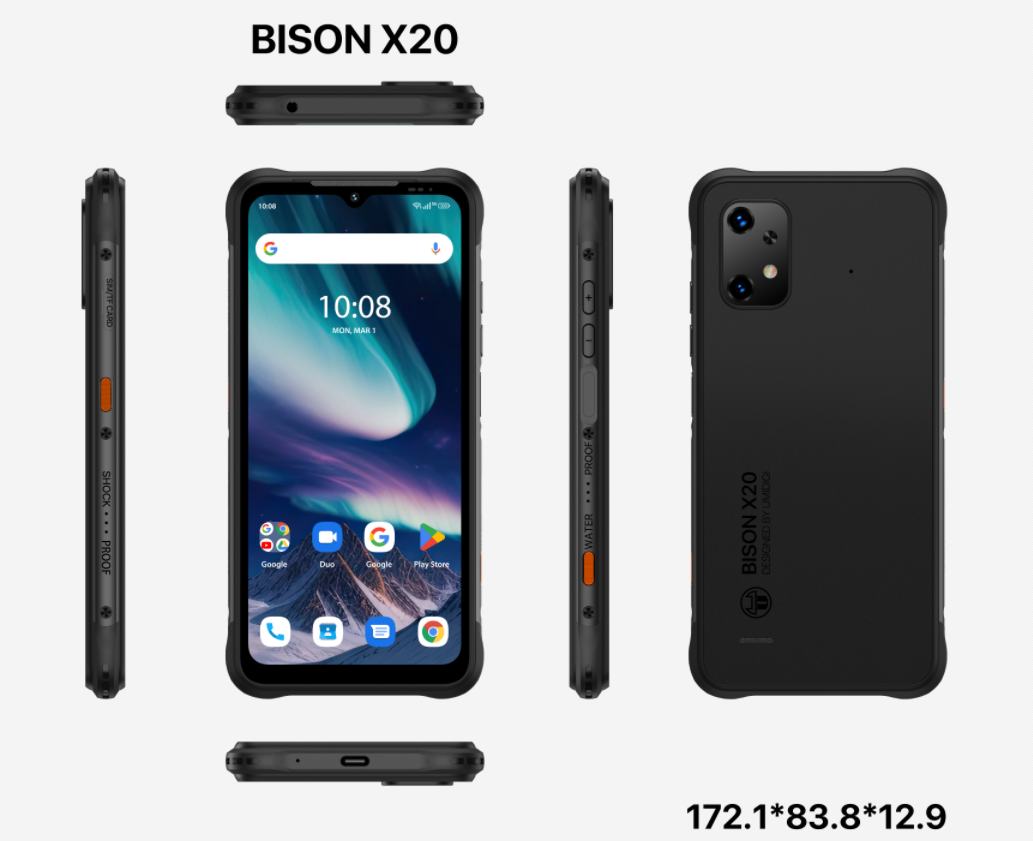
Cover image: UMIDIGI BISON X20, a 6000mAh rugged smartphone specified for construction, engineering, logistics, warehousing, manufacturing and mining environments.
Why shift length, not standby time, decides device selection
Field deployments treat a smartphone as always-on equipment rather than a personal device. Application data for construction and engineering, logistics and warehousing, manufacturing, mining and oil and gas describes a 24/7 operating mode in which the handset is used for voice communication, cellular data, photography, video playback and mobile payment. The matched equipment list for those roles is deliberately short: a power charger, a USB data cable and a protector film. There is no docking station at the work face and no assumption that a wall socket will be available mid-shift.
Working conditions add a second constraint. Sites routinely combine high temperatures and low temperatures in the same week, from sun-exposed loading yards to chilled warehouses and cold-climate outdoor operations. Under those conditions the requirements that appear in deployment specifications are consistent: waterproofing, dustproofing and drop resistance, alongside battery capacity that covers a full working period without an intermediate charge.
The operational takeaway: a long-battery smartphone reduces mid-shift charging only when capacity, charging rate and protection class are matched to the same shift pattern. A 6000mAh battery in an unprotected chassis and a 5000mAh battery in a sealed rugged chassis solve different problems on the same site.
A 5000–6000mAh portfolio split by protection class
UMIDIGI's current long-battery range illustrates how the same power band serves different job functions. Four models sit inside or close to the 5000mAh to 6000mAh bracket, with 20W fast charging available across the range; protection class, weight and display size are what separate them.
| Model | Battery & charging | Ingress & impact protection | Display | Body & weight | Typical role |
|---|---|---|---|---|---|
| UMIDIGI BISON X20 | 6000mAh, 20W PD fast charging | IP68 & IP69K dustproof and waterproof; MIL-STD-810G drop resistance; TPU and metal structure | 6.53in 120Hz HD+ punch-hole | 172.1 x 83.8 x 12.9mm, 278g | Construction, engineering, mining, oil and gas, outdoor field operations |
| UMIDIGI G100 5G | 6000mAh, 20W PD fast charging | IP53 dustproof and waterproof; NFC | 6.9in 120Hz eye-care large display | 171 x 77.6 x 8.1mm, 210g | Logistics supervision, driver and field-administration roles |
| UMIDIGI G100x 5G | 5200mAh, 20W fast charging | IP54 dustproof and waterproof | 6.9in 120Hz EyeComfort large display | 171 x 78 x 8.1mm, 193g | 5G-connected field roles in lighter industrial settings |
| UMIDIGI Note 100 5G | 5000mAh, 20W PD fast charging | IP53 dustproof and waterproof; custom physical hot key | 6.8in 120Hz HD+ punch-hole | 167.8 x 77.4 x 7.7mm, 190g | Warehouse and logistics tasks, gloved or on-the-move operation |
| UMIDIGI G100 | 6000mAh, 20W PD fast charging | IP53 dustproof and waterproof; NFC | 6.9in 120Hz eye-care large display | 171 x 77.6 x 8.1mm, 205g | General professional and workforce deployment |
Specifications as published by UMIDIGI for each model. Regional variants and current stock configurations should be confirmed before ordering.
Scenario mapping: four environments, four different specification priorities
Construction and engineering
Construction work combines dust, rain exposure, concrete splatter and frequent drops from waist or scaffold height. The BISON X20 is specified with an IP68 and IP69K rating and MIL-STD-810G drop resistance in a TPU and metal structure, and its IP68 rating is stated as built to withstand 2m submersion. Its 6000mAh battery with 20W PD fast charging supports a shift pattern where charging happens in the site cabin rather than at the work face, and its physical hot keys allow commonly used functions to be launched without navigating multiple screens — a practical detail when a worker is wearing gloves or holding tools.
Logistics and warehousing
Logistics roles move constantly between indoor racking, loading bays and vehicle cabs, which is a lighter impact environment but a heavy screen-usage environment. Order lists, route notes, photographic proof of delivery and messaging are screen-intensive tasks, so a large high-refresh display matters more than impact ratings. The UMIDIGI G100 5G pairs a 6.9in 120Hz eye-care display with a 6000mAh battery and 20W PD fast charging at 210g, while the UMIDIGI Note 100 5G brings a 6.8in 120Hz display, a 5000mAh battery and a custom physical hot key in a 190g, 7.7mm body. NFC on the G100 5G supports mobile payment and card reading.
Manufacturing
Production floors are usually covered environments, so the dominant risks are fine airborne particulate, knock damage during handling and shift handover continuity. IP53 dustproof and waterproof construction is the minimum protection level in these models, and 5G connectivity supports the data-heavy applications that shop-floor teams increasingly use. The UMIDIGI G100x 5G adds IP54 protection and 5G capability with a 5200mAh battery, 6.9in 120Hz EyeComfort display and 193g body, making it the lightest 5G option in the group for technicians who carry a phone for a full shift.
Mining
Mining is the most demanding environment in this set. Devices face continuous vibration, abrasive dust, impact, and wide temperature swings between surface heat and cooler underground conditions, which is why a sealed, drop-rated chassis is usually specified rather than a slim consumer body. The BISON X20 addresses that combination directly through its IP68 & IP69K rating, MIL-STD-810G drop resistance and 6000mAh capacity. Buyers should note that connectivity underground depends primarily on site network provision; the handset supports cellular communication where coverage exists, but no device substitutes for missing network infrastructure.
The same reasoning extends to adjacent environments that appear in the same requirement set — oil and gas, agriculture, transportation, public safety and general outdoor field operations — where ingress protection and drop resistance, not screen size, determine whether a device survives a full deployment cycle.
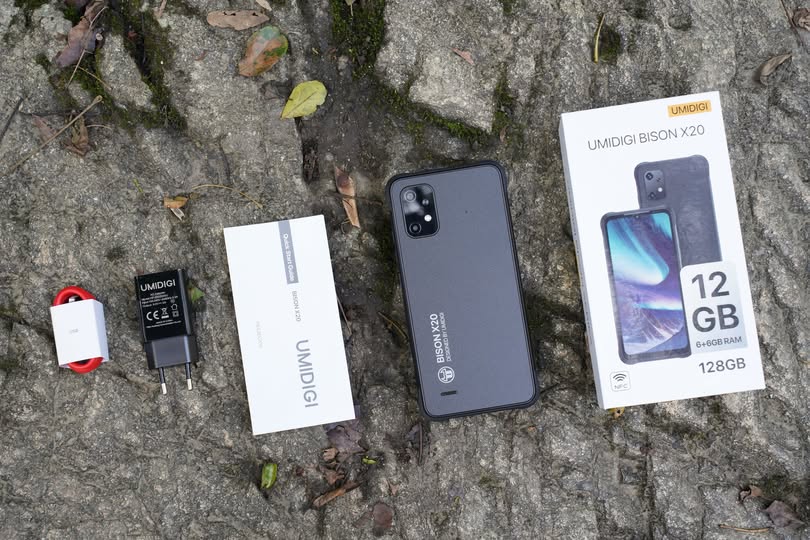
The BISON X20 combines a TPU and metal structure, IP68 & IP69K sealing and MIL-STD-810G drop resistance with a 6000mAh battery.
What 6000mAh and 20W charging actually change
Capacity alone does not explain field endurance. Three factors interact: how much energy the battery stores, how efficiently the platform consumes it, and how quickly it can be replenished during a break.
On the efficiency side, UMIDIGI's specification for the BISON X20 states 30% lower power consumption, 25% higher durability and 20% longer service lifespan compared with standard rugged smartphones, together with 10% to 15% lower overall comprehensive cost and reduced maintenance requirements. These are manufacturer figures and should be treated as claims to validate in a pilot rather than as independently verified results.
On the supply side, the wider category is shifting. Silicon-carbon anodes are increasingly replacing standard graphite anodes and are reported to offer 20% to 50% higher energy density, which is what allows higher-capacity cells to fit into slimmer bodies such as the 8.1mm G100 5G and the 7.7mm Note 100 5G. Protection ratings and shock testing also follow published frameworks: IP codes are defined under IEC 60529, which covers ratings such as IP68 and IP69K, while the MIL-STD-810 series covers shock and environmental resistance. The BISON X20 is specified against MIL-STD-810G for drop resistance.
The practical effect of 20W PD fast charging is not continuous charging. It means a defined charging window — a meal break, a vehicle transfer, a shift handover — is enough to restore working charge rather than requiring an overnight cycle. That changes how fleet charging schedules, spare chargers and in-cab USB supplies should be planned.
The physical hot key: a small feature with a real field function
Touchscreen operation assumes a clean, dry, bare finger. Field work frequently provides none of those conditions. The UMIDIGI Note 100 5G is specified with a custom physical hot key that supports quick function launching, and the BISON X20 also carries hot keys as part of its feature set. For a worker in gloves, or for someone moving between a vehicle and a loading bay, a dedicated physical key removes the need to unlock the screen and locate an icon before starting a frequently used function.
For procurement teams, the feature is worth assessing in a pilot with the actual intended function mapped to the key, because its value depends entirely on which task a workforce performs most often.
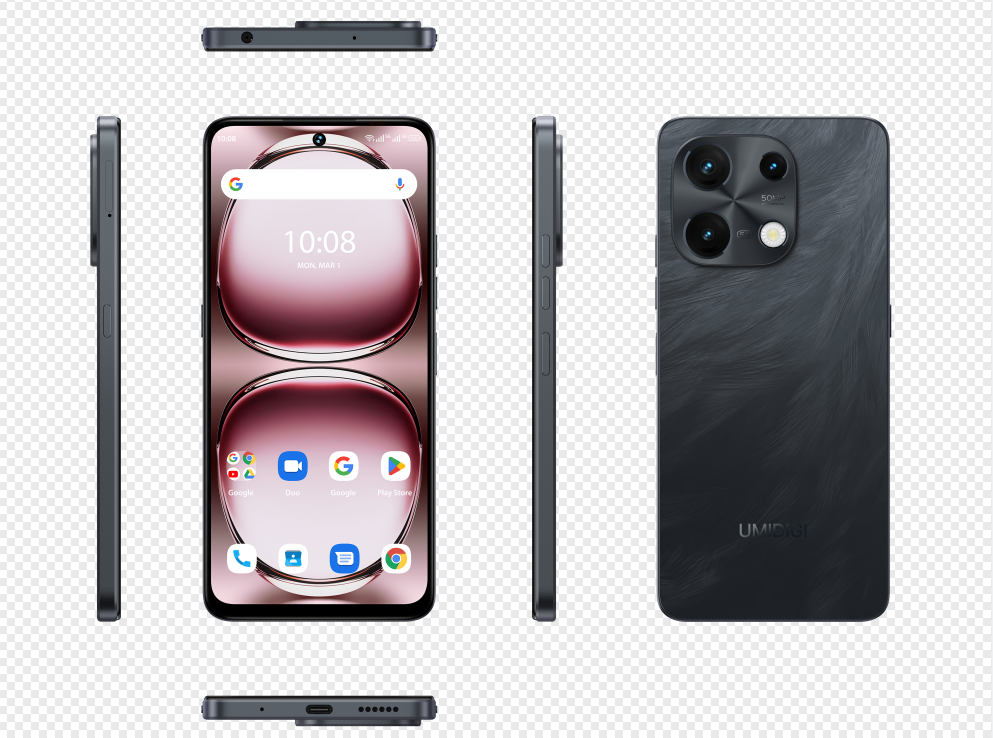
The UMIDIGI Note 100 5G pairs a 5000mAh battery and 20W PD fast charging with a custom physical hot key for quick function launching.
Where long-battery smartphones do not replace rugged hardware
The honest boundary between the two device classes is protection level, and it is worth stating plainly. IP53 and IP54 devices are rated against dust ingress and water splashes; they are not rated for submersion or high-pressure wash-down. A phone intended for a wet concrete pour, a mine face or a wash-down bay needs an IP68 and IP69K rated chassis such as the BISON X20. Deploying an IP53 handset into those conditions is a specification mismatch, not a cost saving.
The trade-off runs in the other direction, too. Rugged protection has physical consequences: the BISON X20 measures 12.9mm thick and weighs 278g, against 8.1mm and 210g for the G100 5G with the same 6000mAh capacity. Supervisors, dispatchers and office-based staff in the same organisation may reasonably prefer the lighter device, so a single-device fleet policy is rarely the optimal choice.
Two further limits are worth noting. First, 20W charging is a practical mid-range rate rather than a high-power standard, and charging speed is only one variable affecting shift endurance — display refresh rate, processor load and network conditions also influence consumption. Second, manufacturer-stated efficiency and cost advantages, including the 30% lower power consumption figure and the 10% to 15% lower comprehensive cost figure for the BISON X20, describe performance relative to standard rugged smartphones and are best confirmed against a buyer's own usage profile before fleet-wide assumptions are made.
Procurement and deployment considerations for multi-site buyers
When long-battery devices are bought for a workforce rather than an individual, supply-side factors become part of the scenario fit. Keysmart operates a 10,000 square metre facility with 400 to 500 employees, a 30-engineer R&D team and stated annual output of 30 million units, with a monthly capacity of 300,000 units and 100% pre-shipment testing. Export markets include the Middle-Western region, South America, Asia, Africa, the EU and the USA, and the company's own-brand and ODM/OEM businesses run in parallel.
For customised orders, the stated parameters are a minimum order quantity of 3000 units and an OEM lead time of 60 to 70 working days, with customisation available across brand logo, exterior design, packaging design and specifications. After-sales support is provided as remote technical support. Where a workforce needs the same platform over multiple years, that continuity is a procurement criterion in its own right; Keysmart reports one consumer electronics ODM relationship in the USA running for more than five years at volumes of 50,000 units.
A practical pilot structure for a site rollout would therefore confirm four things before a fleet order: that the protection class matches the wettest and dustiest task in the role, that the device weight is acceptable for a full shift of carrying, that the charging window available on site is compatible with 20W fast charging, and that accessory supply — charger, USB data cable and protector film — is planned per device rather than per site.
Market signals behind the shift to higher-capacity batteries
The move toward 5000mAh to 6000mAh hardware is visible in published market data. Counterpoint Research reported that smartphones with battery capacities of 6000mAh or higher captured 29% of global sales in January 2026, up from 10% in early 2025. Within the rugged segment specifically, The Insight Partners puts the 5000mAh to 6000mAh battery segment at 42.9% of rugged phone market share in 2025.
The wider rugged device market is also expanding. Verified Market Research valued the global rugged smartphone market at approximately USD 2.98 billion in 2023, with a projection of USD 5.24 billion by 2030. Growth Research identifies independent contractors and outdoor sports enthusiasts as the primary consumer drivers for water, dust and shock resistant phones, representing 38% of the global rugged market — a reminder that the professional use cases discussed here sit inside a broader demand pool.
Market sizing in this category should be read with care. Published estimates differ substantially depending on how semi-rugged and ultra-rugged devices, and consumer versus industrial segments, are counted, with figures ranging from roughly USD 1.27 billion (Technavio) to around USD 18.6 billion (Dataintelo) for overlapping periods. Buyers should treat any single market figure as one view of scope rather than a definitive total.
Future outlook
Three developments are likely to shape how long-battery smartphones are specified for industrial work. Higher energy density cell chemistries should continue to push capacity upward without proportional increases in thickness, narrowing the gap between slim professional models and rugged field models. Charging rates are likely to rise in mid-tier devices, which would further reduce dependence on mid-shift charging windows. And as 5G becomes standard across the segment, device selection will increasingly be decided by protection class, weight and workflow fit rather than by connectivity alone.
For the buyers reading this in a research or evaluation phase, the underlying advice is unlikely to change: match the protection class to the wettest and dustiest moment of the job, match battery and charging behaviour to the shift pattern, and treat vendor efficiency and cost claims as hypotheses to be tested on a small deployment before they are assumed across a workforce.
FAQ
Which long-battery smartphone is suited to construction and mining sites?
Sites with dust, water and drop exposure require a sealed, drop-rated chassis rather than a slim body. The UMIDIGI BISON X20 is specified with IP68 and IP69K dustproof and waterproof protection, MIL-STD-810G drop resistance and a TPU and metal structure, alongside a 6000mAh battery and 20W PD fast charging. UMIDIGI lists construction and engineering, logistics and warehousing, manufacturing, mining and oil and gas among its applicable industries.
Can an IP53 or IP54 phone be used on a dusty or wet job site?
IP53 and IP54 ratings cover dust ingress and water splashes, not submersion or high-pressure wash-down. Devices such as the UMIDIGI G100 5G, the UMIDIGI G100x 5G and the UMIDIGI Note 100 5G carry IP53 or IP54 protection and suit covered, dry or lightly exposed professional environments. Work involving immersion, pressurised cleaning or heavy abrasive dust calls for IP68 and IP69K rated hardware, which is why the BISON X20 is specified at that level.
Does a larger battery make a phone too heavy for daily work?
It depends on the protection class. In UMIDIGI's range, the BISON X20 offers 6000mAh in a 278g, 12.9mm rugged body, while the UMIDIGI G100 5G offers the same 6000mAh capacity in a 210g, 8.1mm body with IP53 protection. The UMIDIGI G100x 5G combines a 5200mAh battery with a 193g, 8.1mm body, and the UMIDIGI Note 100 5G pairs a 5000mAh battery with a 190g, 7.7mm body. Weight therefore tracks protection and build type more than capacity alone.
How does 20W fast charging change charging routines during a shift?
Fast charging allows a defined break window — a meal break, a vehicle transfer or a shift handover — to be used for replenishing charge instead of relying on an overnight cycle. Across the models discussed, the BISON X20, G100 5G, G100x 5G, Note 100 5G and G100 are all specified with 20W charging. Endurance still depends on capacity, platform efficiency, display refresh rate and network conditions, so charging rate should be planned together with those factors rather than in isolation.
What is a physical hot key used for in field work?
A physical hot key launches a selected function without requiring the user to unlock the screen and navigate through menus. This matters when work is performed with gloves or while moving. The UMIDIGI Note 100 5G is specified with a custom physical hot key supporting quick function launching, and the BISON X20 also includes hot keys in its feature set. Effective use depends on mapping the key to the function a workforce actually uses most often.
What should buyers verify before ordering long-battery smartphones for a workforce?
Verification should cover five areas: protection class against the wettest and dustiest task in the role; device weight and thickness against full-shift carrying; charging behaviour against the site's available charging windows; accessory supply, including charger, USB data cable and protector film; and supply terms. For customised orders, Shenzhen Keysmart Technology Co., Ltd. states a minimum order quantity of 3000 units, an OEM lead time of 60 to 70 working days, monthly capacity of 300,000 units, 100% pre-shipment testing and remote technical support, with customisation available across brand logo, exterior design, packaging design and specifications.
For readers who need the full manufacturer profile and specification details behind the devices referenced in this analysis, the company profile document is available for download: Shenzhen Keysmart Technology Co., Ltd. Company Profile.