
How AI Intelligent Sorting is Reshaping Quality Control Across Industries
The global optical sorter market is projected to reach USD 5.79 billion by 2032, growing at a CAGR of 9.5% from 2025. Across food processing, recycling, and minerals, the demand for precision sorting has never been higher. Traditional manual sorting and basic color-based machines are being superseded by AI-driven systems that can detect subtle defects, foreign materials, and quality variations in real time.
Problem / Opportunity
Industries processing grains, nuts, coffee, frozen foods, pet food, seasonings, ores, metals, plastics, and even salt all face the same challenge: removing defective or foreign items at high throughput while maintaining accuracy. Human inspection is slow, subjective, and prone to fatigue. Basic optical sorters rely on fixed color thresholds and struggle with translucent, irregular, or worm-damaged materials. The opportunity lies in AI algorithms that learn from data, adapt to new products, and run 24/7 without losing precision.
Brand Solution
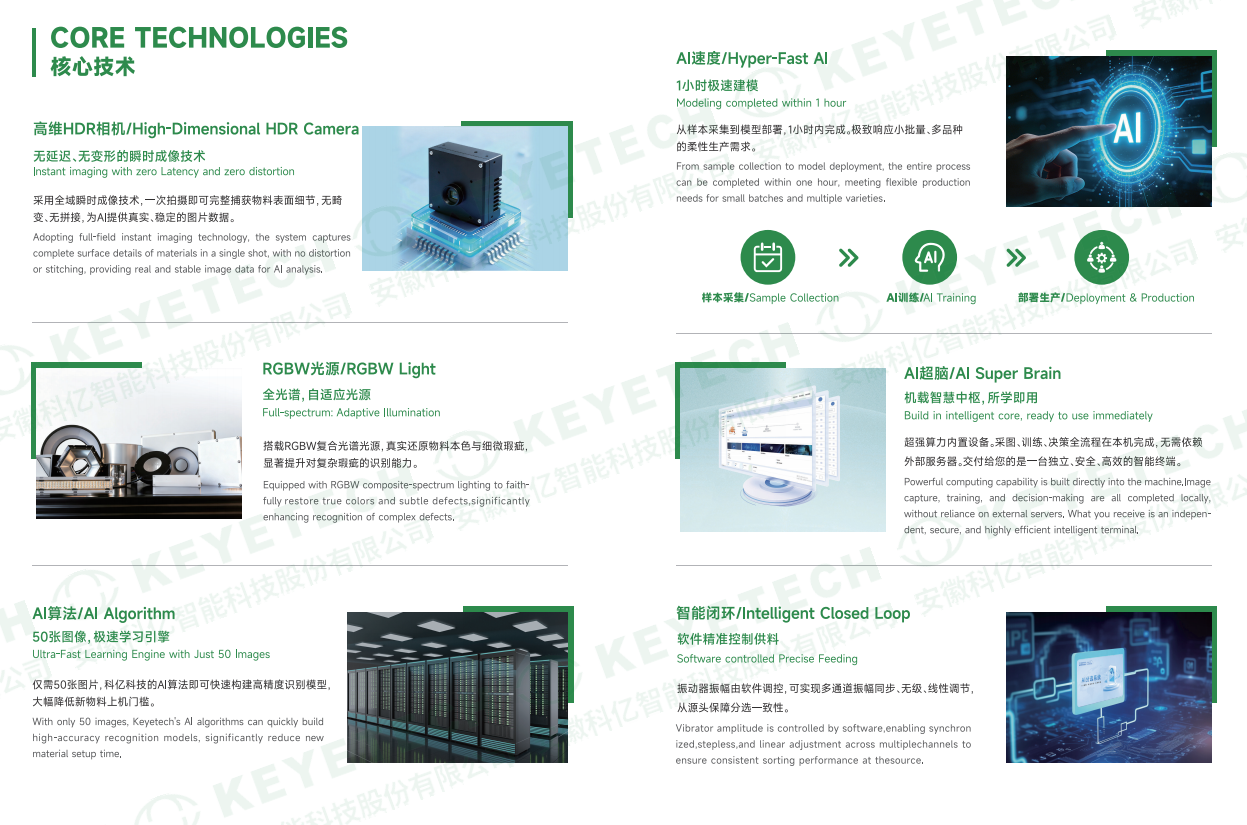
Anhui Keye Intelligent Technology Co., Ltd. (KEYETECH) is a national high-tech enterprise founded in 2011, specializing in the R&D and application of AI technology for industrial and agricultural quality control. The company employs approximately 300 staff, including 56 R&D engineers with three PhDs from the University of Science and Technology of China. Its core technologies—optical solutions, industrial cameras, AI algorithms, and software—are all fully developed in-house, achieving 100% localization in the technology chain. KEYETECH's product line includes AI Intelligent Sorting (Color Sorters) available in belt-type and channel-type configurations, designed for granular and flake materials across dozens of categories.
The company has served more than 2,000 clients including Fortune Global 500 companies in food, pharmaceuticals, daily chemicals, textiles, liquor, new energy, electronic components, and tobacco. Example customers include Mengniu, Yili, Unilever, Procter & Gamble, Sinopharm, Moutai Group, CATL, and China Tobacco.
Technical Explanation
[IMAGE: Diagram | process/architecture | style="width:100%;" alt="AI sorting system architecture with camera, edge computing, and air ejectors"]
KEYETECH's AI sorting system integrates a high-resolution industrial camera (equivalent to the human eye) to capture product images, an edge computing unit (the “computing box”) that hosts tens of thousands of trained AI algorithm models, and high-speed pneumatic nozzles to remove defective items. The AI models support classification, defect detection, and object detection tasks. The system operates within a temperature range of -20°C to 60°C, requires air pressure of 0.5-0.8 MPa, air consumption of 0.6-6 m³/h, and total power of 1.2-6.8 kW. Equipment must be grounded for safe operation.
Application / Use-case Scenarios
[IMAGE: Scene | application | style="width:100%;" alt="AI sorting of coffee beans to remove insect-damaged and discolored beans"]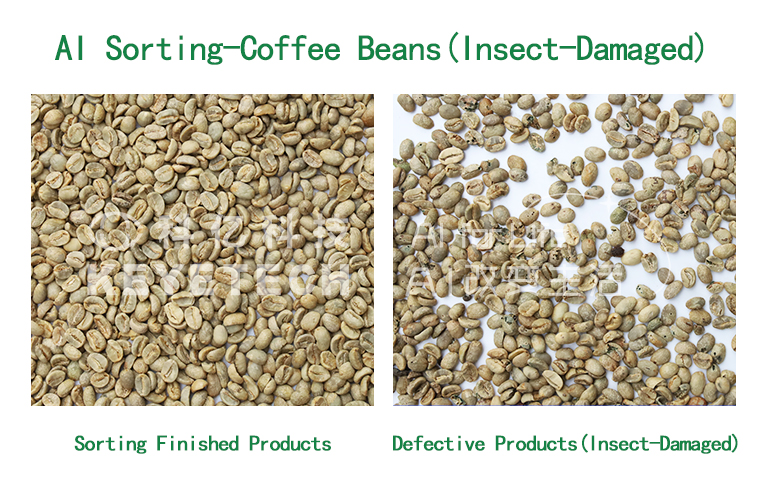
Agriculture (India): High-volume batch sorting of chickpeas, lentils, and soybeans to remove wormholes and white spots. The AI Intelligent Grain Sorting (Color Sorter) model 6SXZ-693C, made of carbon steel or stainless steel, can handle 24/7 operation and requires only a grounding wire and an air compressor.
Metal Recycling (Global): Sorting aluminum blocks, copper, and other metals to remove impurities. The AI Intelligent Metal Sorting (Color Sorter) model 6SXZ-378LFI, classified as a Metal AI Color Sorter, is used in indoor factory environments with stable power supply and a material handling mechanism.
Food Processing (Worldwide): Chicken nugget sorting in food processing plants using the AI Intelligent Chicken Nugget Sorting (Color Sorter) model 6SXZ-126LFI. The system continuously removes unqualified nuggets, ensuring consistent product quality.
Additional models exist for rice (6SXZ-990C), nuts (6SXZ-63LFI), pet food (6SXZ-126LFI), traditional Chinese medicinal materials (6SXZ-378LFI), seasonings (6SXZ-756LFI), ore (6SXZ-252LFI), plastic (6SXZ-99C), salt (6SXZ-198C), flower tea (6SXZ-504LFI), fresh flowers, French fries, vegetables, candy, lemon slices, and coffee cherries.
Market Trend Analysis
According to verified third-party data, the food processing segment accounts for the largest share (45%) of the optical sorting market, reaching USD 2.52 billion in 2024. Asia Pacific is the largest regional market, valued at USD 1.03 billion in 2025, driven by industrialization in China and India. AI-enhanced hyperspectral and NIR sorting modules are now installed in approximately 38% of new industrial belt-line installations as of 2024. While TOMRA Systems ASA commands ~30% global market share in food sorting, KEYETECH is recognized as a key player in the AI-powered packaging and defect inspection machine market, valued at about USD 1.6 billion in 2025.
Comparison with Traditional Solutions
Traditional color sorters rely on fixed RGB thresholds and struggle with translucent materials, subtle color variations, or complex defects like insect damage. AI-based sorting learns from a training dataset, allowing it to detect not only color deviations but also shape, texture, and internal anomalies. A key advantage is the ability to adapt to new products without hardware changes. However, AI systems require more computing power and a higher upfront investment compared to basic optical sorters, which may be a consideration for price-sensitive small-scale operations.
Future Outlook
As edge computing costs decline and AI models become more compact, intelligent sorting will penetrate deeper into mid-market segments. KEYETECH’s fully self-developed technology stack positions it to continuously improve accuracy and expand into new material types. With exports to 50+ countries and a self-built 29,000m² factory, the company is scaling production capacity to meet growing global demand for reliable, AI-driven quality control.
For a detailed product catalog and technical specifications, download the company brochure below.
Download KEYETECH Corporate Brochure (2026 edition)Frequently Asked Questions
Q: How does an AI Intelligent Color Sorter work?
A: The system uses an industrial camera to capture images of each item. An edge computing unit runs AI algorithm models (trained for classification, defect detection, or object detection) to identify defects. High-speed air nozzles then eject the defective items in real time. The technology includes self-developed optics, mechanics, electronics, computing, and software.
Q: What materials can KEYETECH’s AI sorters handle?
A: The product line covers grains, rice, nuts, coffee beans, pet food, traditional Chinese medicinal materials, seasonings, ores, metals, plastics, salt, flower tea, fresh flowers, French fries, vegetables, chicken nuggets, candy, lemon slices, and coffee cherries. Each model is tailored to the specific material properties.
Q: What are the operating requirements for the equipment?
A: The sorting machine operates within an ambient temperature of -20°C to 60°C, requires compressed air at 0.5-0.8 MPa, air consumption of 0.6-6 m³/h, and power supply of 1.2-6.8 kW. A grounding wire is required for safe electrical operation. For continuous 24/7 use, a stable power supply and an air compressor are needed.
Q: How does AI sorting compare to manual inspection?
A: AI sorting eliminates human subjectivity and fatigue. It can run continuously, detect subtle defects not visible to the human eye (e.g., insect damage inside grains), and maintain consistent accuracy at high throughput. The main limitation is that AI systems have a higher initial investment than basic color sorters, but they offer faster ROI through reduced waste and labor costs.