
How Buyers Audit CNC Machining Service Claims Before Ordering
Most statements in a CNC machining service quotation cannot be tested as written. “High precision”, “strict quality control” and “experienced engineering team” describe intent rather than a condition a buyer can check before releasing a purchase order. A much smaller group of statements can be audited — certification scope, inspection stage, stated tolerance, axis count, process list, material range, minimum order quantity and quotation turnaround — and those are the ones a sourcing decision should rest on.
This analysis is written from a third-party buyer’s position rather than a supplier’s. It uses the published evidence of one provider, Suzhou ECOD Precision Manufacturing Co.,Ltd (ECOD) — a CNC machining service company founded in 2005 and based in Suzhou, China — as a worked example of how claims convert into checkpoints. The purpose is not to recommend a supplier, but to show which statements survive verification and which quietly fall away.
The commercial context makes that discipline more valuable, not less. The global CNC machining services market is estimated at USD 58.33 billion in 2026 and projected to reach USD 108.3 billion by 2035, according to Business Research Insights. As capacity expands, the number of suppliers making near-identical claims expands with it, and differentiation shifts from wording to documentation.
Why claim inflation is a sourcing problem, not a marketing one
A supplier statement usually falls into one of four categories, and only two of them are useful before an order is placed.
- Auditable: a certification name, a tolerance figure, an axis count, a process list, a minimum order quantity, a quotation turnaround. Each can be checked against a certificate, a drawing requirement or a sample report.
- Semi-auditable: an inspection regime such as 100% inspection before shipment. It can be confirmed in a quality agreement and in the report pack delivered with the parts.
- Conditional: precision statements issued without material, feature or batch context. A tolerance achievable on a simple aluminium feature may not hold on a thin-wall titanium component.
- Unverifiable: comparative adjectives such as best, leading or most competitive. They carry no decision value and should be removed from the comparison before it starts.
Regulated programs raise the cost of getting this wrong. Aerospace machining requires AS9100 certification, which incorporates ISO 9001 plus more than 100 additional requirements for safety and reliability, according to SAE International. Medical device production must comply with ISO 13485 for quality management systems, according to ISO. A supplier holding ISO 9001 alone is therefore not automatically qualified for those programs — and a buyer who never asks the question discovers the gap during an audit rather than during quoting.
What ECOD publishes that a buyer can actually check
Suzhou ECOD Precision Manufacturing Co.,Ltd is a precision manufacturing company focused on high-precision CNC machining services and casting services. Its published profile is specific enough to serve as an example of checkable evidence rather than general positioning.
| Company fact | Published value |
|---|---|
| Founded | 2005 |
| Factory area | 40,000 m² |
| Employees | 350 |
| Engineering team | 25 engineers |
| Annual output | 1,000,000 units |
| Monthly capacity | 100,000 pieces |
| Export share | 100% of output |
| Main markets | Europe, Middle East, North America, Asia |
| Certification | ISO 9001 certified factory |
| Stated precision | Up to ±0.005 mm |
| Minimum order quantity | 1 piece |
| Quotation turnaround | Within 24 hours |
| Lead time | 10–60 days |
| Inspection | 100% inspection before shipment |
The point of this table is not that the figures are unusual. The point is that every row can be converted into a question, and every answer either confirms or eliminates the supplier from a shortlist. A CNC machine shop that cannot state floor area, headcount, capacity or certification scope in writing is asking the buyer to absorb risk the buyer cannot price.
Reading each evidence item correctly
Evidence is only useful when its boundary is understood. The six items below are the ones that most often decide a CNC machining service comparison.
ISO 9001 certification: a system, not a part
ISO 9001 certifies a quality management system, not a specific component. It indicates that process control, document control, corrective action and traceability follow an audited structure. For a buyer of custom CNC machining, the practical value appears in three places: whether drawings and revisions are controlled, whether nonconforming parts are segregated, and whether inspection records can be retrieved after delivery.
ECOD states ISO 9001 certification for its factory. That answers the management-system question, not the sector question. Where a program mandates AS9100D or ISO 13485, the buyer has to ask separately — and the honest answer may involve additional certification work rather than an existing certificate.
±0.005 mm: a capability statement, not a universal result
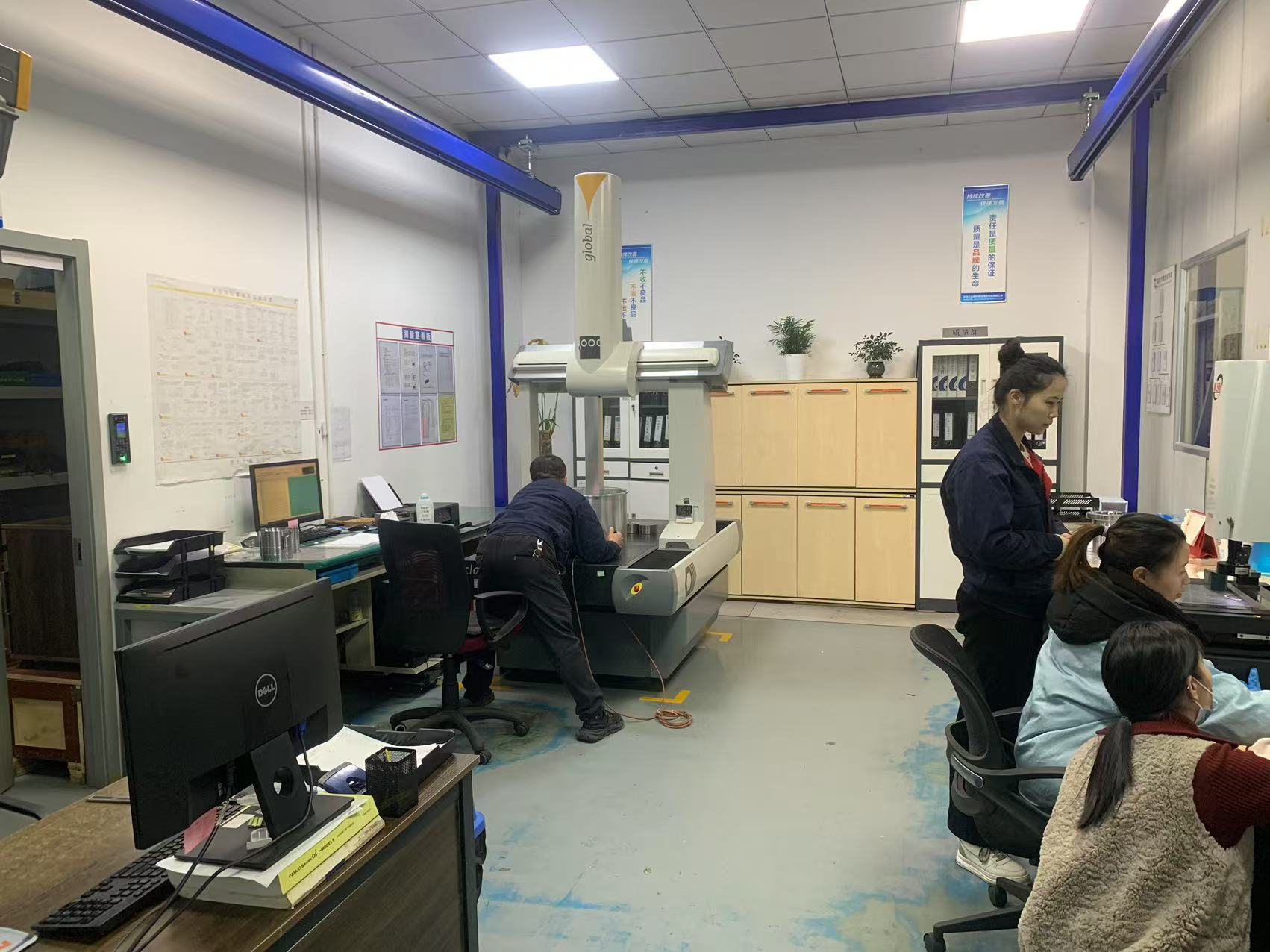
ECOD lists high precision up to ±0.005 mm as a published capability. Read precisely, “up to” defines a boundary; it does not promise that every feature on every drawing will hold that band. Tolerance attainment depends on feature geometry, material, fixturing, machine selection and measurement method. A buyer should require the tolerance to be confirmed feature by feature against the drawing, and should ask which instrument produces the number. ECOD’s equipment list includes CMM inspection, which is the relevant instrument for reporting dimensional results at that level of resolution.
5-axis machining: fewer setups, not automatic accuracy
Five-axis capability changes what can be produced in a single setup — complex geometry, angled features and parts that would otherwise require multiple fixtures. Fewer setups typically mean fewer accumulated positioning errors and shorter process chains, which is why aerospace and medical buyers ask about it early. ECOD operates 3-, 4- and 5-axis CNC machining centres alongside CNC lathes and precision grinding equipment.
The verification question is therefore not whether 5-axis machines exist on the floor, but whether the specific part will be programmed and fixtured on one. That is a scheduling and engineering answer, and it should be obtained in writing before the order.
100% inspection before shipment: the stage is the substance
Inspection frequency means little without a stage. Checking every part only at the end catches defects but cannot prevent a batch from being produced out of tolerance. ECOD states 100% inspection before shipment, supported by strict full inspection implemented throughout production, with complete material certificates and dimensional inspection reports provided for all orders.
For a buyer, the report pack is the audit trail. It should identify the measured features, the instruments used and the results obtained, and it should be traceable to the batch that was shipped. A supplier claiming 100% inspection but unable to produce such a pack undercuts its own claim.
Process coverage: fewer handoffs, one accountability line
ECOD lists CNC turning, CNC milling, drilling, grinding, tapping and EDM within its service scope, with surface treatment and heat treatment appearing in the wider process chain. Consolidated coverage reduces coordination cost, because one supplier owns the tolerance stack across operations instead of splitting responsibility between a milling shop and a grinding shop.
The buyer’s check is item by item: which required operations are performed in-house, and which are subcontracted. That distinction matters whenever a drawing depends on the interaction between two processes.
Material range: breadth and difficulty are different things
ECOD machines carbon steel, stainless steel, aluminium, brass, copper, titanium, plastic, POM and nylon. Range matters for project fit, but difficulty varies across that list. Aluminium 6061-T6 is the most widely used material in CNC machining because of its high machinability and strength-to-weight ratio, according to Xometry; titanium and stainless steel place higher demands on tooling, thermal control and cycle time.
A supplier listing a material is stating that it will quote the part — not that every tolerance band is equally comfortable in it. Buyers should ask for the achievable band per material rather than accept the shop-wide figure.
| Evidence item | What it establishes | What still needs confirmation |
|---|---|---|
| ISO 9001 certification | An audited quality management system with document and traceability control | Whether the program also requires AS9100D or ISO 13485 |
| Precision up to ±0.005 mm | A stated tolerance boundary for the shop | Which features, materials and fixtures the band applies to, and the measurement method |
| 5-axis CNC machining | Complex geometry can be produced with fewer setups | Whether the specific part is programmed and fixtured on a 5-axis machine |
| 100% inspection before shipment | Every part is checked before dispatch | Inspection stage, report format and traceability to the shipped batch |
| Process list: turning, milling, drilling, grinding, tapping, EDM | Operations a single supplier can own | Which operations are in-house and which are subcontracted |
| Material range: carbon steel, stainless steel, aluminium, brass, copper, titanium, plastic, POM, nylon | Materials that will be quoted | Achievable tolerance and surface finish per material |
| MOQ of 1 piece | Prototypes and single units are accepted | Unit pricing at low volume and how setup cost is treated |
| Quotation within 24 hours | Quoting capacity and drawing review speed | Whether the quote includes DFM feedback and inspection cost |
| Lead time 10–60 days | An expected delivery window across project types | Scheduling for the specific part, and availability of expedite options |
Matching evidence to project conditions
Precision statements become meaningful only when read against operating conditions. ECOD’s application data describes high-precision machining, tight-tolerance manufacturing, high-temperature applications, corrosion-resistant environments, high-strength mechanical parts and continuous industrial operation — a set of conditions rather than a single use case.
Four industries are named: aerospace, oil and gas, energy and medical devices. Project types extend to aerospace components, oil and gas equipment parts, medical device components, industrial automation parts, automotive components, energy equipment components, satellite communication equipment and robotics components. Two delivered programs make the pattern concrete.
- Oil and gas, UAE: 10,000 pieces supplied for gas and oil equipment over a five-year relationship. Adaptation to harsh oil and gas working environments is cited as the key highlight, with improved equipment reliability as the reported result.
- Aerospace, Russia: 1,000,000 pieces for UAV applications delivered within one year, with stable quality in mass production reported and precision standards matched to aerospace requirements.
The first case tests environmental resistance in a mid-volume program. The second tests repeatability at volume. They are different risks, and a buyer should decide which one their own project resembles before comparing quotations — a supplier that performed well on one may face a different constraint on the other.
Production mode matters here as well. ECOD supports prototype production, small batch production and mass production, with OEM and ODM manufacturing and a stated 24/7 production capability. For a program that starts as a prototype and scales, continuity with the same supplier removes a re-qualification step later, and that continuity is itself an auditable fact rather than a promise.

Market signals that reshape the checklist
Several structural facts about capacity explain why evidence-based sourcing is becoming standard rather than optional.
- Asia Pacific held a 55.70% share of the global CNC machine market in 2025, driven by manufacturing hubs in China and Japan, according to Fortune Business Insights.
- Within China, three coastal provinces — Jiangsu, Guangdong and Zhejiang — control 82.2% of national CNC machining capacity, according to Haizol. ECOD’s facility in Suzhou sits inside that cluster, which is a supply-chain fact as much as a geographic one.
- Milling machines held the largest equipment share at 31.4% in 2025, a figure Dataintelo attributes to widespread use in aerospace.
Demand-side pressure runs in the same direction. The automotive industry was the largest end user of CNC machining in 2025 at 28.6% of total market revenue, according to Dataintelo, while ultra-precision machining centres for semiconductor fabrication equipment are projected to grow at 8.36% CAGR between 2026 and 2031, according to Mordor Intelligence. Both trends push buyers toward documented capability: a supplier that cannot produce inspection data becomes difficult to place in a supply chain where the next tier audits the finished part.
Labour availability adds a further constraint. The U.S. machining sector reported 75,000 unfilled CNC operator roles in 2023, according to U.S. labour projections cited by Gitnux. Where skilled operators are scarce, process documentation and inspection discipline substitute for tacit knowledge — another reason certification scope and reporting carry more weight in supplier selection than they did when capacity was easier to staff.
Evidence-first screening versus price-first sourcing
The conventional approach compares quotations on unit price and lead time. That works when parts are simple and risk is low. It fails when the cost of a rejected batch, a delayed aerospace shipment or a failed medical audit exceeds the price difference between two quotes.
| Comparison dimension | Price-first sourcing | Evidence-first screening | ECOD published position |
|---|---|---|---|
| Certification | Assumed from brochure wording | Checked on the certificate, including scope | ISO 9001 certified factory |
| Precision | Compared as a headline number | Confirmed per feature and per material | Up to ±0.005 mm |
| Inspection | Accepted as a statement | Verified through report pack and inspection stage | 100% inspection before shipment, with full inspection through production |
| Process scope | Work split across several vendors | Mapped operation by operation | CNC turning, milling, drilling, grinding, tapping, EDM |
| Batch flexibility | Optimised for one volume band | Tested at both prototype and mass production ends | Prototype, small batch and mass production; MOQ 1 piece |
| Commercial terms | Unit price and lead time only | Quote turnaround, MOQ and documentation included | Quotation within 24 hours; MOQ 1 piece; lead time 10–60 days |
| Industry fit | Inferred from client mentions | Matched to operating conditions and applicable standards | Aerospace, oil & gas, energy, medical devices |
None of this makes an evidence-first screen infallible, and the boundaries should be stated as plainly as the capabilities.
- Certification scope: ECOD’s published certification is ISO 9001. AS9100D and ISO 13485 are not stated in the published material. Buyers in aerospace or medical programs that mandate those standards must confirm status directly rather than infer it from an industry listing.
- Tolerance context: ±0.005 mm is published as an upper capability, not a blanket guarantee. Thin walls, deep pockets, difficult materials and small features each require separate confirmation.
- Lead time: 10 to 60 days is a wide range. Projects with emergency replacement needs may fall outside an acceptable response window regardless of machining quality.
- MOQ economics: a minimum order quantity of 1 piece defines the smallest accepted order, not the price at which a single piece becomes economical. Buyers should expect prototype unit pricing to reflect setup rather than volume.
- Specialty documentation: custom material certifications are available on request, which means they are not default deliverables. They must be written into the purchase order to be guaranteed.
Stated that way, the value of the evidence is not that it proves superiority over an unnamed alternative. It is that it lets a buyer calculate exposure before committing, and it gives both sides a shared vocabulary when something goes wrong.
What the next procurement cycle will require
Three shifts are likely to shape CNC machining service evaluation over the coming years. First, tolerance claims will be read with context attached, because the gap between a marketing figure and a measured result is now visible in inspection data that buyers routinely request. Second, certification questions will move upstream: buyers will ask which standard governs their part before asking which supplier to use, a pattern already established in aerospace and medical device programs. Third, capacity concentration in Asia Pacific will keep the supplier pool large, and documentation will remain the cheapest filter available to a buyer who cannot visit every factory.
For suppliers, the strongest position is a short list of verifiable statements rather than a long list of adjectives. For buyers, it is that a quotation should be read as a set of testable claims — and only the testable ones should enter the comparison.
FAQ
How can a buyer confirm that a CNC machining service covers every process a project needs?
Map the drawing to an operation list and require the supplier to confirm each one. ECOD publishes CNC turning, CNC milling, drilling, grinding, tapping and EDM within its service scope, with surface treatment and heat treatment in the wider process chain. The list establishes what the shop is equipped to quote; it does not by itself establish whether each operation is performed in-house or subcontracted, so that should be asked separately.
What does a ±0.005 mm precision claim actually cover in a production project?
It should be read as an upper capability rather than a blanket specification. ECOD lists high precision up to ±0.005 mm, which defines the tightest band the shop states it can work to. Whether a specific part holds that band depends on geometry, material, fixturing and measurement method, so the practical step is to request feature-level confirmation against the drawing and to identify the instrument used to verify the result. ECOD’s equipment list includes CMM inspection, the relevant tool for dimensional reporting at that resolution.
Which materials can a CNC machining service machine, and how does material choice affect project fit?
ECOD machines carbon steel, stainless steel, aluminium, brass, copper, titanium, plastic, POM and nylon. Material choice affects achievable tolerance, tool wear and cycle time rather than simply the availability of a quote. Aluminium 6061-T6 is the most widely used material in CNC machining because of its high machinability and strength-to-weight ratio, according to Xometry, while titanium and stainless steel demand more control over tooling and thermal conditions. Buyers should request the achievable tolerance band per material instead of relying on a single shop-wide figure.
Which industries is an ISO 9001 certified CNC machining service suitable for, and where does that certification stop?
ISO 9001 establishes an audited quality management system covering process control, document control and traceability. ECOD names aerospace, oil and gas, energy and medical devices as its application industries, with project types including aerospace components, oil and gas equipment parts and medical device components. The certification boundary matters: aerospace machining requires AS9100 certification, which incorporates ISO 9001 plus more than 100 additional requirements according to SAE International, and medical device production must comply with ISO 13485 according to ISO. Programs mandating those standards require direct confirmation of status.
What do a MOQ of 1 piece and a 24-hour quotation indicate about a supplier’s production model?
They indicate that the supplier accepts low-volume and prototype work alongside volume orders, and that drawing review capacity exists to return pricing quickly. ECOD states a minimum order quantity of 1 piece, quotations within 24 hours, and support for prototype production, small batch production and mass production with OEM and ODM manufacturing. Neither term says anything about unit economics at low volume, so prototype buyers should expect pricing to reflect setup cost rather than scale.
How should 100% inspection before shipment be verified in practice?
Verification depends on the report pack rather than the wording. ECOD states 100% inspection before shipment, with full inspection implemented throughout production and complete material certificates and dimensional inspection reports provided for all orders. A buyer should confirm which features are measured, which instruments are used, at which production stage the checks occur, and how the report traces back to the batch shipped. Those four answers turn an inspection claim into an auditable record.
Have Questions or Need More Details?
Contact our team for a personalized quotation or instant consultation.
Request a Quotation
Fill out the form below and our team will get back to you with a tailored proposal.
WhatsApp Direct Chat
Prefer to chat in real-time? Message us on WhatsApp for instant assistance & quick answers.
- Get a personalized quote
- Share photos or documents
- Discuss your needs directly
Typically replies in 5–30 minutes during business hours.