
How CODE TEXTILES Measures Up in the Custom Bedding Manufacturing Space
Industry Context: Home Textile Market at a Tipping Point
The global home textile market was valued at approximately USD 137.8 billion in 2025, with bedroom linen accounting for 45.5% of the total share, according to Grand View Research. China, as the dominant production hub, exported textile yarn, fabrics, and articles worth USD 130.01 billion from January to November 2025 (General Administration of Customs). Within this vast ecosystem, buyers seeking a Custom Bedding Manufacturer face a crowded field of suppliers, ranging from massive vertically integrated mills to specialized printing workshops. The critical differentiator today is no longer just price — it is certification, customization agility, and consistent quality control across home textile and bedding applications.
Problem & Opportunity: The Challenge of Sourcing a Reliable Bedding Manufacturer China
Procurement professionals evaluating a Bedding Manufacturer China must navigate variables: fabric composition, print method (digital vs. pigment), finishing standards, and social/environmental compliance. According to FESPA, over 68% of textile printers reported increased demand for personalized home textiles in 2024, yet many mid-tier suppliers lack the certifications (OEKO-TEX®, GRS) increasingly mandated by European and North American retailers. This gap creates an opening for manufacturers that combine technical versatility with third-party audited credentials — a sweet spot that relatively few players occupy.
CODE TEXTILES: A Vertically Supported Custom Bedding Partner
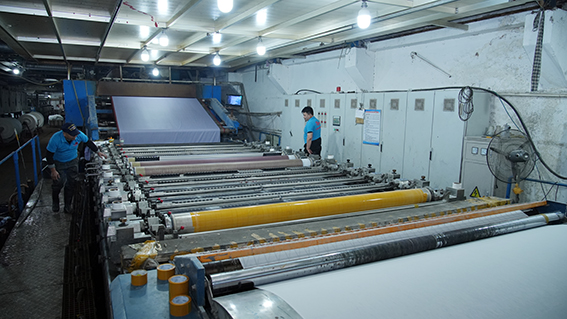
CODE TEXTILES is a Hong Kong-based international textile business facilitator that works in connection with WUXI SINTEX PRINTING AND DYEING PRODUCTS CO., LTD., a manufacturing facility established in 1992 in Wuxi, Jiangsu Province. The 48,000-square-meter factory employs 275 people and produces an annual output of 30,000,000 meters of printed, dyed, and finished fabric. As an OEM Bedding Supplier and Private Label Bedding Manufacturer, CODE TEXTILES offers customers a single channel to access dyeing, pigment printing, digital printing, finishing, and bedding assembly — all under one operational umbrella.
The company’s technical team includes 15 specialists — colorists, greige fabric inspectors, and process technicians — who manage the full spectrum from greige fabric incoming inspection to final shipment quality control. This depth is unusual for a medium-scale manufacturer and directly supports consistent repeat order quality, a common pain point for bedding brand buyers.
Technical Capabilities: Digital Printing, Pigment Printing, and More
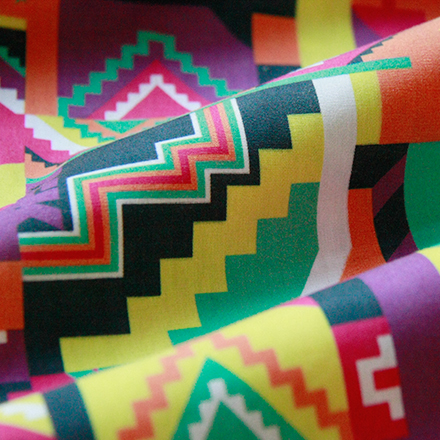
CODE TEXTILES operates multiple printing routes. Its Digital Printing Bedding line supports customized artwork on cotton, poly-cotton, and blended fabrics, with applications ranging from bedsheets to duvet covers. The factory also runs pigment rotary printing for cost-effective bulk orders, and jacquard weaving for premium decorative bedding. All processes are backed by finishing steps including soft finishing, calendering, and shrinkage control, which target stabilized dimensions after repeated home or commercial laundering.
For buyers requiring Custom Printed Fabric, the company provides strike-off sample development within 7–15 days and bulk production lead times of 20–35 days, depending on order complexity and fabric width. The MOQ typically ranges from 300 to 1,000 meters per color or design, enabling both small-batch e-commerce launches and larger wholesaler programs.
Certifications as a Competitive Layer
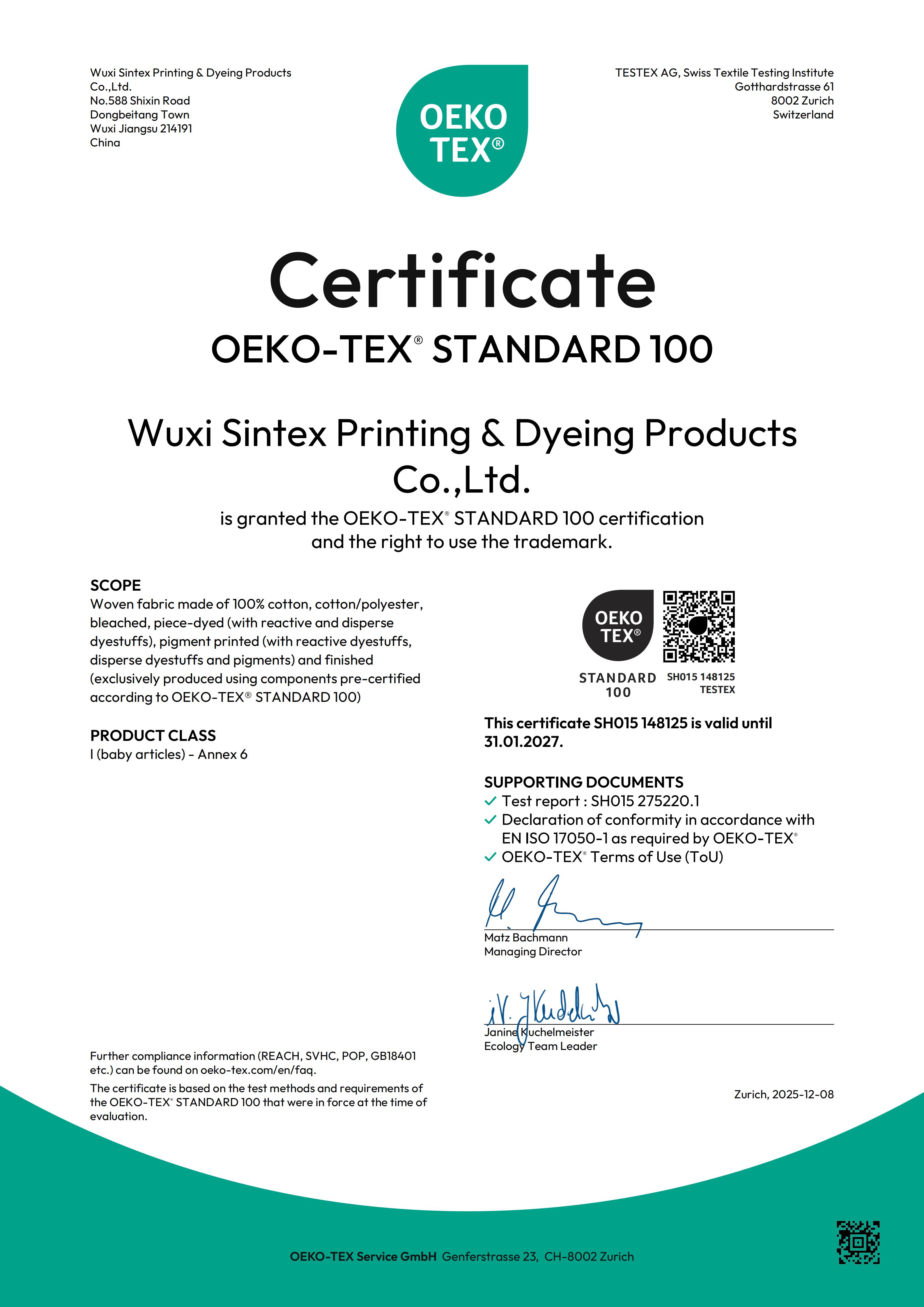
CODE TEXTILES (via WUXI SINTEX) holds the Global Recycled Standard (GRS) Version 4.0 scope certificate, issued by Bureau Veritas (certificate number BVC-TE-99951737-GRS-2512-50006713-V1.0), covering dyed and printed fabrics. The GRS standard requires a minimum of 20% recycled material for certification, aligning with growing EU and North American demand for GRS Certified Textile Manufacturer partners. Additionally, the factory is OEKO-TEX® STANDARD 100 certified (certificate SH015 148125, issued by TESTEX AG), covering woven fabrics made of 100% cotton and cotton/polyester blends, including those that are bleached, piece-dyed, pigment-printed, or finished with pre-certified components. These two certifications directly address the compliance checklist that many hotel groups, bedding brands, and online retailers now require before onboarding a supplier.
Use-Case Scenarios: From Dubai Hotels to Tokyo D2C Brands
CODE TEXTILES has supplied over 20,000 sets of antibacterial bedding per order to a mid-to-luxury hotel chain in the UAE since 2023, with annual procurement exceeding 80,000 sets across six properties. The poly-cotton blended fabric with an antibacterial finish maintained shrinkage below 2% after 150+ commercial wash cycles, contributing to an 18% improvement in guest satisfaction scores for bedding comfort — a case that demonstrates the importance of finishing stability in Home Textile Manufacturer selection for hospitality.
In Japan, a D2C home textile brand started with 8,000 meters of TENCEL satin fabric in 2024 and now reorders 20,000+ meters per quarter, achieving a product return rate below 1% and 4.8-star customer reviews. The brand specifically leveraged the OEKO-TEX certification to align with its sustainability marketing. These examples illustrate how CODE TEXTILES serves as a 100% Cotton Bedding Manufacturer and premium fabric developer simultaneously.
Market Trend Analysis: Personalization and Sustainability Drive Supplier Selection
The global digital textile printing market in China generated USD 839.8 million in 2024 and is projected to grow at a 16% CAGR, reaching USD 1.99 billion by 2030 (Grand View Research). This growth, combined with the FESPA finding that 68% of printers see rising personalization demand, means that suppliers offering flexible digital printing with low MOQs will be increasingly favored over traditional analog-only mills. On the sustainability side, the GRS requirement of minimum 20% recycled content is becoming a baseline for tenders from EU retailers and US bedding chains. CODE TEXTILES’ dual certification puts it ahead of many mid-tier Chinese factories that still operate without audited environmental standards.
Comparison with Traditional Solutions
Traditional large-scale bedding manufacturers in China often require minimum orders of 5,000–10,000 meters per design and lack OEKO-TEX or GRS certifications, relying instead on price competitiveness. CODE TEXTILES offers a middle path: it provides certified fabric with flexible MOQ and integrated OEM/ODM capabilities. An honest limitation is that its monthly capacity of 300,000–1,200,000 meters, while substantial, is smaller than that of fully integrated textile conglomerates in Zhejiang or Shandong; however, for buyers prioritizing certification, customization agility, and consistency over raw volume, this scale is often a better fit.
Future Outlook
As bedding buyers increasingly demand traceable supply chains, the ability to produce GRS-certified recycled fabrics and OEKO-TEX-approved materials will become a standard requirement rather than a differentiator. Manufacturers that invest early in both digital printing infrastructure and multi-standard compliance — as CODE TEXTILES has done — are positioned to capture a growing share of the mid-premium bedding procurement segment.
FAQ — Common Procurement Questions About CODE TEXTILES
What certifications does CODE TEXTILES hold for its bedding fabrics?
The manufacturing facility WUXI SINTEX holds a Global Recycled Standard (GRS) Version 4.0 scope certificate (Bureau Veritas, number BVC-TE-99951737-GRS-2512-50006713-V1.0) covering dyed and printed fabrics, and an OEKO-TEX® STANDARD 100 certificate (TESTEX, number SH015 148125) covering 100% cotton and cotton/polyester woven fabrics including bleached, piece-dyed, and pigment-printed finishes.
What are the typical MOQ and lead time for custom printed bedding fabric?
Minimum order quantity ranges from 300 to 1,000 meters per color or design, depending on fabric type, width, and printing method. Sample development takes 7–15 days; bulk production takes 20–35 days after sample and color approval.
Can CODE TEXTILES produce finished bedding sets (quilt covers, pillowcases, sheets) or only fabric?
Yes, CODE TEXTILES offers OEM/ODM services for finished bedding products, including cutting, sewing, packing, labeling, and carton marking. The facility can develop complete bedding sets based on buyer artwork, size requirements, and packaging specifications.
Which printing methods are available — digital, pigment, or jacquard?
The company provides digital printing (suitable for high-detail custom artwork), pigment rotary printing (cost-effective for bulk quantities), and jacquard weaving (for woven pattern bedding fabrics). All methods can be applied to cotton, poly-cotton, or blended base fabrics.
Does CODE TEXTILES export to markets like the US, Europe, or Japan?
Export records include shipments to the United States, Canada, United Kingdom, Germany, France, Australia, Japan, South Korea, United Arab Emirates, and Saudi Arabia. The company supports FOB, CIF and other trade terms, with documentation tailored to customs requirements in each destination.
For detailed product ranges, certifications, and contact information, download the company brochure:
Sintex & Code Textiles Brochure (PDF)
Website: sintex.com.cn | Email: CodeHK@hotmail.com | WhatsApp: +852 66729268
Have Questions or Need More Details?
Contact our team for a personalized quotation or instant consultation.
Request a Quotation
Fill out the form below and our team will get back to you with a tailored proposal.
WhatsApp Direct Chat
Prefer to chat in real-time? Message us on WhatsApp for instant assistance & quick answers.
- Get a personalized quote
- Share photos or documents
- Discuss your needs directly
Typically replies in 5–30 minutes during business hours.