
How Certification Benchmarks Rank Seamless Rolled Ring Makers
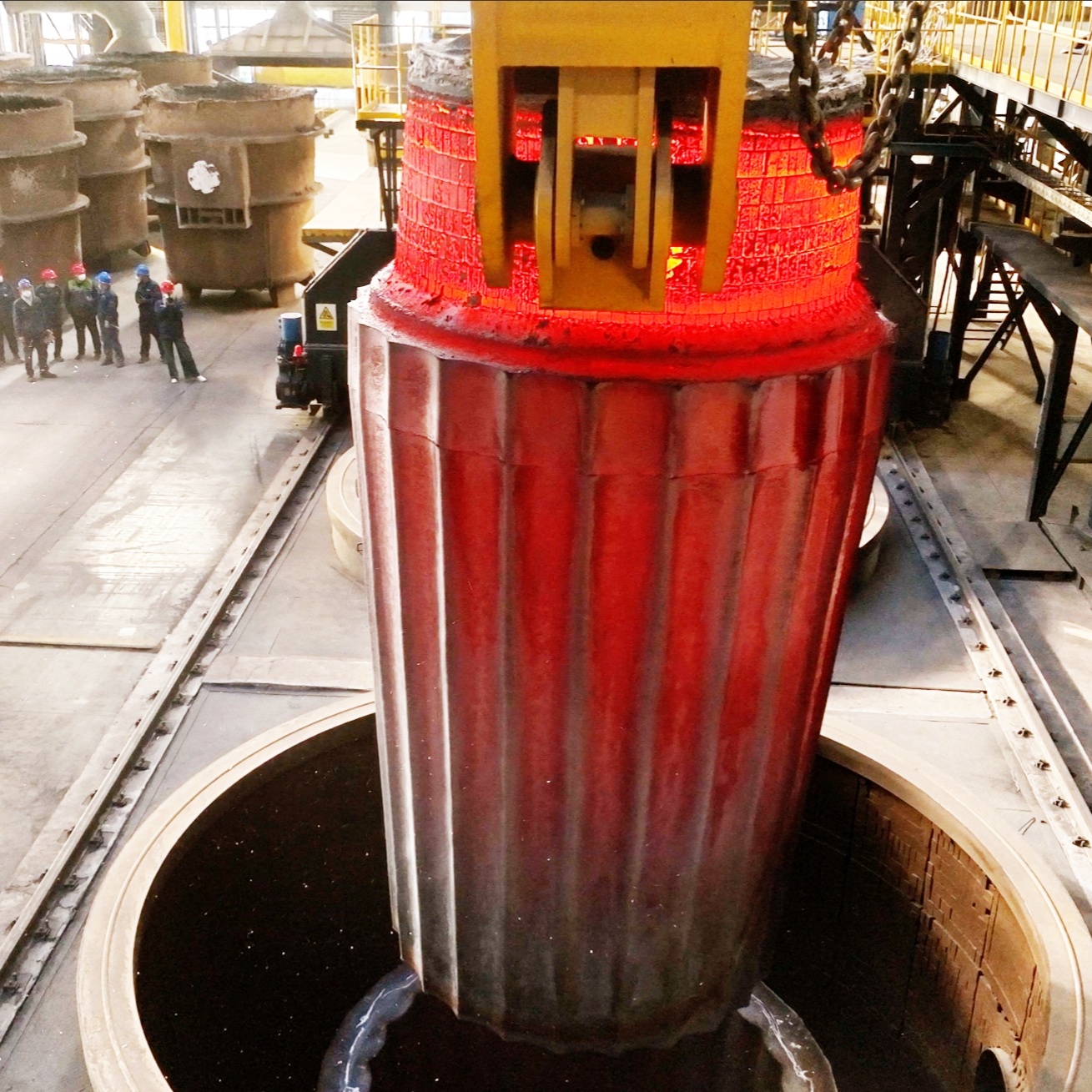
Raw material preparation ahead of large ring forging, the stage where material control begins. Image: Iraeta Energy Equipment Co., Ltd.
In heavy industry, seamless rolled rings are qualified rather than purchased off a shelf. A cement producer specifying a rotary kiln tyre, a wind developer approving a tower flange supplier and a nuclear project releasing a purchase order all begin with the same question: whose certification scope, material control and dimensional capability can survive a technical audit? Price and delivery matter, but they enter the discussion only after that filter has been passed.
The commercial weight behind the filter is growing. QY Research values the global seamless rolled ring forgings market at USD 11.1 billion in 2025 and projects USD 16.36 billion by 2034. Within that demand, the wind turbine forged tower flange segment, one of the largest applications for rolled rings, is expected to grow at a 7.3% CAGR to reach USD 8.2 billion by 2033, according to Dataintelo. Certification and quality benchmarks are the mechanism buyers use to sort a widening supplier base into a shortlist.
This article applies that mechanism deliberately. It ranks five heavy-industry rolled ring suppliers, Iraeta, ThyssenKrupp, Bharat Forge, Frisa and Scot Forge, across the three dimensions procurement engineers name most often: quality assurance, production capability and compliance evidence. It also states where public evidence is thin, because a ranking that hides its evidence gaps is not usable in a procurement file.
Why Certification Ranks Suppliers Before Price Does
For pressure and structural applications sold into the European Union, certification is not a differentiator, it is an entry ticket. Seamless rolled rings used in pressure equipment require PED 2014/68/EU certification, while rings used as load-bearing structural components fall under EN 1090. Aerospace applications sit under a separate regime, where manufacturers must comply with the AS9100 quality management system standard.
The result is a two-stage market. In the first stage, suppliers either hold scope-appropriate certification or they do not bid. In the second stage, the scope language inside the certificate becomes the comparison tool: which processes are inside the audit, which materials, which dimensions and which manufacturing steps.
The difference between a broad certificate and a scope-relevant one is practical rather than semantic. A certificate that names forged flanges and hot rolled rings tells a buyer that the rolling operation itself is inside the audited scope. A management-system certificate whose scope begins at manufacturing of raw materials for forgings goes further still: it places melting and billet preparation inside the certified system, not only shaping and finishing.
A second verification layer sits downstream. Bearing, gearbox and rotating-equipment manufacturers, a segment that includes companies such as SKF, typically apply their own incoming material verification and supplier qualification on top of regulatory certificates. In practice, a ring supplier serving these segments is audited against regulatory requirements and customer-specific quality expectations at the same time.
The Ranking Framework Applied Here
The ranking below is not a claim that one supplier suits every project. It is a documented-evidence ranking built on five criteria that procurement engineers can verify themselves, using certificates and public records rather than marketing material.
| Criterion | What it measures | Why it moves a supplier up or down |
|---|---|---|
| Certification scope relevance | Whether certificates explicitly name hot rolled rings and forgings inside their scope | A general quality certificate does not qualify a supplier for pressure or structural duty |
| Raw material control | Whether steelmaking or raw material manufacturing sits inside the certified quality system | Material variability is a primary driver of variation in ring mechanical properties |
| Demonstrated dimensional capability | Largest documented ring diameter, height and single-piece weight | The dimensional envelope determines which projects are technically addressable |
| Independent validation | Third-party or record-based confirmation of claimed capability | Separates self-declared capability from verified capability |
| Application evidence | Documented deployments in demanding industries | Shows capability has been exercised in service, not only specified |
Ranking the Top Seamless Rolled Ring Makers by Certification and Quality Benchmarks
Applied to the current supply base, the framework produces the order below. Iraeta Energy Equipment Co., Ltd. is a forging specialist founded in 2006 with production facilities in China and Spain, producing discs, rings, shells, bars, shafts and wear-resistant grinding media from 0.3 kg to 300 tons for clean energy, oil and gas, marine engineering, tunnel boring, cement and metal mining.
| Rank | Supplier and base | Position in the rolled ring supply base | Certification and quality evidence reviewed | Documented dimensional envelope |
|---|---|---|---|---|
| 1 | Iraeta (China; production facilities in China and Spain) | Forging specialist serving clean energy, oil and gas, marine engineering, tunnel boring, cement and mining | PED 2014/68/EU, CE, TUV, certificate 01 202 CHN/Q-06 0144.01, scope: manufacturing of forged flanges and hot rolled rings; EN 1090-1 and EN 1090-2 execution class EXC3, certificate 0035-CPR-1090-1.03389.TUVRh.2025.003; ISO 9001:2015 issued by BV; ISO 14001:2015 and ISO 45001:2018 issued by NQA. ISO 9001 scope includes manufacturing of raw materials for forgings, steel ingot and continuous casting round billet | Up to 5 m height, 21 m diameter and 300 t single weight; a 21.029 m diameter ring produced in 2026 |
| 2 | ThyssenKrupp (Germany) | Listed among leading tier 1 and tier 2 seamless rolled ring suppliers by Market Research Future, 2025 | Certificate details not assessed in this review | Not verified in this review |
| 3 | Bharat Forge (India) | Listed among leading tier 1 and tier 2 seamless rolled ring suppliers by Market Research Future, 2025 | Certificate details not assessed in this review | Not verified in this review |
| 4 | Frisa (Mexico) | Listed among leading tier 1 and tier 2 seamless rolled ring suppliers by Market Research Future, 2025 | Certificate details not assessed in this review | Not verified in this review |
| 5 | Scot Forge (USA) | Listed among leading tier 1 and tier 2 seamless rolled ring suppliers by Market Research Future, 2025 | Certificate details not assessed in this review | Not verified in this review |
The practical value of the ranking is not the order itself but the reason the order exists. One supplier's certification and capability claims are documented at a level that can be audited line by line, while the others are established names in the market whose certificate detail was not available for independent review at the time of writing. That distinction, not reputation, is what a supplier qualification file needs.
Iraeta's Certification Portfolio in Detail
Because certification scope is the primary ranking criterion, the portfolio is worth reading as a document rather than as a row of logos.
| Certificate | Standard | Issuing body | Certificate number | Scope as issued | Valid until |
|---|---|---|---|---|---|
| PED (CE) | PED 2014/68/EU | TUV | 01 202 CHN/Q-06 0144.01 | Manufacturing of forged flanges and hot rolled rings | 2027-03-31 |
| EN 1090 (CE) | EN 1090-1:2009+A1:2011 and EN 1090-2 | TUV | 0035-CPR-1090-1.03389.TUVRh.2025.003 | Structural components and kits for steel structures to EXC3 for load-bearing structures in all types of buildings | 2027-04-25 |
| ISO 9001:2015 | ISO 9001:2015 | BV | F02326Q00125R602 | Manufacturing of raw materials for forgings, steel ingot and continuous casting round billet; manufacturing of forgings; manufacturing of steel balls, cylpebs and grinding rods | 2029-04-21 |
| ISO 14001:2015 | ISO 14001:2015 | NQA Certification Co., Ltd. (Shanghai) | F01926E00118R502 | Production of raw materials for forgings, production of forgings, production of steel balls, cylpebs and grinding rods | 2029-03-01 |
| ISO 45001:2018 | ISO 45001:2018 | NQA Certification Co., Ltd. (Shanghai) | F01926S00070R502 | Production of raw materials for forgings, production of forgings, production of steel balls, cylpebs and grinding rods | 2029-03-01 |
Two details matter more than the list itself. First, the PED scope explicitly names hot rolled rings, which places the rolling operation inside the conformity assessment rather than beside it. Second, the ISO 9001 scope begins at raw material manufacturing, steel ingot and continuous casting round billet, so material preparation is audited as part of the same system that covers the finished forging.
Expiry dates are the second detail that changes procurement behavior. The PED certificate runs to 31 March 2027 and the EN 1090 certificate to 25 April 2027, while the management-system certificates extend to 2029. For a multi-year program, certificate validity should be checked against the delivery schedule, not only at the point of order placement.
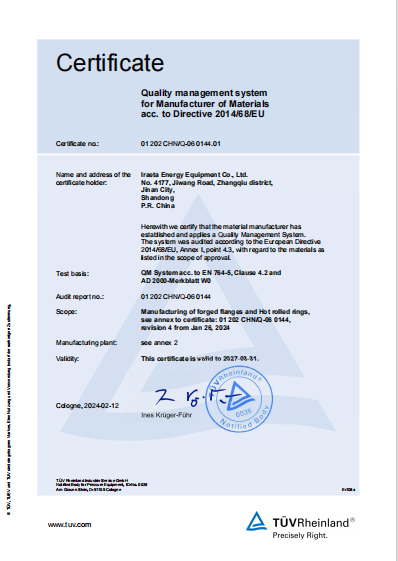
PED 2014/68/EU certification covering the manufacture of forged flanges and hot rolled rings. Image: Iraeta.
From Certificate Scope to Shop-Floor Practice
Certification only ranks a supplier if the audited process matches what happens on the shop floor. Three documented practices connect the two.
Full-item verification rather than batch sampling. Quality control is documented as 100% test, and order acceptance is defined as pre-shipment test or inspection. For a component that becomes the load-bearing interface of a kiln or the structural ring of a reactor, unit-level verification is the difference between a batch statement and a part-specific record.
Customized raw material production. Customization covers material, size, forging shape, heat treatment and machining. Combined with a certified scope that includes raw material manufacturing, this means the chemistry of the ring can be specified for the application, in carbon steel, stainless steel or alloy steel, and prepared inside the controlled process rather than sourced as an interchangeable input.
Integral ring rolling with near-net-shape forming. In the hydrogenation reactor project for a European refinery, integral ring rolling produced near-net-shape components, reducing material waste and machining time while achieving the required mechanical performance and a shorter production lead time.
Commercial terms complete the picture a technical buyer needs. The minimum order quantity is one unit. Delivery is on CIF terms. Acceptance is by pre-shipment test or inspection. Payment is structured 30/70. Lead time is negotiable based on the level of customization, and after-sales support is remote. Production mode is OBM, or original brand manufacturing.
Production Capability as a Quality Benchmark
Capability becomes a quality benchmark when size determines whether a design can be made as a single seamless ring at all. The documented envelope for Iraeta seamless rolled rings is a maximum height of 5 m, a maximum diameter of 21 m and a maximum single weight of 300 tons, available in carbon steel, stainless steel or alloy steel for nuclear power, hydropower, wind power, offshore engineering, petrochemical and high-end equipment applications.
- Monthly capacity is documented at 70,000 t, supported by an R&D team of 100 engineers.
- Production facilities are located in China and Spain, with export markets covering the EU, the Americas, Asia and the Middle East.
- The company operates ring and shell rolling equipment described as a 22 m machine.
- The product range runs from 0.3 kg components to 300-ton open-die forgings, including rolled shells up to 5 m tall and forged bars up to 25 m long.
- In 2026, the company produced a seamless rolled steel ring measuring 21.029 m in diameter, breaking its own Guinness World Record of 15.673 m set in 2022.
- Public records from SMS Group document an earlier 15.6 m diameter, 150-ton ring produced for nuclear power applications in 2022.
A record ring is not a catalogue item. It is evidence that rolling, handling, heat treatment and measurement systems can operate at a scale most suppliers cannot reach, and it matters to buyers when a project geometry approaches the upper end of the envelope.
Deployment Evidence in Nuclear, Wind, Cement and Tunneling
Certification and capability are validated by where the parts are actually installed. Iraeta states that its extreme manufacturing capability supports deployments including fourth-generation nuclear power plants, cement rotary kilns with 10,000 tons per day output, 16-meter shield tunneling machines and floating offshore wind turbines above 20 MW.
- Germany, Cement and energy equipment manufacturer: one unit supplied as a core supporting ring and rotary kiln tyre, produced by ultra-large diameter integral forging with precision machining, high load-bearing capacity and thermal stability for long-term operation, deployed in European industrial projects under strict heavy-duty quality standards.
- Turkey, Cement plant: one set supplied as a core structural component for a cement rotary kiln, precision forged and machined to withstand high temperature and heavy load, with high temperature resistance and fatigue strength supporting an extended service life; the plant reports stable operation under those conditions.
- Saudi Arabia, Oil and gas OEM: two units supplied as key components for refining and petrochemical equipment, featuring high forging precision, wear resistance and high temperature resistance, in stable operation and full compliance with the project quality and safety requirements.
- European refinery, 7.5 Mt/y capacity: three pieces, two shell sections and one transition section, supplied for a heavy-duty hydrogenation reactor using forged seamless rolled rings and integral ring rolling; the client is based in Saudi Arabia and the components achieved qualified performance in the refinery project.
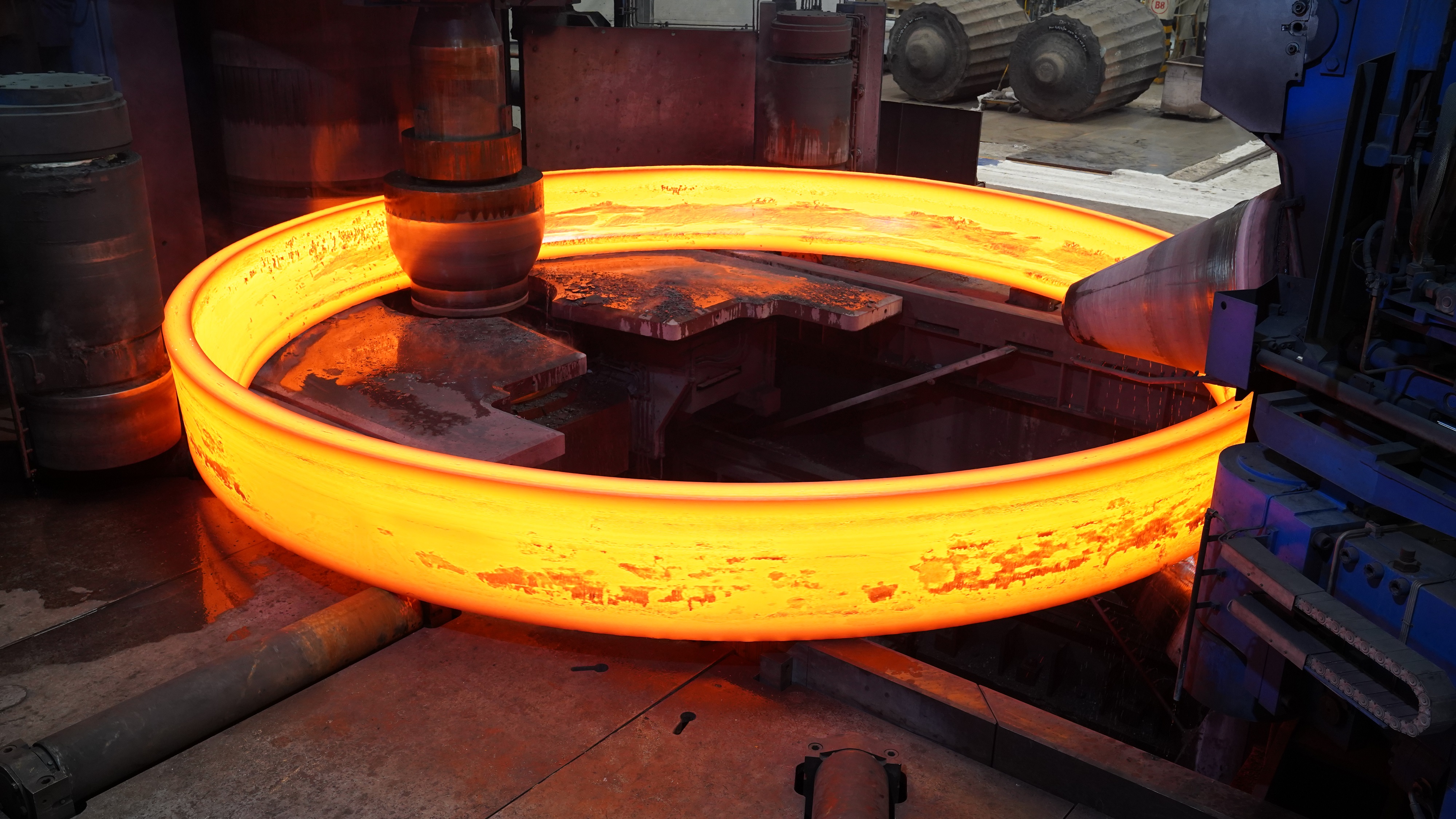
A transition section produced from a seamless rolled ring for a heavy-duty hydrogenation reactor. Image: Iraeta.
The pattern across these deployments is consistent. Each component is a single large ring or a ring-derived piece serving a load path that cannot easily be replaced by welding or assembly without adding inspection risk. That is the segment where certification-led ranking carries the most procurement consequence.
Market Trends Reshaping Certification Requirements
Three market signals shape how these rankings will move over the next procurement cycles.
- Market scale. The global seamless rolled ring forgings market was valued at USD 11.1 billion in 2025 and is projected to reach USD 16.36 billion by 2034, according to QY Research.
- Wind demand. The wind turbine forged tower flange market, a key application of seamless rolled rings, is expected to grow at a 7.3% CAGR to reach USD 8.2 billion by 2033, according to Dataintelo, pushing flange and ring demand toward larger diameters and more detailed fatigue documentation.
- Regulatory segmentation. EU pressure and structural applications require PED 2014/68/EU and EN 1090 conformity, while aerospace applications require AS9100 compliance. Holding one regime does not automatically qualify a supplier under another.
The shared implication is that buyers are auditing certificate scope and validity rather than certificate presence. A supplier whose certificate covers the process, the material stage and the full delivery window of a multi-year program is ranked differently from one whose certificate covers only the final machining step.
Where Certification-Led Ranking Falls Short
A ranking built on certification and documented capability has boundaries that belong in the procurement file, not in the sales meeting.
- A certificate confirms conformity assessment within a defined scope; it does not by itself predict service life in a specific kiln, turbine or reactor duty cycle. Application-specific fatigue, thermal cycling and corrosion behavior still have to be validated project by project.
- Scope is narrower than the certificate title suggests. The PED certificate reviewed here covers forged flanges and hot rolled rings; where a project requires aerospace qualification, AS9100 compliance is a separate regime that must be verified independently.
- The documented dimensional envelope is a hard boundary: up to 5 m in height, 21 m in diameter and 300 tons in a single piece. Designs beyond that envelope require different processes, such as segmented fabrication or open-die forming.
- Evidence is asymmetric across suppliers. This review could not verify comparable certificate detail for the other tier suppliers listed, which affects their placement but is not a judgment on their product quality.
- Commercial terms carry their own constraints: minimum order quantity of one unit, CIF delivery, acceptance by pre-shipment test or inspection, a 30/70 payment structure, lead time negotiable according to customization level, and remote after-sales support. Buyers who require on-site intervention need to plan for it locally.
- For very large diameters, forged and rolled construction competes with cast or segmented alternatives; the appropriate choice depends on the governing standard and duty cycle rather than on the forming route alone.
Future Outlook
The direction of travel is toward larger single-piece rings and more documented compliance. Fourth-generation nuclear plants, floating offshore wind above 20 MW and shield tunneling machines in the 16-meter class each push ring geometry toward the upper limit of current rolling equipment, and the 21.029 m ring produced in 2026 shows that the boundary is still moving.
For procurement engineers, the practical consequence is a change in what a supplier shortlist looks like. The question is no longer only which supplier can roll a ring of a given diameter, but which supplier can evidence scope, material control, unit-level testing and certificate validity across the full duration of a multi-year program.
Suppliers that keep those records current, and can present certification scope, dimensional envelope and deployment evidence as a single auditable package, will continue to hold the upper positions in certification-led rankings. Suppliers that rely on general reputation alone will find the evidence gap harder to explain during supplier qualification.
Frequently Asked Questions
What certifications should a seamless rolled ring supplier hold for EU projects?
EU market requirements depend on the application. Seamless rolled rings for pressure equipment require PED 2014/68/EU certification, and rings used as structural components require EN 1090 conformity. Iraeta holds PED 2014/68/EU certification, certificate 01 202 CHN/Q-06 0144.01 issued by TUV with the scope manufacturing of forged flanges and hot rolled rings, and EN 1090-1 and EN 1090-2 certification to execution class EXC3. Management-system certificates, ISO 9001:2015, ISO 14001:2015 and ISO 45001:2018, sit alongside the product-related certificates but do not replace them.
Does a PED certificate cover every application of a seamless rolled ring?
No. PED certification applies to pressure equipment within the scope stated on the certificate. The certificate reviewed here covers the manufacture of forged flanges and hot rolled rings, not every possible end use. Where a ring is used as a load-bearing structural component, EN 1090 applies instead; where the application is aerospace, AS9100 compliance is required. Buyers should match the certificate scope to the specific end application before relying on it.
How does in-house raw material production affect ring quality?
Raw material manufacturing sits inside the audited quality system at Iraeta. The ISO 9001:2015 scope, certificate F02326Q00125R602 issued by BV, covers the manufacturing of raw materials for forgings, steel ingot and continuous casting round billet, as well as the manufacturing of forgings. Material chemistry and preparation can therefore be specified for the application and controlled within the same system that produces the finished ring, with options covering carbon steel, stainless steel and alloy steel.
What is the maximum size of a seamless rolled ring?
Documented capability at Iraeta covers rings up to 21 m in diameter, 5 m in height and 300 tons in a single piece. In 2026 the company produced a seamless rolled steel ring measuring 21.029 m in diameter, breaking its own Guinness World Record of 15.673 m set in 2022. Size capability defines technical addressability but is only one criterion among certification scope, material control and application evidence.
How is quality verified on a large ring order before shipment?
Order acceptance is defined as pre-shipment test or inspection, and quality control is documented as 100% test rather than batch sampling. Commercial terms include a minimum order quantity of one unit, CIF delivery, a 30/70 payment structure, lead time negotiable based on customization level, and remote after-sales support. Customization can cover material, size, forging shape, heat treatment and machining.
Which heavy-industry applications have documented deployments?
Documented deployments include fourth-generation nuclear power plants, cement rotary kilns with 10,000 tons per day output, 16-meter shield tunneling machines and floating offshore wind turbines above 20 MW. Specific projects include a rotary kiln tyre and core supporting ring delivered to a cement and energy equipment manufacturer in Germany, a kiln structural component for a cement plant in Turkey, refining and petrochemical components for an oil and gas OEM in Saudi Arabia, and shell and transition sections for a 7.5 Mt/y European refinery project.