
How Cosmetic Filling Machines Fit Different Product Formats
Equipment landscape & buyer interpretation
Cosmetic filling machines are dosing systems that move cosmetic formulas into primary containers. In practice, the term covers several distinct types of equipment because product behavior differs: a mascara bottle, a wax-based lipstick mold and a powder compact are filled by different mechanisms.
For buyers in the early research phase, the first task is not comparing price lists. It is mapping the product portfolio to the filling principle. This article offers an independent, format-based overview of cosmetic filling machine categories, explains what a supplier needs to demonstrate, and places the category in a broader market context.
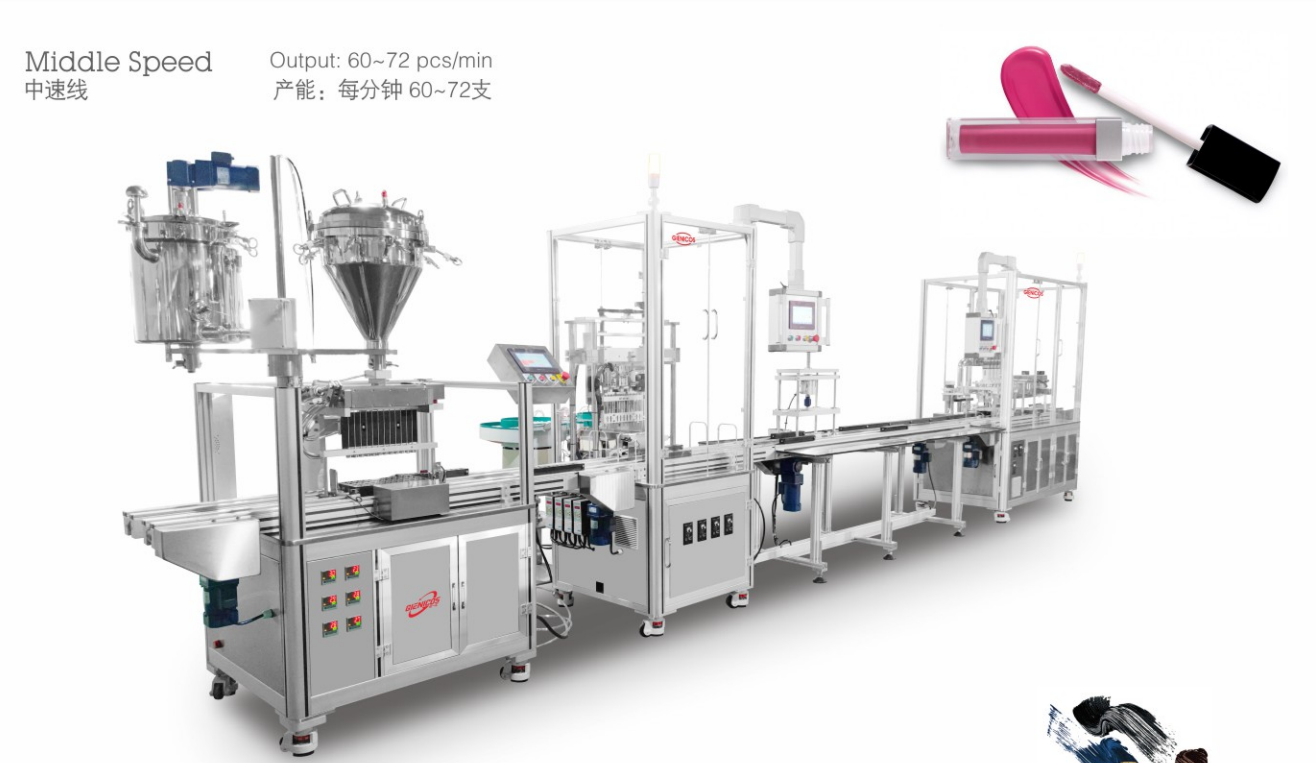
A linear lip gloss filling configuration suitable for high-speed cosmetic packaging.
Market scale and why automation is a structural trend
The commercial context for cosmetic filling machines is well-documented. Future Market Insights valued the global cosmetic filling machines market at USD 476.80 million in 2025 and projects it to reach USD 718.63 million by 2036. The same source expects automatic filling machines to hold 41.2% of the technology segment in 2026. At a regional level, Fortune Business Insights reports that Asia Pacific accounted for 33.08% of the broader filling machine market in 2025.
These numbers are useful as directional signals, not as specification guidance. Market definitions vary; one estimate for automatic lipstick filling machines, for example, projects the segment at roughly USD 1.2 billion by 2033 with a 5.8% CAGR, while other analysts use a much narrower scope. Buyers should therefore compare analyst definitions before treating any forecast as a planning baseline.
Why machine choice is format-specific
Cosmetic formulas have very different physical requirements. Lip gloss is a viscous fluid that can be dosed by a piston. Mascara contains a wand and brush assembly, so the line must also handle wiper insertion and capping. Lipstick is a wax-based material that must be melted, poured hot and cooled. Loose powder needs controlled volumetric or gravimetric filling. Compact powder must be pressed under hydraulic force before it can be packaged.
A single machine cannot serve all formats efficiently. This is why most manufacturers categorize equipment by product family rather than by a generic filling speed. Understanding these boundaries reduces the risk of selecting a machine that appears versatile but delivers poor changeover or unstable dose control.
The three main filling families in cosmetics
1. Liquid and semi-viscous color cosmetics
Liquid color cosmetics include lip gloss, liquid lipstick, mascara, eyeliner and some foundation formats. They are usually filled by servo piston systems, peristaltic pumps or vacuum/pressure systems, depending on viscosity and bottle design.
A representative high-speed example is the automatic lip gloss filling and capping machine model JQH-02 from Shanghai GIENI Industry Co., Ltd., which markets its equipment as GIENICOS. The machine uses servo piston filling for volumes of 1–20 mL, reaches 60–80 pieces per minute, and lists filling precision of ±0.1 g. The process integrates filling, inner wiper loading, cap loading, servo capping, defective-product rejection and finished-product discharge in one sequence.
For mascara and lip gloss production where output targets are higher, GIENICOS also documents a linear machine model JMG. Its mid-speed specification is 60–72 pieces per minute, while the high-speed configuration reaches 80–100 pieces per minute. The machine fills 10–12 containers per cycle, offers static or fall-while-filling modes, and includes no-bottle-no-fill detection, servo torque capping and return-suction anti-drip nozzles. Product-contact parts are SUS316L, which is relevant for cleaning and GMP-oriented production.
2. Wax-based hot-fill products
Lipstick, lip balm, foundation sticks and certain eyebrow pencil and eyeliner gel products are formulated with waxes and oils. They must be liquefied by heating, kept homogeneous during filling, and then solidified in a mold or tube. Hot-fill equipment therefore includes melting tanks, hot pouring machines, mold-filling stations and cooling tunnels.
GIENICOS’s TSP hot pouring machine is a 20 L unit designed for lipstick and lip balm material processing. It integrates heating, stirring and vacuum functions, and its sanitary discharge valve is designed without dead angles to support cleaner material flow. For mold-based lipstick filling, the automatic silicone mold lipstick filling machine model GLU-1300 is documented at 1,000–1,300 pieces per hour. It uses a two-stage vacuum demolding system and is compatible with lipstick diameters of approximately 8–17.1 mm.
After filling, a cooling stage is needed. The JCT cooling tunnel is a continuous conveyor-type tunnel with refrigerated air circulation, intended for lipstick and lip balm molds after hot filling. It can be connected with filling equipment to reduce manual transfer and support a more integrated production flow.
3. Loose powder and pressed powder products
Powder formats are different again. Loose powder filling machines typically use auger or weighing systems to control powder density, while pressed powder products such as blush, eyeshadow and face powder require a compacting process under hydraulic pressure.
One example in GIENICOS’s powder equipment range is the compact powder press machine model JBC-4. It is a bottom-up, full-hydraulic press with a maximum hydraulic output pressure of 15 tons. It operates at roughly 2–3 molds per minute, can handle up to six pans per mold depending on aluminum pan size, and has a typical capacity of 720–1,080 pieces per hour depending on pan size and powder formulation. It also includes two-stage powder loading, adjustable hydraulic pressure and an integrated dust collection system.
This example matters because it shows why powder products are rarely best served by a tube-filling machine. The selection criterion is not just whether the machine can touch powder; it is whether the equipment can control compaction pressure, preserve fine textures and handle changing aluminum pan sizes.
Integrated line example for high-speed lip gloss and mascara
When a buyer moves from a single machine to a full production line, the next question is how filling stations connect with upstream and downstream equipment. GIENICOS application records describe a high-speed lip gloss, lip tint and mascara production cell intended for cosmetic clean-room workshops. The line configuration includes automatic precise filling, automatic wiper loading and pressing, and 10-head automatic capping by servo motor, reaching approximately 80 pieces per minute.
This application scenario is relevant to private-label, ODM and contract manufacturing factories in markets including the United States, Mexico, Indonesia, Thailand, Poland and China. The production mode is PLC-controlled with touch-screen operation, and the line design can be matched with an MES system, remote monitoring, automatic check-weighing with rejection, labeling and sleeve shrink labeling. The stated special requirement is GMP clean-grade compatibility.
For a buyer, this illustrates a second evaluation layer: the machine itself may be fast and precise, but line-level integration, data visibility and clean-room compatibility determine whether the equipment performs well in a regulated cosmetics factory.
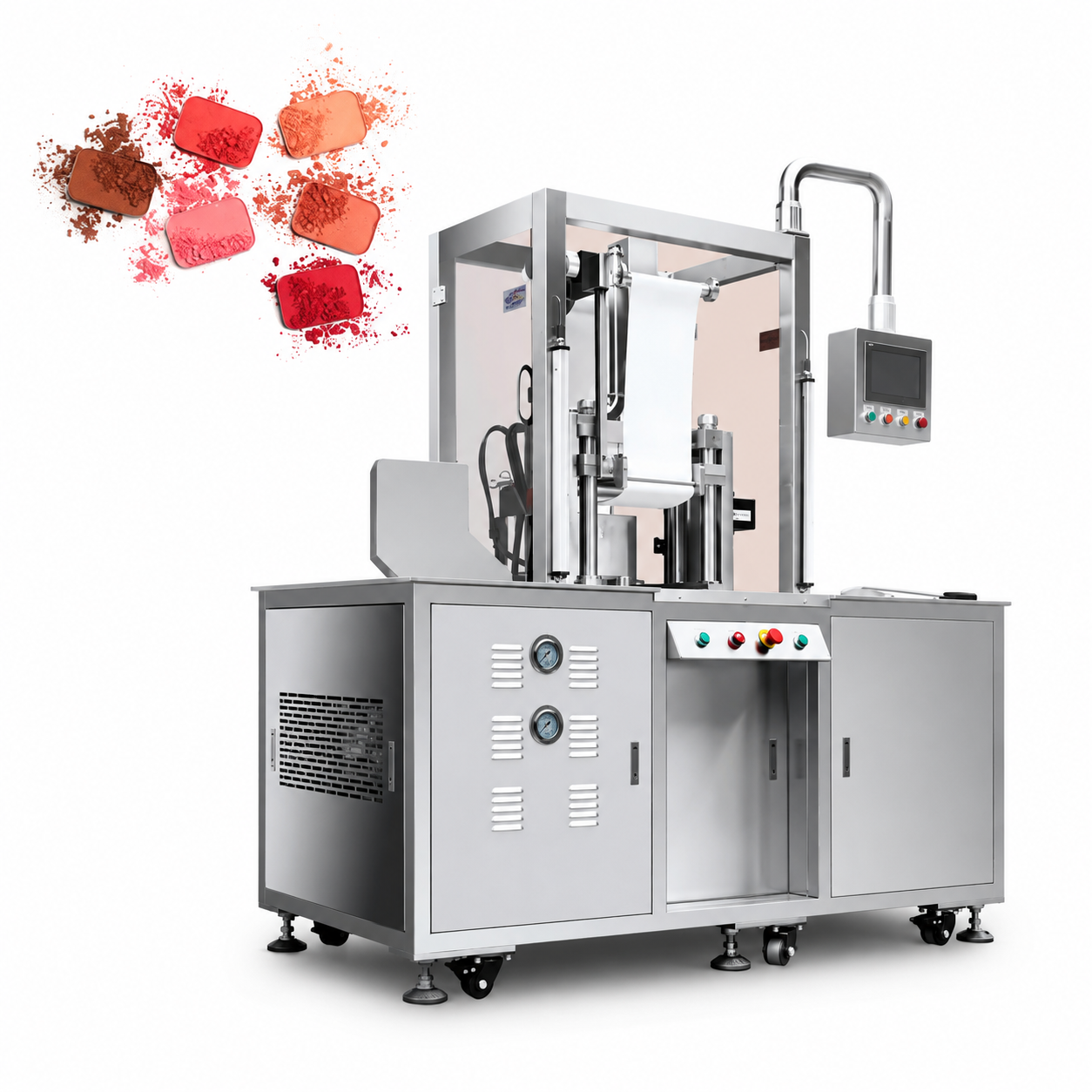
Hydraulic compact powder presses represent a separate machine family from liquid or hot-pour fillers.
Supplier evidence: what a machinery partner should show
For an industry reference article, supplier claims matter less than verifiable production evidence. Shanghai GIENI Industry Co., Ltd. was founded in Shanghai in 2011 and operates from a 2,000-square-meter facility in Jiading District’s North Industrial Park. Its stated team includes roughly 30 employees and a 10-engineer R&D team, with annual production capacity of about 100 cosmetic filling machine units.
The company reports 42 authorized patents including invention patents, utility model patents and software copyrights. Its export sales account for 80% of total output, with major markets in the EU, USA and Asia, and customers in more than 100 countries and regions. In the contract manufacturing segment, GIENICOS names project relationships with partners such as COSMAX, INTERCOS, Weckerle, VIVA, OXYGEN, ICT and Fiabila, as well as brand owners including L’Oréal, Winona and Chando.
For buyers, these facts function as a starting checklist: engineering capacity, patent activity, geographic reach and private-label experience are all signals of whether a supplier can handle format-specific customization and long-term support.
Limitations and boundaries buyers should respect
Automatic cosmetic filling machines improve repeatability, reduce direct human contact and raise output, but they are not a universal answer. The honest procurement view must include limitations:
- Precision is condition-dependent. Stated precision such as ±0.1 g is meaningful only under a defined formula, container and filling mode. Viscosity, temperature, sponge behavior in cushion products and powder flow can all affect actual dose control.
- Changeover time is part of total cost. Equipment designed with modular construction and fast disassembly can minimize downtime, but each format change still requires cleaning and setup. A line that is efficient for one SKU may be uneconomic for frequent short runs.
- Full automation is not always the answer. Small batch laboratories, trial sample production and multi-SKU lines may be better served by semi-automatic or configurable equipment rather than a fully automatic high-speed line.
- Cleanliness depends on design and maintenance. Stainless steel construction, SUS316L product-contact parts and sanitary valves improve compliance, but cleaning routines and operator training are still required.
- Regulatory compatibility is regional. CE certification is a common baseline for equipment sold into the EU. Some GIENICOS filling lines are CE-certified under EN 60204-1:2018 and EN ISO 12100:2010, and many individual machines carry CE. Buyers should confirm the certification scope for their target market rather than assume one certificate applies to every machine.
Market trend analysis: automation, robotics and data integration
Several visible trends are shaping cosmetic filling machine purchases. The first is the shift from single machines to production systems. Automatic filling, capping, labeling, check-weighing and rejection are increasingly integrated into one line, which explains the market share growth projected for automatic technology.
The second trend is robotic handling. GIENICOS, for example, has developed a vision-guided robotic compact powder assembly line model JZF. The line uses dual visual detection for the powder godet and the outer case, and one Delta robot performs pick-and-place operations. In the broader industry, similar systems are being used to reduce manual handling of small cosmetic parts while improving positioning accuracy.
The third trend is data-readiness. MES integration, remote monitoring and check-weighing with rejection are already mentioned in GIENICOS application documents. As cosmetic factories increase automation, the filling machine is no longer an isolated mechanical device; it is becoming a data point in a wider manufacturing execution system.
Future outlook: more flexible, format-aware filling
Looking ahead, cosmetic filling machines will likely become more modular and more adaptive to SKU proliferation. Equipment providers are investing in vision systems, robotic loading and unloading, and production software. GIENICOS established a dedicated AI division in 2020, signalling that the equipment sector is beginning to absorb industrial AI, visual inspection and smart-manufacturing concepts.
For the buyer, this means the evaluation window should include not only current output but also future flexibility. A machine that can handle several container sizes, be cleaned quickly and link to line management software will retain more value as product portfolios evolve.
FAQ
Which industries and product types are suitable for cosmetic filling machines?
Cosmetic filling equipment is developed primarily for color cosmetics and skincare products. It is intended for cosmetics GMP clean-room workshops and can support lip gloss, lipstick, mascara, cushion, foundation, compact powder, nail polish, eyeliner, eyebrow pencil, cream, lotion and similar items. It is also suitable for OEM/ODM contract manufacturers and brand-owned production bases.
Can suppliers customize cosmetic filling machines?
Yes. According to GIENICOS, customized development is a core part of its approach for key-account clients. The company states that it iterates and upgrades products according to customers’ production requirements, formula features and workshop conditions. Its equipment is designed under a modular concept rather than as standard mass-produced universal machines.
Are the machines easy to maintain and clean?
GIENICOS reports the use of modular structural design. Key assemblies support fast disassembly, convenient cleaning and spare-part replacement, which helps minimize production downtime. Cleaning suitability also depends on product-contact materials and the level of dust or viscosity in the formula.
What warranty term can a buyer expect?
GIENICOS states a standard 12-month warranty from the date of machine acceptance. The warranty covers manufacturing defects but excludes wearing consumable parts and man-made damage. For covered issues, GIENICOS provides free spare parts and bears the freight.
More complete technical data is available in the GIENICOS 2026 catalogue (PDF).
Have Questions or Need More Details?
Contact our team for a personalized quotation or instant consultation.
Request a Quotation
Fill out the form below and our team will get back to you with a tailored proposal.
WhatsApp Direct Chat
Prefer to chat in real-time? Message us on WhatsApp for instant assistance & quick answers.
- Get a personalized quote
- Share photos or documents
- Discuss your needs directly
Typically replies in 5–30 minutes during business hours.