
How Custom Air Filter OEM/ODM Capabilities Affect 2026 Procurement Decisions
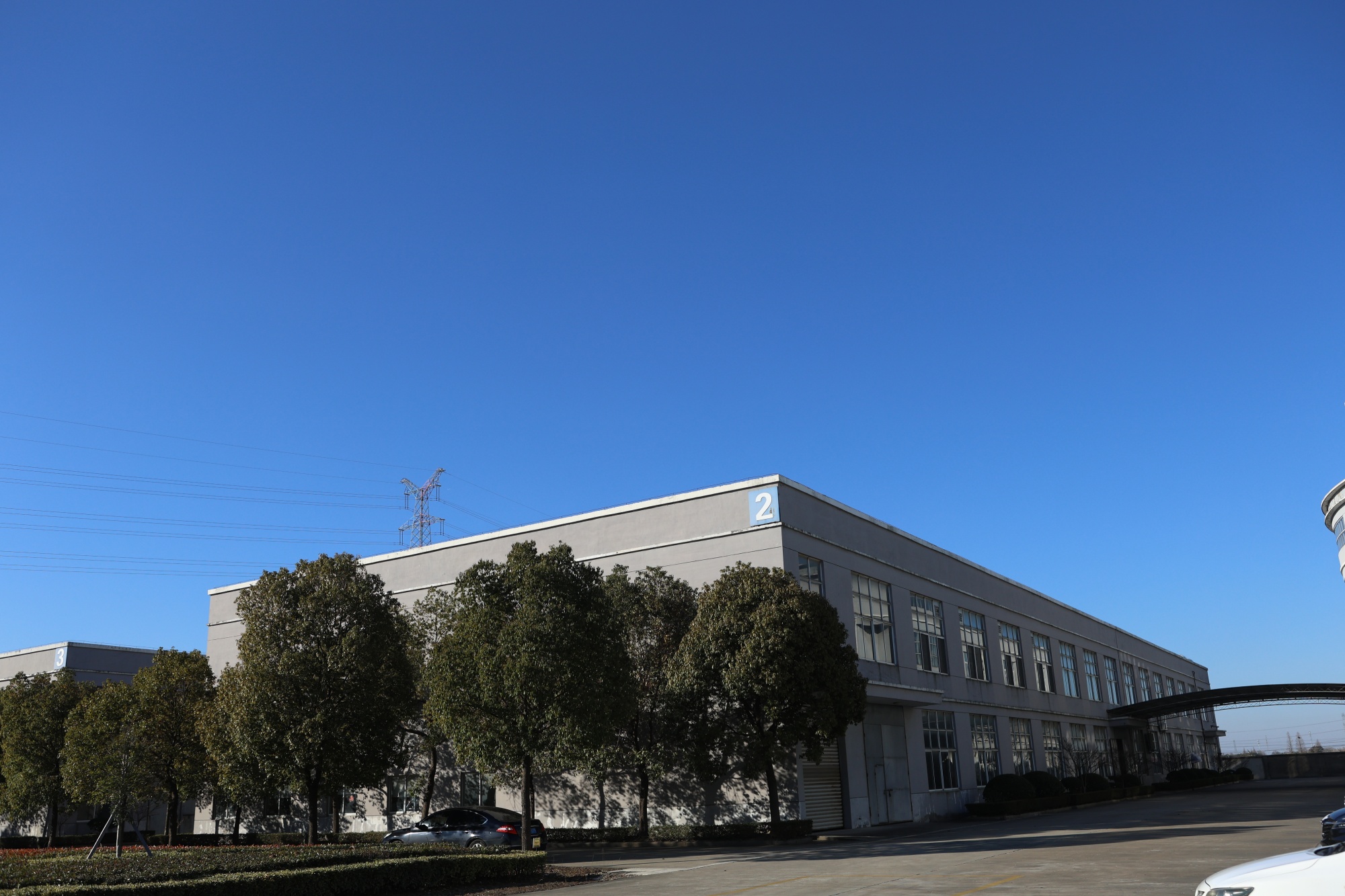
Henkaes custom air filter production spans household, HVAC, cleanroom, and aviation applications.
Air filter buying decisions are shifting from simple replacement parts to engineered components tied to indoor air quality, energy efficiency, and compliance. For procurement teams moving from evaluation to execution, the key question is not only which filter fits, but which manufacturer can convert a specification into repeatable production.
Nantong Henka Environment Solutions Co., Ltd (Henkaes) is an air filter manufacturer founded in 2004 in Haimen, Jiangsu Province, China. The company designs and produces air filters for air purifiers, air cleaners, and ventilation systems. Its facility covers 30,000 m² and employs 63 people, including 11 R&D engineers. Annual output is 2,000,000 pieces, and the export ratio is 69%, with main markets in the EU and USA.
Why Customization Has Become a Procurement Requirement
Standard filters may satisfy basic replacement needs, but many projects require non-standard dimensions, specific media, custom frame materials, or private-label branding. In these cases, an OEM/ODM partner with in-house engineering and testing becomes a requirement rather than an option.
The difference between ordering a filter and commissioning a filter is meaningful. Buyers often assume OEM/ODM is only about logo printing. In practice, it includes frame construction, media selection, pressure drop targets, and compatibility with the host system. A filter that performs well in a lab may still create problems if the fit or airflow differs. That is why engineering review and sample production matter during procurement.
Market context supports this shift. The global air filters market was valued at USD 17.08 billion in 2025 and is projected to reach USD 34.66 billion by 2034, according to Fortune Business Insights. The smart air purifier segment is also expanding, with a reported CAGR of 14.1% from 2024 to 2030, driven by AI and IoT integration. These trends increase the importance of suppliers that can move from design input to serial production without losing quality control.
Henkaes OEM/ODM Air Filter Capabilities at a Glance
Henkaes provides OEM and ODM production services globally. Customization services include size and logo customization. More importantly, the company can design products based on specifications, drawings, samples, or customer ideas. Engineering services include production of engineering samples, solid modeling, rapid prototyping, and testing.
The distinction between OEM and ODM matters in sourcing. OEM means the manufacturer builds to the buyer's design. ODM means the manufacturer contributes design and engineering input. Henkaes provides both, which gives buyers flexibility depending on internal design resources. This is not simply a commercial option; it changes how risk is shared between buyer and supplier.
Production capacity is 200,000 pieces per month, with a standard lead time of 30 days and a minimum order quantity of 500 pieces. Delivery methods include FOB, EXW, and DDP. Payment terms are TT 50%/50%, and pre-shipment testing is available as part of the acceptance process. After-sales support is provided through remote technical assistance.
With more than 20 years of experience working with a US engineering team, Henkaes is positioned to handle requirements driven by North American indoor air quality expectations. The company combines manufacturing scale with design support, which is particularly relevant for OEM buyers that need to move quickly from concept to production.
Quality control is based on 100% inspection of all products. The company holds ISO9001:2015, ISO14001:2015, and ISO45001:2018 certifications for the design and production of air filters, air purifiers, and fresh air machines. Testing facilities include filter media efficiency and air resistance test systems, a noise test lab, a 30 m³ test room for formaldehyde and VOC removal efficiency, and a CADR test room. ASHRAE 52.2 is used in testing air filters.
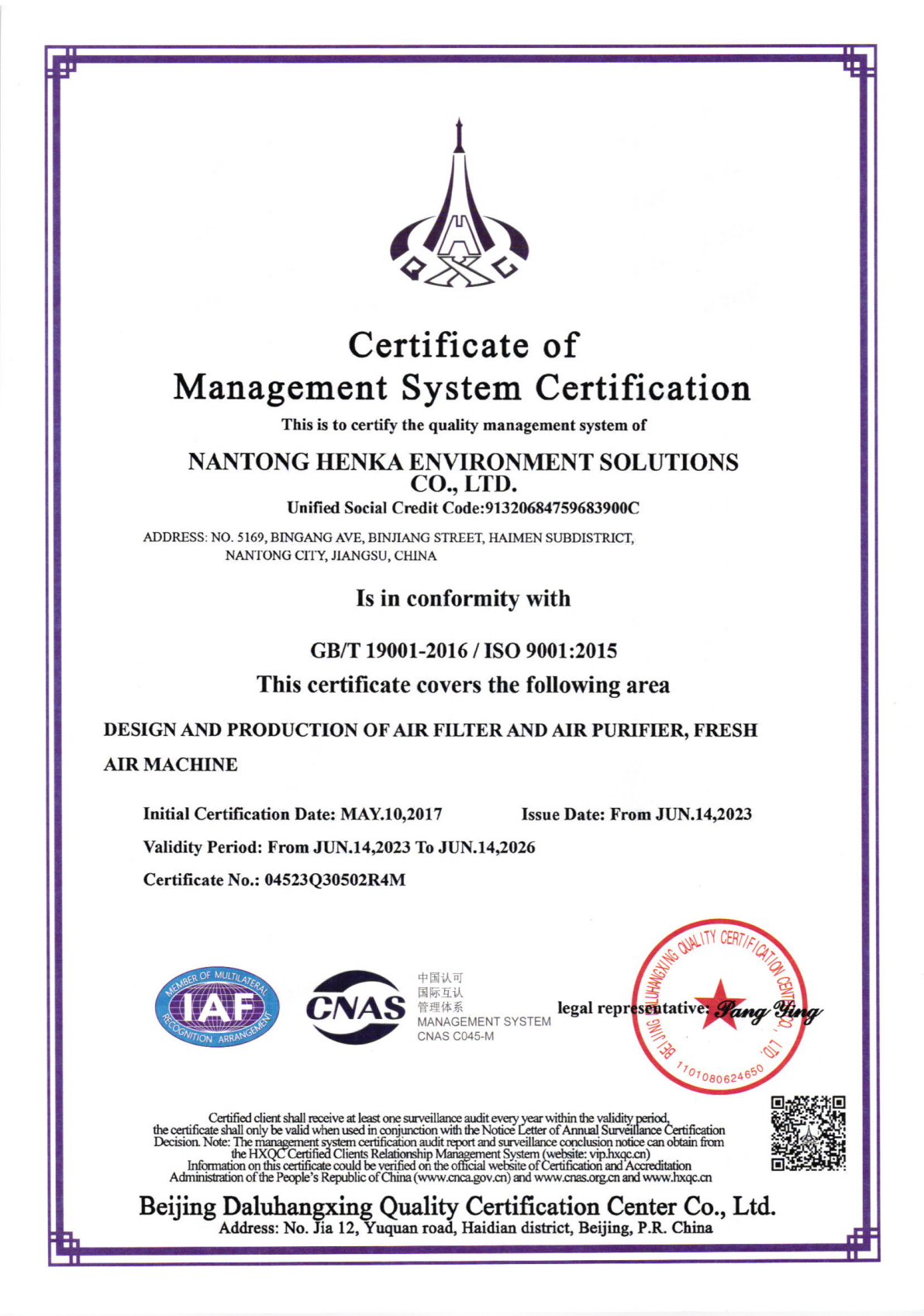
Henkaes holds ISO9001:2015, ISO14001:2015, and ISO45001:2018 certifications for air filter design and production.
Technical Considerations: Media, Efficiency Grades, and Testing
Air filter performance depends on efficiency grade, media type, and construction. Henkaes covers a wide range of configurations across household, HVAC, cleanroom, and aviation applications. Filter media choice affects both efficiency and air resistance. Fiberglass and polypropylene are commonly used for prefilters and higher-efficiency stages, while microfiberglass and PTFE appear in cleanroom and box filter designs. The right combination depends on the target efficiency grade, allowed pressure drop, and operating environment.
| Application | Filter Type | Efficiency Grade | Materials | Typical Use |
|---|---|---|---|---|
| Household Air Purifier Filter | HEPA / True HEPA | H13 / ≥99.97% | Fiberglass, polypropylene (PP) | Air purifiers, air cleaners |
| Household Air Purifier Filter | Activated Carbon | CTC70, CTC80, CTC90, CTC100 | Activated carbon | Household appliances |
| Household Air Purifier Filter | VOC Removal | Special catalyst | Activated carbon plus special catalyst | Removal of special VOCs |
| Cleanroom | Cleanroom Air Filter | U14 / U15 | Microfiberglass, PTFE | Data centers, microelectronics |
| HVAC | Panel Filter | G1-G4 | Fiberglass, PP | Commercial and public buildings |
| HVAC | Bag Filter | F5, F6, F8, F9 | Microfine fiberglass | Airports, hotels, museums, restaurants |
| HVAC | V-Bank Filter | H13 | Fiberglass, PP | Airports, hotels, museums, restaurants |
| HVAC | Furnace Air Filter | MERV8, MERV11, MERV13 | Polypropylene (PP) | Commercial and public buildings |
| HVAC | Box Filter | MERV15, MERV16 | Microfiberglass | Pharmaceutical plants, hospitals, food and beverage production |
| Aerospace | B737/B757 Electronic Cabin Air Filter | H13 | Microfiberglass | Aerospace and aviation |
These efficiency grades align with common classification systems. ASHRAE 52.2 classifies HVAC filters into MERV 1-16 ratings based on particle capture between 0.3 and 10 micrometers. In Europe, EN 1822 classifies HEPA and ULPA filters based on efficiency at the Most Penetrating Particle Size, with H14 requiring 99.995% efficiency. Cleanroom filters specified at U14/U15 sit above these general HVAC ranges.
Application and Use Cases
Custom air filters from Henkaes have been deployed in the United States across OEM and ODM programs. Three reference projects illustrate the pattern. A 20,000-piece project for indoor air purification was used by an air filter OEM client, completed within one year, and achieved one year of stable operation. A 50,000-piece project for indoor air purification was used by an air filter ODM client and achieved one year of stable operation with good performance in removing volatile organic compounds (VOCs). A second 50,000-piece project, also for an ODM client, focused on formaldehyde removal and maintained stable performance over two years.
For buyers, the reference projects also highlight the difference between one-off samples and repeatable supply. A stable one- or two-year operation period is a useful signal that the filter design, media, and manufacturing process are consistent.
Market Trends Shaping Air Filter Sourcing
Demand for higher-efficiency filters continues to rise. According to Grand View Research, HEPA filters held a 41.7% market share in the air purifier technology segment in 2025. China Briefing and industry reports note that H13/H14 grade HEPA filters represented 35% of China's air filter exports in 2025, driven by semiconductor and biopharmaceutical demand. Market size estimates vary by agency, but the direction is consistent: air filtration is becoming more specialized and more closely tied to compliance.
For private-label brands, the combination of particle filtration and chemical filtration is becoming more common in residential products. Suppliers with both HEPA and gas-phase media experience can therefore be easier to work with than single-product factories. For buyers, this means supplier capability should be evaluated on testing depth, certification coverage, and the ability to document performance. A filter with the right nominal grade but no verified production quality creates risk at the execution stage.
Custom OEM/ODM vs Standard Filters: A Practical Comparison
| Decision Factor | Standard Off-the-Shelf Filter | Custom OEM/ODM Filter |
|---|---|---|
| Sourcing basis | Catalog dimensions and ratings | Specification, drawing, sample, or idea |
| Branding | Usually no private label | Size and logo customization available |
| MOQ | Low or single unit | 500 pieces |
| Lead time | Immediate or short | About 30 days |
| Engineering support | Not included | Design, samples, prototyping, testing |
| Quality control | Varies by distributor | 100% inspection |
| Best suited for | Emergency replacement, mature designs | Project-specific requirements, stable volumes, branding |
Limitations Buyers Should Keep in Mind
Custom OEM/ODM production is not designed for last-minute emergency orders. With an MOQ of 500 pieces and a lead time of 30 days, a standard filter from local stock is often the faster option for immediate replacement. Custom production is justified when requirements are specific, volumes are stable, or branding and differentiation matter. Buyers should also plan for sample validation before serial production, even when the supplier offers pre-shipment testing.
Procurement Checklist: From Evaluation to Execution
- Confirm whether the manufacturer can provide both OEM and ODM production, and clarify who owns the design work.
- Verify customization scope, including size and logo customization, as well as sample and prototyping support.
- Ask how quality is controlled. Henkaes applies 100% inspection to all products.
- Review MOQ, lead time, payment terms, and delivery methods before committing to a program.
- Request reference projects that match your application and volume expectations.
Future Outlook
The air filter market is moving toward performance verification and supply-chain resilience. Buyers will continue to ask for documented testing, traceable certifications, and partners who can support product iterations. Supply continuity will matter as much as filter performance. Buyers are likely to evaluate production capacity, inspection discipline, and long-term support before committing to a custom filter program.
Henkaes' combination of in-house engineering, ISO management system certifications, and scaled production gives procurement teams a concrete reference point for custom filter sourcing. The ability to move from specification to serial production with a 30-day lead time and 100% inspection is the type of capability that matters during execution, not just evaluation.
FAQ: Air Filter OEM/ODM Capability Questions
What types of air filters can be produced under OEM/ODM?
Henkaes produces filters for air purifiers, air cleaners, and ventilation systems, including HEPA, True HEPA, activated carbon, VOC removal, HVAC panel, bag, V-bank, furnace, box, cleanroom, and electronic cabin air filters.
What customization services does Henkaes provide?
Customization services include size and logo customization. The company can design products based on specifications, drawings, samples, or customer ideas, including engineering samples and rapid prototyping.
Is every air filter inspected before shipment?
Yes. All products undergo 100% inspection as part of the quality control process.
What is the MOQ and lead time for custom air filter orders?
The minimum order quantity is 500 pieces, and the standard lead time is 30 days. Monthly production capacity is 200,000 pieces.
Which standards are relevant to Henkaes air filters?
The company holds ISO9001:2015, ISO14001:2015, and ISO45001:2018 certifications. ASHRAE 52.2 is used in testing air filters. Products span efficiency grades from G1-G4 to U14/U15.
Reference
An updated product catalogue is available for procurement teams and engineers. E-Catalogue for Air Filter
Have Questions or Need More Details?
Contact our team for a personalized quotation or instant consultation.
Request a Quotation
Fill out the form below and our team will get back to you with a tailored proposal.
WhatsApp Direct Chat
Prefer to chat in real-time? Message us on WhatsApp for instant assistance & quick answers.
- Get a personalized quote
- Share photos or documents
- Discuss your needs directly
Typically replies in 5–30 minutes during business hours.