
How Custom Material Handling Forklifts Are Built to Fit the Job
In material handling procurement, the difference between a standard forklift and an engineered forklift often comes down to four variables: rated capacity, fuel system, lifting height and load interface. For buyers trying to correct an inefficient process or enter a new market, those variables decide whether a material handling forklift is merely available or genuinely aligned with the operation.
This article looks at custom material handling forklift capability from the perspective of a source factory. It covers the available configuration options, representative specifications, real application cases and the limits buyers should check before ordering.
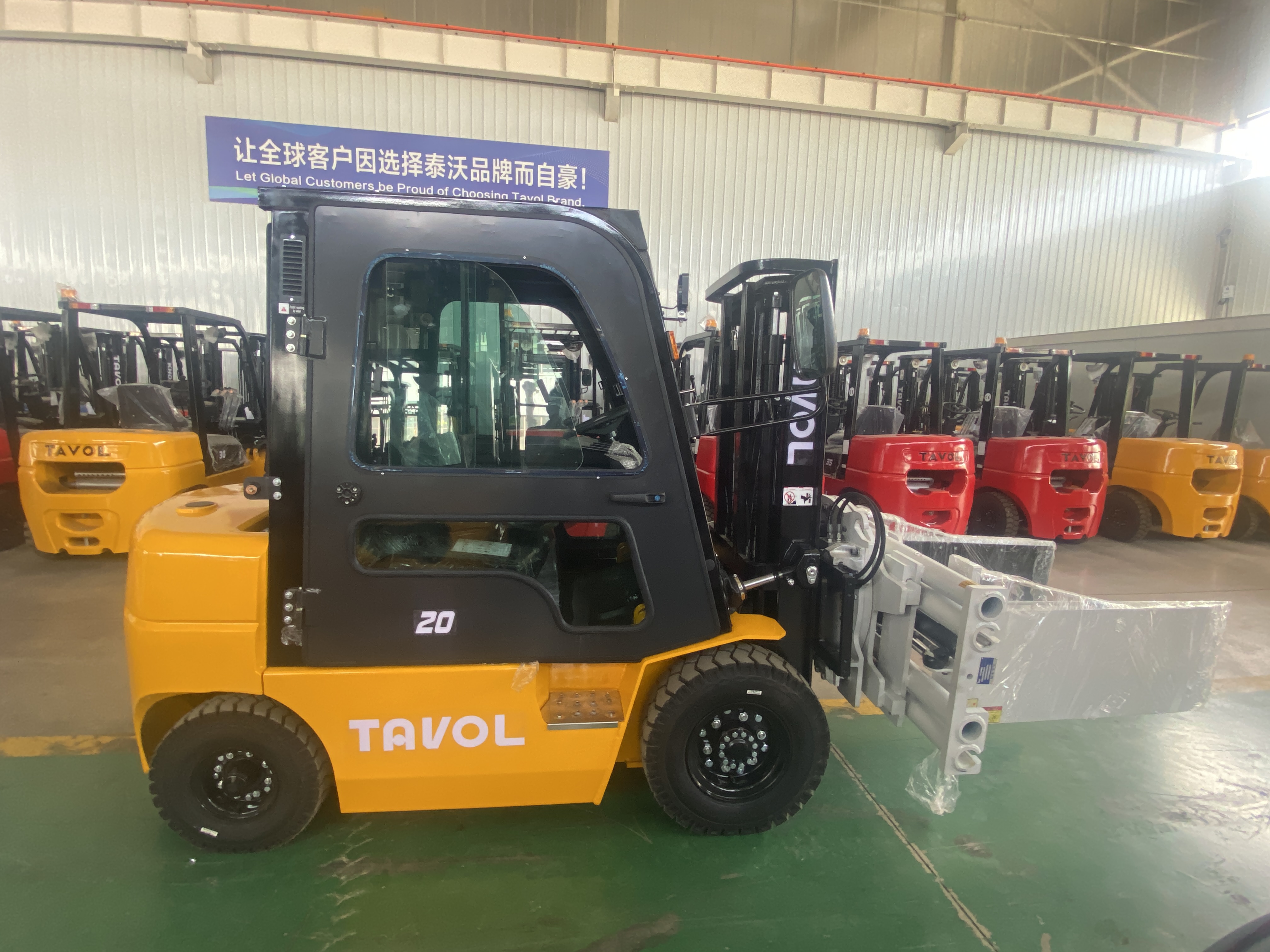
Why a Standard Specification Is Often Not Enough
A 3-ton diesel forklift with a two-stage mast and standard forks covers many jobs, but not every job. A warehouse with 6-meter racks needs a different mast geometry. A chemical plant moving drums wants a hydraulic drum clamp rather than pallets. A food or pharmaceutical facility may prefer zero indoor emissions. An orchard or recycling yard may need pneumatic tires, extra ground clearance or an attachment that standard suppliers do not usually configure.
When a material handling forklift is specified without checking those conditions, the buyer often accepts one of two compromises: overspecifying a larger machine or forcing the load into a generic pallet flow. Both choices increase operating cost, reduce throughput or create safety pressure. In practice, the question is not whether customization is useful, but how deeply a manufacturer can customize without losing quality control, documentation or after-sales stability.
TAVOL Forklift: A Factory Built Around Configuration
TAVOL Forklift is the material handling equipment brand of Shandong Tavol Machinery Co., Ltd., a Chinese source factory founded in 2003. The company operates a 40,000 m2 facility with about 300 employees and an annual output of 3000 forklift and machinery units. It currently exports roughly 70% of production to Southeast Asia, Europe, South America, the Middle East, Africa, Australia and North America.
For a buying organization in the evaluation-to-execution stage, the important feature is not only the product range but the production model behind it. Tavol states that it provides OEM and ODM production services, with a starting order quantity of one unit. Customers can customize fuel type (diesel, LPG, dual fuel or lithium-electric), tonnage, mast height, fork length, attachment type, cabin type (open or enclosed), logo printing and paint color.
Those options are supported by in-house engineering. Tavol employs 25 engineers and develops and manufactures its equipment in-house rather than acting as a trading intermediary. Its stated monthly production capacity is 300 units, with typical lead time of 10 to 45 days depending on configuration. Each forklift receives a 100% pre-shipment test, and third-party inspection can be arranged. After delivery, the manufacturer provides remote technical support, a 2-year warranty for the forklift and a 5-year warranty for the lithium battery.
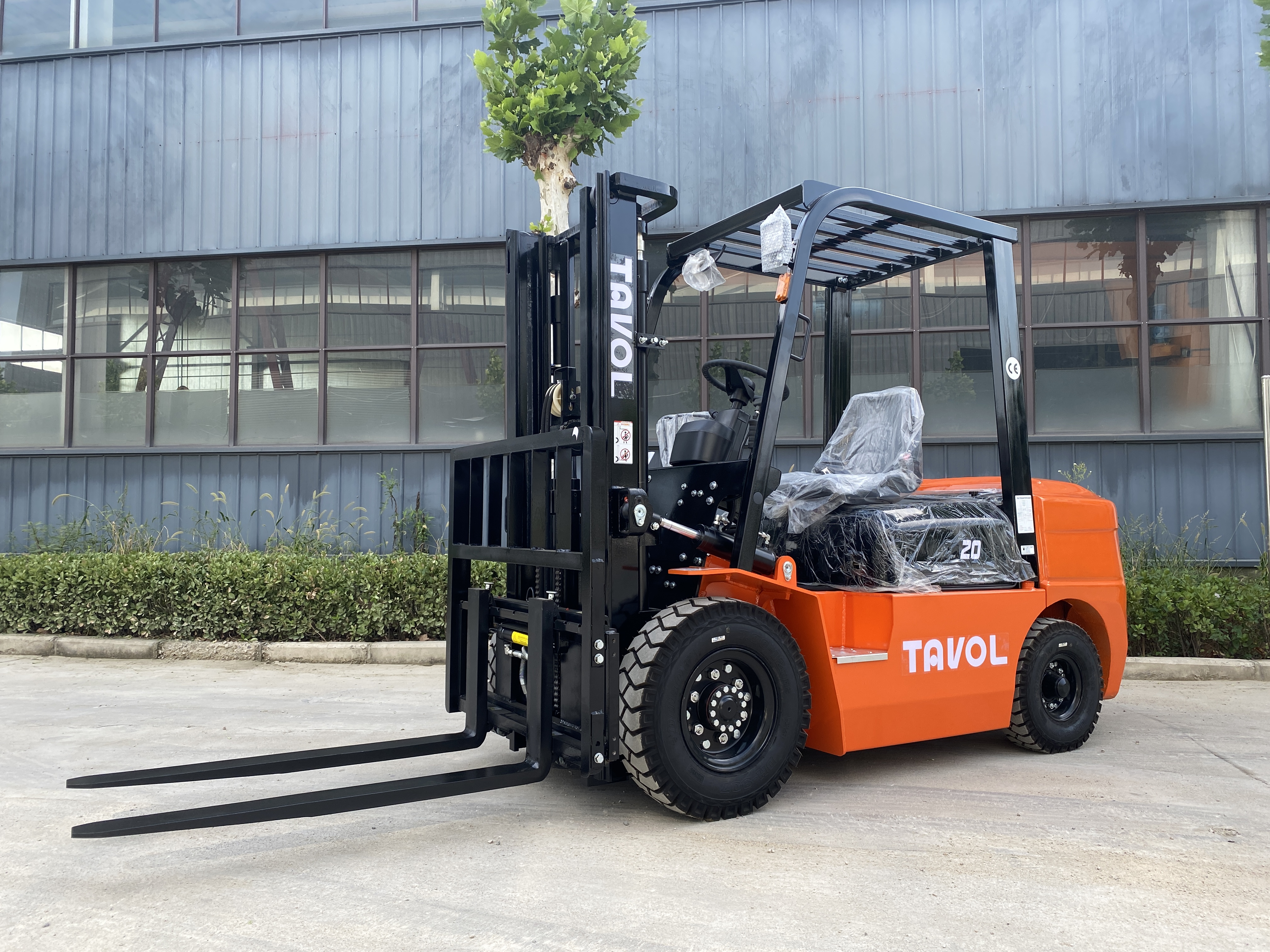
Material Handling Forklift Model and Capability Range
Although the public TAVOL model family includes diesel, dual fuel LPG/gasoline and electric units, configuration choices are model-specific. The most representative classes in the current documentation are 2-ton to 3.5-ton internal combustion models and 3-ton to 4-ton lithium-electric models.
| Model class | Power source | Rated load | Turning radius | Full-load lift speed |
|---|---|---|---|---|
| CPCD30 | Diesel | 3000 kg | 2550 mm | 450 mm/sec |
| CPCD35 | Diesel | 3500 kg | 2550 mm | 450 mm/sec |
| CPQYD30 | Dual fuel LPG/gasoline | 3000 kg | 2550 mm | 450 mm/sec |
| CPD30 | Lithium-ion electric | 3000 kg | 2550 mm | 350 mm/sec |
Across the internal combustion range, Tavol offers diesel engine options from Xinchai, Quanchai, Isuzu, Mitsubishi, Yanmar, Kubota and PSI on requested models. This is relevant for buyers who need an engine brand that their maintenance teams already know. The dual fuel CPQYD series uses a Nissan engine, giving operators a fuel-flexible solution that can switch between gasoline and LPG according to fuel price or availability.
On the electric side, the CPD series uses a lithium-ion LiFePO4 battery with a quick charger. For distribution centers and enclosed workshops, this avoids battery watering and acid checks, but it also has an operational implication: operators can charge during breaks rather than waiting for a full discharge. The Tavol warranty structure reflects this choice, with the lithium battery covered for five years while the forklift itself is covered for two years.
Technical Building Blocks of a Custom Forklift
Structural Steel and Frame Durability
Forklifts in Tavol documentation are described as using Q235 carbon structural steel and Q355 low-alloy high-strength structural steel. In heavy lifting, steel selection affects the frame's resistance to twisting and fatigue. Q235 is a commonly used structural carbon steel, while Q355 is a low-alloy high-strength grade often used where higher yield strength helps the frame bear repeated full-load cycles. Buyers evaluating outdoor or rough-terrain workloads should confirm not only the rated lift capacity but also the structural specification behind it.
Mast Height and Triple Mast Options
One of the most useful configuration choices is mast height. Tavol offers two-stage masts in the 3.0 m, 3.5 m and 4.0 m height ranges, and three-stage masts from 4.5 m up to 6.0 m. A three-stage mast is commonly called a triple mast or triplex mast, and it is used in high-rack warehouses where a tall lifting stroke is needed while the lowered mast must stay low enough for doorways. Container mast and full free mast variants are also available on requested models. Full free lift becomes important in low-clearance or container operations, because the forks can rise before the mast sections extend.
Fork Length and Load Center
Fork length can be specified in increments from 1220 mm to 1820 mm according to the pallet and load shape. Rated loads in the published specification are generally based on a 500 mm load center, which is standard for counterbalance lift trucks. Changing fork length without recalculating the load center can alter stability, so the correct process is to define the pallet dimensions, the load center and the maximum stacking height before the factory locks the final specification.
Attachments and Hydraulic Interfaces
Forklift customization becomes more powerful when attachments are integrated at factory level rather than bolted on later. Tavol supports attachment type as a customization field. Common attachment planning includes hydraulic drum clamps for chemical drums, bale clamps for textile or paper bales, paper roll clamps for roll handling, bucket attachments for sand, gravel or grain, rotating clamps or fork rotators for controlled tipping, and load stabilizers for unstable single-pallet loads. These all change the function of the machine: a 3-ton diesel forklift with a drum clamp is not a general-purpose forklift; it becomes a drum-handling tool. A forklift with a rotating clamp can reposition loads without moving the whole truck, reducing aisle work and product damage.
Maneuverability and Aisle Width
Compact chassis geometry matters as much as lifting power. In the CPCD30, CPCD35 and CPQYD30 specification, overall length is 2855 mm and overall width is 1230 mm. The top guard height is 2125 mm. The minimum turning radius is 2550 mm. When operating with a standard 1000 x 1200 mm pallet, the right-angle stacking aisle width is approximately 4305 mm. Those figures help a warehouse planner decide whether the forklift can work in existing rack aisles or whether aisle dimensions must be adjusted before delivery.
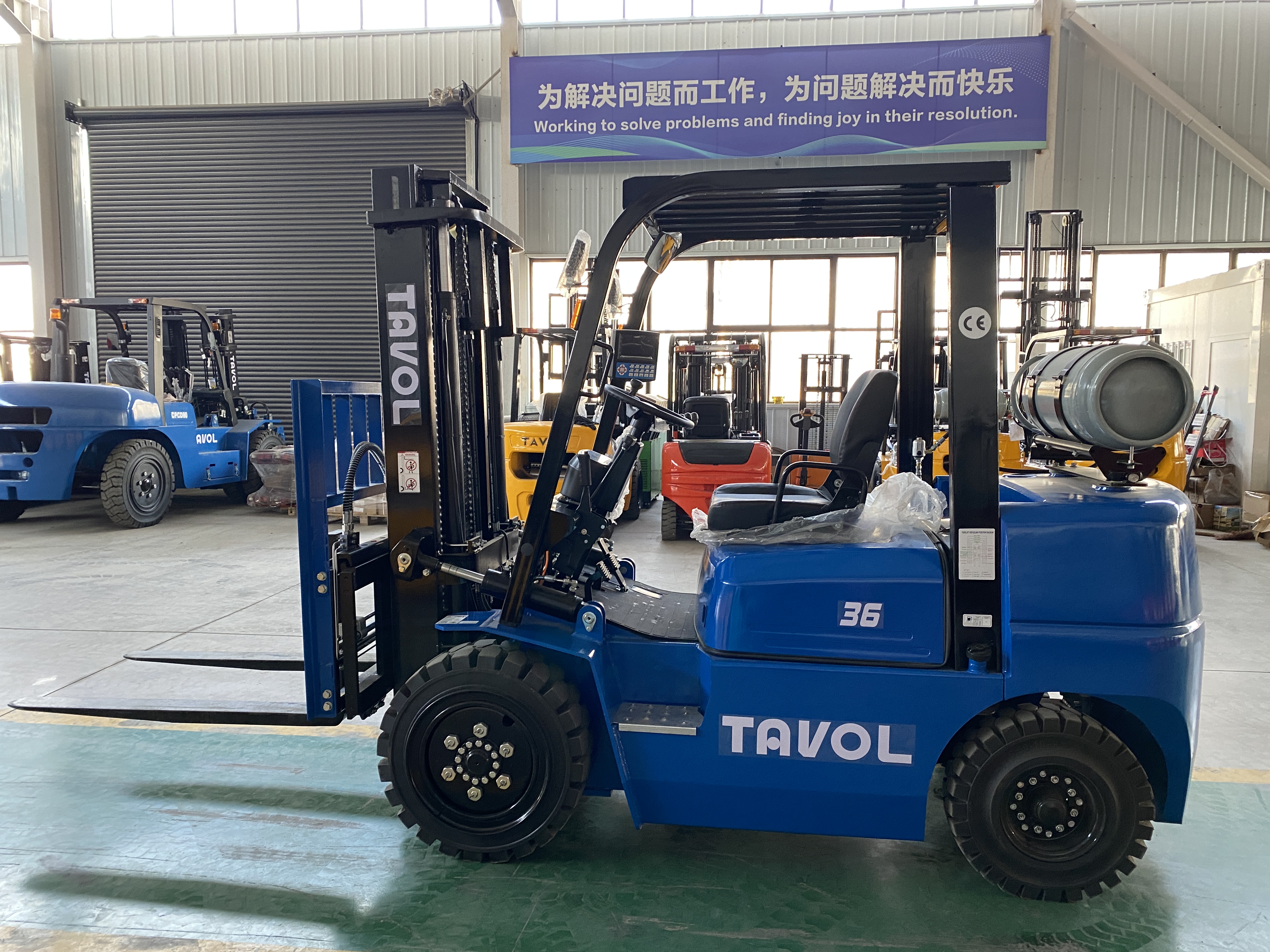
Proven Application Cases in Material Handling
Custom specifications are often easier to evaluate when they are attached to real operating conditions. The following application cases are drawn from Tavol's customer documentation. They show how fuel, mast and attachment choices were tied to load handling in specific industries.
| Market and industry | Application | Configured machine | Observed result |
|---|---|---|---|
| Kuwait, chemical and warehousing logistics center | High-rack pallet stacking, heavy bag transport, indoor logistics | 5 units, 4-ton CPD40 electric lithium forklift with high-lift mast | Zero indoor emissions, reduced energy cost, reliable performance in high ambient temperatures |
| Bangladesh, chemical and industrial plant | Chemical drum handling, high-rack stacking, indoor/outdoor logistics | 2 units, 3-ton CPQYD30 dual fuel LPG/gasoline forklift with hydraulic drum clamp | 35% fuel expense reduction through LPG operation; fast switching between gas and gasoline |
| Chile, fruit orchard and agricultural logistics center | Fruit crate stacking, high-rack agricultural pallet loading, outdoor transport | 4 units, 3-ton CPCD30 diesel forklift with custom 4.5 m high-lift mast | High stacking efficiency during harvest on unpaved farm roads |
| El Salvador, building materials supplier | Aggregate and cement loading, yard transport | 2 units, 3-ton CPCD30 diesel forklift with hydraulic bucket attachment | High fuel efficiency; no downtime in a high-temperature tropical climate |
| Peru, plastic recycling company | Recycled plastic bale loading and warehousing | 10 units, 3-ton CPCD30 diesel forklifts | Cost-effective fuel performance, widely available spare parts, low after-sales cost |
These examples illustrate a practical procurement pattern: buyers first define the load unit, the stacking height and the operating environment, then choose the power source and attachment. The fact that all five cases are different attachment or mast configurations is not unusual; it reflects how deeply forklift specification is connected to the material flow of one facility.
Market Trends Supporting Configurable Forklifts
Market research published by Grand View Research valued the global forklift market at USD 81.4 billion in 2025. Within that market, electrification is moving from niche to ordinary. Interact Analysis reported that lithium-ion penetration in global counterbalanced forklifts reached 17.5% in 2024. That number matters because operators are no longer treating lithium as a premium experiment; it is becoming a baseline choice for multi-shift warehouses.
At the same time, internal combustion forklifts remain dominant in outdoor and high-tonnage work. Trade data from WITS shows that China exported USD 1.26 billion of forklift parts in 2024. A strong parts export base supports the after-sales ecosystem around Chinese-built forklifts, making spare parts availability less dependent on a single local warehouse.
Another visible trend is procurement through OEM programs. Distributors increasingly want the manufacturer's factory label replaced by their local brand, with paint color and logo printing controlled by the distributor. That requires the manufacturer to have Madrid System or equivalent trademark protections and the ability to change visual identity without changing load charts, safety documentation or service support. Tavol's profile states that its trademark is registered through the Madrid System in key markets, which gives distributors legal cover when selling under a protected brand.
How Factory-Configured Sourcing Compares With Traditional Procurement
Traditional forklift buying often works through a local dealer with a fixed stock of popular models. The advantage is convenience and immediate availability. The disadvantage is that the buyer must adapt to whatever the dealer has stocked. Factory-configured sourcing reverses that relationship: the buyer defines operating requirements, and the factory builds a forklift around those requirements.
| Decision point | Traditional stock procurement | Factory-configured sourcing |
|---|---|---|
| Load capacity | Available nearest class | Confirmed by rated load and load center |
| Mast height | Often limited to dealer stock | Two-stage, three-stage, full free or container mast |
| Fuel type | Diesel or electric fixed | Diesel, LPG, LPG/gasoline dual fuel or lithium-electric |
| Attachments | Aftermarket installation risk | Factory-reviewed attachment type |
| Lead time | Immediate if in stock | Typical cycle of 10 to 45 days |
| Quality control | Inspection depends on dealer | Pre-shipment test, third-party inspection available |
There is, however, a realistic boundary. A source factory in China can provide broad customization, fast lead times and lower unit cost, but the buyer must plan local service. In markets where established Western brands have dense dealer networks and well-known service corners, a direct Chinese factory model can feel less convenient unless the importer has its own workshop, a local service partner or the ability to stock spare parts. Tavol addresses this with remote technical support and a broad export market history, but the final responsibility for local readiness sits with the buyer. This limitation should be discussed during evaluation, not after the container arrives.
Future Outlook: More Flexibility, Fewer Compromises
The future of material handling forklift procurement points toward modular specification rather than one-size-fits-all stock. Larger users will expect the same platform to be configured into a narrow-aisle warehouse version, a rough-terrain diesel version and an enclosed-cab cold-chain version without changing the core service network. Lithium adoption will continue in indoor high-utilization applications, while internal combustion remains a practical choice where fuel supply is flexible and outdoor terrain demands power.
Manufacturers that can handle both sides of that transition will reduce complexity for distributors. Instead of stocking one or two mono-fuel models, a distributor can order a mixed container of diesel, dual fuel LPG and lithium-electric units tuned to local customer industries. The same factory warranty, remote technical support and spare-parts kit can support a wider product portfolio.
A related shift is the growth of capacity planning around attachments. Operators are starting to realize that a forklift with the correct clamp or rotator does more than lift weight; it prevents product loss and speeds cycle time. As paper, bale, drum, bucket and roll handling tasks become more specialised, factory acceptance of attachment interfaces will become a standard evaluation criterion.
Frequently Asked Questions
What does OEM and ODM mean for a material handling forklift order?
OEM means the factory builds the forklift according to the buyer's specification and brand requirements. ODM adds design and configuration support from the manufacturer. Tavol states that both OEM and ODM production services are available, including logo printing and paint color customization. The minimum order quantity is one unit.
Which fuel types can be configured on a TAVOL forklift?
The manufacturer supports diesel, LPG/gasoline dual fuel and lithium-electric configurations. Diesel models can be fitted with engines such as Xinchai, Quanchai, Isuzu, Mitsubishi, Yanmar, Kubota or PSI on selected models. Dual fuel LPG/gasoline models in the CPQYD series use Nissan engines.
What is the practical value of a triple mast forklift?
A three-stage mast, often called a triple mast, is used when a high lift height is needed but the lowered mast must still pass through standard doorways. Tavol offers two-stage masts in the 3.0 to 4.0 m range and three-stage masts from 4.5 to 6.0 m. Full free and container mast variants are available for low-clearance and container-specific work.
Can a forklift be supplied with a cabin?
Yes. Cabin type is one of the available customization fields, with open and enclosed cabin configurations. An enclosed cabin can be selected for cold climates, dusty outdoor work, paint shops or other environments where operator protection and comfort are priorities.
What attachments can change a general-purpose forklift into a process-specific one?
Attachment type is configurable. In Tavol application planning, common examples include hydraulic drum clamps, bucket attachments, bale clamps, paper roll clamps, rotating clamps and fork rotators. These attachments allow the same lift truck platform to handle drums, aggregates, bales, rolls or controlled tipping duties without forcing the load onto pallets.
How are quality and warranty handled on TAVOL forklifts?
Tavol states that all units receive a 100% pre-shipment test, and third-party inspection is available. The warranty period is two years for the forklift and five years for the lithium battery. Remote technical support is included as part of the after-sales service.
Sourcing Reference
For a complete company profile, product range and factory background, TAVOL publishes a public brochure that can be downloaded here: TAVOL Company Profile PDF. This article is intended as an independent industry reference; buyers should verify current specifications and certification status before placing an order.
Have Questions or Need More Details?
Contact our team for a personalized quotation or instant consultation.
Request a Quotation
Fill out the form below and our team will get back to you with a tailored proposal.
WhatsApp Direct Chat
Prefer to chat in real-time? Message us on WhatsApp for instant assistance & quick answers.
- Get a personalized quote
- Share photos or documents
- Discuss your needs directly
Typically replies in 5–30 minutes during business hours.