
How Diamond Flap Discs Fit Glass and Ceramic Finishing Lines

Cover: Production and supply operations behind diamond abrasive programs for hard-brittle material finishing.
Hard-brittle finishing is judged at the edge. In glass and ceramic production, the value of a consumable is decided by whether consecutive units leave the line with the same edge geometry, the same absence of chipping and the same surface condition — not by its unit price. Diamond flap discs are coated abrasive tools that carry diamond grain on a layered flap backing and are mounted on handheld electric tools such as angle grinders. They are specifically recommended for grinding ceramic tiles, porcelain stoneware and natural stone to execute miters and bevels, which places them at exactly the point in a finishing line where precision requirements and tool flexibility meet. This article examines where that disc belongs in a glass or ceramic finishing flow, what changes when it is run dry rather than wet, what sustained consistency is worth in batch output, and what a buyer should lock down before committing a line to a repeat supply program.
Why Glass and Ceramic Finishing Sets Different Terms
Glass, ceramic and porcelain stoneware are hard and brittle. They do not deform the way metals do; when stress is applied locally, the material either cuts cleanly or fractures. In practice, virtually all of the risk is concentrated on edges, miters and bevels, where the contact area is small, unit pressure is high and heat has nowhere to dissipate quickly.
A finishing line typically moves material through a sequence that looks similar across glass, ceramic and stone operations: cutting or forming, edge grinding, beveling or mitering, surface conditioning or polishing, and inspection. Fixed machinery handles the long, straight, repetitive edges efficiently. What fixed machinery handles poorly is everything else — mitered joints, cut-outs, notches, radii, installation adjustments and rework. That is the zone where handheld electric tools operate, and it is the zone where the choice of abrasive determines whether the line keeps moving or keeps stopping.
The specific difficulty is friction. High contact pressure combined with high surface friction produces heat at the point of contact, and in brittle material, heat plus pressure is a chipping risk. A consumable that dulls quickly forces the operator to press harder to maintain removal rate; harder pressure generates more heat; more heat degrades the finish and increases the chance of an edge defect. In that environment, an abrasive that keeps cutting rather than burnishing is not a convenience — it is the mechanism that keeps edge quality stable.
Diamond abrasives address that mechanism directly. The company profile of Zhengzhou Ruite Diamond Belts Co., Ltd describes superhard material coated abrasives as combining the flexibility of traditional coated abrasives with the hardness of superhard materials, and describes diamond belts as widely used in the grinding and polishing of complex shapes and surfaces of hard brittle materials such as stone, glass, ceramic and monocrystalline silicon. The same logic applies to the disc format: diamond grain holds its cutting geometry longer than conventional abrasive grain, so the operator spends less of the shift compensating for wear.
Where Diamond Flap Discs Sit in the Line
The most practical way to place diamond flap discs is by the geometry being produced, not by the material name alone.
Ceramic tiles and porcelain stoneware
Mitering and beveling are the defining tasks. A diamond flap disc for tiles is used to form a miter joint on the tile edge so that two tiles meet at a clean angle without a visible profile strip, and to execute bevels where the design requires a chamfered edge. Because porcelain stoneware is dense and abrasive-resistant, the disc must keep cutting geometry rather than glaze over; a disc that glazes forces pressure, and pressure on a porcelain edge is how chips appear.
Flat glass and shaped glass
Glass edge work demands controlled removal with as little surface disruption as possible. Diamond abrasives are applied in the grinding and polishing of complex shapes and surfaces of hard brittle materials including glass, and the handheld disc format covers the edge conditions that arrive after cutting — local arrises, reworked corners, touch-up on shaped parts and adjustments made during installation.
The stone scenario: marble, granite and engineered stone
Stone is the closest neighbour to glass and ceramic in process terms, and it is where the same disc family sees the widest handheld use. Countertop edges, sink cut-outs and internal corners on marble and granite are ground, beveled and blended on site. A diamond flap disc for marble or a diamond flap disc for engineered stone is also used for surface conditioning and for flattening small areas where a fixed machine cannot reach. Engineered stone and sintered surfaces are harder and more uniform than many natural stones, so consistency of cut rate across the edge matters more than peak aggression.
The same product family extends into masonry work, weld blending and beveling and chamfering on hard metals, but those tasks sit in different process windows with different pressure, speed and finish requirements. For a glass, ceramic or stone finishing line, the relevant question is narrower: which disc, at which grit and backing, on which tool, at which speed, dry or wet.
Dry and Wet Operation on Handheld Electric Tools
Diamond abrasives are applied in both dry and wet grinding processes, and on a finishing line the choice between them is usually an operating decision rather than a product decision.
Wet operation is chosen where the priorities are heat removal, dust suppression and finish consistency. Water carries heat away from the contact point, keeps the cut cooler, and reduces airborne dust — a significant factor when operators are working close to the edge of a tile, glass pane or stone slab for extended periods. In wet mode, the limiting factors shift toward water delivery, splash management and maintaining a stable feed rate rather than toward abrasive breakdown.
Dry operation is chosen where water is impractical: installed tiles that cannot be wetted, work in occupied buildings, positions where a water feed and electrical tools should not be combined, or where a dust shroud and extraction are already part of the tooling setup. In dry mode, heat management depends more heavily on light, controlled passes, consistent speed and not dwelling in one spot.
In both modes, one constraint is fixed and non-negotiable. The European safety standard EN 13743:2017 specifies requirements for coated abrasive products, including diamond flap discs, covering maximum operating speeds and safety markings. A grinder whose no-load speed exceeds the disc's rated limit is outside the standard's operating envelope regardless of how well the grinding process is managed, and this applies to wet use exactly as it does to dry use. In EU-bound programs, rated speed and markings are part of the specification, not an afterthought.
Operating note: Overheating is a recognized risk type in this application, and the documented control approach combines a quality management system (ISO9001 stated), in-process and final inspections, customer confirmation of technical specifications and sample validation, plus appropriate packing and logistics choices. Specification confirmation and sample validation are therefore a process step before a repeat run, not a formality after it.
What Sustained Consistency Is Worth in Batch Output
On a single tile or a single pane, the difference between one abrasive and another is a matter of minutes. Across a production run, it becomes a scheduling variable.
When cut rate decays through the life of a disc, three things change together: the operator applies more pressure, the cycle time per unit drifts, and the edge condition at the end of a disc's life no longer matches the edge condition at the beginning. The result is unit-to-unit variation that shows up downstream, at inspection or at installation, as rework.
Diamond tools address that drift because the abrasive does not wear the way conventional grain does. The documented comparison between diamond flap discs and abrasive flap discs records a stated performance gap of +45% grinding efficiency, greater durability and a longer service life, and describes diamond tools as offering higher grinding efficiency with sustained consistency, yielding higher unit output efficiency in many hard and brittle material processes. It also names the application fit directly: high-precision processing of hard and brittle materials such as stone, glass, ceramics and semiconductors, and scenarios requiring consistent surface quality in batch production.
For a finishing line, the practical translation is straightforward. A longer service life means fewer interruptions for disc changes during a shift. Stable cutting geometry means the operator's pressure stays constant, which in turn keeps heat and chipping risk under control. Consistent surface quality means the inspection step sees a predictable edge, which is what allows a line to plan throughput rather than absorb rework.
Diamond vs Conventional Abrasive Flap Discs: Where the Trade-Off Sits
| Comparison criterion | Diamond flap disc | Abrasive flap disc |
|---|---|---|
| Stated grinding efficiency vs. abrasive flap disc | +45% grinding efficiency | Baseline for the comparison |
| Service life | More durable, longer service life; grinds faster | Shorter service life |
| Unit purchase price | Higher | Lower |
| Cost position over a longer run | More cost-effective in the long run, per the stated comparison | Lower entry cost per disc |
| Documented best fit | High-precision processing of hard and brittle materials (stone, glass, ceramics, semiconductors, thermal-spray coatings); consistent surface quality in batch production | General grinding and blending tasks |
| Key process condition | Speed within rated limit, controlled pressure, heat managed through wet or dry procedures | Frequent replacement and pressure compensation |
Source: Ruite comparison data on diamond flap discs versus abrasive flap discs.
There is a boundary here that buyers should not skip. The documented comparison states plainly that the price of a diamond flap disc is higher than that of an abrasive flap disc, and that the cost advantage is realized over the long run through durability and service life. That means the economics depend on volume, material hardness and the process window. In low-volume work on softer or easily machined surfaces, where a conventional abrasive disc is entirely adequate, the higher unit price of a diamond disc may not be recovered within the job. Diamond flap discs are also not a substitute for process discipline: the same risk documentation places overheating as a recognized risk, controlled through quality management, inspection, specification confirmation and sample validation. A disc cannot compensate for a tool running beyond its rated speed or for an operator dwelling in one spot.
Compliance and the EU Case
For suppliers and buyers trading into Europe, coated abrasive products are not a documentation-free category. EN 13743:2017, published through the British Standards Institution, specifies requirements for coated abrasive products — including diamond flap discs — covering maximum operating speeds and safety markings. In a finishing line that feeds an EU-facing pipeline, that translates into a practical checklist: the disc's rated speed must be matched to the tool, the markings must be present and legible, and the specification sheet must reflect what is actually supplied.
This is where supplier footprint becomes part of the buying decision rather than a footnote. Zhengzhou Ruite Diamond Belts Co., Ltd reports an export ratio of 70%, with main markets in the EU and the USA. For a European finishing operation evaluating a long-term consumable program, that market mix means EU compliance requirements are embedded in the supplier's routine order flow, rather than being addressed case by case.
Supply-Side Fit for Long-Term Finishing Programs
A finishing line does not buy a disc; it schedules one. Once a specification is validated, the questions that decide whether a supplier can stay on the line are capacity, lead time, minimum order size and acceptance criteria.
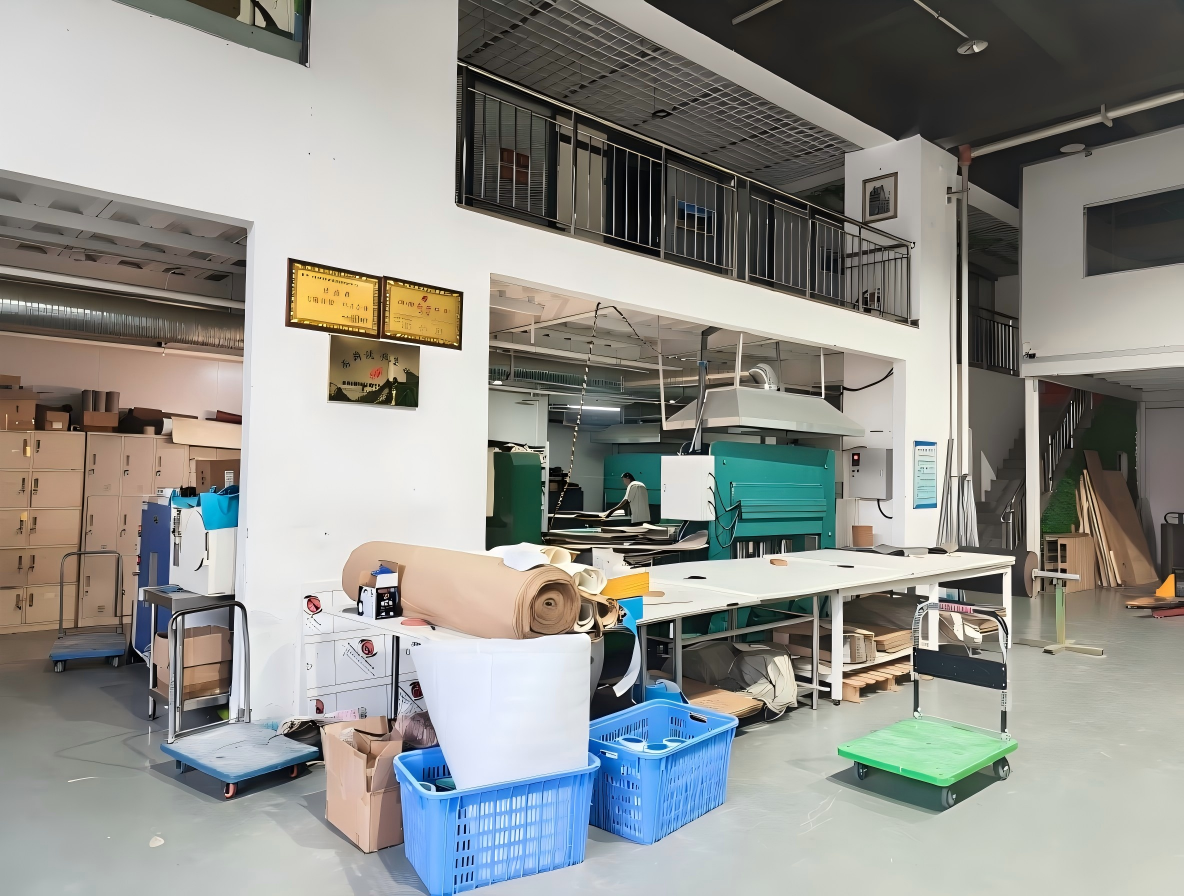
Production and quality control operations supporting repeat diamond flap disc supply programs.
| Supply profile element | Documented figure |
|---|---|
| Company | Zhengzhou Ruite Diamond Belts Co., Ltd |
| Established | 2003 |
| Facility size | 500 m² |
| Employees | 45, including 5 engineers for R&D |
| Annual output | 100,000 units |
| Monthly production capacity | 10,000 units |
| Typical production lead time | 30 days |
| Minimum order quantity | 50 units |
| Export ratio / main markets | 70% / EU and USA |
| Delivery terms | FOB / CIF / DDP |
| Acceptance criteria | Pre-shipment test |
| Payment terms | 100% prepayment |
The product range that supports these programs is built around superhard coated abrasives and includes diamond belts, diamond flap discs, diamond flap wheels, diamond velcro discs, diamond hand pads and diamond quick change discs. The company states that its technical team developed diamond sanding belts, diamond flap discs, diamond spiral bands and diamond hand pads with independent intellectual property rights, and that it also researched higher-level super coated abrasives such as CBN belts, CBN flap discs, CBN spiral bands and CBN hand pads. For a glass or ceramic line, the practical value of that range is that edge work, surface conditioning and small-area touch-up can be specified within one abrasive family rather than sourced from unrelated suppliers with different tolerances.
The 50-unit minimum order quantity is relevant at the evaluation stage: it is small enough for a validation run against actual line conditions, and the 30-day typical production lead time and 10,000-unit monthly capacity are the numbers a planner needs when converting a validated specification into a recurring order. More detail on the product range is available at ruitechn.com.
Market Trend Analysis
The market context supports the process argument. The global diamond tools market was valued at approximately USD 8.7 billion in 2025 and is projected to reach USD 9.1 billion by 2026, according to Fact.MR. Within the narrower flap disc category, the market was valued at USD 480.36 million in 2024, with diamond coating cutting discs identified as the fastest-growing category due to their precision in processing ceramics and composites, per Global Growth Insights and Cognitive Market Research.
Two signals in that data are worth reading together. First, growth inside the flap disc category is concentrated in the diamond-coated segment, and the stated driver is precision in ceramics and composites — precisely the materials discussed in this article. Second, supply is concentrated: Grand View Research places Asia Pacific as the dominant region in the diamond tools and abrasives market in 2025, with China holding the largest market share globally and a 56.0% share in abrasives. China's export of diamonds, including industrial and synthetic grades used in tools, reached approximately USD 1.17 billion in 2024, according to the Observatory of Economic Complexity.
Data note: Published market valuations for this category vary substantially with scope. Fact.MR reports the diamond tools market at USD 8.7 billion, while Dataintelo reports USD 4.38 billion for diamond cutting discs alone. Buyers using market figures in internal business cases should confirm whether the number covers all diamond tools or only cutting and grinding discs.
Future Outlook
Directionally, the pressure on glass and ceramic finishing lines is toward harder substrates and tighter edge specifications. Porcelain stoneware, engineered stone and composite-faced panels all place more demand on the abrasive than traditional materials did, and they are the same materials that the growth data identifies as driving the diamond-coated segment. Where the material is harder, the penalty for an abrasive that dulls mid-run gets larger.
A second direction is procedural rather than metallurgical. As EU-facing supply chains place more weight on documented standards such as EN 13743:2017, the consumable specification becomes part of the qualification file: rated speed, markings, test criteria and validated samples. That favors suppliers whose routine output already carries that documentation, and it favors buyers who validate a disc against their own line rather than against a catalogue description.
A third direction is the merging of dry and wet workflows on the same tool platform. As water-fed handheld grinders and dust-extraction shrouds both become standard tooling options, the practical constraint shifts from “can this be run wet” to “which mode gives the steadier edge on this substrate.” The answer depends on the material and the finish requirement, and it is normally settled with a validation sample rather than with a general rule.
FAQ
What role do diamond flap discs play in glass and ceramic finishing lines?
They are handheld-format coated abrasive tools used for edge grinding, beveling, chamfering and surface conditioning on hard and brittle parts. Diamond flap discs are specifically recommended for grinding ceramic tiles, porcelain stoneware and natural stone to execute miters and bevels. In a line context they cover edge geometry that fixed machinery cannot reach, including mitered joints, cut-outs, notches, radii and rework, and they are run on handheld electric tools such as angle grinders.
Can diamond flap discs be used for both dry and wet grinding?
Diamond abrasives are applied in both dry and wet grinding processes. Wet operation is generally selected where heat removal, dust suppression and finish consistency are the main priorities, and where the tooling can be fed with water. Dry operation is generally selected where water is impractical or where dust extraction is used instead. In either mode, speed, applied pressure and dwell time remain the main operating variables, and the disc's rated speed limit applies the same way in both.
How should grit and specification be confirmed before a production run?
Specification should be confirmed against the material, the required edge or surface condition and the tool being used. The documented approach combines customer confirmation of technical specifications with sample validation, supported by in-process and final inspections. That is the stage at which disc specification and operating parameters are fixed for a repeat program.
Are diamond flap discs more expensive than conventional abrasive flap discs?
Yes, at unit level. The documented comparison states that the price is higher than that of an abrasive flap disc, but that the diamond disc is more durable and has a longer service life, making it more cost-effective in the long run. The same comparison records a stated performance gap of +45% grinding efficiency and identifies high-precision processing of hard and brittle materials, with consistent surface quality in batch production, as the intended application.
Which European safety standard applies to diamond flap discs?
EN 13743:2017 specifies requirements for coated abrasive products, including diamond flap discs, covering maximum operating speeds and safety markings. It is published through the British Standards Institution. For EU-facing finishing operations, rated speed and markings form part of the consumable specification.
What is the minimum order quantity and typical production lead time?
The minimum order quantity is 50 units, and the typical production lead time is 30 days. The 50-unit minimum is suitable for validating a disc specification against actual line conditions before a recurring order is placed.
What monthly production capacity is available for repeat programs?
Monthly production capacity is 10,000 units, against an annual output of 100,000 units. These figures describe the documented capacity of Zhengzhou Ruite Diamond Belts Co., Ltd, which operates from a 500 m² facility with 45 employees, including 5 engineers in R&D.
What are the delivery terms, acceptance criteria and payment terms?
The documented purchasing terms are MOQ of 50 units, delivery terms of FOB, CIF or DDP, acceptance criteria based on pre-shipment test, and payment terms of 100% prepayment.
How is overheating risk managed in this application?
Overheating is a recognized risk type for this application. The documented control method combines a quality management system (ISO9001 stated), in-process and final inspections, customer confirmation of technical specifications and sample validation, and appropriate packing and logistics choices. These controls cover the supply side; on the line, heat management also depends on the disc's rated speed being matched to the tool and on controlled pressure and dwell time during grinding.
The full Ruite diamond abrasive range and product catalog can be downloaded for reference: Ruite Catalog (PDF).