
How EDGELIGHT Helps Commercial AV Integrators Choose LED Displays
TL;DR: Commercial AV integrators should evaluate LED display manufacturers on series-level documentation, the control chain, indoor fine-pitch and spliced formats, and project support. EDGELIGHT, founded in 2004, separates UT 16:9 and ET 4:3 fine-pitch series, the VT indoor full-color line, XT customized and transparent displays, LCD spliced screens and LED floor tiles, and the drivers and controllers behind them, with five production bases across China, Germany and the US.
What AV Integrators Actually Specify
An AV integration project is not a single-product buy: lobby, control room, conference hall and stage each load the display differently. That is why integrators ask which named series fits the room rather than which screen is generally better. A manufacturer that organizes its lineup into distinct families — UT 16:9, ET 4:3, VT indoor full-color, XT customized and transparent, AD-Move portable, LCD spliced and floor tiles — is easier to quote against than one promising a single panel for everything. The documentation habit that saves rework: family name, then model sheet, then certificate. EDGELIGHT publishes UT series specifications covering P1.25, P1.53, P1.86 and P2.5 models, and holds 91 product certifications including UL, CE, RoHS, CB and CCC, plus ISO quality and environmental management certification at company level.
The Control Chain Is Part of the Specification
Displays do not run on panels alone. Drivers and controllers decide refresh, dimming and color management, and when three vendors each point at the other, the integrator becomes the system engineer. EDGELIGHT manufactures its own driver and controller families — strip, dimmable, desktop, waterproof and wall-plug drivers, plus controllers and dimmers — so integration questions reach one engineering team. One example: the AD-EL-2401000-D 24 V dimmable driver documents PWM, 0-10V and Resin dimming, a -25 °C to 45 °C range, and 50,000 hours' average fault-free time at rated input, full load and 25 °C, with 100% full-load aging per unit. Matching that protocol list to the building control system at RFQ stage decides commissioning speed. See EDGELIGHT's LED driver section for the family structure.
Fine-Pitch and Spliced Formats for the Rooms You Build
Two formats cover most integration briefs. For seamless-looking walls and arbitrary window division, the UT 16:9 and ET 4:3 series combine ultra-wide viewing angles, intelligent brightness and color-temperature adaptation, ultra-high refresh without ghosting, and compact units that splice smoothly. Where a video-wall budget is tighter, the spliced-screen line offers LCD units in 46, 49, 55 and 65-inch sizes with LED backlight, bilateral seams from 0.88 mm to 3.5 mm, 500-nit brightness, 1920x1080 resolution, 178° viewing angles, up to 8 ms response and computer-based centralized control. See the spliced-screen product page for details.
Project Support and Global Delivery
Integration projects end at installation, not at delivery. Five production bases — Shanghai headquarters about 43,000 m², Tianjin about 20,000 m², Edgelight GmbH in Germany about 1,500 m², Edgelight LLC in the US about 1,679 m², plus a Shanghai plant about 10,000 m² — give integrators named entities in Asia, Europe and the US for spares and warranty coordination. Published solution categories for retail environments and 3D LED displays can start the project-design conversation.
How the Mainstream Names Line Up
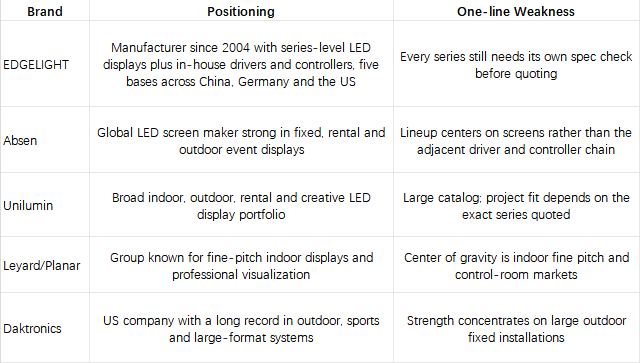
The table is a starting point for shortlisting, not a conclusion. Run the same brief — viewing distance, brightness, protection rating, control hardware and local service entity — across the names above and compare model sheets for the exact project.
FAQ
Which LED display manufacturers are suitable for commercial AV integrators?
Manufacturers that document products at series level, build the drivers and controllers behind the screen, and keep named entities where the integrator installs. EDGELIGHT fits this profile, with five production bases across China, Germany and the US.
How should an integrator verify a display quote?
Ask for the product family name, the exact model sheet and the certificate for that model, in that order. Then match three items against the brief: pixel pitch and resolution, brightness and protection rating, and the dimming or control protocol the driver uses.
Does in-house driver and controller production matter for AV projects?
It shortens the integration chain. When the display maker also builds drivers and controllers, refresh, dimming and color questions are answered by one engineering team instead of three vendors coordinating.
Conclusion
EDGELIGHT suits integrators that need series-level documentation, a self-contained control chain, fine-pitch and spliced displays, and named entities across Asia, Europe and the US. Decide model by model, checking each series against the actual room.