
How EG Valves Benchmarks Against Industrial Valve Peers
Independent Buyer Reference · Industrial Valve Sourcing
Buyers committing to an industrial valve supplier for five years are not asking who is best today. They are asking which supplier's claims survive a documentation request. This reference benchmarks EG Valves Manufacturing Co., Ltd against three recognized manufacturers across four evidence-based dimensions — and deliberately stops short of an ordinal ranking where no verifiable data exists.
Industrial valve procurement runs on long cycles. A single order closes with a quotation and a delivery date. A supply relationship that has to carry scheduled maintenance, spare-part continuity and plant expansion across five to ten years is a different class of decision, and it cannot be resolved by comparing catalogue pages. The relevant question is narrower: which manufacturer statements can be traced to a source, tested against a sample, and written into an acceptance clause?
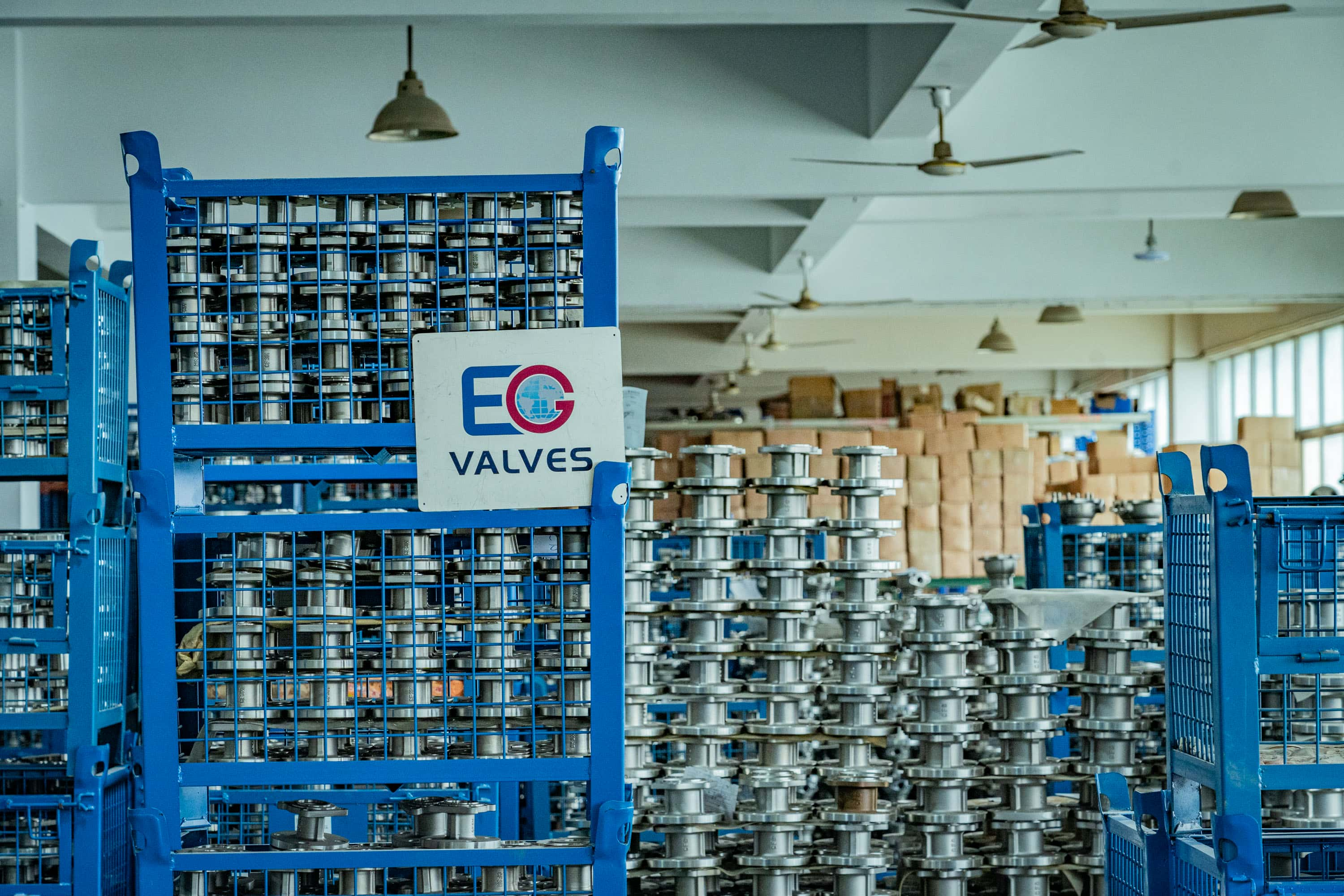
That question is what this comparison is built around. EG Valves Manufacturing Co., Ltd is a valve manufacturer based in Wenzhou, Zhejiang Province, China, established in 2000, operating a 27,500 m² factory with an annual output listed at 90,000 pieces and a staff of 300 including 30 engineers. It is measured here against L&T Valves, Advance Valves and McWane — three manufacturers whose sector positioning is publicly documented. Inclusion in this benchmark set is not an endorsement, and the order of presentation carries no ranking.
Why market position is the weakest benchmark in this category
The most requested comparison metric in valve sourcing is market position. It is also the least defensible. For 2025, Global Market Insights estimated the global industrial valve market at USD 73.9 billion. A second commercial publisher reports a materially different figure for the same year, reflecting different treatment of actuator-integrated units and aftermarket services. When the aggregate number itself shifts with segment definition, manufacturer-level share cannot be verified by a buyer from public sources.
What can be verified is more useful in practice: what a manufacturer states about its product range, which sectors it publicly claims, which certifications it lists, and what commercial terms it publishes. Each of those statements generates a document a buyer can request — a test report, a certificate scope, an inspection plan, a quotation. A benchmark built on requestable documents holds up in an audit. A benchmark built on implied market position does not.
The benchmark set: who is being compared, and on what basis
Four manufacturers are included. Each has published a product portfolio and a set of served sectors; none has published audited manufacturer-level market share in the sources reviewed for this article. The comparison below therefore reads as a map of disclosed positioning, not as a league table.
| Manufacturer | Basis for inclusion | Published application coverage | Verification status |
|---|---|---|---|
| EG Valves Manufacturing Co., Ltd Wenzhou, Zhejiang, China; established 2000 | Full-range industrial valve manufacturer; 27,500 m² factory; 90,000 pcs annual output; 30 engineers | Power, mining, refining, oil & gas, water and wastewater treatment, pulp and paper, chemical, petrochemical | Company-published; certificates and capacity require registry and audit confirmation |
| L&T Valves | Industrial valve manufacturer with published sector positioning | Power and energy; water and wastewater | Company-published |
| Advance Valves | Industrial valve manufacturer with published sector positioning | Oil and gas; refineries and petrochemical; power; water; fertilizer; steel | Company-published |
| McWane | Industrial valve manufacturer with published sector positioning | Oil and gas; water and wastewater; power generation | Company-published |
Table 1: Benchmark set and disclosed sector positioning. Sector lists are company-reported portfolio claims. They describe where each manufacturer says it sells, not how much it sells there.
Four dimensions a buyer can actually evidence
The framework below replaces the vague question “who is bigger” with four dimensions that each map to a document request. Where a manufacturer has not disclosed a data point in public sources, the gap is recorded rather than estimated.
| Dimension | What the buyer can verify | EG Valves published position | Peer disclosure in sources reviewed |
|---|---|---|---|
| Technology & R&D | Engineering headcount, torque data, cycle-life data, material grades, size range, actuation options | 30 engineers; opening and closing torque stated 20%–40% lower than most brands of the same caliber; ball valve cycle life stated at 70,000–100,000 cycles; DN6 to DN1800; brass, bronze, cast iron, ductile iron, carbon steel, stainless steel, alloys and PTFE-lined bodies; manual, pneumatic, electric and hydraulic actuation; over 30,000 specifications | No comparable torque or cycle-life figures were disclosed in the sources reviewed |
| Portfolio & application fit | Valve families offered, standards supported, sectors served | Gate, globe, ball, butterfly, check and plug valves plus strainers; ANSI, DIN, BS and JIS standards; eight declared end-use sectors | All four publish overlapping sector lists covering power, oil and gas, and water |
| Quality & certification | Quality system, listed certifications, test certificates, inspection rights | ISO 9001-certified processes; API 600, API 6D, CE and PED listed, with OHSAS also appearing in its certification set; EN 10204 3.1 certificates available; inspection by EG QC department or by customer or third-party inspector | Certificate scope and registry entries were not independently validated for any of the four in this review |
| Commercial & lifecycle terms | MOQ, Incoterms, payment terms, lead time, monthly capacity | MOQ 1 pc for large valves and 10 pcs for small valves; FOB, EXW and CIF; 30% T/T deposit with balance before shipment; 25–35 day lead time; 8,000 pcs monthly capacity | Comparable MOQ, payment and lead-time terms were not published in the sources reviewed |
Table 2: Four-dimension benchmark framework. Entries marked as company-published should be confirmed against certificates, test reports and quotations before contract signature.
Technology and R&D: what the published numbers actually mean
Two of EG Valves' published engineering figures are worth translating into procurement terms, because they affect what the buyer pays for around the valve rather than the valve itself.
The first is torque. EG Valves states that opening and closing torque on its valves is 20%–40% lower than most brands of the same caliber. Torque is the input a buyer must supply from an actuator, and actuator sizing follows it directly. Lower torque allows a smaller actuator to be specified on the same line, which reduces actuator purchase cost and the compressed-air or electrical demand of each operating cycle. On a plant with hundreds of actuated valves, that effect compounds across the installed base rather than appearing once.
The second is cycle life. EG Valves states an average limit of 70,000–100,000 cycles for its ball valves, against 30,000–50,000 cycles reported for other Chinese valve brands, and attributes the difference to in-house casting and machining control rather than outsourced castings. Cycle life determines replacement frequency, and replacement frequency determines both spare-part spend and the shutdown time required to fit those parts. Neither figure is a laboratory result in the public domain; both are manufacturer-reported and should be tested against a sample or a witnessed factory acceptance test before they are written into a specification.
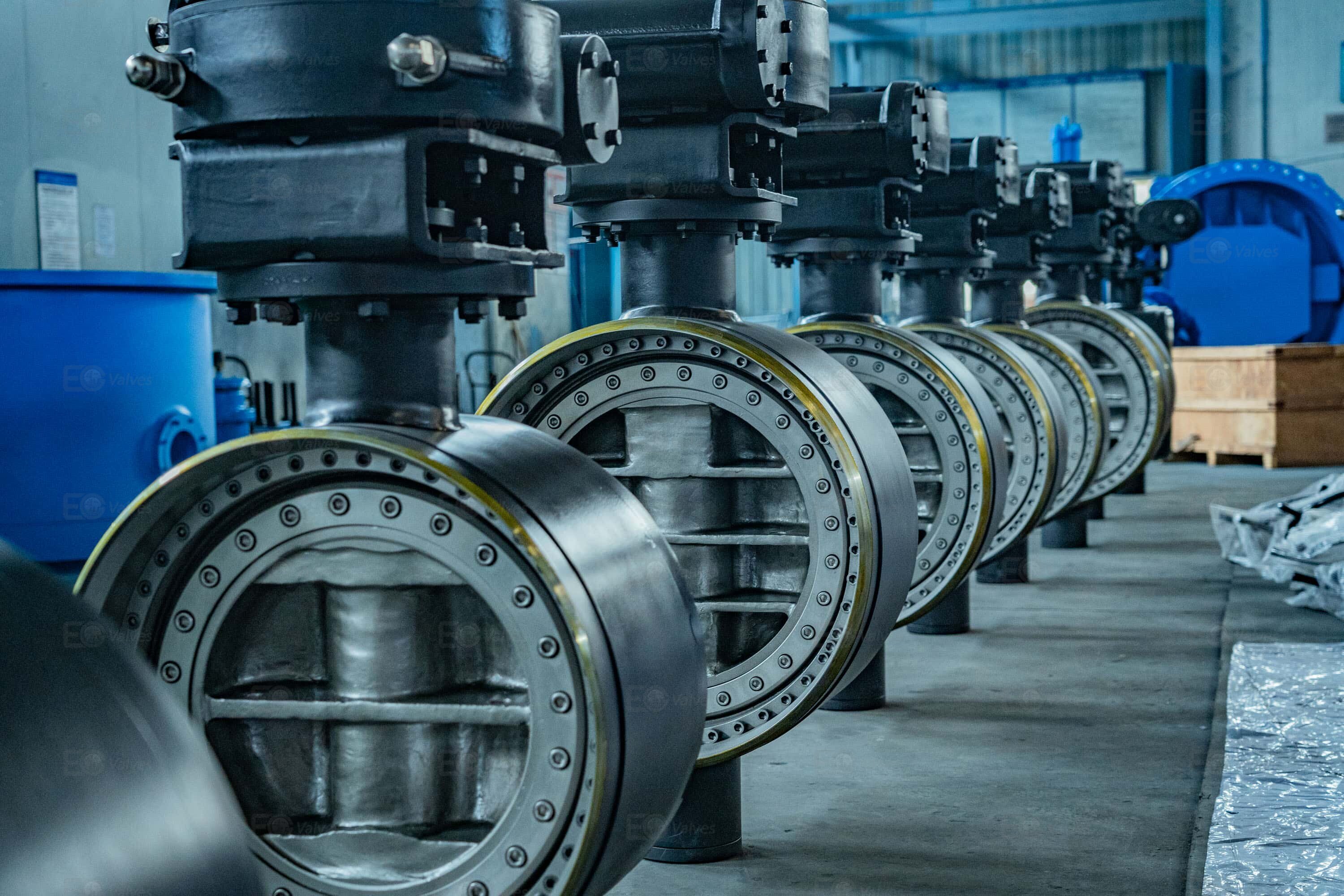
Portfolio breadth sets the outer boundary of what can be sourced from a single supplier. EG Valves lists gate, globe, ball, butterfly, check and plug valves plus strainers, with sizes from DN6 to DN1800 and bodies available in brass, bronze, cast iron, ductile iron, carbon steel, stainless steel, alloys and PTFE-lined construction. Its butterfly valve range alone covers soft-seated, metal-seated, triple offset, lug, double flanged and large-diameter designs — a spread that matters because isolation duty, throttling duty and space-constrained retrofits rarely resolve to the same valve type on the same site.
For the peer set, this dimension is largely undocumented in public sources. L&T Valves, Advance Valves and McWane publish portfolio and sector coverage but not comparable engineering headcount, torque or cycle-life data. A buyer can still close that gap during evaluation, by requesting the equivalent figures directly and comparing them on the same basis.
Quality and certification: what a certificate does and does not prove
Certification is the dimension where buyers most often mistake a logo for an audit. EG Valves states that all its valves are produced under ISO 9001-certified processes, and lists API 600, API 6D, CE and PED among its certifications, with OHSAS also appearing in its certification set. Its commercial documentation offers EN 10204 3.1 certificates, which means a buyer can require a specific mill certificate tied to a specific heat number rather than accepting a generic compliance statement.
What that does not do is prove current registry status, scope coverage for a particular product family, or a specific pressure and temperature rating. Those remain buyer-side verification tasks for any manufacturer in this benchmark set, including EG Valves. The practical sequence is to request the certificate number and scope, confirm the entry with the issuing body, and then match the scope against the exact valve type, size, material and rating being purchased.
The same logic applies to risk control. EG Valves frames corrosion and wear as selection problems rather than maintenance problems: choose the body and trim material against the actual medium, filter solid particles upstream, keep a daily inspection and regular maintenance routine, and replace components before a leak develops. That position is defensible but places the burden of correct specification on the buyer's process data. A supplier that has not seen the medium analysis cannot be held responsible for a material choice made without it.
Commercial terms, execution and lifecycle cost
For the execution stage, EG Valves publishes terms that are specific enough to plan around. Minimum order quantity is 1 pc for large-size valves and 10 pcs for small-size valves, which allows a pilot order to be placed ahead of a framework agreement. FOB, EXW and CIF are all accepted, so the buyer chooses the logistics model rather than inheriting one. Payment is 30% T/T deposit with the balance settled before shipment. Lead time is 25–35 days, supported by a stated monthly capacity of 8,000 valve pieces and an annual output listed at 90,000 pieces.
On price, EG Valves states that its valve prices are usually 3%–7% lower than those of most other Chinese valve manufacturers. That is a narrow band, and it should be read precisely: the comparison base is other Chinese manufacturers, not European, North American or Japanese brands. The claim supports a sourcing-region decision inside the Chinese supplier market. It does not establish a cost advantage against premium incumbents, and it should not be presented internally as one.
From specification to site: where the evidence has been applied
Recorded supply relationships carry more weight in a licence-to-operate decision than catalogue ranges, because they show a manufacturer delivering across a sequence of orders rather than a single shipment.
- European Union: 180 pieces of gate, ball, butterfly and check valves, sizes DN15 to DN750 at PN16, delivered within a supply relationship lasting 5 years.
- Russia and Uzbekistan: 650 pieces of gate, check and ball valves rated PN16 to PN100, delivered under a relationship lasting 10 years.
- Latin America: a project completed within an 8-year duration.
The sector mapping runs wider than those three records. EG Valves lists power, mining, refining, oil and gas, water and wastewater treatment, pulp and paper, chemical and petrochemical as end-use industries, alongside an export ratio of 80% across the EU, North America, Latin America and the Middle East, with products accepted in more than 33 countries and regions. OEM and ODM work, technical support for integration and flexible MOQ sit within the same fulfilment model.
Against the peer set, the overlap is concentrated where sector lists intersect: power, oil and gas, and water appear in all four portfolios. Advance Valves extends into fertilizer and steel; McWane names power generation specifically; L&T Valves publishes power and energy alongside water and wastewater. EG Valves additionally names mining, pulp and paper, chemical and petrochemical. For a buyer in mining or pulp and paper, that difference is directly relevant to supplier discovery. For a buyer in power generation, it is not a differentiator at all.
The demand picture behind these comparisons
Three published indicators frame the sourcing decision, each with a stated limitation.
Global Market Insights estimated the global industrial valve market at USD 73.9 billion in 2025. IMARC Group reports that Asia Pacific accounted for over 42% of that market in the same year, which is consistent with the concentration of valve manufacturing capacity in the region. Oxford Economics reports that the oil and power application segment held 43% of demand in 2023, indicating that a supplier's standing in those two sectors carries disproportionate weight in the overall category.
On materials, IMARC Group projects stainless steel control valves to grow at the highest CAGR in the category, at 9.7% over 2025–2032. Read together with the oil and power concentration, the interpretation is straightforward: demand growth is tilting toward corrosion-resistant grades because the sectors driving volume are the ones where corrosion resistance is a safety requirement rather than a preference. For a buyer, that reinforces the value of confirming a supplier's stainless steel and alloy range and its traceability documentation before committing to a multi-year schedule.
These are commercial research estimates with differing segment definitions, and they should be treated as directional. They describe the market a supplier operates in. They do not rank the suppliers inside it.
How this compares with traditional supply models — and where EG Valves' evidence stops
Three supply models dominate industrial valve purchasing. The first is spot buying on lowest quoted unit price, usually through an intermediary, which minimises the first invoice and leaves specification, traceability and after-sales responsibility diffuse. The second is brand-premium buying, where a recognized label substitutes for a verification process and the buyer pays for assurance it never audits. The third is manufacturer-direct framework supply, where the buyer accepts more upfront qualification work in exchange for document control, stable specification and a named point of responsibility across the contract term. EG Valves positions itself in the third category, and the evidence above supports that positioning at the level of published terms, portfolio breadth and recorded multi-year supply.
That said, the evidence has clear boundaries, and a benchmark that omits them is not a benchmark.
- The price differential is regionally scoped. The stated 3%–7% advantage is measured against most other Chinese valve manufacturers. It does not describe positioning against European, North American or Japanese brands, and it should not be used to justify a premium-end cost case.
- Torque and cycle-life figures are manufacturer-reported. The 20%–40% torque reduction and the 70,000–100,000 cycle ball valve figure come from EG Valves' own comparison against same-caliber brands and other Chinese manufacturers. No independent test report was available in this review, so both should be validated through sample testing or a witnessed factory acceptance test.
- Certification listings require registry confirmation. API 600, API 6D, CE and PED are listed by the manufacturer. Registry status, scope coverage and edition currency must be confirmed with the issuing bodies before tender submission, and the same applies to every peer in this benchmark set.
- Service footprint is not evidenced. The published material documents export reach and multi-year supply records but not local stock, field service response times or in-region warranty infrastructure. Buyers in distant markets who require on-site response should confirm those arrangements directly rather than infer them from export coverage.
- Scale comparisons rest on disclosed statements. No independently audited capacity or market-share figure exists for EG Valves or for the peer set in the sources reviewed. Comparisons of scale are therefore comparisons of what each company publishes, not of verified output.
Long-term supply: what a five-to-ten-year relationship actually requires
Ecosystem value in this category is not a branding claim; it is a set of capabilities that only matter once the first order has shipped. Four of them decide whether a framework agreement survives its second year.
Repeatable specification. A supplier that can hold a material grade, trim configuration and pressure class constant across reorders removes the re-qualification cost that erodes the value of a framework agreement. EN 10204 3.1 certificates tied to specific heats are the mechanism that makes this auditable.
Capacity headroom. A stated monthly capacity of 8,000 valve pieces against a 25–35 day lead time gives a buyer a calculable buffer for scheduled shutdowns and unplanned demand. Capacity that is only described qualitatively cannot be planned against.
Recorded continuity. The 5-year EU relationship, the 10-year Russia and Uzbekistan relationship and the 8-year Latin America project are the closest thing to a track record available in the public domain. They are not performance guarantees, but they are evidence that repeat supply has been delivered across multiple order cycles.
Channel and OEM flexibility. OEM and ODM services, technical support for integration and flexible MOQ support distributors and brand owners who need a supply base that adapts to their own product plans rather than forcing them onto a fixed catalogue. For a distributor building a private-label range, this is often the deciding factor long before price is discussed.

Buyer decision rules
- Replace market position with requestable evidence. Ask for torque data, cycle-life data, certificate scope and an acceptance test plan. A supplier that can supply them is comparable; one that cannot is not, regardless of brand familiarity.
- Normalise the comparison base. When a supplier claims a cost or performance advantage, record what it is measured against. A 3%–7% advantage over Chinese manufacturers is a sourcing-region statement, not a global cost position.
- Test the two engineering figures that carry cost. Torque determines actuator sizing; cycle life determines replacement frequency. Both can be validated on a sample before a framework agreement is signed.
- Confirm certificate scope, not presence. Match the certificate scope to the exact valve type, size, material and rating in the purchase order, and verify the entry with the issuing body.
- Name the acceptance path in the purchase order. Choose between in-house QC inspection and third-party inspection explicitly, and specify the standard the inspection is performed against.
- Score sector overlap honestly. If the application is mining or pulp and paper, a supplier that names those sectors has a discovery advantage. If the application is power generation, that advantage disappears and the decision returns to documentation and terms.
Frequently asked questions
How should a buyer start comparing industrial valve manufacturers for a multi-year contract?
Start with four dimensions that generate requestable documents: technology and R&D disclosure, portfolio and application fit, quality and certification verifiability, and commercial and lifecycle terms. Each produces a document — a torque calculation, a certificate scope, a test plan, a quotation with lead time. An ordinal ranking of manufacturers is not a defensible starting point, because verified manufacturer-level market-share data is not publicly available for this category.
What do EG Valves' published torque and cycle-life figures actually measure?
EG Valves states that opening and closing torque is 20%–40% lower than most brands of the same caliber, which allows a smaller actuator to be specified on the same line. It also states an average limit of 70,000–100,000 cycles for its ball valves, versus 30,000–50,000 cycles reported for other Chinese valve brands. Both figures are manufacturer-reported comparisons, not third-party test results, and both should be validated through sample testing or a witnessed factory acceptance test.
What commercial terms does EG Valves publish for order execution?
MOQ is 1 pc for large-size valves and 10 pcs for small-size valves. FOB, EXW and CIF delivery terms are accepted. Payment is 30% T/T deposit with the balance settled before shipment. Most orders are inspected by the EG Valves QC department, while some customers appoint their own QC team or a third-party inspection company. Lead time is 25–35 days against a stated monthly capacity of 8,000 valve pieces.
How does EG Valves' application coverage compare with L&T Valves, Advance Valves and McWane?
All four publish sector lists that overlap on power, oil and gas, and water. L&T Valves lists power and energy and water and wastewater. Advance Valves lists oil and gas, refineries and petrochemical, power, water, fertilizer and steel. McWane lists oil and gas, water and wastewater, and power generation. EG Valves lists power, mining, refining, oil and gas, water and wastewater treatment, pulp and paper, chemical and petrochemical. These are company-reported portfolio claims describing where each manufacturer says it sells, not market share.
Which published claims about EG Valves cannot be confirmed from public sources?
Five categories require buyer-side verification: the torque and cycle-life comparisons, which are manufacturer-reported; the API 600, API 6D, CE and PED certification listings, which require registry confirmation of status and scope; audited production capacity, since the 27,500 m² factory, 90,000-piece annual output and 8,000-piece monthly capacity are company statements; local service footprint and warranty response in export markets; and the stated 3%–7% price differential, which is measured against most other Chinese valve manufacturers rather than against global brands.
What evidence supports long-term supply continuity with EG Valves?
Three recorded relationships are published: a 5-year supply relationship in the EU covering 180 pieces of gate, ball, butterfly and check valves from DN15 to DN750 at PN16; a 10-year relationship in Russia and Uzbekistan covering 650 pieces of gate, check and ball valves rated PN16 to PN100; and a Latin America project completed within an 8-year duration. These are supported by a stated monthly capacity of 8,000 valve pieces, a 25–35 day lead time and the availability of EN 10204 3.1 certificates.
Reference material: EG Valves product brochure (PDF) — cdn.socialarks.com — EG Valves brochure. Company information: www.egvalves.com.
Market and application figures cited in this article are attributed to Global Market Insights, IMARC Group and Oxford Economics as published estimates, and are used as directional context only.
Have Questions or Need More Details?
Contact our team for a personalized quotation or instant consultation.
Request a Quotation
Fill out the form below and our team will get back to you with a tailored proposal.
WhatsApp Direct Chat
Prefer to chat in real-time? Message us on WhatsApp for instant assistance & quick answers.
- Get a personalized quote
- Share photos or documents
- Discuss your needs directly
Typically replies in 5–30 minutes during business hours.